


Questions
Newest firstShowing 1–50 of 70 questions
-
- (A) 4.5
- (B) 4.9
- (C) 5
- (D) 5.5
Show answer and solution
Correct Answer: (C)
For \(A \xrightarrow{ K _1} B\)
\(\ln (2)=\frac{E_{a_1}}{R}\left[\frac{1}{300}-\frac{1}{500}\right]\)
\(E _{ a _1}=\frac{\ln 2 \times R \times 1500}{2}\)
\(E _{ a _2}=\frac{ E _{ a _1}}{2}=\frac{\ln 2 \times R \times 1500}{4}\)
\(\left( K _1\right)_{ at~500 K}=\frac{\ln 2}{2}\)
\(\left( K _2\right)_{ at~500 K}=\ln 2\)
Now for \(C \xrightarrow{ K _2} D\)
\(\ln \left[\frac{\left( K _2\right)_{\text {at }500K}}{\left( K _2\right)_{\text {at } 300 K}}\right]=\left(\frac{\ln 2 \times R \times 1500}{4}\right) \times \frac{1}{ R } \times\left[\frac{1}{300}-\frac{1}{500}\right]\)
\(\left( K _2\right)_{ at~300 K}=\frac{\ln 2}{\sqrt{2}}=0.49\)
\(\left( K _2\right)_{\text {at }~300 K}=4.9 \times 10^{-1}\) -
- (A) Run 1 = Run 2 = Run 3
- (B) Run 3 < Run 1 = Run 2
- (C) Run 3 < Run 1 < Run 2
- (D) Run 1 < Run 2 < Run 3
Show answer and solution
Correct Answer: (B)
For \(1^{st}\) order reaction,
\(Rate=k[A]\).
with decrease in concentration of A , rate of reaction decreases. -
- (A) 9
- (B) 0.9
- (C) 3
- (D) 30
Show answer and solution
Correct Answer: (A)
\( t = \frac{1}{k} \ln \frac{A_0}{A_t} \)
\( t_{1/8} = \frac{1}{k} \ln \frac{A_0}{A_0/8} = \frac{1}{k} \ln 8 \)
\( t_{1/10} = \frac{1}{k} \ln \frac{A_0}{A_0/10} = \frac{1}{k} \ln 10 \)
\( \frac{t_{1/8}}{t_{1/10}} = \frac{\ln 8}{\ln 10} = \frac{\log 8}{\log 10}\)
\(\frac{t_{1 / 8}}{t_{1 / 10}}=\log 8=3 \log 2=0.9\)
\(\frac{t_{1 / 8}}{t_{1 / 10}} \times 10=9\) -
- (A) \(1 - e^{k_1 t}\)
- (B) \(1 + e^{k_1 t}\)
- (C) \(1 + e^{-k_1 t}\)
- (D) \(1 - e^{-k_1 t}\)
Show answer and solution
Correct Answer: (D)
For a first order reaction, the concentration of reactant at time \(t\) is given by
\([R]_t = [R]_0 e^{-k_1 t}\)
The amount of reactant decomposed is
\([R]_0 - [R]_t = [R]_0 - [R]_0 e^{-k_1 t} = [R]_0 (1 - e^{-k_1 t})\)
The fraction of molecules decomposed is
\(\dfrac{[R]_0 - [R]_t}{[R]_0} = \dfrac{[R]_0 (1 - e^{-k_1 t})}{[R]_0} = 1 - e^{-k_1 t}\)
Answer: \(1 - e^{-k_1 t}\) -
- (A) 15
- (B) 20
- (C) 25
- (D) 30
Show answer and solution
Correct Answer: (B)
For the given gas phase reaction:
\(2A(g) \rightarrow 4B(g) + C(g)\)
Let the initial pressure of \(A(g)\) be \(P_0\).
At \(t = 0\): \(P_A = P_0\), \(P_B = 0\), \(P_C = 0\)
At \(t = t\): \(P_A = P_0 - 2p\), \(P_B = 4p\), \(P_C = p\)
Total pressure at time \(t\), \(P_t = P_0 - 2p + 4p + p = P_0 + 3p\)
At \(t = \infty\), the reaction is complete, so \(P_A = 0 \Rightarrow 2p = P_0 \Rightarrow p = \dfrac{P_0}{2}\)
Total pressure at \(t = \infty\), \(P_{\infty} = 4\left(\dfrac{P_0}{2}\right) + \dfrac{P_0}{2} = \dfrac{5P_0}{2}\)
Given \(P_{\infty} = 600\) mm Hg:
\(\dfrac{5P_0}{2} = 600 \Rightarrow P_0 = 240\) mm Hg
At \(t = 30\) min, \(P_t = 300\) mm Hg:
\(P_0 + 3p = 300\)
\(240 + 3p = 300 \Rightarrow 3p = 60 \Rightarrow p = 20\) mm Hg
The pressure of \(C(g)\) at \(30\) minutes is \(p = 20\) mm Hg.
Answer: \(20\) -
- (A) \(6.9 \times 10^{-1}\)
- (B) \(6.9 \times 10^{-3}\)
- (C) \(6.9 \times 10^{-2}\)
- (D) \(6.9 \times 10^{-4}\)
Show answer and solution
Correct Answer: (B)
\(A_{g} \rightarrow B_{g} + C_{g}\)
\(1 \quad - \quad -\)
\(1- P \quad P \quad P\)
\(P_{\text {total }}=1+P\)
\(1.5=1+P\)
\(P =0.5\)
\(K =\frac{1}{100} \ln \frac{1}{0.5}\)
\(=\frac{0.693}{100}\)
\(=6.9 \times 10^{-3} min^{-1}\) -
- (A) \(\dfrac{1}{t}\ln\dfrac{p_i}{2p_i - p_t}\)
- (B) \(\dfrac{1}{t}\ln\dfrac{2p_i}{p_i - p_t}\)
- (C) \(\dfrac{1}{t}\ln\dfrac{p_i}{3p_i - 2p_t}\)
- (D) \(\dfrac{1}{t}\ln\dfrac{3p_i}{4p_i - p_t}\)
Show answer and solution
Correct Answer: (A)
The given reaction is \(A(g) \rightarrow B(g) + C(g)\)
At \(t = 0\), the initial pressure of A is \(p_i\) and the pressures of B and C are \(0\).
At time \(t\), let the decrease in pressure of A be \(x\).
Pressure of A \(= p_i - x\)
Pressure of B \(= x\)
Pressure of C \(= x\)
Total pressure at time \(t\) is \(p_t = (p_i - x) + x + x = p_i + x\)
From this, we get \(x = p_t - p_i\)
The partial pressure of A at time \(t\) is \(P_A = p_i - x = p_i - (p_t - p_i) = 2p_i - p_t\)
For a first order reaction, the rate constant \(k\) is given by
\(k = \dfrac{1}{t}\ln\dfrac{P_{A,0}}{P_A}\)
Substituting the values, we get
\(k = \dfrac{1}{t}\ln\dfrac{p_i}{2p_i - p_t}\)
Answer: \(\dfrac{1}{t}\ln\dfrac{p_i}{2p_i - p_t}\) -
- (A) 4
- (B) 5
- (C) 6
- (D) 7
Show answer and solution
Correct Answer: (D)
For a first order reaction, the rate constant \(k\) is given by:
\(k = \dfrac{1}{t} \ln \dfrac{[A]_0}{[A]_t}\)
Using the data at \(t = 20\) min:
\(k = \dfrac{1}{20} \ln \dfrac{0.6500}{0.00065} = \dfrac{1}{20} \ln 1000 = \dfrac{3}{20} \ln 10\)
Using the data at \(t = x\) min:
\(k = \dfrac{1}{x} \ln \dfrac{0.6500}{0.0650} = \dfrac{1}{x} \ln 10\)
Equating the two expressions for \(k\):
\(\dfrac{3}{20} \ln 10 = \dfrac{1}{x} \ln 10\)
\(\dfrac{3}{20} = \dfrac{1}{x}\)
\(x = \dfrac{20}{3} = 6.66...\)
Rounding to the nearest integer, we get \(x = 7\).
Answer: \(7\) -
- (A) 5
- (B) 10
- (C) 15
- (D) 20
Show answer and solution
Correct Answer: (B)
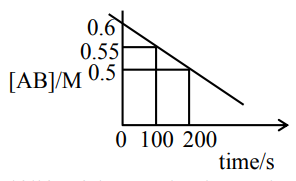
\([AB]_{0}-[AB]_{t}=kt\)
\(0.60-0.55=k(100)\)
\(k =5 \times 10^{-4}\)
Half life \(\left(t_{1 / 2}\right)=\frac{[A B]_0}{2 k}\)
\(=\frac{0.60}{2 \times 5 \times 10^{-4}}\)
\(=600 sec\)
\(=10 min\) -
- (A) 4
- (B) 3
- (C) 2
- (D) 5
Show answer and solution
Correct Answer: (B)
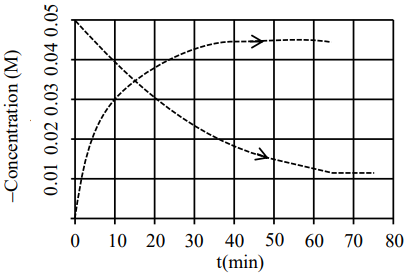
\( A \rightarrow nB \)
\(0.05 \quad 0\)
\(0.04 \quad 0.01 \times n\)
\(0.01 \times n =0.03\)
\(n =3\) -
- (A) Both Statement I and Statement II are true
- (B) Both Statement I and Statement II are false
- (C) Statement I is true but Statement II is false
- (D) Statement I is false but Statement II is true
Show answer and solution
Correct Answer: (C)
For Statement I:
According to the Arrhenius equation:
\(\log \left( \dfrac{k_2}{k_1} \right) = \dfrac{E_a}{2.303 R} \left( \dfrac{T_2 - T_1}{T_1 T_2} \right)\)
Given that the rate constant doubles, \(k_2 = 2k_1\). The temperatures are \(T_1 = 298\) K and \(T_2 = 308\) K.
The gas constant \(R = 8.314\) J K\(^{-1}\) mol\(^{-1} = \dfrac{8.314}{4.2}\) cal K\(^{-1}\) mol\(^{-1} \approx 1.98\) cal K\(^{-1}\) mol\(^{-1}\).
Substituting the values:
\(\log(2) = \dfrac{E_a}{2.303 \times 1.98} \left( \dfrac{308 - 298}{298 \times 308} \right)\)
\(0.301 = \dfrac{E_a}{4.56} \left( \dfrac{10}{91784} \right)\)
\(E_a = \dfrac{0.301 \times 4.56 \times 91784}{10} \approx 12598\) cal/mol \(\approx 12.6\) kcal/mol.
Thus, Statement I is true.
For Statement II:
For a first order reaction, the half-life is given by:
\(t_{1/2} = \dfrac{0.693}{k}\)
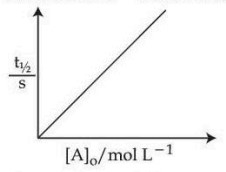
This indicates that the half-life of a first order reaction is independent of the initial concentration \([A]_o\). The graph of \(t_{1/2}\) versus \([A]_o\) should be a horizontal line parallel to the concentration axis.
The given graph shows \(t_{1/2}\) directly proportional to \([A]_o\), which corresponds to a zero order reaction (\(t_{1/2} = \dfrac{[A]_o}{2k}\)).
Thus, Statement II is false.
Therefore, Statement I is true but Statement II is false.
Answer: Statement I is true but Statement II is false -
- (A) 46.01
- (B) 46.02
- (C) 46.03
- (D) 46.06
Show answer and solution
Correct Answer: (D)
Explanation:
Let us calculate the time required for 99% completion of the first-order reaction step-by-step:
1. Finding the Rate Constant (\(k\)):
The relation between the half-life (\(t_{1/2}\)) and the rate constant (\(k\)) for a first-order reaction is:
\(k = \frac{2.303 \times \log 2}{t_{1/2}}\)
Using the standard approximation \(2.303 \times \log 2 \approx 0.693\):
\(k = \frac{0.693}{6.93} = 0.1\text{ min}^{-1}\)
2. Using the Integrated Rate Law Equation:
The time expression for a first-order reaction is given by:
\(t = \frac{2.303}{k} \log\left(\frac{a}{a-x}\right)\)
Where:
- \(a\) = Initial concentration = 100
- \(x\) = Reacted concentration = 99
- \(a - x\) = Remaining concentration = \(100 - 99 = 1\)
3. Substituting the Values:
\(t = \frac{2.303}{0.1} \log\left(\frac{100}{1}\right)\)
\(t = 23.03 \times \log(10^2)\)
Since \(\log(10^2) = 2\):
\(t = 23.03 \times 2 = 46.06\text{ minutes}\)
Hence, Option D is the correct choice. -
- (A) \( 2 \times 10^{-3} \)
- (B) \( 10^{-3} \)
- (C) \( 10^{-2} \)
- (D) \( 4 \times 10^{-4} \)
Show answer and solution
Correct Answer: (D)
Rate of reaction II = \( -\frac{1}{5}\frac{\Delta[Br^{-}]}{\Delta t} \)
Rate of reaction II = \( \frac{1}{5} \times (2 \times 10^{-4} \text{ mol L}^{-1} \text{Min}^{-1}) = 4 \times 10^{-5} \text{ mol L}^{-1} \text{Min}^{-1} \)
Rate of reaction I = Rate of reaction II = \( 4 \times 10^{-5} \text{ mol L}^{-1} \text{Min}^{-1} \)
For first order reaction I: Rate = \( k[A] \)
\( k = \frac{\text{Rate}}{[A]} = \frac{4 \times 10^{-5} \text{ mol L}^{-1} \text{Min}^{-1}}{10^{-1} \text{ mol L}^{-1}} \)
\( k = 4 \times 10^{-4} \text{ min}^{-1} \)
-
- (A) 10
- (B) 15
- (C) 20
- (D) 25
Show answer and solution
Correct Answer: (D)
For a first order reaction, the amount of reactant remaining after \(n\) half-lives is given by \(N_t = \dfrac{N_0}{2^n}\).
Given \(t_{1/2} = 3\) hours and total time \(t = 6\) hours.
Number of half-lives, \(n = \dfrac{t}{t_{1/2}} = \dfrac{6}{3} = 2\).
The amount of sucrose remaining is \(N_t = \dfrac{N_0}{2^2} = \dfrac{N_0}{4}\).
Percentage of sucrose remaining \(= \dfrac{N_t}{N_0} \times 100 = \dfrac{1}{4} \times 100 = 25\).
Answer: \(25\) -
- (A) 102
- (B) 122
- (C) 245
- (D) 61
Show answer and solution
Correct Answer: (A)
\(t _{1 / 2}=\frac{\ell n 2}{K}\)
\(K =\frac{\ell n 2}{245}\)
\(t =\frac{1}{K} \ell n \frac{ a _0}{ a _{ t }}\)
\(t_{25 \%}=\frac{1}{K} \ell n \frac{4}{3}\)
\(t _{25 \%}=\frac{1}{\frac{\ell n 2}{245}} \ell n \frac{4}{3}\)
\(t _{25 \%}=245 \frac{\ell n \frac{4}{3}}{\ell n 2}=245\left[\frac{2 \log 2-\log 3}{\log 2}\right]\)
\(=245\left[\frac{2 \times 0.3010-0.4771}{0.3010}\right]=101.66\) day. -
- (A) 68
- (B) 69
- (C) 70
- (D) 71
Show answer and solution
Correct Answer: (B)
\(\begin{aligned} & \mathrm{t}_{1 / 2}=\frac{0.693}{\mathrm{~K}} \\ & \mathrm{~K}=\mathrm{Ae}^{-\mathrm{Ea} / \mathrm{RT}} \\ & =10^{20} \times \mathrm{e}^{-\frac{191.48 \times 10^3}{8.314 \times 1000}} \\ & =10^{20} \times \mathrm{e}^{-23.031}=10^{20} \times-\mathrm{e}^{\ln 10 \times 10} \\ & =\frac{10^{20}}{10^{10}}=10^{10} \mathrm{sec} . \\ & \mathrm{t}_{1 / 2}=\frac{0.693}{10^{10}}=6.93 \times 10^{-11} \\ & \quad=69.3 \times 10^{-12} \mathrm{sec} .\end{aligned}\) -
- (A) 2
- (B) 6
- (C) 12
- (D) 3
Show answer and solution
Correct Answer: (B)
Drug \(\mathrm{X} \xrightarrow{\text { 1st order }}\) Product
Initial concentration of drug \(=16 \mathrm{mg} / \mathrm{mL}\)
Concentration of drug after 12 months \(=4 \mathrm{mg} / \mathrm{mL}\)
Half life of drug = 6 months
Drug become ineffective after 50\% decomposition. The expiry time of drug \(=6\) months -
- (A) A and C Only
- (B) A, B and D Only
- (C) C and D Only
- (D) A and B Only
Show answer and solution
Correct Answer: (B)
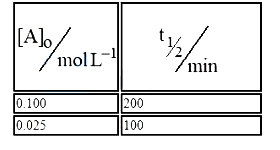
\(\frac{t_1}{2} \propto\left(C_0\right)^{1-\eta}\)
\(\frac{t_1}{t_2}=\left(\frac{C_1}{C_2}\right)^{1-\eta} \)
\( \Rightarrow \frac{200}{100}=\left(\frac{0.100}{0.025}\right)^{1-\eta} \)
\( \Rightarrow 2=(4)^{1-\eta} \)
\( (1-\eta)=\frac{1}{2} \)
\( \eta=\frac{1}{2} \)
\( \text { For } \eta=\frac{1}{2} \)
\( \frac{-d A}{d t}=k(A)^{\frac{1}{2}} \)
\( \int_{C_0}^C \frac{d A}{(A)^{\frac{1}{2}}}=-\int_0^t k d t \)
\( \Rightarrow 2 \mathrm{~A}^{\frac{1}{2}}=-\mathrm{kt} \)
\( \Rightarrow \sqrt{\mathrm{C}}-\sqrt{\mathrm{C}_0}=\frac{-\mathrm{kt}}{2} \)
\( \sqrt{\mathrm{C}}-\sqrt{\mathrm{C}_0}-\frac{\mathrm{kt}}{2} \)
\( \text { For } \mathrm{C}_0=0.1 \Rightarrow \mathrm{t}_{\frac{1}{2}}=200 \mathrm{~min} \)
\( \sqrt{\frac{c_0}{2}}=\sqrt{c_0}-\frac{k t}{2} \)
\( \frac{\mathrm{kt}}{2}=\sqrt{\mathrm{c}_0}-\sqrt{\frac{\mathrm{c}_0}{2}} \)
\( \frac{\mathrm{kt}}{2}=\sqrt{\mathrm{c}_0}\left(\frac{\sqrt{2}-1}{\sqrt{2}}\right) \)
\( t_{\frac{1}{2}}=\frac{2 \sqrt{c_0}}{k}\left(\frac{\sqrt{2}-1}{\sqrt{2}}\right) \)
\( 200=\frac{2 \sqrt{0.1}}{k}\left(\frac{\sqrt{2}-1}{\sqrt{2}}\right) \)
\(\mathrm{k}=\frac{\sqrt{0.1}}{100}\left(\frac{\sqrt{2}-1}{\sqrt{2}}\right)\)
For \(\mathrm{C}_0=1 \mathrm{M}\)
\(t_{\frac{1}{2}}=\frac{2 \times 100(\sqrt{2})}{\sqrt{0.1}(\sqrt{2}-1)} \times \frac{(\sqrt{2}-1)}{\sqrt{2}}\)
\(\Rightarrow 200 \sqrt{10} \mathrm{~min}\).
\(\Rightarrow B\) is correct
C is incorrect
For \(\mathrm{C}_0=1.6 \mathrm{M}\)
\(\mathrm{t}_{\frac{1}{2}}=\frac{2 \sqrt{1.6}(\sqrt{2})(\sqrt{2}-1) \times 100}{\sqrt{0.1}(\sqrt{2}-1)(\sqrt{2})} \)
\( \mathrm{t}_{\frac{1}{2}}=400 \times 2 \mathrm{~min} \)
\( \mathrm{t}_{\frac{1}{2}}=800 \mathrm{~min}\) -
- (A) 43
- (B) 46
- (C) 49
- (D) 50
Show answer and solution
Correct Answer: (A)
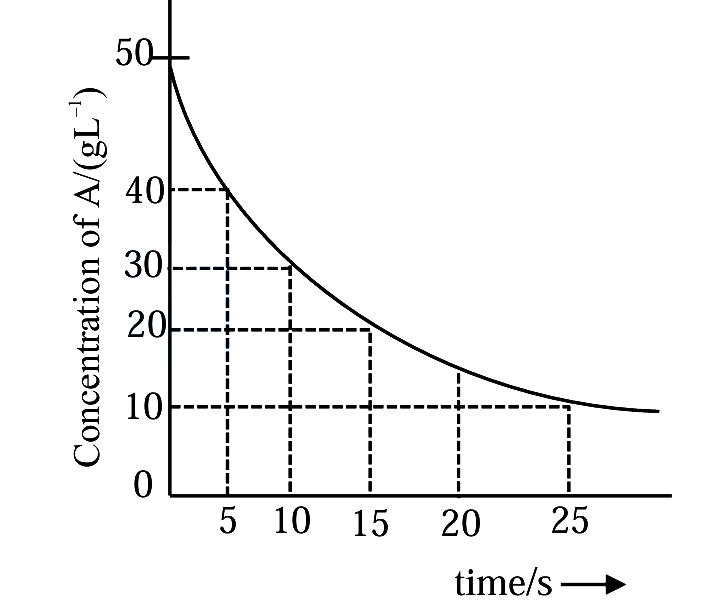
As it is difficult to predict order using data provided in graph.
For specific time interval \(0-5 \mathrm{sec}, 5-10 \mathrm{sec}\) and \(10-15 \mathrm{sec}\). order comes to be zero, but graph is not a straight line.
Assuming \(1^{\text {st }}\) order kinetics
\(\begin{aligned}
& \mathrm{K}=\frac{1}{\mathrm{t}} \ln \frac{\mathrm{~A}_0}{\mathrm{~A}_{\mathrm{t}}} \\
& \mathrm{~K}=\frac{1}{10} \ln \frac{40}{20}
\end{aligned}\)
Time required to reduce to \(2.5 \mathrm{~g} / \mathrm{L}\)
\(\begin{aligned}
& \mathrm{K}=\frac{1}{\mathrm{t}} \ln \frac{50}{2.5} \\
& \frac{1}{10} \ln 2=\frac{1}{\mathrm{t}} \ln 20 \\
& \mathrm{t}=\frac{1.3010 \times 10}{0.3010}=43.3 \mathrm{sec}
\end{aligned}\) - 20. Given below are two statements :
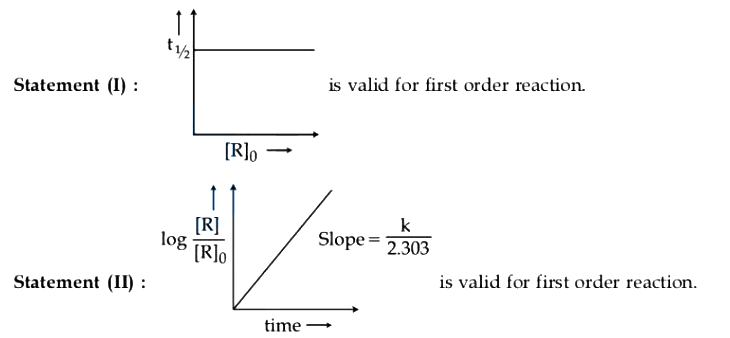
In the light of the above statements, choose the correct answer from the options given below : 2025 Medium- (A) Both Statement I and Statement II are true
- (B) Statement I is false but Statement II is true
- (C) Statement I is true but Statement II is false
- (D) Both Statement I and Statement II are false
Show answer and solution
Correct Answer: (C)
For first order reaction \(\mathrm{t}_{1 / 2}=\frac{\ell \mathrm{n} 2}{\mathrm{k}}\)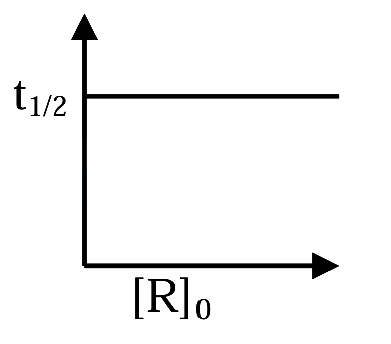
For first order reaction
\(\begin{aligned}
& \log \frac{[R]_0}{[R]}=\frac{1}{2.303} \mathrm{kt} \\
& \log \frac{[\mathrm{R}]_0}{[\mathrm{R}]}=\left(\frac{\mathrm{k}}{2.303}\right) \times \mathrm{t}
\end{aligned}\)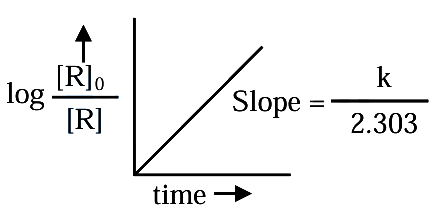
-
- (A) \(3\)
- (B) \(5\)
- (C) \(8\)
- (D) \(9\)
Show answer and solution
Correct Answer: (A)
\(\mathrm{A}(\mathrm{g}) \rightarrow 2 \mathrm{~B}(\mathrm{~g})+\mathrm{C}(\mathrm{g})\)\(\mathrm{P}_{23}=\mathrm{P}_0+2 \mathrm{x}=200\)
\(\mathrm{P}_{\infty}=3 \mathrm{P}_0=300\)
\(\mathrm{A}(\mathrm{g}) \rightarrow 2 \mathrm{~B}(\mathrm{~g})+\mathrm{C}(\mathrm{g})\)
\(\mathrm{P}_{23}=\mathrm{P}_0+2 \mathrm{x}=200\)
\(\mathrm{P}_{\infty}=3 \mathrm{P}_0=300\)
\(\mathrm{A}(\mathrm{g}) \rightarrow 2 \mathrm{~B}(\mathrm{~g})+\mathrm{C}(\mathrm{g})\)
\(\mathrm{P}_{23}=\mathrm{P}_0+2 \mathrm{x}=200\)
\(\mathrm{P}_{\infty}=3 \mathrm{P}_0=300\)
\(\mathrm{P}_0=100\)
\(\mathrm{~K}=\frac{1}{\mathrm{t}} \ln \frac{\mathrm{P}_{\infty}-\mathrm{P}_0}{\mathrm{P}_{\infty}-\mathrm{P}_{\mathrm{t}}}\)
\(\mathrm{K}=\frac{2.3}{23} \log \frac{300-100}{300-200}\)
\(=\frac{2.3 \times 0.301}{23}=0.0301=3.01 \times 10^{-2} \mathrm{sec}^{-1}\)
\(\mathrm{P}_0=100\)
\(\mathrm{~K}=\frac{1}{\mathrm{t}} \ln \frac{\mathrm{P}_{\infty}-\mathrm{P}_0}{\mathrm{P}_{\infty}-\mathrm{P}_{\mathrm{t}}}\)
\(\mathrm{K}=\frac{2.3}{23} \log \frac{300-100}{300-200}\)
\(=\frac{2.3 \times 0.301}{23}=0.0301=3.01 \times 10^{-2} \mathrm{sec}^{-1}\)
\(\mathrm{P}_0=100\)
\(\mathrm{~K}=\frac{1}{\mathrm{t}} \ln \frac{\mathrm{P}_{\infty}-\mathrm{P}_0}{\mathrm{P}_{\infty}-\mathrm{P}_{\mathrm{t}}}\)
\(\mathrm{K}=\frac{2.3}{23} \log \frac{300-100}{300-200}\)
\(=\frac{2.3 \times 0.301}{23}=0.0301=3.01 \times 10^{-2} \mathrm{sec}^{-1}\)
-
- (A) \(5\)
- (B) \(4\)
- (C) \(3\)
- (D) \(1\)
Show answer and solution
Correct Answer: (D)
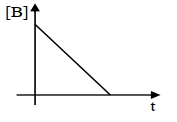
For \(1^{\text {st }}\) order reaction\(75 \% \text { life }=2 \times 50 \% \text { life }\)
So order with respect to \(A\) will be first order.
So order with respect to \(B\) will be zero. Overall order of reaction \(=1+0=1\)
-
- (A) \(50\)
- (B) \(40\)
- (C) \(51\)
- (D) \(55\)
Show answer and solution
Correct Answer: (A)
\(\mathrm{K}=\frac{2.303}{\mathrm{t}} \log \frac{1}{0.1}\)\(4.6 \times 10^{-2}=\frac{2.303}{\mathrm{t}}\)
\(\mathrm{t}=50 \mathrm{sec}.\)
-
- (A) \(15\)
- (B) \(18\)
- (C) \(20\)
- (D) \(17\)
Show answer and solution
Correct Answer: (D)
\(\frac{\left(\mathrm{t}_{1 / 2}\right)_{\mathrm{I}}}{\left(\mathrm{t}_{1 / 2}\right)_{\mathrm{II}}}=\frac{\mathrm{K}_2}{\mathrm{~K}_1}=\frac{5}{2}\)\(\therefore \mathrm{K}_1 \mathrm{t}_1=\ln \frac{1}{1-\frac{2}{3}}=\ln 3\)
\(\mathrm{~K}_2 \mathrm{t}_2=\ln \frac{1}{1-\frac{4}{5}}=\ln 5\)
\(\Rightarrow \frac{\mathrm{K}_1}{\mathrm{~K}_2} \times \frac{\mathrm{t}_1}{\mathrm{t}_2}=\frac{0.477}{0.699}\)
\(\Rightarrow \frac{\mathrm{t}_1}{\mathrm{t}_2}=\frac{0.477}{0.699} \times \frac{5}{2}=1.7=17 \times 10^{-1}\)
-
- (A) \(\mathrm{k}=\frac{2.303}{\mathrm{t}} \times \log \frac{\mathrm{P}_{\mathrm{i}}}{\left(2 \mathrm{P}_{\mathrm{i}}-\mathrm{P}_{\mathrm{t}}\right)}\)
- (B) \(k=\frac{2.303}{t} \times \log \frac{2 P_i}{\left(2 P_i-P_t\right)}\)
- (C) \(k=\frac{2.303}{t} \times \log \frac{\left(2 P_i-P_t\right)}{P_i}\)
- (D) \(\mathrm{k}=\frac{2.303}{\mathrm{t}} \times \frac{\mathrm{P}_{\mathrm{i}}}{\left(2 \mathrm{P}_{\mathrm{i}}-\mathrm{P}_{\mathrm{t}}\right)}\)
Show answer and solution
Correct Answer: (A)
\(\mathrm{A} \rightarrow\) \(\mathrm{B}+\) \(\mathrm{C}\) \(P_i\) \(0\) \(0\) \(P_i-\) \(x\) \(x\) \(\mathrm{P}_{\mathrm{t}}=\mathrm{P}_{\mathrm{i}}+\mathrm{x}\)
\(\mathrm{P}_{\mathrm{i}}-\mathrm{x}=\mathrm{P}_{\mathrm{i}}-\mathrm{P}_{\mathrm{t}}+\mathrm{P}_{\mathrm{i}}\)
\(=2 \mathrm{P}_{\mathrm{i}}-\mathrm{P}_{\mathrm{t}}\)
\(\mathrm{K}=\frac{2.303}{\mathrm{t}} \log \frac{\mathrm{P}_{\mathrm{i}}}{2 \mathrm{P}_{\mathrm{i}}-\mathrm{P}_{\mathrm{t}}}\)
-
- (A) \(390\)
- (B) \(399\)
- (C) \(499\)
- (D) \(490\)
Show answer and solution
Correct Answer: (B)
\({r}=\mathrm{k}[\mathrm{A}]\)So, order of reaction \(=1\)
\({t}_{1 / 2}=120 \mathrm{~min}\)
For \(90 \%\) completion of reactio
\(\Rightarrow \mathrm{k}=\frac{2.303}{\mathrm{t}} \log \left(\frac{\mathrm{a}}{\mathrm{a}-\mathrm{x}}\right)\)
\(\Rightarrow \frac{0.693}{\mathrm{t}_{1 / 2}}=\frac{2.303}{\mathrm{t}} \log \frac{100}{10}\)
\(\therefore \mathrm{t}=399 \mathrm{~min} .\)
-
- (A) \(1\)
- (B) \(2\)
- (C) \(5\)
- (D) \(10\)
Show answer and solution
Correct Answer: (B)
\(\text { Sol. } \mathrm{A}(\mathrm{g}) \rightarrow 2 \mathrm{B}(\mathrm{g})+\mathrm{C}(\mathrm{g})\)\(\mathrm{t}=0 \quad 0.1\)
\(\mathrm{t}=115 \mathrm{sec} . \quad 0.1-\mathrm{x} \quad 2 \mathrm{x} \quad \mathrm{x}\)
\(0.1+2 \mathrm{x}=0.28\)
\(2 \mathrm{x}=0.18\)
\(x=0.09\)
\(\mathrm{~K}=\frac{1}{115} \ln \frac{0.1}{0.1-0.09}\)
\(=0.0200 \mathrm{sec}^{-1}\)
\(=2 \times 10^{-2} \sec ^{-1}\)
-
- (A) \(41\)
- (B) \(52\)
- (C) \(63\)
- (D) \(36\)
Show answer and solution
Correct Answer: (C)
Half life of bromine \(-82=36\) hours\( \mathrm{t}_{1 / 2}=\frac{0.693}{\mathrm{~K}} \)
\( \mathrm{~K}=\frac{0.693}{36}=0.01925 \mathrm{hr}^{-1} \)
\(1^{\text {st }}\) order rxn kinetic equation
\( t=\frac{2.303}{K} \log \frac{a}{a-x} \)
\( \log \frac{a}{a-x}=\frac{t \times K}{2.303} \quad(t=1 \text { day }=24 \mathrm{hr}) \)
\( \log \frac{\mathrm{a}}{\mathrm{a}-\mathrm{x}}=\frac{24 \mathrm{hr} \times 0.01925 \mathrm{hr}^{-1}}{2.303} \)
\( \log \frac{\mathrm{a}}{\mathrm{a}-\mathrm{x}}=0.2006 \)
\( \frac{\mathrm{a}}{\mathrm{a}-\mathrm{x}}=\operatorname{anti} \log (0.2006) \)
\( \frac{\mathrm{a}}{\mathrm{a}-\mathrm{x}}=1.587 \)
\( \text { If } \mathrm{a}=1 \)
\( \frac{1}{1-\mathrm{x}}=1.587 \Rightarrow 1-\mathrm{x}=0.6301=\text { Fraction remain } \) after one day
-
- (A) \(24\)
- (B) \(30\)
- (C) \(35\)
- (D) \(40\)
Show answer and solution
Correct Answer: (A)
\(0.04=\mathrm{k}[\mathrm{A}]_0 \mathrm{e}^{-\mathrm{k} \times 10 \times 60}\) \(...(1)\)\(0.03=\mathrm{k}[\mathrm{A}]_0 \mathrm{e}^{-\mathrm{k} \times 20 \times 60}\) \(...(2)\)
\((1) /(2)\)
\(\frac{4}{3}=\mathrm{e}^{600 \mathrm{k}(2-1)}\)
\(\frac{4}{3}=\mathrm{e}^{600 \mathrm{k}}\)
\(\ln \frac{4}{3}=600 \mathrm{k}\)
\(\ln \frac{4}{3}=600 \times \frac{\ln 2}{\mathrm{t}_{1 / 2}}\)
\(\mathrm{t}_{1 / 2}=600 \frac{\ln 2}{\ln \frac{4}{3}}\)sec
\(\mathrm{t}_{1 / 2}=600 \times \frac{\log 2}{\log 4-\log 3} \text { sec. }=10 \times \frac{0.3010}{0.6020-0.477} \mathrm{~min}\)
\(\mathrm{t}_{1 / 2}\)
Ans. \(24\)
-
- (A) \(17160\)
- (B) \(17170\)
- (C) \(17180\)
- (D) \(17190\)
Show answer and solution
Correct Answer: (D)
\(\lambda t=\ln \frac{\left({ }^{14} \mathrm{C} /{ }^{12} \mathrm{C}\right)_{\text {atmosphere }}}{\left({ }^{14} \mathrm{C} /{ }^{12} \mathrm{C}\right)_{\text {wood sample }}}\)As per the question,
\(\frac{\left({ }^{14} \mathrm{C} / 12 \mathrm{C}\right)_{\text {wood }}}{\left({ }^{14} \mathrm{C} /{ }^{12} \mathrm{C}\right)_{\text {atrmophere }}}=\frac{1}{8}\)
So, \(\lambda \mathrm{t}=\ln 8\)
\(\frac{\ln 2}{t_{1 / 2}} t=\ln 8\)
\(t=3 \times t_{1 / 2}=17190 \text { years }\)
-
- (A) \(5\)
- (B) \(4\)
- (C) \(3\)
- (D) \(8\)
Show answer and solution
Correct Answer: (C)
\(\mathrm{K}=\frac{1}{\mathrm{t}_{99.9 \%}} \ln \left(\frac{100}{0.1}\right)=\frac{1}{\mathrm{t}_{90 \%}} \ln \left(\frac{100}{10}\right)\)\(\mathrm{t}_{99.9 \%}=\mathrm{t}_{90 \%} \frac{\ln \left(10^3\right)}{\ln 10}\)
\(\mathrm{t}_{99.9 \%}=\mathrm{t}_{90 \%} \times 3\)
-
- (A) \(15\)
- (B) \(17\)
- (C) \(10\)
- (D) \(5\)
Show answer and solution
Correct Answer: (C)
\(\frac{t_{99.9 \%}}{t_{1 / 2}}=\frac{\frac{2.303}{k}\left(\frac{a}{a-x}\right)}{\frac{2.303}{k} \log 2}=\frac{\log \left(\frac{100}{100-99.9}\right)}{\log 2}=\frac{\log 10^3}{\log 2}=\frac{3}{0.3}=10\) -
- (A) \(4\)
- (B) \(6\)
- (C) \(8\)
- (D) \(2\)
Show answer and solution
Correct Answer: (D)
\(t_{ LAS }=\frac{1}{ K } \ln \left(\frac{ a }{ a - x }\right)=\frac{1}{ K } \ln \left(\frac{100}{90}\right)\)\(t _{10 s }=\frac{2.303}{ K }(\log 10-\log 9)\)
\(t _{10 s }=\frac{2.093}{ K } \times(0.04)\)
Similarly,
\(t _{90 \% 6}=\frac{1}{ K } \ln \left(\frac{100}{10}\right)\)
\(t _{90 s }=\frac{2.303}{ K }\)
\(\frac{t_{9 rP _6}}{t_{10 \%}}=\frac{1}{0.04}=25\)
\(e^k=\frac{a}{a-x}\)
\(\frac{a-x}{a}=e^{-k t}\)3
\(1-\frac{x}{a}=e^{-k t}\)
\(x=a\left(1-e^{-l a t}\right)\)
\(\alpha=\frac{x}{a}=\left(1-e^{-b}\right)\)
-
- (A) \(2100\)
- (B) \(2000\)
- (C) \(2300\)
- (D) \(2200\)
Show answer and solution
Correct Answer: (D)
\(t _{\frac{1}{2}}=10\) minutes\(\left( P _{ A }\right)_{30 \min }=\left( P _{ A }\right)_0\left(\frac{1}{2}\right)^{30 / 10}\)
\(\left( P _{ A }\right)_{30 \min }=100\,mm\,Hg\)
\(A ( g ) \rightarrow 2 B ( g )+ C ( g )\)
\(\begin{array}{lccc}\text { at } t =0 & 800\,mm & 0 & 0 \\ \text { at } t =30 & 100\,mm & 1400\,mm & 700\,mm \end{array}\)
Total pressure after \(30\) minutes \(=2200\,mm\,Hg\)
-
- (A) \(4\)
- (B) \(2\)
- (C) \(6\)
- (D) \(8\)
Show answer and solution
Correct Answer: (B)
\(\frac{1}{t_{1 / 2}}=\frac{1}{3}+\frac{1}{12}=\frac{4+1}{12}=\frac{5}{12}\)\(t_{1 / 2}=\frac{12}{5} min =2.4\)
\(\approx 2\)
-
- (A) \(1351\)
- (B) \(1352\)
- (C) \(1353\)
- (D) \(1350\)
Show answer and solution
Correct Answer: (D)
\(\frac{t_1}{t_2}=\frac{\frac{1}{ K } \ln \frac{ a _0}{0.4 a _0}}{\frac{1}{ K } \ln \frac{ a _0}{0.1 a _0}}\)\(\frac{540}{ t _2}=\frac{\ln \frac{10}{4}}{\ln 10}\)
\(\frac{540}{ t _2}=\frac{\log 10-\log 4}{\log 10}\)
\(\frac{540}{ t _2}=\frac{1-0.6}{1}\)
\(\Rightarrow \frac{540}{ t _2}=0.4\)
\(\Rightarrow t _2=\frac{540}{0.4}=1350\,sec\)
-
- (A) \(30\)
- (B) \(60\)
- (C) \(15\)
- (D) \(20\)
Show answer and solution
Correct Answer: (B)
\(t _{1 / 2}= T _{50}=30\,min\)\(T _{75}=2 t _{1 / 2}=30 \times 2=60\,min\)
-
- (A) \(332\)
- (B) \(331\)
- (C) \(336\)
- (D) \(333\)
Show answer and solution
Correct Answer: (D)
\(KClO _3+6 FeSO _4+3 H _2 SO _4 \rightarrow KCl + 3 Fe _2\left( SO _4\right)_3+3 H _2 O\)\(ROR =-\frac{\Delta\left[ KClO _3\right]}{\Delta t }=\frac{-1}{6} \frac{\Delta\left[ FeSO _4\right]}{\Delta t }\)
\(=\frac{+1}{3} \frac{\Delta\left[ Fe _2\left( SO _4\right)_3\right]}{\Delta t }\)
\(\frac{\Delta\left[ Fe _2\left( SO _4\right)_3\right]}{\Delta t }=\frac{1}{2} \frac{-\Delta\left[ FeSO _4\right]}{\Delta t }\)
\(=\frac{1}{2} \frac{(10-8.8)}{30 \times 60}\)
\(=0.333 \times 10^{-3}\)
\(=333 \times 10^{-6}\,mol\,litre ^{-1}\,sec ^{-1}\)
-
- (A) \(4\)
- (B) \(2\)
- (C) \(3\)
- (D) \(1\)
Show answer and solution
Correct Answer: (C)
\(A _{ t }= A _0 \times \frac{12.5}{100}=\frac{ A _0}{8} \quad[87.5 \% \text { complete }]\)\(A _0 \stackrel{ t _{1 / 2}}{\longrightarrow} \frac{ A _0}{2} \stackrel{ t _{ H / 2}}{\longrightarrow} \frac{ A _0}{4} \stackrel{ t _{ L / 2}}{\longrightarrow} \frac{ A _0}{8}\)
\(t _{87.5}=3 t _{1 / 2}\)
\(\therefore x =3\)
-
- (A) \(2\)
- (B) \(3\)
- (C) \(1\)
- (D) \(4\)
Show answer and solution
Correct Answer: (C)
\((A)\) For zero order \(t_{1 / 2}=\frac{[ A ]_0}{2 K }\) as concentration decreases half life decreases (Correct statement)\((B)\) If order w.r.t. that reactant is zero then it will not affect rate of reaction. (Correct statement)
\((C)\) Order can be fractional but molecularity can not be (Incorrect statement)
\((D)\) For zero order reaction unit is \(mol L ^{-1} s ^{-1}\) and for second order reaction unit is \(mol ^{-1} Ls ^{-1}\) (Correct statement)
-
- (A) \(16\)
- (B) \(15\)
- (C) \(17\)
- (D) \(14\)
Show answer and solution
Correct Answer: (C)
\(C=\frac{C_o}{2^n}=\frac{C_o}{32}\)\(n =5\)
\(t =5 t _{1 / 2}\)
\(=\frac{5 \times 0.693}{20}=\frac{0.693}{4}\)
\(=0.17325\,min =17.325 \times 10^{-2}\,min\)
-
- (A) \(91\)
- (B) \(85\)
- (C) \(75\)
- (D) \(750\)
Show answer and solution
Correct Answer: (C)
\(t =\frac{ t _{1 / 2}}{0.3} \log \frac{[ A ]_{0}}{[ A ]_{ t }}\)\(83=\frac{200}{0.3} \log \frac{[ A ]_{0}}{[ A ]_{ t }}\)
\(0.125=\log \frac{[ A ]_{0}}{[ A ]_{ t }}\)
\(\frac{[ A ]_{0}}{[ A ]_{ t }}=1.333 \cong \frac{4}{3}\)
\(\therefore \frac{[ A ]_{ t }}{[ A ]_{0}} \times 100=\frac{3}{4} \times 100=75\, \%\)
-
- (A) \(166\)
- (B) \(165\)
- (C) \(167\)
- (D) \(186\)
Show answer and solution
Correct Answer: (B)
\(K =\frac{0.693}{ t _{1 / 2}}=\frac{0.693}{70 \times 60}\)\(=\frac{6930}{7 \times 6} \times 10^{-6}\)
\(=165 \times 10^{-6}\,s ^{-1}\)
-
- (A) \(0\)
- (B) \(2\)
- (C) \(1\)
- (D) \(3\)
Show answer and solution
Correct Answer: (C)
\(t =\frac{1}{\lambda} \ln \left(\frac{ a }{ a - x }\right)\)\(100=\frac{30}{\ln 2} \ln \left(\frac{1}{ w }\right)\)
\(\frac{1}{ w }=10\)
\(W =0.1 \times\,\mu\,g\)
Ans. \(1 \times 10^{-1}\,\mu\,g\)
-
- (A) \(200\)
- (B) \(323\)
- (C) \(467\)
- (D) \(532\)
Show answer and solution
Correct Answer: (C)
\(T _{1 / 2}=200 s\) and \(1^{\text {st }}\) order reaction\(K =\frac{2.303 \log 2}{200}=\frac{2.303}{ t } \log \frac{ A _{0}}{0.2 A _{0}}\)
\(\frac{\log 2}{200}=\frac{1}{t} \log 5\)
\(t =\frac{7}{3} \times 200=466.67 s =467\,s\)
-
- (A) \(1\)
- (B) \(0\)
- (C) \(2\)
- (D) \(3\)
Show answer and solution
Correct Answer: (B)
\(t_{1 / 2} \times \frac{1}{\left[P_{0}\right]^{n-1}}\)\(\frac{t_{1}}{t_{2}}=\frac{\left(P_{2}\right)^{n-1}}{\left(P_{1}\right)^{n-1}}\)
\(\frac{340}{170}=\left(\frac{27.8}{55.5}\right)^{ n -1}\)
\(\Rightarrow 2=\frac{1}{(2)^{ n -1}}\)
\(n =0\)
-
- (A) \(160\)
- (B) \(16\)
- (C) \(35\)
- (D) \(90\)
Show answer and solution
Correct Answer: (B)
\(t _{67 \,\%}=\frac{1}{ k } \ln \left(\frac{1}{1-0.67}\right)=\frac{ t _{1 / 2}}{\ln 2} \times \ln \left(\frac{1}{1-\frac{2}{3}}\right)\)\(t _{67 \%}=\frac{ t _{1 / 2}}{\log 2} \times \log 3=\frac{ t _{1 / 2} \times 0.4771}{0.301}\)
\(\Rightarrow t _{67 \%}=1.585 \times t _{1 / 2}\)
\(X \times 10^{-1}=1.585\)
\(\Rightarrow X =15.85\)
-
- (A) \(1.12\)
- (B) \(2.43\)
- (C) \(3.32\)
- (D) \(33.31\)
Show answer and solution
Correct Answer: (C)
Given \(t _{0.90}= t _{0.90}= xt _{1 / 2}\)First order rate constant
\(K =\frac{\ln 2}{ t _{1 / 2}}=\frac{1}{ xt _{1 / 2}} \ln \frac{ A _{0}}{ A _{0}- A _{0} \times \frac{90}{100}}\)
\(\frac{\ln 2}{ t _{1 / 2}}=\frac{\ln 10}{ xt _{1 / 2}}\)
\(x =\frac{\ln 10}{\ln 2}=\frac{2.303}{2.303 \times 0.3010}=3.32\)
-
- (A) \(1\)
- (B) \(2\)
- (C) \(3\)
- (D) \(9\)
Show answer and solution
Correct Answer: (B)
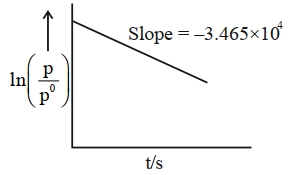
For first order reaction\(k =\frac{1}{ t } \ln \left(\frac{ P _{0}}{ P }\right)\)
\(\ln \left(\frac{ P _{0}}{ P }\right)= kt\)
\(t _{1 / 2}=\frac{\ln 2}{ k }=\frac{0.693}{3.465 \times 10^{4}}=2 \times 10^{-5}\)
-
- (A) \(110\)
- (B) \(112\)
- (C) \(100\)
- (D) \(113\)
Show answer and solution
Correct Answer: (C)
\(A \rightarrow B \quad t _{1 / 2}=0.3010\,min\)\(A _{0} / A _{ t }\) at time \(2\,min =?\)
\(K =\frac{2.303}{ t } \log \left[\frac{ A _{0}}{ A _{ t }}\right]\)
\(\frac{0 \cdot 693}{ t _{\frac{1}{2}}}=\frac{2 \cdot 303}{2} \log \left(\frac{ A _{0}}{ A _{ t }}\right)\)
Or \(\frac{2.303 \times 0.3010}{0.3010}=\frac{2.303}{2} \log \frac{ A _{0}}{ A _{ t }}\)
\(\log \frac{ A _{0}}{ A _{ t }}=2\)
\(\frac{ A _{0}}{ A _{ t }}=10^{2}=100\)
No questions on this page match these filters.
Other STD 12 - Chemical kinetics topics
Frequently asked
How many First Order reaction questions came in JEE Mains?
70 questions from 2014–2026, each with the correct answer and a full solution.
How difficult are First Order reaction questions?
10% are easy, 50% medium and 40% hard.