


Questions
Newest firstShowing 1–41 of 41 questions
-
- (A) Among the isotopes of carbon, \({}^{13}C\) is a radioactive isotope.
- (B) Carbon exhibits negative oxidation states along with +4 and +2.
- (C) Carbon cannot exceed its covalency more than four.
- (D) \(CO_{2}\) is the most acidic oxide among the dioxides of group of 14 elements.
Show answer and solution
Correct Answer: (A)
\(C^{13}\) is not radioactive
\(C^{14}\) is radioactive -
- (A) Both Statement I and Statement II are true.
- (B) Both Statement I and Statement II are false.
- (C) Statement I is true but Statement II is false.
- (D) Statement I is false Statement II is true.
Show answer and solution
Correct Answer: (A)
\( SiO_{2}, CO_{2}, GeO, GeO_{2} \) are acidic in nature.
SnO, \( SnO_{2}, PbO, PbO_{2} \) are amphoteric in nature.
→ \( BF_{3} \) is lewis acid according to Lewis octet theory and has \( sp^{2} \) hybridization with trigonal planar geometry and it can accept lone pair from ammonia to form adduct. -
- (A) \(+4\) and +1
- (B) +1 and +4
- (C) +4 and +3
- (D) +2 and +3
Show answer and solution
Correct Answer: (C)
Among \(\mathrm{Al}, \mathrm{In}, \mathrm{Tl}, \mathrm{Ge}, \mathrm{Sn}, \mathrm{Pb}\), the metal having highest \(\mathrm{IE}_1\) is Ge and lowest \(\mathrm{IE}_1\) is In .
Most stable oxidation state of Ge is +4 and In is +3 . -
- (A) 6
- (B) 82
- (C) 14
- (D) 50
Show answer and solution
Correct Answer: (D)
Order of M.P. of group 14: \(\mathrm{C}>\mathrm{Si}>\mathrm{Ge}>\mathrm{Pb}>\mathrm{Sn}\)
\(\begin{array}{ll}
\text { element } & \text { M.P. }\left({ }^{\circ} \mathrm{C}\right) \\
\mathrm{Z}=6=\mathrm{C} & 3730 \\
\mathrm{Z}=14=\mathrm{Si} & 1410 \\
\mathrm{Z}=32=\mathrm{Ge} & 937 \\
\mathrm{Z}=50=\mathrm{Sn} & 232 \\
\mathrm{Z}=82=\mathrm{Pb} & 327
\end{array}\) -
- (A) Statement I is correct but Statement II is incorrect
- (B) Statement I is incorrect but Statement II is correct
- (C) Both Statement I and Statement II are incorrect
- (D) Both Statement I and Statement II are correct
Show answer and solution
Correct Answer: (A)
Statement 1 is correct since left to right \(1 E\) increases in general in periodic table.
Statement 2 is incorrect since M.P. of group 14 elements is more than group 13 elements. -
- (A) \(\mathrm{GeO}, \mathrm{GeO}_2\)
- (B) \(\mathrm{SiO}_2, \mathrm{GeO}_2\)
- (C) \(\mathrm{SnO}_2, \mathrm{PbO}_2\)
- (D) \(\mathrm{SnO}_2, \mathrm{CO}\)
Show answer and solution
Correct Answer: (C)
\(\mathrm{SnO}_2\) and \(\mathrm{PbO}_2\) are amphoteric. -
- (A) \(Br ^{-}\)
- (B) \(I ^{-}\)
- (C) \(Cl ^{-}\)
- (D) \(CO _3{ }^{2-}\)
Show answer and solution
Correct Answer: (A)
\(Ag ^{+}+ I ^{-}\rightarrow AgI\) - Yellow ppt
\(Ag ^{+} Cl ^{-}\rightarrow AgCl\) - White ppt
\(Ag ^{+} Br ^{-}\rightarrow AgBr\) - Pale yellow ppt -
- (A) \((C), (D)\) and \((E)\) Only
- (B) \((A)\) and \((B)\) Only
- (C) \((A), (B)\) and \((C)\) Only
- (D) \((C)\) and \((D)\) Only
Show answer and solution
Correct Answer: (A)
\((A)\) Down the group; radius increases\((B)\) EN does not decrease gradually from \(\mathrm{C}\) to \(\mathrm{Pb}\).
\((C)\) Correct.
\((D)\) Correct.
\((E)\) Range of oxidation state of carbon ; \(-4\) to \(+4\)
-
- (A) Both Statement \(I\) and Statement \(II\) are false
- (B) Both Statement \(I\) and Statement \(II\) are true
- (C) Statement \(I\) is true but Statement \(II\) is false
- (D) Statement \(I\) is false but Statement \(II\) is true
Show answer and solution
Correct Answer: (C)
\(\mathrm{SiO}_2\) and \(\mathrm{GeO}_2\) are acidic and \(\mathrm{SnO}, \mathrm{PbO}\) are amphoteric.Carbon does not have d-orbitals so can not form \(\mathrm{p} \pi-\mathrm{d} \pi\) Bond with itself. Due to properties of catenation and \(\mathrm{p} \pi-\mathrm{p} \pi\) bond formation. carbon is able to show allotropic forms.
-
- (A) Statement \(I\) is false but Statement \(II\) is true
- (B) Statement \(I\) is true but Statement \(II\) is false
- (C) Both Statement \(I\) and Statement \(II\) are true
- (D) Both Statement \(I\) and Statement \(II\) are false
Show answer and solution
Correct Answer: (A)
\(Gr-14\) \(EN\)\(C\) \(2.5\)
\(Si\) \(1.8\)
\(Ge\) \(1.8\)
\(Sn\) \(1.8\)
\(Pb\) \(1.9\)
The electronegativity values for elements from \(\mathrm{Si}\) to \(\mathrm{Pb}\) are almost same. So Statement \(\mathrm{I}\) is false.
-
- (A) \(3\)
- (B) \(4\)
- (C) \(1\)
- (D) \(2\)
Show answer and solution
Correct Answer: (D)
Due to inert pair effect; \(\mathrm{T}^{+3}\) and \(\mathrm{Pb}^{-4}\) can behave as oxidising agents. - 12. When \(MnO _2\) and \(H _2 SO _4\) is added to a salt \(( A )\), the greenish yellow gas liberated as salt \(( A )\) is _______. 2024 Medium
- (A) \(CaI _2\)
- (B) NaBr
- (C) \(KNO _3\)
- (D) \(NH _4 Cl\)
Show answer and solution
Correct Answer: (D)
\(2 NH _4 Cl + MnO _2+2 H _2 SO _4 \xrightarrow{\Delta} MnSO _4+\left( NH _4\right)_2 SO _4+2 H _2 O +\underset{\substack{\text { greenish } \\ \text { yellow } \\ \text { solution }}}{ Cl _2 \uparrow}\) -
- (A) Germanium
- (B) Graphite
- (C) Silicon
- (D) Copper oxide
Show answer and solution
Correct Answer: (B)
Graphite is conductor -
- (A) \(3\)
- (B) \(4.5\)
- (C) \(2\)
- (D) \(1.5\)
Show answer and solution
Correct Answer: (A)
For good quality cement, the ratio of silica \(\left( SlO _2\right)\) to Alumina \(\left( Al _2 O _3\right)\) should be between \(2.5\) to \(4\). -
- (A) Both \(A\) and \(R\) are correct but \(R\) is NOT the correct explanation of \(A\).
- (B) Both \(A\) and \(R\) are correct and \(R\) is the correct explanation of \(A\).
- (C) \(A\) is not correct but \(R\) is correct.
- (D) \(A\) is correct but \(R\) is not correct.
Show answer and solution
Correct Answer: (B)
The oxide which form acid on dissolving in water is acidic oxide. -
- (A) Both the statements \(I\) and \(II\) are correct
- (B) Statement \(I\) is incorrect but statement \(II\) is correct
- (C) Both the statements \(I\) and \(II\) are incorrect
- (D) Statement \(I\) is correct but statement \(II\) is incorrect
Show answer and solution
Correct Answer: (D)
Statement- \(I\) is correct.\(Ni\) is used in Hydrogenation of unsaturated fat to make edible fats.
Statements\(-II\) is false as hydride of Silicon is electron precise and neither electron deficient nor electron rich.
-
- (A) \(A-IV, B-I, C-II, D-III\)
- (B) \(A-IV, B-III, C-I, D-II\)
- (C) \(A-II, B-III, C-IV, D-I\)
- (D) \(A-IV, B-III, C-II, D-I\)
Show answer and solution
Correct Answer: (D)
Cobalt catalyst \(\rightarrow\) Methanol productionSyn gas \(\rightarrow\) Coal gasification
\(\left( C _{\text {(Redhot coke) }}+ H _2 O ( g ) \rightarrow CO + H _2\right)\)
Nickel catalyst \(\rightarrow\) Water gas production
Brine solution \(\rightarrow\) Production
(aq. \(NaCl ) \quad\left(\begin{array}{l} H _2 \rightarrow \text { Cathode } \\ Cl _2 \rightarrow \text { anode }\end{array}\right)\)
-
- (A) \(Si - Si > C - C > Sn - Sn > Ge - Ge\)
- (B) \(Si - Si > C - C > Ge - Ge > Sn - Sn\)
- (C) \(C - C > Si - Si > Sn - Sn > Ge - Ge\)
- (D) \(C - C > Si - Si > Ge - Ge > Sn - Sn\)
Show answer and solution
Correct Answer: (D)
(Bond enthalpy order \(C - C > Si - Si > Ge - Ge > Sn - Sn )\) -
- (A) \(Be + Li \left[ AlCl _{4}\right]+ H _{2}\)
- (B) \(Be + AlH _{3}+ LiCl + HCl\)
- (C) \(BeH _{2}+ LiCl + AlCl _{3}\)
- (D) \(BeH _{2}+ Li \left[ AlCl _{4}\right]\)
Show answer and solution
Correct Answer: (C)
\(2 BeCl _{2}+ LiAlH _{4} \rightarrow 2 BeH _{2}+ LiCl + AlCl _{3}\)This is the method to prepare \(BeH _{2}\)
-
- (A) \(B ( OH )_{3}\) and \(NH _{3}\)
- (B) \(B _{2} H _{6}\) and \(NH _{3}\)
- (C) \(B _{2} H _{6}\) and \(HN _{3}\)
- (D) \(NH _{3}\) and \(B _{2} O _{3}\)
Show answer and solution
Correct Answer: (B)
\(3 B _{2} H _{6}+6 NH _{3} \stackrel{\Delta}{\longrightarrow} 2 B _{3} N _{3} H _{6}+12 H _{2}\) -
- (A) Both \(A\) and \(R\) are correct. and \(R\) is correct explanation of \(A\).
- (B) Both \(A\) and \(R\) are correct. but \(R\) is NOT the correct explanation of \(A\).
- (C) \(A\) is correct \(R\) is not correct.
- (D) \(A\) is not correct. \(R\) is correct.
Show answer and solution
Correct Answer: (B)
From Ellingham diagram given in NCERT, it can be seen that \(Mg , MgO\) line crosses \(Al , Al _{2} O _{3}\) line after \(1350^{\circ} C\) hence assertion is true.Yes, Mg have lower MP and BP than aluminium but it does not explain the above fact.
-
- (A) Both \((A)\) and \((R)\) are true and \((R)\) is the correct explanation of \((A)\)
- (B) Both \((A)\) and \((R)\) are true but \((R)\) is not the correct explanation of \((A)\)
- (C) \((A)\) is true but \((R)\) is false
- (D) \((A)\) is false but \((R)\) is true
Show answer and solution
Correct Answer: (B)
Assertion \((A)\): TrueReason \((R)\): True but not correct explanation.
Correct explanation: Expansion of octet not possible for '\(B\)'.
-
- (A) \((A) - (III), (B) - (II), (C) - (I), (D) - (IV)\)
- (B) \((A) - (IV), (B) - (I), (C) - (II), (D) - (III)\)
- (C) \((A) - (II), (B) - (I), (C) - (IV), (D) - (III)\)
- (D) \((A) - (III), (B) - (IV), (C) - (I), (D) - (II)\)
Show answer and solution
Correct Answer: (D)
\(\left( CH _{3}\right)_{4} Si\) is a silane\(\left( CH _{3}\right) Si ( OH )_{3}\) polymerise to form 2D silicone
\(\left( CH _{3}\right)_{2} Si ( OH )_{2}\) polymerise to form chain silicone
\(\left( CH _{3}\right)_{3} Si ( OH )\) form dimer \(\left( CH _{3}\right)_{3} Si - O - Si \left( CH _{3}\right)_{3}\)
-
- (A) trigonal, planar
- (B) tetrahedral
- (C) pyramidal
- (D) square, planar
Show answer and solution
Correct Answer: (B)
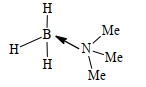
\(BH _{3}+ NaH \stackrel{450 K }{\longrightarrow} \underset{\text { (diborane) }}{ B _{2} H _{6}+ NaF }\)\(B _{2} H _{6}+ NMe _{3} \longrightarrow 2\left[ BH _{3} \leftarrow NMe _{3}\right]\)
-
- (A) \(\left[\mathrm{GeCl}_{6}\right]^{2-}\)
- (B) \(\left[\mathrm{SiCl}_{6}\right]^{2-}\)
- (C) \(\left[\mathrm{Sn}(\mathrm{OH})_{6}\right]^{2-}\)
- (D) \(\left[\mathrm{SiF}_{6}\right]^{2-}\)
Show answer and solution
Correct Answer: (B)
\(\left[\mathrm{SiCl}_{6}\right]^{2-}\) does not exist due to steric crowding of surrounding atoms. - 26. \('X'\) melts at low temperature and is a bad conductor of electricity in both liquid and solid state. \(X\) is 2020 Medium
- (A) Carbon tetrachloride
- (B) Mercury
- (C) Silicon carbide
- (D) Zinc sulphide
Show answer and solution
Correct Answer: (A)
\(CCl_4\) is molecular solid so does not conduct electricity in liquid and solid state. -
- (A) \(20\) hexagons and \(12\) pentagons.
- (B) \(12\) hexagons and \(20\) pentagons
- (C) \(18\) hexagons and \(14\) pentagons
- (D) \(16\) hexagons and \(16\) pentagons
Show answer and solution
Correct Answer: (A)
In \(\;{C_{60 < {\rm{ }}Vsub{\rm{ }} > }}\) molecule there are \(20\) hexagons and \(12\) pentagons \(\therefore\) Ans.\((1)\) -
- (A) \((i), (ii), (iii)\) and \((iv)\)
- (B) \((i), (ii)\) and \((iii)\)
- (C) \((i)\) and \((ii)\) only
- (D) \((i), (ii)\) and \((iv)\)
Show answer and solution
Correct Answer: (D)
Silicones are polymers and hydrophobic due to presence of alkyl groups. They are used as greases as some of them are cyclic -
- (A) quartz
- (B) kieselguhr
- (C) cristobalite
- (D) tridymite
Show answer and solution
Correct Answer: (B)
Kieselguhr is amorphous form of silica -
- (A) \(\begin{array}{*{20}{c}}
{R\,\,\,\,\,\,\,\,\,\,} \\
{|\,\,\,\,\,\,\,\,\,\,} \\
{{{[ - Si - O - ]}_n}} \\
{|\,\,\,\,\,\,\,\,\,\,} \\
{R\,\,\,\,\,\,\,\,\,\,}
\end{array}\) \((R = Me)\) - (B) \({\left( {Si{O_3}} \right)^{2 - }}\)
- (C) \({Si{O_2}}\)
- (D) \({\left( {Si{O_4}} \right)^{4 - }}\)
Show answer and solution
Correct Answer: (D)
Basic unit is silicat \({\left( {Si{O_4}} \right)^{4 - }}\) - (A) \(\begin{array}{*{20}{c}}
-
- (A) graphite
- (B) \(C_{70}\)
- (C) diamond
- (D) \(C_{60}\)
Show answer and solution
Correct Answer: (C)
Since carbon in diamond is \(sp^3\) hybridized and its \(C -C\) bond order is \(1\). In graphite and fullerene there is both \(C -C\) and \(C = C\) in conjugation, hence there is partial double bond character between carbon atoms -
- (A) \(PbCl_4\)
- (B) \(CCl_4\)
- (C) \(SnCl_4\)
- (D) \(SiCl_4\)
Show answer and solution
Correct Answer: (B)
Central atom has no vacant orbital. -
- (A) \(C > Sn > Si \approx Ge\)
- (B) \(Ge > Sn > Si > C\)
- (C) \(Si > Sn > C > Ge\)
- (D) \(C > Si > Ge \approx Sn\)
Show answer and solution
Correct Answer: (D)
In this order of catenation is asked. Catenation is a self-linking property here and for group \(14\) : Self-linking is through covalent bonding \(C > Si > Ge \approx Sn\) In \(C\) there is \(2p -2p\) overlapping further \(3p -3p, 4p-4p\) and so on and the extent of overlapping is more in \(2p-2p > 3p-3p > 4p-4p \approx 5p-5p\) -
- (A) \(Ge\)
- (B) \(Si\)
- (C) \(Sn\)
- (D) \(Pb\)
Show answer and solution
Correct Answer: (D)
Due to the lowest bond energy of \(Pb -Pb\) bond. - 35. In graphite and diamond, the percentage of \(p-\) characters of the hybrid orbitals in hybridisation are respectively 2018 Hard
- (A) \(33\) and \(25\)
- (B) \(67\) and \(75\)
- (C) \(50\) and \(75\)
- (D) \(33\) and \(75\)
Show answer and solution
Correct Answer: (B)
\(\%\) of \(p-\) in graphite \({(sp)^2} = \frac{2}{3} \times 100 = 67\% \)\(\%\) of \(p-\) in diamond \({(sp)^3} = \frac{3}{4} \times 100 = 75\% \)
-
- (A) \(KO_2\)
- (B) \(BaO_2\)
- (C) \(SiO_2\)
- (D) \(CsO_2\)
Show answer and solution
Correct Answer: (C)
Compound nature\(KO_2\) Superoxide
\(BaO_2\) Peroxide
\(SiO_2\) Oxide
\(CsO_2\) Superoxide
-
- (A) \((A) - (iii), (B) - (i), (C) - (iv), (D) - (ii)\)
- (B) \((A) - (iv), (B) - (i), (C) - (ii), (D) - (iii)\)
- (C) \((A) - (ii), (B) - (i), (C) - (iv), (D) - (iii)\)
- (D) \((A) - (ii), (B) - (iv), (C) - (i), (D) - (iii)\)
Show answer and solution
Correct Answer: (A)
\(A - \) Silica gel packets are used to absorb moisture and keep things dry \(i.e.\) as drying agent.
\(B -\) Silicon is a semiconductor and is used in transistors.
\(C -\) Silicone is used as sealant.
\(D -\) Silicates are widely used in ion-exchange beds in domestic and commercial water purification, softening, and other applications -
- (A) \(PH_3\)
- (B) \(CH_4\)
- (C) \(NH_3\)
- (D) \(H_2O\)
Show answer and solution
Correct Answer: (B)
More the number of lone pairs on central atom, the greater is the contraction caused in the angle between bond pairs. In \(PH_3\) the bond pairs of electrons are so much farther away from the central atom due to larger size. Thus the lone pair cause greater distortion in \(PH_3\) . Hence the bond angle decreases to \(98^o\) . -
- (A) Zeolites
- (B) Ultramarines
- (C) Feldspars
- (D) Beryls
Show answer and solution
Correct Answer: (C)
The feldspars are most abundant aluminosilicate minerals in the Earth surface. The silicon atoms and aluminium atoms occupy the centres of interlinked tetrahedra of \(SiO_4^{-4}\) and \(AlO_4^{-5}\) . These tetrahedra connect at each corner to other tetrahedra forming an intricate, three dimesional, negatively charged framework. The sodium cations sit within the voids in this structure -
- (A) hydrofluosilicic acid
- (B) silica gel
- (C) silicic acid
- (D) calciumfluorosilicate
Show answer and solution
Correct Answer: (D)
\(2CaF_2 + SiO_2 + H_2SO_4\, \longrightarrow\)\(Si{F_4} + {H_2}O + CaS{O_4}\xrightarrow{{hydrolysis}}CaSi{F_6}\)
-
- (A) In \((Si_3O_9)^{6-}\), tetrahedral \(SiO_4\) units share two oxygen atoms
- (B) Trialkylchlorosilane on hydrolysis gives \(R_3SiOH\).
- (C) \(SiCl_4\) undergoes hydrolysis to give \(H_4SiO_4\)
- (D) \((Si_3O_9)^{6-}\) has cyclic structure.
Show answer and solution
Correct Answer: (B)
The hydrolysis of Trialkylchlorosilane \(R_3SiCl\) yields dimer :\(\begin{matrix}
\,\,\,R\,\,\,\,\,\,\,\,\,\,\,\,\,\,\,\,\,R\, \\
\,|\,\,\,\,\,\,\,\,\,\,\,\,\,\,\,\,\,\,\,\,|\, \\
R-Si-O-Si-R \\
|\,\,\,\,\,\,\,\,\,\,\,\,\,\,\,\,\,\,\,\,\,| \\
R\,\,\,\,\,\,\,\,\,\,\,\,\,\,\,\,\,R \\
\end{matrix}\)
No questions on this page match these filters.
Other STD 11 -P-Block elements - I topics
Frequently asked
How many Carbon family questions came in JEE Mains?
41 questions from 2013–2026, each with the correct answer and a full solution.
How difficult are Carbon family questions?
12% are easy, 41% medium and 46% hard.