


All JEE Mains 2023 Physics questions
32 chaptersShowing 151–200 of 644 questions
-
- (A) \(1.02\)
- (B) \(0.85\)
- (C) \(1.70\)
- (D) \(0.51\)
Show answer and solution
Correct Answer: (C)
Least count \(=0.2\,cm\)\(u =(100 \pm 0.2)-(80 \pm 0.2)=(20 \pm 0.4)\,cm\)
\(v =(180 \pm 0.2)-(100 \pm 0.2)=(80 \pm 0.4)\,cm\)
From lens formula,
\(\frac{1}{v}-\frac{1}{u}=\frac{1}{f} \Rightarrow \frac{1}{f}=\frac{1}{80}-\frac{1}{-20}\)
\(f=16\,cm\)
Also \(\frac{\Delta v}{v^2}+\frac{\Delta u}{u^2}=\frac{\Delta f}{f^2}\)
\(\Rightarrow \frac{\Delta f}{f} \times 100=\left(\frac{\Delta v}{v^2}+\frac{\Delta u}{u^2}\right) \times f \times 100\)
\(\Rightarrow \% f=\left(\frac{0.4}{400}+\frac{0.4}{6400}\right) \times 16 \times 100\)
\(=1.70\)
-
- (A) \(4\)
- (B) \(5\)
- (C) \(3\)
- (D) \(2\)
Show answer and solution
Correct Answer: (B)
Let power of each part is \(P_1\), then\(P _1+ P _1= P =\frac{1}{ f }\)
\(2 P _1=\frac{1}{0.1}=10\)
\(P _1=5\,D\)

-
- (A) \(55\)
- (B) \(53\)
- (C) \(54\)
- (D) \(52\)
Show answer and solution
Correct Answer: (C)
\(\frac{ I }{ f _{ H _2 O }}=\left(\frac{\mu_{ g }}{\mu_{ H _2 O }}-1\right)\left(\frac{2}{ R }\right)\)\(=\frac{1}{8}\left(\frac{2}{ R }\right)\)
\(=\frac{1}{\left(4 f _{\text {air }}\right)}\)
So, \(f _{ H _2 O }=4 f _{ air }=72\,cm\)
So change in focal length \(=72-18=54\,cm\)
-
- (A) \(6\)
- (B) \(9\)
- (C) \(3\)
- (D) \(12\)
Show answer and solution
Correct Answer: (C)
\(\frac{V_{ b / f }}{\frac{4}{3}}=\frac{-8}{\frac{4}{3}}+\frac{(- v )}{1}\)\(\Rightarrow \frac{-12}{\frac{4}{3}}=\frac{-8}{\frac{4}{3}}+\frac{(- v )}{1}\)
\(\Rightarrow v =3\,m / s\)
-
- (A) \(\lambda_2=\lambda_1, v_2=\sqrt{2} v_1\)
- (B) \(\lambda_2=\frac{1}{\sqrt{2}} \lambda_1, v_2=v_1\)
- (C) \(\lambda_2=\sqrt{2} \lambda_1, v_2=v_1\)
- (D) \(\lambda_2=\lambda_1, v_2=\frac{1}{\sqrt{2}} v_1\)
Show answer and solution
Correct Answer: (B)
Snell's law \(\mu_1 \sin 45^{\circ}=\mu_2 \sin 30^{\circ}\)\(\frac{\mu_1}{\mu_2}=\frac{1}{\sqrt{2}}\)
\(\Rightarrow \frac{\mu_1}{\mu_2}=\frac{\lambda_2}{\lambda_1}=\frac{1}{\sqrt{2}}\)
\(\Rightarrow \lambda_2=\frac{\lambda_1}{\sqrt{2}}\)
Frequency doesn't change on change in medium.
-
- (A) \(10\)
- (B) \(40\)
- (C) \(30\)
- (D) \(50\)
Show answer and solution
Correct Answer: (D)
\(\frac{1}{ v }-\frac{1}{ u }=\frac{1}{ f }\)\(P =2 D =2 m ^{-1}\)
\(\Rightarrow \frac{1}{ f }=\frac{2}{100} cm ^{-1}\)
\(\frac{1}{ V }-\left(-\frac{1}{25}\right)=\frac{2}{100}\)
\(\Rightarrow \frac{1}{ V }=\frac{1}{50}-\frac{1}{25}\)
\(\Rightarrow V =-50\,cm\)
-
- (A) \(31\)
- (B) \(32\)
- (C) \(34\)
- (D) \(33\)
Show answer and solution
Correct Answer: (C)
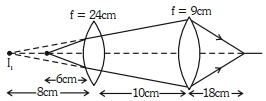
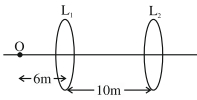
\(\text { From Ist lens } \frac{1}{ v }+\frac{1}{6}=\frac{1}{24}\)\(\frac{1}{ v } =\frac{1}{24}-\frac{1}{6}=-\frac{1}{8}\)
\(v =-8\,cm\)
From \(IInd\) lens \(\frac{1}{ v } +\frac{1}{18}=\frac{1}{9}\)
\(\frac{1}{ v }= \frac{1}{18}\)
\(v =18\)
So distance between object and its image
\(=6+10+18=34\,cm\)
-
- (A) \(49\)
- (B) \(48\)
- (C) \(47\)
- (D) \(50\)
Show answer and solution
Correct Answer: (D)
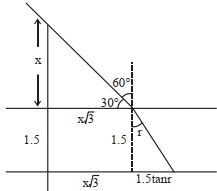
By Snell's law\(1 \sin 60^{\circ}=\frac{4}{3} \sin r \rightarrow \sin r=\frac{3 \sqrt{3}}{8} \rightarrow \tan r=\frac{3 \sqrt{3}}{\sqrt{37}}\)
By the diagram
\(x \sqrt{3}+1.5 \tan r =2.15\)
\(x \sqrt{3}=2.15-1.5 \times \frac{3 \sqrt{3}}{\sqrt{37}}\)
\(x =\frac{2.15}{\sqrt{3}}-\frac{1.5 \times 3}{\sqrt{37}}\)
\(=1.241-0.739\)
\(=0.502\)
\(\approx 0.50 \text { meter }\)
\(x =50\,cm\)
-
- (A) \(21\)
- (B) \(69\)
- (C) \(50\)
- (D) \(52\)
Show answer and solution
Correct Answer: (D)
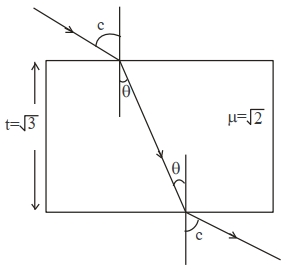
\(\sin c=\frac{1}{\sqrt{2}}\)\(c=45^{\circ}\)
\(\sin c=\mu \sin \theta\)
\(\frac{1}{\sqrt{2}}=\sqrt{2} \sin \theta\)
\(\theta=30^{\circ}\)
Lateral displacement:
\(x=t \sin (i-r) \sec r\)
\(x=\sqrt{3} \sin \left(45^{\circ}-30^{\circ}\right) \sec 30^{\circ}\)
\(x=\sqrt{3}(0.26)\left(\frac{2}{\sqrt{3}}\right)\)
\(X=0.52\,cm\)
\(x=52 \times 10^{-2}\,cm\)
-
- (A) \(30\)
- (B) \(32\)
- (C) \(31\)
- (D) \(59\)
Show answer and solution
Correct Answer: (B)
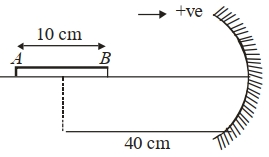
\(U_A=-45\,cm , f =-20\,cm\)\(V_A=\frac{-45 \times(-20)}{-45-(-20)}=\frac{-900}{25}=-36\,cm\)
\(\text { And } U_B=-35\,cm\)
\(\therefore V_B=\frac{-35 \times(-20)}{-35-(-20)}=\frac{700}{-15}\)
\(\therefore V_A-V_B=\text { length of image }\)
\(=\left(-36+\frac{140}{3}\right)\,cm\)
\(=\frac{-108+140}{3}\,cm\)
\(=\frac{32}{3}\,cm\)
\(\therefore x=32\)
-
- (A) \(6\)
- (B) \(1.3\)
- (C) \(7.8\)
- (D) \(4.5\)
Show answer and solution
Correct Answer: (D)
\(\delta_1=\delta_2 \text { [for no average deviation] }\)\(\Rightarrow 6^{\circ}(1.54-1)= A (1.72-1)\)
\(\Rightarrow A =\frac{6^{\circ} \times 0.54}{0.72}\)
\(=\frac{18^{\circ}}{4}=4.5^{\circ}\)
-
- (A) \(\frac{d n_1 n_2}{\left(n_1+n_2\right)}\)
- (B) \(\frac{d\left(n_1+n_2\right)}{2 n_1 n_2}\)
- (C) \(\frac{d n_1 n_2}{2\left(n_1+n_2\right)}\)
- (D) \(\frac{2 d \left( n _1+ n _2\right)}{ n _1 n _2}\)
Show answer and solution
Correct Answer: (B)
Formula used \(d _{ app }=\frac{ d _1}{ n _1}+\frac{ d _2}{ n _2}\)\(d _{a p p}=\frac{ d }{2}\left\lfloor\frac{ n _1+ n _2}{ n _1 n _2}\right\rfloor\)
-
- (A) \(\frac{4}{3}\)
- (B) \(\frac{3}{2}\)
- (C) \(\frac{2}{3}\)
- (D) \(\frac{6}{5}\)
Show answer and solution
Correct Answer: (B)
\(d _{\text {appprent }}=\frac{ d _{\text {actual }}}{\mu_{\text {rel }}}\)\(12=\frac{ x }{\mu}\)
\(4=\frac{24- x }{\mu}\)
On solving we get \(\mu=1.5\)
-
- (A) \(4\,cm\) towards mirror
- (B) \(8\,cm\) towards mirror
- (C) \(8\,cm\) away from mirror
- (D) \(2\,cm\) towards mirror
Show answer and solution
Correct Answer: (B)
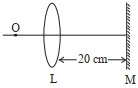
\(\therefore\) Shifting of image will be \(8\,cm\) towards mirror.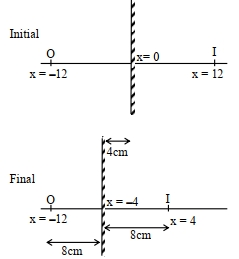
-
- (A) \(28\)
- (B) \(30\)
- (C) \(29\)
- (D) \(3.2\)
Show answer and solution
Correct Answer: (B)
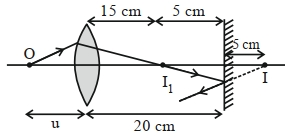
\(f =10\,cm\)\(\frac{1}{ v }-\frac{1}{ u }=\frac{1}{ f }\)
\(\frac{1}{15}-\frac{1}{- u }=\frac{1}{10}\)
\(\Rightarrow \frac{1}{ u }=\frac{1}{10}-\frac{1}{15}\)
On solving we get value of \(u\) as \(30\,cm\).
-
- (A) \(120\)
- (B) \(60\)
- (C) \(40\)
- (D) \(240\)
Show answer and solution
Correct Answer: (A)
\(\frac{1}{ f _1}=(1.75-1)\left(-\frac{1}{30}\right)\)\(\Rightarrow f _1=-40\,cm\)
\(\frac{1}{ f _2}=(1.75-1)\left(\frac{1}{30}\right) \Rightarrow f _2=40\,cm\)
Image from \(L_1\) will be virtual and on the left of \(L_1\) at focal length \(40 \,cm\). So the object for \(L_2\) will be \(80\,cm\) from \(L _2\) which is \(2 f\). Final image is formed at \(80\,cm\) from \(L _2\) on the right. So \(x=120\)
-
- (A) \(98\)
- (B) \(99\)
- (C) \(97\)
- (D) \(96\)
Show answer and solution
Correct Answer: (A)
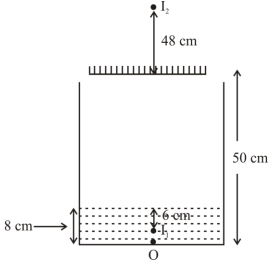
Apparent depth of \(O =\frac{ d }{\mu}=6\)Distance between \(O\) and \(I _2=48+50=98\,cm\)
-
- (A) Both \(A\) and \(R\) are correct but \(R\) is NOT the correct explanation of \(A\)
- (B) \(A\) is correct but \(R\) is not correct
- (C) Both \(A\) and \(R\) are correct and \(R\) is the correct explanation of \(A\)
- (D) \(A\) is not correct but \(R\) is correct
Show answer and solution
Correct Answer: (C)
As medium changes, optical path changes.Also, \(\frac{\Delta x}{\lambda}=\frac{\Delta \phi}{2 \pi}\)
Hence phase difference changes.
-
- (A) \(5\)
- (B) \(4\)
- (C) \(3\)
- (D) \(2\)
Show answer and solution
Correct Answer: (A)
\(V =\frac{ C }{\mu} \Rightarrow \mu=\frac{ C }{ V }=\frac{ C }{0.2 C }\)\(\mu=5\)
\(\mu=\sqrt{\epsilon_{ r } \mu_{ r }}\)
\(\Rightarrow \epsilon_{ r }=\frac{\mu^2}{\mu_{ r }}\)
\(\therefore \frac{\epsilon_{ r }}{\mu}=\frac{\mu}{\mu_{ r }}=5\)
-
- (A) reduce the problem of mechanical support
- (B) remove spherical aberration
- (C) make chromatic aberration zero
- (D) move the eyepiece outside the telescopic tube
Show answer and solution
Correct Answer: (D)
It has advantage of a large focal length in a short telescope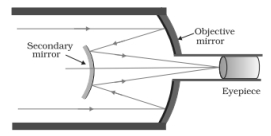
-
- (A) \(30\)
- (B) \(31\)
- (C) \(33\)
- (D) \(32\)
Show answer and solution
Correct Answer: (D)
\(\frac{1}{ v }+\frac{1}{ u }=\frac{1}{ f }\)\(\frac{-1}{120}-\frac{1}{40}=\frac{1}{ f }, \quad f =-30\,cm\)
Now,
\(\frac{-1}{ v ^2} dv -\frac{1}{ u ^2} du =-\frac{1}{ f ^2} df\)
Also \(dv = du =\frac{1}{20} cm\)
\(\frac{\frac{1}{20}}{(120)^2}+\frac{\frac{1}{20}}{(40)^2}=\frac{d f}{(30)^2}\)
On solving
\(df =\frac{1}{32}\,cm\)
\(k =32\)
-
- (A) \(40\)
- (B) \(41\)
- (C) \(42\)
- (D) \(43\)
Show answer and solution
Correct Answer: (B)
\(u =\frac{ h }{ h ^{\prime}}=\frac{5.25}{5.00}\)Least count \(=\frac{1}{20} cm -\frac{49}{50} \cdot \frac{1}{20} cm\)
\(=\frac{1}{50} \times \frac{1}{20} cm =0.01\,mm\)
\(\ln u =\ln h -\ln h ^{\prime}\)
\(\frac{ du }{ u }=\frac{ dh }{ h }-\frac{ dh ^{\prime}}{ h ^{\prime}}\)
\(du =\left[\frac{0.01}{5.25}+\frac{0.01}{5.00}\right] \frac{5.25}{5.00}\)
\(=\frac{41}{10} \times 10^{-3}\)
Ans. \(=41\)
-
- (A) \(5 \times 10^7\,m / s\)
- (B) \(2.12 \times 10^8\,m / s\)
- (C) \(3.12 \times 10^7\,m / s\)
- (D) \(\sqrt{2} \times 10^8\,m / s\)
Show answer and solution
Correct Answer: (B)
\(i _{ C }=\) Critical angle\(\frac{v}{C}=\frac{1}{\mu}=\sin i_C=\sin 45^{\circ}=\frac{1}{\sqrt{2}}\)
\(\Rightarrow v=\frac{ C }{\sqrt{2}}=\frac{3 \times 10^8}{\sqrt{2}}\,m / s =2.12 \times 10^8\,m / s\)
-
- (A) \(B\) and \(D\) only
- (B) \(B\) and \(C\) only
- (C) \(A\) and \(D\) only
- (D) \(A,C\) and \(D\) only
Show answer and solution
Correct Answer: (A)
Plane mirror forms erect, same sized, laterally inverted and virtual image of real object. -
- (A) \(3\)
- (B) \(4\)
- (C) \(2\)
- (D) \(1\)
Show answer and solution
Correct Answer: (B)
\(P=(1.8-1)\left(\frac{1}{20}+\frac{1}{20}\right)\) by lens maker's formula\(P^{\prime}=\left(\frac{1.8}{1.5}-1\right)\left(\frac{1}{20}+\frac{1}{20}\right)\)
Dividing \(\frac{ P }{ P ^{\prime}}=\frac{0.8}{1.2-1}=4\)
- 176. The refractive index of a transparent liquid filled in an equilateral hollow prism is \(\sqrt{2}\). The angle of minimum deviation for the liquid will be 2023 Medium
- (A) \(30\)
- (B) \(20\)
- (C) \(40\)
- (D) \(50\)
Show answer and solution
Correct Answer: (A)
\(\text { As } \mu=\frac{\sin \left(\frac{D_{\min }+A}{2}\right)}{\sin \left(\frac{A}{2}\right)}\)\(\sqrt{2}=\frac{\frac{\sin \left(D_{\min }+60\right)}{2}}{\sin \left(\frac{60}{2}\right)}\)
\(\Rightarrow \frac{1}{\sqrt{2}}=\sin \left(\frac{D_{\min }+60}{2}\right)\)
\(\Rightarrow \frac{D_{\min }+60}{2}=45\)
\(\Rightarrow D_{\min }=30\)
-
- (A) \(99\)
- (B) \(98\)
- (C) \(93\)
- (D) \(100\)
Show answer and solution
Correct Answer: (D)
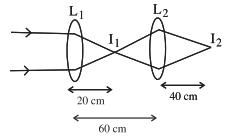
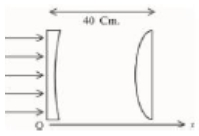
\(1^{\text {st }}\) refraction in \(L _1\left( I _1\right)\)\(\frac{1}{ v }-\frac{1}{ u }=\frac{1}{ f }\)
\(\frac{1}{ v }-\frac{1}{\infty}=\frac{1}{ f }\)
\(\therefore v = f\)
\(2^{2 dr } \text { refraction in } L _2\)
\(I _1 \rightarrow \text { object }\)
\(I _2 \rightarrow \text { image }\)
\(u =-40\,cm \quad f =20\,cm\)
\(\frac{1}{ v }-\frac{1}{ u }=\frac{1}{ f }\)
\(\frac{1}{ v }-\frac{1}{(-40)}=\frac{1}{20}\)
\(\frac{1}{ v }=\frac{1}{20}-\frac{1}{40}=\frac{6-3}{120}\)
\(\frac{1}{ v }=\frac{3}{120}=\frac{1}{40}\)
\(\therefore \quad v =40\,cm\)
Correct Answer is \(100.\)
-
- (A) \(40\)
- (B) \(60\)
- (C) \(160\)
- (D) \(100\)
Show answer and solution
Correct Answer: (C)
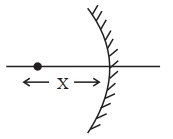
by mirror formula\(\frac{1}{ v }+\frac{1}{ u }=\frac{1}{ f }\)
\(\frac{1}{ v _1}+\frac{1}{-15}=\frac{1}{(-20)}\)
\(\frac{1}{ v _1}=-\frac{1}{20}+\frac{1}{15}\)
\(=\frac{-3+4}{60}\)
\(v _1=60\,cm\)
\(\frac{1}{ v _2}+\frac{1}{(-25)}=\frac{1}{(-20)}\)
\(\frac{1}{ v _2}=\frac{-1}{20}+\frac{1}{25}\)
\(=\frac{-5+4}{100}=\frac{-1}{100}\)
\(v _2=-100\,cm\)
\(d =60+100=160\,cm\)
-
- (A) \(30\)
- (B) \(15\)
- (C) \(7.5\)
- (D) \(66\)
Show answer and solution
Correct Answer: (A)
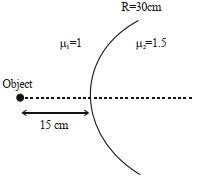
\(\frac{\mu_2}{ v }-\frac{\mu_1}{ u }=\frac{\mu_2-\mu_1}{ R }\)\(\frac{1.5}{ v }-\frac{1}{-15}=\frac{1.5-1}{30}=\frac{1}{60}\)
\(\frac{1.5}{ v }+\frac{1}{15}=\frac{1}{60}\)
\(\frac{1.5}{ v }=\frac{1}{60}-\frac{1}{15}=\frac{-1}{20}\)
\(\frac{1.5}{ v }=-\frac{1}{20} \Rightarrow v =-30\,cm\)
-
- (A) \(16\)
- (B) \(18\)
- (C) \(15\)
- (D) \(14\)
Show answer and solution
Correct Answer: (B)
The desired image is \(18\,cm\) from \(A.\)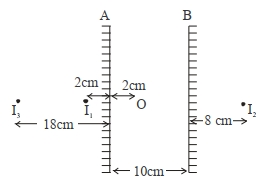
-
- (A) Scattering
- (B) Chromatic aberration
- (C) Spherical aberration
- (D) Polarisation
Show answer and solution
Correct Answer: (B)
Based on fact. -
- (A) \(140\)
- (B) \(120\)
- (C) \(110\)
- (D) \(130\)
Show answer and solution
Correct Answer: (B)
\(\delta=180^{\circ}-60^{\circ}=120^{\circ}\) -
- (A) \(A\) and \(C\) only
- (B) \(B\) and \(D\) only
- (C) \(B\) and \(C\) only
- (D) \(C\) and \(D\) only
Show answer and solution
Correct Answer: (D)
Speed of light does not depend on the motion of source as well as intensity. -
- (A) \(2\)
- (B) \(\frac{1}{\sqrt{2}}\)
- (C) \(\sqrt{2}\)
- (D) \(2 \sqrt{2}\)
Show answer and solution
Correct Answer: (A)
\(I_0=\frac{E_0}{x_c}=\frac{E_0}{\frac{1}{\omega_c}}=E_0 \omega_c\)\(\Rightarrow I_0=36 \times 120 \pi \times 150 \times 10^{-6}\)
\(\Rightarrow I_0=2.03\)
\(\simeq 2\,A\)
-
- (A) \(4\)
- (B) \(3\)
- (C) \(2\)
- (D) \(1\)
Show answer and solution
Correct Answer: (A)
\(\text { Quality factor }=\frac{X_L}{R}=\frac{\omega L}{R}\)\(\omega=\frac{1}{\sqrt{ LC }}=\frac{1}{\sqrt{1 \times 6.25 \times 10^{-6}}}=\frac{10^3}{2.5}=400 / sec\)
\(\text { Q-factor }=\frac{400 \times 1}{100}=4\)
-
- (A) \(24\)
- (B) \(23\)
- (C) \(25\)
- (D) \(22\)
Show answer and solution
Correct Answer: (C)
\(X = X_L - X_C = 100 - 40 = 60\,\Omega\)
\(Z = \sqrt{R^2 + X^2} = \sqrt{80^2 + 60^2} = \sqrt{6400 + 3600} = \sqrt{10000} = 100\,\Omega\)
\(I_0 = \frac{V_0}{Z} = \frac{2500}{100} = 25\,A\)
-
- (A) \(4\)
- (B) \(8\)
- (C) \(6\)
- (D) \(2\)
Show answer and solution
Correct Answer: (B)
Explanation:
1. Calculation of Impedance (Z):
The total impedance of a series LCR circuit is determined by the formula:
\( Z = \sqrt{R^2 + (X_C - X_L)^2} \)
Substituting the given values into the equation:
\( Z = \sqrt{80^2 + (130 - 70)^2} = \sqrt{80^2 + 60^2} = \sqrt{6400 + 3600} = 100\ \Omega \)
2. Calculation of Power Factor (\( \cos\phi \)):
The power factor of an alternating current circuit is given by:
\( \cos\phi = \frac{R}{Z} = \frac{80}{100} = 0.8 \)
3. Finding the value of x:
The question defines the power factor as the fraction \( \frac{x}{10} \). Equating the calculated value to this format gives:
\( \frac{x}{10} = 0.8 \implies \frac{x}{10} = \frac{8}{10} \implies x = 8 \)
Hence, Option B is the correct choice. -
- (A) \(35\)
- (B) \(40\)
- (C) \(44\)
- (D) \(48\)
Show answer and solution
Correct Answer: (B)
To maximize the average rate at which energy supplied i.e. power will be maximum.So in \(LCR\) circuit power will be maximum at the condition of resonance and in resonance condition
\(X_L =X_C\)
\(79.6 =\frac{1}{\omega C}\)
\(\therefore C =\frac{1}{2 \pi \times 50 \times 79.6}\)
\(\therefore C =40 \mu F\)
-
- (A) \(3.14\)
- (B) \(6.28\)
- (C) \(0.5\)
- (D) \(0.318\)
Show answer and solution
Correct Answer: (A)
Explanation:
Let us calculate the inductive reactance step-by-step based on the Alternating Current chapter of the NCERT Class 12 Physics textbook:
Step 1: Find the angular frequency (\(\omega\))
The standard equation for an alternating voltage source is given by:
\(V = V_m\sin(\omega t)\)
Comparing this standard expression with the given equation \(V = 260\sin(628t)\), we get:
\(\omega = 628\text{ rad s}^{-1}\)
Step 2: Convert the inductance (\(L\)) into standard SI units
The given inductance value is:
\(L = 5\text{ mH} = 5 \times 10^{-3}\text{ H}\)
Step 3: Calculate the inductive reactance (\(X_L\))
The formula for inductive reactance is:
\(X_L = \omega L\)
Substituting the values into the formula:
\(X_L = 628 \times (5 \times 10^{-3})\)
\(X_L = 3140 \times 10^{-3} = 3.14\ \Omega\)
Hence, Option A is the correct choice. -
- (A) \(242\)
- (B) \(241\)
- (C) \(240\)
- (D) \(236\)
Show answer and solution
Correct Answer: (A)
\(X _{ L }= X _{ C }\)So, \(Z=R=20\,\Omega\)
\(i_{rms}=\frac{220}{20}=11\)
\(i_{\max }=11 \sqrt{2}=\sqrt{242}\)
-
- (A) \(3875\)
- (B) \(3872\)
- (C) \(3800\)
- (D) \(3654\)
Show answer and solution
Correct Answer: (B)
\(\frac{1}{2 \pi fC }=2 \pi fL\)\(C =\frac{1}{4 \pi^2 f ^2 L }=\frac{1}{4 \times \pi^2 \times 49 \times 10^6 \times 2 \times 10^{-6}}\)
\(C =\frac{1}{3872}\,F\)
\(x =3872\)
-
- (A) \(101\)
- (B) \(10\)
- (C) \(995\)
- (D) \(100\)
Show answer and solution
Correct Answer: (D)
\(f =\frac{1}{2 \pi \sqrt{ LC }}\)\(2000\,Hz =\frac{1}{2 \pi \sqrt{ L \times 62.5 \times 10^{-9}}}\)
\(L =\frac{1}{4 \pi^2 \times 2000^2 \times 62.5 \times 10^{-9}}=0.1\,H =100\,mH\)
-
- (A) \(8\)
- (B) \(9\)
- (C) \(6\)
- (D) \(5\)
Show answer and solution
Correct Answer: (B)
Maximum energy stored in capacitor is same as maximum energy stored in inductor.\(\frac{1}{2} Li _{\max }^2=\frac{1}{2} \frac{ Q _{\max }^2}{ C }\)
\(i _{\max }=\sqrt{\frac{1}{ LC }} Q _{\max }\)
\(=\frac{2.7 \times 10^{-6}}{\sqrt{75 \times 10^{-3} \times 1.2 \times 10^{-6}}}=9\,mA\)
-
- (A) \(A = X _{ C }, B = R\)
- (B) \(A = X _{ L }, B = Z\)
- (C) \(A = X _{ C }, B = X _{ L }\)
- (D) \(A = X _{ L }, B = R\)
Show answer and solution
Correct Answer: (C)
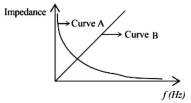
\(X _{ C }=\frac{1}{\omega C }=\frac{1}{(2 \pi f ) C }\)\(\therefore X _{ C } \propto \frac{1}{ f }\)
\(\therefore \text { Curve } A\)
\(X _{ L }=\omega L =(2 \pi f ) L\)
\(\therefore X _{ L } \propto f\)
\(\therefore \text { Curve B }\)
-
- (A) The rms current in circuit \((b)\) can never be larger than that in \((a)\)
- (B) The rms current in figure \((a)\) is always equal to that in figure \((b)\)
- (C) The rms current in circuit \((b)\) can be larger than that in \((a)\)
- (D) At resonance, current in \((b)\) is less than that in \((a)\)
Show answer and solution
Correct Answer: (A)
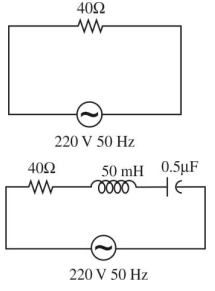
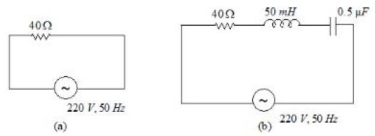
\(I _{ rms }=\frac{220}{40}=5.5\,A\)\(X _{ L }\) is not equal to \(X _{ C }\). So rms current in \((b)\) can never be larger than \((a)\).
-
- (A) Both Statement \(I\) and Statement \(II\) are false
- (B) Statement \(I\) is true but Statement \(II\) is false
- (C) Both Statement \(I\) and Statement \(II\) are true
- (D) Statement I is false but Statement \(II\) is true
Show answer and solution
Correct Answer: (A)
For resonance, \(\phi=0\), hence both inductor and capacitor must be present. Also power factor is zero for pure inductor or pure capacitor hence both the component consume zero average power. -
- (A) Statement \(I\) is false but Statement \(II\) is true
- (B) Statement \(I\) is true but Statement \(II\) is false
- (C) Both Statement \(I\) and Statement \(II\) are true
- (D) Both Statement \(I\) and Statement \(II\) are false
Show answer and solution
Correct Answer: (C)
Power will be maximum when impedance is minimum\(Z =\left[ R ^2+\left( X _{ L }- X _{ C }\right)^2\right]^{\frac{1}{2}}\)
At resonance, \(X _{ L }= X _{ C }\)
\(Z_{\min }=R\)
-
- (A) Statement \(I\) is incorrect but Statement \(II\) is true.
- (B) Both Statement \(I\) and Statement \(II\) are false.
- (C) Statement \(I\) is correct but Statement \(II\) is false.
- (D) Both Statement \(I\) and Statement \(II\) are true.
Show answer and solution
Correct Answer: (D)
Both statements are correct. Theory based. -
- (A) \(1: 3\)
- (B) \(1: \sqrt{2}\)
- (C) \(1: 1\)
- (D) \(1: 2\)
Show answer and solution
Correct Answer: (B)
\(P=\frac{R}{Z} \Rightarrow P_1=\frac{R}{\sqrt{R^2+X_L^2}}=\frac{R}{R \sqrt{2}}\left(\text { as } X_L=R\right)\)\(P_1=\frac{1}{\sqrt{2}}\)
\(P_2=\frac{R}{\sqrt{R^2+\left(X_L-X_L\right)^2}}=P_2=1\)
\(\frac{P_1}{P_2}=\frac{1}{\sqrt{2}}\)
-
- (A) \(\frac{1}{4}\)
- (B) \(16\)
- (C) \(\frac{1}{16}\)
- (D) \(4\)
Show answer and solution
Correct Answer: (A)
The resonance frequency of LC oscillations circuit is\(\omega_0=\frac{1}{\sqrt{ LC }}\)
\(L \rightarrow 2 L\)
\(C \rightarrow 8 C\)
\(\omega=\frac{1}{\sqrt{2 L \times 8 C }}=\frac{1}{4 \sqrt{ LC }}\)
\(\omega=\frac{\omega_0}{4}\)
So \(x =\frac{1}{4}\)
No questions on this page match these filters.