


Questions
Newest firstShowing 1–20 of 20 questions
-
- (A) \(B < C < A\)
- (B) \(C < A < B\)
- (C) \(C < B < A\)
- (D) \(A < C < B\)
Show answer and solution
Correct Answer: (C)
For mixture A:
Millimoles of OH\(^{-}\) = \(10 \times 0.2 \times 2 = 4\)
Millimoles of H\(^{+}\) = \(25 \times 0.1 \times 1 = 2.5\)
Remaining OH\(^{-}\) = \(4 - 2.5 = 1.5\) mmol
The solution is basic, so pH \(> 7\).
For mixture B:
Millimoles of H\(^{+}\) = \(10 \times 0.01 \times 2 = 0.2\)
Millimoles of OH\(^{-}\) = \(10 \times 0.01 \times 2 = 0.2\)
The solution is completely neutralized, so pH \(= 7\).
For mixture C:
Millimoles of H\(^{+}\) = \(10 \times 0.1 \times 2 = 2\)
Millimoles of OH\(^{-}\) = \(10 \times 0.1 \times 1 = 1\)
Remaining H\(^{+}\) = \(2 - 1 = 1\) mmol
The solution is acidic, so pH \(< 7\).
Therefore, the increasing order of pH values is C \(<\) B \(<\) A.
Answer: \(C < B < A\) - 2. A weak acid HA has degree of dissociation x . Which option gives the correct expression of ( pH - \(\mathrm{pK}_{\mathrm{a}}\) )? 2025 Medium
- (A) 0
- (B) \(\log (1+2 \mathrm{x})\)
- (C) \(\log \left(\frac{1-x}{x}\right)\)
- (D) \(\log \left(\frac{x}{1-x}\right)\)
Show answer and solution
Correct Answer: (D)
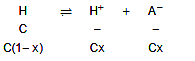
\(\begin{aligned} & \mathrm{K}_{\mathrm{a}}=\frac{\left[\mathrm{H}^{+}\right](\mathrm{x})}{\mathrm{C}(1-\mathrm{x})} \\ & {\left[\mathrm{H}^{+}\right]=\mathrm{K}_{\mathrm{a}} \frac{(1-\mathrm{x})}{\mathrm{x}}} \\ & \log \mathrm{H}^{+}=\log \mathrm{K}_{\mathrm{a}}+\log \left(\frac{1-\mathrm{x}}{\mathrm{x}}\right) \\ & -\log \mathrm{H}^{+}=-\log \mathrm{K}_{\mathrm{a}}-\log \frac{1-\mathrm{x}}{\mathrm{x}} \\ & \mathrm{pH}=\mathrm{pK}_{\mathrm{a}}-\log \frac{1-\mathrm{x}}{\mathrm{x}} \\ & \mathrm{pH}-\mathrm{pK}_{\mathrm{a}}=\log \frac{\mathrm{x}}{1-\mathrm{x}}\end{aligned}\) -
- (A) reduce to \(0.5\)
- (B) increase to \(1.3\)
- (C) remain same
- (D) increase to \(2\)
Show answer and solution
Correct Answer: (B)
\(\mathrm{HCl}_{(\mathrm{aq})} \mathrm{pH}=1 ;\left[\mathrm{H}^{+}\right]=10^{-1}\)
If equal volume of water is added concentration will become half
\(\begin{aligned}& {\left[\mathrm{H}^{+}\right]_{\mathrm{sol}}=\frac{10^{-1}}{2}} \\& \mathrm{pH}=1.3\end{aligned}\) -
- (A) 40
- (B) 48
- (C) 50
- (D) 52
Show answer and solution
Correct Answer: (B)
\(\begin{aligned}
& \mathrm{pOH}=\mathrm{pK}_{\mathrm{b}}+\log \frac{\left[\mathrm{NH}_4^{+}\right]}{\left[\mathrm{NH}_3\right]} \\
& \mathbf{p O H}=4.745
\end{aligned}\)
on adding 0.05 mole HCl
\(\begin{aligned}
& \begin{array}{llll}
\mathrm{NH}_3+ & \mathrm{H}^{\oplus} & \rightarrow & \mathrm{NH}_4^{\oplus} \\
0.1 & 0.05 & & 0.1 \\
0.05 & 0 & & 0.15
\end{array} \\
& \mathrm{pOH}^{\prime}=4.745+\log 3 \\
& \mathrm{pOH}^{\prime}-\mathrm{pOH}=0.477 \\
& 14-\mathrm{pH}^{\prime}-14+\mathrm{pH}=0.477 \\
& \Delta \mathrm{pH}=0.477 \\
& =47.7 \times 10^{-2} \approx 48 \times 10^{-2}
\end{aligned}\) - 5. pH of water is 7 at \(25^{\circ} \mathrm{C}\). If water is heated to \(80^{\circ} \mathrm{C}\)., it's pH will : 2025 Easy
- (A) Decrease
- (B) \(\mathrm{H}^{+}\)concentration increases, \(\mathrm{OH}^{-}\)concentration decreases
- (C) Remains the same
- (D) Increase
Show answer and solution
Correct Answer: (A)
At \(25^{\circ} \mathrm{C}\), pure water has \(\mathrm{pH}=7\)
As temperature increased, water molecules dissociate more into hydrogen ions ( \(\mathrm{H}^{+}\)) and hydroxide ions \(\left(\mathrm{OH}^{-}\right)\).
This increased dissociation leads to slightly decrease in pH .
At \(80^{\circ} \mathrm{C}, \mathrm{pH} \approx 6.93\) - 6. Which of the following mixing of 1 M base and 1 M acid leads to the largest increase in temperature? 2025 Hard
- (A) \(30 \mathrm{~mL} \mathrm{CH}_3 \mathrm{COOH}\) and 30 mL NaOH
- (B) 45 mL \(\mathrm{CH}_3\) COOH and 25 mL NaOH
- (C) 30 mL HCl and 30 mL NaOH
- (D) 50 mL HCl and 20 mL NaOH
Show answer and solution
Correct Answer: (C)
The rise in temperature of neutralization reaction will be maximum for maximum number of moles of strong acid and strong base neutralized and lower volume of final solution.
(3) \(\mathrm{HCl}+\mathrm{NaOH} \rightarrow \mathrm{NaCl}+\mathrm{H}_2 \mathrm{O}\)
mmol \(30 \quad 30\)
Final volume of solution \(=60 \mathrm{~mL}\)
Option (1) and (2) have weak acids and in option (4) only 20 mmol of HCl will be neutralized with 70 mL final volume. -
- (A) 3
- (B) 4
- (C) 5
- (D) 6
Show answer and solution
Correct Answer: (A)
\(\begin{aligned}
& \mathrm{pH}=10 \\
& \mathrm{pOH}=4 \\
& {\left[\mathrm{OH}^{-}\right]=10^{-4}}
\end{aligned}\)
no. of moles of \(\mathrm{OH}^{-}=10^{-4}\)
no. of moles of \(\operatorname{Mg}(\mathrm{OH})_2=\frac{10^{-4}}{2}=5 \times 10^{-5}\)
\(\text { mass of } \begin{aligned}
\mathrm{Mg}(\mathrm{OH})_2 & =5 \times 10^{-5} \times 58 \times 10^3 \mathrm{mg} \\
& =2.9
\end{aligned}\) -
- (A) \(185\)
- (B) \(186\)
- (C) \(184\)
- (D) \(183\)
Show answer and solution
Correct Answer: (B)
Total milimoles of \(H ^{+}=(600 \times 0.01)+(400 \times 0.01 \times 2)\)\(=14\)
\(\left[ H ^{+}\right]=\frac{14}{1000}=14 \times 10^{-3}\)
\(pH =3-\log 14\)
\(=1.86\)
\(=186 \times 10^{-2}\)
- 9. \(200\; mL\) of \(0.01\; M\; HCl\) is mixed with \(400 \;mL\) of \(0.01\; M\; H _{2} SO _{4}\). The \(pH\) of the mixture is 2022 Medium
- (A) \(1.14\)
- (B) \(1.78\)
- (C) \(2.34\)
- (D) \(3.02\)
Show answer and solution
Correct Answer: (B)
\(HCl + H _{2} SO _{4}\)\(\left[ H ^{+}\right]=\frac{(0.01 \times 200)+(0.01 \times 2 \times 400)}{600}\)
\(=\frac{2+8}{600}=\frac{10}{600}=\frac{1}{60}\)
\(pH =-\log [\frac{1}{60}]\)
\(=1.78\)
-
- (A) \(7\)
- (B) \(14\)
- (C) \(3\)
- (D) \(11\)
Show answer and solution
Correct Answer: (D)
\(0.001 M NaOH\)\(\left[ OH ^{-}\right]=10^{-3}\)
\(pOH =3\)
\(pH =11\)
-
- (A) \(1\)
- (B) \(2\)
- (C) \(3\)
- (D) \(4\)
Show answer and solution
Correct Answer: (A)
No. of equivalents of \(H _{2} SO _{4}=100 \times 0.1 \times 2=20\)No. of equivalents of \(NaOH =50 \times 0.1=5\)
No. of equivalents of \(H _{2} SO _{4}\) left \(=20-5=15\)
\(150 \times x =15\)
\(x =\frac{1}{10}=0.1 N =1 \times 10^{-1}\,N\)
-
- (A) \(2\)
- (B) \(1\)
- (C) \(3\)
- (D) \(4\)
Show answer and solution
Correct Answer: (B)
\(\mathrm{Ba}(\mathrm{OH})_{2} \rightarrow \mathrm{Ba}^{+2}+2 \mathrm{OH}^{-} \rightarrow 2 \times 0.005=0.01=10^{-2}\)At \(298\, \mathrm{~K}:\) in aq. solution \([H3O^{+}][\mathrm{OH}^{-}]=10^{-14}\)
\({\left[\mathrm{H}_{3} \mathrm{O}^{+}\right]=\frac{10^{-14}}{10^{-2}}=10^{-12}}\)
\({\left[\mathrm{H}_{3} \mathrm{O}^{+}\right]=1 \times 10^{-12}\, \mathrm{M}}\)
-
- (A) \(5021\)
- (B) \(6021\)
- (C) \(2211\)
- (D) \(3211\)
Show answer and solution
Correct Answer: (B)
\(\quad\quad\quad\mathrm{HCl}(\) aq. \()+\mathrm{NaOH}\) (aq.) \(\rightarrow \mathrm{NaCl}(\) aq. \()+\mathrm{H}_{2} \mathrm{O}(\ell)\)\(\quad\quad\quad50\, \mathrm{ml}, 1\, \mathrm{M} \quad 30\, \mathrm{ml}, 1\, \mathrm{M} \quad\quad\quad\quad-\quad\quad\quad\quad\quad-\)
\(\mathrm{t}=0 \,\quad 50 \,\mathrm{~mm} \,\quad\quad 30\, \mathrm{~mm}\)
\(\mathrm{t}=\infty\quad 20\, \mathrm{~mm} \quad\quad\quad\, -\)
\([\mathrm{HCl}]=\frac{20}{80}=\frac{1}{4}\, \mathrm{M}=2.5 \times 10^{-1}\, \mathrm{M}\)
\(\mathrm{pH}=-\log 2.15 \times 10^{-1}=1-0.3979=0.6021\)
\(\mathrm{pH}=6021 \times 10^{-4}\)
-
- (A) \(7.2\)
- (B) \(6.43\)
- (C) \(3.22\)
- (D) \(5.23\)
Show answer and solution
Correct Answer: (D)
Sol. 3 gm Acetic Acid \(+250 \mathrm{ml}\; 0.1 \mathrm{M} \;\mathrm{HCl}+\) Water\(\longrightarrow\) made to 500 ml solution.
\(\Rightarrow 500 \mathrm{ml}\) solution has \(25 \mathrm{meq}\) of \(\mathrm{HCl}\)
\(50 \mathrm{meq}\) of \(\mathrm{CH}_{3} \mathrm{COOH}\)
\(\therefore 20 \mathrm{ml}\) solution has \(1 meq.\) of \(\mathrm{HCl}\) \(2 \mathrm{meq}\) of \(\mathrm{CH}_{3} \mathrm{COOH}\)
We have added 2.5 meq. of \(\mathrm{NaOH}\left(5 \mathrm{M}, \frac{1}{2} \mathrm{ml}\right)\)
Finally, \(NaOH \;and\; HCl\) are completely consumed and we are left with 0.5 meq of \(\mathrm{CH}_{3} \mathrm{COOH}\) and 1.5 meq of \(\mathrm{CH}_{3} \mathrm{COONa}\)
\(\mathrm{pH}=\mathrm{pKa}+\log \frac{1.5}{0.5}\)
\(=4.75+ \log 3=4.75+0.4771\)
\(=5.2271\)
-
- (A) Both assertion and reason are true, but the reason is not the correct explanation for the assertion.
- (B) Both assertion and reason are false.
- (C) Assertion is not true, but reason is true.
- (D) Both assertion and reason are true, and the reason is the correct explanation for the assertion.
Show answer and solution
Correct Answer: (B)
\(\mathrm{H}_{2} \mathrm{O}(\ell) \rightleftharpoons \mathrm{H}_{(\mathrm{aq})}^{+}+\mathrm{OH}_{(\mathrm{aq})}^{-}\)For ionization of \(\mathrm{H}_{2} \mathrm{O}: \Delta \mathrm{H}>\mathrm{O}\) \(\Rightarrow\) Endothermic
On temperature increase reaction shifts forward
\(\Rightarrow\) both \(\left[\mathrm{H}^{+}\right]\) and \(\left[\mathrm{OH}^{-}\right]\) increase
\(\Rightarrow \mathrm{pH} \;and\; \mathrm{pOH}\) decreases.
-
- (A) \(7.3\)
- (B) \(8.7\)
- (C) \(9.6\)
- (D) \(10.6\)
Show answer and solution
Correct Answer: (D)
\(4 \mathrm{gm}\) of \(\mathrm{NaOH}\) in \(100 \mathrm{L}\) sol. \(\Rightarrow 10^{-3} \mathrm{M}\) sol.\(9.8 \mathrm{gm}\) of \(\mathrm{H}_{2} \mathrm{SO}_{4}\) in \(100 \mathrm{L}\) sol. \(\Rightarrow 10^{-3} \mathrm{M}\) sol.
Mixture : \(40 L\) of \(10^{-3} \mathrm{M} \mathrm{NaOH}\) and \(10 \mathrm{L}\) of
\(10^{-3} \mathrm{M} \mathrm{H}_{2} \mathrm{SO}_{4}\) sol.
Final Conc. of \(OH^-=\frac{10^{-3}(40 \times 1-10 \times 1 \times 2)}{40+10}=6 \times 10^{-4} \mathrm{M}\)
\(\mathrm{pOH}=-\log \left(6 \times 10^{-4}\right)\)
\(=4-\log 6=4-0.60=3.40\)
\(\mathrm{pH}=14-3.40=10.60\)
-
- (A) \(55\,mL\,\frac{M}{{10}}\,HCl + 45\,mL\,\frac{M}{{10}}\,NaOH\)
- (B) \(75\,mL\,\frac{M}{5}\,HCl + 25\,mL\,\frac{M}{5}\,NaOH\)
- (C) \(100\,mL\,\frac{M}{{10}}\,HCl + 100\,mL\,\frac{M}{{10}}\,NaOH\)
- (D) \(60\,mL\,\frac{M}{{10}}HCl + 40\,mL\,\frac{M}{{10}}NaOH\)
Show answer and solution
Correct Answer: (B)
\(75\,mL\,\frac{M}{5}\,HCl + 25\,ml\,\frac{M}{5}\,NaOH\)\(25\,mL\,\frac{M}{5}\,NaOH\,\) will neutralise \(25\,mL\,\frac{M}{5}\,HCl\)
\(75 - 25 = 50\,mL\,\frac{M}{5}\,HCl\) will remain.
Total volume will be \(75 + 25 = 100\,mL\)
\(50\,mL\,\frac{M}{5}\,HCl\) is diluted to \(100\,mL\)
\([{H^ + }] = [HCl] = \frac{M}{5} \times \frac{{50}}{{100}} = \frac{M}{{10}}\)
\(pH = - {\log _{10}}[{H^ + }] = - {\log _{10}}\,\frac{M}{{10}} = 1\)
-
- (A) \(320\)
- (B) \(325\)
- (C) \(316\)
- (D) \(330\)
Show answer and solution
Correct Answer: (C)
\(\frac{{V \times 45}}{{100}} + \frac{{(800 - V) \times 20}}{{100}} = \frac{{800 \times 29.875}}{{100}}\)\( \Rightarrow \frac{{9V}}{{20}} + 160 - \frac{V}{5} = 239\)
\( \Rightarrow V = 136\)
-
- (A) \(0.1\)
- (B) \(0.9\)
- (C) \(2\)
- (D) \(9\)
Show answer and solution
Correct Answer: (D)
As \(p H=1 ; H^{+}=10^{-1}=0.1 \,M\)\(p H=2 ; H^{+}=10^{-2}=0.01\, M\)
\(\therefore M_{1}=0.1 ; V_{1}=1\)
\(M_{2}=0.01; V_{2}=?\)
From
\(M_{1} V_{1}=M_{2} V_{2} ; 0.1 \times 1=0.01 \times V_{2}\)
\(V_{2}=10\) litre
volume of water added \(=10-1=9\) litre.
- 20. \(NaOH\) is a strong base. What will be \(pH\) of \(5.0 \times 10^{-2}\,M\) \(NaOH\) solution \((log\,2 = 0.3)\) 2013 Medium
- (A) \(14\)
- (B) \(13.70\)
- (C) \(13\)
- (D) \(12.70\)
Show answer and solution
Correct Answer: (D)
Given \([O{H^ - }] = 5 \times {10^{ - 2}}\)\(\therefore \,pOH = - \log \,5 \times {10^{ - 2}}\)
\( = - \log \,5 + 2\log \,10 = 1.30\)
\(\because \,pH + pOH = 14\)
\(\because \,pH = 14 - pOH\)
\( = 14 - 1.30 = 12.70\)
No questions on this page match these filters.
Other STD 11 - Equilibrium - II (icon Equilibrium) topics
Frequently asked
How many PH of strong Acids and strong Bases questions came in JEE Mains?
20 questions from 2013–2026, each with the correct answer and a full solution.
How difficult are PH of strong Acids and strong Bases questions?
15% are easy, 40% medium and 45% hard.