


Questions
Newest firstShowing 1–18 of 18 questions
- 1. Rods x and y of equal dimensions but of different materials are joined as shown in figure. Temperatures of end points A and F are maintained at \( 100^{\circ}C \) and \( 40^{\circ}C \) respectively. Given the thermal conductivity of rod x is three times of that of rod y, the temperature at junction points B and E are (close to):
 2026 Easy
- 2. Three conductors of same length having thermal conductivity \(\mathrm{k}_1, \mathrm{k}_2\) and \(\mathrm{k}_3\) are connected as shown in figure.

Area of cross sections of \(1^{\text {st }}\) and \(2^{\text {nd }}\) conductor are same and for \(3^{\text {rd }}\) conductor it is double of the \(1^{\text {st }}\) conductor. The temperatures are given in the figure. In steady state condition, the value of \(\theta\) is _______ \({ }^{\circ} \mathrm{C}\).
(Given : \(\mathrm{k}_1=60 \mathrm{Js}^{-1} \mathrm{~m}^{-1} \mathrm{~K}^{-1}, \mathrm{k}_2=120 \mathrm{Js}^{-1}\mathrm{~m}^{-1}\) \( \mathrm{~K}^{-1}, \mathrm{k}_3=135 \mathrm{Js}^{-1} \mathrm{~m}^{-1} \mathrm{~K}^{-1}\) ) 2025 Medium - 3. Two cylindrical rods A and B made of different materials, are joined in a straight line. The ratio of lengths, radii and thermal conductivities of these rods are :
\(\frac{\mathrm{L}_{\mathrm{A}}}{\mathrm{L}_{\mathrm{B}}}=\frac{1}{2}, \frac{\mathrm{r}_{\mathrm{A}}}{\mathrm{r}_{\mathrm{B}}}=2\) and \(\frac{\mathrm{K}_{\mathrm{A}}}{\mathrm{K}_{\mathrm{B}}}=\frac{1}{2}\). The free ends of rods A and B are maintained at \(400 \mathrm{~K}, 200 \mathrm{~K}\), respectively. The temperature of rods interface is ________ K, when equilibrium is established. 2025 Hard - 4. Two plates \(A\) and \(B\) have thermal conductivities \(84\,Wm ^{-1}\,K ^{-1}\) and \(126\,Wm ^{-1}\,K ^{-1}\) respectively. They have same surface area and same thickness. They are placed in contact along their surfaces. If the temperatures of the outer surfaces of \(A\) and \(B\) are kept at \(100^{\circ}\,C\) and \(0{ }^{\circ}\,C\) respectively, then the temperature of the surface of contact in steady state is \(..........\,{ }^{\circ} C\). 2023 Medium
- 5. An ice cube of dimensions \(60\,cm \times 50\,cm \times 20\,cm\) is placed in an insulation box of wall thickness \(1\,cm\). The box keeping the ice cube at \(0^{\circ}\,C\) of temperature is brought to a room of temperature \(40^{\circ}\,C\). The rate of melting of ice is approximately. (Latent heat of fusion of ice is \(3.4 \times 10^{5}\,J\,kg ^{-1}\) and thermal conducting of insulation wall is \(0.05\,Wm ^{-10} C ^{-1}\) ) 2022 Hard
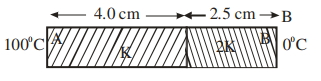
- 6. As per the given figure, two plates \(A\) and \(B\) of thermal conductivity \(K\) and \(2 K\) are joined together to form a compound plate. The thickness of plates are \(4.0 \,cm\) and \(2.5 \,cm\) respectively and the area of cross-section is \(120 \,cm ^{2}\) for each plate. The equivalent thermal conductivity of the compound plate is \(\left(1+\frac{5}{\alpha}\right) K\), then the value of \(\alpha\) will be_______
 2022 Hard
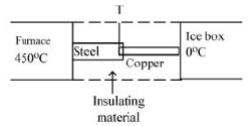
- 7. If \(K_{1}\) and \(K_{2}\) are the thermal conductivities \(L_{1}\) and \(L _{2}\) are the lengths and \(A _{1}\) and \(A _{2}\) are the cross sectional areas of steel and copper rods respectively such that \(\frac{K_{2}}{K_{1}}=9, \frac{A_{1}}{A_{2}}=2, \frac{L_{1}}{L_{2}}=2\). Then, for the arrangement as shown in the figure. The value of temperature \(T\) of the steel - copper junction in the steady state will be ........... \(^{\circ} C\)
 2022 Medium
- 8. Two metallic blocks \(M_{1}\) and \(M_{2}\) of same area of cross-section are connected to each other (as shown in figure). If the thermal conductivity of \(M _{2}\) is \(K\) then the thermal conductivity of \(M _{1}\) will be ]...............\(K\) [Assume steady state heat conduction]
 2022 Medium
- 9. A rod \(C D\) of thermal resistance \(10.0\; {KW}^{-1}\) is joined at the middle of an identical rod \({AB}\) as shown in figure, The end \(A, B\) and \(D\) are maintained at \(200^{\circ} {C}, 100^{\circ} {C}\) and \(125^{\circ} {C}\) respectively. The heat current in \({CD}\) is \({P}\) watt. The value of \({P}\) is ... .
 2021 Hard
- 10. If two metallic plates of equal thicknesses and thermal conductivities \({K_1}\) and \({K_2}\) are put together face to face and a common plate is constructed, then the equivalent thermal conductivity of this plate will be
 2021 Medium
- 11. The temperature \(\theta\) at the junction of two insulating sheets, having thermal resistances \(R _{1}\) and \(R _{2}\) as well as top and bottom temperatures \(\theta_{1}\) and \(\theta_{2}\) (as shown in figure) is given by
 2021 Medium
- 12. Two thin metallic spherical shells of radii \({r}_{1}\) and \({r}_{2}\) \(\left({r}_{1}<{r}_{2}\right)\) are placed with their centres coinciding. A material of thermal conductivity \({K}\) is filled in the space between the shells. The inner shell is maintained at temperature \(\theta_{1}\) and the outer shell at temperature \(\theta_{2}\left(\theta_{1}<\theta_{2}\right)\). The rate at which heat flows radially through the material is :- 2021 Hard
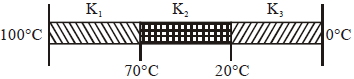
- 13. Three rods of identical cross-section and lengths are made of three different materials of thermal conductivity \(K _{1}, K _{2},\) and \(K _{3}\), respectively. They are joined together at their ends to make a long rod (see figure). One end of the long rod is maintained at \(100^{\circ} C\) and the ther at \(0^{\circ} C\) (see figure). If the joints of the rod are at \(70^{\circ} C\) and \(20^{\circ} C\) in steady state and there is no loss of energy from the surface of the rod, the correct relationship between \(K _{1}, K _{2}\) and \(K _{3}\) is
 2020 Hard
- 14. A cylinder of radius \(R\) is surrounded by a cylindrical shell of inner radius \(R\) and outer radius \(2R\). The thermal conductivity of the material of the inner cylinder is \(K_1\) and that of the outer cylinder is \(K_2\). Assuming no loss of heat, the effective thermal conductivity of the system for heat flowing along the length of the cylinder is 2019 Medium
- 15. A heat source at \(T = 10^3\, K\) is connected to another heat reservoir at \(T = 10^2\, K\) by a copper slab which is \(1\, m\) thick. Given that the thermal conductivity of copper is \(0.1\, WK^{-1}\, m^{-1}\), the energy flux through it in the steady state is ........... \(Wm^{-2}\) 2019 Hard
- 16. Temperature difference of \(120\,^oC\) is maintained between two ends of a uniform rod \(AB\) of length \(2L\). Another bent rod \(PQ\), of same cross-section as \(AB\) and length \(\frac{{3L}}{2}\), is connected across \(AB\) (See figure). In steady state, temperature difference between \(P\) and \(Q\) will be close to .......... \(^oC\)
 2019 Hard
- 17. Two materials having coefficients of thermal conductivity \(3K\) and \(K\) and thickness \(d\) and \(3d\), respectively, are joined to form a slab as shown in the figure. The temperatures of the outer surfaces are \(\theta_2\) and \(\theta_1\) respectively \(\left( {\theta _2} > {\theta _1} \right)\) . The temperature at the interface is
 2019 Medium
- 18. Three rods of Copper, Brass and Steel are welded together to form a \(Y\) shaped structure. Area of cross - section of each rod \(= 4\ cm^2\) . End of copper rod is maintained at \(100^o C \) where as ends ofbrass and steel are kept at \(0^o C\). Lengths of the copper, brass and steel rods are \(46, 13\) and \(12\ cms\) respectively. The rods are thermally insulated from surroundings excepts at ends. Thermal conductivities of copper, brass and steel are \(0.92, 0.26\) and \(0.12\ CGS\) units respectively. Rate ofheat flow through copper rod is ....... \(cal\, s^{-1}\) 2014 Hard
No questions on this page match these filters.
Other STD 11 - Transmission of heat topics
Frequently asked
How many Thermal Conductivity and Thermal Resistance questions came in JEE Mains?
18 questions from 2014–2026, each with the correct answer and a full solution.
How difficult are Thermal Conductivity and Thermal Resistance questions?
6% are easy, 44% medium and 50% hard.