


Questions
Newest firstShowing 1–32 of 32 questions
- 1. Five positive charges each having charge q are placed at the vertices of a pentagon as shown in the figure. The electric potential (V) and the electric field \((\vec{E})\) at the center O of the pentagon due to these five positive charges are:
 2026 Hard
- 2. There are three co-centric conducting spherical shells \(A , B\) and C of radii \(a , b\) and c respectively. The potential of the spheres \(A , B\) and C respectively, are : 2026 Hard
- 3. Three small identical bubbles of water having same charge on each coalesce to form a bigger bubble. Then the ratio of the potentials on one initial bubble and that on the resultant bigger bubble is: 2026 Hard
- 4. Two charges \(7 \mu C\) and \(-2 \mu C\) are placed at \((-9,0,0) cm\) and \((9,0,0) cm\) respectively in an external field \(E=\frac{ A }{ r ^2} \hat{ r }\), where \(A=9 \times 10^5 N / C . m ^2\).
Considering the potential at infinity is 0 , the electrostatic energy of the configuration is ___________ J . 2026 Medium - 5. Which one of the following is not a measurable quantity ? 2026 Medium
- 6. Given below are two statements : one is labelled as Assertion A and the other is labelled as Reason \(\mathrm{R}\) Assertion A : Work done in moving a test charge between two points inside a uniformly charged spherical shell is zero, no matter which path is chosen.
Reason \(\mathrm{R}\) : Electrostatic potential inside a uniformly charged spherical shell is constant and is same as that on the surface of the shell. In the light of the above statements, choose the correct answer from the options given below 2025 Medium - 7. The electrostatic potential on the surface of uniformly charged spherical shell of radius \(\mathrm{R}=10 \mathrm{~cm}\) is 120 V. The potential at the centre of shell, at a distance \(\mathrm{r}=5 \mathrm{~cm}\) from centre, and at a distance \(\mathrm{r}=15 \mathrm{~cm}\) from the centre of the shell respectively, are : 2025 Easy
- 8. An electric charge \(10^{-6} \mu \mathrm{C}\) is placed at origin \((0,0)\) \(\mathrm{m}\) of \(\mathrm{X}-\mathrm{Y}\) co-ordinate system. Two points \(\mathrm{P}\) and \(\mathrm{Q}\) are situated at \((\sqrt{3}, \sqrt{3}) \mathrm{m}\) and \((\sqrt{6}, 0) \mathrm{m}\) respectively. The potential difference between the points \(P\) and \(Q\) will be : 2024 Hard
- 9. At the centre of a half ring of radius \(R=10 \mathrm{~cm}\) and linear charge density \(4 \mathrm{n} \mathrm{C} \mathrm{m}^{-1}\), the potential is \(x \pi V\). The value of \(x\) is _______. 2024 Hard
- 10. Two charged conducting spheres of radii \(a\) and \(b\) are connected to each other by a conducting wire. The ratio of charges of the two spheres respectively is _______. 2024 Hard
- 11. \(64\) identical drops each charged upto potential of \(10\,mV\) are combined to form a bigger dorp. The potential of the bigger drop will be \(..........\,mV\) 2023 Medium
- 12. Electric potential at a point \(P\) due to a point charge of \(5 \times 10^{-9}\; C\) is \(50 \;V\). The distance of \(P\) from the point charge is ......... \(cm\) (Assume, \(\frac{1}{4 \pi \varepsilon_0}=9 \times 10^{+9}\; Nm ^2 C ^{-2}\)) 2023 Easy
- 13. The electric potential at the centre of two concentric half rings of radii \(R_1\) and \(R_2\), having same linear charge density \(\lambda\) is
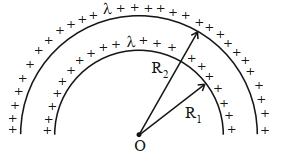 2023 Hard
- 14. Three concentric spherical metallic shells \(X , Y\) and \(Z\) of radius \(a , b\) and c respectively \([ a < b < c ]\) have surface charge densities \(\sigma,-\sigma\) and \(\sigma\), respectively. The shells \(X\) and \(Z\) are at same potential. If the radii of \(X\) and \(Y\) are \(2\,cm\) and \(3\,cm\), respectively.The radius of shell \(Z\) is \(......cm\). 2023 Hard
- 15. \(27\) identical drops are charged at \(22\, V\,\,each.\) They combine to form a bigger drop. The potential of the bigger drop will be............ \(V.\) 2022 Medium
- 16. \(512\) identical drops of mercury are charged to a potential of \(2\, V\) each. The drops are joined to form a single drop. The potential of this drop is ......... \(V.\) 2021 Hard
- 17. The two thin coaxial rings, each of radius \('a'\) and having charges \(+{Q}\) and \(-{Q}\) respectively are separated by a distance of \('s'.\) The potential difference between the centres of the two rings is : 2021 Hard
- 18. Concentric metallic hollow spheres of radii \(R\) and \(4 R\) hold charges \(Q _{1}\) and \(Q _{2}\) respectively. Given that surface charge densities of the concentric spheres are equal, the potential difference \(V ( R )- V (4 R )\) is 2020 Medium
- 19. Consider two charged metallic spheres \(S_{1}\) and \(\mathrm{S}_{2}\) of radii \(\mathrm{R}_{1}\) and \(\mathrm{R}_{2},\) respectively. The electric \(\left.\text { fields }\left.\mathrm{E}_{1} \text { (on } \mathrm{S}_{1}\right) \text { and } \mathrm{E}_{2} \text { (on } \mathrm{S}_{2}\right)\) on their surfaces are such that \(\mathrm{E}_{1} / \mathrm{E}_{2}=\mathrm{R}_{1} / \mathrm{R}_{2} .\) Then the ratio \(\left.\mathrm{V}_{1}\left(\mathrm{on}\; \mathrm{S}_{1}\right) / \mathrm{V}_{2} \text { (on } \mathrm{S}_{2}\right)\) of the electrostatic potentials on each sphere is 2020 Medium
- 20. Ten charges are placed on the circumference of a circle of radius \(R\) with constant angular separation between successive charges. Alternate charges \(1,3,5,7,9\) have charge \((+q)\) each, while \(2,4,6,8,10\) have charge \((-q)\) each. The potential \(V\) and the electric field \(E\) at the centre of the circle are respectively (Take \(V =0\) at infinity \()\) 2020 Hard
- 21. A charge \(Q\) is distributed over three concentric spherical shell of radii \(a, b, c (a < b < c)\) such that their surface charge densities are equal to one another. The total potential at a point at distance \(r\) from their common centre, where \(r < a\), would be 2019 Hard
- 22. A solid conducting sphere, having a charge \(Q\), is surrounded by an uncharged conducting hollow spherical shell. Let the potential difference between the surface of the solid sphere and that of the outer surface of the hollow shell be \(V\). If the shell is now given a charge of \(-4\, Q\), the new potential difference between the same two surface is......\(V\) 2019 Hard
- 23. The election field in a region is given by \(\vec E = (Ax + B)\hat i\) where \(E\) is in \(N\,C^{-1}\) and \(x\) in meters. The values of constants are \(A = 20\, SI\, unit\) and \(B = 10\, SI\, unit\). If the potential at \(x =1\) is \(V_1\) and that at \(x = -5\) is \(V_2\) then \(V_1 -V_2\) is.....\(V\) 2019 Medium
- 24. The give graph shown variation (with distance \(r\) from centre) of
 2019 Hard
- 25. Three concentric metal shells \(A, B\) and \(C\) of respective radii \(a, b\) and \(c (a < b < c)\) have surface charge densities \(+\sigma,-\sigma\) and \(+\sigma\) respectively. The potential of shell \(B\) is 2018 Hard
- 26. There is a uniform electrostatic field in a region. The potential at various points on a small sphere centred at \(P\), in the region, is found to vary between in the limits \(589.0\,V\) to \(589.8\, V\). What is the potential at a point on the sphere whose radius vector makes an angle of \(60^o\) with the direction of the field ?........\(V\) 2017 Hard
- 27. An electric field \(\vec E\, = (25 \hat i + 30 \hat j)\,NC^{-1}\) exists in a region of space. If the potential at the origin is taken to be zero then the potential at \(x\, = 2\, m, y\, = 2\, m\) is......\(volt\) 2015 Medium
- 28. Assume that an electric field \(\vec E = 30{x^2}\hat i\) exists in space. Then the potential difference \(V_A-V_O\) where \(V_O\) is the potential at the origin and \(V_A\) the potential at \(x = 2\ m\) is....\(V\) 2014 Medium
- 29. A point charge of magnitude \(+ 1\,\mu C\) is fixed at \((0, 0, 0) \). An isolated uncharged spherical conductor, is fixed with its center at \((4, 0, 0).\) The potential and the induced electric field at the centre of the sphere is 2013 Hard
- 30. charge \(Q\) is uniformly distributed over a long rod \(AB\) of length \(L\) as shown in the figure. The electric potential at the point \(O\) lying at distance \(L\) from the end \(A\) is
 2013 Medium
- 31. Consider a finite insulated, uncharged conductor placed near a finite positively charged conductor. The uncharged body must have a potential 2013 Hard
- 32. Two small equal point charges of magnitude \(q\) are suspended from a common point on the ceiling by insulating mass less strings of equal lengths. They come to equilibrium with each string making angle \(\theta \) from the vertical. If the mass of each charge is \(m,\) then the electrostatic potential at the centre of line joining them will be \(\left( {\frac{1}{{4\pi { \in _0}}} = k} \right).\) 2013 Hard
No questions on this page match these filters.
Other STD 12 - Electric potential and capacitance topics
- 14Qs Charging and Discharging of Capacitance and RC circuit
- 9Qs Parallel Plate Capacitor
- 26Qs Energy Stored in a Capacitor
- 38Qs Combination of Capacitor and Sharing of Charge
- 54Qs Effect of Dielectric and Dielectric Inside Capacitor and Polarisation
- 10Qs Conductor, Electrostatic Shielding, Induced Charge and Charge Redistribution
- 9Qs Electric Field and Potential and Potential Gradient
- 12Qs Electric potential and Potential Energy and dipole
- 20Qs Potential Energy and Work Done
- 4Qs Equipotential Surface
- 5Qs Capacitance
Frequently asked
How many Electric potential questions came in JEE Mains?
32 questions from 2013–2026, each with the correct answer and a full solution.
How difficult are Electric potential questions?
6% are easy, 34% medium and 59% hard.