


Questions
Newest firstShowing 1–9 of 9 questions
-
- (A) \(t_{100\%} = (t_{1/2})^2\) and \(t_{100\%} = (t_{1/2})^{-\infty}\)
- (B) \(t_{100\%} = 2t_{1/2}\) and \(t_{100\%} = (t_{1/2})^\infty\)
- (C) \(t_{100\%} = 2t_{1/2}\) and \(t_{100\%} = (2t_{1/2})^2\)
- (D) \(t_{100\%} = (t_{1/2})^\infty\) and \(t_{100\%} = 2t_{1/2}\)
Show answer and solution
Correct Answer: (B)
For a zero-order reaction:
The integrated rate law is given by \(t = \dfrac{[A]_0 - [A]_t}{k}\).
For \(50\%\) completion (\(t_{1/2}\)), \([A]_t = \dfrac{[A]_0}{2}\):
\(t_{1/2} = \dfrac{[A]_0 - \dfrac{[A]_0}{2}}{k} = \dfrac{[A]_0}{2k}\)
For \(100\%\) completion (\(t_{100\%}\)), \([A]_t = 0\):
\(t_{100\%} = \dfrac{[A]_0 - 0}{k} = \dfrac{[A]_0}{k}\)
Comparing the two, we get:
\(t_{100\%} = 2t_{1/2}\)
For a first-order reaction:
The integrated rate law is given by \(t = \dfrac{1}{k} \ln\left(\dfrac{[A]_0}{[A]_t}\right)\).
For \(100\%\) completion (\(t_{100\%}\)), \([A]_t = 0\):
\(t_{100\%} = \dfrac{1}{k} \ln\left(\dfrac{[A]_0}{0}\right) = \infty\)
A first-order reaction takes infinite time for \(100\%\) completion. Among the given choices, this is symbolically represented as \(\infty\) or \((t_{1/2})^\infty\).
Thus, the correct relation is \(t_{100\%} = 2t_{1/2}\) for zero-order and \(t_{100\%} = \infty\) for first-order.
Answer: \(t_{100\%} = 2t_{1/2}\) and \(t_{100\%} = (t_{1/2})^\infty\) -
- (A) 2435
- (B) 2400
- (C) 2541
- (D) 1254
Show answer and solution
Correct Answer: (A)
\(\begin{aligned}
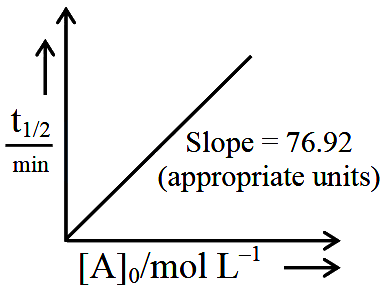
& \mathrm{t}_{1 / 2} \propto[\mathrm{A}]_0 \Rightarrow \text { Order }=\text { zero } \\
& \mathrm{t}_{1 / 2}=\frac{\mathrm{A}_0}{2 \mathrm{~K}} \Rightarrow \text { Slope }=\frac{1}{2 \mathrm{~K}}=76.92 \\
& \mathrm{~K}=\frac{1}{2 \times 76.92} \\
& {[\mathrm{A}]_{10}=-\mathrm{Kt}+\mathrm{A}_0=-\frac{1}{2 \times 76.92} \times 10+2.5=2.435} \\
& =2435 \times 10^{-3} \mathrm{~mol} / \mathrm{L}
\end{aligned}\) -
- (A) 0.5 hour
- (B) 4 hour
- (C) 15 min
- (D) 60 min
Show answer and solution
Correct Answer: (C)
For zero order reaction
\(\begin{aligned}
& \text { Half life }=\frac{A_o}{2 k} \\
& 60 \min =\frac{2}{2 k} \\
& k=\frac{1}{60} \mathrm{M} / \min
\end{aligned}\)
Now
\(\begin{aligned} & \mathrm{A}_{\mathrm{t}}=\mathrm{A}_{\mathrm{o}}-\mathrm{kt} \\ & \mathrm{t}=\frac{\mathrm{A}_{\mathrm{o}}-\mathrm{A}_{\mathrm{t}}}{\mathrm{k}} \\ & =\frac{0.5-0.25}{1 / 60} \\ & 0.25 \times 60\end{aligned}\)
\(\mathrm{t}=15 \mathrm{~min}\) -
- (A) \(74\)
- (B) \(75\)
- (C) \(72\)
- (D) \(73\)
Show answer and solution
Correct Answer: (B)
Assume reaction starts with \(1\) mole \(A\)\(\left( t _{1 / 2}=\frac{ a }{2 k }, K =\frac{1}{2 \times 50}\right.\)
For \(75 \%\) completion
\(a -\frac{ a }{4}= kt\)
\(t =\frac{3}{4} \frac{ a }{ k }=\frac{3}{4} \times \frac{100}{ a }=75\)
-
- (A) \(2\)
- (B) \(1\)
- (C) \(3\)
- (D) \(0\)
Show answer and solution
Correct Answer: (A)
\(t _{\frac{1}{2}} \propto \frac{1}{\left[ A _{0}\right]^{ n -1}}\)\([100] \propto \frac{1}{(0.5)^{n-1}}\)
\((50) \propto \frac{1}{(1)^{n-1}}\)
\([2]^{1}=\left[\frac{1}{0.5}\right]^{ n -1}\)
\([2]^{1}=[2]^{n-1}\)
\(n -1=1\)
\(n=2\)
\(\text { order }=2\)
-
- (A) A zero order reaction is a single step reaction
- (B) A second order reaction is always a multistep reaction
- (C) A first order reaction is always a single step reaction
- (D) A zero order reaction is a multistep reaction
Show answer and solution
Correct Answer: (D)
Zero order reaction is multiple step reaction. -
- (A) \(50\)
- (B) \(25\)
- (C) \(20\)
- (D) \(40\)
Show answer and solution
Correct Answer: (A)
According to unit of rate constant it is a zero order reaction then half life of reaction will be \({t_{1/2}} = \frac{{{C_0}}}{{2k}} = \frac{{5\,\mu g}}{{2 \times 0.05\,\mu g/year}} = 50\,years\) -
- (A) \(9.0\)
- (B) \(12.0\)
- (C) \(18.0\)
- (D) \(7.2\)
Show answer and solution
Correct Answer: (C)
For zero order reaction\({C_o}\, - \,{C_t}\, = \,Kt\)
\(0.5M\, - \,0.2M\, = \,Kt\)
\(0.3\, = \,Kt\) ....... \((1)\)
\('K'\) can be calculated by
\({t_{1/2}}\, = \,\frac{{{C_o}}}{{2K}}\)
\(6\, = \,\frac{{0.2}}{{2K}}\)
\(K\, = \,\frac{{0.2}}{{12}}\, = \,\frac{{2 \times {{10}^{ - 1}}}}{{12}}\, = \,\frac{1}{{60}}\)
Putting the value of \(K\) in eq \((1)\)
\(t\, = \,\frac{{0.3}}{K}\, = \,\frac{{0.3}}{{1/60}}\, = \,60\, \times \,0.3\, = \,18\,Hr\)
-
- (A) \(0.5\)
- (B) \(1.25\)
- (C) \(12.5\)
- (D) \(1.0\)
Show answer and solution
Correct Answer: (D)
For a zero order reactionRate constant \( = \,k\, = \,\frac{{a - x}}{t}\)
\(2\, \times \,{10^{ - 2}}\, = \,\frac{{a\, - \,0.5}}{{25}}\)
\(a\, - \,0.5\, = \,0.5\)
\(a\, = \,1.0\,M\)
No questions on this page match these filters.
Other STD 12 - Chemical kinetics topics
Frequently asked
How many Zero order reaction questions came in JEE Mains?
9 questions from 2013–2026, each with the correct answer and a full solution.
How difficult are Zero order reaction questions?
11% are easy, 78% medium and 11% hard.