


Questions
Newest firstShowing 1–8 of 8 questions
-
- (A) A-IV, B-I, C-III, D-II
- (B) A-III, B-IV, C-I, D-II
- (C) A-III, B-IV, C-II, D-I
- (D) A-I, B-II, C-IV, D-III
Show answer and solution
Correct Answer: (C)
Explanation:
Let us match the given chloro derivatives with their respective structural formulas:
1. Vinyl Chloride: In vinylic halides, the halogen atom is directly bonded to the \( sp^2 \) hybridized carbon atom of a carbon-carbon double bond. Therefore, Vinyl chloride corresponds to \( \text{CH}_2 = \text{CHCl} \) (A-III).
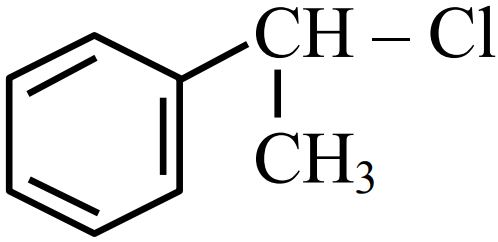
2. Benzylic chloride: In benzylic halides, the halogen atom is bonded to an \( sp^3 \) hybridized carbon atom attached next to an aromatic ring. Therefore, structure IV \( \text{C}_6\text{H}_5 - \text{CH(Cl)} - \text{CH}_3 \) represents a benzylic chloride derivative (B-IV).
3. Alkyl chloride: In alkyl halides, the halogen atom is bonded to a saturated alkyl chain. Isopropyl chloride \( \text{CH}_3 - \text{CH(Cl)} - \text{CH}_3 \) is a standard alkyl chloride (C-II).
4. Allyl chloride: In allylic halides, the halogen atom is bonded to an \( sp^3 \) hybridized carbon atom next to a carbon-carbon double bond. Therefore, Allyl chloride corresponds to \( \text{CH}_2 = \text{CH} - \text{CH}_2\text{Cl} \) (D-I).
Hence, the correct matching is A-III, B-IV, C-II, D-I, which corresponds to Option C. -
- (A) \((A)\) is true but \((R)\) is false
- (B) Both \((A)\) and \((R)\) are true but \((R)\) is not the correct explanation of \((A)\)
- (C) \((A)\) is false but \((R)\) is true
- (D) Both \((A)\) and \((R)\) are true and \((R)\) is the correctexplanation of \((A)\)
Show answer and solution
Correct Answer: (A)
\(\mathrm{CH}_2=\mathrm{CH}-\mathrm{CH}_2-\mathrm{Cl}\)
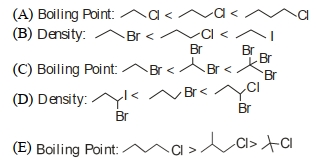
It is allyl carbon and \(\mathrm{sp}^3\) hybridized. - 3. Identify the correct order for the given property for following compounds.Choose the correct answer from the option given below :-
 2023 Medium
- (A) \((B), (C)\) and \((D)\) only
- (B) \((A), (C)\) and \((E)\) only
- (C) \((A), (C)\) and \((D)\) only
- (D) \((A), (B)\) and \((E)\) only
Show answer and solution
Correct Answer: (B)
Boiling point of alkyl halide increases with increase in size, mass of halogen atom and size of alkyl groupBoiling point of isomeric alkyl halide decreases with increase in branching
Density increases with increase in atomic mass of halogen atom
-
- (A) \(3\)
- (B) \(4\)
- (C) \(5\)
- (D) \(6\)
Show answer and solution
Correct Answer: (A)
Total numbers of isomer \(=03\)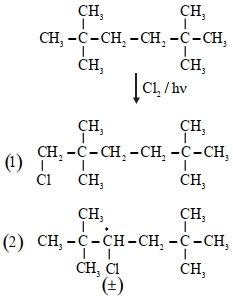
-
- (A) \(1\)
- (B) \(2\)
- (C) \(3\)
- (D) \(5\)
Show answer and solution
Correct Answer: (C)
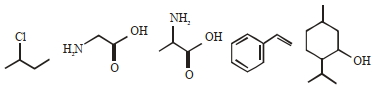
Number of compounds containing asymmetric carbons are three.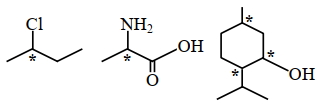
-
- (A) \(5,3\) and \(4\)
- (B) \(6,4\) and \(5\)
- (C) \(5,4\) and \(3\)
- (D) \(7,5\) and \(6\)
Show answer and solution
Correct Answer: (A)
Oxidation state of \(\mathrm{P}\) in \(\mathrm{H}_{4} \mathrm{P}_{2} \mathrm{O}_{7}, \mathrm{H}_{4} \mathrm{P}_{2} \mathrm{O}_{5}\) and \(\mathrm{H}_{4} \mathrm{P}_{2} \mathrm{O}_{6}\) is \(5,3 \& 4\) respectively\(\mathrm{H}_{4} \mathrm{P}_{2} \mathrm{O}_{7}\)
\(2 \mathrm{x}+4(+1)+7(-2)=0\)
\(\mathrm{x}=+5\)
\(\mathrm{H}_{4} \mathrm{P}_{2} \mathrm{O}_{5}\)
\(2 \mathrm{x}+4(+1)+5(-2)=0\)
\(\mathrm{x}=+3\)
\(\mathrm{H}_{4} \mathrm{P}_{2} \mathrm{O}_{6}\)
\(2 \mathrm{x}+4(+1)+6(-2)=0\)
\(\mathrm{x}=+4\)
-
- (A) Both \((A)\) and \((R)\) are correct statements but \((R)\) is not the correct explanation of \((A)\)
- (B) Both \((A)\) and \((R)\) are wrong statements
- (C) Both \((A)\) and \((R)\) are correct statements and \((R)\) is the correct explanation of \((A)\)
- (D) \((A)\) is a correct statement but \((R)\) is a wrong statement.
Show answer and solution
Correct Answer: (D)
Due to resonance there is partial double bond character between carbon and chlorine, hence it do not undergoes nucleophilic substitution reaction - 8. For the compounds \(CH_3Cl, CH_3Br, CH_3I\) and \(CH_3F\), the correct order of increasing \(C-\) halogen bond length is 2014 Medium
- (A) \(CH_3F < CH_3Cl < CH_3Br < CH_3I\)
- (B) \(CH_3F < CH_3Br < CH_3Cl < CH_3I\)
- (C) \(CH_3F < CH_3I < CH_3Br < CH_3Cl\)
- (D) \(CH_3Cl< CH_3Br < CH_3F < CH_3I\)
Show answer and solution
Correct Answer: (A)
The correct order of increasing bond length is\(CH_3F < CH_3Cl < CH_3Br < CH_3I\)
No questions on this page match these filters.
Other STD 12 - Haloalkanes and Haloarenes topics
Frequently asked
How many Introduction of Halogen containing compounds questions came in JEE Mains?
8 questions from 2014–2026, each with the correct answer and a full solution.
How difficult are Introduction of Halogen containing compounds questions?
0% are easy, 63% medium and 38% hard.