


Topics
6 topics- 97Qs Electrode potential, ECell, Nernst equation and ECS Most asked
- 13Qs Electrochemical cells
- 41Qs Conductor and Conductance and Cell constant
- 29Qs Faraday's law of electrolysis
- 3Qs Corrosion
- 2Qs Electrolytes and Electrolysis
All Electrochemistry questions
Newest firstShowing 1–50 of 185 questions
-
- (A) 70
- (B) 75
- (C) 78
- (D) 80
Show answer and solution
Correct Answer: (C)
We have considered
\(E _{\left[ Sn ( OH )_6\right]^{2-} / HSnO _2^{-}}^{ o }=-0.9 V\)
\(Pt \left| HSnO _2^{-}(aq ),\left[ Sn ( OH )_6\right]^{2-}( aq ), OH ^{-}( aq )\right| Bi _2 O _3(s) \\ | Bi ( s )|\)
\(\quad \quad\quad0.5 M \quad\quad\quad 0.05 M\)
\(E _{\text {cell }}^{\circ}=+0.9-0.44=0.46 V\)
Oxidation Half :
\(HSnO _2^{-}+ H _2 O +3 OH ^{-} \rightarrow\left[ Sn ( OH )_6\right]^{2-}+2 e ^{-}\)
Reduction Half :
\(\frac{ Bi _2 O _3+3 H _2 O +6 e ^{-} \rightarrow 2 Bi +6 OH ^{-}}{3 HSnO _2^{-}( aq )+ Bi _2 O _3(s)+6 H _2 O +3 OH ^{-}( aq )}\)
\(\rightarrow 3\left[ Sn ( OH )_6\right]^{-}( aq )+2 Bi ( s )\)
\(E _{\text {cell }}= E _{\text {cell }}^{ o }-\frac{0.059}{6} \log \frac{(0.5)^3}{(0.05)^3 \times\left[ OH ^{-}\right]^3}\)
\(0.2353=0.46-\frac{0.059}{6} \times 3 \log \left[\frac{10}{\left[ OH ^{-}\right]}\right]\)
\(\log \left[\frac{10}{ OH ^{-}}\right]=\frac{2 \times 0.2247}{0.059}=7.6\)
\(I + pOH =7.6\)
\(pOH =6.6\)
\(pH =14-6.6=7.4\)
\(pH = pK _{ a _1}+\log \frac{\left[ HCO _3^{-}\right]}{\left[ H _2 CO _3\right]}\)
\(7.4=6.11+\log \frac{5 x}{20}\)
\(1.29=\log \frac{x}{4}\)
\(\frac{x}{4}=19.5\)
\(x=78\) -
- (A) 0
- (B) 1
- (C) 2
- (D) 4
Show answer and solution
Correct Answer: (C)
Given standard reduction potentials:
\(E^{\ominus}_{M^{x+}/M} = +0.15\) V
\(E^{\ominus}_{Fe^{3+}/Fe} = -0.036\) V
Since \(E^{\ominus}_{M^{x+}/M} > E^{\ominus}_{Fe^{3+}/Fe}\), reduction occurs at the \(M^{x+}/M\) electrode (cathode) and oxidation occurs at the \(Fe^{3+}/Fe\) electrode (anode).
Cathode reaction: \((M^{x+} + x e^{-} \rightarrow M) \times 3\)
Anode reaction: \((Fe \rightarrow Fe^{3+} + 3 e^{-}) \times x\)
Overall balanced cell reaction:
\(3 M^{x+} + x Fe \rightarrow 3 M + x Fe^{3+}\)
The number of electrons transferred in the balanced reaction is \(n = 3x\).
Standard cell potential \(E^{\ominus}_{cell}\) is:
\(E^{\ominus}_{cell} = E^{\ominus}_{cathode} - E^{\ominus}_{anode}\)
\(E^{\ominus}_{cell} = 0.15 - (-0.036) = 0.186\) V
Using the Nernst equation:
\(E_{cell} = E^{\ominus}_{cell} - \dfrac{2.303RT}{nF} \log Q\)
Substitute the given values (\(E_{cell} = 0.2057\) V, \(Q = 10^{-2}\), and \(\dfrac{2.303RT}{F} = 0.059\) V):
\(0.2057 = 0.186 - \dfrac{0.059}{3x} \log(10^{-2})\)
\(0.2057 - 0.186 = -\dfrac{0.059}{3x} \times (-2)\)
\(0.0197 = \dfrac{0.118}{3x}\)
\(3x = \dfrac{0.118}{0.0197}\)
\(3x \approx 6\)
\(x = 2\)
Answer: \(2\) -
- (A) Overall reaction \(Fe(s) + 2OH^-(aq) + 2AgBr(s) \rightleftharpoons Fe(OH)_2(s) + 2Ag(s) + 2Br^-(aq)\)
- (B) \(E^\theta_{cell} = -0.95\) V
- (C) Fe is reduced in the electrochemical cell
- (D) \(E^\theta_{cell}\) is an extensive property
Show answer and solution
Correct Answer: (A)
For a spontaneous reaction, the cell potential \(E^{\theta}_{cell}\) must be positive. The half-cell with the higher standard reduction potential acts as the cathode (reduction), and the one with the lower standard reduction potential acts as the anode (oxidation).
Given standard reduction potentials:
\(E^{\theta}_{AgBr/Ag} = +0.07\) V
\(E^{\theta}_{Fe(OH)_2/Fe} = -0.88\) V
Since \(+0.07\) V \(> -0.88\) V, \(AgBr\) undergoes reduction at the cathode and \(Fe\) undergoes oxidation at the anode.
Cathode reaction: \(2AgBr(s) + 2e^{-} \rightarrow 2Ag(s) + 2Br^{-}(aq)\)
Anode reaction: \(Fe(s) + 2OH^{-}(aq) \rightarrow Fe(OH)_2(s) + 2e^{-}\)
Overall cell reaction:
\(Fe(s) + 2OH^{-}(aq) + 2AgBr(s) \rightleftharpoons Fe(OH)_2(s) + 2Ag(s) + 2Br^{-}(aq)\)
Standard cell potential:
\(E^{\theta}_{cell} = E^{\theta}_{cathode} - E^{\theta}_{anode} = 0.07 - (-0.88) = +0.95\) V
\(E^{\theta}_{cell}\) is an intensive property, and \(Fe\) is oxidized in the cell. Thus, only the overall reaction given in the first option is correct.
Answer: Overall reaction \(Fe(s) + 2OH^-(aq) + 2AgBr(s) \rightleftharpoons Fe(OH)_2(s) + 2Ag(s) + 2Br^-(aq)\) -
- (A) 10
- (B) 15
- (C) 20
- (D) 25
Show answer and solution
Correct Answer: (B)
The conductivity (specific conductance), \(\kappa\), is given by the product of conductance and cell constant:
\(\kappa = G \times G^*\)
\(\kappa = 1.9 \times 10^{-3} \text{ S} \times 1.3 \text{ cm}^{-1} = 2.47 \times 10^{-3} \text{ S cm}^{-1}\)
The molar conductivity, \(\Lambda_m\), is related to the conductivity and molarity \(C\) by the formula:
\(\Lambda_m = \dfrac{\kappa \times 1000}{C}\)
Substituting the given values:
\(123.5 = \dfrac{2.47 \times 10^{-3} \times 1000}{C}\)
\(123.5 = \dfrac{2.47}{C}\)
\(C = \dfrac{2.47}{123.5} = 0.02 \text{ mol L}^{-1}\)
Molarity \(C\) can also be expressed in terms of mass percentage \(x\) (w/w), density \(d\), and molar mass \(M\):
\(C = \dfrac{x \times d \times 10}{M}\)
Substituting the known values (\(d = 1.0 \text{ g mL}^{-1}\), \(M = 75 \text{ g mol}^{-1}\)):
\(0.02 = \dfrac{x \times 1.0 \times 10}{75}\)
\(1.5 = 10x\)
\(x = 0.15\)
Expressing \(x\) in the required format:
\(x = 15 \times 10^{-2}\)
The value is \(15\).
Answer: \(15\) -
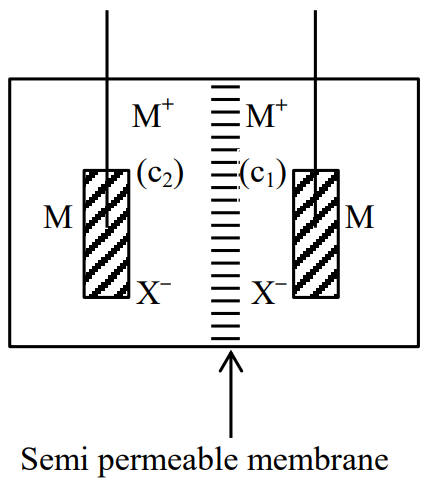
- (A) If \( c_{1} \) is present at anode, then \( c_{1} = c_{2} \)
- (B) If \( c_{1} \) is present at cathode, then \( c_{1} < c_{2} \)
- (C) If \( c_{1} \) is present at cathode, then \( c_{1} > c_{2} \)
- (D) If \( c_{1} \) is present at anode, then \( c_{1} > c_{2} \)
Show answer and solution
Correct Answer: (C)
(1) If \(C _1\) is at anode ⇒ cell reaction
\( M^{+}(C_{2}) \rightarrow M^{+}(C_{1}) \)
\( E_{cell} = -0.059 \log \frac{C_{1}}{C_{2}} \)
\(\therefore E_{cell} > 0 \Rightarrow C_{1} < C_{2} \)
(2) If \( C_{1} \) is at cathode
\( M^{+}(C_{1}) \rightarrow M^{+}(C_{2}) \)
\( E_{cell} = -0.059 \log \frac{C_{2}}{C_{1}} > 0 \)
\( C_{2} < C_{1} \) -
- (A) 2
- (B) 4
- (C) 6
- (D) 8
Show answer and solution
Correct Answer: (B)
For spontaneity \(E_{cell} > 0\).
At limiting condition:
\(E_{oxi}(anode) = -E_{red}(cathode)\)
\(H_{2}O \rightarrow 2H^{+} + \frac{1}{2}O_{2} + 2e^{-}\)
\(E = E ^{\circ}-\frac{0.059}{2} \log \left[\frac{\left[ H ^{+}\right]^2 \times P _{ O _2}^{1 / 2}}{1}\right]\)
\(-0.997 = -1.23 + 0.059 \times pH\)
\(pH = 3.94\)
\(pH \simeq 4\) -
- (A) \(\dfrac{10^6 x^2}{\alpha^2(x_1 + x_2 - 2x_3)^2}\)
- (B) \(\dfrac{x^2}{(x_1 + x_2 - 2x_3)^2}\)
- (C) \(\dfrac{\alpha^2(x_1 + x_2 - 2x_3)^2}{10^6 x^2}\)
- (D) \(\dfrac{x^2}{(x_1 + x_2 + 2x_3)^2}\)
Show answer and solution
Correct Answer: (A)
Using Kohlrausch's law of independent migration of ions, the limiting molar conductivity of \(\text{BaSO}_4\) is given by:
\(\Lambda^{\circ}_m(\text{BaSO}_4) = \Lambda^{\circ}_m(\text{BaCl}_2) + \Lambda^{\circ}_m(\text{H}_2\text{SO}_4) - 2\Lambda^{\circ}_m(\text{HCl})\)
Substituting the given values:
\(\Lambda^{\circ}_m(\text{BaSO}_4) = x_1 + x_2 - 2x_3\)
For a sparingly soluble salt, the solubility \(S\) (in mol L\(^{-1}\)) is related to its conductivity \(\kappa\) (in S cm\(^{-1}\)) and molar conductivity \(\Lambda_m\) (in S cm\(^2\) mol\(^{-1}\)) by the relation:
\(\Lambda_m = \dfrac{\kappa \times 1000}{S}\)
Given that \(\kappa = x\) and \(\Lambda_m = \Lambda^{\circ}_m\) (which implies complete dissociation, meaning the degree of dissociation \(\alpha = 1\)), we get:
\(S = \dfrac{1000 x}{x_1 + x_2 - 2x_3}\)
The solubility product \(K_{sp}\) for \(\text{BaSO}_4\) (which dissociates into \(\text{Ba}^{2+}\) and \(\text{SO}_4^{2-}\)) is:
\(K_{sp} = S^2 = \left( \dfrac{1000 x}{x_1 + x_2 - 2x_3} \right)^2 = \dfrac{10^6 x^2}{(x_1 + x_2 - 2x_3)^2}\)
Since \(\alpha = 1\), this expression is equivalent to \(\dfrac{10^6 x^2}{\alpha^2(x_1 + x_2 - 2x_3)^2}\).
Answer: \(\dfrac{10^6 x^2}{\alpha^2(x_1 + x_2 - 2x_3)^2}\) -
- (A) 2
- (B) 3
- (C) 4
- (D) 5
Show answer and solution
Correct Answer: (C)
\(E_{cell}^{\circ} = -0.44 - (-0.90)\)
\(= +0.46 V\)
Applying Nernst equation :-
\(E_{\text {cell }}=E_{\text {cell }}^{\circ}-\frac{0.06}{n} \log Q\)
\(E _{\text {cell }}=0.46-\frac{0.06}{6} \log 10^6\)
\(E _{\text {cell }}=4 \times 10^{-1}\)
\(x = 4\) -
- (A) 6
- (B) 12
- (C) 24
- (D) 8
Show answer and solution
Correct Answer: (C)
\( 3BH_{4}^{-}+4ClO_{3}^{-} \rightarrow 4Cl^{-}+3H_{2}BO_{3}^{-}+3H_{2}O \)
n -factor \(=8\)
moles \(=3\)
\(\therefore n =3 \times 8=24\) -
- (A) \(Al > Cr > Fe^{2+} > Co^{2+}\)
- (B) \(Al > Fe^{2+} > Cr > Co^{2+}\)
- (C) \(Al > Cr > Co^{2+} > Fe^{2+}\)
- (D) \(Cr > Fe^{2+} > Al > Co^{2+}\)
Show answer and solution
Correct Answer: (A)
Reducing power \(\propto \frac{1}{\text { Reduction potential }}\) -
- (A) -560
- (B) -565
- (C) -570
- (D) -575
Show answer and solution
Correct Answer: (A)
Explanation:
Let us compute the change in volume step-by-step based on the Electrochemistry and Chemical Thermodynamics principles in the NCERT Class 12 Chemistry textbook:
Step 1: Determine the standard cell potential (\(E^\circ_{cell}\))
Both given equations are written as reduction half-reactions. The half-reaction with the larger reduction potential occurs at the cathode, while the other is reversed to serve as the oxidation reaction at the anode:
- Cathode (Reduction): \(\frac{3}{2}O_2 + 6H^+ + 6e^- \rightarrow 3H_2O \quad E^\circ_{red} = 1.23\text{ V}\)
- Anode (Oxidation): \(CH_3OH + H_2O \rightarrow CO_2 + 6H^+ + 6e^- \quad E^\circ_{ox} = -0.02\text{ V}\)
- Net Cell Reaction: \(CH_3OH + \frac{3}{2}O_2 \rightarrow CO_2 + 2H_2O\)
The standard cell potential is calculated as:
\(E^\circ_{cell} = E^\circ_{cathode} - E^\circ_{anode} = 1.23\text{ V} - 0.02\text{ V} = 1.21\text{ V}\)
Step 2: Calculate the maximum electrical work (\(W_{max}\))
The number of moles of electrons transferred (\(n\)) per mole of \(CH_3OH\) reacted is 6. Using Faraday's constant (\(F = 96500\text{ C mol}^{-1}\)):
\(W_{max} = nFE^\circ_{cell} = 6 \times 96500 \times 1.21 = 700590\text{ J}\)
Step 3: Find the actual work derived (\(W_{actual}\))
Because the cell operates at 80% efficiency, the actual energy available to perform external work is:
\(W_{actual} = 0.80 \times 700590\text{ J} = 560472\text{ J}\)
Step 4: Calculate the volume change (\(\Delta V\)) during compression
The electrical energy delivered by the cell is utilized to perform work on the ideal gas during isothermal compression against a constant external pressure (\(P_{ext} = 1\text{ kPa} = 1000\text{ Pa}\)):
\(W = -P_{ext} \cdot \Delta V\)
Since work is done on the gas, \(W\) is positive:
\(560472 = -1000 \times \Delta V\)
\(\Delta V = -\frac{560472}{1000} = -560.472\text{ m}^3\)
Rounding to the nearest integer yields \(-560\text{ m}^3\).
Hence, Option A is the correct choice. -
- (A) 55
- (B) 222
- (C) 111
- (D) 148
Show answer and solution
Correct Answer: (C)
Eq of \( Cu = Eq \) of \( O_{2} \)
\(\frac{300 \times 10^{-3} \times 2}{63.54}= n _{ O _2} \times 4\)
\(2.36 \times 10^{-3}= n _{ O _2}\)
When current is further passed
\(n _{ O _2} \times 4=\frac{600 \times 28 \times 60}{96500 \times 1000}\)
\(n _{ O _2}=2.611 \times 10^{-3}\)
Total \( O_{2} \) released
\(=\left[10^{-3} \times(2.36+2.611)\right] \times 22400 ml\)
\(=111.35 ml\) -
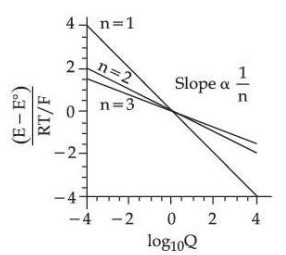
- (A) The overall reaction can be written as \(n_2\text{Red}_1 + n_1\text{Ox}_2 \rightleftharpoons n_2\text{Ox}_1^{n_1^+} + n_1\text{Red}_2^{n_2^-}\)
- (B) The electrons do not appear in the overall reaction because electrons produced at the anode are consumed at the cathode.
- (C) Here \(n\) is the number of electrons transferred in redox reaction.
- (D) If the reaction is carried out reversibly, the electrical work done is equal to the ratio of charge and potential difference through which charge is moved.
Show answer and solution
Correct Answer: (D)
For the given redox reaction, the half-cell reactions are:
Anode: \(\text{Red}_1 \rightarrow \text{Ox}_1^{n_1^+} + n_1 e^-\)
Cathode: \(\text{Ox}_2 + n_2 e^- \rightarrow \text{Red}_2^{n_2^-}\)
To obtain the overall balanced chemical equation, we multiply the anode reaction by \(n_2\) and the cathode reaction by \(n_1\) so that the number of electrons lost equals the number of electrons gained:
\(n_2\text{Red}_1 \rightarrow n_2\text{Ox}_1^{n_1^+} + n_1 n_2 e^-\)
\(n_1\text{Ox}_2 + n_1 n_2 e^- \rightarrow n_1\text{Red}_2^{n_2^-}\)
Adding these gives the overall reaction:
\(n_2\text{Red}_1 + n_1\text{Ox}_2 \rightleftharpoons n_2\text{Ox}_1^{n_1^+} + n_1\text{Red}_2^{n_2^-}\)
Thus, statement (A) is correct.
In the overall reaction, electrons do not appear because the electrons produced at the anode are exactly consumed at the cathode. Thus, statement (B) is correct.
From the Nernst equation:
\(E = E^\circ - \dfrac{RT}{nF} \ln Q = E^\circ - \dfrac{2.303 RT}{nF} \log_{10} Q\)
\(\dfrac{E - E^\circ}{RT/F} = -\dfrac{2.303}{n} \log_{10} Q\)
The graph of \(\dfrac{E - E^\circ}{RT/F}\) versus \(\log_{10} Q\) is a straight line with a slope of \(-\dfrac{2.303}{n}\), where \(n\) is the number of electrons transferred in the balanced redox reaction. Thus, statement (C) is correct.
The electrical work done by a galvanic cell is given by the product of the total charge transferred and the cell potential (potential difference), not their ratio.
\(W_{\text{electrical}} = \text{Charge} \times \text{Potential difference} = nF E_{\text{cell}}\)
Thus, statement (D) is incorrect.
Answer: If the reaction is carried out reversibly, the electrical work done is equal to the ratio of charge and potential difference through which charge is moved. -
- (A) 2
- (B) 4
- (C) 6
- (D) 8
Show answer and solution
Correct Answer: (B)
Using equation : \(\Lambda_{ m }=\Lambda^0{ }_{ m }- A \sqrt{ c }\)
\(96.1=\Lambda_{ m }^0- A \sqrt{0.04}\)
\(96.1=\Lambda_{ m }^0- A \times 0.2 \quad\ldots(1)\)
\(95.7=\Lambda_{ m }^0- A \times \sqrt{0.09}\)
\(95.7=\Lambda_m^0- A \times 0.3 \quad\ldots(2)\)
From eq. (1) and eq. (2)
\(A =4\) -
- (A) \(2X-3Y\)
- (B) \(3Y-2X\)
- (C) \(3Y+2X\)
- (D) \(Y+X\)
Show answer and solution
Correct Answer: (B)
The half-reactions and their standard Gibbs free energy changes are given by:
\(Fe^{2+} + 2e^{-} \rightarrow Fe\)
\(\Delta G^{\ominus}_{1} = -2FX\)
\(Fe^{3+} + 3e^{-} \rightarrow Fe\)
\(\Delta G^{\ominus}_{2} = -3FY\)
The required half-reaction is:
\(Fe^{3+} + e^{-} \rightarrow Fe^{2+}\)
\(\Delta G^{\ominus}_{3} = -1FE^{\ominus}_{Fe^{3+}/Fe^{2+}}\)
This reaction is obtained by subtracting the first reaction from the second reaction:
\(\Delta G^{\ominus}_{3} = \Delta G^{\ominus}_{2} - \Delta G^{\ominus}_{1}\)
\(-FE^{\ominus}_{Fe^{3+}/Fe^{2+}} = -3FY - (-2FX)\)
\(-FE^{\ominus}_{Fe^{3+}/Fe^{2+}} = -3FY + 2FX\)
\(E^{\ominus}_{Fe^{3+}/Fe^{2+}} = 3Y - 2X\)
Answer: \(3Y-2X\) -
- (A) A and B only
- (B) A and E only
- (C) B only
- (D) C, D and E only
Show answer and solution
Correct Answer: (D)
\(Cl_{aq}^{-}+Ag_{(S)}+Fe_{aq}^{+3}\rightarrow Fe_{aq}^{+2}+AgCl_{(S)}\)
\(E_{cell}=E_{cell}^{o}-\frac{0.059}{1}log\frac{[Fe^{2+}]}{[Cl^{-}][Fe^{3+}]}\) -
- (A) 2
- (B) 1
- (C) 3
- (D) 4
Show answer and solution
Correct Answer: (A)
\(K _{ a }( HQ )= C _1 \alpha_1^2 \quad\alpha_1=\frac{\lambda_{ m }( HQ )}{\lambda_{ m }^{\infty}( HQ )}\)
\(K _{ a }( HZ )= C _2 \alpha_2^2 \quad \alpha_2=\frac{\lambda_{ m }( HZ )}{\lambda_{ m }^{\infty}( HZ )}\)
\(\frac{ K _{ a }( HQ )}{ K _{ a }( HZ )}=\frac{ C _1}{ C _2} \cdot\left(\frac{\alpha_1}{\alpha_2}\right)^2=\frac{0.18}{0.02} \cdot\left[\frac{\lambda_{ m }( HQ )}{\lambda_{ m }( HZ )}\right]^2\)
\(\frac{K_a( HQ )}{K_a( HQ )}=9 \times\left(\frac{1}{30}\right)^2=\frac{1}{100}\)
\(pK _3( HQ )- pK _3( HZ )=2\) -
- (A) 200
- (B) 790
- (C) 590
- (D) 1380
Show answer and solution
Correct Answer: (A)
\(E _{ X ^{-} / MX ( s ) / M }^{ o }= E _{ M ^{+} / M }^{ o }+\frac{0.0591}{ n } \log K _{ sp }\)
\(=0.79+\frac{0.059}{1} \log 10^{-10}\)
\(=0.79-0.59\)
\(=0.20 V=200 mV\) -
- (A) \(\dfrac{2}{3.9}\)
- (B) \(\dfrac{4}{5.9}\)
- (C) \(\dfrac{2.9}{2}\)
- (D) \(\dfrac{5.9}{4}\)
Show answer and solution
Correct Answer: (B)
The cell reaction is \(Zn(s) + 2Ag^+(aq) \rightarrow Zn^{2+}(aq) + 2Ag(s)\)
The standard cell potential is given by:
\(E^\circ_{cell} = E^\circ_{cathode} - E^\circ_{anode} = 0.80 - (-0.76) = 1.56\text{ V}\)
Using the Nernst equation:
\(E_{cell} = E^\circ_{cell} - \dfrac{0.059}{n} \log \dfrac{[Zn^{2+}]}{[Ag^+]^2}\)
Substituting the given values (\(n = 2\), \([Zn^{2+}] = 1\text{ M}\), \(E_{cell} = 1.60\text{ V}\)):
\(1.60 = 1.56 - \dfrac{0.059}{2} \log \dfrac{1}{x^2}\)
\(0.04 = - \dfrac{0.059}{2} (-2 \log x)\)
\(0.04 = 0.059 \log x\)
\(\log x = \dfrac{0.04}{0.059} = \dfrac{4}{5.9}\)
Answer: \(\dfrac{4}{5.9}\) -
- (A) 2
- (B) 4
- (C) 6
- (D) 8
Show answer and solution
Correct Answer: (C)
\(pH =5\)
\(\left[ H ^{+}\right]=10^{-5}=[ HX ] \cdot \alpha\)
\(=[ HX ] \cdot \frac{\Lambda_{ m }}{\Lambda_{ m }^{\infty}}\)
\(\Lambda_{ m }=\frac{ k \times 1000}{[ HX ]}\)
\(K = G . G ^*=4 \times 10^{-5} \times \frac{15}{1}=6 \times 10^{-4} S . cm ^{-1}\)
\(\left[ H ^{+}\right]=10^{-5}=[ HX ] \times \frac{6 \times 10^{-4} \times 1000}{\Lambda_{ m }^{\infty} \times[ HX ]}\)
\(\Lambda_{ m }^{\infty}=60000 S.cm^2 mol^{-1}\)
\(\Lambda_{ m }^{\infty}=6 S . m^2 mol^{-1}\) -
- (A) 20
- (B) 23
- (C) 26
- (D) 29
Show answer and solution
Correct Answer: (B)
Given : Concentration of \(\mathrm{NaOH}=0.2 \%(\mathrm{w} / \mathrm{v})\)
\(\therefore 0.2 \mathrm{~g}\) of NaOH in 100 ml of solution.
Molarity of NaOH solution
\(\begin{array}{r}
=\frac{\text { moles of solute }}{\mathrm{V}_{\mathrm{ml}}} \times 1000 \\
=\frac{0.2 / 40}{100} \times 1000==\frac{0.2}{40 \times 100} \times 1000=\frac{2}{40} \mathrm{M}
\end{array}\)
Given resistivity of solution \(=870 \mathrm{~m}\) ohm m \(=870 \times 10^{-3} \mathrm{ohm} \mathrm{m}\)
\(=870 \times 10^{-3} \times 10 \mathrm{ohm} \mathrm{dm}\)
\(=870 \times 10^{-2}\) ohm dm
\(=8.7\) ohm dm
Now conductivity
\(\mathrm{K}=\frac{1}{\rho}=\frac{1}{8.7} \mathrm{ohm}^{-1} \mathrm{dm}^{-1}\)
Now molar conductivity of solution is
\(\begin{aligned}
& \lambda_{\mathrm{m}}=\frac{\mathrm{K}}{\mathrm{M}}=\frac{\frac{1}{8.7}}{\frac{2}{40}}=\frac{40}{2 \times 8.7}=2.29 \mathrm{~S} \mathrm{dm}^2 \mathrm{~mol}^{-1} \\
& 2.29 \times 10^3 \mathrm{~m} \mathrm{~S} \mathrm{dm}^2 \mathrm{~mol}^{-1} \\
& =22.9 \times 10^2 \mathrm{~m} \mathrm{~S} \mathrm{dm}^2 \mathrm{~mol}^{-1} \\
& =23 \times 10^2 \mathrm{~m} \mathrm{~S} \mathrm{dm}^2 \mathrm{~mol}^{-1}
\end{aligned}\) -
- (A) 100
- (B) 200
- (C) 300
- (D) 400
Show answer and solution
Correct Answer: (D)
\(\mathrm{Cu}^{+2}+2 \mathrm{e}^{-} \longrightarrow \mathrm{Cu}\)
\(\begin{aligned}& (1 \text { faraday }=\text { charge on } 1 \text { mole electron }) \\& \mathrm{t}=0 \quad 1.5 \quad 1 \mathrm{~mole} \\& \mathrm{t}=\mathrm{t} \quad 1 \quad-\quad 0.5 \text { mole }\end{aligned}\)
\(\left[\mathrm{Cu}^{+2}\right]=1 \mathrm{M}\) after electrolysis
* \(\mathrm{Ag} \oplus+\mathrm{e}^{-} \quad \longrightarrow \mathrm{Ag}\)
\(\begin{array}{lll}\mathrm{t}=0 & 0.2 & 0.1 \text { mole } \\ \mathrm{t}=\mathrm{t} & 0.1 & - \qquad -\end{array}\)
\(\left[\mathrm{Ag}^{+}\right]=0.1 \mathrm{M}\) after electrolysis
Cell \(\quad \mathrm{Cu}_{(\mathrm{s})}+2 \mathrm{Ag}_{(\mathrm{aq})}^{+} \rightarrow \mathrm{Cu}_{(\mathrm{aq})}^{+2}+2 \mathrm{Ag}_{(\mathrm{s})}\)
reaction
\(\begin{aligned} & \mathrm{E}=\mathrm{E}^{\circ}-\frac{0.06}{\mathrm{n}} \log \frac{\left[\mathrm{Cu}^{+2}\right]}{\left[\mathrm{Ag}^{+}\right]^2} \\ & \mathrm{E}=(0.8-0.34)-\frac{0.06}{2} \log \frac{1}{(0.1)^2}=0.4 \mathrm{~V}\end{aligned}\)
Correct answer \(=400 \mathrm{mV}\) -
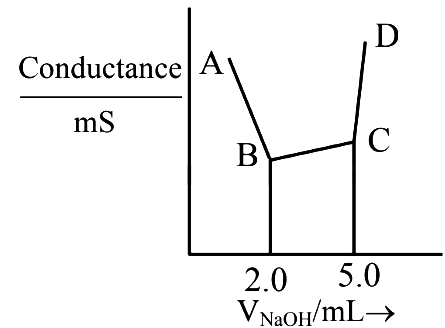
- (A) The concentration of \(\mathrm{CH}_3 \mathrm{COOH}\) in the original mixture is 0.005 M
- (B) The concentration of HCl in the original mixture is 0.005 M
- (C) \(\mathrm{CH}_3 \mathrm{COOH}\) is neutralised first followed by neutralisation of HCl
- (D) Point ' C ' indicates the complete neutralisation HCl
Show answer and solution
Correct Answer: (B)
From the given graph 2 ml NaOH solution is used for neutralisation of HCl and 3 ml NaOH solution is used for neutralisation of \(\mathrm{CH}_3 \mathrm{COOH}\).
\(\therefore\) Mole of \(\mathrm{HCl}=\) Mole of NaOH used
\(\begin{aligned}
& \mathrm{M} \times 40=0.1 \times 2 \\
& \mathrm{M}=0.005
\end{aligned}\)
\(\therefore\) Mole of \(\mathrm{CH}_3 \mathrm{COOH}=\) Mole of NaOaH used
\(\begin{aligned}
& \mathrm{M} \times 40=0.1 \times 3 \\
& \mathrm{M}=0.0075
\end{aligned}\)
HCl is strong acid and will be neutralised first. -
- (A) 1.660 g
- (B) 0.336 g
- (C) 0.441 g
- (D) 1.007 g
Show answer and solution
Correct Answer: (B)
\(\mathrm{Al}^{1++}+3 \mathrm{e}^{-} \longrightarrow \mathrm{Al}\)
\(\begin{aligned}
\text { Moles of electron } & =\frac{2 \times 30 \times 60}{96500} \\
& =\frac{36}{965}
\end{aligned}\)
\(\begin{aligned}
\text { Moles of } \mathrm{Al} & =\frac{36}{3 \times 965} \\
& =\frac{12}{965}
\end{aligned}\)
\(\text { Mass of } \mathrm{Al}=\frac{12}{965} \times 27\)
\(=0.336 \mathrm{gm}\) -
- (A) Cr
- (B) \(\mathrm{Cl}^{-}\)
- (C) \(\mathrm{MnO}_4^{-}\)
- (D) \(\mathrm{Mn}^{2+}\)
Show answer and solution
Correct Answer: (A)
\(\begin{aligned}
& \mathrm{E}_{\mathrm{Cr}_2 \mathrm{Of}_4^{\circ} / \mathrm{ca}^8}^0=1.33 \mathrm{~V}_{\mathrm{C}_2 / \mathrm{Cr}}^{\circ}=1.36 \mathrm{~V} \\
& \mathrm{E}_{\mathrm{MnO}_4 / \mathrm{Mm}^2}^{\circ}=1.51 \mathrm{~V} \mathrm{E}_{\mathrm{Cr}^2 / \mathrm{Cr}}^0=-0.74 \mathrm{~V}
\end{aligned}\)
The species which has the most negative value of standard reduction potential will be the strongest reducing agent. Since \(\mathrm{Cr}^{3+} / \mathrm{Cr}\) has SRP value of \(-0.74 \mathrm{~V}, \mathrm{Cr}\) is the strongest reducing agent. -
- (A) 2
- (B) 4
- (C) 6
- (D) 8
Show answer and solution
Correct Answer: (C)
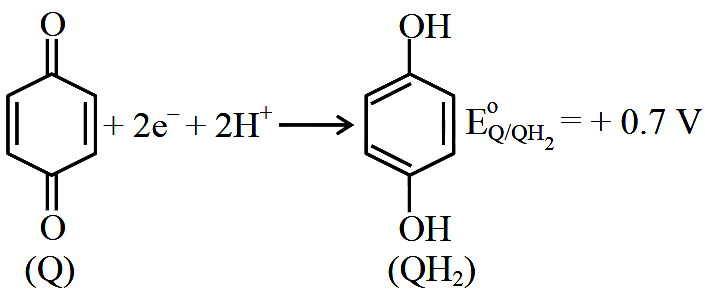
\(\begin{aligned}
& \mathrm{QH}_2+2 \mathrm{Ag}^{+} \rightarrow 2 \mathrm{Ag}+\mathrm{Q}+2 \mathrm{H}^{+} \\
& \mathrm{E}=\mathrm{E}^{\circ}-\frac{0.06}{2} \log \left[\mathrm{H}^{+}\right]^2 \\
& \mathrm{E}=\mathrm{E}^{\circ}-0.06 \times \log \left[\mathrm{H}^{+}\right] \\
& \mathrm{pH}=-\log \left(\mathrm{H}^{+}\right)=\frac{\mathrm{E}-\mathrm{E}^{\mathrm{o}}}{0.06}=\frac{0.4-0.1}{0.06} \\
& =\frac{0.3}{0.06}=5
\end{aligned}\)
\(\begin{aligned} & \mathrm{pH}+\mathrm{NH}_4 \mathrm{X}=7-\frac{1}{2} \mathrm{pK}_{\mathrm{b}}-\frac{1}{2} \log \mathrm{C} \\ & 5=7-\frac{1}{2} \times \mathrm{pK}_{\mathrm{b}}-\frac{1}{2} \log \left(10^{-2}\right) \\ & \mathrm{pK}_{\mathrm{b}}=6\end{aligned}\) -
- (A) 10
- (B) 20
- (C) 30
- (D) 40
Show answer and solution
Correct Answer: (A)
\(\begin{aligned} & \mathrm{Cr}_2 \mathrm{O}_{7 \text { (aq) }}^{-2}+14 \mathrm{H}_{(\mathrm{aq})}^{+}+6 \mathrm{e}^{-} \rightarrow 2 \mathrm{Cr}_{(\mathrm{aq})}^{+3}+7 \mathrm{H}_2 \mathrm{O}_{(\ell)} \\ & \mathrm{E}_{\mathrm{R}}=\mathrm{E}_{\mathrm{R}}^0-\frac{0.059}{6} \log \frac{\left[\mathrm{Cr}^{+3}\right]^2}{\left[\mathrm{Cr}_2 \mathrm{O}_7^{-2}\right]\left[\mathrm{H}^{+}\right]^{14}} \\ & 0=1.33-\frac{0.059}{6} \log \frac{10^{-6}}{\left[\mathrm{H}^{+}\right]^{14}} \\ & \frac{1.33 \times 6}{0.059}=\log \frac{10^{-6}}{[\mathrm{H}]^{14}} \\ & 135.254=-6-14 \log \left[\mathrm{H}^{+}\right] \\ & 141.254=14 \mathrm{pH} \\ & \mathrm{pH}=\frac{141.254}{14}=10.08\end{aligned}\) -
- (A) \(\mathrm{H}^{+} \gt \mathrm{Na}^{+} \gt \mathrm{K}^{+} \gt \mathrm{Ca}^{2+} \gt \mathrm{Mg}^{2+}\)
- (B) \(\mathrm{H}^{+} \gt \mathrm{Ca}^{2+} \gt \mathrm{Mg}^{2+} \gt \mathrm{K}^{+} \gt \mathrm{Na}^{+}\)
- (C) \(\mathrm{Mg}^{2+} \gt \mathrm{H}^{+} \gt \mathrm{Ca}^{2+} \gt \mathrm{K}^{+} \gt \mathrm{Na}^{+}\)
- (D) \(\mathrm{H}^{+} \gt \mathrm{Na}^{+} \gt \mathrm{Ca}^{2+} \gt \mathrm{Mg}^{2+} \gt \mathrm{K}^{+}\)
Show answer and solution
Correct Answer: (B)
Limiting Molar Conductivities of Ions:
- \(\stackrel{\oplus}{\mathrm{H}}: 349.8 \mathrm{Scm}^2 \mathrm{~mol}^{-1}\)
- \(\mathrm{Na}^{+}: 50.11 \mathrm{Scm}^2 \mathrm{~mol}^{-1}\)
- \(\mathrm{K}^{+}: 73.52 \mathrm{Scm}^2 \mathrm{~mol}^{-1}\)
- \(\mathrm{Ca}^{+2}: 119 \mathrm{Scm}^2 \mathrm{~mol}^{-1}\)
- \(\mathrm{Mg}^{+2}: 106.12 \mathrm{Scm}^2 \mathrm{~mol}^{-1}\)
Therefore correct order of limiting molar conductivity of cations will be -
\(\stackrel{\oplus}{\mathrm{H}} \gt \mathrm{Ca}^{+2} \gt \mathrm{Mg}^{+2} \gt \mathrm{K}^{+} \gt \mathrm{Na}^{+}\) -
- (A) 2
- (B) 4
- (C) 6
- (D) 8
Show answer and solution
Correct Answer: (A)
Electrolysis of NaCl is
\(\mathrm{NaCl}+\mathrm{H}_2 \mathrm{O}(\mathrm{aq}) \rightarrow \mathrm{NaOH}(\mathrm{aq})+\frac{1}{2} \mathrm{Cl}_2(\mathrm{~g})+\frac{1}{2} \mathrm{H}_2(\mathrm{~g})\)
Since during electrolysis pH changes to 12
So \(\left[\mathrm{OH}^{\ominus}\right]=10^{-2}\) and \(\left[\mathrm{H}^{+}\right]=10^{-12}\)
So by Faraday law
Gram amount of substance deposited \(=\) Amount of electricity passed
\(\begin{aligned} & 10^{-2} \times \frac{600}{1000} \times 96500=\mathrm{I} \times \mathrm{t} \\ & \frac{10^{-2} \times 600}{1000} \times 96500=\mathrm{I} \times 5 \times 60 \\ & \mathrm{I}=\frac{10^{-2} \times 600 \times 96500}{1000 \times 5 \times 60} \\ & \mathrm{I}=1.93 \text { ampere } \\ & \text { So }, I=2 \text { ampere (nearest integer) }\end{aligned}\) -
- (A) 2.1 V
- (B) 1 .7 V
- (C) 1 .4 V
- (D) 1 .2 V
Show answer and solution
Correct Answer: (B)
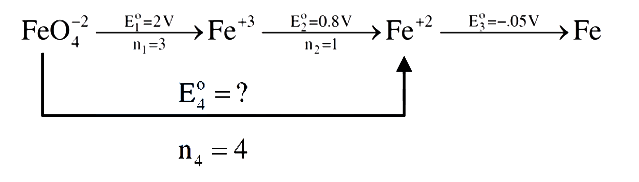
\(\begin{aligned} & \Delta \mathrm{G}_4^{\mathrm{o}}=\Delta \mathrm{G}_1^{\mathrm{o}}+\Delta \mathrm{G}_2^{\mathrm{o}} \\ \Rightarrow & -\mathrm{n}_4 \mathrm{FE}_4^{\mathrm{o}}=-\mathrm{n}_1 \mathrm{FE}_1^0-\mathrm{n}_2 \mathrm{FE}_2^{\mathrm{o}} \\ \Rightarrow & +4 \mathrm{E}_4^{\mathrm{o}}=3 \times 2+(1 \times 0.8) \\ \Rightarrow & \mathrm{E}_4^{\mathrm{o}}=\frac{6.8}{4} \mathrm{~V} \\ \Rightarrow & \mathrm{E}_4^{\mathrm{o}}=1.7 \mathrm{~V}\end{aligned}\) -
- (A) \(\mathrm{E}_{\text {cell }}=\mathrm{E}_{\text {cell }}^{\mathrm{o}}-\frac{\mathrm{RT}}{2 \mathrm{~F}} \ln \frac{\left[\mathrm{Ag}^{+}\right]}{\left[\mathrm{Mg}^{2+}\right]}\)
- (B) \(\mathrm{E}_{\text {cell }}=\mathrm{E}_{\text {cell }}^{\mathrm{o}}+\frac{\mathrm{RT}}{2 \mathrm{~F}} \ln \frac{\left[\mathrm{Ag}^{+}\right]^2}{\left[\mathrm{Mg}^{2+}\right]}\)
- (C) \(\mathrm{E}_{\text {cell }}=\mathrm{E}_{\text {cell }}^{\mathrm{o}}-\frac{\mathrm{RT}}{2 \mathrm{~F}} \ln \frac{\left[\mathrm{Ag}^{+}\right]^2}{\left[\mathrm{Mg}^{2+}\right]}\)
- (D) \(\mathrm{E}_{\text {cell }}=\mathrm{E}_{\text {cell }}^{\mathrm{o}}-\frac{\mathrm{RT}}{2 \mathrm{~F}} \ln \frac{\left[\mathrm{Mg}^{2+}\right]}{\left[\mathrm{Ag}^{+}\right]}\)
Show answer and solution
Correct Answer: (B)
\(\begin{array}{lll}\text { Cathode } & \left(\mathrm{Ag}+(\mathrm{aq})+\mathrm{e}^{-}\right. & \rightarrow \mathrm{Ag}) \times 2 \\ \text { Anode } & \mathrm{Mg} & \rightarrow \mathrm{Mg}^{2+}(\mathrm{aq})+2 \mathrm{e}^{-}\end{array}\)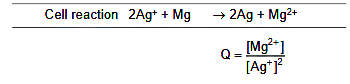
By Nernst equation
\(\begin{aligned}
& \mathrm{E}_{\text {cell }}=\mathrm{E}_{\mathrm{cell}}^{\circ}-\frac{\mathrm{RT}}{\mathrm{nF}} \ln \mathrm{Q} \\
& \mathrm{E}_{\text {cell }}=\mathrm{E}_{\mathrm{cell}}^{\circ}-\frac{\mathrm{RT}}{\mathrm{nF}} \ln \frac{\left[\mathrm{Mg}^{2+}\right]}{\left[\mathrm{Ag}^{+}\right]^2} \\
& =\mathrm{E}_{\text {cell }}^{\circ}+\frac{\mathrm{RT}}{2 \mathrm{~F}} \ln \frac{\left[\mathrm{Ag}^{+}\right]^2}{\left[\mathrm{Mg}^{2+}\right]}
\end{aligned}\) -
- (A) \(x+y-z\)
- (B) \(x+2 y\)
- (C) \(x+2 y-3 z\)
- (D) \(y-2 x\)
Show answer and solution
Correct Answer: (C)
\(\mathrm{Fe}^{2+}(\mathrm{aq})+\mathrm{Ag}^{+}(\mathrm{aq}) \rightarrow \mathrm{Fe}^{3+}(\mathrm{aq})+\mathrm{Ag}(\mathrm{s})\)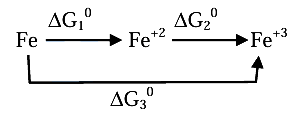
\(\begin{aligned}
& \Delta \mathrm{G}_3^0=\Delta \mathrm{G}_1^0+\Delta \mathrm{G}_2^0 \\
& -3 \mathrm{~F}(-\mathrm{z})=-2 \mathrm{~F}(-\mathrm{y})+\Delta \mathrm{G}_2{ }^0 \\
& \Delta \mathrm{G}_2^0=3 \mathrm{Fz}-2 \mathrm{Fy}
\end{aligned}\)
Also \(\Delta \mathrm{G}_2^0=-\mathrm{nFE}_{\mathrm{Fe}^{+2} / \mathrm{Fe}^{t^{43}}}^0\)
\(\begin{aligned}
& 3 \mathrm{Fz}-2 \mathrm{Fy}=-1 \mathrm{~F}\left(\mathrm{E}_{\mathrm{Fe}^{t^2} / \mathrm{Fe}^{43}}^0\right) \\
& \mathrm{E}_{\mathrm{Fe}^{2+2} / \mathrm{Fe}^{t^3}}^0=2 \mathrm{y}-3 \mathrm{z}
\end{aligned}\)
\(\mathrm{E}_{\text {Cell }}^0\) for reaction will be
\(\begin{aligned}
& \mathrm{E}_{\mathrm{Ag}^{+} / \mathrm{Ag}}^0+\mathrm{E}_{\mathrm{Fe}^{t^2 / \mathrm{Fe}}}^{03} \\
& =\mathrm{x}+2 \mathrm{y}-3 \mathrm{z}
\end{aligned}\) -
- (A) Both statement I and statement II are incorrect
- (B) Statement I is correct but statement II is incorrect
- (C) Both statement I and statement II are correct
- (D) Statement I is incorrect but statement II is correct
Show answer and solution
Correct Answer: (B)
Statement-II \(\Rightarrow\) At cathode, instead of \(\mathrm{Mg}, \mathrm{H}_2 \mathrm{O}_{(\ell)}\) will reduce & evolve \(\mathrm{H}_2\) gas. -
- (A) Both Statement I and Statement II are true
- (B) Statement I is false but Statement II is true
- (C) Statement I is true but Statement II is false
- (D) Both Statement I and Statement II are false
Show answer and solution
Correct Answer: (C)
Statement I :
Corrosion is an example of electrochemical phenomenon
In which pure metal act as anode and impure metal (rusted metal) act as cathode.
Statement II :
Corrosion is more favourable in acid medium than alkaline so rate of corrosion is high is acid medium then alkaline. -
- (A) 100
- (B) 150
- (C) 200
- (D) 250
Show answer and solution
Correct Answer: (B)
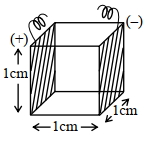
\(\begin{aligned} & \mathrm{R}=\rho \frac{\ell}{\mathrm{A}} \\ & \kappa=\mathrm{G} \cdot \mathrm{G}^* \quad \mathrm{G}=\frac{1}{\mathrm{R}} ; \kappa=\frac{1}{\rho}\end{aligned}\)
\(\begin{aligned} \mathrm{G}^*= & \frac{\ell}{\mathrm{A}} \\ \mathrm{R} & =\text { Resistance } \\ \rho & =\text { Resistivity } \\ \frac{\ell}{\mathrm{A}} & =\text { cell constant }\left(\mathrm{G}^*\right)\end{aligned}\)
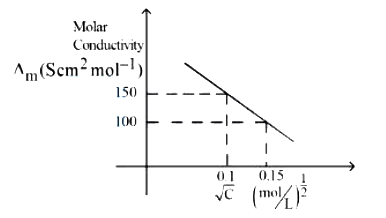
\(\begin{aligned} & \frac{\kappa_{\mathrm{c}}}{\kappa_{\mathrm{d}}}=\frac{\mathrm{R}_{\mathrm{d}}}{\mathrm{R}_{\mathrm{c}}} ; \lambda_{\mathrm{m}}=\frac{\kappa \times 1000}{\mathrm{C}} \\ & \frac{\kappa_{\mathrm{c}}}{\kappa_{\mathrm{d}}}=\frac{\left(\lambda_{\mathrm{m}} \cdot \mathrm{C}\right)}{\left(\lambda_{\mathrm{m}} \cdot C\right)_{\mathrm{d}}}=\frac{\mathrm{R}_{\mathrm{d}}}{R_{\mathrm{c}}} \quad \\ & \mathrm{c}=\text { concentrated sol. } \quad \mathrm{d} \text { = diluted solution } \\ & \frac{100 \cdot(0.15)^2}{150 .(0.1)^2}=\frac{R_{\mathrm{d}}}{100} \\ & \mathrm{R}_{\mathrm{d}}=150 \Omega\end{aligned}\) -
- (A) (A)-(III), (B)-(II), (C)-(IV), (D)-(I)
- (B) (A)-(II), (B)-(III), (C)-(IV), (D)-(I)
- (C) (A)-(III), (B)-(I), (C)-(IV), (D)-(II)
- (D) (A)-(IV), (B)-(III), (C)-(II), (D)-(I)
Show answer and solution
Correct Answer: (C)
In transistor, anode is Zn and cathode is carbon.
In hearing, aids mercury battery are used.
In invertors, lead storage battery is used.
In apollo space ship, hydrogen fuel cell was used. -
- (A) (A) and (C) only
- (B) (B) and (C) only
- (C) (A) and (D) only
- (D) (B) and (D) only
Show answer and solution
Correct Answer: (B)
When an aqueous solution of \(\mathrm{AgNO}_3\) is electrolysed using Pt electrodes
Cathode: \(\mathrm{Ag}^{+}(\mathrm{aq})+\mathrm{e}^{-} \rightarrow \mathrm{Ag}(\mathrm{s})\)
Anode : \(2 \mathrm{H}_2 \mathrm{O}(\mathrm{l}) \rightleftharpoons 4 \mathrm{H}^{+}(\mathrm{aq})+\mathrm{O}_2(\mathrm{~g})+4 \mathrm{e}^{-}\)
\(\Rightarrow\) When dilute \(\mathrm{H}_2 \mathrm{SO}_4\) is electrolysed using Pt electrodes
\(\Rightarrow\) When dilute \(\mathrm{H}_2 \mathrm{SO}_4\) is electrolysed using Pt electrodes
Anode : \(2 \mathrm{H}_2 \mathrm{O}(\mathrm{l}) \rightarrow \mathrm{O}_2(\mathrm{~g})+4 \mathrm{H}^{+}(\mathrm{aq})+4 \mathrm{e}^{-}\)
Cathode: \(2 \mathrm{H}^{+}(\mathrm{aq})+2 \mathrm{e}^{-} \rightarrow \mathrm{H}_2(\mathrm{~g})\) -
- (A) \(\mathrm{Zn}\left|\mathrm{Zn}^{2+}(1 \mathrm{M})\right|\left|\mathrm{Ag}^{+}(1 \mathrm{M})\right| \mathrm{Ag}\)
- (B) \(\mathrm{Zn}\left|\mathrm{Zn}^{2+}(1 \mathrm{M})\right|\left|\mathrm{Mg}^{2+}(1 \mathrm{M})\right| \mathrm{Mg}\)
- (C) \(\mathrm{Ag}\left|\mathrm{Ag}^{+}(1 \mathrm{M})\right|\left|\mathrm{Mg}^{2+}(1 \mathrm{M})\right| \mathrm{Mg}\)
- (D) \(\mathrm{Cu}\left|\mathrm{Cu}^{2+}(1 \mathrm{M}) \| \mathrm{Ag}^{+}(1 \mathrm{M})\right| \mathrm{Ag}\)
Show answer and solution
Correct Answer: (A)
\(\begin{gathered}\because \Delta \mathrm{G}^{\circ}=-\mathrm{nFE}^{\circ} \\ \text { Option }(1) \mathrm{E}^{\circ}=0.8+0.76 \\ =1.56 \mathrm{~V} \\ \therefore \Delta \mathrm{G}^{\circ}=-2 \times \mathrm{F} \times 1.56 \\ =-3.12 \mathrm{~V} \\ \text { Option (2) } \mathrm{E}^{\circ}=-2.37+0.76 \\ =-1.61 \mathrm{~V} \\ \therefore \Delta \mathrm{G}^{\circ}=-2 \times \mathrm{F} \times(-1.61) \\ =+3.22 \mathrm{~V} \\ \text { Option (3) } \mathrm{E}^{\circ}=-2.37-0.8 \\ =-3.17 \mathrm{~V} \\ \left.\begin{array}{c}\Delta \mathrm{G}^{\circ}=-2\end{array}\right) \times \mathrm{F} \times(-3.17) \\ =+6.34 \\ \text { Option }(4) \mathrm{E}^{\circ}=0.8-0.34 \\ =0.46 \mathrm{~V} \\ \Delta \mathrm{G}^{\circ}=-2 \times \mathrm{F} \times 0.46 \\ =-0.92 \mathrm{~V}\end{gathered}\) -
- (A) 3
- (B) 6
- (C) 9
- (D) 12
Show answer and solution
Correct Answer: (A)
\(\begin{aligned} & \lambda_{\mathrm{m}}^{\circ} \text { of } \mathrm{NH}_4 \mathrm{Cl}=185 \\ & \left(\lambda_{\mathrm{m}}^{\circ}\right)_{\mathrm{NH}_4^{+}}+\left(\lambda_{\mathrm{m}}^{\circ}\right)_{\mathrm{Cl}^{-}}=185 \\ & \left(\lambda_{\mathrm{m}}^{\circ}\right)_{\mathrm{NH}_4^{+}}=185-70=115 \mathrm{Scm}^2 \mathrm{~mol}^{-1} \\ & \left(\lambda_{\mathrm{m}}^{\circ}\right)_{\mathrm{NH}_4 \mathrm{OH}}=\left(\lambda_{\mathrm{m}}^{\circ}\right)_{\mathrm{NH}_4^{+}}+\left(\lambda_{\mathrm{m}}^{\circ}\right)_{\mathrm{OH}^{-}} \\ & =115+170 \\ & \left(\lambda_{\mathrm{m}}^{\circ}\right)_{\mathrm{NH}_4 \mathrm{OH}}=285 \mathrm{Scm}^2 \mathrm{~mol}^{-1}\end{aligned}\)
\(\begin{aligned} \text { degree of dissociation } & =\frac{\left(\lambda_{\mathrm{m}}\right)_{\mathrm{NH}_4 \mathrm{OH}}}{\left(\lambda_{\mathrm{m}}^{\circ}\right)_{\mathrm{NH}_4 \mathrm{OH}}} \\ & =\frac{85.5}{285} \\ & =0.3 \\ & =3 \times 10^{-1}\end{aligned}\) -
- (A) A small decrease in molar conductivity is observed at infinite dilution.
- (B) Molar conductivity decreases sharply with increase in concentration.
- (C) A small increase in molar conductivity is observed at infinite dilution.
- (D) Molar conductivity increases sharply with increase in concentration.
Show answer and solution
Correct Answer: (B)
For weak electrolyte, variation of \(\wedge_m\) with \(\sqrt{\mathrm{c}}\) is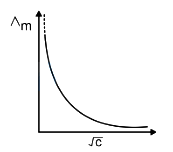
-
- (A) The standard half cell reduction potential for the reduction of \(\mathrm{CO}_2\left(\mathrm{E}_{\mathrm{CO}_2 / \mathrm{CH}_3 \mathrm{OH}}^0\right)\) is 19 mV
- (B) Oxygen is formed at the anode.
- (C) Reactants are fed at one go to each electrode.
- (D) Reduction of methanol takes place at the cathode.
Show answer and solution
Correct Answer: (A)
\(\begin{aligned}
\because \mathrm{E}_{\text {cell }}^{\mathrm{o}} & =\mathrm{E}_{\text {cathode }}^{\mathrm{o}}-\mathrm{E}_{\text {Anode }}^{\mathrm{o}} \\
1.21 & =1.229-\mathrm{E}_{\text {Anode }}^{\mathrm{o}}
\end{aligned}\)
\(\because\) Fuel cell involves oxidation of methanol which will occur at anode and reduction of \(\mathrm{O}_2\) will occur at cathode. - 42. The standard reduction potential values of some of the p-block ions are given below. Predict the one with the strongest oxidising capacity. 2025 Medium
- (A) \(\mathrm{E}_{\mathrm{Pb}^{4+} / \mathrm{Pb}^{2+}}^{\ominus}=+1.67 \mathrm{~V}\)
- (B) \(\mathrm{E}_{\mathrm{Sn}^{4+} / \mathrm{Sn}^{2+}}^{\ominus}=+1.15 \mathrm{~V}\)
- (C) \(\mathrm{E}_{\mathrm{Al}^{3+} / \mathrm{Al}}^{\ominus}=-1.66 \mathrm{~V}\)
- (D) \(\mathrm{E}_{\mathrm{Tl}^{3+}\mathrm{/Tl}}^{\ominus}=1.26 \mathrm{~V}\)
Show answer and solution
Correct Answer: (A)
The element having strongest oxidising capacity will have highest value of standard reduction potential. -
- (A) Dilute solution of sodium sulphate.
- (B) Acidified dilute solution of sodium sulphate.
- (C) Dilute solution of sulphuric acid
- (D) Concentrated solution of sulphuric acid
Show answer and solution
Correct Answer: (D)
Theory based.
At anode :
\(2 \mathrm{HSO}_4^{-} \rightarrow \mathrm{H}_2 \mathrm{~S}_2 \mathrm{O}_8+2 \mathrm{e}^{-}\) -
- (A) \(7\)
- (B) \(9\)
- (C) \(10\)
- (D) \(11\)
Show answer and solution
Correct Answer: (D)
Volume of silver coating =\(0.05 \times 0.05 \times 10000\)\(=25 \mathrm{~cm}^3\)
Mass of silver deposited=\(25 \times 7.9 \mathrm{~g}\)
Moles of silver atoms =\(\frac{25 \times 7.9}{108}\)
Number of silver atoms =\(\frac{25 \times 7.9}{108} \times 6.023 \times 10^{23}\)
\(=11.01 \times 10^{23}\)
Ans. \(11\)
-
- (A) increasing concentration of \(\mathrm{T1}^{+}\)ions
- (B) increasing concentration of both \(\mathrm{T1}^{+}\)and \(\mathrm{Cu}^{2+}\) ions
- (C) decreasing concentration of both \(\mathrm{T1}^{+}\)and \(\mathrm{Cu}^{2+}\) ions
- (D) increasing concentration of \(\mathrm{Cu}^{2+}\) ions
Show answer and solution
Correct Answer: (D)
\(\mathrm{E}_{\text {cell }}\) increases by increasing concentration of \(\left[\mathrm{Cu}^{+2}\right]\) ions.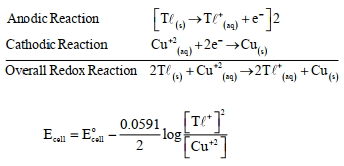
-
- (A) increase sharply
- (B) remain same or can not be measured accurately
- (C) decrease sharply
- (D) depend upon type of electrolyte
Show answer and solution
Correct Answer: (B)
Solution is already infinitely dilute, hence no change in molar conductivity upon addition of water -
- (A) \(2\)
- (B) \(3\)
- (C) \(4\)
- (D) \(5\)
Show answer and solution
Correct Answer: (A)
\(\frac{\mathrm{W}}{\mathrm{E}}=\frac{\text { ch arge }}{1 \mathrm{~F}} \)\(\frac{1.314}{\frac{197}{3}}=\frac{\mathrm{Q}}{1 \mathrm{~F}}\)
\(\mathrm{Q}=2 \times 10^{-2} \mathrm{~F}\)
-
- (A) \(339\)
- (B) \(350\)
- (C) \(390\)
- (D) \(340\)
Show answer and solution
Correct Answer: (A)
Cell \(\mathrm{Rx}^{\mathrm{n}} ; \mathrm{MnO}_4^{-}+\mathrm{H}_2 \mathrm{C}_2 \mathrm{O}_4 \rightarrow \mathrm{Mn}^{2+}+\mathrm{CO}_2\)\(\mathrm{E}_{\text {coll }}^{\mathrm{c}}=\mathrm{E}_{\mathrm{op}}^{\circ} \text { of anode }+\mathrm{E}_{\mathrm{RP}}^{\circ} \text { of cathode }\)
\(=0.49+1.51=2.00 \mathrm{~V}\)
At equilibrium
\(\mathrm{E}_{\text {cell }}=0,\)
\(\mathrm{E}_{\text {cell }}^{\circ}=\frac{0.059}{\mathrm{n}} \log \mathrm{K}\)
\(\text { (As per NCERT } \frac{\mathrm{RT}}{\mathrm{F}}=0.059 \text { But } \frac{\mathrm{RT}}{\mathrm{F}}=0.0591\)can also be taken.)
\(2=\frac{0.059}{10} \log \mathrm{K}\)
\(\log \mathrm{K}=338.98\)
- 49. find out the quantity of silver deposited when one coulomb charge is passed through \(\mathrm{AgNO}_3\) solution. 2024 Medium
- (A) \(0.1 \mathrm{~g}\) atom of silver
- (B) \(1\) chemical equivalent of silver
- (C) \(1 \mathrm{~g}\) of silver
- (D) \(1\) electrochemical equivalent of silver
Show answer and solution
Correct Answer: (D)
\(\mathrm{W}=\mathrm{ZIt}\)\(\mathrm{W}=\mathrm{ZQ}\)
\(\mathrm{Q}=\frac{\mathrm{W}}{\mathrm{Z}}\)
\(\mathrm{W}=\mathrm{ZQ}=\text { (electrochemical equivalent) }\)
-
- (A) \(\mathrm{S} \mathrm{cm}^2 \mathrm{~mol}^{-3 / 2} \mathrm{~L}^{1 / 2}\)
- (B) \(\mathrm{S} \mathrm{cm}^2 \mathrm{~mol}^{-1} \mathrm{~L}^{1 / 2}\)
- (C) \(\mathrm{S} \mathrm{cm}^2 \mathrm{~mol}^{-3 / 2} \mathrm{~L}\)
- (D) \(\mathrm{S} \mathrm{cm}^2 \mathrm{~mol}^{-3 / 2} \mathrm{~L}^{-1 / 2}\)
Show answer and solution
Correct Answer: (A)
\(\Lambda_{\mathrm{m}}=\Lambda_{\mathrm{m}}^{\circ}-\mathrm{A} \sqrt{\mathrm{C}}\)Units of \(\mathrm{A} \sqrt{\mathrm{C}}=\mathrm{S} \mathrm{cm}^2 \mathrm{~mole}^{-1}\)
Uits of \(\mathrm{A}=\mathrm{S} \mathrm{cm}^2 \mathrm{~mole}^{-3 / 2} \mathrm{~L}^{1 / 2}\)

No questions on this page match these filters.
About Electrochemistry PYQs
Electrochemistry has 185 questions from 2013–2026. The most came in 2024 (31), 2025 (23) and 2026 (20).
The most asked topics are Electrode potential, ECell, Nernst equation and ECS, Conductor and Conductance and Cell constant and Faraday's law of electrolysis.
10% are easy, 41% medium and 50% hard.
Electrochemistry PYQs by year
Frequently asked
How many Electrochemistry questions came in JEE Mains?
185 questions from 2013–2026, each with the correct answer and a full solution.
Which Electrochemistry topic is asked the most?
Electrode potential, ECell, Nernst equation and ECS, with 97 questions, followed by Conductor and Conductance and Cell constant with 41.
Which year had the most Electrochemistry questions?
2024, with 31 questions.
How difficult are Electrochemistry questions?
10% are easy, 41% medium and 50% hard.