


Questions
Newest firstShowing 1–10 of 10 questions
-
- (A) Both Statement I and Statement II are true
- (B) Both Statement I and Statement II are false
- (C) Statement I is true but Statement II is false
- (D) Statement I is false but Statement II is true
Show answer and solution
Correct Answer: (C)
Statement I:
When \(3\)-phenylpropene reacts with \(HBr\), protonation of the alkene occurs to form a secondary carbocation.
\(C_6H_5-CH_2-CH=CH_2 + H^+ \rightarrow C_6H_5-CH_2-CH^+-CH_3\)
This secondary carbocation undergoes a \(1,2\)-hydride shift to form a more stable, resonance-stabilized benzylic carbocation.
\(C_6H_5-CH_2-CH^+-CH_3 \rightarrow C_6H_5-CH^+-CH_2-CH_3\)
The bromide ion then attacks this benzylic carbocation to form the major product, \(1\)-bromo-\(1\)-phenylpropane.
\(C_6H_5-CH^+-CH_2-CH_3 + Br^- \rightarrow C_6H_5-CH(Br)-CH_2-CH_3\)
The carbon atom bonded to the bromine is attached to four different groups: a phenyl group (\(-C_6H_5\)), an ethyl group (\(-CH_2CH_3\)), a hydrogen atom (\(-H\)), and a bromine atom (\(-Br\)). Thus, it is a chiral carbon. The product is a secondary alkyl bromide. Therefore, Statement I is true.
Statement II:
The Sandmeyer reaction involves treating a diazonium salt with \(Cu(I)\) salts (\(CuCl\), \(CuBr\), \(CuCN\)) to prepare aryl chlorides, aryl bromides, and aryl cyanides, respectively.
The Gattermann reaction involves treating a diazonium salt with copper powder (\(Cu\)) and halogen acids (\(HCl\), \(HBr\)) to prepare aryl chlorides and aryl bromides. Aryl cyanides are not prepared using the Gattermann reaction. Therefore, Statement II is false.
Conclusion: Statement I is true but Statement II is false.
Answer: Statement I is true but Statement II is false -
- (A) A-I, B-IV, C-III, D-II
- (B) A-III, B-I, C-IV, D-II
- (C) A-IV, B-II, C-I, D-III
- (D) A-I, B-III, C-II, D-IV
Show answer and solution
Correct Answer: (B)
Finkelstein reaction involves the conversion of alkyl chlorides or bromides to alkyl iodides using \(NaI\) in dry acetone. Thus, A matches with III.
Swarts reaction is used for the synthesis of alkyl fluorides by heating an alkyl chloride or bromide in the presence of a metallic fluoride such as \(SbF_3\), \(AgF\), \(Hg_2F_2\), or \(CoF_2\). Thus, B matches with I.
Sandmeyer's reaction involves the conversion of aryl diazonium salts to aryl halides using cuprous halides like \(Cu_2Cl_2\) or \(Cu_2Br_2\). Thus, C matches with IV.
Fittig reaction involves the coupling of two aryl halide molecules in the presence of sodium (\(Na\)) and dry ether to form a diaryl compound. Thus, D matches with II.
The correct matching is A-III, B-I, C-IV, D-II.
Answer: A-III, B-I, C-IV, D-II -
- (A) 20
- (B) 30
- (C) 40
- (D) 50
Show answer and solution
Correct Answer: (B)
The reaction of Grignard reagent with water yields an alkane:
\(RMgI + H_2O \rightarrow RH + Mg(OH)I\)
Given that \(1 \text{ g}\) of the gas \(RH\) occupies \(1.4 \text{ dm}^3\) at STP, we can find its molar mass. Using the standard molar volume at STP (\(22.4 \text{ dm}^3\)):
\(\text{Molar mass of } RH = \dfrac{22.4 \text{ dm}^3 \text{ mol}^{-1}}{1.4 \text{ dm}^3 \text{ g}^{-1}} = 16 \text{ g mol}^{-1}\)
The alkane with a molar mass of \(16 \text{ g mol}^{-1}\) is methane (\(CH_4\)).
Methane reacts with iodine in the presence of an oxidizing agent like \(HIO_3\) (which prevents the backward reaction by consuming the formed \(HI\)) to give methyl iodide:
\(CH_4 + I_2 \xrightarrow{HIO_3} CH_3I + HI\)
Thus, compound (X) is methyl iodide (\(CH_3I\)).
Compound (X) undergoes the Wurtz reaction when treated with sodium and dry ether to form a higher alkane:
\(2CH_3I + 2Na \xrightarrow{\text{dry ether}} CH_3-CH_3 + 2NaI\)
Compound (Y) is ethane (\(C_2H_6\)).
The molar mass of ethane (\(C_2H_6\)) is:
\(2 \times 12 + 6 \times 1 = 30 \text{ g mol}^{-1}\)
Answer: \(30\) -
- (A) A-II, B-I, C-III, D-IV
- (B) A-II, B-III, C-I, D-IV
- (C) A-IV, B-I, C-III, D-II
- (D) A-IV, B-III, C-I, D-II
Show answer and solution
Correct Answer: (D)
LIST-I
Name reactionLIST-II
Product obtainable(A) Swarts reaction (I) \(Et-I \xrightarrow{KF/DF} Et-F\) (B) Sandmeyer's reaction (II) \(\mathrm{PhN}_2^{\oplus} \mathrm{Cl}^{-} \xrightarrow[\mathrm{CuCN} / \mathrm{KCN}]{\mathrm{PhCN}+\mathrm{N}_2}\) (C) Wurtz Fittig reaction (III) \(Ph-Cl + EtCl \xrightarrow{Na/ether} Ph-Et + Ph-Ph + Et-Et\) (D) Finkelstein reaction (IV) \(Et-Cl \xrightarrow[acetone]{NaI} Et-I + NaCl\)
Explanation:
Let us evaluate each named organic reaction to determine its correct product:
1. Swarts reaction (A): This reaction involves the synthesis of alkyl fluorides by heating alkyl chlorides or bromides in the presence of metallic fluorides such as \( \text{AgF} \). For example, heating ethyl chloride with \( \text{AgF} \) gives Ethyl fluoride (IV).
2. Sandmeyer's reaction (B): This reaction is used to synthesize aryl nitriles or aryl halides from diazonium salts. Treating a benzene diazonium salt with \( \text{CuCN} \) yields Cyanobenzene (III).
3. Wurtz Fittig reaction (C): This reaction involves the coupling of an aryl halide and an alkyl halide when treated with sodium metal in the presence of dry ether to form an alkylbenzene. Reacting chlorobenzene and ethyl chloride with sodium yields Ethyl benzene (I).
4. Finkelstein reaction (D): This is a halogen exchange reaction where alkyl iodides are prepared by reacting alkyl chlorides or bromides with \( \text{NaI} \) in the presence of dry acetone. This gives Ethyl iodide (II).
Matching these correctly gives: A-IV, B-III, C-I, D-II.
Hence, Option D is the correct choice. -
- (A) \(6\)
- (B) \(5\)
- (C) \(4\)
- (D) \(7\)
Show answer and solution
Correct Answer: (A)
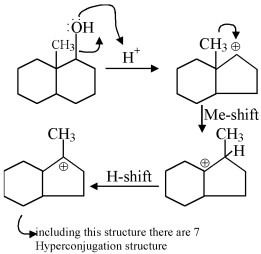
Let's analyze the step-by-step carbocation rearrangement mechanism for the given reaction:
1. Initial Carbocation Formation: Protonation of the alcohol (\( -\text{OH} \)) group followed by the loss of a water molecule (\( \text{H}_2\text{O} \)) forms a secondary (\( 2^\circ \)) carbocation on the 5-membered ring.
2. 1,2-Methyl Shift: To increase stability, the methyl group (\( -\text{CH}_3 \)) on the bridgehead carbon undergoes a 1,2-shift to the adjacent positive carbon. This creates a highly stable tertiary (\( 3^\circ \)) carbocation at the bridgehead position.
Counting Alpha-Hydrogens (\( \alpha \)-H):
For this stable tertiary carbocation, the adjacent (\( \alpha \)) positions relative to the positive charge are:
- The neighboring \( \text{-CH}_2- \) group in the 5-membered ring: contains 2 \( \alpha \)-hydrogens.
- The neighboring \( \text{-CH}_2- \) group in the 6-membered ring: contains 2 \( \alpha \)-hydrogens.
- The adjacent bridgehead \( \text{-CH}- \) carbon: contains 1 \( \alpha \)-hydrogen.
Total number of \( \alpha \)-hydrogens = \( 2 + 2 + 1 = 5 \).
Total Hyperconjugation Structures:
The total number of hyperconjugation structures is given by the formula:
Total structures = \( \text{Number of } \alpha\text{-hydrogens} + 1 \) (including the parent contributing structure).
Total structures = \( 5 + 1 = 6 \).
Therefore, Option A is the correct answer. -
- (A) Carbocation \(B\) is more stable and formed relatively at faster rate
- (B) Carbocation \(A\) is more stable and formed relatively at slow rate
- (C) Carbocation \(B\) is more stable and formed relatively at slow rate
- (D) Carbocation \(A\) is more stable and formed relatively at faster rate
Show answer and solution
Correct Answer: (A)
This is more stable due to secondary cation formation and formed with faster rate due to low activation energy.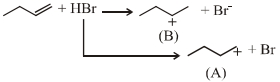
-
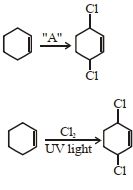
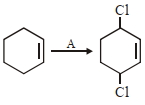
- (A) \(A = HCl ;\) Anhydrous \(AlCl _{3}\)
- (B) \(A = HCl , ZnCl _{2}\)
- (C) \(A = Cl _{2} ; UV\) light
- (D) \(A = Cl _{2}\); dark, Anhydrous \(AlCl _{3}\)
Show answer and solution
Correct Answer: (C)
For substitution at allylic position in the given compound, the reagent used is \(Cl _{2} / uv\) light.The reaction is free radical halogenation.
-
- (A) \(\mathrm{HOCl}\)
- (B) Liquid \(NH_{3}\)
- (C) dilute \(HNO_{2}\)
- (D) Concentrated \(\mathrm{HIO}_{3}\)
Show answer and solution
Correct Answer: (D)
lodination of alkane is reversible reaction.It can be irreversible in the presence of strong oxidising agent like conc. \(\mathrm{HNO}_{3}\) or conc. \(\mathrm{HIO}_{3}\)
-
- (A) \(CH _{3} CH _{2} CH _{2} C ( Br )\left( CH _{3}\right)_{2}\)
- (B) \(Br \left( CH _{2}\right)_{3} CH \left( CH _{3}\right)_{2}\)
- (C) \(CH _{3} CH _{2} CH ( Br ) CH \left( CH _{3}\right)_{2}\)
- (D) \(CH _{3} CH ( Br ) CH _{2} CH \left( CH _{3}\right)_{2}\)
Show answer and solution
Correct Answer: (A)
\(CH _{3} CH = CHCH \\left( CH _{3}\\right)_{2} + H^{+} \longrightarrow CH _{3} CH _{2} \stackrel{+}{C} H CH \\left( CH _{3}\\right)_{2}\)
\(CH _{3} CH _{2} \stackrel{+}{C} H CH \\left( CH _{3}\\right)_{2} \stackrel{1,2-H\, shift}{\longrightarrow} CH _{3} CH _{2} CH _{2} \stackrel{+}{C} \\left( CH _{3}\\right)_{2}\)
\(CH _{3} CH _{2} CH _{2} \stackrel{+}{C} \\left( CH _{3}\\right)_{2} + Br^{-} \longrightarrow CH _{3} CH _{2} CH _{2} C ( Br )\\left( CH _{3}\\right)_{2}\)
-
- (A) Finkelstein reaction
- (B) Swarts reaction
- (C) Free radical fluorination
- (D) Sandmeyer's reaction
Show answer and solution
Correct Answer: (B)
Alkyl fluorides can be prepared by action of mercurous fluoride or antimony trifluorides (inorganic fluorides) on corresponding alkyl halide. This reaction is known as Swarts reaction.\(C H_{3} B r+A g F \rightarrow \underset{\text { Methyl fluoride}}{C H_3F}+A g B r\)
But, when aciton of Nallacetone takes place on alkyl chloride of bromide alkyl lodide forms. This reaction is called Finkelstein reaction
\(C_{2} H_{2} C I \stackrel{N a t}{\longrightarrow} C_{2} H_{5} I+N a C I\)
Free redical fluorination is highly explosive reaction, so not preferred for the preparation of fluoride.
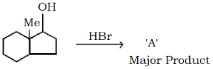
No questions on this page match these filters.
Other STD 12 - Haloalkanes and Haloarenes topics
Frequently asked
How many Preparation of Haloalkanes questions came in JEE Mains?
10 questions from 2015–2026, each with the correct answer and a full solution.
How difficult are Preparation of Haloalkanes questions?
30% are easy, 40% medium and 30% hard.