


Questions
Newest firstShowing 1–27 of 27 questions
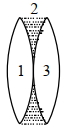
- 1. A biconvex lens is formed by using two thin planoconvex lenses, as shown in the figure. The refractive index and radius of curved surfaces are also mentioned in figure. When an object is placed on the left side of lens at a distance of 30 cm from the biconvex lens, the magnification of the image will be :
 2026 Easy
- 2. A collimated beam of light of diameter 2 mm is propagating along x -axis. The beam is required to be expanded in a collimated beam of diameter 14 mm using a system of two convex lenses. If first lens has focal length 40 mm , then the focal length of second lens is _________ mm. 2026 Medium
- 3. A thin convex lens and a thin concave lens are kept in contact and are co-axial. Which of the following statements is correct for this combination of two lenses ? 2026 Medium
- 4. A thin convex lens of focal length 5 cm and a thin concave lens of focal length 4 cm are combined together (without any gap) and this combination has magnification \( m_{1} \), when an object is placed 10 cm before the convex lens. Keeping the positions of convex lens and object undisturbed a gap of 1 cm is introduced between the lenses by moving the concave lens away, which lead to a change in magnification of total lens system to \( m_{2} \).
The value of \(\left|\frac{m_1}{m_2}\right|\) is __________ . 2026 Medium - 5. An object \(AB\) is placed \(15\text{ cm}\) on the left of a convex lens \(P\) of focal length \(10\text{ cm}\). Another convex lens \(Q\) is now placed \(15\text{ cm}\) right of lens \(P\). If the focal length of lens \(Q\) is \(15\text{ cm}\), the final image is _______. 2026 Medium
- 6. A concave-convex lens of refractive index 1.5 and the radii of curvature of its surfaces are 30 cm and 20 cm , respectively. The concave surface is upwards and is filled with a liquid of refractive index 1.3. The focal length of the liquid-glass combination will be _______. 2025 Hard
- 7. A convex lens of focal length 30 cm is placed in contact with a concave lens of focal length 20 cm. An object is placed at 20 cm to the left of this lens system. The distance of the image from the lens in cm is ________ 2025 Easy
- 8. A plano-convex lens having radius of curvature of first surface 2 cm exhibits focal length of \(f_1\) in air. Another plano-convex lens with first surface radius of curvature 3 cm has focal length of \(\mathrm{f}_2\) when it is immersed in a liquid of refractive index 1.2 . If both the lenses are made of same glass of refractive index 1.5 , the ratio of \(f_1\) and \(f_2\) will be _______. 2025 Hard
- 9. In the diagram given below, there are three lenses formed. Considering negligible thickness of each of them as compared to \(\left|R_1\right|\) and \(\left|R_2\right|\), i.e., the radii of curvature for upper and lower surfaces of the glass lens, the power of the combination is :
 2025 Hard
- 10. Two identical symmetric double convex lenses of focal length \(f\) are cut into two equal parts \(L_1, L_2\) by \(A B\) plane and \(L_3, L_4\) by \(X Y\) plane as shown in figure respectively. The ratio of focal lengths of lenses \(L_1\) and \(L_3\) is ________.
 2025 Medium
- 11. Two thin convex lenses of focal length 30 cm and 10 cm are placed coaxially, 10 cm apart. The power of this combination is : 2025 Medium
- 12. An effective power of a combination of \(5\) identical convex lenses which are kept in contact along the principal axis is \(25 \mathrm{D}\). Focal length of each of the convex lens is _______. 2024 Hard
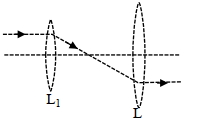
- 13. move in opposite direction with speed ratio \(1: 2\). The following figure represents two biconvex lenses \(L_1\) and \(L_2\) having focal length \(10 \mathrm{~cm}\) and \(15 \mathrm{~cm}\) respectively. The distance between \(\mathrm{L}_1 \& \mathrm{~L}_2\) is _______.
 2024 Hard
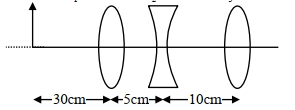
- 14. The position of the image formed by the combination of lenses is _______. \(\mathrm{f}_1=10 \mathrm{~cm} \quad \mathrm{f}_2=10 \quad \mathrm{f}_3=30 \mathrm{~cm}\)
 2024 Hard
- 15. A bi convex lens of focal length \(10\,cm\) is cut in two identical parts along a plane perpendicular to the principal axis. The power of each lens after cut is \(...........\,D\). 2023 Medium
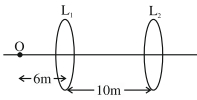
- 16. A point object, \(O\) is placed in front of two thin symmetrical coaxial convex lenses \(L _1\) and \(L _2\) with focal length \(24\,cm\) and \(9\,cm\) respectively. The distance between two lenses is \(10\,cm\) and the object is placed \(6\,cm\) away from lens \(L _1\) as shown in the figure. The distance between the object and the image formed by the system of two lenses is .........\(cm\)
 2023 Hard
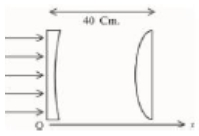
- 17. As shown in the figure, a combination of a thin plano concave lens and a thin plano convex lens is used to image an object placed at infinity. The radius of curvature of both the lenses is \(30\,cm\) and refraction index of the material for both the lenses is \(1.75\). Both the lenses are placed at distance of \(40\,cm\) from each other. Due to the combination, the image of the object is formed at distance \(x =..........cm\), from concave lens.
 2023 Hard
- 18. Two convex lenses of focal length \(20\,cm\) each are placed coaxially with a separation of \(60\,cm\) between them. The image of the distant object formed by the combination is at \(...........\,cm\) from the first lens. 2023 Medium
- 19. Two identical thin biconvex lenses of focal length \(15\, cm\) and refractive index \(1.5\) are in contact with each other. The space between the lenses is filled with a liquid of refractive index \(1.25\). The focal length of the combination is \(cm\).
 2022 Hard
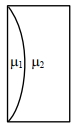
- 20. Curved surfaces of a plano-convex lens of refractive index \(\mu_{1}\) and a plano-concave lens of refractive index \(\mu_{2}\) have equal radius of curvature as shown in figure. Find the ratio of radius of curvature to the focal length of the combined lenses.
 2021 Hard
- 21. Find the distance of the image from object \(O\), formed by the combination of lenses in the figure : (in \(cm\))
 2021 Hard
- 22. A plano-convex lens (focal length \(f_2,\) refractive index \(\mu _2,\) radius of curvature \(R\) ) fits exactly into a plano-concave lens (focal length \(f_1,\) refractive index \(\mu _1,\) radius of curvature \(R\) ). Their plane surfaces are parallel to each other. Then, the focal length of the combination will be 2019 Medium
- 23. A plano convex lens of refractive index \({\mu _1}\) and focal length \(f_1\) is kept in contact with another plano concave lens of refractive index \({\mu _2}\) and focal length \(f_2\). If the radius of curvature of their spherical faces is \(R\) each and \(f_1 = 2f_2\), then \({\mu _1}\) and \({\mu _2}\) are related as 2019 Hard
- 24. One plano-convex and one plano-concave lens of same radius of curvature \(‘R’\) but of different materials are joined side by side as shown in the figure. If the refractive index of the material of \(1\) is \(\mu_1\) and that of \(2\) is \(\mu _2\), then the focal length of the combination is
 2019 Hard
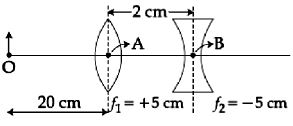
- 25. What is the position and nature of image formed by lens combination shown in figure? (\(f_1, f_2\) are focal lengths)
 2019 Hard
- 26. A convergent doublet of separated lenses, corrected for spherical aberration, has resultant focal length of \(10\,cm\). The separation between the two lenses is \(2\,cm\). The focal lengths of the component lenses 2018 Hard
- 27. A diverging lens with magnitude of focal length \(25\ cm\) is placed at a distance of \(15\ cm\) from a converging lens of magnitude of focal length \(20\ cm\). A beam of parallel light falls on the diverging lens. The final image formed is 2017 Medium
No questions on this page match these filters.
Other STD 12 - Ray optics and optical instruments topics
- 33Qs Refraction Through Prism
- 10Qs Refraction Through Single Curved Surface
- 44Qs Refraction by Lenses
- 28Qs Spherical Mirror
- 18Qs Combination of Lens and Mirror and Silvering of Lens
- 2Qs Combination of Mirrors and Cutting of Mirror
- 15Qs Refraction through Plane Surface and Glass Slab
- 20Qs Critical Angle and Total Internal Reflection
- 10Qs Microscope
- 19Qs Refraction of Light
- 2Qs Angle of Deviation and Rotation of Plane Mirror
- 7Qs Plane Mirror
- 8Qs Telescope
- 2Qs Human Eye and Defects of Vision
- 1Qs Aberrations in Optical Elements
- 1Qs Some Natural Phenomenon of Sunlight
- 1Qs Scattering of light
Frequently asked
How many Combination of Lenses questions came in JEE Mains?
27 questions from 2017–2026, each with the correct answer and a full solution.
How difficult are Combination of Lenses questions?
7% are easy, 37% medium and 56% hard.