


Questions
Newest firstShowing 1–50 of 85 questions
-
- (A) 3
- (B) 1
- (C) 6
- (D) 10
Show answer and solution
Correct Answer: (A)
\(\begin{array}{lc}{\left[ Cr \left( H _2 O \right)_5 Cl \right] Cl _2 \cdot H _2 O + AgNO _3} & \rightarrow 2 AgCl \\ 2.75 / 266.5 & - \\ =0.0103 \text { moles } & 0.02063 \text { mole }\end{array}\)
Mass of \(AgCl =0.02063 \times 143.5=2.96 gm\) -
- (A) \(2, 2, 2\) and \((A)>(C)>(B)\)
- (B) \(0, 2, 0\) and \((A)>(C)>(B)\)
- (C) \(2, 2, 0\) and \((B)>(C)>(A)\)
- (D) \(2, 2, 2\) and \((C)>(A)>(B)\)
Show answer and solution
Correct Answer: (A)
The oxidation state of \(Ni\) in all three complexes is \(+2\). The electronic configuration of \(Ni^{2+}\) is \([Ar] 3d^{8}\).
In \([Ni(en)_3]^{2+}\) (A), the coordination number is \(6\) (octahedral geometry). The \(d^{8}\) configuration in an octahedral field is \(t_{2g}^{6} e_{g}^{2}\), which has \(2\) unpaired electrons.
In \([NiCl_4]^{2-}\) (B), the coordination number is \(4\) with weak field \(Cl^{-}\) ligands (tetrahedral geometry). The \(d^{8}\) configuration in a tetrahedral field is \(e^{4} t_{2}^{4}\), which has \(2\) unpaired electrons.
In \([Ni(NH_3)_6]^{2+}\) (C), the coordination number is \(6\) (octahedral geometry). The \(d^{8}\) configuration in an octahedral field is \(t_{2g}^{6} e_{g}^{2}\), which has \(2\) unpaired electrons.
Thus, the number of unpaired electrons in (A), (B), and (C) are \(2, 2,\) and \(2\) respectively.
The frequency of absorption of light is directly proportional to the crystal field splitting energy (\(\Delta\)).
According to the spectrochemical series, the field strength of the ligands follows the order: \(en > NH_3 > Cl^{-}\).
Furthermore, the crystal field splitting energy for octahedral complexes is significantly greater than that for tetrahedral complexes (\(\Delta_o = \dfrac{9}{4}\Delta_t\)).
Therefore, the order of crystal field splitting energy, and hence the frequency of absorption, is \([Ni(en)_3]^{2+} > [Ni(NH_3)_6]^{2+} > [NiCl_4]^{2-}\), which corresponds to \((A) > (C) > (B)\).
Answer: \(2, 2, 2\) and \((A)>(C)>(B)\) -
- (A) Statement I is false but Statement II is true
- (B) Both Statement I and Statement II are true
- (C) Both Statement I and Statement II are false
- (D) Statement I is true but Statement II is false
Show answer and solution
Correct Answer: (D)
\( [Cu(NH_{3})_{4}]^{2+} \rightarrow d^{9}, dsp ^2\) one unpaired electron
\( [Ni(en)_{3}]^{2+} \rightarrow d^{8}, sp ^3 d^2\) two unpaired electrons
\( [Ni(NH_{3})_{6}]^{2+} \rightarrow d^{8} ,sp ^3 d^2\) two unpaired electrons
\( [Mn(H_{2}O)_{6}]^{2+} \rightarrow d^{5}, sp ^3 d^2\) five unpaired electrons
\( [Ni(CO)_{4}] \) (diamagnetic),
\( [Ni(CN)_{4}]^{2-} \) (paramagnetic),
\( [NiCl_{4}]^{-2} \) (diamagnetic). -
- (A) 6
- (B) 12
- (C) 24
- (D) 48
Show answer and solution
Correct Answer: (A)
To determine the magnetic nature of the given complexes, we analyze the oxidation state, electronic configuration, and the nature of the ligands for each central metal atom/ion:
1. \([\text{MnBr}_4]^{2-}\): Mn\(^{2+}\) has a \(3d^5\) configuration. Br\(^-\) is a weak field ligand. The complex is tetrahedral with \(5\) unpaired electrons. (Paramagnetic)
2. \([\text{NiCl}_4]^{2-}\): Ni\(^{2+}\) has a \(3d^8\) configuration. Cl\(^-\) is a weak field ligand. The complex is tetrahedral with \(2\) unpaired electrons. (Paramagnetic)
3. \([\text{Ni(CN)}_4]^{2-}\): Ni\(^{2+}\) has a \(3d^8\) configuration. CN\(^-\) is a strong field ligand. The complex is square planar (\(dsp^2\)) with all electrons paired. (Diamagnetic)
4. \([\text{Ni(CO)}_4]\): Ni\(^0\) has a \(3d^8 4s^2\) configuration, which becomes \(3d^{10}\) in the presence of the strong field ligand CO. The complex is tetrahedral with all electrons paired. (Diamagnetic)
5. \([\text{CoF}_6]^{3-}\): Co\(^{3+}\) has a \(3d^6\) configuration. F\(^-\) is a weak field ligand. The complex is octahedral and high spin (\(t_{2g}^4 e_g^2\)) with \(4\) unpaired electrons. (Paramagnetic)
6. \([\text{Fe(CN)}_6]^{4-}\): Fe\(^{2+}\) has a \(3d^6\) configuration. CN\(^-\) is a strong field ligand. The complex is octahedral and low spin (\(t_{2g}^6 e_g^0\)) with all electrons paired. (Diamagnetic)
7. \([\text{Mn(CN)}_6]^{3-}\): Mn\(^{3+}\) has a \(3d^4\) configuration. CN\(^-\) is a strong field ligand. The complex is octahedral and low spin (\(t_{2g}^4 e_g^0\)) with \(2\) unpaired electrons. (Paramagnetic)
8. \([\text{Ti(CN)}_6]^{3-}\): Ti\(^{3+}\) has a \(3d^1\) configuration. The complex is octahedral (\(t_{2g}^1 e_g^0\)) with \(1\) unpaired electron. (Paramagnetic)
9. \([\text{Cu(H}_2\text{O)}_6]^{2+}\): Cu\(^{2+}\) has a \(3d^9\) configuration. The complex is octahedral (\(t_{2g}^6 e_g^3\)) with \(1\) unpaired electron. (Paramagnetic)
10. \([\text{Co(C}_2\text{O}_4\text{)}_3]^{3-}\): Co\(^{3+}\) has a \(3d^6\) configuration. Oxalate (\(\text{C}_2\text{O}_4^{2-}\)) acts as a strong field ligand for Co\(^{3+}\). The complex is octahedral and low spin (\(t_{2g}^6 e_g^0\)) with all electrons paired. (Diamagnetic)
Therefore, the paramagnetic complexes are \([\text{MnBr}_4]^{2-}\), \([\text{NiCl}_4]^{2-}\), \([\text{CoF}_6]^{3-}\), \([\text{Mn(CN)}_6]^{3-}\), \([\text{Ti(CN)}_6]^{3-}\), and \([\text{Cu(H}_2\text{O)}_6]^{2+}\).
The total number of paramagnetic complexes is \(6\).
Answer: \(6\) -
- (A) A = B < C < D
- (B) A = B < D < C
- (C) C = D < B < A
- (D) C < B < D < A
Show answer and solution
Correct Answer: (D)
\(Mn^{2+}~3d^{5}~n=5\)
\(Cu ^{2+}~3 d^9~t _{2 g}^{2,2,2}~e _{ g }^{2,1} n =1\)
\(Ni ^{2+}~3 d^8\) square planar \(n =0\)
\(Ni ^{2+}~3 d^8\) tetrahedral \(e ^{2,2}~t _2^{2,1,1}~n =2\) -
- (A) B, C and D Only
- (B) B, D and E Only
- (C) A, C and D Only
- (D) C, D and E Only
Show answer and solution
Correct Answer: (B)
Coordination isomerism arises from the interchange of ligands between cationic and anionic entities of different metal ions present in a complex.
A. \([Ag(NH_3)_2][Ag(CN)_2]\): Both the complex cation and anion contain the same metal ion (\(Ag^+\)). Interchanging one ligand produces a neutral molecule \([Ag(NH_3)(CN)]\), and interchanging both ligands yields the identical compound. Thus, it does not show coordination isomerism.
B. \([Co(NH_3)_6][Cr(CN)_6]\): The complex contains different metal ions (\(Co^{3+}\) and \(Cr^{3+}\)). Interchange of ligands gives the coordination isomer \([Cr(NH_3)_6][Co(CN)_6]\). Thus, it shows coordination isomerism.
C. \([Co(NH_3)_6][Co(CN)_6]\): Both the complex cation and anion contain the same metal ion (\(Co^{3+}\)). According to the strict definition requiring different metal ions, this is generally excluded from being a primary example of coordination isomerism in standard contexts.
D. \([Fe(NH_3)_6][Co(CN)_6]\): The complex contains different metal ions (\(Fe^{3+}\) and \(Co^{3+}\)). Interchange of ligands gives the coordination isomer \([Co(NH_3)_6][Fe(CN)_6]\). Thus, it shows coordination isomerism.
E. \([Co(NH_3)_6][Fe(CN)_6]\): This is the coordination isomer of complex D. Since it contains different metal ions, it also shows coordination isomerism by interchanging ligands to form \([Fe(NH_3)_6][Co(CN)_6]\).
Since complexes D and E are coordination isomers of each other, they must both be included together. Therefore, the complexes that show coordination isomerism are B, D, and E.
Answer: B, D and E Only -
- (A) A, B, C and D
- (B) B, C and D only
- (C) A, C and D only
- (D) A, B and D only
Show answer and solution
Correct Answer: (D)
In \([\text{NiCl}_4]^{2-}\), Ni is in \(+2\) oxidation state with a \(3d^8\) configuration. Since \(\text{Cl}^-\) is a weak field ligand, no pairing of electrons takes place. The hybridisation is \(sp^3\), the geometry is tetrahedral, and the presence of two unpaired electrons makes it paramagnetic. Thus, statement A is correct.
In \([\text{Ni(NH}_3)_6]^{2+}\), Ni is in \(+2\) oxidation state with a \(3d^8\) configuration. In an octahedral field, a \(d^8\) ion cannot form inner orbital complexes. It undergoes \(sp^3d^2\) hybridisation, forming an octahedral geometry. It has two unpaired electrons, making it paramagnetic. Thus, statement B is correct.
In \([\text{Ni(CO)}_4]\), Ni is in \(0\) oxidation state with a \(3d^8 4s^2\) configuration. Since \(\text{CO}\) is a strong field ligand, the \(4s\) electrons are forced to pair up in the \(3d\) orbitals, resulting in a \(3d^{10}\) configuration. The hybridisation is \(sp^3\), the geometry is tetrahedral, and since there are no unpaired electrons, it is diamagnetic. Statement C incorrectly lists it as paramagnetic.
In \([\text{Ni(CN)}_4]^{2-}\), Ni is in \(+2\) oxidation state with a \(3d^8\) configuration. Since \(\text{CN}^-\) is a strong field ligand, it causes the pairing of \(3d\) electrons, leaving one \(3d\) orbital empty. The hybridisation is \(dsp^2\), the geometry is square planar, and the absence of unpaired electrons makes it diamagnetic. Thus, statement D is correct.
Therefore, only statements A, B, and D are correct.
Answer: A, B and D only -
- (A) 4
- (B) 5
- (C) 6
- (D) 7
Show answer and solution
Correct Answer: (C)
Here
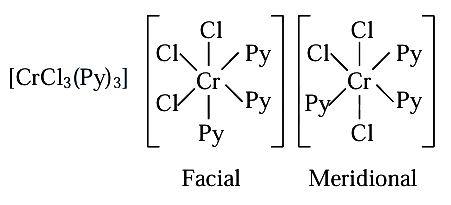
\(X =3\) (Two cis + one trans isomers \()\)
\(Y=1\) (trans isomer)
\(Z =2\) (Fac- mer isomer)
\(X+Y+Z=3+1+2=6\) -
- (A) Co-ordinate isomerism
- (B) Linkage isomerism
- (C) Ionisation isomerism
- (D) Geometrical isomerism
Show answer and solution
Correct Answer: (C)
(A) complex is \(\left[\mathrm{Co}\left(\mathrm{NH}_3\right)_5\left(\mathrm{SO}_4\right)\right] \mathrm{Cl}\)
(B) complex is \(\left[\mathrm{Co}\left(\mathrm{NH}_3\right)_5 \mathrm{Cl}\right] \mathrm{SO}_4\)
Both \((\mathrm{A})\) and \((\mathrm{B})\) are Ionisation isomers. -
- (A) \(3 \& 3\)
- (B) \(2 \& 2\)
- (C) \(2 \& 3\)
- (D) \(1 \& 2\)
Show answer and solution
Correct Answer: (C)
So total stereo isomer \(=2\)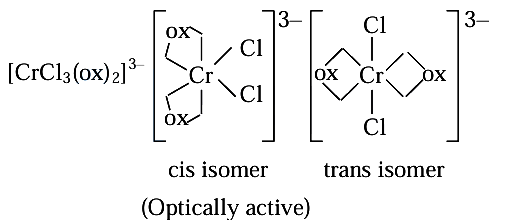
Geometrical isomer \(=2(1\) cis +1 trans \()\)
Optical isomer \(=3\) ( 2 optically active +1 optically inactive)
Stereoisomer \(=3\) -
- (A) \(\left[\mathrm{Co}\left(\mathrm{NH}_3\right)_4 \mathrm{Cl}_2\right] \cdot \mathrm{Cl} \cdot \mathrm{NH}_3\)
- (B) \(\left[\mathrm{Co}\left(\mathrm{NH}_3\right)_3 \mathrm{Cl}_3\right] \cdot 2 \mathrm{NH}_3\)
- (C) \(\left[\mathrm{Co}\left(\mathrm{NH}_3\right)_5 \mathrm{Cl}\right] \mathrm{Cl}_2\)
- (D) \(\left[\mathrm{Co}\left(\mathrm{NH}_3\right)_4 \mathrm{Cl}\right] \cdot \mathrm{Cl}_2 \cdot \mathrm{NH}_3\)
Show answer and solution
Correct Answer: (C)
\(\begin{array}{l}{\left[\mathrm{Co}\left(\mathrm{NH}_3\right)_5 \mathrm{Cl}\right] \mathrm{Cl}_2 \rightarrow \underbrace{\left[\mathrm{Co}\left(\mathrm{NH}_3\right)_5 \mathrm{Cl}\right]^{2+}(\text { aq. })+2 \mathrm{Cl}^{-}(\text {aq. })}_{3 \text { ions in water }}} \\ {\left[\mathrm{Co}\left(\mathrm{NH}_3\right)_5 \mathrm{Cl}\right] \mathrm{Cl}_2(\text { aq. })+2 \mathrm{AgNO}_3(\text { aq. }) \rightarrow} {\left[\mathrm{Co}\left(\mathrm{NH}_3\right)_5 \mathrm{Cl}\right]\left(\mathrm{NO}_3\right)_2(\text { aq. })+2 \mathrm{AgCl}(\mathrm{s})}\end{array}\) -
- (A) \({ }_{1 .}\left[\mathrm{Co}(\mathrm{en})_2 \mathrm{Cl}_2\right]^{+}\)
- (B) \(\left[\mathrm{Co}(\mathrm{en})_3\right]^{3+}\)
- (C) \(\left[\mathrm{Co}\left(\mathrm{NH}_3\right)_3 \mathrm{Cl}_3\right]\)
- (D) \(\left[\mathrm{Co}\left(\mathrm{NH}_3\right)_4 \mathrm{Cl}_2\right]^{+}\)
Show answer and solution
Correct Answer: (C)
\(\mathrm{Ma}_3 \mathrm{~b}_3\) type complexes show Facial - Meridional isomerism
(i) \(\left[\mathrm{Co}\left(\mathrm{NH}_3\right)_3 \mathrm{Cl}_3\right] \Rightarrow \mathrm{Ma}_3 \mathrm{~b}_3\)
(ii) \(\left[\mathrm{Co}\left(\mathrm{NH}_3\right)_4 \mathrm{Cl}_2\right]^{+} \Rightarrow \mathrm{Ma}_4 \mathrm{~b}_2\)
(iii) \(\left[\mathrm{Co}(\mathrm{en})_3\right]^{3+} \Rightarrow \mathrm{M}(\mathrm{AA})_3\)
(iv) \(\left[\mathrm{Co}(\mathrm{en})_2 \mathrm{Cl}_2\right]^{+} \Rightarrow \mathrm{M}(\mathrm{AA})_2 \mathrm{~b}_2\)
\(\mathrm{a}, \mathrm{b},=\mathrm{NH}_3, \mathrm{Cl}^{-}\)
\(\mathrm{AA}=\mathrm{en}\) -
- (A) \(R < Q < P\)
- (B) \(R < P < Q\)
- (C) \(Q < R < P\)
- (D) \(Q < P < R\)
Show answer and solution
Correct Answer: (C)
\(\left[\mathrm{FeF}_6\right]^{3-}: \mathrm{Fe}^{+3}:[\mathrm{Ar}] 3 \mathrm{~d}^5\)
F : Weak field Ligand No. of unpaired electron'\(s=5\)
\( \mu=\sqrt{5(5+2)} \)
\( \mu=\sqrt{35} \mathrm{BM} \)
\( {\left[\mathrm{V}\left(\mathrm{H}_2 \mathrm{O}\right)_6\right]^{+2}: \mathrm{V}^{+2}: 3 \mathrm{~d}^3}\)
No. of unpaired electron's \(=3\)
\( \mu=\sqrt{3(3+2)} \)
\( \mu=\sqrt{15} \mathrm{BM} \)
\( {\left[\mathrm{Fe}\left(\mathrm{H}_2 \mathrm{O}\right)_6\right]^{+2}: \mathrm{Fe}^{+2}: 3 \mathrm{~d}^6}\)
\(\mathrm{H}_2 \mathrm{O}\) : Weak field Ligand
No. of unpaired electron's\(=4\)
\( \mu=\sqrt{4(4+2)} \)
\( \mu=\sqrt{24} \mathrm{BM}\)
-
- (A) 0
- (B) 1
- (C) 2
- (D) 3
Show answer and solution
Correct Answer: (A)
If \(M ^{+2}= Co ^{+2}\)
then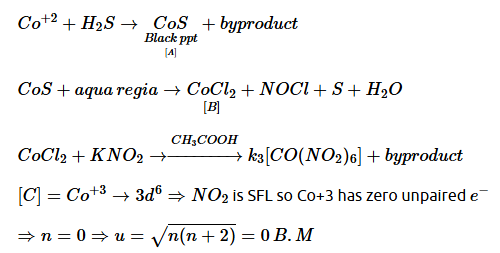
-
- (A) Both \((A)\) and \((R)\) are correct and \((R)\) is the correct explanation of \((A)\).
- (B) \((A)\) is correct but \((R)\) is not correct.
- (C) \((A)\) is not correct but \((R)\) is correct.
- (D) Both \((A)\) and \((R)\) are correct but \((R)\) is not the correct explanation of \((A)\).
Show answer and solution
Correct Answer: (C)
\(\left[\mathrm{Co}(\mathrm{en})_2 \mathrm{Cl}_2\right]^{+}\)has octahedral geometry with two geometrical isomers.
-
- (A) Both Statement \(I\) and Statement \(II\) are incorrect
- (B) Both Statement \(I\) and Statement \(II\) are correct
- (C) Statement \(I\) is incorrect but Statement \(II\) is correct
- (D) Statement \(I\) is correct but Statement \(II\) is incorrect
Show answer and solution
Correct Answer: (B)
\(\left[\mathrm{Ni}\left(\mathrm{H}_2 \mathrm{O}\right)_6\right]^{+2} \rightarrow\) Green colour solution due to d-d transition.\(\left[\mathrm{Ni}(\mathrm{CN})_4\right]^{-2} \rightarrow\) is diamagnetic and it is colourless.
-
- (A) \((A)-(I), (B)-(IV), (C)-(II), (D)-(III)\)
- (B) \((A)-(IV), (B)-(III), (C)-(I), (D)-(II)\)
- (C) \((A)-(II), (B)-(IV), (C)-(I), (D)-(III)\)
- (D) \((A)-(II), (B)-(III), (C)-(I), (D)-(IV)\)
Show answer and solution
Correct Answer: (C)
\((A)\)\({\left[\mathrm{Cr}\left(\mathrm{NH}_3\right)_6\right]^{3+}}\)
\(\mathrm{Cr}^{3+}: 3 \mathrm{~d}^3\)
\(\mathrm{n}=3 \text { (unpaired electrons) }\)
\(\mu \simeq 3.87 \text { B.M. (II) }\)
\((B)\)
\({\left[\mathrm{NiCl}_4\right]^{2-}}\)
\(\mathrm{Ni}^{2+}: 3 \mathrm{~d}^8\)
\(\mathrm{n}=2\)
\(\mu \simeq 2.83 \text { B.M. (IV) }\)
\((C)\)
\({\left[\mathrm{CoF}_6\right]^{3-}}\)
\(\mathrm{Co}^{3+}: 3 \mathrm{~d}^6\)
\(\mathrm{n}=4\)
\(\mu \simeq 4.90 \text { B.M. (I) }\)
\((D)\)
\({\left[\mathrm{Ni}(\mathrm{CN})_4\right]^{2-}}\)
\(\mathrm{Ni}^{2+}: 3 \mathrm{~d}^8\)
\(\mathrm{n}=0\)
\(\mu=0 \text { B.M. (III) }\)
-
- (A) \(4\)
- (B) \(5\)
- (C) \(6\)
- (D) \(7\)
Show answer and solution
Correct Answer: (A)
cis \(-\left[\mathrm{Cr}(\mathrm{ox})_2 \mathrm{Cl}_2\right]^{3-} \rightarrow\) can show optical isomerism (no \(POS\) & \(COS\))\(\left[\mathrm{Co}(\mathrm{en})_3\right]^{3+} \rightarrow\) can show (no \(POS\) & \(COS\))
cis \(-\left[\mathrm{Pt}(\mathrm{en})_2 \mathrm{Cl}_2\right]^{2+} \rightarrow\) can show (no \(POS\) & \(COSV\))
cis \(-\left[\mathrm{Co}(\mathrm{en})_2 \mathrm{Cl}_2\right]^{+} \rightarrow\) can show (no \(POS\) & \(COS\))
trans \(-\left[\mathrm{Pt}(\mathrm{en})_2 \mathrm{Cl}_2\right]^{2+} \rightarrow\) can't show (contains \(POS\) & \(COS\))
trans \(-\left[\mathrm{Cr}(\mathrm{ox})_2 \mathrm{Cl}_2\right]^{3-} \rightarrow\) can't show (contains \(POS\) & \(COS\))
-
- (A) \(\left[\mathrm{Ni}(\mathrm{CO})_4\right]\) and \(\left[\mathrm{NiCl}_4\right]^{2-}\) both diamagnetic
- (B) \(\left[\mathrm{Ni}(\mathrm{CO})_4\right]\) and \(\left[\mathrm{NiCl}_4\right]^{2-}\) both paramagnetic
- (C) \(\left[\mathrm{NiCl}_4\right]^{2-}\) diamagnetic, \(\left[\mathrm{Ni}(\mathrm{CO})_4\right]\) paramagnetic
- (D) \(\left[\mathrm{Ni}(\mathrm{CO})_4\right]\) diamagnetic, \(\left[\mathrm{NiCl}_4\right]^{2-}\) paramagnetic
Show answer and solution
Correct Answer: (D)
\(\left[\mathrm{Ni}(\mathrm{CO})_4\right] \rightarrow\) diamagnetic, \(\mathrm{sp}^3\) hybridisation, number of unpaired electrons \(=0\)\(\left[\mathrm{NiCl}_4\right]^{2-}, \rightarrow\) paramagnetic, \(\mathrm{sp}^3\) hybridisation, number of unpaired electrons \(=2\)
-
- (A) 2
- (B) 0
- (C) 4
- (D) 3
Show answer and solution
Correct Answer: (B)
Tetrahedral complex does not show geometrical isomerism. -
- (A) \(20\)
- (B) \(28\)
- (C) \(30\)
- (D) \(35\)
Show answer and solution
Correct Answer: (B)
\(\mathrm{NH}_3\) act as WFL with \(\mathrm{Ni}^{2+}\) \(\mathrm{Ni}^{2+}=3 \mathrm{~d}^8\)\(Image\)
No. of unpaired electron \(=2\)
\(\mu=\sqrt{n(n+2)}=\sqrt{8}=2.82 \mathrm{BM}\)
\(=28.2 \times 10^{-1} \mathrm{BM}\)
\(\mathrm{x}=28\)

-
- (A) \(1\)
- (B) \(2\)
- (C) \(3\)
- (D) \(0\)
Show answer and solution
Correct Answer: (D)
\(\mathrm{Pt}^{2+}\left(\mathrm{d}^8\right)\)
\(\mathrm{Pt}^{2+} \rightarrow \mathrm{dsp}^2\) hybridization and have no unpaired e-s.
\(\therefore\) Magnetic moment \(\mathrm{o} 0\)
-
- (A) \(\left[\mathrm{Co}\left(\mathrm{H}_2 \mathrm{O}\right)_6\right]^{2+}\)
- (B) \(\left[\mathrm{Fe}\left(\mathrm{H}_2 \mathrm{O}\right)_6\right]^{2+}\)
- (C) \(\left[\mathrm{Mn}\left(\mathrm{H}_2 \mathrm{O}\right)_6\right]^{2+}\)
- (D) \(\left[\mathrm{Cr}\left(\mathrm{H}_2 \mathrm{O}\right)_6\right]^{2+}\)
Show answer and solution
Correct Answer: (A)
Least paramagnetic behaviour \(=\left[\mathrm{Co}\left(\mathrm{H}_2 \mathrm{O}\right)_6\right]^{2+}\)Number of unpaired \(\mathrm{e}^{-}\) \(\mu=\sqrt{n(n+2)}\) \(B.M.\) \(\left[\mathrm{Co}\left(\mathrm{H}_2 \mathrm{O}\right)_6\right]^{2+}\) \(3\) \(3.87\) \(\left[\mathrm{Fe}\left(\mathrm{H}_2 \mathrm{O}\right)_6\right]^{2+}\) \(4\) \(4.89\) \(\left[\mathrm{Mn}\left(\mathrm{H}_2 \mathrm{O}\right)_6\right]^{2+}\) \(5\) \(5.92\) \(\left[\mathrm{Cr}\left(\mathrm{H}_2 \mathrm{O}\right)_6\right]^{2+}\) \(4\) \(4.89\) - 24. For a metal ion, the calculated magnetic moment is \(4.90\,BM\). This metal ion has \(........\) number of unpaired electons. 2023 Medium
- (A) \(6\)
- (B) \(8\)
- (C) \(4\)
- (D) \(5\)
Show answer and solution
Correct Answer: (C)
\(\mu=\sqrt{n(n+2)}\,B M\)\(4.90=\sqrt{n(n+2)}\)
\(n=4\)
-
- (A) \(4\)
- (B) \(2\)
- (C) \(6\)
- (D) \(8\)
Show answer and solution
Correct Answer: (B)
\(\mu_{ s }=\sqrt{ n ( n +2)} BM \quad\) (n=no. of unpaired electrons)\(n\) \(V ^{3+}:[ Ar ] 3 d ^2 4 s ^0\) \(2\) \(Cr ^{3+}:[ Ar ] 3 d ^3 4 s ^0\) \(3\) \(Fe ^{2+}:[ Ar ] 3 d ^6 4 s ^0\) \(4\) \(Ni ^{3+}:[ Ar ] 3 d ^7 4 s ^0\) \(5\) \(Cr ^{3+}\) and \(Ni ^{3+}\) have same value of \(\mu_{ s }\)
-
- (A) \(A, B\) and \(C\)
- (B) \(A, B\) and \(D\)
- (C) \(A\) and \(D\)
- (D) \(B\) and \(C\)
Show answer and solution
Correct Answer: (B)
\(\left[ NiBr _2 Cl _2\right]^{2-} \rightarrow\) This complex species is tetrahedral as \(Br ^{\Theta}\) and \(Cl ^{\Theta}\) are weak field ligands. \(\left[ PtBr _2 Cl _2\right]^{2-} \rightarrow As\) Pt belongs to 5 d series. This complex species is square planar.Both the complex species are optically inactive. \(\left[ NiBr _2 Cl _2\right]^{2-}\), being tetrahedral does not show Geometrical Isomerism. \(\left[ PtBr _2 Cl _2\right]^{2-}\) shows two Geometrical Isomers.
\(\left[ PtBr _2 Cl _2\right]^{2-}\) shows two Geometrical Isomers.
-
- (A) A - II, B - IV, C - I, D - III
- (B) A - IV, B-III, C - II, D - I
- (C) A - III, B - IV, C - I, D - II
- (D) A - II , B - I , C - IV , D - III
Show answer and solution
Correct Answer: (A)
For option \((A)\)\(Cr ^{+3}: 3 d ^3\)
\(CN ^{-} \rightarrow SFL\)
\(\Rightarrow \text { No. of unpaired electrons }=3\)
For option \((B)\)
\(Fe ^{+2}: 3 d ^6\)
\(H _2 O : WFL\)
No. of unpaired electrons \(=4\)
For option \((C)\)
\(Co ^{+3}: 3 d ^6\)
\(NH _3: SFL\)
No. of unpaired electrons \(=0\)
For option \((D)\)
\(Ni ^{-+2}: 3 d ^8\)
\(NH _3: SFL\)
No. of unpaired electrons \(=2\)
-
- (A) \(6\)
- (B) \(8\)
- (C) \(10\)
- (D) \(4\)
Show answer and solution
Correct Answer: (D)
\(\left[ M ( en )( SCN )_4\right]\)Ambidentate ligand means two ligand site,
so ambidentate ligand is \(SCN\).
- 29. The \(Cl - Co - Cl\) bond angle values in a fac\(\left[ Co \left( NH _3\right)_3 Cl _3\right]\) complex is/are: 2023 Medium
- (A) \(90^{\circ}\) and \(180^{\circ}\)
- (B) \(90^{\circ}\)
- (C) \(180^{\circ}\)
- (D) \(90^{\circ}\) and \(120^{\circ}\)
Show answer and solution
Correct Answer: (B)
The \(Cl - Co - Cl\) bond angle in above octahedral complex is \(90^{\circ}\)
-
- (A) \(\left[ Co \left( H _2 O \right)_6\right]^{3+}\)
- (B) \(\left[ Co \left( NH _3\right)_5 Cl \right]^{2+}\)
- (C) \(\left[ Co \left( NH _3\right)_5 NO _2\right]^{2+}\)
- (D) \(\left[ Co \left( NH _3\right)_5 Cl \right]^{+}\)
Show answer and solution
Correct Answer: (C)
\(\left(\left[ Co \left( NH _3\right)_5 NO _2\right]^{2+}\right.\)Two linkage isomers possible \(NO _2 \rightarrow\) Ambidentate ligand
-
- (A) \(A < E < D < C < B\)
- (B) \(E < A < D < C < B\)
- (C) \(E < A < B < D < C\)
- (D) \(A < E < C < B < D\)
Show answer and solution
Correct Answer: (B)
\(A\). \(\left[ Fe ( CN )_6\right]^{3-} n =1\)\(B\). \(\left[ FeF _6\right]^{3-} n =5\)
\(C\). \(\left[ CoF _6\right]^{3-} n =4\)
\(D\). \(\left.[\text { Cr(oxalate })_3\right]^{3-} n =3\)
\(E\). \(\left[ Ni ( CO )_4\right] n =0\)
-
- (A) \(6.92\,B.M.\) in both
- (B) \(4.89\,B.M.\) and \(6.92\,B.M.\)
- (C) \(3.87\,B.M.\) and \(1.732\,B.M.\)
- (D) \(5.92\,B.M.\) and \(1.732\,B.M\)
Show answer and solution
Correct Answer: (D)
\(\left[ Fe \left( H _2 O \right)_6\right]^{3+}\)\(\therefore \text { Unpaired } e ^{-}=5\)
\(\mu=\sqrt{ n ( n +2)}\)
\(=\sqrt{5(5+2)}\)
\(\mu=\sqrt{35}=5.92 \text { B.M. }\)
\({\left[ Fe ( CN )_6\right]^{-3}}\)
Pairing occur due to strong field ligand \(CN ^{-}\)
\(\therefore\) Unpaired \(e^-\) \(\Rightarrow 1\)
\(\mu=\sqrt{ n ( n +2)}\)
\(=\sqrt{1(1+2)}=\sqrt{3}=1.732 \text { B.M. }\)

-
- (A) \(4\)
- (B) \(6\)
- (C) \(8\)
- (D) \(10\)
Show answer and solution
Correct Answer: (A)
\(\left[ Mn ( NCS )_6\right]^{x-}\)Number of unpaired electron \(=5\)
So, \(Mn\) must be in \(+2\) oxidation state \(\left( Mn ^{+2}\right)\)
\(\Rightarrow 2+(-6)=-x\)
\(\Rightarrow-4=-x\)
\(\Rightarrow x=4\)
-
- (A) \(\left[ NiCl _4\right]^{2-}\)
- (B) \(\left[ CoCl _6\right]^{3-}\)
- (C) \(\left[ CoF _6\right]^{3-}\)
- (D) \(\left[ Co \left( NH _3\right)_6\right]^{3+}\)
Show answer and solution
Correct Answer: (D)
(1) Paramagnetic, High Spin and Tetrahedral(2) Paramagnetic, High Spin and Octahedral
(3) Paramagnetic, High Spin and Octahedral
(4) Diamagnetic, Low Spin and Octahedral
\(\left[ Co \left( NH _3\right)_6\right]^{3+}, CN =6(\text { Octahedral })\)
\(NH _3= SFL\)
\(Co ^{+3}=[ Ar ] 3 d ^6\)
Diamagnetic and Low spin complex

-
- (A) \(2\)
- (B) \(3\)
- (C) \(4\)
- (D) \(1\)
Show answer and solution
Correct Answer: (D)
Spin magnetic moment of \(\left[ Cr ( CN )_6\right]^{3-}\left( t _{2 g }^3 e _{ g }^0\right)\)\(\mu_1=\sqrt{3(3+2)}=\sqrt{15}\,BM\)
Spin magnetic moment of \(\left[ Cr \left( H _2 O \right)_6\right]^{3+}\left( t _{2 g }^3 e _{ g }^0\right)\)
\(\mu_2=\sqrt{3(3+2)}=\sqrt{15}\,BM\)
\(\frac{\mu_1}{\mu_2}=\frac{\sqrt{15}}{\sqrt{15}}=1\)
-
- (A) \(3\)
- (B) \(6\)
- (C) \(9\)
- (D) \(12\)
Show answer and solution
Correct Answer: (B)
\(\left(\left[ Mn \left( H _2 O \right)_6\right]^{2+}\right.\)\(Mn ^{2+}=3 d ^5\)
\(\mu=\sqrt{5(5+2)}=5.91\,BM\)
- 37. The total number of stereoisomers for the complex \(\left[ Cr ( ox )_2 ClBr ^{3-}\right.\) (where ox = oxalate) is: 2023 Hard
- (A) \(2\)
- (B) \(3\)
- (C) \(1\)
- (D) \(4\)
Show answer and solution
Correct Answer: (B)
\(\left[ Cr ( Ox )_2 ClBr ^{-3}\right.\)- No. of isomers -
- This structure has plane of symmetry, So no optical isomerism will be shown.
- This structure does not contain plane of symmetry, So two forms \(d\) as well as \(1\) will be shown.

-
- (A) \(\left[ Co \left( NH _3\right)_3\left( NO _2\right)_3\right]\)
- (B) \(\left[ Co ( en )_3\right]\)
- (C) \(\left[ Co (\text { en })_2 Cl _2\right]\)
- (D) \(\left[ Pt \left( NH _3\right)_2 Cl _2\right]\)
Show answer and solution
Correct Answer: (A)
\(\left[ MA _3 B _3\right]\) type of compound exists as facial and meridonial isomer.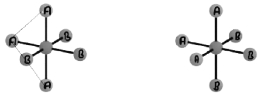
-
- (A) \(4\)
- (B) \(3\)
- (C) \(2\)
- (D) \(1\)
Show answer and solution
Correct Answer: (D)
\((a)\) \(CoCl _{3} \cdot 4 NH _{3}=\left[ Co \left( NH _{3}\right)_{4} Cl _{2}\right] Cl\)Can exhibit \(G.I.\)
\((b)\) \(CoCl _{3} \cdot 5 NH _{3}=\left[ Co \left( NH _{3}\right)_{5} Cl \right] Cl _{2}\)
Can't exhibit \(G.I.\)
\((c)\) \(CoCl _{3} \cdot 6 NH _{3}=\left[ Co \left( NH _{3}\right)_{6}\right] Cl _{3}\)
Can't exhibit \(G.I.\)
\((d)\) \(CoCl \left( NO _{3}\right)_{2} \cdot 5 NH _{3}=\left[ Co \left( NH _{3}\right)_{5} Cl \right]\left( NO _{3}\right)_{2}\)
OR
\(=\left[ Co \left( NH _{3}\right)_{5}\left( NO _{3}\right)\right] Cl \left( NO _{3}\right)\)
Both can't exhibit \(G.I.\)
-
- (A) \(5\)
- (B) \(0.2\)
- (C) \(2\)
- (D) \(20\)
Show answer and solution
Correct Answer: (C)
\(\left[ Fe \left( H _{2} O \right)_{3} Cl _{3}\right], \quad \underbrace{ K _{3}\left[ Fe ( CN )_{6}\right],\left[ Co \left( NH _{3}\right)_{6}\right] Cl _{3}}_{\text {inner orbital complexes }}\)\(K _{3}\left[ Fe ( CN )_{6}\right]\) has more value of \(\Delta_{0}\) than that of \(\left[ Co \left( NH _{3}\right)_{6}\right] Cl _{3} ;\) as \(\overline{ CN }\) is stronger ligand.
More \(\Delta_{0} \Rightarrow\) smaller value of absorbed \(\lambda\)
Spin only magnetic moment \((\mu)=\sqrt{3} \,BM\)
\(=1.732 \,BM\)
Rounding off \(\Rightarrow 2\)

-
- (A) \(A \,<\, B\, <\, D \,< \,C\)
- (B) \(B \,<\, D \,< \,C\, <\, A\)
- (C) \(A \,<\, C\, <\, D\, < \,B\)
- (D) \(B \,< \,D\, < \,A \,<\, C\)
Show answer and solution
Correct Answer: (B)
\((A)\) \(\left[ FeF _{6}\right]^{3-}\)\(Fe ^{+3} \rightarrow 3 d ^{5} 4 s ^{0}\)
\(n =5\)
\((B)\) \(\left[ Fe ( CN )_{6}\right]^{3-}\)
\(Fe ^{+3} \rightarrow 3 d ^{5} 4 s ^{0}\)
\(n =1\)
\((C)\) \(\left[ MnCl _{6}\right]^{3-}\)
\(Mn ^{+3} \rightarrow 3 d ^{4} 4 s ^{0}\)
\(n =4\)
\((D)\) \(\left[ Mn ( CN )_{6}\right]^{3-}\)
\(Mn ^{+3} \rightarrow 3 d ^{4} 4 s ^{0}\)
\(n =2\)
\(\mu \Rightarrow A > C > D > B\)

-
- (A) \(1\)
- (B) \(3\)
- (C) \(2\)
- (D) \(7\)
Show answer and solution
Correct Answer: (C)
\(\left[ Fe ( CN )_{6}\right]^{4-} \quad\) Diamagnetic\(\left[ Fe ( CN )_{6}\right]^{3-} \quad\) Paramagnetic (\(1\) unpaired electron)
\(\left[ Ti ( CN )_{6}\right]^{3-} \quad\) Paramagnetic (\(1\) unpaired electron)
\(\left[ Ni ( CN )_{4}\right]^{2-} \quad\) Diamagnetic
\(\left[ Co ( CN )_{6}\right]^{3-} \quad\) Diamagnetic
-
- (A) \(1\)
- (B) \(2\)
- (C) \(0\)
- (D) \(3\)
Show answer and solution
Correct Answer: (C)
number of unpaired \(e^{-}=3\)\(\mu=\sqrt{15}\,BM\)
\({\left[ Cr \left( H _{2} O \right)_{6}\right]^{3+}}\)
number of unpaired \(e^{-}=3\)
\(\mu=\sqrt{15}\,BM\)
Difference in spin only magnetic moment \(=0\)

-
- (A) \(K _{3}\left[ Cu ( CN )_{4}\right]\)
- (B) \(K _{2}\left[ Cu ( CN )_{4}\right]\)
- (C) \(K _{3}\left[ Fe ( CN )_{4}\right]\)
- (D) \(K _{4}\left[ FeCl _{6}\right]\)
Show answer and solution
Correct Answer: (A)
\(K _{3}\left[ Cu ( CN )_{4}\right]\)\(O.N.\) of copper is \(Cu ^{+1}\)
\(Cu ^{+1}=[ Ar ] 3 d ^{10} \Rightarrow\) Diamagnetic
-
- (A) \(2\)
- (B) \(1\)
- (C) \(4\)
- (D) \(3\)
Show answer and solution
Correct Answer: (D)
\(A , B , C\) are correct and \(D\) is incorrect because Fehling solution has \(Cu\, (II)\) -
- (A) \(3\)
- (B) \(30\)
- (C) \(12\)
- (D) \(1\)
Show answer and solution
Correct Answer: (A)
\(CoCl _{3} \cdot 4 NH _{3} \rightarrow\left[ Co \left( NH _{3}\right)_{4} Cl _{2}\right] Cl\)\(NiCl _{2} \cdot 6 H _{2} O \rightarrow\left[ Ni \left( H _{2} O \right)_{6}\right] Cl _{2}\)
\(PtCl _{4} \cdot 2 HCl \rightarrow H _{2}\left[ PtCl _{6}\right]\)
\(\left[ Ni \left( H _{2} O \right)_{6}\right] Cl _{2} \stackrel{2 AgNO _{3}}{\longrightarrow} 2 AgCl \downarrow+\left[ Ni \left( H _{2} O \right)_{6}\right]\left( NO _{3}\right)_{2}\)
\(\mu=\sqrt{2(2+2)}\) B.M \(=2.84 BM \approx 3\)

-
- (A) \((b) < (a) < (c)\)
- (B) \((c) < (a) < (b)\)
- (C) \((a) < (b) < (c)\)
- (D) \((a) < (c) < (b)\)
Show answer and solution
Correct Answer: (D)
\((a)\) \({ }_{58} Ce \rightarrow[ Xe ] 4 f ^{2} 5 d ^{0} 6 s ^{2}\)In complex \(Ce ^{4+} \rightarrow[ Xe ] 4 f ^{0} 5 d ^{0} 6 s ^{0}\)
there is no unpaired electron so \(\mu_{ m }=0\)
\((b)\) \({ }_{64} Gd ^{3+} \rightarrow[ Xe ] 4 f ^{7} 5 d ^{0} 6 s ^{\circ}\)
contain seven unpaired electrons so, \(\mu_{ m }=\sqrt{7(7+2)}=\sqrt{63} B.M\)
\((c)\) \({ }_{63} Eu ^{3+} \rightarrow\left[{ }_{54} Xe \right] 4 f ^{6} 5 d ^{0} 6 s ^{\circ}\)
contain six unpaired electron
so, \(\mu_{ m }=\sqrt{6(6+2)}=\sqrt{48} B . M\)
Hence, order of spin only magnetic movement
\(b > c > a\)
-
- (A) \(( i ) > ( iii ) > ( iv ) > ( ii )\)
- (B) \((ii) > ( iii) > ( i ) > ( iv )\)
- (C) \((iii) > ( iv ) > ( ii ) > ( i )\)
- (D) \(( ii ) > ( i ) > ( iii ) > ( iv )\)
Show answer and solution
Correct Answer: (A)
Complex\((i)\) \(\left[ FeF _{6}\right]^{3-} Fe ^{3+} \Rightarrow[ Ar ] 3 d ^{5}, F ^{-}\) is \(WFL\)
\(n =5, \quad \mu=\sqrt{35}\, B .M.\)
\((ii)\) \(\left[ Co \left( NH _{3}\right)_{6}\right]^{3+} \Rightarrow Co ^{3+}[ Ar ] 3 d ^{6}, NH _{3}\) is \(SFL\)
\(n =0, \quad \mu=0\)
\((iii)\) \(\left[ NiCl _{4}\right]^{2-} Ni ^{2+} \Rightarrow[ Ar ] 3 d ^{8}, Cl ^{-} \rightarrow WFL\)
\(n =2, \quad \mu=\sqrt{8}\, B . M.\)
\((iv)\) \(\left[ Cu \left( NH _{3}\right)_{4}\right]^{2+} Cu ^{2+} \Rightarrow[ Ar ] 3 d ^{9}, NH _{3} \rightarrow \,SFL\)
\(n =1, \quad \mu=\sqrt{3} B.M.\)
Thus correct order of spin only magnetic moment is \(( i ) > ( iii ) > ( iv ) > ( ii )\)

-
- (A) \(\left[\mathrm{CoCl}_{2}(\mathrm{en})_{2}\right]\)
- (B) \(\left[\mathrm{Co}(\mathrm{CN})_{5}(\mathrm{NC})\right]^{3-}\)
- (C) \(\left[\mathrm{Co}\left(\mathrm{NH}_{3}\right)_{3}\left(\mathrm{NO}_{2}\right)_{3}\right]\)
- (D) \(\left[\mathrm{Co}\left(\mathrm{NH}_{3}\right)_{4} \mathrm{Cl}_{2}\right]^{+}\)
Show answer and solution
Correct Answer: (B)
(1) \(\left[\mathrm{CoCl}_{2}(\mathrm{en})_{2}\right]\) show Cis-trans isomerism(2) \(\left[\mathrm{Co}(\mathrm{CN})_{5}(\mathrm{NC})\right]^{-3}\) can't Show \(G.I.\)
(3) \(\left[\mathrm{Co}\left(\mathrm{NH}_{3}\right)_{3}\left(\mathrm{NO}_{2}\right)_{3}\right]\)
Show fac \(\&\) mer isomerism
(4) \(\left[\mathrm{Co}\left(\mathrm{NH}_{3}\right)_{4} \mathrm{Cl}_{2}\right]^{\oplus}\) show cis \(\&\) trans isomerism
-
- (A) \((a)-(iii), (b)-(i), (c)-(ii), (d)-(iv)\)
- (B) \((a)-(iv), (b)-(ii), (c)-(iii), (d)-(i)\)
- (C) \((a)-(ii), (b)-(i), (c)-(iii), (d)-(iv)\)
- (D) \((a)-(i), (b)-(ii), (c)-(iii), (d)-(iv)\)
Show answer and solution
Correct Answer: (A)
Sol. Complex Type of Isomerism \((a)\) \(\left[ Co \left( NH _{3}\right)_{6}\right]\left[ Cr ( CN )_{6}\right]\) Co-ordination isomerism
\((b)\) \(\left[ Co \left( NH _{3}\right)_{3}\left( NO _{2}\right)_{3}\right]\) Linkage isomerism
\((c)\) \(\left[ Cr \left( H _{2} O \right)_{6}\right] Cl _{3}\) Solvate isomerism
\((d)\) \(cis-[CrCl\) \(\left._{2}(\text { ox })_{2}\right]^{3-}\) Optical isomerism
No questions on this page match these filters.
Other STD 12 - Co-ordination chemistry topics
Frequently asked
How many Isomerism and Magnetic properties questions came in JEE Mains?
85 questions from 2013–2026, each with the correct answer and a full solution.
How difficult are Isomerism and Magnetic properties questions?
6% are easy, 52% medium and 42% hard.