


Questions
25 questionsShowing 1–25 of 25 questions
-
- (A) \(\frac{\lambda}{4}\)
- (B) \(4 \lambda\)
- (C) \(\frac{3}{2} \lambda\)
- (D) \(3 \lambda\)
Show answer and solution
Correct Answer: (D)
From the equation of photoelectric effect\(eV _0=\frac{ hc }{\lambda}-\phi_0=\frac{ hc }{\lambda}-\frac{ hc }{\lambda_0}\)
\(\frac{ eV _0}{4}=\frac{ hc }{2 \lambda}=\frac{ hc }{\lambda_0}\)
\(\Rightarrow \frac{1}{4}\left(\frac{ hc }{\lambda}-\frac{ hc }{\lambda_0}\right)=\frac{ hc }{2 \lambda}-\frac{ hc }{\lambda_0}\)
\(\frac{1}{\lambda_0}-\frac{1}{4 \lambda_0}=\frac{1}{2 \lambda}-\frac{1}{4 \lambda}\)
\(\frac{3}{4 \lambda_0}=\frac{1}{4 \lambda}\)
\(\Rightarrow \lambda_0=3 \lambda\)
-
- (A) \(3\)
- (B) \(2\)
- (C) \(1\)
- (D) \(4\)
Show answer and solution
Correct Answer: (D)
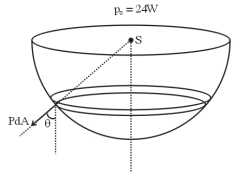
\(\text { Force }=\int PdA \cos \theta\)\(=\frac{2 I }{ C } \int dA \cos \theta=\frac{2 I }{ C } \pi R ^2=2 \frac{ p _0}{4 \pi R ^2} \cdot \frac{\pi R ^2}{ C }\)
\(=\frac{ p _0}{2 C }=\frac{24}{2 \times 3 \times 10^8}=4 \times 10^{-8} N \text { (Ans) }\)
-
- (A) \(4:1\)
- (B) \(2:1\)
- (C) \(8:1\)
- (D) \(16:1\)
Show answer and solution
Correct Answer: (A)
\(\lambda=\frac{ h }{ mv }=\frac{ h }{\sqrt{2 mK }}=\frac{ h }{\sqrt{2 mq \Delta V }}\)\(\frac{\lambda_\alpha}{\lambda_p}=\sqrt{\frac{m_p V_p q_p}{ m _\alpha V_\alpha q_\alpha}}\)
\(\Rightarrow \frac{\lambda_\alpha}{\lambda_p}=\sqrt{\frac{1 \times 2 \times 1}{4 \times 4 \times 2}}=\frac{1}{4}\)
\(\Rightarrow \lambda_p: \lambda_\alpha=4: 1\)
-
- (A) \(2: 1\)
- (B) \(4: 1\)
- (C) \(1: 2\)
- (D) \(1: 4\)
Show answer and solution
Correct Answer: (B)
\(K E=\frac{p^2}{2 m}=\frac{h^2}{2 m \lambda^2}\)\(\frac{K E_p}{K E_\alpha}=\frac{m_\alpha}{m_p}=4: 1\)
-
- (A) \(0.5\)
- (B) \(2\)
- (C) \(3\)
- (D) \(1\)
Show answer and solution
Correct Answer: (B)
Momentum \(=\frac{\text { Energy }}{ C }\)\(=\frac{\text { Power } \times \text { time }}{ C }\)
\(=\frac{\left(20 \times 10^{-3} w \right)\left(300 \times 10^{-9}\,s \right)}{3 \times 10^8 m / s }\)
\(=2 \times 10^{-17}\,kg - m / s\)
-
- (A) \(3\)
- (B) \(\frac{9}{4}\)
- (C) \(\frac{3}{2}\)
- (D) \(4\)
Show answer and solution
Correct Answer: (B)
\(KE =\frac{ P ^2}{2 m }, \quad P =\frac{ h }{\lambda}\)\(eV _1=\frac{\left(\frac{ h }{\lambda}\right)^2}{2 m }\)
\(eV _2=\frac{\left(\frac{ h }{1.5 \lambda}\right)^2}{2 m }\)
\(\frac{ V _1}{ V _2}=(1.5)^2=\frac{9}{4}\)
-
- (A) \(\lambda_\alpha>\lambda_{ p }>\lambda_{ e }\)
- (B) \(\lambda_\alpha<\lambda_{ p }<\lambda_{ e }\)
- (C) \(\lambda_\alpha=\lambda_{ p }=\lambda_{ e }\)
- (D) \(\lambda_\alpha>\lambda_{ p }<\lambda_{ e }\)
Show answer and solution
Correct Answer: (B)
\(\lambda_{ D }=\frac{ h }{ p }=\frac{ h }{\sqrt{2 mK }}\)\(\therefore \lambda \propto \frac{1}{\sqrt{ m }}\)
\(\because m _\alpha > m _{ p } > m _{ e }\)
\(\lambda_{ e } > \lambda_{ p } > \lambda_\alpha\)
-
- (A) \(3 \lambda_0\)
- (B) \(9 \lambda_0\)
- (C) \(\frac{\lambda_0}{2}\)
- (D) \(\frac{\lambda_0}{\sqrt{2}}\)
Show answer and solution
Correct Answer: (D)
When electron is accelerated through potential difference \(V\), then\(\text { K.E. }= eV\)
\(\Rightarrow \lambda=\frac{ h }{\sqrt{2 m ( KE )}}=\frac{ h }{\sqrt{2 meV }}\)
\(\therefore \quad \lambda \propto \frac{1}{\sqrt{ V }}\)
\(\therefore \quad \frac{\lambda}{\lambda_0}=\sqrt{\frac{20}{40}}\)
\(\therefore \quad \lambda=\frac{\lambda_0}{\sqrt{2}}\)
-
- (A) \(B, C\) only
- (B) \(A, C, D\) only
- (C) \(B\) only
- (D) \(A, B, D\) only
Show answer and solution
Correct Answer: (C)
\((A)\) Stopping potential depends on both frequency of light and work function.\((B)\) Saturation current \(\propto\) intensity of light
\((C)\) Maximum \(KE\) depends on frequency
\((D)\) Photoelectric effect is explained using particle theory
-
- (A) \(A\) is correct but \(R\) is not correct
- (B) \(A\) is not correct but \(R\) is correct
- (C) Both \(A\) and \(R\) are correct but \(R\) is Not the correct explanation of \(A\)
- (D) Both \(A\) and \(R\) are correct and \(R\) is the correct explanation of \(A\)
Show answer and solution
Correct Answer: (D)
Conceptual -
- (A) Statement \(I\) is true but Statement \(II\) is false
- (B) Both Statement \(I\) and Statement \(II\) are true
- (C) Statement \(I\) is false but Statement \(II\) is true
- (D) Both Statement \(I\) and Statement \(II\) are false
Show answer and solution
Correct Answer: (A)
\(UV\) rays have maximum frequency hence are most effective for emission of electrons from a metallic surface.\(KE _{\max .}= hf - hf _0\)
-
- (A) Statement \(I\) is incorrect but statement \(II\) is correct
- (B) Both Statement \(I\) and Statement \(II\) are incorrect
- (C) Statement \(I\) is correct but statement \(II\) is incorrect
- (D) Both statement \(I\) and statement \(II\) are correct
Show answer and solution
Correct Answer: (D)
Stopping potential \(V _{ S }=\frac{ KE _{\max }}{ e }\)\(V _{ S }=\frac{\frac{ hC }{ \lambda }-\phi}{ e }\)
Stopping potential does not depend on intensity or power of light used, it only depends on frequency or wavelength of incident light.
So both statements \(I\) and \(II\) are correct
-
- (A) \(A\) and \(C\) only
- (B) \(A\) and \(E\) only
- (C) \(B\) and \(C\) only
- (D) \(A\) and \(B\) only
Show answer and solution
Correct Answer: (A)
Intensity of light \(\propto\) number of photons \(\propto\) no of photo electrons \(\propto\) photo currentSo, \(A\) is correct
\(KE _{\max }= h v-\phi\)
\(KE _{\max }\) depends on frequency
So, \(C\) is correct
So, \(A\) and \(C\) are correct
-
- (A) \(A-III, B-I, C-II, D-IV\)
- (B) \(A-III, B-IV, C-I, D-II\)
- (C) \(A-II, B-IV, C-III, D-I\)
- (D) \(A-I, B-III, C-IV, D-II\)
Show answer and solution
Correct Answer: (B)
(A) Planck's constant\(h v= E\)
\(h =\frac{ E }{v}=\frac{ M ^1 L ^2 T ^{-2}}{ T ^{-1}}= M ^1 L ^2 T ^{-1}\)
(B) \(E = qV\)
\(V=\frac{E}{q}=\frac{M^1 L^2 T^{-2}}{A^1 T^1}=M^1 L^2 T^{-3} A^{-1} \text { (IV) }\)
(C) \(\phi\) (work function) \(=\) energy
\(= M ^1 L ^2 T ^{-2}\)
(D) Momentum (p) = F.t
\(= M ^1 L ^1 T ^{-2} T ^1\)
\(= M ^1 L ^1 T ^{-1}\)
-
- (A) \(1: 43\)
- (B) \(43: 1\)
- (C) \(1: 1849\)
- (D) \(1: 1\)
Show answer and solution
Correct Answer: (D)
De Broglie wavelength is \(\lambda=\frac{h}{ mv }\)\(\lambda_{ p }=\lambda_{ e } \Rightarrow m _{ p } v _{ p }= m _{ e } v _{ e } \Rightarrow p _{ p }= p _{ e }\)
-
- (A) \(\frac{1}{\sqrt{2}} \lambda_1\)
- (B) \(2 \lambda_1\)
- (C) \(\frac{1}{2} \lambda_1\)
- (D) \(\sqrt{2} \lambda_1\)
Show answer and solution
Correct Answer: (A)
From K.T.G.\(v _{ RMS }=\sqrt{\frac{3 k _{ B } T }{ m }}\)
\(v _{ RMS } \propto \sqrt{ T }\)
\(\text { and } \frac{ h }{ m v_{ RMS }}=\lambda \text { i.e., } \lambda \propto \frac{1}{\sqrt{ T }}\)
\(\frac{\lambda_2}{\lambda_1}=\sqrt{\frac{ T _1}{ T _2}}=\sqrt{\frac{300}{600}}=\frac{1}{\sqrt{2}}\)
\(\lambda_2=\frac{\lambda_1}{\sqrt{2}}\)
-
- (A) \(\frac{\lambda}{\sqrt{2}}\)
- (B) \(\frac{\lambda}{2}\)
- (C) \(2 \lambda\)
- (D) \(\sqrt{2} \lambda\)
Show answer and solution
Correct Answer: (C)
\(\lambda=\frac{ h }{\sqrt{2 mE }}\)\(\lambda^{\prime}=\frac{ h }{\sqrt{2 m \left(\frac{ E }{4}\right)}}=\frac{2 h }{\sqrt{2 mE }}=2 \lambda\)
-
- (A) \(264\)
- (B) \(138\)
- (C) \(276\)
- (D) \(540\)
Show answer and solution
Correct Answer: (B)
\(\lambda_{ A }=\left(\frac{1242}{9}\right)=138\,nm\)\(\lambda_{ B }=\left(\frac{1242}{4.5}\right)=276\,nm\)
\(\lambda_{ B }-\lambda_{ A }=138\,nm\)
-
- (A) \(\lambda \alpha=\lambda p < \lambda e\)
- (B) \(\lambda \alpha > \lambda p > \lambda e\)
- (C) \(\lambda \alpha < \lambda p < \lambda e\)
- (D) \(\lambda \alpha=\lambda p>\lambda e\)
Show answer and solution
Correct Answer: (C)
\(Electron\) \(Alpha\) \(Proton\) \(Mass:\) \(\frac{m}{1840}\) \(4m\) \(m\) \(Charge:\) \(e\) \(2e\) \(e\) \(Kinetic energy:\) \(4K\) \(2K\) \(K\) \(\lambda=\frac{h}{\sqrt{2 mK }}\) \(\frac{ h }{\sqrt{2 \cdot \frac{ m }{1840} \cdot 4 K }}\) \(\frac{h}{\sqrt{2.4 m.2K }}\) \(\frac{h}{\sqrt{2 mK }}\) \(\lambda_\alpha < \lambda_p < \lambda_e\)
-
- (A) \(4\)
- (B) \(16\)
- (C) \(8\)
- (D) \(2\)
Show answer and solution
Correct Answer: (C)
\(\frac{\lambda_\alpha}{\lambda_{ p }}=\frac{ h }{\frac{\sqrt{2 m _\alpha q _\alpha V }}{ h }}\)\(\frac{\sqrt{2 m _{ p } q _{ p } V }}{\lambda_{ p }}=\sqrt{\frac{1}{8}}\)
\(m =8\)
- 21. The ratio of the de-Broglie wavelengths of proton and electron having same kinetic energy: (Assume \(m_p=m_e \times 1849\) ) 2023 Medium
- (A) \(1: 43\)
- (B) \(1: 30\)
- (C) \(1: 62\)
- (D) \(2: 43\)
Show answer and solution
Correct Answer: (A)
\(\lambda \propto \frac{1}{\sqrt{ m }} \Rightarrow \frac{\lambda_{ p }}{\lambda_e}=\sqrt{\frac{ m _e}{ m _{ p }}}=1: 43\) -
- (A) \(\frac{v_1}{v_2}=\frac{1}{2}\)
- (B) \(\frac{v_1}{v_2}=\frac{1}{8}\)
- (C) \(\frac{v_1}{v_2}=\frac{1}{16}\)
- (D) \(\frac{v_1}{v_2}=\frac{1}{4}\)
Show answer and solution
Correct Answer: (A)
\(K _{\max }= hf - hf _0\)For \(f =2 f _0\)
\(\frac{1}{2} m V _1^2=2 h f _0- hf _0= hf f _0\)
For \(f =5 f _0\)
\(\frac{1}{2} m V _2^2=5 h \textrm {f } _ { 0 } - hf _0=4 h _0\)
\(\frac{ V _1}{ V _2}=\frac{1}{2}\)
-
- (A) \(B\) and \(C\) only
- (B) \(A\) and \(D\) only
- (C) \(C\) only
- (D) \(C\) and \(D\) only
Show answer and solution
Correct Answer: (D)
\(\lambda < 5500\, \mathring A\) for photoelectric emission.\(\lambda_{ uv } < 5500\, \mathring A\)
-
- (A) \(18.6\)
- (B) \(2.98\)
- (C) \(2.07\)
- (D) \(1.36\)
Show answer and solution
Correct Answer: (C)
\(eV _0= h v-\phi\)\(0= h v-\phi\)
\(\phi= h v\)
\(=6.6 \times 10^{-34} \times 5 \times 10^{14}\)
\(=33 \times 10^{-20}\,J\)
\(\phi=\frac{33 \times 10^{-20}}{1.6 \times 10^{-19}}=2.07\,eV\)
-
- (A) \(1.24\)
- (B) \(2\)
- (C) \(1\)
- (D) \(1.5\)
Show answer and solution
Correct Answer: (C)
\(eV _{ s }= k _{\max }\)\(V_x=\left\{\frac{h}{e}\right\} f+\left\{\frac{-\phi}{e}\right\}\)
Slope is independent of nature of metal
\(\operatorname{slope}\left(V_s\right)^{\text {Gold }}=\operatorname{slope}\left(V_s\right)^{\text {Alumiun }}\)

No questions on this page match these filters.