


Questions
Newest firstShowing 1–47 of 47 questions
-
- (A) Both Statement I and Statement II are true
- (B) Both Statement I and Statement II are false
- (C) Statement I is true but Statement II is false
- (D) Statement I is false but Statement II is true
Show answer and solution
Correct Answer: (D)
Statement I: \(1,2,3\)-Trihydroxypropane (glycerol) has a very high boiling point (around \(290^{\circ}\text{C}\)) and it decomposes at its boiling point under normal atmospheric pressure. Therefore, it cannot be separated from water by simple distillation. Instead, it is separated by distillation under reduced pressure (vacuum distillation). Hence, Statement I is false.
Statement II: An azeotropic mixture is a constant boiling mixture in which the liquid and vapour phases have the exact same composition. Because there is no change in composition upon boiling, the components of an azeotropic mixture cannot be separated by fractional distillation. Hence, Statement II is true.
Therefore, Statement I is false but Statement II is true.
Answer: Statement I is false but Statement II is true -
- (A) Both Statement I and Statement II are true
- (B) Both Statement I and Statement II are false
- (C) Statement I is true but Statement II is false
- (D) Statement I is false but Statement II is true
Show answer and solution
Correct Answer: (A)
Statement I : Sugar (\(\text{C}_{12}\text{H}_{22}\text{O}_{11}\)) is soluble in alcohol, whereas sodium chloride (\(\text{NaCl}\)) is insoluble in alcohol. Therefore, a mixture of sugar and salt can be separated based on their differential solubility in alcohol. This statement is true.
Statement II : Steam distillation is used to separate and purify organic compounds that are steam volatile and immiscible (insoluble) in water. Rose essence (essential oil) from rose petals possesses these properties, making steam distillation the appropriate method for its extraction. This statement is also true.
Therefore, both Statement I and Statement II are true.
Answer: Both Statement I and Statement II are true -
- (A) Both Statement I and Statement II are true
- (B) Both Statement I and Statement II are false
- (C) Statement I is true but Statement II is false
- (D) Statement I is false but Statement II is true
Show answer and solution
Correct Answer: (D)
Statement I is false because Kolbe's electrolysis of sodium acetate produces ethane, not methane. The reaction is: \(2\text{CH}_3\text{COONa} + 2\text{H}_2\text{O} \xrightarrow{\text{Electrolysis}} \text{CH}_3-\text{CH}_3 + 2\text{CO}_2 + \text{H}_2 + 2\text{NaOH}\). Decarboxylation of sodium ethanoate and the reaction of \(\text{CH}_3\text{MgBr}\) with water do produce methane.
Statement II is true because the simplest unsaturated hydrocarbon is ethene (\(\text{C}_2\text{H}_4\)), which upon hydrogenation yields ethane, meaning methane cannot be prepared from unsaturated hydrocarbons. Additionally, the Wurtz reaction involves the coupling of two alkyl halide molecules to form an alkane with at least two carbon atoms (\(2\text{RX} + 2\text{Na} \rightarrow \text{R}-\text{R} + 2\text{NaX}\)), so methane cannot be prepared by this method.
Therefore, Statement I is false but Statement II is true.
Answer: Statement I is false but Statement II is true -
- (A) Statement-I is false but Statement-II is true
- (B) Statement-I is true but Statement-II is false
- (C) Both Statement-I and Statement-II are true
- (D) Both Statement-I and Statement-II are false
Show answer and solution
Correct Answer: (D)
Theory based. -
- (A) A-II, B-III, C-I, D-IV
- (B) A-II, B-IV, C-I, D-III
- (C) A-II, B-IV, C-III, D-I
- (D) A-IV, B-III, C-II, D-I
Show answer and solution
Correct Answer: (B)
Simple distillation is used to separate two liquids with a large difference in boiling points.
Fractional distillation is used to separate two liquids with close boiling points.
Steam distillation is used to separate steam volatile compounds.
Distillation under reduced pressure is used to separate liquids that decompose at their boiling points.
Therefore, the correct match is A-II, B-IV, C-I, D-III.
Answer: A-II, B-IV, C-I, D-III - 6. Method used for separation of mixture of products (B and C) obtained in the following reaction is:
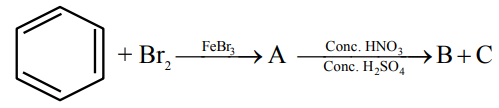 2026 Hard
- (A) Simple distillation
- (B) Sublimation
- (C) Steam distillation
- (D) Fractional distillation
Show answer and solution
Correct Answer: (D)
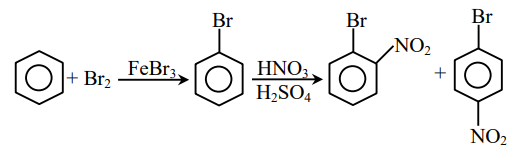
B & C separate by
Fractional Distillation method
Due to their different boiling point. -
- (A) \(0.42\)
- (B) \(0.82\)
- (C) \(0.62\)
- (D) \(0.12\)
Show answer and solution
Correct Answer: (D)
\(2\)-methylpropene reacts with dilute \(H_2SO_4\) to undergo hydration, forming tert-butyl alcohol as the major product (X).
The reaction is:
\(CH_2=C(CH_3)_2 \xrightarrow{\text{dil. } H_2SO_4} (CH_3)_3C-OH\)
Product (X) is an alcohol, which is significantly more polar than the starting alkene due to the presence of the \(-OH\) group. In normal phase chromatography, the stationary phase (such as silica gel) is highly polar. The polar \(-OH\) group forms strong hydrogen bonds with the stationary phase, causing the alcohol to be adsorbed more strongly than the non-polar alkene.
Consequently, the alcohol travels a shorter distance along the chromatography plate, resulting in a lower \(R_f\) value compared to the alkene.
Since the \(R_f\) value of \(2\)-methylpropene is \(0.42\), the \(R_f\) value of product (X) must be less than \(0.42\). Among the given choices, only \(0.12\) satisfies this condition.
Answer: \(0.12\) -
- (A) Statement I is true but Statement II is false
- (B) Statement I is false but Statement II is true
- (C) Both Statement I and Statement II are false
- (D) Both Statement I and Statement II are true
Show answer and solution
Correct Answer: (A)
Statement \(I\) is true.
In partition chromatography, stationary phase is thin liquid film present in the inert support.
Statement II is false.
Because stationary phase in paper chromatography is water. -
- (A) (A)-(II), (B)-(III), (C)-(IV), (D)-(I)
- (B) (A)-(II), (B)-(IV), (C)-(I), (D)-(III)
- (C) (A)-(III), (B)-(IV), (C)-(II), (D)-(I)
- (D) (A)-(III), (B)-(I), (C)-(IV), (D)-(II)
Show answer and solution
Correct Answer: (D)
List-I (Purification technique) List-II (Mixture of organic compounds) (A) Distillation (simple) (III) Chloroform + Aniline (B) Fractional distillation (I) Diesel + Petrol (C) Distillation under reduced pressure (IV) Glycerol + Spent-lye (D) Steam distillation (II) Aniline + Water -
- (A) (A)-(IV), (B)-(III), (C)-(II), (D)-(I)
- (B) (A)-(I), (B)-(II), (C)-(III), (D)-(IV)
- (C) (A)-(III), (B)-(IV), (C)-(I), (D)-(II)
- (D) (A)-(II), (B)-(I), (C)-(IV), (D)-(III)
Show answer and solution
Correct Answer: (A)
(A) Aniline \(-\mathrm{H}_2 \mathrm{O}\) : Steam Distillation
(B) Glycerol from spent-lye in soap industry - Distillation under reduced pressure
(C) Different fraction of crude oil in petroleum industry - Fractional distillation
(D) \(\mathrm{CHCl}_3-\) Aniline - Simple distillation -
- (A) Distillation
- (B) Extraction
- (C) Sublimation
- (D) Crystallization
Show answer and solution
Correct Answer: (C)
Phase transfer from solid to vapour directly is known as sublimation. -
- (A) Extraction
- (B) Chromatography
- (C) Distillation
- (D) Sublimation
Show answer and solution
Correct Answer: (B)
Principle used in chromotography is adsorption. -
- (A) \(B\) only
- (B) \(A\) only
- (C) \(A\) & \(B\) only
- (D) \(C\) only
Show answer and solution
Correct Answer: (C)
Memory Based -
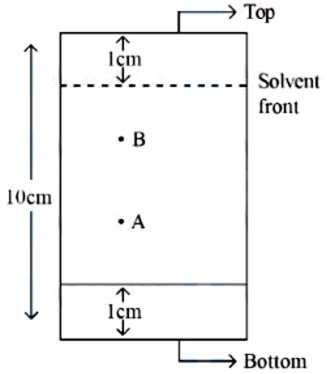
- (A) 15
- (B) 20
- (C) 25
- (D) 30
Show answer and solution
Correct Answer: (A)
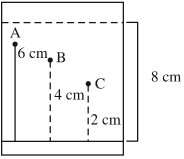
\(\begin{array}{l}R_{f_A}=\frac{\text { distance traveled by substance from base line }}{\text { distance traveled by Solvent from base line }} \\ R_{f_A}=\frac{4}{8} R_{f_B}=\frac{6}{8} \\ \frac{R_{f_B}}{R_{f_A}}=\frac{6}{8} \times \frac{8}{4} \\ R_{f_B}=1.5 \times R_{f_A} \\ x =15\end{array}\) -
- (A) \(A-IV, B-I, C-II, D-III\)
- (B) \(A-IV, B-III, C-II. D-I\)
- (C) \(A-I. B-II, C-IV, D-III\)
- (D) \(A-II, B-III. C-I, D-IV\)
Show answer and solution
Correct Answer: (B)
Fact \((NCERT)\) -
- (A) neither on nature of compound nor on the impurity present.
- (B) nature of compound only.
- (C) nature of compound and presence of impurity.
- (D) presence of impurity only.
Show answer and solution
Correct Answer: (C)
Organic compounds are purified based on their nature and impruity present in it. -
- (A) \(06\)
- (B) \(07\)
- (C) \(8\)
- (D) \(5\)
Show answer and solution
Correct Answer: (B)
Retardation factor \(=\frac{\text { Distance travelled by sample/organic compound }}{\text { Distance travelled by solvent }}\) \(=\frac{3.5}{5}=7 \times 10^{-1}\) -
- (A) \(B\) only
- (B) \(C\) and \(D\) only
- (C) \(A\) and \(B\) only
- (D) \(A\) only
Show answer and solution
Correct Answer: (C)
The most common polar and acidic support used is adsorption chromatography is silica. The surface silanol groups on their supported to adsorb polar compound and work particularly well for basic substances. Alumina is the example of polar and basic adsorbent that is used in adsorption chromatography. - 19. The correct statements among the following for a ' chromatography ' purification method is _______. 2024 Medium
- (A) Organic compounds run faster than solvent in the thin layer chromatographic plate.
- (B) Non-polar compounds are retained at top and polar compounds come down in column chromatography.
- (C) \(R_f\) of a polar compound is smaller than that of a non-polar compound.
- (D) \(R_f\) is an integral value.
Show answer and solution
Correct Answer: (C)
Non polar compounds are having higher value of \(R_f\) than polar compound. -
- (A) crystallisation
- (B) distillation under reduced pressure
- (C) distillation
- (D) steam distillation
Show answer and solution
Correct Answer: (D)
Steam distillation technique is applied to separate substances which are steam volatile and are immiscible with water. -
- (A) Fractional distillation
- (B) Fractional distillation under reduced pressure
- (C) Distillation
- (D) Steam distillation
Show answer and solution
Correct Answer: (D)
Steam distillation is used for those liquids which are insoluble in water, containing non-volatile impurities and are steam volatile. -
- (A) \(50\)
- (B) \(40\)
- (C) \(30\)
- (D) \(20\)
Show answer and solution
Correct Answer: (A)
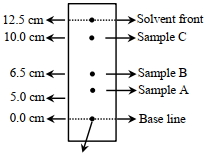
\(R_r \text { of } A=\frac{5}{12.5} \quad R_r \text { of } C=\frac{10}{12.5}\)\(\text { Ratio }=\frac{R_{f(A)}}{R_{f(C)}}=\frac{1}{2}=0.5 \text { or } 50 \times 10^{-2}\)
- 23. Which among the following purification methods is based on the principle of "Solubility" in two different solvents? 2024 Hard
- (A) Column Chromatography
- (B) Sublimation
- (C) Distillation
- (D) Differential Extraction
Show answer and solution
Correct Answer: (D)
Different ExtractionDifferent layers are formed which can be separated in funnel. (Theory based).
-
- (A) \(A, B, C\) only
- (B) \(A, C, D\) only
- (C) \(B, C, D\) only
- (D) \(A, B, D\) only
Show answer and solution
Correct Answer: (B)
Option \((B)\) is incorrect because aniline is immisible in water. -
- (A) \(A-(iii), B-(iv), C-(ii), D-(i)\)
- (B) \(A-(i), B-(iii), C-(ii), D-(iv)\)
- (C) \(A-(ii), B-(iii), C-(iv), D-(i)\)
- (D) \(A-(ii), B-(iv), C-(i), D-(iii)\)
Show answer and solution
Correct Answer: (C)
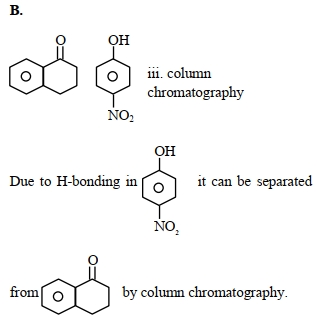
\(A\). \(H _2 O / CH _2 Cl _2 \rightarrow\) \(ii\), \(CH _2 Cl _2> H _2 O\) (density) so they can be separated by differential solvent extraction.\(B\).\(C.\) Kerosene / Naphthalene \(\rightarrow\) iv. Fractional distillation.
Due to different B.P. of kerosene and Naphthalene it can be separated by fractional distillation.
\(D.\) \(C _6 H _{12} O _6 / NaCl \rightarrow\) i. Crystallization.
\(NaCl\) (ionic compound) can be crystallized.
-
- (A) \(A-IV, B-I, C-III, D-II\)
- (B) \(A-III, B-IV, C-I, D-II\)
- (C) \(A-II, B-I, C-III, D-IV\)
- (D) \(A-III, B-I, C-IV, D-II\)
Show answer and solution
Correct Answer: (B)
List \(I\) (Mixture) List \(II\) (Separation Technique) \(A\) \(CHCl _3+ C _6 H _5 NH _2\) \(I\) Distillation \(B\) \(C _6 H _{14}+ C _5 H _{12}\) \(II\) Fractional distillation \(C\) \(C _6 H _5 NH _2+ H _2 O\) \(III\) Steam distillation \(D\) Organic compound in \(H _2 O\) \(IV\) Differential extraction NCERT \((XI)\) Vol. \(2\) Page No. \(359, 360. \)
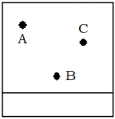
- 27. Thin layer chromatography of a mixture shows the following observation: The correct order of elution in the silica gel column chromatography is
 2023 Medium
- (A) \(A,C,B\)
- (B) \(B,C,A\)
- (C) \(C,A,B\)
- (D) \(B,A,C\)
Show answer and solution
Correct Answer: (A)
According to the observation,\(A\) is more mobile and interacts with the mobile phase more than \(C\), and \(C\) is more drawn to the mobile phase than \(B\).Hence, the correct order of elution in the silico gel column chromatography is \(- B < C < A\)

-
- (A) \(24\)
- (B) \(25\)
- (C) \(23\)
- (D) \(22\)
Show answer and solution
Correct Answer: (B)
More \(R _{ f }\), less its polarity\(R _{ f }=\frac{\text { Distance travelled by compound ' } X \text { ' }}{\text { Distance travelled by solvent ' } Y '}\)
\(=\frac{2}{8}=0.25=25 \times 10^{-2}\)
- 29. Using column chromatography, mixture of two compounds ' \(A\) ' and ' \(B\) ' was separated. '\(A\)' eluted first, this indicates ' \(B\) ' has 2023 Medium
- (A) low \(R_f\), weaker adsorption
- (B) high \(R _{ f }\), stronger adsorption
- (C) high \(R_f\), weaker adsorption
- (D) low \(R _{ f }\), stronger adsorption
Show answer and solution
Correct Answer: (D)
If any component eluted second then it means that its \(R_f\) value is low and its adsorption is stronger\(R _{ f }=\frac{\text { distance covered by substance from base line }}{\text { total distance covered by solvent from base line }}\)
-
- (A) Water present in the mobile phase gets absorbed by the paper which then forms the stationary phase.
- (B) Water present in the pores of the paper forms the stationary phase.
- (C) Paper sheet forms the stationary phase.
- (D) Paper and water present in its pores together form the stationary phase.
Show answer and solution
Correct Answer: (B)
In paper chromatography, a special quality paper known as chromatography paper is used. Paper contains water trapped in it, which acts as the stationary phase. -
- (A) Both \(A\) and \(R\) are true and \(R\) is the correct explanation of \(A.\)
- (B) Both \(A\) and \(R\) are true but \(R\) is \(NOT\) the correct explanation of \(A\)
- (C) \(A\) is true but \(R\) is false
- (D) \(A\) is false but \(R\) is true
Show answer and solution
Correct Answer: (A)
Theory basedThin layer chromoatography \((TLC)\) is another type of adsorption chromatography, which involve sepration of substance of a mixture ovel a thin layer of an adsorbent coated on glass plate. A thin layer (about \(0.2\,mm\) thick) of an adsorbent (silica gel) or (Alumina) in spread overa glass plate of suitable size. Hence Assertion \((A)\) is correct and Reason \((R)\) is correct explanation of \((A)\)
-
- (A) \((A)-(IV), (B)-(III), (C)-(I), (D)-(II)\)
- (B) \((A)-(III), (B)-(I), (C)-(IV), (D)-(II)\)
- (C) \((A)-(III), (B)-(IV), (C)-(II), (D)-(I)\)
- (D) \((A)-(III), (B)-(IV), (C)-(I), (D)-(II)\)
Show answer and solution
Correct Answer: (D)
\((A)\) Chloroform + Aniline \(\rightarrow\) \((III)\) Distillation\((B)\) Benzoic acid + Napthalene \(\rightarrow\) \((IV)\) Crystallisation
\((C)\) Water + Aniline \(\rightarrow\) \((I)\) Steam distillation
\((D)\) Napthalene + Sodium chloride \(\rightarrow\) \((II)\) Sublimation
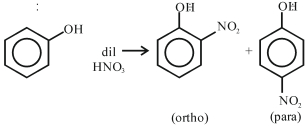
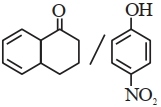
- 33. Phenol on reaction with dilute nitric acid, gives two products. Which method will be most effective for large scale separation ? 2022 Medium
- (A) Chromatographic separation
- (B) Fractional Crystallisation
- (C) Steam distillation
- (D) Sublimation
Show answer and solution
Correct Answer: (C)
Para product has higher boiling point than ortho as intermolecular \(H\)-bond is possible in former, where as intramolecular \(H\)-bond is possible in ortho product.Steam distillation can separate them as ortho product is steam volatile.
-
- (A) \((A)\) is false but \((R)\) is true.
- (B) Both \((A)\) and \((R)\) are correct but \((R)\) is not the correct explanation of \((\mathrm{A})\)
- (C) \((A)\) is true but \((R)\) is false
- (D) Both \((A)\) and \((R)\) are correct and \((R)\) is the correct explanation of \((\mathrm{A})\)
Show answer and solution
Correct Answer: (D)
Both assertion \(\&\) reason are correct \(\&\) \((\mathrm{R})\) is the correct explanation of \((A)\) -
- (A) Statement\(-I\) is false but Statement \(II\) is true
- (B) Both Statement\(-I\) and Statement \(II\) are false
- (C) Statement\(-I\) is true but Statement \(II\) is false
- (D) Both Statement\(-I\) and Statement \(II\) are true
Show answer and solution
Correct Answer: (D)
Statement \(1: B.P.\) of chloroform \(=334 K\)\(B.P.\) of aniline \(=457 K\)
thus can be seprated of simple distillation.
Statement \(2 :\) Mixture of aniline and water seprated by simple distillation.
-
- (A) Statement\(-I\) is true but statement\(-II\) is false
- (B) Both statement\(-I\) and statement\(-II\) are true
- (C) Both statement\(-I\) and statement\(-II\) are false
- (D) Statement\(-I\) is false but statement-II is true
Show answer and solution
Correct Answer: (C)
\(R _{ f }=\) retardation factorDistance travelled by the substance from
\(R _{ f }=\frac{\text { reference line }( c \cdot m )}{\text { Distan ce travelled by the solvent from }}\)
reference line \((c.m)\)
Note : \(R _{ f }\) value of different compounds are different.
-
- (A) Mobility or flow of solvent system
- (B) Solubility of the compound
- (C) Length of the column or \(TLC\) Plate
- (D) Physical state of the pure compound
Show answer and solution
Correct Answer: (D)
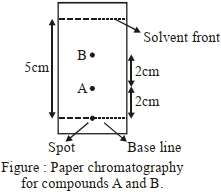
In chromotography technique, the purification of a compound is independent of the physical - 38. Using the provided information in the following paper chromatogram the calculate \(R _{ f }\) value of \(A\) .......... \(\times 10^{-1}\)
 2021 Medium
- (A) \(2\)
- (B) \(1\)
- (C) \(4\)
- (D) \(3\)
Show answer and solution
Correct Answer: (C)
\(R _{ f }=\frac{\text { Distance travelled by compound }}{\text { Distance travelled by solvent }}\)on chromatogram distance travelled by cmopound is \(\rightarrow 2 \,cm\)
Distance travelled by solvent \(=5\, cm\)
So \(R _{ f }=\frac{2}{5}=4 \times 10^{-1}=0.4\)
- 39. Which purification technique is used for high boiling organic liquid compound (decomposes near its boiling point)? 2021 Medium
- (A) Steam distillation
- (B) Simple distillation
- (C) Fractional distillation
- (D) Reduced pressure distillation
Show answer and solution
Correct Answer: (D)
Reduced pressure distillation used for the purification of high boiling organic liquids which decomposes at or below their boiling point. -
- (A) \((\mathrm{B}),(\mathrm{C})\) and \((\mathrm{A})\)
- (B) \((\mathrm{C}),(\mathrm{A})\) and \((\mathrm{B})\)
- (C) \((\mathrm{A}),(\mathrm{B})\) and \((\mathrm{C})\)
- (D) \((\mathrm{B}),(\mathrm{A})\) and \((\mathrm{C})\)
Show answer and solution
Correct Answer: (B)
Benzanilide \(\rightarrow\) Ph-NH-CO-Ph \((\mu=2.71 \mathrm{D})\)Aniline \(\rightarrow \mathrm{Ph}-\mathrm{NH}_{2}\), \((\mu=1.59 \mathrm{D})\)
Acetophenone \(\rightarrow\) Ph-O-CH \(_{3}\) ( \(\mu=3.05 \mathrm{D}\) )
Dipole moment : \({C}>{A}>{B}\)
Hence the sequence of obtained compounds is \((\mathrm{C})\;,(\mathrm{A})\) and \((\mathrm{B})\)
-
- (A) simple distillation, \(3-\)methylpentane
- (B) simple distillation, isohexane
- (C) fractional distillation, isohexane
- (D) fractional distillation, \(3-\)methylpentane
Show answer and solution
Correct Answer: (C)
Liquid which have less difference in boiling point can be isolated by fractional distillation and liquid with less boiling point will be isolated first. -
- (A) Steam distillation
- (B) Differential extraction
- (C) Distillation under reduced pressure
- (D) Fractional distillation
Show answer and solution
Correct Answer: (C)
Glycerol is separated by reduced pressure distillation in soap industries. -
- (A) \(a\, \to \,q,\,\,b \to \,p,\,\,c \to r\)
- (B) \(a\, \to \,r,\,\,b \to \,q,\,\,c \to p\)
- (C) \(a\, \to \,q,\,\,b \to \,r,\,\,c \to p\)
- (D) \(a\, \to \,p,\,\,b \to \,r,\,\,c \to q\)
Show answer and solution
Correct Answer: (B)
Acetonitrile is used as mobile phase for most of the reverse chromatography. Benzaldehyde is adsorbed on alumina. -
- (A) \(a - d, b -r, c -p\)
- (B) \(a -q, b -r, c -s\)
- (C) \(a -r, b -p, c -s\)
- (D) \(a -q, b -r, c -p\)
Show answer and solution
Correct Answer: (B)
(mixture) \(\quad\quad\quad\quad\) (seperation method)\(H _2 O : \text { Sugar } \Rightarrow \text { Recrystallization }\)
\(H _2 O : \text { Aniline } \Rightarrow \text { Steam distillation }\)
\(H _2 O \text { : Toluene } \Rightarrow \text { Differential extraction }\)
-
- (A) \(II\) moves slower and has higher \(R_f\) value than \(I\)
- (B) \(II\) moves faster and has higher \(R_f\) value than \(I\)
- (C) \(I\) moves faster and has higher \(R_f\) value than \(II\)
- (D) \(I\) moves slower and has higher \(R_f\) value than \(I\)
Show answer and solution
Correct Answer: (B)
Since, adsorption of \(I > II\), \(I\) is firmly attached to column (stationary phase). Hence, it will move slowly and will move little distance. Also \(II\) is loosely attached to column (stationary phase). Hence, it will move faster and will move large distance -
- (A) Mobile phase can be a gas
- (B) Stationary phase is a finely divided solid adsorbent
- (C) Separation depends upon equilibration of solute between a mobile and a stationary phase
- (D) Paper chromatography is an example of partition chromatography
Show answer and solution
Correct Answer: (B)
Partition chromatography is the process of separation where by the component of the mixture get distributed into two phases that may be liquid-liquid, liquid gas but not to solid-gas. - 47. The distillation technique most suited for separating glycerol from spent-lye in the soap industry is: 2016 Medium
- (A) Steam distillation.
- (B) Distillation under reduced pressure.
- (C) Simple distillation
- (D) Fractional distillation
Show answer and solution
Correct Answer: (B)
Spent-lye and glycerol are separated by distillation under reduced pressure.Under the reduced pressure the liquid boil at low temperature and the temperature of decomposition will not reach. e.g. glycerol boils at \(290^{\circ} \mathrm{C}\) with decomposition but at reduced pressure it boils at \(180^{\circ} \mathrm{C}\) without decomposition.

No questions on this page match these filters.
Other STD 11 - Organic chemistry purification and characterization topics
Frequently asked
How many Purification of Organic Compounds questions came in JEE Mains?
47 questions from 2016–2026, each with the correct answer and a full solution.
How difficult are Purification of Organic Compounds questions?
4% are easy, 60% medium and 36% hard.