


Chapters asked in 2025
32 chapters- 35Qs STD 11 Units, dimensions and measurement Most asked
- 13Qs STD 12 Semicondutor electronics
- 8Qs STD 12 Nuclei
- 12Qs STD 12 Atoms
- 20Qs STD 12 Dual nature of radiation and matter
- 8Qs STD 12 Electromagnetic waves
- 19Qs STD 12 Wave optics
- 41Qs STD 12 Ray optics and optical instruments Most asked
- 10Qs STD 12 Alternating current
- 33Qs STD 11 System of particles and rotational motion Most asked
- 21Qs STD 12 Moving charges and magnetism
- 8Qs STD 12 Electromagnetic induction
- 5Qs STD 12 Magnetism and matter
- 14Qs STD 12 Current electricity
- 28Qs STD 12 Electric potential and capacitance
- 23Qs STD 12 Electric charges and fields
- 12Qs STD 11 Waves and sound
- 7Qs STD 11 Oscillations
- 11Qs STD 11 Kinetic theory of gases
- 23Qs STD 11 Thermodynamics
- 4Qs STD 11 10.1, thermonetry, thermal expansion and calorimetry
- 11Qs STD 11 Mechanical properties of solids
- 9Qs STD 11 Surface tension
- 12Qs STD 11 Fluid mechanics
- 7Qs STD 11 Newtons laws of motion
- 14Qs STD 11 Gravitation
- 16Qs STD 11 Work, energy, power and collision
- 2Qs STD 11 Friction
- 14Qs STD 11 Motion in plane
- 7Qs STD 11 Motion in straight line
- 6Qs STD 11 Transmission of heat
- 1Qs STD 11 Vectors
All JEE Mains 2025 Physics questions
32 chaptersShowing 1–50 of 454 questions
-
- (A) 661.845 g
- (B) 662 g
- (C) 661.8 g
- (D) 661.84 g
Show answer and solution
Correct Answer: (C)
\(\mathrm{m}_1+\mathrm{m}_2+\mathrm{m}_3=435.42+226.3+0.125\)
According to least significant digits \(\mathrm{m}=661.8 \mathrm{~g}\) -
- (A) 10
- (B) 15
- (C) 20
- (D) 50
Show answer and solution
Correct Answer: (B)
\(\mathrm{C}=\mathrm{P}^1 \mathrm{q}^2 \mathrm{r}^{-3} \mathrm{~s}^{1 / 2}\)
\(\left(\frac{\mathrm{dC}}{\mathrm{C}}\right)_{\max }=\frac{\mathrm{dP}}{\mathrm{P}}+\frac{2 \mathrm{dq}}{\mathrm{q}}+\frac{3 \mathrm{dr}}{\mathrm{r}}+\frac{1}{2} \frac{\mathrm{ds}}{\mathrm{s}}\)
\(\begin{aligned}& =\left(1+2 \times 2+3 \times 3+\frac{1}{2} \times 2\right) \% \\& =15 \%\end{aligned}\)
Ans. \(15\) -
- (A) 7500
- (B) 7200
- (C) 7700
- (D) 7100
Show answer and solution
Correct Answer: (C)
\(\begin{aligned} & \mathrm{Q}=\frac{\mathrm{ab}^4}{\mathrm{~cd}} \\ & \Rightarrow \frac{\Delta \mathrm{Q}}{\mathrm{Q}} \times 100=\left[\frac{\Delta \mathrm{a}}{\mathrm{a}}+4 \frac{\Delta \mathrm{~b}}{\mathrm{~b}}+\frac{\Delta \mathrm{c}}{\mathrm{c}}+\frac{\Delta \mathrm{d}}{\mathrm{d}}\right] \times 100 \\ & \Rightarrow \frac{\mathrm{x}}{1000}=\left[\frac{3}{60}+4\left(\frac{0.1}{20}\right)+\left(\frac{0.2}{40}\right)+\frac{0.1}{50}\right] \times 100 \\ & \Rightarrow \mathrm{x}=7700\end{aligned}\) -
- (A) 0.1
- (B) 0.8
- (C) 0.7
- (D) 0.6
Show answer and solution
Correct Answer: (C)
\(\begin{aligned} & \text { Fractional error }=2 \frac{\Delta X}{X}+\frac{3}{2} \frac{\Delta Y}{Y}+\frac{2}{5} \frac{\Delta Z}{Z} \\ & =2(0.1)+\frac{3}{2}(0.2)+\frac{2}{5}(0.5) \\ & =0.2+0.3+0.2=0.7\end{aligned}\) -
- (A) 5
- (B) 3
- (C) 4
- (D) 2
Show answer and solution
Correct Answer: (B)
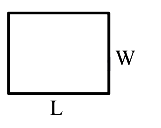
Since least count of the instrument can be calculated as
\(\begin{aligned}
& \text { Least count }=\frac{\text { pitch length }}{\text { No. of division on circular scale }} \\
& =\frac{0.75}{15}=0.05 \mathrm{~mm} .
\end{aligned}\)
Here we are provided \(\mathrm{L}=5 \mathrm{~mm} \& \mathrm{~W}=2.5 \mathrm{~mm}\) \(\mathrm{L}=5 \mathrm{~mm} \& \mathrm{~W}=2.5 \mathrm{~mm}\)
\(\because\) We know that
\(\mathrm{A}=\mathrm{L} . \mathrm{W}\)
For calculating fractional error, we can write
\(\frac{\mathrm{dA}}{\mathrm{~A}}=\frac{\mathrm{dL}}{\mathrm{~L}}+\frac{\mathrm{dW}}{\mathrm{~W}}\)
Here \(\mathrm{dL}=\mathrm{dW}=0.05 \mathrm{~mm}\)
\(\begin{aligned}
& \frac{\mathrm{dA}}{\mathrm{~A}}=\frac{0.05}{5}+\frac{0.05}{2.5} \\
& \Rightarrow \frac{\mathrm{dA}}{\mathrm{~A}}=\frac{1}{100}+\frac{2}{100}=\frac{3}{100}
\end{aligned}\)
So, \(x=3\) -
- (A) \(y=1326.19\)
- (B) \(y=1330\)
- (C) \(y=1326.186\)
- (D) \(y=1326.2\)
Show answer and solution
Correct Answer: (B)
Explanation:
The provided answer key is completely correct. The preference for Option D usually happens when the rule for addition/subtraction is mistakenly applied instead of the rule for multiplication/division:
1. Rule for Multiplication and Division:
In operations involving multiplication and division, the final result must be rounded off to contain the same number of significant figures as present in the component term with the least number of significant figures.
2. Counting Significant Figures in the Given Terms:
- \( 32.3 \) has 3 significant figures.
- \( 1125 \) has 4 significant figures.
- \( 27.4 \) has 3 significant figures.
Since the minimum number of significant figures among the given values is 3, the final answer must be rounded off to exactly 3 significant figures.
3. Calculation and Rounding:
\( y = \frac{32.3 \times 1125}{27.4} = 1326.186... \)
Rounding off \( 1326.186... \) to 3 significant figures:
The first three digits are 1, 3, and 2. The fourth digit is 6 (which is greater than 5), so the third digit increases by 1, yielding \( 1330 \). In the number \( 1330 \), the trailing zero without a decimal point is not significant, leaving exactly 3 significant figures.
Option D (\( 1326.2 \)) has 5 significant figures, which violates the rounding rule for multiplication and division.
Hence, Option B is the correct choice. -
- (A) \(0.001\)
- (B) \(0.002\)
- (C) \(0.0005\)
- (D) \(0.0025\)
Show answer and solution
Correct Answer: (B)
\(\begin{aligned} & 300 \mathrm{msd}=15 \mathrm{~cm} \\ & 1 \mathrm{msd}=\frac{15}{300} \mathrm{~cm}=0.05 \mathrm{~cm} \\ & 25 \mathrm{vsd}=24 \mathrm{msd} \\ & 1 \mathrm{vsd}=\frac{24}{25} \mathrm{msd} \\ & \mathrm{LC}=1 \mathrm{msd}-1 \mathrm{vsd}\end{aligned}\)
\(\begin{aligned}
& \mathrm{LC}=1 \mathrm{msd}-\frac{24}{25} \mathrm{msd}=\frac{1}{25} \mathrm{msd} \\
& \mathrm{LC}=\frac{1}{25} \times 0.05=0.002 \mathrm{~cm}
\end{aligned}\)
correct option (2) - 8. Given a charge \(q\), current I and permeability of vacuum \(\mu_0\). Which of the following quantity has the dimension of momentum? 2025 Medium
- (A) \(\mathrm{qI} / \mu_0\)
- (B) \(q \mu_0 I\)
- (C) \(q^2 \mu_0 I\)
- (D) \(q \mu_0 / I\)
Show answer and solution
Correct Answer: (B)
\(\begin{aligned} & \mathrm{Q}=\mathrm{AT} \\ & \mathrm{I}=\mathrm{A} \\ & \mu_0=\mathrm{MLT}^{-2} \mathrm{~A}^{-2} \\ & \mathrm{P}=\mathrm{Q}^{\mathrm{x}} \mu_0^{\mathrm{y}} \mathrm{I}^{\mathrm{z}}=[\mathrm{AT}]^{\mathrm{x}}\left[\mathrm{MLT}^{-2} \mathrm{~A}^{-2}\right]^{\mathrm{y}}[\mathrm{A}]^{\mathrm{z}} \\ & \mathrm{MLT}^{-1}=\mathrm{M}^{\mathrm{y}} \mathrm{L}^{\mathrm{y}} \mathrm{T}^{\mathrm{x}-2 \mathrm{y}} \mathrm{A}^{-2 \mathrm{y}+\mathrm{z+x}} \\ & \text { Now; } \mathrm{y}=1 \\ & \mathrm{x}-2 \mathrm{y}=-1 \\ & -2 \mathrm{y}+\mathrm{z}=0 \\ & \therefore \mathrm{x}=\mathrm{y}=\mathrm{z}=1\end{aligned}\) -
- (A) Statement I is true but Statement II is false
- (B) Statement I is false but Statement II is true
- (C) Both Statement I and Statement II are false
- (D) Both Statement I and Statement II are true
Show answer and solution
Correct Answer: (C)
In general one vernier scale division is smaller than one main scale division but in some modified cases it may be not correct. Also least count is given by one main scale division / number of vernier scale division for normal vernier calliper. -
- (A) \(\mathrm{L} / \mathrm{T}^2\)
- (B) \(L^2 / T^2\)
- (C) \(T^2 / L\)
- (D) \(\mathrm{T}^2 / \mathrm{L}^2\)
Show answer and solution
Correct Answer: (B)
\(\mathrm{C}=\frac{1}{\sqrt{\mu_0 \varepsilon_0}} \Rightarrow \frac{1}{\mu_0 \varepsilon_0}=\mathrm{C}^2=\mathrm{L}^2 \mathrm{~T}^{-2}\) -
- (A) Electric field
- (B) Electric potential
- (C) Electric charge
- (D) Electric current
Show answer and solution
Correct Answer: (D)
We know that formula for displacement current is given by
\(\mathrm{id}=\varepsilon_0 \frac{\mathrm{~d} \phi_{\varepsilon}}{\mathrm{dt}}\) - 12. If \(B\) is magnetic field and \(\mu_0\) is permeability of free space, then the dimensions of \(\left(B / \mu_0\right)\) is 2025 Easy
- (A) \(\mathrm{ML}^2 \mathrm{~T}^{-2} \mathrm{~A}^{-1}\)
- (B) \(\mathrm{MT}^{-2} \mathrm{~A}^{-1}\)
- (C) \(\mathrm{L}^{-1} \mathrm{~A}\)
- (D) \(\mathrm{LT}^{-2} \mathrm{~A}^{-1}\)
Show answer and solution
Correct Answer: (C)
For a current carrying loop at centre
\(\begin{aligned}
& B=\frac{\mu_0 i}{2 R} \\
& \therefore \quad \frac{B}{\mu_0} \equiv \frac{i}{R} \equiv\left[\mathrm{AL}^{-1}\right]
\end{aligned}\) -
- (A) 0
- (B) -5
- (C) -6
- (D) -1
Show answer and solution
Correct Answer: (A)
Modulus of Elasticity: \(E = \left[ML^{-1}T^{-2}\right]\)
Torque: \(\tau = \left[ML^2T^{-2}\right]\)
Dimension of \(\frac{E}{\tau}\): \(\frac{\left[ML^{-1}T^{-2}\right]}{\left[ML^2T^{-2}\right]} = \left[M^{1-1} L^{-1-2} T^{-2-(-2)}\right] = \left[M^0 L^{-3} T^0\right]\)
Comparing with \(\left[M^a L^b T^c\right]\): \(a=0, b=-3, c=0\)
Given \(b=-3\), the value of \(c\) is \(0\).
-
- (A) \(-1,0\)
- (B) \(-1,1\)
- (C) \(1,-1\)
- (D) \(0,-1\)
Show answer and solution
Correct Answer: (D)
Electric dipole moment \((\overrightarrow{\mathrm{P}})=\mathrm{q} \times 2 \ell\)
Magnetic dipole moment \((\overrightarrow{\mathrm{M}})=\mathrm{IA}\)
\(\left[\frac{\mathrm{P}}{\mathrm{M}}\right]=\left[\frac{\mathrm{LTA}}{\mathrm{~L}^2 \mathrm{~A}}\right]=\mathrm{L}^{-1} \mathrm{~T}=\mathrm{M}^0 \mathrm{~L}^{-1} \mathrm{~T}^1 \mathrm{~A}^0\)
After compering values of \(\mathrm{P} \& \mathrm{Q}\) are \(0,-1\) Correct Answer : Option 4 -
- (A) \((3,-5)\)
- (B) \((-2,2)\)
- (C) \((-2,1)\)
- (D) \((1,-1)\)
Show answer and solution
Correct Answer: (D)
\(\begin{aligned} & \frac{\phi_{\mathrm{E}}}{\phi_{\mathrm{M}}}=\frac{\mathrm{EA}}{\mathrm{BA}}=\frac{E}{B} \\ & \mathrm{~B}=\frac{\mathrm{M} \ell \mathrm{T}^{-2}}{\mathrm{ATLT}^{-1}} \\ & \text { So }\left[\frac{\mathrm{E}}{\mathrm{B}}\right]=\frac{\mathrm{ML}^{-3} \mathrm{~A}^{-1}}{\mathrm{MT}^{-2} \mathrm{~A}^{-1}}=\mathrm{LT}^{-1}\end{aligned}\)
\(\begin{aligned} & \text { Or } \\ & E=c \cdot B \\ & {\left[\frac{E}{B}\right]=L T^{-1}}\end{aligned}\) -
- (A) (A)-(III), (B)-(I), (C)-(II), (D)-(IV)
- (B) (A)-(IV), (B)-(III), (C)-(II), (D)-(I)
- (C) (A)-(III), (B)-(IV), (C)-(I), (D)-(II)
- (D) (A)-(II), (B)-(III), (C)-(I), (D)-(IV)
Show answer and solution
Correct Answer: (D)
\(\begin{aligned} & \mathrm{C}^{\prime}=\frac{\Delta \mathrm{Q}}{\Delta \mathrm{T}}=\mathrm{JK}^{-1} \\ & \mathrm{~S}=\frac{\Delta \mathrm{Q}}{\mathrm{m} \Delta \mathrm{T}}=\mathrm{Jkg}^{-1} \mathrm{~K}^{-1} \\ & \mathrm{~L}=\frac{\Delta \mathrm{Q}}{\mathrm{m}}=\mathrm{Jkg}^{-1} \\ & \Delta \mathrm{Q}=\frac{\mathrm{KA} \Delta \mathrm{T}}{\mathrm{L}} \Rightarrow \mathrm{K}=\frac{\Delta \mathrm{Q}(\mathrm{L})}{\mathrm{A} \Delta \mathrm{T}}=\mathrm{Jm}^{-1} \mathrm{~K}^{-1} \mathrm{~s}^{-1}\end{aligned}\) -
- (A) (A)-(IV), (B)-(III), (C)-(I), (D)-(II)
- (B) (A)-(III), (B)-(II), (C)-(IV), (D)-(I)
- (C) (A)-(I), (B)-(IV), (C)-(II), (D)-(III)
- (D) (A)-(II), (B)-(I), (C)-(III), (D)-(IV)
Show answer and solution
Correct Answer: (B)
(A) \(B=\frac{\mu_0 i}{2 \pi r} \& q v B=F\)
\(\mu_0 \equiv \frac{B r}{i} \equiv \frac{F r}{q v i} \equiv \frac{\mathrm{MLT}^{-2} \times L}{\mathrm{~A}^2 \mathrm{TLT}^{-1}} \equiv \mathrm{MLT}^{-2} A^{-2}\)
(B) \(B \equiv \frac{F}{q V} \equiv \frac{\mathrm{MLT}^{-2}}{\mathrm{ATLT}^{-1}}=\mathrm{MT}^{-2} \mathrm{~A}^{-1}\)
(C) \(M=i A \equiv \mathrm{AL}^2\)
(D) \(\tau=C \theta \Rightarrow C \equiv \mathrm{ML}^2 \mathrm{~T}^{-2}\) -
- (A) (A)-(I), (B)-(III), (C)-(II), (D)-(IV)
- (B) (A)-(IV), (B)-(II), (C)-(III), (D)-(I)
- (C) (A)-(II), (B)-(IV), (C)-(I), (D)-(III)
- (D) (A)-(II), (B)-(I), (C)-(IV), (D)-(III)
Show answer and solution
Correct Answer: (C)
(A) \([\mathrm{Y}]=\frac{\mathrm{F}}{\mathrm{A}\left(\frac{\Delta \ell}{\ell}\right)} \Rightarrow \frac{\mathrm{MLT}^{-2}}{\mathrm{~L}^2}=\mathrm{ML}^{-1} \mathrm{~T}^{-2}\)
(B) Torque \((\vec{\tau})=\overrightarrow{\mathrm{r}} \times \overrightarrow{\mathrm{F}}\)
\((\vec{\tau})=\mathrm{L} \times \mathrm{MLT}^{-2}=\mathrm{ML}^2 \mathrm{~T}^{-2}(\mathrm{IV})\)
(C) Coefficient of viscosity \(\Rightarrow F=\eta A \frac{d V}{d t}\)
\(\eta \rightarrow \mathrm{Pa} \cdot \mathrm{sec}\)
\([\eta]=\frac{\mathrm{MLT}^{-2}}{\mathrm{~L}^2} \times \mathrm{T}=\mathrm{ML}^{-1} \mathrm{~T}^{-1}\)
(D) Gravitational constant (G)
\(\begin{aligned}
& \mathrm{F}=\frac{\mathrm{GM}_1 \mathrm{M}_2}{\mathrm{r}^2} \\
& {[\mathrm{G}]=\frac{\mathrm{F} \cdot \mathrm{r}^2}{\mathrm{~m}_1 \mathrm{~m}_2}=\frac{\mathrm{MLT}^{-2} \times \mathrm{L}^2}{\mathrm{M}^2}=\mathrm{M}^{-1} \mathrm{~L}^3 \mathrm{~T}^{-2}}
\end{aligned}\) -
- (A) (A)-(II), (B)-(I), (C)-(IV), (D)-(III)
- (B) (A)-(I), (B)-(III), (C)-(IV), (D)-(II)
- (C) (A)-(III), (B)-(I), (C)-(II), (D)-(IV)
- (D) (A)-(III), (B)-(I), (C)-(IV), (D)-(II)
Show answer and solution
Correct Answer: (D)
Angular impulse = \(\left[M L^2 T^{-1}\right]\)
Latent Heat = \(\left[M^0 L^2 T^{-2}\right]\)
Electrical resistivity = \(\left[M L^3 T^{-3} A^{-2}\right]\)
Electromotive force = \(\left[M L^2 T^{-3} A^{-1}\right]\) -
- (A) (A)-(IV), (B)-(II), (C)-(III), (D)-(I)
- (B) (A)-(I), (B)-(III), (C)-(IV), (D)-(II)
- (C) (A)-(IV), (B)-(II), (C)-(I), (D)-(III)
- (D) (A)-(II), (B)-(III), (C)-(IV), (D)-(I)
Show answer and solution
Correct Answer: (C)
(A) Mass density \(=\frac{M}{V}=M^1 L^{-3}\)...(iv)
(B) Impulse \(=\mathrm{M} \times \mathrm{u}=\mathrm{M}^1 \mathrm{~L}^1 \mathrm{~T}^{-1}\)....(ii)
(C) Power \(=\mathrm{F}. \mathrm{V}=\mathrm{M}^1 \mathrm{~L}^2 \mathrm{~T}^{-3}\)....(i)
(D) Moment of inertia \(=\mathrm{Mr}^2=\mathrm{M}^1 \mathrm{~L}^2\)...(iii) -
- (A) (A)-(I), (B)-(II), (C)-(III), (D)-(IV)
- (B) (A)-(III), (B)-(IV), (C)-(I), (D)-(II)
- (C) (A)-(III), (B)-(II), (C)-(I), (D)-(IV)
- (D) (A)-(III), (B)-(IV), (C)-(II), (D)-(I)
Show answer and solution
Correct Answer: (D)
(A) Magnetic induction \(\rightarrow\) Gauss (III)
(B) Magnetic intensity
\(\left(\mathrm{H}=\frac{\mathrm{B}}{\mu}\right) \rightarrow\) Ampere \(/\) meter (IV)
(C) Magnetic flux \(\rightarrow\) Weber (Wb) (II)
(D) Magnetic moment \(\rightarrow\) Ampere-meter \({ }^2\)
\((\overrightarrow{\mathrm{M}}=\mathrm{i} \overrightarrow{\mathrm{~A}})\) -
- (A) \((\mathrm{A})-(\mathrm{I}),(\mathrm{B})-(\mathrm{IV}),(\mathrm{C})-(\mathrm{III}),(\mathrm{D})-(\mathrm{II})\)
- (B) (A)-(IV), (B)-(I), (C)-(II), (D)-(III)
- (C) \((\mathrm{A})-(\mathrm{IV}),(\mathrm{B})-(\mathrm{II}),(\mathrm{C})-(\mathrm{I}),(\mathrm{D})-(\mathrm{III})\)
- (D) (A)-(II), (B)-(III), (C)-(IV), (D)-(I)
Show answer and solution
Correct Answer: (B)
(A) Coefficient of viscosity \([\eta]=\left[\mathrm{M}^1 \mathrm{~L}^{-1} \mathrm{~T}^{-1}\right]\)
(B) Intensity \([\mathrm{I}]=\left[\mathrm{M}^1 \mathrm{~L}^0 \mathrm{~T}^{-3}\right]\)
(C) Pressure gradient \(=\left[\mathrm{ML}^{-2} \mathrm{~T}^{-2}\right]\)
(D) Compressibility \([\mathrm{K}]=\left[\mathrm{M}^{-1} \mathrm{~L}^1 \mathrm{~T}^2\right]\) -
- (A) A-III, B-IV, C-I, D-II
- (B) A-II, B-III, C-IV, D-I
- (C) A-III, B-II, C-I, D-IV
- (D) A-III, B-IV, C-II, D-I
Show answer and solution
Correct Answer: (A)
(A) \([\mathrm{k}]=\frac{\mathrm{PV}}{\mathrm{NT}}=\frac{\mathrm{ML}^2 \mathrm{~T}^{-2}}{\mathrm{~K}}=\mathrm{ML}^2 \mathrm{~T}^{-2} \mathrm{~K}^{-1}\)
(B) \([\eta]=\frac{\mathrm{F}}{6 \pi \mathrm{rv}}=\frac{\mathrm{MLT}^{-2}}{\mathrm{~L}^2 \mathrm{~T}^{-1}}=\mathrm{ML}^{-1} \mathrm{~T}^{-1}\)
(C) \([\mathrm{h}]=\frac{\mathrm{E}}{\mathrm{f}}=\frac{\mathrm{ML}^2 \mathrm{~T}^{-2}}{\mathrm{~T}^{-1}}=\mathrm{ML}^2 \mathrm{~T}^{-1}\)
(D) \(\frac{\mathrm{dQ}}{\mathrm{dt}}=\mathrm{k} \frac{\mathrm{AdT}}{\mathrm{dx}}\)
\(\mathrm{k}=\frac{\left(\mathrm{ML}^2 \mathrm{~T}^{-3}\right) \mathrm{L}}{\mathrm{L}^2 \cdot \mathrm{~K}}=\mathrm{MLT}^{-3} \mathrm{~K}^{-1}\) -
- (A) A-IV, B-III, C-II, D-I
- (B) A-III, B-II, C-I, D-IV
- (C) A-II, B-IV, C-III, D-I
- (D) A-I, B-III, C-IV, D-II
Show answer and solution
Correct Answer: (A)
\(\begin{aligned}
& \text { (A) } \mathrm{G}=\frac{\mathrm{Fr}^2}{\mathrm{~m}^2} \\
& {[\mathrm{G}]=\frac{\left[\mathrm{MLT}^{-2}\right]\left[\mathrm{L}^2\right]}{\left[\mathrm{M}^2\right]}=\left[\mathrm{M}^{-1} \mathrm{~L}^3 \mathrm{~T}^{-2}\right](\mathrm{IV})}
\end{aligned}\)
(B)
\(\begin{aligned}
& \text { P.E. }=\mathrm{mgh}=\left[\mathrm{MLT}^{-2} \mathrm{~L}\right] \\
& =\left[\mathrm{ML}^2 \mathrm{~T}^{-2}\right] \text { (III) }
\end{aligned}\)
(C) Gravitational Potential \(=\frac{\mathrm{GM}}{\mathrm{r}}\)
\(=\frac{\left[\mathrm{M}^{-1} \mathrm{~L}^3 \mathrm{~T}^{-2}\right][\mathrm{M}]}{[\mathrm{L}]}=\left[\mathrm{M}^0 \mathrm{~L}^2 \mathrm{~T}^{-2}\right]=\left[\mathrm{L}^2 \mathrm{~T}^{-2}\right](\mathrm{II})\)
(D) Acceleration due to gravity \(=[\mathrm{g}]=\left[\mathrm{LT}^{-2}\right](\mathrm{I})\) -
- (A) Voltage
- (B) Capacitance
- (C) Inductance
- (D) Resistance
Show answer and solution
Correct Answer: (D)
\(\begin{aligned} & L=\frac{\mu_0 N A}{\ell} \\ & C=\frac{A \epsilon_0}{d} \\ & \frac{L}{C} \propto \frac{\mu_0}{\epsilon_0} \\ & \sqrt{\frac{\mu_0}{\epsilon_0}} \propto \sqrt{\frac{L}{C}} \\ & \frac{L}{C}=\frac{\tau R}{(\tau / R)}=R^2 \\ & \sqrt{\frac{\mu_0}{\epsilon_0}}=R\end{aligned}\) -
- (A) electric field
- (B) area
- (C) charge
- (D) displacement
Show answer and solution
Correct Answer: (D)
\(\begin{aligned} & \alpha \equiv \frac{\phi}{\sigma} \\ & \beta=\frac{\phi}{\lambda} \\ & \frac{\alpha}{\beta} \equiv \frac{\lambda}{\sigma} \equiv \text { displacement }\end{aligned}\) -
- (A) \(6 \%\)
- (B) \(8.4 \%\)
- (C) \(11.6 \%\)
- (D) \(4 \%\)
Show answer and solution
Correct Answer: (A)
\(\begin{aligned}
& d E=3 \alpha^2 d \alpha e^{-\beta t}+\alpha^3 e^{-\beta t}(-\beta) d t \\
& \frac{d E}{E}=\frac{3 d \alpha}{\alpha}+(-\beta) d t \\
& \frac{\Delta E}{E}=\frac{3 \Delta \alpha}{\alpha}+\beta \Delta t
\end{aligned}\)
(\%) \(\Delta t=1.6 \% \times 5=8 \%\)
\(\%\left(\frac{3 \Delta \alpha}{\alpha}\right)=3 \times 1.2 \%=3.6 \%\)
Putting values we get
\(\Rightarrow 3.6+8 \times 0.3=6 \%\) -
- (A) Planck's constant
- (B) Compressibility
- (C) Strain
- (D) Energy density
Show answer and solution
Correct Answer: (D)
\(\begin{aligned} & {\left[\mathrm{P}+\frac{\mathrm{a}}{\mathrm{V}^2}\right](\mathrm{V}-\mathrm{b})=\mathrm{RT}} \\ & \therefore[\mathrm{a}]=[\mathrm{P}]\left[\mathrm{V}^2\right]=\mathrm{ML}^{-1} \mathrm{~T}^{-2} \mathrm{~L}^6=\mathrm{ML}^5 \mathrm{~T}^{-2} \\ & {[\mathrm{~b}]=[\mathrm{V}]=\mathrm{L}^3} \\ & {\left[\mathrm{ab}^{-2}\right]=\mathrm{ML}^5 \mathrm{~T}^{-2} \mathrm{~L}^{-6}=\mathrm{ML}^{-1} \mathrm{~T}^{-2}}\end{aligned}\)
Dimension of energy density. -
- (A) \(\left[\mathrm{M}^0 \mathrm{~L}^1 \mathrm{~T}^{-3}\right]\)
- (B) \(\left[\mathrm{M}^0 \mathrm{~L}^2 \mathrm{~T}^{-2}\right]\)
- (C) \(\left[\mathrm{M}^0 \mathrm{~L}^1 \mathrm{~T}^{-2}\right]\)
- (D) \(\left[\mathrm{M}^0 \mathrm{~L}^2 \mathrm{~T}^{-3}\right]\)
Show answer and solution
Correct Answer: (D)
\(\begin{aligned} & {\left[\mathrm{LT}^{-1}\right]=[\mathrm{A}]\left[\mathrm{T}^2\right]=\frac{[\mathrm{B}][\mathrm{T}]}{[\mathrm{C}]+[\mathrm{T}]}} \\ & {[\mathrm{C}]=[\mathrm{T}]} \\ & {[\mathrm{A}]=\left[\mathrm{LT}^{-3}\right]} \\ & {[\mathrm{B}]=\left[\mathrm{LT}^{-1}\right]} \\ & {[\mathrm{ABC}]=\left[\mathrm{L}^2 \mathrm{~T}^{-3}\right]}\end{aligned}\) -
- (A) 30
- (B) 40
- (C) 35
- (D) 45
Show answer and solution
Correct Answer: (C)
\(\begin{aligned} & \text { Given least count of Screw Gauge }=0.01 \mathrm{~mm} \\ & \text { L.C }=\frac{(\text { pitch })}{\text { No. of circular turn }}=\frac{\mathrm{P}}{\mathrm{N}}=0.01 \mathrm{~mm} \\ & \text { New pitch }=\frac{\mathrm{P}(1+0.75)}{\mathrm{N}(1-0.5)}=\frac{\mathrm{P}}{\mathrm{N}}\left[\frac{1.75}{0.5}\right] \\ & =(0.01) 3.5 \\ & =0.035 \mathrm{~mm} \\ & =35 \times 10^{-3} \mathrm{~mm}\end{aligned}\) -
- (A) 8
- (B) 5
- (C) 4
- (D) 7
Show answer and solution
Correct Answer: (B)
\(\begin{aligned} & \mathrm{d}=\frac{\mathrm{m}}{\text { vol. }}=\frac{\mathrm{m}}{\pi \mathrm{R}^2 \ell} \Rightarrow \frac{\mathrm{~d} \rho}{\rho}=\frac{\mathrm{dm}}{\mathrm{m}}+\frac{2 \mathrm{dR}}{\mathrm{R}}+\frac{\mathrm{d} \ell}{\ell} \\ & \Rightarrow \frac{\mathrm{d} \rho}{\rho}=\left(\frac{0.003}{0.6}+\frac{2 \times 0.01}{0.5}+\frac{0.05}{10}\right) 100=5 \%\end{aligned}\) -
- (A) Pressure and Young's modulus
- (B) Surface tension and impulse
- (C) Torque and energy
- (D) Angular momentum and Planck's constant
Show answer and solution
Correct Answer: (B)
[Angular momentum \(]=\mathrm{ML}^2 \mathrm{~T}^{-1}\)
[Planck's Constant] \(=\mathrm{ML}^2 \mathrm{~T}^{-1}\)
[Torque] \(=\mathrm{ML}^2 \mathrm{~T}^{-2}\)
[Energy] \(=\mathrm{ML}^2 \mathrm{~T}^{-2}\)
[Surface tension] \(=\mathrm{MT}^{-2}\)
[Impulse]= MLT \(^{-1}\)
[Pressure \(]=\mathrm{ML}^{-1} \mathrm{~T}^{-2}\)
[Young's modulus] \(=\mathrm{ML}^{-1} \mathrm{~T}^{-2}\) -
- (A) \(L^2 T^{-2}\)
- (B) \(L^2\)
- (C) \(L\)
- (D) \(L^3 \mathrm{~T}^{-2}\)
Show answer and solution
Correct Answer: (A)
\(\begin{aligned} & \text { Dimension }[\mathrm{x}(\mathrm{t})]=[\mathrm{L}] \\ & {[\mathrm{A}]=[\mathrm{L}]} \\ & {[\mathbf{B}]=[\mathrm{L}]} \\ & {[\mathbf{C}]=\left[\mathrm{LT}^{-2}\right]} \\ & {[\mathrm{D}]=[\mathrm{L}]} \\ & {\left[\frac{\mathrm{ABC}}{\mathrm{D}}\right]=\left[\frac{\mathrm{L} \times \mathrm{L} \times \mathrm{LT}^{-2}}{\mathrm{~L}}\right]=\left[\mathrm{L}^2 \mathrm{~T}^{-2}\right]}\end{aligned}\) -
- (A) Vm
- (B) NC
- (C) Nm
- (D) \(\mathrm{NC}^{-1}\)
Show answer and solution
Correct Answer: (D)
\(\begin{aligned}
& \mathrm{I}=\frac{1}{2} \epsilon_0 \mathrm{E}_0^2 \times \mathrm{C} \\
& \mathrm{E}_0=\sqrt{\frac{2 \mathrm{I}}{\epsilon_0 \mathrm{C}}}
\end{aligned}\)
\(E_0\) : electric field N/C -
- (A) \([\mathrm{F}]=\left[\mathrm{C}^2 \mathrm{M}^{-1} \mathrm{~L}^{-2} \mathrm{~T}^2\right]\)
- (B) \([\mathrm{F}]=\left[\mathrm{C}^2 \mathrm{M}^{-2} \mathrm{~L}^2 \mathrm{~T}^2\right]\)
- (C) \([\mathrm{F}]=\left[\mathrm{CM}^{-2} \mathrm{~L}^{-2} \mathrm{~T}^{-2}\right]\)
- (D) \([\mathrm{F}]=\left[\mathrm{CM}^{-1} \mathrm{~L}^{-2} \mathrm{~T}^2\right]\)
Show answer and solution
Correct Answer: (A)
\(\begin{aligned} & \text { Energy }=\frac{Q^2}{2 C} \\ & \begin{aligned} \therefore \quad[\mathrm{F}] & =\frac{\left[\mathrm{C}^2\right]}{\left[\mathrm{ML}^2 \mathrm{~T}^{-2}\right]} \\ & =\left[\mathrm{C}^2 \mathrm{M}^{-1} \mathrm{~L}^{-2} \mathrm{~T}^{+2}\right]\end{aligned}\end{aligned}\) -
- (A) \(\mathrm{I}_{\mathrm{L}}=20 \mathrm{~mA} ; \mathrm{R}_{\mathrm{L}}=250 \Omega\)
- (B) \(\mathrm{I}_{\mathrm{L}}=10 \mathrm{~A} ; \mathrm{R}_{\mathrm{L}}=0.5 \Omega\)
- (C) \(\mathrm{I}_{\mathrm{L}}=0.02 \mathrm{~mA} ; \mathrm{R}_{\mathrm{L}}=250 \Omega\)
- (D) \(\mathrm{I}_{\mathrm{L}}=10 \mathrm{~mA} ; \mathrm{R}_{\mathrm{L}}=500 \Omega\)
Show answer and solution
Correct Answer: (D)
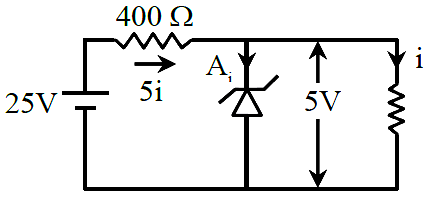
From the circuit diagram,
\(\begin{aligned}
& 5 \mathrm{i}=\frac{20}{400}=\frac{1}{20} \mathrm{~A} \\
& \therefore \mathrm{i}=\frac{1}{100} \mathrm{~A}=10 \mathrm{~mA}=\text { Load current }
\end{aligned}\)
Also, \(\mathrm{V}_{\mathrm{L}}=5 \mathrm{~V}\)
\(\therefore \mathrm{R}_{\mathrm{L}}=\frac{5}{10 \times 10^{-3}} \Omega=500 \Omega\) -
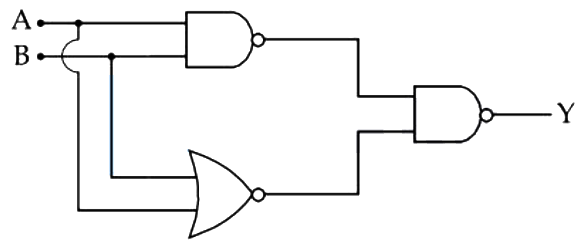
- (A) OR Gate
- (B) AND Gate
- (C) NOR Gate
- (D) NAND Gate
Show answer and solution
Correct Answer: (C)
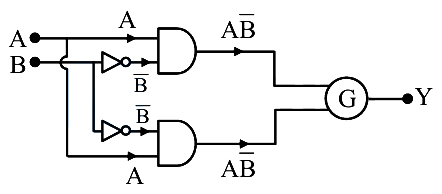
For NOR gate : \(\overline{\mathrm{A} \overline{\mathrm{B}}}=\overrightarrow{\mathrm{A}}+\mathrm{B}\)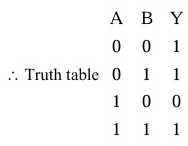
-
- (A) (A), (C), (D) only
- (B) (A), (C), (E) only
- (C) (A), (B), (E) only
- (D) (A), (B), (C) only
Show answer and solution
Correct Answer: (C)
(A) n type semiconductor holes are minority carriers and \(\mathrm{e}^{-}\)are majority carriers
(B) Dopant are pentavalent atom.
(C) \(\mathrm{n}_{\mathrm{e}} \cdot \mathrm{n}_{\mathrm{h}}=\mathrm{n}_{\mathrm{i}}^2\) for intrinsic semiconductor
(E) In \(n\) type semiconductor primary source of holes generation are thermal excitation. -
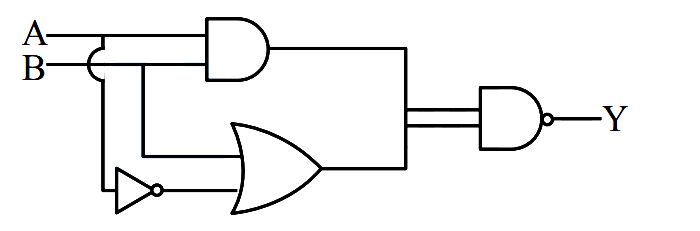
- (A) \(\mathrm{A}=1\) and \(\mathrm{B}=1\)
- (B) \(\mathrm{A}=0\) and \(\mathrm{B}=1\)
- (C) \(\mathrm{A}=1\) and \(\mathrm{B}=0\)
- (D) \(\mathrm{A}=0\) and \(\mathrm{B}=0\)
Show answer and solution
Correct Answer: (A)
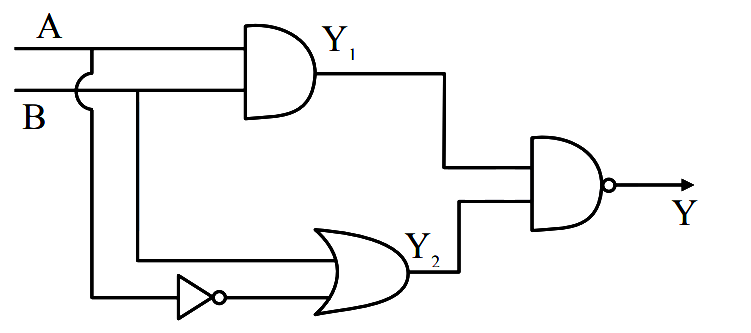
\(\begin{aligned}
& \mathrm{Y}_1=\mathrm{A} \cdot \mathrm{~B}, \mathrm{Y}_2=\overline{\mathrm{A}}+\mathrm{B} \\
& \mathrm{Y}=\overline{\mathrm{Y}_1 \cdot \mathrm{Y}_2}=\overline{\mathrm{Y}}_1+\overline{\mathrm{Y}}_2 \\
& \mathrm{Y}=\overline{\mathrm{A} \cdot \mathrm{~B}}+\overline{\mathrm{A}+\mathrm{B}} \\
& \mathrm{Y}=\overline{\mathrm{A}}+\overline{\mathrm{B}}+\mathrm{A} \cdot \overline{\mathrm{~B}}
\end{aligned}\)
\(\begin{array}{|c|c|c|} \hline A & B & Y \\ \hline 0 & 0 & 1 \\ \hline 1 & 0 & 1 \\ \hline 0 & 1 & 1 \\ \hline 1 & 1 & 0 \\ \hline \end{array}\) -
- (A) B, E Only
- (B) B, D, E Only
- (C) A, C Only
- (D) A, C, E Only
Show answer and solution
Correct Answer: (A)
LED is highly doped, with different materials for different colours.
Increasing forward current only increases light intensity until a certain maximum. -
- (A) OR gate
- (B) NAND gate
- (C) NOT gate
- (D) AND gate
Show answer and solution
Correct Answer: (A)
\(\begin{array}{l|l|l}
A & B & Y \\
\hline 0 & 0 & 0 \\
0 & 1 & 1 \\
1 & 0 & 1 \\
1 & 1 & 1
\end{array}\)
\(\Rightarrow\) OR Gate - 42. In the following circuit, the reading of the ammeter will be : (Take Zener breakdown voltage \(=4 \mathrm{~V})\)
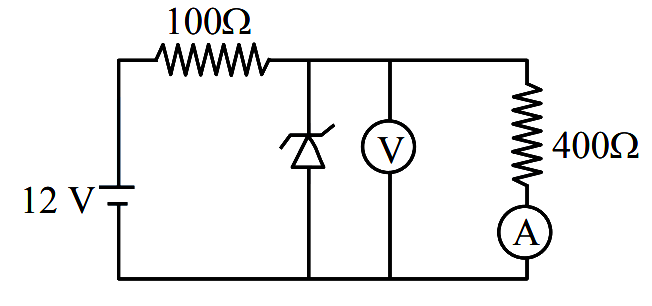 2025 Medium
- (A) 24 mA
- (B) 80 mA
- (C) 10 mA
- (D) 60 mA
Show answer and solution
Correct Answer: (C)
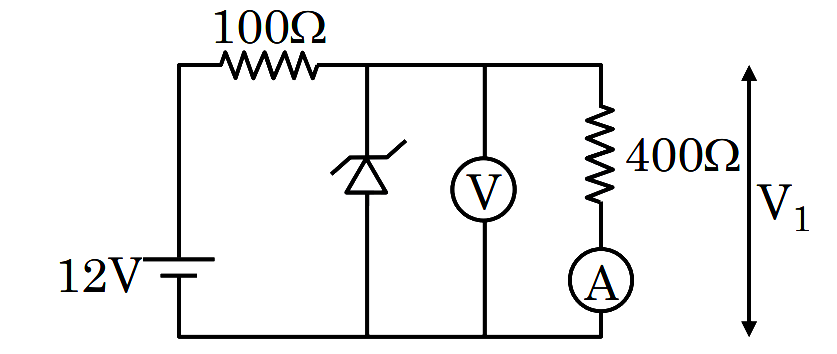
\(\mathrm{V}_1=\frac{400}{100+400} \times 12 \mathrm{~V}=\frac{4}{5} \times 12=\frac{48}{5} \mathrm{~V}\)
here, \(\mathrm{V}_1 \gt \mathrm{V}_{\mathrm{z}},\left(\mathrm{V}_{\mathrm{z}}=\right.\) Zener Voltage \()\) So, Zener breakdown will be take place. So, voltage across \(400 \Omega\) will be 4 V.
\(\mathrm{I}=\frac{4}{400} \mathrm{~A}=\frac{1}{100 \mathrm{~A}}=10 \mathrm{~mA}\) -
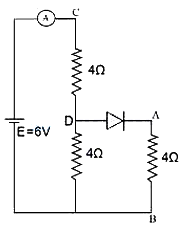
- (A) A, B and D Only
- (B) A, B and C Only
- (C) A, C and D Only
- (D) B, C and E Only
Show answer and solution
Correct Answer: (A)
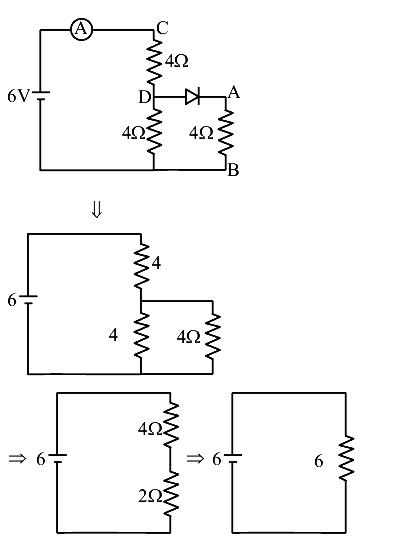
Current through ammeter \(=1 \mathrm{~A}\)
\(\mathrm{R}_{\mathrm{net}}=6 \Omega\)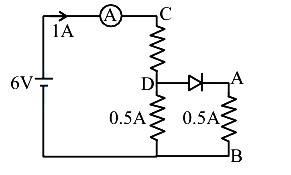
\(\begin{aligned}
& \mathrm{V}_{\mathrm{AB}}=0.5 \times 4=2 \mathrm{volt} \\
& \mathrm{~V}_{\mathrm{CD}}=1 \times 4=4 \mathrm{volt}
\end{aligned}\)
A, B & D are correct. -
- (A) B, C Only
- (B) A,B Only
- (C) A, B, C Only
- (D) A, C Only
Show answer and solution
Correct Answer: (B)
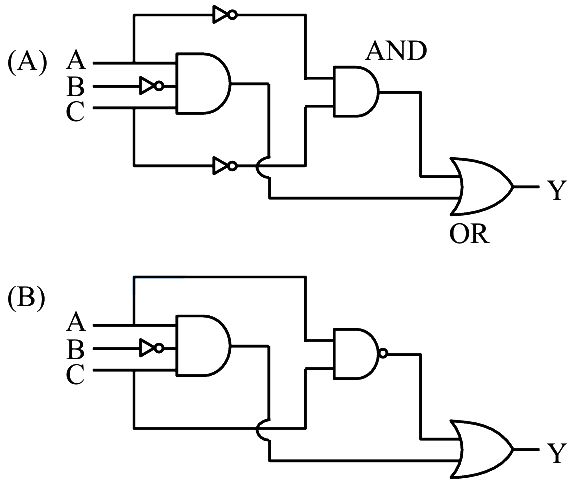
\(\because \overline{\mathrm{A}} \cdot \overline{\mathrm{C}}+\overline{\mathrm{A}+\mathrm{C}} \equiv \mathrm{NOR}\) gate -
- (A) (B), (C) and (D) only
- (B) (A), (B) and (C) only
- (C) (A), (C) and (D) only
- (D) (A), (B) and (D) only
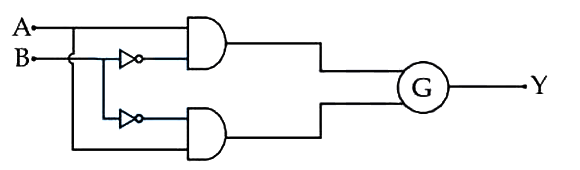
Show answer and solution
Correct Answer: (A)

\(\begin{array}{c|c|c}
x & y & \\
\hline 0 & 0 & 1 \\
0 & 1 & 0 \\
1 & 0 & 0 \\
1 & 1 & 0
\end{array}\) -
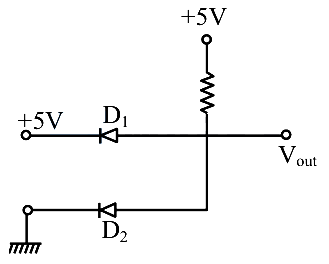
- (A) 10 V
- (B) 0 V
- (C) \(+5 \mathrm{~V}\)
- (D) \(-5 \mathrm{~V}\)
Show answer and solution
Correct Answer: (B)
Here \(D_1\) is reverse biased and \(D_2\) is forward biased. Therefore current flow through \(\mathrm{D}_{\mathrm{Q}}\) and 5 V drop on resistor.
So, \(V_{\text {out }}=0\) -
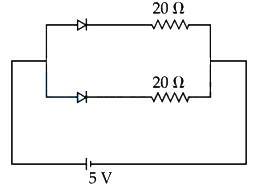
- (A) 1.5 A
- (B) 0.5 A
- (C) 0.25 A
- (D) 1.0 A
Show answer and solution
Correct Answer: (B)
Both are forward biased
\(\begin{aligned}
& \text { hence } \mathrm{R}_{\text {eq }}=10 \Omega \\
& \mathrm{i}=\frac{\mathrm{V}}{\mathrm{R}}=\frac{5}{10}=\frac{1}{2} \mathrm{~A}
\end{aligned}\) - 48. Which of the following circuits represents a forward biased diode?
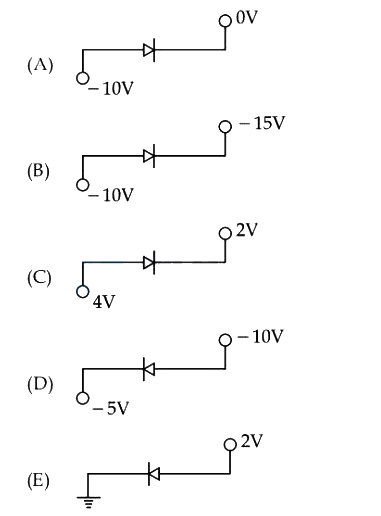
Choose the correct answer from the options given below : 2025 Easy- (A) (A) and (D) only
- (B) (B), (D) and (E) only
- (C) (C) and (E) only
- (D) (B), (C) and (E) only
Show answer and solution
Correct Answer: (D)
For forward bias potential of \(p\) side should be higher than \(n\) side. -
- (A) \(1 / 8\)
- (B) \(8\)
- (C) \(4\)
- (D) \(1 / 4\)
Show answer and solution
Correct Answer: (D)
\(\begin{aligned} & \mathrm{N}_2=\mathrm{N}_0 \mathrm{e}^{-3 \lambda t} \\ & \mathrm{~N}_1=\mathrm{N}_0 \mathrm{e}^{-\lambda \mathrm{t}} \\ & \frac{\mathrm{N}_2}{\mathrm{~N}_1}=\mathrm{e}^{-2 \lambda \mathrm{t}} \\ & \mathrm{t}_{\text {half lifeofN }} \mathrm{t} \\ & \mathrm{t}=\frac{\ln 2}{\lambda}{ }_{\mathrm{n}} 1 \\ & \frac{\mathrm{~N}_0}{2}=\mathrm{N}_0 \mathrm{e}^{-\lambda \mathrm{t}}\end{aligned}\)
\(\begin{aligned} & \lambda \mathrm{t}=\ln 2 \\ & \mathrm{t}=\frac{\ln 2}{\lambda} \\ & =\mathrm{e}^{-2 \lambda \frac{\ln 2}{\lambda}} \\ & \frac{\mathrm{~N}_2}{\mathrm{~N}_1}=\frac{1}{4}\end{aligned}\) -
- (A) \(\mathrm{n} \rightarrow \mathrm{p}+\mathrm{e}^{+}+\bar{v}\)
- (B) \(\mathrm{n} \rightarrow \mathrm{p}+\mathrm{e}^{+}+\boldsymbol{v}\)
- (C) \(\mathrm{n} \rightarrow \mathrm{p}+\mathrm{e}^{-}+\boldsymbol{v}\)
- (D) \(\mathrm{n} \rightarrow \mathrm{p}+\mathrm{e}^{-}+\bar{v}\)
Show answer and solution
Correct Answer: (D)
For all nuclear processes, charge must be conserved. Also, when a release of an electron ( \(e^{-}\)) is always accompanied by a release of an antineutrino ( \(\bar{v}\) )
Hence, \(n \rightarrow p+\mathrm{e}^{-}+\overline{\mathrm{v}}\) is the correct answer.

No questions on this page match these filters.
Other years
Frequently asked
How many JEE Mains 2025 Physics questions are on ExamBro?
454 questions, each with the correct answer and a full solution.
Which JEE Mains 2025 Physics chapter is asked the most?
Ray optics and optical instruments, with 41 questions, followed by Units, dimensions and measurement with 35.
How difficult are JEE Mains 2025 Physics questions?
41% are easy, 43% medium and 16% hard.