


Questions
Newest firstShowing 1–4 of 4 questions
-
- (A) \(P > Q > R\)
- (B) \(R > P > Q\)
- (C) \(R > Q > P\)
- (D) \(P > R > Q\)
Show answer and solution
Correct Answer: (A)
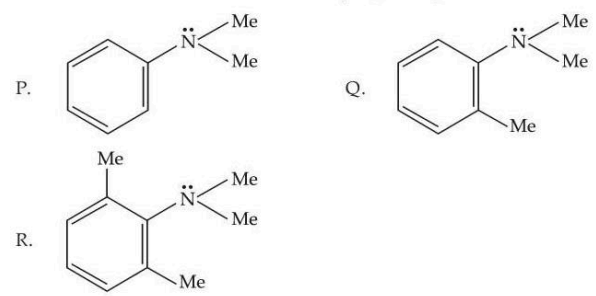
The reaction of the given aromatic compounds with benzenediazonium chloride (\(Ph-N_2^+ Cl^-\)) is an azo coupling reaction, which is a type of electrophilic aromatic substitution.
The electrophile, the diazonium ion (\(Ph-N_2^+\)), is a weak electrophile and requires a strongly activated aromatic ring to undergo coupling. The reactivity of the ring depends on its electron density, which is enhanced by the \(+M\) (mesomeric) effect of the \(-NMe_2\) group.
1. In molecule P (N,N-dimethylaniline), the \(-NMe_2\) group is coplanar with the benzene ring. The lone pair on the nitrogen atom is fully delocalized into the ring, providing a strong \(+M\) effect and making the ring highly electron-rich and reactive.
2. In molecule Q, there is one methyl group at the ortho position to the \(-NMe_2\) group. This causes steric hindrance, forcing the \(-NMe_2\) group slightly out of the plane of the benzene ring. This phenomenon is known as Steric Inhibition of Resonance (SIR). As a result, the delocalization of the nitrogen lone pair into the ring is reduced, decreasing the \(+M\) effect and making it less reactive than P.
3. In molecule R, there are two methyl groups at the ortho positions. This causes severe steric repulsion, forcing the \(-NMe_2\) group almost completely out of the plane of the ring. The \(+M\) effect is minimized because the lone pair can no longer effectively overlap with the \(\pi\)-system of the ring. Consequently, the ring is the least activated among the three.
Therefore, the electron density on the aromatic ring and the reactivity towards electrophilic substitution follow the order: P \(>\) Q \(>\) R.
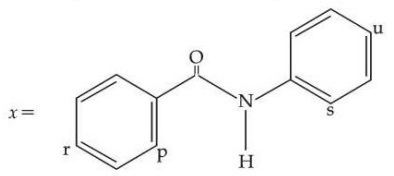
Answer: \(P > Q > R\) - 2. For the given molecule, "\(x\)", the preferred site for the attack of the electrophile is :
 2026 Medium
- (A) Predominantly at "r"
- (B) "r" and "u"
- (C) "p" and "s"
- (D) Predominantly at "u"
Show answer and solution
Correct Answer: (D)
The given molecule, benzanilide, contains two phenyl rings with different reactivities towards electrophilic aromatic substitution.
The left phenyl ring is attached to the carbonyl carbon of the amide group (\(-C(=O)NHPh\)). The carbonyl group is electron-withdrawing due to its \(-M\) and \(-I\) effects, which deactivates this ring towards electrophilic attack.
The right phenyl ring is attached to the nitrogen atom of the amide group (\(-NHC(=O)Ph\)). The nitrogen atom possesses a lone pair of electrons that can delocalize into the ring via resonance (\(+M\) effect). This electron donation activates the right ring, making it significantly more reactive than the left ring.
The \(-NHC(=O)Ph\) group is an ortho/para directing group. The possible sites for electrophilic attack on the activated ring are the ortho position ('s') and the para position ('u').
Due to the large steric bulk of the \(-NHC(=O)Ph\) group, the ortho position ('s') experiences significant steric hindrance. Therefore, the electrophile will preferentially attack the less hindered para position.
Thus, the preferred site for the attack of the electrophile is predominantly at 'u'.
Answer: Predominantly at "u" -
- (A) Both Statement I and Statement II are correct
- (B) Both Statement I and Statement II are incorrect
- (C) Statement I is correct but Statement II is incorrect
- (D) Statement I is incorrect but Statement II is correct
Show answer and solution
Correct Answer: (C)
Statement I is correct because alkyl groups exert a +I effect (electron-donating inductive effect). This increases the electron density on the negatively charged carbon atom, destabilizing the carbanion. Thus, as the number of alkyl groups increases, the stability of the carbanion decreases. The order of stability is \(\text{CH}_3^- > \text{CH}_3\text{CH}_2^- > (\text{CH}_3)_2\text{CH}^- > (\text{CH}_3)_3\text{C}^-\).
Statement II is incorrect because allyl and benzyl carbanions are highly stabilized by the resonance effect, where the negative charge is delocalized over the adjacent \(\pi\) bonds or the benzene ring, rather than by the inductive effect.
Answer: Statement I is correct but Statement II is incorrect -
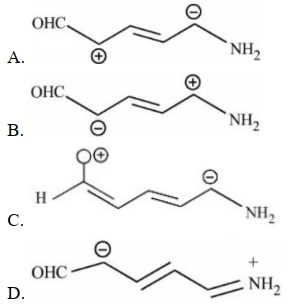
- (A) \(C , D , B , A\)
- (B) \(C, A, B, D\)
- (C) \(D, C, A, B\)
- (D) \(D , C , B , A\)
Show answer and solution
Correct Answer: (B)
Based on Theory
No questions on this page match these filters.
Other STD 11 - Organic chemistry reaction mechanism topics
Frequently asked
How many Dipole moment, resonance and reaction intermediates questions came in JEE Mains?
4 questions from 2023–2026, each with the correct answer and a full solution.
How difficult are Dipole moment, resonance and reaction intermediates questions?
25% are easy, 50% medium and 25% hard.