


Questions
Newest firstShowing 1–19 of 19 questions
- 1. The velocity of a particle is given as \(\vec{v} = -x\hat{i} + 2y\hat{j} - z\hat{k}\) m/s. The magnitude of acceleration at point \((1, 2, 4)\) is _______ m/s\(^2\). 2026 Hard
- 2. A particle moves along the \(x\)-axis and has its displacement \(x\) varying with time \(t\) according to the equation \(\mathrm{x}=\mathrm{c}_0\left(\mathrm{t}^2-2\right)+\mathrm{c}(\mathrm{t}-2)^2\) where \(c_0\) and \(c\) are constants of appropriate dimensions. Then, which of the following statements is correct? 2025 Medium
- 3. A body moves on a frictionless plane starting from rest. If \(\mathrm{S}_{\mathrm{n}}\) is distance moved between \(\mathrm{t}=\mathrm{n}-1\) and \(\mathrm{t}\) \(=\mathrm{n}\) and \(\mathrm{S}_{\mathrm{n}-1}\) is distance moved between \(\mathrm{t}=\mathrm{n}-2\) and \(t=n-1\), then the ratio \(\frac{S_{n-1}}{S_n}\) is \(\left(1-\frac{2}{x}\right)\) for \(n\) \(=10\). The value of \(x\) is _______. 2024 Hard
- 4. A body travels \(102.5 \mathrm{~m}\) in \(\mathrm{n}^{\text {th }}\) second and \(115.0 \mathrm{~m}\) in \((n+2)^{\text {th }}\) second. The acceleration is what? 2024 Hard
- 5. A particle initially at rest starts moving from reference point. \(\mathrm{x}=0\) along \(\mathrm{x}\)-axis, with velocity \(v\) that varies as \(v=4 \sqrt{\mathrm{x} m} / \mathrm{s}\). The acceleration of the particle is _______ \( \mathrm{ms}^{-2}\). 2024 Hard
- 6. A particle moves in a straight line so that its displacement \(x\) at any time \(t\) is given by \(x^2=1+t^2\). Its acceleration at any time \(\mathrm{t}\) is \(\mathrm{x}^{-\mathrm{n}}\) where \(\mathrm{n}=\) _______. 2024 Hard
- 7. A particle starts from origin at \(t=0\) with a velocity \(5 \hat{i} \mathrm{~m} / \mathrm{s}\) and moves in \(x-y\) plane under action of a force which produces a constant acceleration of \((3 \hat{i}+2 \hat{j}) \mathrm{m} / \mathrm{s}^2\). If the \(x\)-coordinate of the particle at that instant is \(84 \mathrm{~m}\), then the speed of the particle at this time is \(\sqrt{\alpha} \mathrm{m} / \mathrm{s}\). The value of \(\alpha\) is___________. 2024 Hard
- 8. The relation between time ' \(t\) ' and distance ' \(x\) ' is \(t=\) \(\alpha x^2+\beta x\), where \(\alpha\) and \(\beta\) are constants. The relation between acceleration \((a)\) and velocity \((v)\) is _______. 2024 Hard
- 9. Given below are two statements: Statement \(I:\) Area under velocity- time graph gives the distance travelled by the body in a given time. Statement \(II:\) Area under acceleration- time graph is equal to the change in velocity- in the given time. In the light of given statements, choose the correct answer from the options given below. 2023 Medium
- 10. The distance travelled by a particle is related to time \(t\) as \(x =4 t ^2\). The velocity of the particle at \(t =\) \(5 s\) is \(.........ms^{-1}\) 2023 Easy
- 11. A car is moving with speed of \(150\,km / h\) and after applying the brake it will move \(27\,m\) before it stops. If the same car is moving with a speed of one third the reported speed then it will stop after travelling \(....m\) distance. 2022 Medium
- 12. The velocity of the bullet becomes one third after it penetrates \(4\,cm\) in a wooden block. Assuming that bullet is facing a constant resistance during its motion in the block. The bullet stops completely after travelling at \((4+x)\,cm\) inside the block. The value of \(x\) is\(.....\) 2022 Medium
- 13. A particle is moving with constant acceleration \('a'.\) Following graph shows \(v^{2}\) versus \(x\) (displacement) plot. The acceleration of the particle is \(......{m} / {s}^{2}\)
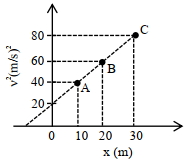 2021 Hard
- 14. A particle is projected with velocity \(v_{0}\) along \(x-\) axis. A damping force is acting on the particle which is proportional to the square of the distance from the origin i.e., \(ma =-\alpha x ^{2}.\) The distance at which the particle stops: 2021 Hard
- 15. A scooter accelerates from rest for time \(t_{1}\) at constant rate \(a _{1}\) and then retards at constant rate \(a _{2}\) for time \(t _{2}\) and comes to rest. The correct value of \(\frac{t_{1}}{t_{2}}\) will be ..... . 2021 Hard
- 16. The relation between time \(t\) and distance \(x\) for a moving body is given as \(t=m x^{2}+n x\), where \({m}\) and \({n}\) are constants. The retardation of the motion is - (Where \(v\) stands for velocity) 2021 Hard
- 17. The distance \(x\) covered by a particle in one dimensional motion varies with time \(t\) as \(\mathrm{x}^{2}=\mathrm{at}^{2}+2 \mathrm{bt}+\mathrm{c.}\) If the acceleration of the particle depends on \(\mathrm{x}\) as \(\mathrm{x}^{-\mathrm{n}},\) where \(\mathrm{n}\) is an integer, the value of \(\mathrm{n}\) is 2020 Hard
- 18. A particle starts from origin \(O\) from rest and moves with a uniform acceleration along the positive \(x -\) axis. Identify all figures that correctly represent the motion qualitatively. (\(a =\) acceleration, \(v =\) velocity, \(x =\) displacement, \(t =\) time)
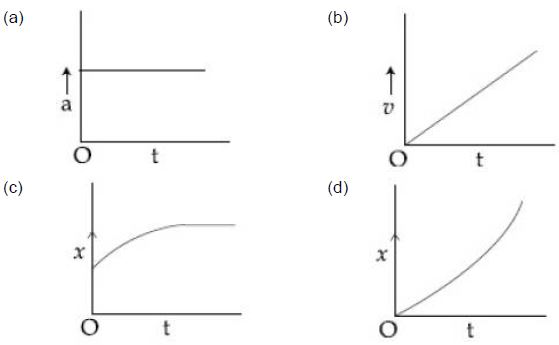 2019 Hard
- 19. The velocity-time graphs of a car and a scooter are shown in the figure. \((i)\) the difference between the distance travelled by the car and the scooter in \(15\, s\) and \((ii)\) the time at which the car will catch up with the scooter are, respectively
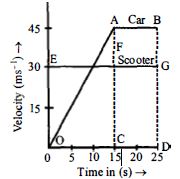 2018 Hard
No questions on this page match these filters.
Other STD 11 - Motion in straight line topics
Frequently asked
How many Acceleration questions came in JEE Mains?
19 questions from 2018–2026, each with the correct answer and a full solution.
How difficult are Acceleration questions?
5% are easy, 21% medium and 74% hard.