


Questions
Newest firstShowing 1–44 of 44 questions
- 1. A convex lens of refractive index 1.5 and focal length \(f=18 cm\) is immersed in water. The difference in focal lengths of the given lens when it is in water and in air is \(\alpha \times f\). The value of \(\alpha\) is ___________.
(refractive index of water \(=4 / 3\) ) 2026 Medium - 2. Five persons \(P_1, P_2, P_3, P_4\) and \(P_5\) recorded object distance (u) and image distance (v) using same convex lens having power +5 D as \((25,96),(30,62)\), \((35,37),(45,35)\) and \((50,32)\) respectively. Identify correct statement 2026 Hard
- 3. If sunlight is focused on a paper using convex lens, it starts burning the paper in shortest time when the lens is kept at \(30\) cm above the paper. If the radius of curvature of the lens is \(60\) cm then the refractive index of the lens material is \(\dfrac{\alpha}{10}\). The value of \(\alpha\) is _______. 2026 Medium
- 4. The magnitudes of power of a biconvex lens (refractive index 1.5) and that of a plano-concave lens (refractive index \(=1.7\)) are same. If the curvature of plano-concave lens exactly matches with the curvature of back surface of the biconvex lens, then ratio of radius of curvature of front and back surface of the biconvex lens is ___________ . 2026 Easy
- 5. The size of the images of an object, formed by a thin lens are equal when the object is placed at two different positions 8 cm and 24 cm from the lens. The focal length of the lens is ___________ cm. 2026 Medium
- 6. A bi-convex lens has radius of curvature of both the surfaces same as \(1 / 6 \mathrm{~cm}\). If this lens is required to be replaced by another convex lens having different radii of curvatures on both sides \(\left(R_1 \neq R_2\right)\), without any change in lens power then possible combination of \(R_1\) and \(R_2\) is : 2025 Hard
- 7. A convex lens made of glass (refractive index \(=1.5\) ) has focal length 24 cm in air. When it is totally immersed in water (refractive index \(=1.33\) ), its focal length changes to ________. 2025 Medium
- 8. A lens having refractive index 1.6 has focal length of 12 cm , when it is in air. Find the focal length of the lens when it is placed in water.
(Take refractive index of water as 1.28) 2025 Easy - 9. A photograph of a landscape is captured by a drone camera at a height of 18 km . The size of the camera film is \(2 \mathrm{~cm} \times 2 \mathrm{~cm}\) and the area of the landscape photographed is \(400 \mathrm{~km}^2\). The focal length of the lens in the drone camera is : 2025 Easy
- 10. A slanted object \(A B\) is placed on one side of convex lens as shown in the diagram. The image is formed on the opposite side. Angle made by the image with principal axis is:
 2025 Medium
- 11. The radius of curvature for a thin convex lens are 10 cm and 15 cm respectively. The focal length of the lens is 12 cm. The refractive index of the lens material is : 2025 Easy
- 12. What is the relative decrease in focal length of a lens for an increase in optical power by 0.1 D from 2.5D ? ['D' stands for dioptre] 2025 Medium
- 13. A biconvex lens of refractive index \(1.5\) has a focal length of \(20 \mathrm{~cm}\) in air. Its focal length when immersed in a liquid of refractive index \(1.6\) will be: 2024 Hard
- 14. For the thin convex lens, the radii of curvature are at \(15 \mathrm{~cm}\) and \(30 \mathrm{~cm}\) respectively. The focal length the lens is \(20 \mathrm{~cm}\). The refractive index of the material is _______. 2024 Hard
- 15. Given below are two statements :
Statement (I) : When an object is placed at the centre of curvature of a concave lens, image is formed at the centre of curvature of the lens on the other side.
Statement (II) : Concave lens always forms a virtual and erect image.
In the light of the above statements, choose the correct answer from the options given below : 2024 Medium - 16. Given below are two statements: Statement \((I)\) : When currents vary with time, Newton's third law is valid only if momentum carried by the electromagnetic field is taken into account. Statement \((II)\) : Ampere's circuital law does not depend on Biot-Savart's law. In the light of the above statements, choose the correct answer from the options given below: 2024 Hard
- 17. In an experiment to measure focal length \((f)\) of convex lens, the least counts of the measuring scales for the position of object \((u)\) and for the position of image \((v)\) are \(\Delta u\) and \(\Delta v\), respectively. The error in the measurement of the focal length of the convex lens will be _______. 2024 Hard
- 18. In an experiment to measure the focal length ( \(f\) ) of a convex lens, the magnitude of object distance \((x)\) and the image distance \((y)\) are measured with reference to the focal point of the lens. The \(y-x\) plot is shown in figure. The focal length of the lens is _______ \(\mathrm{cm}\).
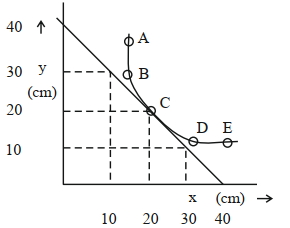 2024 Hard
- 19. The distance between object and its \(3\) times magnified virtual image as produced by a convex lens is \(20 \mathrm{~cm}\). The focal length of the lens used is _______ \(\mathrm{cm}\). 2024 Hard
- 20. The distance between object and its two times magnified real image as produced by a convex lens is \(45 \mathrm{~cm}\). The focal length of the lens used is _______ \(\mathrm{cm}\). 2024 Hard
- 21. A \(2\,meter\) long scale with least count of \(0.2\,cm\) is used to measure the locations of objects on an optical bench. While measuring the focal length of a convex lens, the object pin and the convex lens are placed at \(80\,cm\) mark and \(1\,m\) mark, respectively. The image of the object pin on the other side of lens coincides with image pin that is kept at \(180\,cm\) mark. The \(\%\) error in the estimation of focal length is 2023 Hard
- 22. A convex lens of refractive index \(1.5\) and focal length \(18 cm\) in air is immersed in water. The change in focal length of the lens will be \(...........cm\).\(\left(\right.\) Given refractive index of water \(\left.=\frac{4}{3}\right)\) 2023 Medium
- 23. The radius of curvature of each surface of a convex lens having refractive index \(1.8\) is \(20\,cm\). The lens is now immersed in a liquid of refractive index \(1.5\). The ratio of power of lens in air to its power in the liquid will be \(x : 1\). The value of \(x\) is \(.....\) 2023 Medium
- 24. A parallel beam of light is allowed to fall on a transparent spherical globe of diameter \(30 \,cm\) and refractive index \(1.5\). The distance from the centre of the globe at which the beam of light can converge is________ \(mm\) 2022 Hard
- 25. For an object placed at a distance \(2.4\,m\) from a lens, a sharp focused image is observed on a screen placed at a distance \(12\,cm\) from the lens. A glass plate of refractive index \(1.5\) and thickness \(1\,cm\) is introduced between lens and screen such that the glass plate plane faces parallel to the screen. By what distance should the object be shifted so that a sharp focused image is observed again on the screen \(\dots\,m\) 2022 Hard
- 26. In an experiment with a convex lens. The plot of the image distance (\(v'\)) against the object distance \(\left(\mu^{\prime}\right)\) measured from the focus gives a curve \(v^{\prime} \mu^{\prime}=225\). If all the distances are measured in \(cm\). The magnitude of the focal length of the lens is \(cm\). 2022 Medium
- 27. An object is placed at the focus of concave lens having focal length \(f\). What is the magnification and distance of the image from the optical centre of the lens? 2021 Hard
- 28. Diameter of a plano-convex lens is \(6 \,cm\) and thickness at the centre is \(3\, mm\). If the speed of light in the material of the lens is \(2 \times 10^8 m/sec\), the focal length of the lens is.......\(cm\) 2021 Hard
- 29. The image of an object placed in air formed by a convex refracting surface is at a distance of \(10\, m\) behind the surface. The image is real and is at \(\frac{2}{3}\) of the distance of the object from the surface . The wavelength of light inside the surface is \(\frac{2}{3}\) times the wavelength in air. The radius of the curved surface is \(\frac{ x }{13}\, m\). the value of \(^{\prime} x^{\prime}\) is ....... . 2021 Hard
- 30. The refractive index of a converging lens is \(1.4.\) What will be the focal length of this lens if it is placed in a medium of same refractive index ? (Assume the radii of curvature of the faces of lens are \(R _{1}\) and \(R _{2}\) respectively) 2021 Medium
- 31. The same size images are formed by a convex lens when the object is placed at \(20\, cm\) or at \(10\, cm\) from the lens. The focal length of convex lens is ............ \(cm\). 2021 Hard
- 32. A double convex lens has power \(P\) and same radii of curvature \(R\) of both the surfaces. The radius of curvature of a surface of a plano-convex lens made of the same material with power \(1.5P\) is ......\(R\) 2020 Medium
- 33. A point object in air is in front of the curved surface of a plano-convex lens. The radius of curvature of the curved surface is \(30 \;\mathrm{cm}\) and the refractive index of the lens material is \(1.5 .\) then the focal length of the lens (in \(\mathrm{cm}\) ) is 2020 Medium
- 34. A thin lens made of glass (refractive index \(= 1.5\)) of focal length \(f=16\; \mathrm{cm}\) is immersed in a liquid of refractive index \(1.42 .\) If its focal length in liquid is \(f_{l},\) then the ratio \(f_{l} /f\) is closest to the integer 2020 Hard
- 35. The distance between an object and a screen is \(100\, cm .\) A lens can produce real image of the object on the screen for two different positions between the screen and the object. The distance between these two positions is \(40\, cm .\) If the power of the lens is close to \(\left(\frac{ N }{100}\right) D\) where \(N\) is an integer, the value of \(N\) is....... 2020 Hard
- 36. A convex lens is put \(10\, cm\) from a light source and it makes a sharp image on a screen, kept \(10\, cm\) from the lens. Now a glass block (refractive index \(1.5\)) of \(1.5\, cm\) thickness is placed in contact with the light source. To get the sharp image again, the screen is shifted by a distance \(d\). Then \(d\) is 2019 Hard
- 37. A convex lens of focal length \(20\, cm\) produces images of the same magnification \(2\) when an object is kept at two distances \(x_1\) and \(x_2\) \((x_1 > x_2)\) from the lens. The ratio of \(x_1\) and \(x_2\) is 2019 Hard
- 38. An object is at a distance of \(20\,m\) from a convex lens of focal length \(0.3\,m.\) The lens forms an image of the object. If the object moves away from the lens at a speed of \(5\,m/s,\) the speed and direction of the image will be 2019 Medium
- 39. Formation of real image using a biconvex lens is shown below: If the whole set up is immersed in water without disturbing the object and the screen positions, what will one observe on the screen?
 2019 Medium
- 40. The eye can be regarded as a single refracting surface. The radius of curvature of this surface is equal to that of cornea \((7.8\, mm)\). This surface separates two media of refractive indices \(1\) and \(1.34\). Calculate the distance from the refracting surface at which a parallel beam of light will come to focus.......\(cm\) 2019 Medium
- 41. The graph shows how the magnification \(m\) produced by a thin lens varies with image distance \(v\). What is the focal length of the lens used?
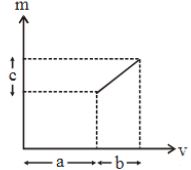 2019 Medium
- 42. A thin convex lens made from crown glass \(\left( {\mu = \frac{3}{2}} \right)\) has focal length \(f\). When it is measured in two different liquids having refractive indices \(\frac{4}{3}\) and \(\frac{5}{3}\) it has the focal lengths \(f_1\) and \(f_2\) respectively. The correct relation between the focal lengths is: 2014 Medium
- 43. An object is located in a fixed position in front of a screen. Sharp image is obtained on the screen for two positions of a thin lens separated by \(10\, cm\). The size of the images in two situations are in the ratio \(3 : 2\). What is the distance between the screen and the object?......\(cm\) 2014 Hard
- 44. The image of an illuminated square is obtained on a screen with the help of a converging lens. The distance of the square from the lens is \(40\,cm.\) The area of the image is \(9\,times\) that of the square. The focal length of the lens is........\(cm\) 2013 Hard
No questions on this page match these filters.
Other STD 12 - Ray optics and optical instruments topics
- 33Qs Refraction Through Prism
- 10Qs Refraction Through Single Curved Surface
- 28Qs Spherical Mirror
- 18Qs Combination of Lens and Mirror and Silvering of Lens
- 2Qs Combination of Mirrors and Cutting of Mirror
- 27Qs Combination of Lenses
- 15Qs Refraction through Plane Surface and Glass Slab
- 20Qs Critical Angle and Total Internal Reflection
- 10Qs Microscope
- 19Qs Refraction of Light
- 2Qs Angle of Deviation and Rotation of Plane Mirror
- 7Qs Plane Mirror
- 8Qs Telescope
- 2Qs Human Eye and Defects of Vision
- 1Qs Aberrations in Optical Elements
- 1Qs Some Natural Phenomenon of Sunlight
- 1Qs Scattering of light
Frequently asked
How many Refraction by Lenses questions came in JEE Mains?
44 questions from 2013–2026, each with the correct answer and a full solution.
How difficult are Refraction by Lenses questions?
9% are easy, 41% medium and 50% hard.