


Questions
Newest firstShowing 1–8 of 8 questions
-
- (A) A, C and E only
- (B) B, C and D only
- (C) A, D and E only
- (D) B, C and E only
Show answer and solution
Correct Answer: (D)
Chlorocylohexane is more polar due to - I effect of - Cl,
Whereas chlorobenzene has \(- I >+ M\), so it is less polar & also has partial double bond character. -
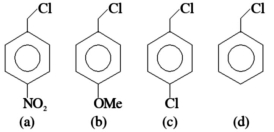
- (A) \(a > c > d > b\)
- (B) \(a > b > c > d\)
- (C) \(b > d > c > a\)
- (D) \(d > b > c > a\)
Show answer and solution
Correct Answer: (C)
The rate of \(S_N 1\) reaction depends upon stability of carbocation which follows the order\(\therefore\) Reactivity order
\((b) > (d) > (c) > (a)\)
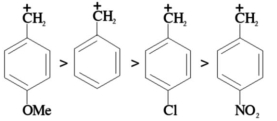
-
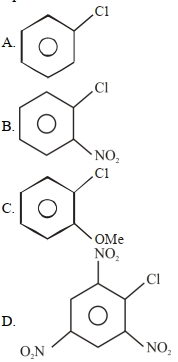
- (A) \(A > B > D > C\)
- (B) \(C > A > D > B\)
- (C) \(D > C > B > A\)
- (D) \(D > B > A > C\)
Show answer and solution
Correct Answer: (D)
\((-M)\) group increases reactivity where as \((+M)\) group decreases reactivity of Halobenzene towards Nucleophilic substitution reaction.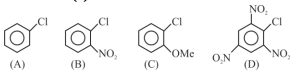
-
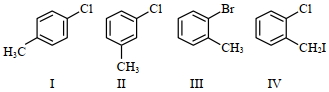
- (A) \(II\)
- (B) \(IV\)
- (C) \(I\)
- (D) \(III\)
Show answer and solution
Correct Answer: (B)
Other compounds halide can't be removed because corresponding \(\mathrm{C}^{+}\) is highly unstable.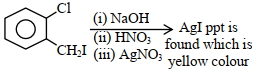
-
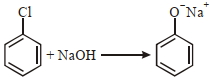
- (A) \(573\, K ,\, Cu , 300\, atm\)
- (B) \(623\, K ,\, Cu , 300\, atm\)
- (C) \(573\, K , 300\, atm\)
- (D) \(623\, K , 300\, atm\)
Show answer and solution
Correct Answer: (D)
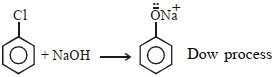
Temperature \(=623 K\)Pressure \(=300 atm\)
-
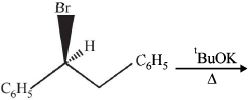
- (A) \(( \pm ){C_6}{H_5}CH({O^t }Bu)C{H_2}{C_6}{H_5}\)
- (B) \(C_6H_5CH=CHC_6H_5\)
- (C) \(( + ){C_6}{H_5}CH({O^t }Bu)C{H_2}{C_6}{H_5}\)
- (D) \(( - ){C_6}{H_5}CH({O^t }Bu)C{H_2}{C_6}{H_5}\)
Show answer and solution
Correct Answer: (B)
Carrying out dehydrohalogenation with a bulky base such as potassium tert-butoxide ( \(t\) -\(BuOK\) ) in \(1,2\) -diphenyl1-bromoethane \((t-\mathrm{BuOH})\) favors the formation of the alkene via \(E_2\) mechanism. The reaction involved is
-
- (A) two molecules of aryl halides
- (B) one molecule of each of aryl- halide and alkyl-halide.
- (C) one molecule of each of aryl-halide and phenol.
- (D) two molecules of aralkyl-halides.
Show answer and solution
Correct Answer: (B)
Reaction between alkyl halide, aryl halide and sodium in presence of ether is known as Wurtz fitting reaction\({C_6}H_5Cl + 2Na + ClC{H_3} \to \mathop {{C_6}{H_5}C{H_3}}\limits_{{\text{Toluene}}} + 2NaCl\)
-
- (A) \(1-\) butene \(+ HF\)
- (B) \(2-\) butanol \(+ H_2SO_4\)
- (C) Butanoyl chloride \(+ AlCl_3\) then \(Zn, HCl\)
- (D) Butyl choloride \(+ AlCl_3\)
Show answer and solution
Correct Answer: (C)
The fridal - crafts alkylation reaction will give propyl phenyl ketone which further on clemmenson's reduction will give butyl benzene\({C_6}{H_6}\, + \,C{H_3}C{H_2}C{H_2}COCl\,\xrightarrow{{AlC{l_3}}}\) \({C_6}{H_5}COC{H_2}C{H_2}C{H_3}\,\xrightarrow{{Zn - Hg\,/\,HCl}}\) \(\mathop {{C_6}{H_5}C{H_2}C{H_2}C{H_2}C{H_3}}\limits_{Butyl\,\,benzene} \)
No questions on this page match these filters.
Other STD 12 - Haloalkanes and Haloarenes topics
Frequently asked
How many Properties of Haloarenes questions came in JEE Mains?
8 questions from 2013–2026, each with the correct answer and a full solution.
How difficult are Properties of Haloarenes questions?
0% are easy, 50% medium and 50% hard.