


Questions
Newest firstShowing 1–50 of 57 questions
- 1. A beam of light consisting of wavelengths 650 nm and 550 nm illuminates the Young's double slits with separation of 2 mm such that the interference fringes are formed on a screen, placed at a distance of 1.2 m from the slits. The least distance of a point from the central maximum, where the bright fringes due to both the wavelengths coincide, is ___________ \(\times 10^{-5} m\). 2026 Easy
- 2. Given below are two statements:
Statement I: In a Young's double slit experiment, the angular separation of fringes will increase as the screen is moved away from the plane of the slits
Statement II : In a Young's double slit experiment, the angular separation of fringes will increase when monochromatic source is replaced by another monochromatic source of higher wavelength
In the light of the above statements, choose the correct answer from the options given below: 2026 Hard - 3. In a double slit experiment, when one of the slits is covered by a transparent mica sheet of refractive index \(1.56\), the central fringe shifts to the position of \(7^{th}\) bright fringe, obtained with both slits uncovered. If the light source wavelength is \(450\) nm, the thickness of mica sheet is \(\alpha \times 10^{-9}\) m. The value of \(\alpha\) is ______. 2026 Medium
- 4. In a Young double slit experiment, the wavelength of incident light is \(6000\) Å, the separation between slits \(S_1\) and \(S_2\) is \(5\) cm and the distance between slits plane and screen is \(50\) cm, as shown in the figure below. If the resultant intensity at \(P\) is equal to the intensity due to individual slits, the path difference between interfering waves is __________ Å.
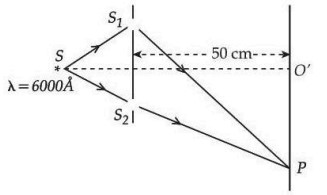 2026 Hard
- 5. In a Young's double slit experiment, the intensity at some point on the screen is found to be \(\dfrac{3}{4}\) times of the maximum of the interference pattern. The path difference between the interfering waves at this point is \(\dfrac{\lambda}{x}\) where \(\lambda\) is wavelength of the incident light. The value of \(x\) is _______. 2026 Medium
- 6. In interference experiment the path difference between two interfering waves at a point \(A\) on the screen is \(\lambda/3\), where \(\lambda\) is the wavelength of these waves, and at another point \(B\) the path difference is \(\lambda/6\). The ratio of intensities at points \(A\) and \(B\) is _______. 2026 Medium
- 7. In the Young's double slit experiment the intensity produced by each one of the individual slits is \(I_0\). The distance between two slits is 2 mm . The distance of screen from slits is 10 m . The wavelength of light is \(6000\) Å. The intensity of light on the screen in front of one of the slits is _________ . 2026 Medium
- 8. In two separate Young's double-slit experimental set-ups, two monochromatic light sources of different wavelengths are used to get fringes of equal width. The ratios of the slit separations and that of the wavelengths of light used are \(2: 1\) and \(1: 2\) respectively. The corresponding ratio of the distances between the slits and the respective screens ( \(D_1 / D_2\) ) is ___________ . 2026 Easy
- 9. The maximum intensity in a Young's double slit experiment is \(I_0\). Distance between the slits (\(d\)) is \(5\lambda\), where \(\lambda\) is the wavelength of light used. The intensity of the fringe, exactly opposite to one of the slits on the screen, placed at \(D = 10d\) is _______. 2026 Hard
- 10. A double slit interference experiment performed with a light of wavelength 600 nm forms an interference fringe pattern on a screen with 10 th bright fringe having its centre at a distance of 10 mm from the central maximum. Distance of the centre of the same 10th bright fringe from the central maximum when the source of light is replaced by another source of wavelength 660 nm would be _________ mm . 2025 Hard
- 11. Given below are two statements : one is labelled as Assertion (A) and the other is labelled as Reason (R).
Assertion-(A) : If Young's double slit experiment is performed in an optically denser medium than air, then the consecutive fringes come closer.
Reason-(R) : The speed of light reduces in an optically denser medium than air while its frequency does not change.
In the light of the above statements, choose the most appropriate answer from the options given below : 2025 Easy - 12. Given below are two statements. One is labelled as Assertion (A) and the other is labelled as Reason (R).
Assertion (A) : In Young's double slit experiment, the fringes produced by red light are closer as compared to those produced by blue light.
Reason (R): The fringe width is directly proportional to the wavelength of light.
In the light of the above statements, choose the correct answer from the options given below. 2025 Easy - 13. In a Young's double slit experiment, the slits are separated by 0.2 mm. If the slits separation is increased to 0.4 mm , the percentage change of the fringe width is _______. 2025 Easy
- 14. In a Young's double slit experiment, the source is white light. One of the slits is covered by red filter and another by a green filter. In this case... 2025 Medium
- 15. The width of one of the two slits in Young's double slit experiment is d while that of the other slit is \(x \mathrm{~d}\). If the ratio of the maximum to the minimum intensity in the interference pattern on the screen is \(9: 4\) then what is the value of \(x\) ?
(Assume that the field strength varies according to the slit width.) 2025 Hard - 16. The Young's double slit interference experiment is performed using light consisting of 480 nm and 600 nm wavelengths to form interference patterns. The least number of the bright fringes of 480 nm light that are required for the first coincidence with the bright fringes formed by 600 nm light is _______. 2025 Medium
- 17. In a double slit experiment shown in figure, when light of wavelength \(400 \mathrm{~nm}\) is used, dark fringe is observed at \(P\). If \(D=0.2 \mathrm{~m}\). the minimum distance between the slits \(S_1\) and \(S_2\) is ____________ \(mm\).
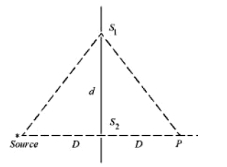 2024 Hard
- 18. In a single slit experiment, a parallel beam of green light of wavelength \(550 \mathrm{~nm}\) passes through a slit of width \(0.20 \mathrm{~mm}\). The transmitted light is collected on a screen \(100 \mathrm{~cm}\) away. The distance of first order minima from the central maximum will be \(\mathrm{x} \times 10^{-5} \mathrm{~m}\). The value of \(\mathrm{x}\) is _______. 2024 Hard
- 19. In a Young's double slit experiment, the intensity at a point is \(\left(\frac{1}{4}\right)^{\text {th }}\) of the maximum intensity, the minimum distance of the point from the central maximum is _______ \(\mu \mathrm{m}\). (Given : \(\lambda=600 \mathrm{~nm}, d=1.0 \mathrm{~mm}, \mathrm{D}=1.0 \mathrm{~m}\) ) 2024 Hard
- 20. In Young's double slit experiment, carried out with light of wavelength \(5000\) \(A\), the distance between the slits is \(0.3 \mathrm{~mm}\) and the screen is at \(200 \mathrm{~cm}\) from the slits. The central maximum is at \(x=0 \mathrm{~cm}\). The value of \(\mathrm{x}\) for third maxima is _______ \(\mathrm{mm}\). 2024 Hard
- 21. The width of one of the two slits in a Young's double slit experiment is \(4\) times that of the other slit. The ratio of the maximum of the minimum intensity in the interference pattern is _______. 2024 Hard
- 22. Two slits are \(1 \mathrm{~mm}\) apart and the screen is located \(1 \mathrm{~m}\) away from the slits. A light wavelength \(500 \mathrm{~nm}\) is used. The width of each slit to obtain \(10\) maxima of the double slit pattern within the central maximum of the single slit pattern is _______ \(\times 10^{-4} \mathrm{~m}\) 2024 Hard
- 23. Two wavelengths \(\lambda_1\) and \(\lambda_2\) are used in Young's double slit experiment \(\lambda_1=450 \mathrm{~nm}\) and \(\lambda_2=650 \mathrm{~nm}\). The minimum order of fringe produced by \(\lambda_2\) which overlaps with the fringe produced by \(\lambda_1\) is \(n\). The value of \(n\) is _________. 2024 Hard
- 24. A beam of light consisting of two wavelengths \(7000\; \mathring A\) and \(5500 \;\mathring A\) is used to obtain interference pattern in Young's double slit experiment. The distance between the slits is \(2.5\,mm\) and the distance between the plane of slits and the screen is \(150\,cm\). The least distance from the central fringe, where the bright fringes due to both the wavelengths coincide, is \(n \times 10^{-5}\,m\). The value of \(n\) is ............. 2023 Medium
- 25. In a Young's double slit experiment, the intensities at two points, for the path difference \(\frac{\lambda}{4}\) and \(\frac{\lambda}{3}\) ( \(\lambda\) being the wavelength of light used) are \(I_1\) and \(I_2\) respectively. If \(I_0\) denotes the intensity produced by each one of the individual slits, then \(\frac{ I _1+ I _2}{ I _0}=..............\) 2023 Medium
- 26. In a Young's double slit experiment, two slits are illuminated with a light of wavelength \(800 nm\). The line joining \(A _1 P\) is perpendicular to \(A _1 A _2\) as shown in the figure. If the first minimum is detected at \(P\), the value of slits separation ' \(a\) ' will be \(.........\,mm\) The distance of screen from slits \(D =5\,cm\)
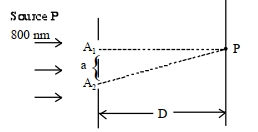 2023 Medium
- 27. In a Young's double slits experiment, the ratio of amplitude of light coming from slits is \(2: 1\). The ratio of the maximum to minimum intensity in the interference pattern is : 2023 Medium
- 28. In Young's double slits experiment, the position of \(5^{\text {th }}\) bright fringe from the central maximum is \(5\,cm\). The distance between slits and screen is \(1\,m\) and wavelength of used monochromatic light is \(600\,nm\). The separation between the slits is \(........\mu m\) 2023 Easy
- 29. The ratio of intensities at two points \(P\) and \(Q\) on the screen in a Young's double slit experiment where phase difference between two wave of same amplitude are \(\pi / 3\) and \(\pi / 2\), respectively are 2023 Medium
- 30. The width of fringe is \(2\,mm\) on the screen in a double slits experiment for the light of wavelength of \(400\,nm\). The width of the fringe for the light of wavelength \(600\,nm\) will be \(..............\,mm\) 2023 Medium
- 31. Two light waves of wavelengths \(800\) and \(600\,nm\) are used in Young's double slit experiment to obtain interference fringes on a screen placed \(7\,m\) away from plane of slits. If the two slits are separated by \(0.35\,mm\), then shortest distance from the central bright maximum to the point where the bright fringes of the two wavelength coincide will be \(.............mm\). 2023 Medium
- 32. In a double slit experiment with monochromatic light, fringes are obtained on a screen placed at some distance from the plane of slits. If the screen is moved by \(5 \times 10^{-2} \,m\) towards the slits, the change in fringe width is \(3 \times 10^{-3} \,cm\). If the distance between the slits is \(1 \,mm\), then the wavelength of the light will be_______ \(nm\) 2022 Hard
- 33. In a Young's double slit experiment, a laser light of \(560\,nm\) produces an interference pattern with consecutive bright fringes' separation of \(7.2\,mm\). Now another light is used to produce an interference pattern with consecutive bright fringes' separation of \(8.1\,mm\). The wavelength of second light is \(......nm\) 2022 Medium
- 34. In Young's double slit experiment the two slits are \(0.6 \; mm\) distance apart. Interference pattern is observed on a screen at a distance \(80 \; cm\) from the slits. The first dark fringe is observed on the screen directly opposite to one of the slits. The wavelength of light will be \(\dots \; nm .\) 2022 Medium
- 35. Using Young's double slit experiment, a monochromatic light of wavelength \(5000\,\mathring A\) produces fringes of fringe width \(0.5 \,mm\). If another monochromatic light of wavelength \(6000\,\mathring A\) is used and the separation between the slits is doubled, then the new fringe width will be ............... \(mm\) 2022 Hard
- 36. A fringe width of \(\,6 mm\) was produced for two slits separated by \(1\, mm\) apart. The screen is placed \(10\, m\) away. The wavelength of light used is \('x'\, nm.\) The value of \('x'\) to the nearest integer is 2021 Medium
- 37. In a Young's double slit experiment, the slits are separated by \(0.3\, {mm}\) and the screen is \(1.5\, {m}\) away from the plane of slits. Distance between fourth bright fringes on both sides of central bright is \(2.4\, {cm}\). The frequency of light used is \(..........\,\times 10^{14} {Hz}\) 2021 Hard
- 38. In a Young's double slit experiment, the width of the one of the slit is three times the other slit. The amplitude of the light coming from a slit is proportional to the slit-width. Find the ratio of the maximum to the minimum intensity in the interference pattern. 2021 Hard
- 39. In a Young's double slit experiment two slits are separated by \(2\, mm\) and the screen is placed one meter away. When a light of wavelength \(500 \,nm\) is used, the fringe separation will be ........ \(mm\) 2021 Medium
- 40. In the Young's double slit experiment, the distance between the slits varies in time as \({d}({t})={d}_{0}+{a}_{0}\, sin\omega \,t\) ; where \({d}_{0}, \omega\) and \(a_{0}\) are constants. The difference between the largest fringe width and the smallest fringe width obtained over time is given as : 2021 Hard
- 41. In Young's double slit arrangement, slits are separated by a gap of \(0.5\, mm ,\) and the screen is placed at a distance of \(0.5\, m\) from them. The distance between the first and the third bright fringe formed when the slits are illuminated by a monochromatic light of \(5890\, A^o\) is 2021 Hard
- 42. The width of one of the two slits in a Young's double slit experiment is three times the other slit. If the amplitude of the light coming from a slit is proportional to the slit-width, the ratio of minimum to maximum intensity in the interference pattern is \(x: 4\) where \(x\) is ..... . 2021 Hard
- 43. A Young's doublc\(-\)slit experiment is performed using monochromatic light of wavelength \(\lambda\). The intensity of light at a point on the screen, where the path difference is \(\lambda,\) is \(K\) units. The intensity of light at a point where the path difference is A \(\frac{\lambda}{6}\) is given by \(\frac{n K}{12},\) where \(n\) is an integer. The value of \(n\) is\(......\) 2020 Medium
- 44. In a double slit experiment, at a certain point on the screen the path difference between the two interfering waves is \(\frac{1}{8} ^{th}\) of a wavelength. The ratio of the intensity of light at that point to that at the centre of a bright fringe is 2020 Medium
- 45. In a Young's double slit experiment \(15\) fringes are observed on a small portion of the screen when light of wavelength \(500 \;\mathrm{nm}\) is used. Ten fringes are observed on the same section of the screen when another light source of wavelength \(\lambda\) is used. Then the value of \(\lambda\) is (in \(\mathrm{nm})\) 2020 Medium
- 46. In a Young's double slit experiment, \(16\) fringes are observed in a certain segment of the screen when light of wavelength \(700 \,nm\) is used. If the wavelength of light is changed to \(400 \,nm\), the number of fringes observed in the same segment of the screen would be........ 2020 Medium
- 47. In a Young's double slit experiment, light of \(500\, nm\) is used to produce an interference pattern. When the distance between the slits is \(0.05\, mm\), the angular width (in degree) of the fringes formed on the distance screen is close to\(........^o\) 2020 Medium
- 48. In a Young's double slit experiment, the separation between the slits is \(0.15\; \mathrm{mm}\). In the experiment, a source of light of wavelength \(589 \;\mathrm{nm}\) is used and the interference pattern is observed on a screen kept \(1.5\; \mathrm{m}\) away. The separation between the successive bright fringes on the screen is......\(mm\) 2020 Medium
- 49. Interference fringes are observed on a screen by illuminating two thin slits \(1 \,mm\) apart with a light source \((\lambda=632.8\, nm )\). The distance between the screen and the slits is \(100\, cm\). If a bright fringe is observed on a screen at a distance of \(1.27\, mm\) from the central bright fringe, then the path difference between the waves, which are reaching this point from the slits is close to\(....\mu m\) 2020 Hard
- 50. Consider a Young’s double slit experiment as shown in figure. What should be the slit separation \(d\) in terms of wavelength \(\lambda \) such that the first minima occurs directly in front of the slit \((S_1)\)?
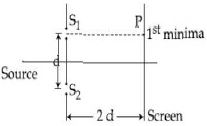 2019 Hard
No questions on this page match these filters.
Other STD 12 - Wave optics topics
- 25Qs Single Slit Diffraction of Light
- 14Qs Resolving power-Human eye, Microscopes and Telescopes
- 10Qs Brewster's Law and Other methods of polarisation
- 20Qs Polarisation of Light and Malus' Law
- 23Qs Wave Nature and Interference of Light
- 4Qs Fresnel distance, Diffraction through circular slit, concept of Airy Disc, Rayleigh Criterion of Resolution, Fraunhofer diffraction
- 15Qs Variations in YDSE
- 2Qs Thin film Interference
- 2Qs Huygens' Principle and Wave-fronts
- 1Qs Mix Examples-Wave Optics
- 4Qs Doppler's Effect of Light
Frequently asked
How many Young's Double Slit Experiment questions came in JEE Mains?
57 questions from 2013–2026, each with the correct answer and a full solution.
How difficult are Young's Double Slit Experiment questions?
14% are easy, 47% medium and 39% hard.