


Topics
10 topics- 12Qs Buoyancy, Archimedes' Principle and Laws of Floatation
- 7Qs Newton's Law of Viscosity
- 7Qs Types of Flow, Equation of Continuity and Flow Rate
- 9Qs Velocity of Efflux and Torricelli's law
- 22Qs Bernoulli's Theorem and Applications of Bernoulli's Theory
- 23Qs Viscosity and Stoke's Law and Terminal Most asked
- 10Qs Pressure and Density
- 5Qs Pascal's Law
- 10Qs Pressure due to Liquid Column and Barometer
- 10Qs Reynold's Number and Poiseuille's Equation
All STD 11 - Fluid mechanics questions
Newest firstShowing 1–50 of 115 questions
- 1. A cubical block of density \(\rho_{ b }=600 kg / m ^3\) floats in a liquid of density \(\rho_{ e }=900 kg / m ^3\). If the height of block is \(H=8.0 cm\) then height of the submerged part is _________ cm . 2026 Hard
- 2. A cylindrical tube AB of length \(l\), closed at both ends contains an ideal gas of 1 mol having molecular weight M. The tube is rotated in a horizontal plane with constant angular velocity \( \omega \) about an axis perpendicular to AB and passing through the edge at end A. If \( P_{A} \) and \( P_{B} \) are the pressures at A and B respectively, then (Consider the temperature is same at all points in the tube)
 2026 Hard
- 3. A cylindrical vessel of \(40\) cm radius is completely filled with water and its capacity is \(528\) dm\(^3\) (dm : decimeter). The vessel is placed on a solid block of exactly same height as vessel. If a small hole is made at \(70\) cm below the top of water level, then horizontal range of water falling on the ground in the beginning is __________ cm. 2026 Hard
- 4. A liquid of density \(600\) kg/m\(^3\) flowing steadily in a tube of varying cross-section. The cross-section at a point \(A\) is \(1.0\) cm\(^2\) and that at \(B\) is \(20\) mm\(^2\). Both the points \(A\) and \(B\) are in same horizontal plane, the speed of the liquid at \(A\) is \(10\) cm/s. The difference in pressures at \(A\) and \(B\) points is ________ Pa. 2026 Medium
- 5. A small metallic sphere of diameter 2 mm and density \(10.5 g / cm ^3\) is dropped in glycerine having viscosity 10 Poise and density \(1.5 g / cm ^3\) respectively. The terminal velocity attained by the sphere is ___________ \(cm / s\).
\(\left(\pi=\frac{22}{7}\right.\) and \(\left.g=10 m / s ^2\right)\) 2026 Hard - 6. A spherical body of radius \(r\) and density \(\sigma\) falls freely through a viscous liquid having density \(\rho\) and viscosity \(\eta\) and attains a terminal velocity \(v _0\). Estimated maximum error in the quantity \(\eta\) is : (Ignore errors associated with \(\sigma, \rho\) and g , gravitational acceleration) 2026 Hard
- 7. A spherical liquid drop of radius \(R\) acquires the terminal velocity \(v_1\) when falls through a gas of viscosity \(\eta\). Now the drop is broken into \(64\) identical droplets and each droplet acquires terminal velocity \(v_2\) falling through the same gas. The ratio of terminal velocities \(v_1/v_2\) is ________. 2026 Medium
- 8. A tub is filled with water and a wooden cube \(10\) cm \(\times\) \(10\) cm \(\times\) \(10\) cm is placed in the water. The wooden cube is found to float on the water with a part of it submerged in water. When a metal coin is placed on the wooden cube, the submerged part is increased by \(3.87\) cm. The mass of the metal coin is _______ gram.
(Take water density as \(1\) g/cm\(^3\) and density of wood as \(0.4\) g/cm\(^3\)) 2026 Medium - 9. A water spray gun is attached to a hose of cross sectional area \(30\) cm\(^2\). The gun comprises of \(10\) perforations each of cross sectional area \(15\) mm\(^2\). If the water flows in the hose with the speed of \(50\) cm/s, calculate the speed at which the water flows out from each perforation. (Neglect any edge effects) 2026 Medium
- 10. If an air bubble of diameter \(2\) mm rises steadily through a liquid of density \(2000\) kg/m\(^3\) at a rate of \(0.5\) cm/s, then the coefficient of viscosity of liquid is _______ Poise. (Take \(g = 10\) m/s\(^2\)) 2026 Hard
- 11. Sixty four rain drops of radius 1 mm each falling down with a terminal velocity of \(10 cm / s\) coalesce to form a bigger drop. The terminal velocity of bigger drop is _________ \(cm / s\). 2026 Hard
- 12. The terminal velocity of a metallic ball of radius 6 mm in a viscous fluid is \(20 cm / s\). The terminal velocity of another ball of same material and having radius 3 mm in the same fluid will be _________ \(cm / s\). 2026 Easy
- 13. Water flows through a horizontal tube as shown in the figure. The difference in height between the water columns in vertical tubes is 5 cm and the area of cross-sections at \(A\) and \(B\) are \(6 cm^2\) and \(3 cm^2\) respectively.
The rate of flow will be ___________ \(cm ^3 / s\). (take \(g =10 m / s ^2\) ) 2026 Hard
- 14. A 400 g solid cube having an edge of length 10 cm floats in water. How much volume of the cube is outside the water ?
(Given : density of water \(=1000 \mathrm{~kg} \mathrm{~m}^{-3}\) ) 2025 Easy - 15. A cube having a side of 10 cm with unknown mass and 200 gm mass were hung at two ends of an uniform rigid rod of 27 cm long. The rod along with masses was placed on a wedge keeping the distance between wedge point and 200 gm weight as 25 cm. Initially the masses were not at balance. A beaker is placed beneath the unknown mass and water is added slowly to it. At given point the masses were in balance and half volume of the unknown mass was inside the water.
(Take the density of unknown mass is more than that of the water, the mass did not absorb water and water density is \(1 \mathrm{gm} / \mathrm{cm}^3\).) The unknown mass is ________ kg. 2025 Hard - 16. A small rigid spherical ball of mass M is dropped in a long vertical tube containing glycerine. The velocity of the ball becomes constant after some time. If the density of glycerine is half of the density of the ball, then the viscous force acting on the ball will be (consider g as acceleration due to gravity) 2025 Medium
- 17. A solid steel ball of diameter 3.6 mm acquired terminal velocity \(2.45 \times 10^{-2} \mathrm{~m} / \mathrm{s}\) while falling under gravity through an oil of density \(925 \mathrm{~kg} \mathrm{~m}^{-3}\). Take density of steel as \(7825 \mathrm{~kg} \mathrm{~m}^{-3}\) and g as 9.8 \(\mathrm{m} / \mathrm{s}^2\). The viscosity of the oil in SI unit is 2025 Medium
- 18.

A tube of length \(L\) is shown in the figure. The radius of cross section at the point (1) is 2 cm and at the point (2) is 1 cm , respectively. If the velocity of water entering at point (1) is \(2 \mathrm{~m} / \mathrm{s}\), then velocity of water leaving the point (2) will be 2025 Easy - 19. A vessel with square cross-section and height of 6 m is vertically partitioned. A small window of \(100 \mathrm{~cm}^2\) with hinged door is fitted at a depth of 3 m in the partition wall. One part of the vessel is filled completely with water and the other side is filled with the liquid having density \(1.5 \times 10^3 \mathrm{~kg} / \mathrm{m}^3\). What force one needs to apply on the hinged door so that it does not get opened ?
(Acceleration due to gravity \(=10 \mathrm{~m} / \mathrm{s}^2\)) 2025 Easy - 20. Consider a completely full cylindrical water tank of height 1.6 m and cross-sectional area \(0.5 \mathrm{~m}^2\). It has a small hole in its side at a height 90 cm from the bottom. Assume, the cross-sectional area of the hole to be negligibly small as compared to that of the water tank. If a load 50 kg is applied at the top surface of the water in the tank then the velocity of the water coming out at the instant when the hole is opened is : \(\left(\mathrm{g}=10 \mathrm{~m} / \mathrm{s}^2\right)\) 2025 Hard
- 21. Consider following statements:
A. Surface tension arises due to extra energy of the molecules at the interior as compared to the molecules at the surface, of a liquid.
B. As the temperature of liquid rises, the coefficient of viscosity increases.
C. As the temperature of gas increases, the coefficient of viscosity increases
D. The onset of turbulence is determined by Reynold's number.
E. In a steady flow two stream lines never intersect.
Choose the correct answer from the options given below: 2025 Medium - 22. In a hydraulic lift, the surface area of the input piston is \(6 \mathrm{~cm}^2\) and that of the output piston is \(1500 \mathrm{~cm}^2\). If 100 N force is applied to the input piston to raise the output piston by 20 cm, then the work done is _______ kJ. 2025 Medium
- 23. In the experiment for measurement of viscosity ' \(\eta\) ' of given liquid with a ball having radius \(R\), consider following statements.
A. Graph between terminal velocity V and R will be a parabola.
B. The terminal velocities of different diameter balls are constant for a given liquid.
C. Measurement of terminal velocity is dependent on the temperature.
D. This experiment can be utilized to assess the density of a given liquid.
E. If balls are dropped with some initial speed, the value of \(\eta\) will change.
Choose the correct answer from the options given below: 2025 Hard - 24. Two cylindrical vessels of equal cross sectional area of \(2 \mathrm{~m}^2\) contain water up to height 10 m and 6 m , respectively. If the vessels are connected at their bottom then the work done by the force of gravity is : (Density of water is \(10^3 \mathrm{~kg} / \mathrm{m}^3\) and \(\mathrm{g}=10 \mathrm{~m} / \mathrm{s}^2\)) 2025 Medium
- 25. Water flows in a horizontal pipe whose one end is closed with a valve. The reading of the pressure gauge attached to the pipe is \(P_1\). The reading of the pressure gauge falls to \(P_2\) when the valve is opened. The speed of water flowing in the pipe is proportional to 2025 Hard
- 26. A cube of ice floats partly in water and partly in kerosene oil. The ratio of volume of ice immersed in water to that in kerosene oil is _______.(specific gravity of Kerosene oil \(=0.8\), specific gravity of ice \(=0.9\) )
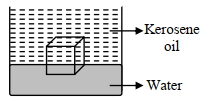 2024 Hard
- 27. A hydraulic press containing water has two arms with diameters as mentioned in the figure. A force of \(10 \mathrm{~N}\) is applied on the surface of water in the thinner arm. The force required to be applied on the surface of water in the thicker arm to maintain equilibrium of water is _______ \({N}\).
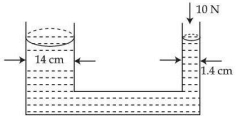 2024 Hard
- 28. A plane is in level flight at constant speed and each of its two wings has an area of \(40 \mathrm{~m}^2\). If the speed of the air is \(180 \mathrm{~km} / \mathrm{h}\) over the lower wing surface and \(252 \mathrm{~km} / \mathrm{h}\) over the upper wing surface, the mass of the plane is _______ \(\mathrm{kg}\). (Take air density to be \(1 \mathrm{~kg} \mathrm{~m}^{-3}\) and \(\mathrm{g}=10 \mathrm{~ms}^{-2}\) ) 2024 Hard
- 29. A small ball of mass \(m\) and density \(\rho\) is dropped in a viscous liquid of density \(\rho_0\). After sometime, the ball falls with constant velocity. The viscous force on the ball is _______. 2024 Hard
- 30. A small spherical ball of radius \(r\), falling through a viscous medium of negligible density has terminal velocity ' \(v\) '. Another ball of the same mass but of radius \(2 r\), falling through the same viscous medium will have terminal velocity _______. 2024 Hard
- 31. A sphere of relative density \(\sigma\) and diameter \(D\) has concentric cavity of diameter \(d\). The ratio of \(\frac{D}{d}\), if it just floats on water in a tank is _______. 2024 Hard
- 32. A spherical ball of radius \(1 \times 10^{-4} \mathrm{~m}\) and density \(10^5\) \(\mathrm{kg} / \mathrm{m}^3\) falls freely under gravity through a distance \(h\) before entering a tank of water, If after entering in water the velocity of the ball does not change, then the value of \(h\) is approximately _______. (The coefficient of viscosity of water is \(9.8 \times 10^{-6}\) \(\left.\mathrm{N} \mathrm{s} / \mathrm{m}^2\right)\) 2024 Hard
- 33. Correct Bernoulli's equation is _______. (symbols have their usual meaning) 2024 Hard
- 34. Given below are two statements : Statement \(I\) : When speed of liquid is zero everywhere, pressure difference at any two points depends on equation \(\mathrm{P}_1-\mathrm{P}_2=\rho \mathrm{g}\left(\mathrm{h}_2-\mathrm{h}_1\right)\) Statement \(II\) : In ventury tube shown \(2 \mathrm{gh}=v_1^2-v_2^2\) In the light of the above statements, choose the most appropriate answer from the options given below.
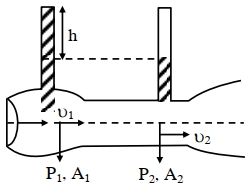 2024 Hard
- 35. In a test experiment on a model aeroplane in wind tunnel, the flow speeds on the upper and lower surfaces of the wings are \(70 \mathrm{~ms}^{-1}\) and \(65 \mathrm{~ms}^{-1}\) respectively. If the wing area is \(2 \mathrm{~m}^2\) the lift of the wing is _______ \(\mathrm{N}\). (Given density of air \(=1.2 \mathrm{~kg} \mathrm{~m}^{-3}\) ) 2024 Hard
- 36. Mercury is filled in a tube of radius \(2 \mathrm{~cm}\) up to a height of \(30 \mathrm{~cm}\). The force exerted by mercury on the bottom of the tube is _______ \(\mathrm{N}\). (Given, atmospheric pressure \(=10^5 \mathrm{Nm}^{-2}\), density of mercury \(=1.36 \times 10^4 \mathrm{~kg} \mathrm{~m}^3, \mathrm{~g}=10 \mathrm{~ms}^2\), \(\left.\pi=\frac{22}{7}\right)\) 2024 Hard
- 37. Small water droplets of radius \(0.01 \mathrm{~mm}\) are formed in the upper atmosphere and falling with a terminal velocity of \(10 \mathrm{~cm} / \mathrm{s}\). Due to condensation, if \(8 \mathrm{such}\) droplets are coalesced and formed a larger drop, the new terminal velocity will be _______ \(\mathrm{cm} / \mathrm{s}\). 2024 Hard
- 38. The reading of pressure metre attached with a closed pipe is \(4.5 \times 10^4 \mathrm{~N} / \mathrm{m}^2\). On opening the valve, water starts flowing and the reading of pressure metre falls to \(2.0 \times 10^4 \mathrm{~N} / \mathrm{m}^2\). The velocity of water is found to be \(\sqrt{\mathrm{V}} \mathrm{m} / \mathrm{s}\). The value of \(\mathrm{V}\) is__________ 2024 Hard
- 39. A fully loaded boeing aircraft has a mass of \(5.4 \times 10^5\,kg\). Its total wing area is \(500\,m ^2\). It is in level flight with a speed of \(1080\,km / h\). If the density of air \(\rho\) is \(1.2\,kg\,m ^{-3}\), the fractional increase in the speed of the air on the upper surface of the wing relative to the lower surface in percentage will be \(\left( g =10\,m / s ^2\right)\) 2023 Hard
- 40. A hydraulic automobile lift is designed to lift vehicles of mass \(5000\,kg\). The area of cross section of the cylinder carrying the load is \(250\,cm ^2\). The maximum pressure the smaller piston would have to bear is [Assume \(g=10\,m / s ^2\)] 2023 Easy
- 41. A metal block of base area \(0.20\,m ^2\) is placed on a table, as shown in figure. A liquid film of thickness \(0.25\,mm\) is inserted between the block and the table. The block is pushed by a horizontal force of \(0.1\,N\) and moves with a constant speed. If the viscosity of the liquid is \(5.0 \times 10^{-3} \;Pa-s\), the speed of block is \(.........\times 10^{-3}\,m / s\)
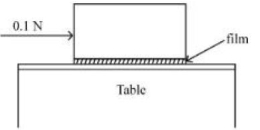 2023 Medium
- 42. A small ball of mass \(M\) and density \(\rho\) is dropped in a viscous liquid of density \(\rho_0\). After some time, the ball falls with a constant velocity. What is the viscous force on the ball ? 2023 Medium
- 43. A Spherical ball of radius \(1 mm\) and density \(10.5 g / cc\) is dropped in glycerine of coefficient of viscosity \(9.8\) poise and density \(1.5 g / cc\). Viscous force on the ball when it attains constant velocity is \(3696 \times 10^{-x} N\). The value of \(x\) is \(\text { (Given, } g =9.8 m / s ^2 \text { and } \pi=\frac{22}{7} \text { ) }\) 2023 Medium
- 44. An air bubble of diameter \(6\,mm\) rises steadily through a solution of density \(1750\,kg / m ^3\) at the rate of \(0.35\,cm / s\). The co-efficient of viscosity of the solution (neglect density of air) is \(..........\,Pas\) (given, \(g =10\,ms ^{-2}\)) 2023 Medium
- 45. An air bubble of volume \(1\,cm ^3\) rises from the bottom of a lake \(40\,m\) deep to the surface at a temperature of \(12^{\circ}\,C\). The atmospheric pressure is \(1 \times 10^5 Pa\), the density of water is \(1000\,kg / m ^3\) and \(g =10\,m / s ^2\). There is no difference of the temperature of water at the depth of \(40\,m\) and on the surface. The volume of air bubble when it reaches the surface will be \(..........\,cm^{3}\) 2023 Medium
- 46. Eight equal drops of water are falling through air with a steady speed of \(10\,cm / s\). If the drops coalesce, the new velocity is \(.........\,cm/s\) 2023 Hard
- 47. Figure below shows a liquid being pushed out of the tube by a piston having area of cross section \(2.0\,cm ^2\). The area of cross section at the outlet is \(10\,mm ^2\). If the piston is pushed at a speed of \(4\,cm s ^{-1}\), the speed of outgoing fluidis \(.........\,cm s ^{-1}\).
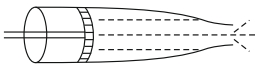 2023 Easy
- 48. Given below are two statements: one is labelled as Assertion \(A\) and the other is labelled as Reason \(R\) Assertion \(A:\) When you squeeze one end of a tube to get toothpaste out from the other end, Pascal's principle is observed. Reason \(R:\) A change in the pressure applied to an enclosed incompressible fluid is transmitted undiminished to every portion of the fluid and to the walls of its container. In the light of the above statements, choose the most appropriate answer from the options given below 2023 Medium
- 49. Given below are two statements: Statement \(I :\) Pressure in a reservoir of water is same at all points at the same level of water. Statement \(II :\) The pressure applied to enclosed water is transmitted in all directions equally. In the light of the above statements, choose the correct answer from the options given below: 2023 Medium
- 50. Glycerine of density \(1.25 \times 10^3\,kg\,m ^{-3}\) is flowing through the conical section of pipe. The area of cross-section of the pipe at its ends is \(10\,cm ^2\) and \(5\,cm ^2\) and pressure drop across its length is \(3\,Nm ^{-2}\). The rate of flow of glycerine through the pipe is \(x \times 10^{-5} m ^3 s ^{-1}\). The value of \(x\) is \(..............\).
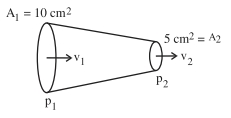 2023 Hard
No questions on this page match these filters.
Frequently asked
How many STD 11 - Fluid mechanics questions came in JEE Mains?
115 questions from 2013–2026, each with the correct answer and a full solution.
Which STD 11 - Fluid mechanics topic is asked the most?
Viscosity and Stoke's Law and Terminal, with 23 questions, followed by Bernoulli's Theorem and Applications of Bernoulli's Theory with 22.
How difficult are STD 11 - Fluid mechanics questions?
7% are easy, 40% medium and 53% hard.