


Chapters asked in 2020
31 chapters- 16Qs STD 11 Units, dimensions and measurement
- 13Qs STD 12 Semicondutor electronics
- 9Qs STD 12 Nuclei
- 6Qs STD 12 Atoms
- 17Qs STD 12 Dual nature of radiation and matter
- 16Qs STD 12 Electromagnetic waves
- 15Qs STD 12 Wave optics
- 16Qs STD 12 Ray optics and optical instruments
- 5Qs STD 12 Alternating current
- 68Qs STD 11 System of particles and rotational motion Most asked
- 22Qs STD 12 Moving charges and magnetism Most asked
- 15Qs STD 12 Electromagnetic induction
- 6Qs STD 12 Magnetism and matter
- 19Qs STD 12 Current electricity
- 20Qs STD 12 Electric potential and capacitance Most asked
- 8Qs STD 12 Electric charges and fields
- 14Qs STD 11 Waves and sound
- 6Qs STD 11 Oscillations
- 16Qs STD 11 Kinetic theory of gases
- 13Qs STD 11 Thermodynamics
- 8Qs STD 11 10.1, thermonetry, thermal expansion and calorimetry
- 3Qs STD 11 Mechanical properties of solids
- 4Qs STD 11 Surface tension
- 11Qs STD 11 Fluid mechanics
- 6Qs STD 11 Newtons laws of motion
- 15Qs STD 11 Gravitation
- 19Qs STD 11 Work, energy, power and collision
- 6Qs STD 11 Motion in plane
- 6Qs STD 11 Motion in straight line
- 2Qs STD 11 Transmission of heat
- 1Qs STD 11 Vectors
All JEE Mains 2020 Physics questions
31 chaptersShowing 1–50 of 401 questions
-
- (A) \(12.5\)
- (B) \(14.5\)
- (C) \(16.5\)
- (D) \(13.5\)
Show answer and solution
Correct Answer: (B)
\(\frac{\Delta Z}{Z}=\frac{2 \Delta a }{ a }+\frac{2}{3} \frac{\Delta b }{ b }+\frac{1}{2} \frac{\Delta c }{ c }+\frac{3 \Delta d }{ d }=14.5 \%\) -
- (A) Momentum
- (B) Area
- (C) Energy
- (D) Volume
Show answer and solution
Correct Answer: (C)
\([\mathrm{h}]=\mathrm{M}^{1} \mathrm{L}^{2} \mathrm{T}^{-1}\)\([\mathrm{C}]=\mathrm{L}^{1} \mathrm{T}^{-1}\)
\([\mathrm{G}]=\mathrm{M}^{-1} \mathrm{L}^{3} \mathrm{T}^{-2}\)
\([\mathrm{f}]=\sqrt{\frac{\mathrm{M}^{1} \mathrm{L}^{2} \mathrm{T}^{-1} \times \mathrm{L}^{5} \mathrm{T}^{-5}}{\mathrm{M}^{-1} \mathrm{L}^{3} \mathrm{T}^{-2}}}=\mathrm{M}^{1} \mathrm{L}^{2} \mathrm{T}^{-2}\)
-
- (A) Planck's constant
- (B) Force constant
- (C) Energy density
- (D) Coefficient of viscosity
Show answer and solution
Correct Answer: (C)
\(x=\frac{I F V^{2}}{W L^{4}}\)\([ x ]=\frac{\left[ ML ^{2}\right]\left[ MI T ^{-2}\right]\left[ L T ^{-1}\right]^{2}}{\left[ ML ^{2} T ^{-2}\right][ L ]^{4}}\)
\([ x ]=\left[ ML ^{-1} T ^{-2}\right]\)
[Energy density] \(=\left[\frac{ E }{ V }\right]\)
\(=\left[\frac{M L^{2} T^{-2}}{L^{3}}\right]\)
\(=\left[ ML ^{-1} T ^{-2}\right]\)
Same as \(x\)
-
- (A) Negative, \(2\, \mu m\)
- (B) Positive, \(10\, \mu m\)
- (C) Positive, \(0.1\) \(\mu m\)
- (D) Positive, \(0.1\) \(mm\)
Show answer and solution
Correct Answer: (B)
Least count of screw gauge\(=\frac{\text { Pitch }}{\text { no. of division on circular scale }}\)
\(=\frac{0.5}{50} mm =1 \times 10^{-5} m\)
\(=10\, \mu m\)
Zero error in positive
-
- (A) \(3.40\)
- (B) \(5.40 \)
- (C) \(4.40 \)
- (D) \(2.40 \)
Show answer and solution
Correct Answer: (C)
\(\mathrm{T}=2 \pi \sqrt{\frac{\ell}{\mathrm{g}}}\)\(\mathrm{g}=\frac{4 \pi^{2} \ell}{\mathrm{T}^{2}}\)
\(\frac{\Delta g}{g}=\frac{\Delta \ell}{\ell}+\frac{2 \Delta T}{T}\)
\(=\frac{0.1}{25}+\frac{2 \times 1}{50}\)
\(\frac{\Delta g}{g}=4.4 \%\)
-
- (A) \((5.5375 \pm 0.0739)\, mm\)
- (B) \((5.538 \pm 0.074)\, mm\)
- (C) \((5.54 \pm 0.07)\, mm\)
- (D) \((5.5375 \pm 0.0740)\, mm\)
Show answer and solution
Correct Answer: (C)
Use significant figures. Answer must be upto three significant figures. -
- (A) \(ML ^{2} T ^{-2}\)
- (B) \(MLT ^{-2}\)
- (C) \(M ^{2} L ^{0} T ^{-1}\)
- (D) \(ML ^{0} T ^{-3}\)
Show answer and solution
Correct Answer: (D)
\(S=\frac{P}{A}=\frac{M L^{2} T^{-3}}{L^{2}}=M T^{-3}\) -
- (A) \(\mathrm{A}_{4}+\mathrm{B}_{4}+\mathrm{C}_{4} < \mathrm{A}_{1}+\mathrm{B}_{1}+\mathrm{C}_{1} < \)\(\mathrm{A}_{3}+\mathrm{B}_{3}+\mathrm{C}_{3} < \mathrm{A}_{2}+\mathrm{B}_{2}+\mathrm{C}_{2}\)
- (B) \(\mathrm{A}_{1}+\mathrm{B}_{1}+\mathrm{C}_{1} < \mathrm{A}_{3}+\mathrm{B}_{3}+\mathrm{C}_{3} < \)\(\mathrm{A}_{2}+\mathrm{B}_{2}+\mathrm{C}_{2} < \mathrm{A}_{4}+\mathrm{B}_{4}+\mathrm{C}_{4}\)
- (C) \(\mathrm{A}_{1}+\mathrm{B}_{1}+\mathrm{C}_{1} = \mathrm{A}_{2}+\mathrm{B}_{2}+\mathrm{C}_{2} = \)\(\mathrm{A}_{3}+\mathrm{B}_{3}+\mathrm{C}_{3} = \mathrm{A}_{4}+\mathrm{B}_{4}+\mathrm{C}_{4}\)
- (D) \(\mathrm{A}_{4}+\mathrm{B}_{4}+\mathrm{C}_{4} > \mathrm{A}_{3}+\mathrm{B}_{3}+\mathrm{C}_{3} = \)\(\mathrm{A}_{2}+\mathrm{B}_{2}+\mathrm{C}_{2} > \mathrm{A}_{1}+\mathrm{B}_{1}+\mathrm{C}_{1}\)
Show answer and solution
Correct Answer: (D)
\(\mathrm{A}_{1}+\mathrm{B}_{1}+\mathrm{C}_{1}=24.36+0.0724+256.2\)\(=280.6324\)
\(=280.6\) (After rounding off) \(\mathrm{A}_{2}+\mathrm{B}_{2}+\mathrm{C}_{2}=24.44+16.082+240.2\)
\(=280.722\)
\(=280.7\) (After rounding off) \(\mathrm{A}_{3}+\mathrm{B}_{3}+\mathrm{C}_{3}=25.2+19.2812+236.183\)
\(=280.6642\)
\(=280.7\) (After rounding off)
\(\mathrm{A}_{4}+\mathrm{B}_{4}+\mathrm{C}_{4}=25+236.191+19.5\)
\(=280.691\)
\(=281\) (After rounding off)
\(\mathrm{A}_{4}+\mathrm{B}_{4}+\mathrm{C}_{4} > \mathrm{A}_{3}+\mathrm{B}_{3}+\mathrm{C}_{3} = \)\(\mathrm{A}_{2}+\mathrm{B}_{2}+\mathrm{C}_{2} > \mathrm{A}_{1}+\mathrm{B}_{1}+\mathrm{C}_{1}\)
-
- (A) \(\left[ PA ^{-1} T ^{-2}\right]\)
- (B) \(\left[ PA ^{1 / 2} T ^{-1}\right]\)
- (C) \(\left[ P ^{2} AT ^{-2}\right]\)
- (D) \(\left[ P ^{1 / 2} AT ^{-1}\right]\)
Show answer and solution
Correct Answer: (B)
Let \([ E ]=[ P ]^{ x }[ A ]^{ y }[ T ]^{z}\)\(ML ^{2} T ^{-2}=\left[ MLT ^{-1}\right]^{ x }\left[ L ^{2}\right] y [ T ]^{z}\)
\(ML ^{2} T ^{-2}= M ^{ x } L ^{ x +2 y } T ^{- x +z}\)
\(\rightarrow x =1\)
\(\rightarrow x +2 y =2\)
\(1+2 y =2\)
\(y =\frac{1}{2}\)
\(\rightarrow- x + z =-2\)
\(-1+ z =-2\)
\(z =-1\)
\([ E ]=\left[ P A ^{1 / 2} T ^{-1}\right]\)
- 10. If speed \(V,\) area \(A\) and force \(F\) are chosen as fundamental units, then the dimension of Young's modulus will be : 2020 Hard
- (A) \(FA ^{-1} V ^{0}\)
- (B) \(FA ^{2} V ^{-1}\)
- (C) \(FA ^{2} V ^{-3}\)
- (D) \(FA ^{2} V ^{-2}\)
Show answer and solution
Correct Answer: (A)
\(Y = F ^{ x } A ^{ y } V ^{z}\)\(M ^{1} L ^{-1} T ^{-2}=\left[ MLT ^{-2}\right] x \left[ L ^{2}\right] y \left[ L T ^{-1}\right]^{z}\)
\(M ^{1} L ^{1} T ^{-2}=[ M ]^{ x }[ L ]^{ x +2 y +z}[ T ]^{-2 x - z }\)
comparing power of \(ML\) and \(T\)
\(x=1 \ldots(1)\)
\(x+2 y+z=-1\)\(...(2)\)
\(-2 x-z=-2\)\(...(3)\)
after solving
\(x=1\)
\(y=-1\)
\(z=0\)
\(Y=F A^{-1} V^{0}\)
-
- (A) \(0.001\; mm\)
- (B) \(0.001\; cm\)
- (C) \(0.02\; mm\)
- (D) \(0.01\; cm\)
Show answer and solution
Correct Answer: (B)
On six rotation, reading of main scale changes by \(3 \mathrm{mm} .\)1 rotation corresponds to \(\frac{1}{2} \mathrm{mm}\)
Also no. of division on circular scale \(=50 .\)
Least count of the screw gauge will be
\(\frac{0.5}{50} \mathrm{mm}=0.001 \mathrm{cm}\)
-
- (A) \(1000\)
- (B) \(1075\)
- (C) \(1060\)
- (D) \(1050\)
Show answer and solution
Correct Answer: (D)
\(\rho=\frac{M}{V}=\frac{M}{\frac{4}{3} \pi\left(\frac{D}{2}\right)^{3}}\)\(\rho=\frac{6}{\pi} M D ^{-3}\)
taking log
\(\ell n \rho=\ell n \left(\frac{6}{\pi}\right)+\ell n M -3 \ell m D\)
Differentiates
\(\frac{ d p}{\rho}=0+\frac{ d M }{ M }-3 \frac{ d ( D )}{ D }\)
for maximum error
\(100 \times \frac{ d \rho}{\rho}=\frac{ dM }{ M } \times 100+\frac{3 d D }{ D } \times 100\)
\(=6+3 \times 1.5\)
\(=10.5 \%\)
\(=\frac{1050}{100} \%\)
\(x=1050.00\)
-
- (A) \(M L^{-1} T^{-2}\)
- (B) \(\mathrm{ML}^{2} \mathrm{T}^{-1}\)
- (C) \(\mathrm{ML} \mathrm{T}^{-2}\)
- (D) \(\mathrm{ML}^{2} \mathrm{T}^{-2}\)
Show answer and solution
Correct Answer: (A)
Magnetic energy stored per unit volume is \(\frac{\mathrm{B}^{2}}{2 \mu_{0}}\)Dimension is \(ML ^{-1} \mathrm{T}^{-2}\)
-
- (A) \(\mathrm{h}^{2} \mathrm{G}^{3 / 2} \mathrm{C}^{1 / 3} \mathrm{A}^{-1}\)
- (B) \(\mathrm{h}^{-2 / 3} \mathrm{c}^{-1 / 3} \mathrm{G}^{4 / 3} \mathrm{A}^{-1}\)
- (C) \(\mathrm{h}^{1 / 3} \mathrm{G}^{2 / 3} \mathrm{c}^{1 / 3} \mathrm{A}^{-1}\)
- (D) \(\mathrm{h}^{0} \mathrm{c}^{5} \mathrm{G}^{-1} \mathrm{A}^{-1}\)
Show answer and solution
Correct Answer: (D)
\(\mathrm{v}_{0}=\mathrm{h}^{\mathrm{x}} \mathrm{c}^{\mathrm{y}} \mathrm{G}^{\mathrm{z}} \mathrm{A}^{\mathrm{w}}\)\(\frac{\mathrm{ML}^{2} \mathrm{T}^{-2}}{\mathrm{AT}}=\left(\mathrm{ML}^{2} \mathrm{T}^{-1}\right)^{\mathrm{x}}\left(\mathrm{LT}^{-1}\right)^{\mathrm{y}}\left(\mathrm{M}^{-1} \mathrm{L}^{3} \mathrm{T}^{-2}\right)^{\mathrm{z}} \mathrm{A}^{\mathrm{w}}\)
\(\Rightarrow \mathrm{w}=-1\)
\((\mathrm{x}-\mathrm{z}=1)\)
\((\mathrm{x}-\mathrm{z}=1)\)
\(-\mathrm{x}-\mathrm{x}=1-2 \mathrm{z}=2\)
\(-\mathrm{x}-\mathrm{y}-2 \mathrm{z}=-3\)
\(\mathrm{x}-\frac{1}{2} \mathrm{x}=0\)
\(\mathrm{x}=0\)
\(\mathrm{x}=-1\)
\(2 \times 0+\mathrm{y}+3 \mathrm{x}-1=2\)
\(y=5\)
\(\Rightarrow \mathrm{v}_{0}=\mathrm{h}^{0} \mathrm{c}^{5} \mathrm{G}^{-1} \mathrm{A}^{-1}\)
-
- (A) \(3.21\)
- (B) \(2.99\)
- (C) \(3.2\)
- (D) \(3.07\)
Show answer and solution
Correct Answer: (D)
Least count \(=1 mm\) or \(0.01 cm\)Zero error \(=0+0.01 \times 7=0.07 cm\)
Reading \(=3.1+(0.01 \times 4)-0.07\)
\(=3.1+0.04-0.07\)
\(=3.1-0.03\)
\(=3.07 cm\)
-
- (A) Only \(x\) and \(y\) have the same dimension
- (B) \(x, y\) and \(z\) have the same dimension
- (C) Only \(x\) and \(z\) have the same dimension
- (D) Only \(y\) and \(z\) have the same dimension
Show answer and solution
Correct Answer: (B)
\(x =\frac{1}{\sqrt{\mu_{0} \varepsilon_{0}}}=\operatorname{speed} \Rightarrow[ x ]=\left[ L ^{1} T ^{-1}\right]\)\(y =\frac{ E }{ B }=\operatorname{speed} \Rightarrow[ y ]=\left[ L ^{1} T ^{-1}\right]\)
\(z=\frac{\ell}{R C}=\frac{\ell}{\tau} \Rightarrow[z]=\left[L^{1} T^{-1}\right]\)
So, \(x, y, z\) all have the same dimensions.
-
- (A) \(A+B\)
- (B) \(\overline{\mathrm{A}}+\overline{\mathrm{B}}\)
- (C) \(\overline{\mathrm{A}}\cdot \overline{\mathrm{B}}\)
- (D) \(A \cdot B\)
Show answer and solution
Correct Answer: (C)
\(\begin{array}{|c|c|c|}\hline A & {B} & {Y} \\ \hline 0 & {0} & {1} \\ \hline 1 & {0} & {0} \\ \hline 0 & {1} & {0} \\ \hline 1 & {1} & {0} \\ \hline\end{array}\) -
- (A) \(18\)
- (B) \(8\)
- (C) \(12\)
- (D) \(15\)
Show answer and solution
Correct Answer: (C)
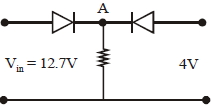
Diode \(D_{1}\) is forward biased and \(D_{2}\) is reverse biased.\(\therefore \mathrm{V}_{\mathrm{A}}=12.7-0.7=12\; \mathrm{V}\)
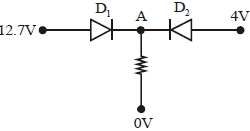
-
- (A) \(AND\)
- (B) \(NAND\)
- (C) \(OR\)
- (D) \(NOT\)
Show answer and solution
Correct Answer: (A)
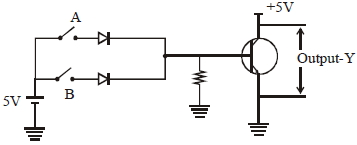
\(A\) \(B\) \(C\) \(0\) \(0\) \(0\) \(0\) \(1\) \(0\) \(0\) \(0\) \(0\) \(1\) \(0\) \(0\) \(0\) \(0\) \(1\) \(0\) \(1\) \(1\) \(0\) \(0\) \(1\) \(0\) \(1\) \(0\) \(0\) \(1\) \(1\) \(0\) \(1\) \(1\) \(1\) \(1\) 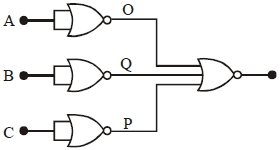
-
- (A) \(2.0\; eV\)
- (B) \(1.5\; eV\)
- (C) \(3.1\; eV\)
- (D) \(1.1 \;eV\)
Show answer and solution
Correct Answer: (C)
\(\Delta E =\frac{h c }{\lambda e }=3.1\; eV\) -
- (A) \(5\)
- (B) \(10\)
- (C) \(0\)
- (D) \(15\)
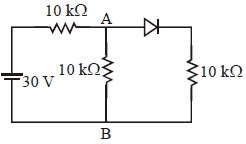
Show answer and solution
Correct Answer: (B)
\(\frac{30-\mathrm{V}_{\mathrm{A}}}{10}+\frac{0-\mathrm{V}_{\mathrm{A}}}{10}+\frac{0-\mathrm{V}_{\mathrm{A}}}{10}=0\)\(3=\frac{3 V_{A}}{10}\)
\(\mathrm{V}_{\mathrm{A}}=10 \mathrm{V}\)
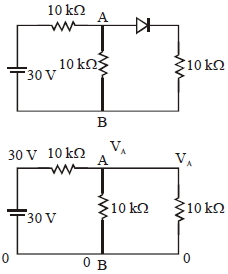
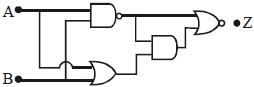
-
- (A) \(1,0,1,1\)
- (B) \(0,1,0,0\)
- (C) \(0,0,1,0\)
- (D) \(1,1,0,1\)
Show answer and solution
Correct Answer: (C)
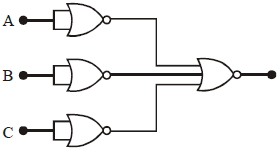
\(Z=(\overline{P+R})\)\(Z=(\overline{P+P Q})\)
\(Z=(\overline{P(1+Q)})\)
\(Z=(\bar{P})[\) Using Identity \((1+A)=1]\)
\(Z=\overline{(A B)}\)
\(Z = AB\)
Truth table for \(Z=A B\)
\(A\) \(B\) \(Z\) \(1\) \(0\) \(0\) \(0\) \(0\) \(0\) \(1\) \(1\) \(1\) \(0\) \(1\) \(0\) 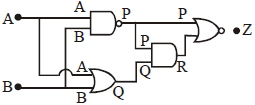
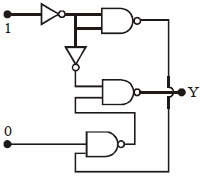
-
- (A) will not execute
- (B) \(0\)
- (C) toggles between \(0\) and \(1\)
- (D) \(1\)
Show answer and solution
Correct Answer: (B)
\(Y=\overline{\mathrm{AB}} \cdot \mathrm{A}\)\(=\overline{\overline{\mathrm{AB}}}+\overline{\mathrm{A}}\)
\(=0+0\)
\(=0\)
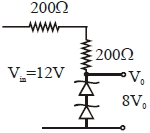
-
- (A) \(20\)
- (B) \(8\)
- (C) \(24\)
- (D) \(40\)
Show answer and solution
Correct Answer: (D)
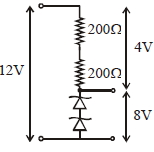
Current in circuit \(=\frac{4}{400}=\frac{1}{100} \mathrm{A}\)So power dissipited in each diode \(=\) \(\mathrm{VI}\)
\(=4 \times \frac{1}{100} \;\mathrm{W}\)
\(=40 \times 10^{-3}\; \mathrm{mW}\)
-
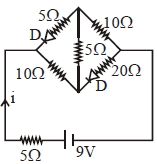
- (A) \(0 \)
- (B) \(0.6\)
- (C) \(0.3 \)
- (D) \(0.2 \)
Show answer and solution
Correct Answer: (C)
\(i=\frac{9}{(5+10+5+10)}=\frac{9}{30} A\)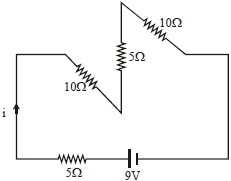
-
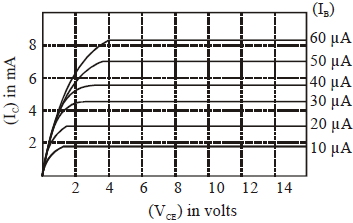
- (A) \(130\)
- (B) \(125\)
- (C) \(150\)
- (D) \(100\)
Show answer and solution
Correct Answer: (C)
\(\Delta I _{ B }=(30-20)=10 \mu A\)\(\Delta I _{ C }=(4.5-3) mA =1.5 mA\)
\(\beta_{ x }=\frac{\Delta I _{ C }}{\Delta I _{ B }}=\frac{1.5 mA }{10 \mu A }=150\)
\(\beta_{ ac }=150\)
-
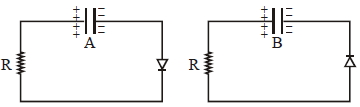
- (A) \(\mathrm{Q}_{\mathrm{A}}=\mathrm{VC}, \mathrm{Q}_{\mathrm{B}}=\frac{\mathrm{VC}}{\mathrm{e}}\)
- (B) \(\mathrm{Q}_{\mathrm{A}}=\frac{\mathrm{CV}}{2}, \mathrm{Q}_{\mathrm{B}}=\frac{\mathrm{VC}}{\mathrm{e}}\)
- (C) \(\mathrm{Q}_{\mathrm{A}}=\mathrm{VC}, \mathrm{Q}_{\mathrm{B}}=\mathrm{CV}\)
- (D) \(\mathrm{Q}_{\mathrm{A}}=\frac{\mathrm{VC}}{\mathrm{e}}, \mathrm{Q}_{\mathrm{B}}=\frac{\mathrm{CV}}{2}\)
Show answer and solution
Correct Answer: (A)
For (A)No current flows
Hence \(Q_{A}=C V\)
For \((\mathrm{B})\)
\(\mathrm{i}=\frac{\mathrm{V}}{\mathrm{R}} \mathrm{e}^{-\frac{\mathrm{t}}{\mathrm{RC}}}\)
\(\mathrm{q}=\mathrm{CV} \mathrm{e}^{\frac{\mathrm{t}}{\mathrm{RC}}}\)
at \(\mathrm{t}=\mathrm{CR}\)
\(\mathrm{Q}_{\mathrm{B}}=\mathrm{CV} \mathrm{e}^{-1}=\frac{\mathrm{CV}}{\mathrm{e}}\)
-
- (A) \(100\)
- (B) \(50\)
- (C) \(300\)
- (D) \(200\)
Show answer and solution
Correct Answer: (A)
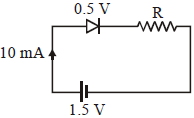
\(1.5-0.5- R \times 10 \times 10^{-3}=0\)\(\therefore R =100\, \Omega\)
-
- (A) increases initially and saturates finally
- (B) increases initially and after attaining certain value, it decreases
- (C) increases linearly
- (D) remains constant
Show answer and solution
Correct Answer: (A)
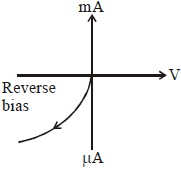
\(I-V\) characteristic of a photodiode is as followsOn increasing the potential difference the current first increases and then attains a saturation.
-
- (A) \(9\)
- (B) \(55\)
- (C) \(6\)
- (D) \(12\)
Show answer and solution
Correct Answer: (A)
\(\frac{1}{ T _{\text {eff }}}=\frac{1}{ T _{1}}+\frac{1}{ T _{2}}\)\(T _{ eff }=\frac{ T _{1} T _{2}}{ T _{1}+ T _{2}}=\frac{1000}{110}=\frac{100}{11}=9.09\)
\(T _{ eff } \cong 9\)

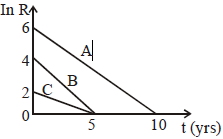
-
- (A) \(3: 2: 1\)
- (B) \(4: 3: 1\)
- (C) \(2: 1: 3\)
- (D) \(2: 1: 1\)
Show answer and solution
Correct Answer: (C)
\(R = R _{0} e ^{-\lambda t}\)ln \(R =\ln R _{0}-\lambda t\)
\(\lambda_{ A }=\frac{6}{10} \Rightarrow T _{ A }=\frac{10}{6}\) ln \(2\)
\(\lambda_{ B }=\frac{6}{5} \Rightarrow T _{ B }=\frac{5 \ln 2}{6}\)
\(\lambda_{ C }=\frac{2}{5} \Rightarrow T _{ C }=\frac{5 \ln 2}{2}\)
\(\frac{10}{6}: \frac{5}{6}: \frac{15}{6}:: 2: 1: 3\)
-
- (A) \(8.5\)
- (B) \(7.5\)
- (C) \(8.0\)
- (D) \(9.0\)
Show answer and solution
Correct Answer: (A)
\(B.E =[\Delta m ] \cdot c ^{2}\)\(M _{\text {expected }}= ZM _{ p }+( A - Z ) M _{ n }\)
\(=50[1.00783]+70[1.00867]\)
\(B E .=[50[1.00783]+70[1.00867]-119.902199]\)\(\times 931\)
\(=1020.56\)
\(\frac{ BE }{\text { nucleon }}=\frac{1020.56}{120}=8.5 MeV\)
-
- (A) \(n+p \rightarrow d+\gamma\)
- (B) \(e ^{+}+ e ^{-} \rightarrow \gamma\)
- (C) \(n + n \rightarrow\) deuterium atom (electron bound to the nucleus)
- (D) \(p \rightarrow n+e^{+}+\bar{v}\)
Show answer and solution
Correct Answer: (A)
Only in \(case-I,\) \(M _{ LHS }> M _{ RHS }\) i.e.total mass on reactant side is greater then that on the product side. Hence it will only be allowed.
-
- (A) \(\frac{3}{4}\)
- (B) \(\frac{7}{8}\)
- (C) \(\frac{4}{5}\)
- (D) \(\frac{3}{5}\)
Show answer and solution
Correct Answer: (A)
First order decay\(N ( t )= N _{0} e ^{-\lambda 1}\)
Given \(N ( t ) / N _{0}=9 / 16= e ^{-\lambda}\)
Now, \(N ( t / 2)= N _{0} e ^{-2} v / 2\)
\(\frac{ N ( t / 2)}{ N _{0}}=\sqrt{ e ^{-\lambda t}}=\sqrt{9 / 16}\)
\(N(t/2)=3/4 N _{0}\)
-
- (A) \(125\)
- (B) \(60\)
- (C) \(35\)
- (D) \(54\)
Show answer and solution
Correct Answer: (B)
Number of uranium atoms in \(2 kg\)\(=\frac{2 \times 6.023 \times 10^{26}}{235}\)
energy from one atom is \(200 \times 10^{6}\) e.v. hence total energy from \(2 kg\) uranium
\(=\frac{2 \times 6.023 \times 10^{26}}{235} \times 200 \times 10^{6} \times 1.6 \times 10^{-19} J\)
\(2 kg\) uranium is used in \(30\) days hence this energy is recieved in 30 days hence energy recived per second or power is
Power \(=\frac{2 \times 6.023 \times 10^{26} \times 200 \times 10^{6} \times 1.6 \times 10^{-19}}{235 \times 30 \times 24 \times 3600}\)
Power \(=63.2 \times 10^{6}\) watt or \(63.2\) Mega Watt
-
- (A) \(66\)
- (B) \(52\)
- (C) \(72\)
- (D) \(62\)
Show answer and solution
Correct Answer: (D)
\(A=A_{0}\left(\frac{1}{2}\right) \frac{t}{T_{1 / 2}}\)\(500=700\left(\frac{1}{2}\right) \frac{t}{T_{1 / 2}}\)
\(0.7 \approx\left(\frac{1}{2}\right) \frac{t}{T_{1 / 2}}\)
\(\left(\frac{1}{2}\right)^{1 / 2} \approx \frac{t}{T_{1 / 2}}\)
\(\frac{30}{\mathrm{T}_{1 / 2}} \approx \frac{1}{2} \Rightarrow \mathrm{T}_{1 / 2}=60\)
-
- (A) \(10^{24} \;kg m ^{-3}\)
- (B) \(10^{3} \;kg m ^{-3}\)
- (C) \(10^{17} \;kg m ^{-3}\)
- (D) \(10^{10} \;kg m ^{-3}\)
Show answer and solution
Correct Answer: (C)
\(\rho_{\text {nucleus }}=\frac{\text { mass }}{\text { volume }}=\frac{A}{(4 / 3) \pi r_{0}^{3} A}=\frac{3}{4 \pi r_{0}^{3}}=2.3 \times 10^{17} kg / m^{3}\) -
- (A) \(8 \times 10^{6}\)
- (B) \(1.33 \times 10^{6}\)
- (C) \(6.82 \times 10^{5}\)
- (D) \(4.5 \times 10^{5}\)
Show answer and solution
Correct Answer: (B)
\({ }_{3}^{7} Li +{ }_{1}^{1} H \rightarrow 2\left({ }_{2}^{4} He \right)\)\(\Delta m \Rightarrow\left[ m _{ Li }+ m _{ H }\right]-2\left[ M _{ He }\right]\)
Energy released in \(1\) reaction \(\Rightarrow \Delta mc ^{2}\)
In use of \(7.016\, u\) \(Li\) energy is \(\Delta mc ^{2}\)
In use of \(1\, gm\) \(Li\) energy is \(\frac{\Delta mc ^{2}}{ m _{ Li }}\)
In use of \(20\, gm\) energy is \(\Rightarrow \frac{\Delta mc ^{2}}{ m _{ Li }} \times 20 gm\)
\(\Rightarrow \frac{[(7.016+1.0079)-2 \times 4.0026] u \times c ^{2}}{7.016 \times 1.6 \times 10^{-24} gm } \times 20 gm\)
\(\Rightarrow\left(\frac{0.0187 \times 1.6 \times 10^{-19} \times 10^{9}}{7.016 \times 1.6 \times 10^{-24} gm } \times 20 gm \right)\) Joule
\(\Rightarrow 0.05 \times 10^{+14} J\)
\(\Rightarrow 1.4 \times 10^{+6} kwh\)
\(\left[1 J \Rightarrow 2.778 \times 10^{-7} kwh \right]\)
-
- (A) \(55\)
- (B) \(65\)
- (C) \(60\)
- (D) \(51\)
Show answer and solution
Correct Answer: (D)
\(m V _{0}= M V = p\)\(10.2=\frac{ p ^{2}}{2 m }-\frac{ p ^{2}}{2 M }=\frac{ p ^{2}}{2 m }\left(1-\frac{ m }{ M }\right)\)
\(=\frac{ p ^{2}}{2 m }(1-0.2)\)
\(\Rightarrow \frac{ p ^{2}}{2 m }= K =\frac{10.2}{0.8}\)
-
- (A) \(\frac{1}{n^{4}}\)
- (B) \(\frac{1}{n^{3}}\)
- (C) \(\frac{1}{n^{2}}\)
- (D) \(\frac{1}{n}\)
Show answer and solution
Correct Answer: (B)
In hydrogen atom,\(E _{ n }=\frac{- E _{0}}{ n ^{2}}\)
Where \(E _{0}\) is Ionisation Energy of \(H\).
\(\rightarrow\) For transition from \((n+1)\) to \(n,\) the energy of emitted radiation is equal to the difference in energies of levels.
\(\Delta E = E _{ n +1}- E _{ n }\)
\(\Delta E = E _{0}\left(\frac{1}{ n ^{2}}-\frac{1}{( n +1)^{2}}\right)\)
\(\Delta E = h v= E _{0}\left(\frac{( n +1)^{2}- n ^{2}}{ n ^{2}( n +1)^{2}}\right)\)
\(h v= E _{0}\left[\frac{2 n +1}{ n ^{4}\left(1+\frac{1}{ n }\right)^{2}}\right]\)
\(h v= E _{0}\left[\frac{ n \left(2+\frac{1}{ n }\right)}{ n ^{4}\left(1+\frac{1}{ n }\right)^{2}}\right]\)
since \(n >>>1\)
Hence, \(\frac{1}{ n } \simeq 0\)
\(h v= E _{0}\left[\frac{2}{ n ^{3}}\right]\)
\(v \alpha \frac{1}{ n ^{3}}\)
-
- (A) \(10553\)
- (B) \(10560\)
- (C) \(10555\)
- (D) \(10165\)
Show answer and solution
Correct Answer: (A)
\(\lambda=\frac{ c }{\left(\frac{1}{ n _{1}^{2}}-\frac{1}{ n _{2}^{2}}\right)}\)for lyman series
\(\lambda_{1}=\frac{ c }{\frac{1}{1^{2}}-\frac{1}{\infty^{2}}}= c ( n =\infty\) to \(n =1)\)
\(\lambda_{2}=\frac{c}{\frac{1}{1^{2}}-\frac{1}{2^{2}}}=\frac{4 c}{3}(n=2\) to \(n=1)\)
\(\Delta \lambda=\lambda_{2}-\lambda_{1}=\frac{ c }{3}=304 A \Rightarrow c =912 A\)
for paschen series
\(\lambda_{1}=\frac{ c }{\frac{1}{3^{2}}-\frac{1}{\infty^{2}}}=9 c ( n =\infty\) to \(n =3)\)
\(\lambda_{2}=\frac{ c }{\frac{1}{3^{2}}-\frac{1}{4^{2}}}=\frac{144 c }{7}( n =4\) to \(n =3)\)
\(\Delta \lambda=\lambda_{2}-\lambda_{1}=\frac{144 c }{7}-9 c =\frac{81 c }{7}=\frac{81 \times 912}{7}\)
\(=10553.14 \mathring {A}\)
-
- (A) \(35.8\)
- (B) \(24.2\)
- (C) \(8.6\)
- (D) \(11.4 \)
Show answer and solution
Correct Answer: (D)
\(1\) Rydberg energy \(=13.6 \mathrm{eV}\) So, ionisation energy \(=\left(13.6 \mathrm{Z}^{2}\right) \mathrm{eV}\)\(=9 \times 13.6 \mathrm{eV}\)
\(z=3\)
\(\frac{1}{\lambda}=\mathrm{R} Z^{2}\left(\frac{1}{1^{2}}-\frac{1}{3^{2}}\right)=1.09 \times 10^{7} \times 9 \times \frac{8}{9}\)
\(\lambda=11.4 \mathrm{nm}\)
-
- (A) \(256\)
- (B) \(540\)
- (C) \(486\)
- (D) \(626\)
Show answer and solution
Correct Answer: (C)
For Balmer series.\(\frac{1}{\lambda}=\mathrm{R}_{\mathrm{H}}\left(\frac{1}{2^{2}}-\frac{1}{\mathrm{n}_{2}^{2}}\right)\)
\(\frac{\lambda_{2}}{\lambda_{1}}=\frac{\left(\frac{1}{2^{2}}-\frac{1}{3^{2}}\right)}{\left(\frac{1}{2^{2}}-\frac{1}{4^{2}}\right)}\)
\(\frac{\lambda_{2}}{6561}=\frac{5 / 36}{3 / 16}\)
\(\lambda_{2}=\frac{20}{27} \times 6561\)
\(\lambda_{2}=4860 \mathring{A}\)
\(=486 \mathrm{nm}\)
-
- (A) \(6.2 \times 10^{15}\)
- (B) \(5.6 \times 10^{12}\)
- (C) \(7.8 \times 10^{14}\)
- (D) \(1.6 \times 10^{14}\)
Show answer and solution
Correct Answer: (C)
Time period of revolution of electron in \(\mathrm{n}^{\text {th }}\) orbit \(\mathrm{T}=\frac{2 \pi \mathrm{r}}{\mathrm{V}}=\frac{2 \pi \mathrm{a}_{0}\left(\frac{\mathrm{n}^{2}}{\mathrm{Z}}\right)}{\mathrm{V}_{0}\left(\frac{\mathrm{Z}}{\mathrm{n}}\right)}\)\(\Rightarrow \mathrm{T} \propto \frac{\mathrm{n}^{3}}{\mathrm{Z}^{2}}\)
\(\frac{\mathrm{T}_{2}}{\mathrm{T}_{1}}=\frac{(2)^{3}}{(1)^{3}}=8 \Rightarrow \mathrm{T}_{2}=8 \times 1.6 \times 10^{-16}\)
Now frequency \(f_{2}=\frac{1}{T_{2}}=\frac{10^{16}}{8 \times 1.6} \approx 7.8 \times 10^{14} \mathrm{Hz}\)
-
- (A) \(5\)
- (B) \(8\)
- (C) \(11\)
- (D) \(13\)
Show answer and solution
Correct Answer: (C)
Power incident \(P=I \times A\)\(\mathrm{n}=\mathrm{no} .\) of photons incident/second
\(\mathrm{nE}_{\mathrm{ph}}=\mathrm{IA}\)
\(\mathrm{n}=\frac{\mathrm{IA}}{\mathrm{E}_{\mathrm{ph}}}\)
\(\mathrm{n}=\frac{\mathrm{IA}}{\left(\frac{\mathrm{hc}}{\lambda}\right)}=\frac{6.4 \times 10^{-5} \times 1}{\frac{1240}{310} \times 1.6 \times 10^{-19}}\)
\(\mathrm{n}=10^{+14}\) per second
since efficiency \(=10^{-3}\)
no. of electrons emitted \(=10^{+11}\) per second.
\(\mathrm{x}=11\)
-
- (A) \(57\)
- (B) \(65\)
- (C) \(50\)
- (D) \(51\)
Show answer and solution
Correct Answer: (C)
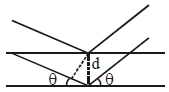
\(2 d \sin \theta=\lambda=\frac{ h }{\sqrt{2 mE }}\)\(2 \times 10^{-10} \times \frac{\sqrt{3}}{2}=\frac{6.6 \times 10^{-34}}{\sqrt{2 mE }}\)
\(E =\frac{1}{2} \times \frac{6.64^{2} \times 10^{-48}}{9.1 \times 10^{-31} \times 3 \times 1.6 \times 10^{-19}}=50.47\)
-
- (A) \(4.8 \times 10^{-27}\, kg\)
- (B) \(1.2 \times 10^{-28}\, kg\)
- (C) \(9.1 \times 10^{-31}\, kg\)
- (D) \(9.7 \times 10^{-28}\, kg\)
Show answer and solution
Correct Answer: (D)
Let mass of particle \(= m\)Let speed of \(e= V\)
\(\Rightarrow\) speed of particle \(=5 V\)
Debroglie wavelength \(\lambda_{ d }=\frac{ h }{ P }=\frac{ h }{ mv }\)
\(\Rightarrow\left(\lambda_{d}\right)_{P}=\frac{h}{m(5 V)}\) \(...(1)\)
\(\Rightarrow\left(\lambda_{d}\right)_{e}=\frac{ h }{ m _{ e } \cdot V }\)\(...(2)\)
According to question
\(\frac{(1)}{(2)}=\frac{m_{e}}{5 m}=1.878 \times 10^{-4}\)
\(\Rightarrow m =\frac{ m _{ e }}{5 \times 1.878 \times 10^{-4}}\)
\(\Rightarrow m =\frac{9.1 \times 10^{-31}}{5 \times 1.878 \times 10^{-4}}\)
\(\Rightarrow m =9.7 \times 10^{-28} kg\)
-
- (A) \(2E\)
- (B) \(E\)
- (C) \(3E\)
- (D) \(4E\)
Show answer and solution
Correct Answer: (C)
de-Broglie wavelength \(=\frac{\mathrm{h}}{\sqrt{2 \mathrm{mE}}}=\lambda\)Also, \(\frac{\mathrm{h}}{\sqrt{2 \mathrm{m}(\mathrm{E}+\Delta \mathrm{E})}}=\frac{\lambda}{2}\)
\(\therefore \quad \frac{\mathrm{E}+\Delta \mathrm{E}}{\mathrm{E}}=4 \Rightarrow \Delta \mathrm{E}=3 \mathrm{E}\)
-
- (A) \(\lambda_{ e }<\lambda_{ P }<\lambda_{ He ^{++}}\)
- (B) \(\lambda_{e}<\lambda_{H e^{++}}=\lambda_{P}\)
- (C) \(\lambda_{e}>\lambda_{H e^{++}}>\lambda_{P}\)
- (D) \(\lambda_{e}>\lambda_{P}>\lambda_{H e^{++}}\)
Show answer and solution
Correct Answer: (D)
\(\lambda=\frac{ h }{ P }=\frac{ h }{\sqrt{2 m ( KE )}}\)\(\lambda \propto \frac{1}{\sqrt{ m }} \Rightarrow \lambda=\frac{ C }{\sqrt{ m }}\)
\(m _{ He ^{++}}> m _{ P }> m _{ e }\)
\(\therefore \lambda_{ He ^{++}}<\lambda_{ P }<\lambda_{ e }\)
-
- (A) \(\frac{\lambda_{0} \sqrt{2}}{\sqrt{ {\Large{1}}+\cfrac{\mathrm{e}^{2} \mathrm{E}^{2} \mathrm{t}^{2}}{\mathrm{m}^{2} \mathrm{v}_{0}^{2}}}}\)
- (B) \(\frac{\lambda_{0}}{\sqrt{{\Large{2}}+\cfrac{\mathrm{e}^{2} \mathrm{E}^{2} \mathrm{t}^{2}}{\mathrm{m}^{2} \mathrm{v}_{0}^{2}}}}\)
- (C) \(\frac{\lambda_{0}}{\sqrt{{\Large{1}}+\cfrac{\mathrm{e}^{2} \mathrm{E}^{2} \mathrm{t}^{2}}{2 \mathrm{m}^{2} \mathrm{v}_{0}^{2}}}}\)
- (D) \(\frac{\lambda_{0}}{\sqrt{{\Large{1}}+\cfrac{\mathrm{e}^{2} \mathrm{E}_{0}^{2} \mathrm{t}^{2}}{\mathrm{m}^{2} \mathrm{v}_{0}^{2}}}}\)
Show answer and solution
Correct Answer: (C)
By de-Broglie hypothesis\(\lambda=\frac{\mathrm{h}}{\mathrm{mv}}\)
\(\lambda_{0}=\frac{\mathrm{h}}{\mathrm{m} \sqrt{2} \mathrm{v}_{0}}\dots(1)\)
\(\lambda^{\prime}=\frac{\mathrm{h}}{\sqrt{\mathrm{v}_{0}^{2}+\mathrm{v}_{0}^{2}+\left(\frac{\mathrm{eE}_{0} \mathrm{t}}{\mathrm{m}}\right)^{2}}}\)
\(=\frac{h}{m \sqrt{2 v_{0}^{2}+\frac{e^{2} E_{0}^{2} t^{2}}{m^{2}}}}\dots(2)\)
\(\mathrm{By}(1)\) and ( 2)
\(\lambda^{\prime}=\frac{\lambda_{0}}{\sqrt{1+\frac{\mathrm{e}^{2} \mathrm{E}_{0}^{2} \mathrm{t}^{2}}{2 \mathrm{m}^{2} \mathrm{v}_{0}^{2}}}}\)
No questions on this page match these filters.
Other years
Frequently asked
How many JEE Mains 2020 Physics questions are on ExamBro?
401 questions, each with the correct answer and a full solution.
Which JEE Mains 2020 Physics chapter is asked the most?
System of particles and rotational motion, with 68 questions, followed by Moving charges and magnetism with 22.
How difficult are JEE Mains 2020 Physics questions?
3% are easy, 52% medium and 45% hard.