


All JEE Mains 2023 Physics questions
32 chaptersShowing 301–350 of 644 questions
-
- (A) \(6.8\)
- (B) \(10\)
- (C) \(5\)
- (D) \(100\)
Show answer and solution
Correct Answer: (B)
\(I =2\,A\)\(\Delta V =3.4\,V\)
Using Ohm's Law
\(R =\frac{3.4}{2}=1.7 \Omega\)
\(1.7=\frac{\rho L }{ A }\)
\(L =\frac{1.7( A )}{\rho}\)
\(M =(\text { density volume })\)
\(Volume =\frac{8.92 \times 10^{-3}}{8.92 \times 10^3}=10^{-6}\)
\(L ^2=\frac{1.7}{\rho}\left(10^{-6}\right)=\frac{1.7}{1.7} \times 10^2\)
\(L =10\,m\)
-
- (A) \(10\)
- (B) \(640\)
- (C) \(40\)
- (D) \(16\)
Show answer and solution
Correct Answer: (A)
Volume \(=\) Constant\(A _1 L _1= A _2 L _2\)
\(A _1 L = A _2 \frac{ L }{4}\)
\(4 A _1= A _2\)
\(R _1=\frac{\rho L_1}{ A _1} \quad R _2=\frac{\rho L_2}{ A _2}\)
\(\frac{ R _2}{ R _1}=\frac{ L _2 A _1}{ A _2 L _1}=\frac{ L }{4} \frac{ A _1}{4 A _1 L }\)
\(R _2=\frac{1}{16} R _1=10\,\Omega\)
-
- (A) \(I _4=\frac{8}{5} A\) and \(I _5=\frac{2}{5}\,A\)
- (B) \(I _4=\frac{24}{5} A\) and \(I _5=\frac{6}{5}\,A\)
- (C) \(I _4=\frac{6}{5} A\) and \(I _5=\frac{24}{5}\,A\)
- (D) \(I _4=\frac{2}{5} A\) and \(I _5=\frac{8}{5}\,A\)
Show answer and solution
Correct Answer: (D)
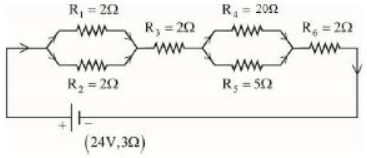
Equivalent resistance of circuit\(R _{ eq } =3+1+2+4+2\)
\(=12 \Omega\)
Current through battery \(i =\frac{24}{12}=2 A\)
\(I _4=\frac{ R _5}{ R _4+ R _5} \times 2=\frac{5}{20+5} \times 2=\frac{2}{5} A\)
\(I _5=2-\frac{2}{5}=\frac{8}{5} A\)
-
- (A) \(18\)
- (B) \(17\)
- (C) \(20\)
- (D) \(19\)
Show answer and solution
Correct Answer: (C)
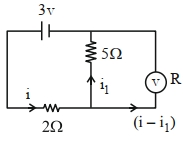
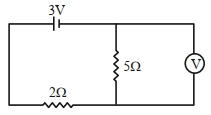
\(i_1=\frac{2\,V}{5\,\Omega}=\frac{2}{5}\,A\)\(i=\frac{1 V}{2 \Omega}=\frac{1}{2}\,A\)
\(\therefore \text { Current through voltmeter }=i-i_1\)
\(=\frac{1}{2}-\frac{2}{5}=\frac{5-4}{10}=\frac{1}{10}\,A\)
\(\therefore \text { For voltmeter }\)
\(2=\left(\frac{1}{10}\right) R \Rightarrow R=20\,\Omega\)
- 305. Different combination of \(3\) resistors of equal resistance \(R\) are shown in the figures.
The increasing order for power dissipation is: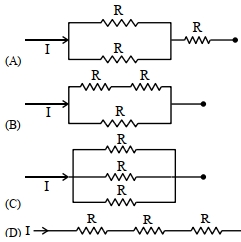 2023 Medium
- (A) \(P _{ A } < P _{ B } < P _{ C } < P _{ D }\)
- (B) \(P _{ C } < P _{ D } < P _{ A } < P _{ B }\)
- (C) \(P _{ B } < P _{ C } < P _{ D } < P _{ A }\)
- (D) \(P _{ C } < P _{ B } < P _{ A } < P _{ D }\)
Show answer and solution
Correct Answer: (D)
\(P = I ^2 R\)\(R _1=\frac{3 R }{2}, R _2=\frac{2 R }{3}, R _3=\frac{ R }{3}, R _4=3 R\)
Since \(i\) is same, hence \(P \alpha R\) so options \((4)\) is correct
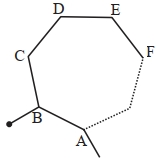
- 306. Equivalent resistance between the adjacent corners of a regular \(n\)-sided polygon of uniform wire of resistance \(R\) would be: 2023 Medium
- (A) \(\frac{(n-1) R}{n^2}\)
- (B) \(\frac{(n-1) R}{(2 n-1)}\)
- (C) \(\frac{n^2 R}{n-1}\)
- (D) \(\frac{(n-1) R}{n}\)
Show answer and solution
Correct Answer: (A)
Suppose resistance of each arm is \(r\), then \(r = R / n\)\(R _{ eq(AB )}=\frac{ R _1 R_2}{R_1+R_2}\)
\(\frac{ r ( n -1) r }{ r +( n -1) r }\)
\(=\frac{ r ( n -1) r }{ nr }\)
\(=\frac{ n -1}{ n } r\)
\(=\frac{( n -1) R }{ n ^2}\)
-
- (A) \(0.4\)
- (B) \(0.2\)
- (C) \(0.6\)
- (D) \(1.0\)
Show answer and solution
Correct Answer: (A)
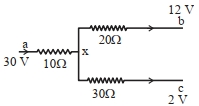
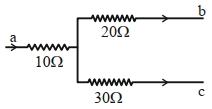
sum of current at junction point will be zero:\(\frac{x-30}{10}+\frac{x-12}{20}+\frac{x-2}{30}=0\)
\(\Rightarrow x\left(\frac{1}{10}+\frac{1}{20}+\frac{1}{30}\right)=\frac{30}{10}+\frac{12}{20}+\frac{2}{30}\)
\(\Rightarrow x\left(\frac{6+3+2}{60}\right)=\frac{180+36+4}{60}\)
\(\Rightarrow x =\frac{220}{11}=20\,V\)
\(\therefore \text { Current through } 20\,\Omega=\frac{x-12}{20}\)
\(=\frac{20-12}{20}=\frac{2}{5}=0.4\,A\)
- 308. For the given circuit, in the steady state, \(\left| V _{ B }- V _{ D }\right|=.......V.\)
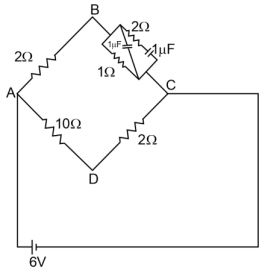 2023 Hard
- (A) \(2\)
- (B) \(3\)
- (C) \(1\)
- (D) \(4\)
Show answer and solution
Correct Answer: (C)
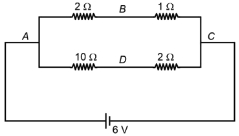
In steady state, capacitor behaves as an open circuit. Circuit is\(i_{A B}=\frac{6}{3}=2 A\)
\(i_{A D}=\frac{6}{12}=0.5 A\)
\(V_B+2 \times 2-10 \times 0.5=V_D\)
\(V_B-V_D=1\;volt\)
-
- (A) Statement \(I\) is false but Statement \(II\) is true
- (B) Both Statement \(I\) and Statement \(II\) are false
- (C) Statement \(I\) is true but Statement \(II\) is false
- (D) Both Statement \(I\) and Statement \(II\) are true
Show answer and solution
Correct Answer: (B)
\(R _{ eq }= R _1+ R _2+ R _3 \text { So St-1 False }\)Resistivity depends on temperature.\(St-2\) False
- 310. If a copper wire is stretched to increase its length by \(20 \% \). The percentage increase in resistance of the wire is \(..........\%\) 2023 Medium
- (A) \(40\)
- (B) \(41\)
- (C) \(44\)
- (D) \(43\)
Show answer and solution
Correct Answer: (C)
As volume is constant,So resistance \(\propto\) (length \()^2\)
\(\Rightarrow \% \text { change in resistance }=20+20+\frac{400}{100}=44 \%\)
- 311. If the potential difference between \(B\) and \(D\) is zero, the value of \(x\) is \(\frac{1}{n} \Omega\). The value of \(n\) is .......
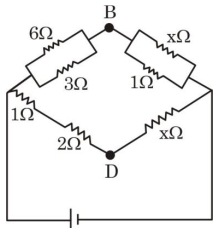 2023 Medium
- (A) \(1\)
- (B) \(3\)
- (C) \(2\)
- (D) \(4\)
Show answer and solution
Correct Answer: (C)
\(\frac{2}{3}=\frac{\frac{x}{x+1}}{x}\)\(\Rightarrow \frac{2}{3}=\frac{1}{x+1}\)
\(\Rightarrow x=0.5=\frac{1}{2}\)
\(n=2\)
- 312. In a metallic conductor, under the effect of applied electric field, the free electrons of the conductor 2023 Medium
- (A) drift from higher potential to lower potential.
- (B) move in the curved paths from lower potential to higher potential
- (C) move with the uniform velocity throughout from lower potential to higher potential
- (D) move in the straight line paths in the same direction
Show answer and solution
Correct Answer: (B)
Move in curve path\(i = neAV _{ d }\)
-
- (A) \(2\)
- (B) \(4\)
- (C) \(6\)
- (D) \(8\)
Show answer and solution
Correct Answer: (A)
\(\frac{2}{\left(\frac{3 x}{3+x}\right)}=\frac{40+22.5}{60-22.5}=\frac{62.5}{37.5}=\frac{5}{3}\)\(\frac{6}{5}=\frac{3 x}{3+x}\)
\(6+2 x=5 x \Rightarrow x=2\)
-
- (A) \(24\)
- (B) \(25\)
- (C) \(23\)
- (D) \(22\)
Show answer and solution
Correct Answer: (B)
\(\frac{E_1}{E_2}=\frac{l_1}{l_2}\)\(\frac{1.5}{E_2}=\frac{60}{60+40}=\frac{6}{10}=\frac{3}{5}\)
\(E_2=\frac{5}{2}=\frac{x}{10}\)
\(x=25\)
-
- (A) \(0.5\)
- (B) \(1\)
- (C) \(2\)
- (D) \(4\)
Show answer and solution
Correct Answer: (B)
\(\frac{1}{3}+\frac{1}{6}=\frac{1}{2}=\frac{1}{R}\)\(R =2\,\Omega\)
\(I _1=\left(\frac{6}{3+6}\right) \times 0.5\)
\(I _1=\frac{2}{3} \times 0.5=\frac{1}{3}\,A\)
\(I _1=\frac{ x }{3}=\frac{1}{3} \therefore x =1\)
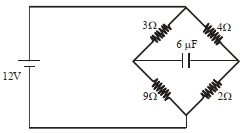
- 316. In the circuit shown, the energy stored in the capacitor is \(n\,\mu J\). The value of \(n\) is ..............
 2023 Hard
- (A) \(70\)
- (B) \(75\)
- (C) \(74\)
- (D) \(73\)
Show answer and solution
Correct Answer: (B)
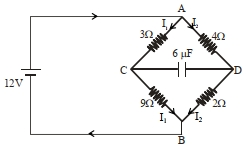
\(I _1=\frac{12}{3+9}=1\,A\)\(I _2=\frac{12}{4+2}=2\,A\)
\(V_A-V_C=3 I_1=3\,V\)
\(V_A-V_D=2 \times 4=8\,V\)
Subtracting eq.\((1)\) from eq.\((2)\)
\(V _{ C }- V _{ D }=5 V \Rightarrow V =5\,V\)
\(U =\frac{1}{2} CV ^2=\frac{1}{2} \times 6 \times 5^2=75\,\mu J\)
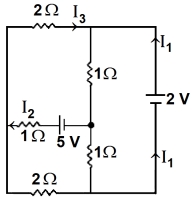
- 317. In the following circuit, the magnitude of current \(I _{ l }\), is \(............A\).
 2023 Hard
- (A) \(2\)
- (B) \(3\)
- (C) \(4\)
- (D) \(1\)
Show answer and solution
Correct Answer: (D)
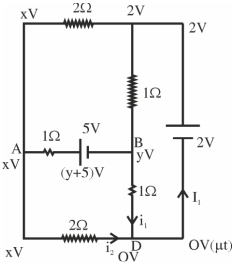
Junction law at \(A4\),\(\frac{x-(y+5)}{1}+\frac{x-2}{2}+\frac{x-0}{2}=0\)
Junction law at \(B\),
\(\frac{y+5-x}{1}+\frac{y-0}{1}+\frac{y-2}{1}=0\)
On solving equation (1) and Equation (2) \(x =3\)
\(y=0\)
At \(D\) junction
\(I_1 =i_1+i_2\)
\(I_1 =\frac{y-0}{1}+\frac{x-0}{2}\)
\(=\frac{0-0}{1}+\frac{3-0}{2}\)
\(I_1 =1.5\,A\)
- 318. In the given circuit, the equivalent resistance between the terminal \(A\) and \(B\) is \(........\Omega\).
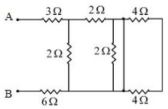 2023 Medium
- (A) \(1\)
- (B) \(100\)
- (C) \(65\)
- (D) \(10\)
Show answer and solution
Correct Answer: (D)
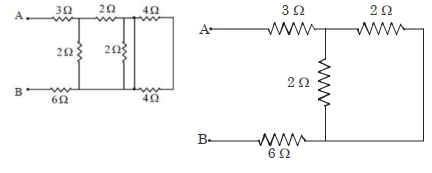
Both \(4\,\Omega\) resistance gets short.Remove the resistors that have no current.\(R _{ eq }=3+(2 \| 2)+6\)
\(R _{ eq }=3+1+6\)
\(R _{ eq }=10\,\Omega\)
-
- (A) \(4\)
- (B) \(6\)
- (C) \(8\)
- (D) \(2\)
Show answer and solution
Correct Answer: (D)
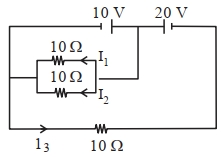
\(I_1=I_2=\frac{20-10}{10}=1\,A\)\(I_3=1\,A\)
\(\left|\frac{I_1+I_3}{ I _2}\right|=2\)
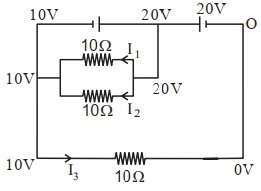
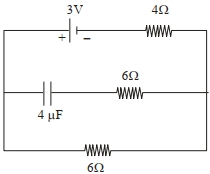
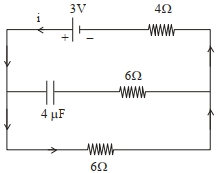
- 320. In the network shown below, the charge accumulated in the capacitor in steady state will be ........... \(\mu C\)
 2023 Medium
- (A) \(7.2\)
- (B) \(4.8\)
- (C) \(10.3\)
- (D) \(12\)
Show answer and solution
Correct Answer: (A)
No current will flow in capacitor in steady state, current flowing in the circuit in steady state\(I=\frac{3}{6+4}=\frac{3}{10}\)
Potential difference on \(6\,\Omega\) resistance
\(V=6 \times \frac{3}{10}=1.8 \text { volt }\)
Capacitor will have same potential so charge,
\(q = CV =(4\,\mu F ) \cdot(1.8 \text { volt })=7.2\,\mu C\)
-
- (A) \(1\)
- (B) \(\frac{4}{5}\)
- (C) \(\frac{3}{4}\)
- (D) \(\frac{5}{4}\)
Show answer and solution
Correct Answer: (B)
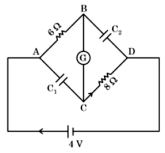
At steady state, current in the circuit is\(i =\frac{4 V }{6+2+8}=\frac{1}{4}\,A\)
Voltage across \(C_1\) is
\(V _1= V _{ AC }=i(6 \Omega+2 \Omega)=\frac{1}{4} \times 8=2\,V\)
Voltage across \(C _2\) is
\(V _2= V _{ BD }=i(2 \Omega+8 \Omega)=\frac{1}{4} \times 10=2.5\,V\)
\(\Rightarrow \frac{ V _1}{ V _2}=\frac{2}{2.5}=\frac{4}{5}\)
- 322. Ratio of thermal energy released in two resistor \(R\) and \(3 R\) connected in parallel in an electric circuit is : 2023 Easy
- (A) \(3: 1\)
- (B) \(1: 1\)
- (C) \(1: 3\)
- (D) \(1: 27\)
Show answer and solution
Correct Answer: (A)
\(H =\frac{ V ^2}{ R } \times t\)\(\frac{ H _1}{ H _2}=\frac{\frac{ V ^2 t }{ R }}{\frac{ V ^2 t }{3 R }}=3: 1\)
-
- (A) \(\alpha-\frac{3 \beta^2}{\gamma}\)
- (B) \(\alpha-\frac{\gamma^2}{3 \beta}\)
- (C) \(\beta-\frac{\alpha^2}{3 \gamma}\)
- (D) \(\alpha-\frac{\beta^2}{3 \gamma}\)
Show answer and solution
Correct Answer: (D)
\(Q=\left(\alpha t-\beta t^2+\gamma t^3\right)\)\(i=\frac{d Q}{d t}=\left(\alpha-2 \beta t+3 \gamma t^2\right)\)
\(\frac{d i}{d t}=(3 \gamma t-2 \beta)=0\)
\(\Rightarrow t=\frac{\beta}{3 \gamma}\)
\(i=\left(\alpha-2 \beta t+3 \gamma t^2\right)=\left(\alpha-\frac{\beta^2}{3 \gamma}\right)\)
-
- (A) \(14\)
- (B) \(13\)
- (C) \(12\)
- (D) \(15\)
Show answer and solution
Correct Answer: (D)
\(i_0 R_0=i_{100} R_{100} \quad\) [For same source]\(\Rightarrow 2 R_0=1.2 R_0[1+100 \alpha]\)
\(\Rightarrow 1+100 \alpha=\frac{5}{3} \Rightarrow 100 \alpha=\frac{2}{3}\)
\(\Rightarrow 50 \alpha=\frac{1}{3}\)
\(\therefore i_{50} R_{50}=i_0 R_0\)
\(\Rightarrow i_{50}=\frac{i_0 R_0}{R_{50}}=\frac{2 \times R_0}{R_0(1+50 \alpha)}=\frac{2}{1+\frac{1}{3}}=1.5\,A\)
\(=15 \times 10^2\,mA\)
-
- (A) \(\frac{2}{3}\,A\)
- (B) \(\frac{1}{4}\,A\)
- (C) \(\frac{1}{2}\,A\)
- (D) \(\frac{1}{3}\,A\)
Show answer and solution
Correct Answer: (D)
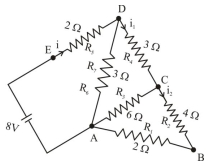
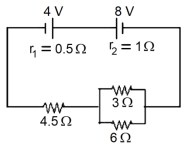
\(R _{ eq }=4\,\Omega\)
\(i =\frac{8}{4}=2\,A\)\(i _1=\frac{2 \times 3}{3+6}=\frac{2}{3}\,A\)
\(i _2=\frac{2 / 3}{2}=\frac{1}{3}\,A\)
-
- (A) \(V _{ d }\)
- (B) \(\frac{ V _{ d }}{2}\)
- (C) \(\frac{ V _{ d }}{4}\)
- (D) \(2V_d\)
Show answer and solution
Correct Answer: (A)
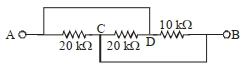
\(V _{ d }=\frac{ eE }{ m } \tau\) that is independent of area - 327. The equivalent resistance between \(A\) and \(B\) as shown in figure is \(........\,k\Omega\)
 2023 Easy
- (A) \(5\)
- (B) \(30\)
- (C) \(10\)
- (D) \(20\)
Show answer and solution
Correct Answer: (A)
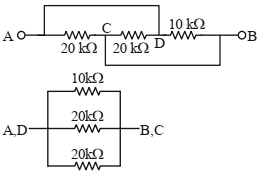
\(V_A =V_D\)\(V_C =V_B\)
All resistors are in parallel. So,
\(\frac{1}{R_{e q 1}}=\frac{1}{10}+\frac{1}{20}+\frac{1}{20}\)
\(R_{e q}=5\,k \Omega\)
-
- (A) \(\frac{2}{3} \Omega\)
- (B) \(\frac{1}{2} \Omega\)
- (C) \(\frac{3}{2} \Omega\)
- (D) \(\frac{1}{3} \Omega\)
Show answer and solution
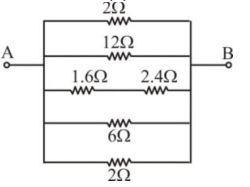
Correct Answer: (A)
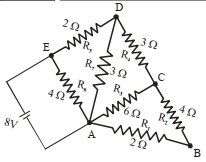
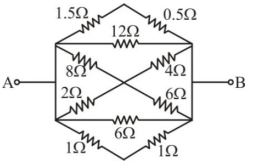
\(\frac{1}{ R _{ eq }}=\frac{1}{2}+\frac{1}{12}+\frac{1}{4}+\frac{1}{6}+\frac{1}{2}\)\(=\frac{6+1+3+2+6}{12}=\frac{18}{12}=\frac{3}{2}\)
\(\Rightarrow \quad R_{ eq }=\frac{2}{3}\,\Omega\)
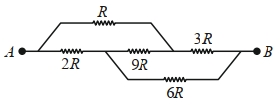
-
- (A) \(11 \frac{2\,R}{3}\)
- (B) \(14\,R\)
- (C) \(21\,R\)
- (D) \(\frac{8}{3}\,R\)
Show answer and solution
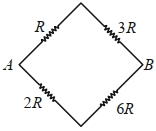
Correct Answer: (D)
Wheat stone bridge is in balanced condition.\(\frac{1}{R_{e q}}=\frac{1}{4 R}+\frac{1}{8 R}\)
\(R_{e q}=\frac{8 R}{3}\)
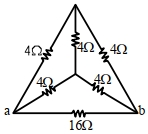
- 330. The equivalent resistance of the circuit shown below between points \(a\) and \(b\) is \(..........\Omega\)
 2023 Medium
- (A) \(24\)
- (B) \(3.2\)
- (C) \(20\)
- (D) \(16\)
Show answer and solution
Correct Answer: (B)
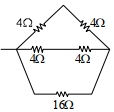
The circuit can be reduced to\(\Rightarrow R _{ eq }=\frac{16 \times 4}{16+4}=\frac{16}{5}\,\Omega\)
\(= R _{ eq }=3.2\,\Omega\)
-
- (A) \(24\)
- (B) \(23\)
- (C) \(22\)
- (D) \(25\)
Show answer and solution
Correct Answer: (D)
\(R =\rho \frac{\ell}{ A }\) be the initial resistance new resistance\(R ^{\prime}=\rho \frac{1.2 \ell}{0.96 A }=1.25 \rho \frac{\ell}{ A }=1.25 R\)
\(\text { percentage change }=\frac{1.25 R - R }{ R } \times 100=25 \%\)
-
- (A) \(125\)
- (B) \(124\)
- (C) \(123\)
- (D) \(122\)
Show answer and solution
Correct Answer: (A)
\(n =8 \times 10^{28}\,m ^{-3}\)Area \(=2 \times 10^{-6}\,m ^2\)
\(I=3.2\,A\)
\(I = neAv_{d }\)
\(V_{ d }=\frac{ I }{ neA }=125 \times 10^{-6}\,m / s\)
- 333. The resistance of a wire is \(5 \Omega\). It's new resistance in ohm if stretched to \(5\) times of it's original length will be : 2023 Medium
- (A) \(625\)
- (B) \(5\)
- (C) \(125\)
- (D) \(25\)
Show answer and solution
Correct Answer: (C)
\(R _{\text {initial }}=\frac{\rho \ell}{ A }=5 \Omega\)\(\because\) Volume of wire is constant in stretching
\(V _{ i }= V _{ f }\)
\(A _{ i } \ell_{ i }= A _{ f } \ell_{ f }\)
\(A \ell= A ^{\prime}(5 \ell)\)
\(A ^{\prime}=\frac{ A }{5}\)
\(R _{ f }=\frac{\rho \ell_{ f }}{ A _{ f }}=\frac{\rho(5 \ell)}{\left(\frac{ A }{5}\right)}\)
\(=25\left(\frac{\rho \ell}{A}\right)\)
\(=25 \times 5=125 \Omega\)
-
- (A) \(0\)
- (B) \(1\)
- (C) \(2\)
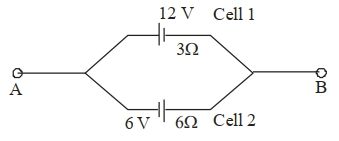
- (D) \(3\)
Show answer and solution
Correct Answer: (B)
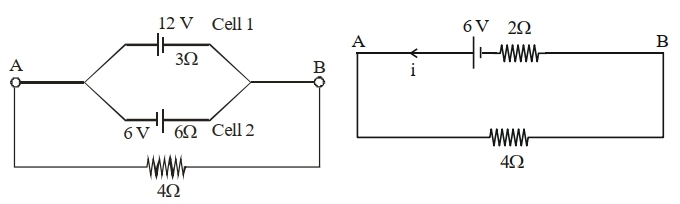
\(E _{ eq }=\frac{\frac{12}{3}-\frac{6}{6}}{\frac{1}{3}+\frac{1}{6}}\)\(E _{ eq }=6\,V\)
\(r _{ eq }=2\,\Omega\)
\(R =4\,\Omega\)
So, \(i=\frac{6}{2+4}=1\,A\)
-
- (A) \(5\)
- (B) \(10\)
- (C) \(15\)
- (D) \(20\)
Show answer and solution
Correct Answer: (A)
\(V = I \times 10\)\(1.5=\left(\frac{3}{10+2 r }\right) \times 10\)
\(r =5\,\Omega\)
-
- (A) \(5\)
- (B) \(4\)
- (C) \(3\)
- (D) \(2\)
Show answer and solution
Correct Answer: (A)
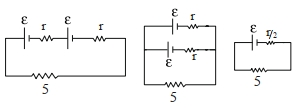
\(i=\frac{2 \varepsilon}{5+2 r}........(1)\)\(i=\frac{\varepsilon}{\frac{r}{2}+5}.........(2)\)
Equating \((1)\) and \((2)\)
\(\frac{2 \varepsilon}{5+2 r }=\frac{\varepsilon}{\frac{ r }{2}+5} \Rightarrow r +10=5+2 r\)
\(r=5\)
Ans.\(5\)
-
- (A) \(4: 1\)
- (B) \(2: 1\)
- (C) \(1: 2\)
- (D) \(1: 4\)
Show answer and solution
Correct Answer: (A)
Parallel combination\(H _{ p }=\left[\frac{ V ^2}{\left(\frac{ R }{2}\right)}\right) t =\frac{2 V ^2 t }{ R }\)
Series combination
\(H _s=\left(\frac{ V ^2}{2 R }\right) t \quad \therefore \frac{ H _{ p }}{ H _{ s }}=4\)
-
- (A) \(31\)
- (B) \(30\)
- (C) \(32\)
- (D) \(33\)
Show answer and solution
Correct Answer: (B)
\(\frac{ R _1+ R _2}{10}=\frac{60}{40}=\frac{3}{2} \Rightarrow R _1+ R _2=15\)Now \(\frac{ R _1 R _2}{\left( R _1+ R _2\right) \times 3}=\frac{40}{60}=\frac{2}{3} \Rightarrow R _1 R _2=30\)
-
- (A) \(B\) and \(D\) only
- (B) \(A\) and \(C\) only
- (C) \(A\) only
- (D) \(C\) only
Show answer and solution
Correct Answer: (B)
Sensitivity of potentiometer wire is inversely proportional to potential gradient. -
- (A) \(150\)
- (B) \(140\)
- (C) \(130\)
- (D) \(160\)
Show answer and solution
Correct Answer: (D)
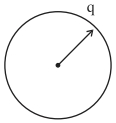
Let \(q =\) charge on each drop\(V =\frac{ Kq }{ r } \text {-.- (1) }\)
Now for combination of 64 drop
\(64 \times \frac{4}{3} \pi r^3=\frac{4}{3} \pi R^3\)
\(R=4 r\)
And \(Q =64 q\)
Potential of bigger drop
\(=\frac{ KQ }{ R }=\frac{ K 64 q }{4 r }=16 \frac{ Kq }{ r }\)
\(=16 \times 10\,mV =160\,mV\)
Correct answer is \(160 .\)
-
- (A) \(6\)
- (B) \(5\)
- (C) \(4\)
- (D) \(3\)
Show answer and solution
Correct Answer: (A)
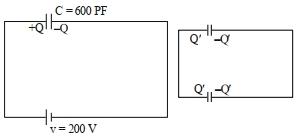
\(Q = CV =600 \times 10^{-12} \times 200=12 \times 10^{-8} C\)\(\text { Initial energy }=\frac{1}{2} CV ^2\)
\(=\frac{1}{2} \times 600 \times 10^{-12} \times(200)^2=12\,\mu J\)
When connected to another uncharged capacitor
Charge will be equally distributed on identical capacitor
\(Q ^{\prime}=\frac{ Q }{2}=6 \times 10^{-8}\)
Final energy \(=2 \times \frac{ Q ^{\prime 2}}{2 C }=\frac{ Q ^{\prime 2}}{ C }\)
\(\frac{\left(6 \times 10^{-8}\right)^2}{600 \times 10^{-12}}=6\,\mu J\)
Energy lost = Initial energy - Final energy
\(=(12-6)\,\mu\, J =6\, \mu\, J\)
-
- (A) \(5\)
- (B) \(6\)
- (C) \(4\)
- (D) \(3\)
Show answer and solution
Correct Answer: (B)
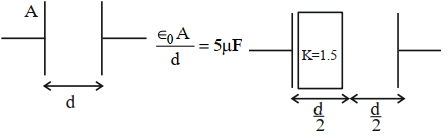
\(C _{\text {new }}=\frac{\in_0 A }{\frac{\left(\frac{ d }{2}\right)}{1.5}+\frac{\left(\frac{ d }{2}\right)}{1}}\)\(=\frac{\in_0 A}{\left(\frac{d}{3}+\frac{d}{2}\right)}=\frac{6 \in_0 A}{5 d}\)
\(=\frac{6}{5} \times 5 \mu F =6 \mu F\)
-
- (A) \(224\)
- (B) \(223\)
- (C) \(222\)
- (D) \(225\)
Show answer and solution
Correct Answer: (D)
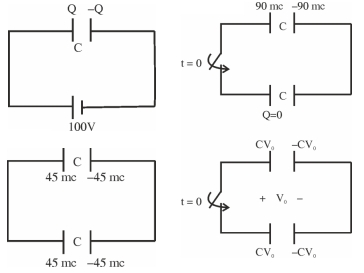
\(C =900\,\mu F\)\(Q = CV =900 \times 10^{-6} \times 100=9 \times 10^{-2}=90\,MC\)
Now
Common potential will be developed across both capacitors by \(kVL\)
Total charge on left plates of capacitors should be conserved.
\(90\,mc +0=2\,cv _0\)
\(cv _0=45\,mc\)
Heat dissipated \(= U _{ i }- U _{ f }\) [Change in energy stored in the capacitors]
\(=\frac{1}{2} \frac{(90\,mc )^2}{900\,\mu F }-2 \times \frac{1}{2} \frac{(45\,mc )^2}{900\,\mu F }\left[ U =\frac{ Q ^2}{2 c }\right]\)
\(=\frac{1}{2 \times 900 \times 10^{-6}}(8100-4050) \times 10^{-6}\)
\(=2.25\,Joule\)
OR
Heat \(=\frac{1}{2} \frac{ C _1 C _2}{ C _1+ C _2}\left( V _1- V _2\right)^2\)
\(=\frac{1}{2} \frac{ C ^2}{2 C }(100-0)^2\)
\(=\frac{1}{2} \frac{900 \times 10^{-6}}{2} \times 10^4=\frac{9}{4} \text { Joule }=2.25 \text { Joule }\)
-
- (A) \(\frac{ CV }{2 \varepsilon_0}\)
- (B) \(\frac{2 CV }{\varepsilon_0}\)
- (C) \(\frac{ CV }{\varepsilon_0}\)
- (D) Zero
Show answer and solution
Correct Answer: (C)
\(\phi=\frac{q_{\text {in }}}{\epsilon_0}\)\(=\frac{Q}{\epsilon_0}\)
\(=\frac{C V}{\epsilon_0}\)
-
- (A) \(24 \varepsilon_0\; F\)
- (B) \(\frac{3}{10} \varepsilon_0\; F\)
- (C) \(\frac{10}{3} \varepsilon_0\; F\)
- (D) \(10 \varepsilon_0 \; F\)
Show answer and solution
Correct Answer: (C)
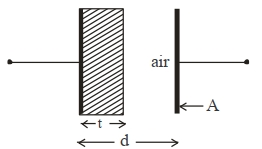
This can be seen as two capacitors in series combination so\(\frac{1}{C_{e q}}=\frac{1}{C_1}+\frac{1}{C_2}\)
\(=\frac{1}{\frac{K \in_0 A}{t}}+\frac{1}{\frac{\epsilon_0 A}{d-t}}\)
\(=\frac{ t }{ K \in_0 A }+\frac{ d - t }{\epsilon_0 A }\)
\(=\frac{1 \times 10^{-3}}{5 \epsilon_0 \times 40 \times 10^{-4}}+\frac{1 \times 10^{-3}}{\epsilon_0 40 \times 10^{-4}}\)
\(\frac{1}{ C _{ eq }}=\frac{1}{20 \epsilon_0}+\frac{1}{4 \epsilon_0}\)
\(C _{ eq }=\frac{20 \times 4 \epsilon_0}{24}=\frac{10 \epsilon_0}{3} F\)
-
- (A) \(2: 1\)
- (B) \(1: 2\)
- (C) \(1: 4\)
- (D) \(2: 3\)
Show answer and solution
Correct Answer: (B)
Initially\(Q _1= CV =(2) V\)
\(E _1=1 / 2 CV ^2=1 / 2(2) V ^2= V ^2\)
Finally
Charge on each capacitor, \(Q _2=\frac{ Q _1}{2}=\frac{2 V }{2}= V\)
\(E _2=2\left(\frac{1}{2} \frac{ Q _2^2}{ C }\right)=\frac{ V ^2}{2} \quad \therefore \frac{ E _2}{ E _1}=\frac{1}{2}\)
-
- (A) \(10.5\)
- (B) \(1.05\)
- (C) \(105\)
- (D) \(108\)
Show answer and solution
Correct Answer: (C)
\(C _0=\frac{\in_0 A }{ d }=15\,pF\)\(C =\frac{ K \in_0 A }{2 d }=\frac{3.5}{2} \times 15\,pF\)
\(=\frac{105}{4}\,pF\)
-
- (A) \(4\)
- (B) \(5\)
- (C) \(2\)
- (D) \(3\)
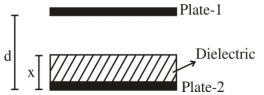
Show answer and solution
Correct Answer: (D)
\(\text { For } x =\frac{ d }{3}\)\(C _1=\frac{\epsilon_0 A }{\left(\frac{ d / 3}{ k }+\frac{2 d }{3}\right)}=\frac{\epsilon_0 A }{\frac{ d }{12}+\frac{2 d }{3}}\)
\(=\frac{\epsilon_0 A }{ d } \times\left(\frac{12}{9}\right)\)
\(C _1=\frac{4}{3} \frac{\epsilon_0 A }{ d }=2 \mu F\)
\(\text { for } x =\frac{2 d }{3}\)
\(C _2=\frac{\epsilon_0 A }{\left(\frac{2 d / 3}{ k }+\frac{ d }{3}\right)}=\frac{\epsilon_0 A }{ d } \times 2\)
\(\Rightarrow \frac{6}{4} \times 2=3 \mu F\)
-
- (A) \(1200\)
- (B) \(600\)
- (C) \(-600\)
- (D) \(-1200\)
Show answer and solution
Correct Answer: (C)
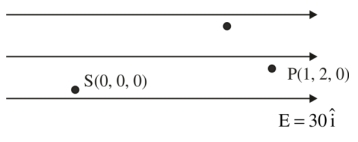
\(\omega_{ E }= q \overrightarrow{ E } \cdot \overrightarrow{ S }\)\(=2 \times 10^{-2}[30 \hat{ i } \cdot(-\hat{ i })]\)
\(=2 \times 10^{-2}(-30)\)
\(=-60 \times 10^{-2}\)
\(=-\frac{60}{100}=-0.6\,J\)
\(=-600\,mJ\)
-
- (A) \(17\)
- (B) \(18\)
- (C) \(16\)
- (D) \(13\)
Show answer and solution
Correct Answer: (B)
The work done in rotating the electric dipole \(=\Delta U\)\(= U _{ f }- U _{ i }\)
\(=\left(- pE \cos \left(180^{\circ}\right)\right)-\left(- pE \cos \left(0^{\circ}\right)\right)\)
\(= pE + pE =2 pE\)
\(=2 \times 6 \times 10^{-6} \times 1.5 \times 10^3=18\,mJ\)
No questions on this page match these filters.