


Questions
34 questionsShowing 1–34 of 34 questions
-
- (A) \(\sqrt{g R}\)
- (B) \(\sqrt{4 g R}\)
- (C) \(\sqrt{2 g R}\)
- (D) \(\sqrt{\frac{g R}{2}}\)
Show answer and solution
Correct Answer: (A)
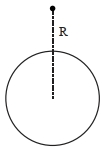
By conservation of mechanical energy\(U _{ i }+ K _{ i }= U _{ f }+ K _{ i }\)
\(-\frac{ GMm }{2 R }+0=-\frac{ GMm }{ R }+\frac{1}{2} mv ^2\)
\(\frac{ GMm }{2 R }=\frac{1}{2} mv ^2\)
\(v =\sqrt{\frac{ GM }{ R }}=\sqrt{ gR }\)
-
- (A) \(67.2\)
- (B) \(16.8\)
- (C) \(33.6\)
- (D) \(11.2\)
Show answer and solution
Correct Answer: (B)
\(V_p=\sqrt{\frac{2 G_p}{R_p}} V_E=\sqrt{\frac{2 GM _E}{R_E}}\)\(\frac{V_P}{V_E}=\frac{\sqrt{\frac{2 G_P}{R_p}}}{\sqrt{\frac{2 G_E}{R_E}}}=\sqrt{\frac{R_E}{R_P} \times \frac{M_P}{M_E}}\)
\(V_P=\sqrt{\frac{1}{4} \times 9} \times V_E=\frac{3}{2} V_E\)
\(V _{ P }=\frac{3}{2} \times 11.2\,km / sec\)
\(=16.8\,km / sec\)
-
- (A) \(11.2(\sqrt{2}-1)\,km / s\)
- (B) \(7.9(\sqrt{2}-1)\,km / s\)
- (C) \(8(\sqrt{2}-1)\,km / s\)
- (D) \(7.4(\sqrt{2}-1)\,km / s\)
Show answer and solution
Correct Answer: (C)
\(v _{\text {orbit }}=\sqrt{\frac{ GM }{ R }}=\sqrt{ gR }\)\(v _{\text {escape }}=\sqrt{\frac{2 GM }{ R }}=\sqrt{2 gR }\)
\(\Delta v =(\sqrt{2}-1) \sqrt{ gR }=8(\sqrt{2}-1)\,km / s\)
-
- (A) \(2 \sqrt{g R}\)
- (B) \(\sqrt{g R}\)
- (C) \(\sqrt{\frac{g R}{2}}\)
- (D) \(\sqrt{2 g R}\)
Show answer and solution
Correct Answer: (B)
Loss in \(PE =\) Gain in \(KE\)\(\left(-\frac{ GMm }{2 R }\right)-\left(-\frac{ GMm }{ R }\right)=\frac{1}{2} mv ^2\)
\(\Rightarrow v ^2=\frac{ GM }{ R }= gR\)
\(\Rightarrow v =\sqrt{ gR }\)
-
- (A) \(400\)
- (B) \(500\)
- (C) \(300\)
- (D) \(100\)
Show answer and solution
Correct Answer: (D)
\(M =\frac{ W }{ g }=\frac{200}{10}=20\,kg\)Acc. due to gravity at a depth \(g^{\prime}= g \left(1-\frac{ d }{ R }\right)\)
\(d \rightarrow\) depth from surface
\(d =\frac{ R }{2}\)
\(g ^{\prime}= g \left(1-\frac{ R / 2}{ R }\right)=\frac{ g }{2}=5 m / s ^2\)
weight \(= m \times g\)
at depth \(R / 2=20 \times 5=100\,N\)
-
- (A) \(5260\)
- (B) \(640\)
- (C) \(2560\)
- (D) \(4800\)
Show answer and solution
Correct Answer: (D)
\(\frac{ GM }{ R ^2}\left[1-\frac{ d }{ R }\right]=\frac{4 \times GM }{(4 R )^2}\)\(1-\frac{ d }{ R }=\frac{1}{4} \Rightarrow \frac{ d }{ R }=\frac{3}{4} \Rightarrow d \frac{3}{4} R\)
\(d =4800\,km\)
-
- (A) The speed of satellite in a given circular orbit remains constant.
- (B) For a planet revolving around the sun in an elliptical orbit, the total energy of the planet remains constant.
- (C) When a body fall towards earth, the displacement of earth towards the body is negligible.
- (D) The linear speed of a planet revolving around the sun remains constant.
Show answer and solution
Correct Answer: (D)
Planets revolve in elliptical paths around sun. Thus their linear speed is not constant -
- (A) \(A\) and \(D\) only
- (B) \(C\) and \(D\) only
- (C) \(B\) and \(C\) only
- (D) \(A\) and \(C\) only
Show answer and solution
Correct Answer: (A)
\(F =\frac{ Gm _1 m _2}{ r ^2}\)\(\Rightarrow F \propto \frac{1}{ r ^2}\)
\(\Rightarrow F \propto m _1 m _2\)
\(\Rightarrow \text { This force provides centripetal force and acts }\)
towards sun
\(\Rightarrow T ^2 \propto a ^3 \text { (Kepler's third law) }\)
-
- (A) Both \(A\) and \(R\) are correct but \(R\) is NOT the correct explanation of \(A\)
- (B) Both \(A\) and \(R\) are correct and \(R\) is the correct explanation of \(A\)
- (C) \(A\) is not correct but \(R\) is correct
- (D) \(A\) is correct but \(R\) is not correct
Show answer and solution
Correct Answer: (C)
\(T \propto \frac{1}{\sqrt{ g }}\) -
- (A) \(A\) is true but \(R\) is false
- (B) \(A\) is false but \(R\) is true
- (C) Both \(A\) and \(R\) are correct but \(R\) is \(NOT\) the correct explanation of \(A\)
- (D) Both \(A\) and \(R\) are correct and \(R\) is correct explanation of \(A\)
Show answer and solution
Correct Answer: (D)
At Moon, due to low escape velocity, the rms velocity of molecules is greater than escape velocity. Hence molecules escape and there is no atmosphere at Moon. -
- (A) Both Statement \(I\) and Statement \(II\) are true
- (B) Both Statement \(I\) and Statement \(II\) are false
- (C) Statement \(I\) is true but Statement \(II\) is false
- (D) Statement \(I\) is false but Statement \(II\) is true
Show answer and solution
Correct Answer: (C)
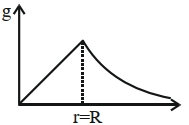
\(g_{e f f}=g-\omega^2 R_e \sin ^2 \theta, \theta \rightarrow\) co-latitude angle\(g_{e f f}=g\left(1-\frac{d}{R_e}\right), d\) here depth
-
- (A) Statement \(I\) is incorrect but statement \(II\) is correct
- (B) Both Statement \(I\) and Statement \(II\) are incorrect
- (C) Statement \(I\) is correct but statement \(II\) is incorrect
- (D) Both Statement \(I\) and \(II\) are correct
Show answer and solution
Correct Answer: (C)
\(g ^{\prime}=\frac{ g }{\left(1+\frac{ h }{ R }\right)^2}\)\(g^{\prime} = g 1-\frac {d }{R}\)
Statement \(I\) is correct and Statement \(II\) is incorrect
-
- (A) Both Statement \(I\) and Statement \(II\) are incorrect
- (B) Statement \(I\) is correct but statement \(II\) is incorrect
- (C) Statement \(I\) is incorrect but statement \(II\) is correct
- (D) Both Statement \(I\) and Statement \(II\) are correct
Show answer and solution
Correct Answer: (B)
\(V _{ e }=\sqrt{\frac{2 GM }{ R }} \Rightarrow V _{ e } \propto \sqrt{\frac{ M }{ R }}\)As \(\frac{M}{R}\) increases \(\Rightarrow V_e\) increases
Statement \((1)\) is correct
Also \(V _{ e } \propto \frac{1}{\sqrt{ R }}\)
As \(V _{ e }\) depends upon \(R\)
\(\Rightarrow\) Statement \((2)\) is incorrect
-
- (A) Both Statement \(I\) and Statement \(II\) are correct
- (B) Both Statement \(I\) and Statement \(II\) are incorrect
- (C) Statement \(I\) is incorrect but Statement \(II\) is correct
- (D) Statement \(I\) is correct but Statement \(II\) is incorrect
Show answer and solution
Correct Answer: (B)
Energy of satellite in orbit \(E=\frac{- GMm }{2 R }\).\(PE\) of satellite in orbit \(U=\frac{-G M m}{R}\)
\(\Rightarrow U =2 E\)
\(KE\) of satellite in orbit \(K = E - U\)
\(K =\frac{ GMm }{2 R }=(- E )\)
-
- (A) Statement \(I\) is false but Statement \(II\) is true.
- (B) Statement \(I\) is true but Statement \(II\) are false.
- (C) Both Statement \(I\) and Statement \(II\) are true.
- (D) Both Statement \(I\) and Statement \(II\) are false.
Show answer and solution
Correct Answer: (B)
Statement \(I\) is true due to centrifugal force.Statement \(II\) is incorrect,
At pole \(g=g_s\) (no effect)
At equator \(g=g_s-r \omega^2 \cos ^2 \lambda=g_s-r \omega^2\)
\(\therefore\left(\cos ^2 \lambda_{\text {maximum }}\right.\) at \(\lambda=0^{\circ}\) i.e. at equator \()\)
Effect is maximum at equator.
-
- (A) \(2\)
- (B) \(3\)
- (C) \(18\)
- (D) \(1\)
Show answer and solution
Correct Answer: (A)
\(v_{\text {(escape) plant }}=\sqrt{\frac{2 G M_P}{R_P}}\)\(=\sqrt{\frac{2 G\left(\frac{M_e}{9}\right)}{\left(\frac{R_e}{2}\right)}}=\frac{v_e \sqrt{2}}{3} \therefore x=2\)
-
- (A) \(0.6\)
- (B) \(6\)
- (C) \(3\)
- (D) \(0.3\)
Show answer and solution
Correct Answer: (C)
\(T ^2 \propto R ^3 \Rightarrow\left(\frac{ T _1}{ T _2}\right)^2=\left(\frac{ R _1}{ R _2}\right)^3\)\(\Rightarrow\left(\frac{1}{2.83}\right)^2=\left(\frac{1.5 \times 10^6}{ R _2}\right)^3\)
\(\Rightarrow R _2=\left[(2.83)^2 \times\left(1.5 \times 10^6\right)^3\right]^{1 / 3}\)
\(=8^{1 / 3} \times 1.5 \times 10^6=3 \times 10^6\,km\)
-
- (A) \(8\)
- (B) \(4\)
- (C) \(2\)
- (D) \(16\)
Show answer and solution
Correct Answer: (D)
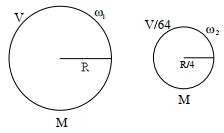
From conservation of angular momentum\(\frac{2}{5} MR ^2 \omega_1=\frac{2}{5} M \left(\frac{ R }{4}\right)^2 \omega_2\)
\(\Rightarrow MR ^2 \omega_1=\frac{ MR ^2}{16} \omega_2\)
\(\Rightarrow \frac{\omega_1}{\omega_2}=\frac{1}{16} \Rightarrow \frac{ T _2}{ T _2}=\frac{1}{16} \Rightarrow \frac{ T _1}{ T _2}=\frac{16}{1}=\frac{ t _1}{ x }\)
\(\therefore t _1=24 \Rightarrow \frac{16}{1}=\frac{24}{ t _2} \Rightarrow x =16\)
-
- (A) \(9\)
- (B) \(11\)
- (C) \(12\)
- (D) \(10\)
Show answer and solution
Correct Answer: (B)
\(-\frac{ dV }{ dr }=-\frac{ k }{ r ^2} \Rightarrow \int \limits_{10}^{ V } dV =\int \limits_2^3 \frac{ k }{ r ^2} dr\)\(V -10= k \left[\frac{1}{2}-\frac{1}{3}\right]\)
\(V -10=\frac{ k }{6} \Rightarrow V =11 \text { volts }\)
-
- (A) \(\frac{3 V }{2}\)
- (B) \(V\)
- (C) \(\frac{4}{3} V\)
- (D) \(\frac{ V }{2}\)
Show answer and solution
Correct Answer: (A)
\(V =\frac{ GM }{2 R ^3}\left(3 R ^2- r ^2\right) \text { at } r=R \Rightarrow V=\left(\frac{ GM }{ R }\right)\)\(\text { at } r =0, V _0=\frac{3 GM }{2 R }=\left(\frac{3 V }{2}\right)\)
-
- (A) \(4\)
- (B) \(2\)
- (C) \(\frac{1}{2}\)
- (D) \(\frac{1}{4}\)
Show answer and solution
Correct Answer: (B)
At surface of earth time period\(T =2 \pi \sqrt{\frac{\ell}{ g }}\)
At height \(h = R\)
\(g ^{\prime}=\frac{ g }{\left(1+\frac{ h }{ R }\right)^2}=\frac{ g }{4}\)
\(xT =2 \pi \sqrt{\frac{\ell}{( g / 4)}}\)
\(\Rightarrow xT =2 \times 2 \pi \sqrt{\frac{\ell}{ g }}\)
\(\Rightarrow xT =2 T \Rightarrow x =2\)
- 22. The acceleration due to gravity at height \(h\) above the earth if \(h \ll R\) (radius of earth) is given by 2023 Medium
- (A) \(g^{\prime}=g\left(1-\frac{2 h}{R}\right)\)
- (B) \(g^{\prime}=g\left(1-\frac{2 h^2}{R^2}\right)\)
- (C) \(g^{\prime}=g\left(1-\frac{h}{2 R}\right)\)
- (D) \(g^{\prime}=g\left(1-\frac{h^2}{2 R^2}\right)\)
Show answer and solution
Correct Answer: (A)
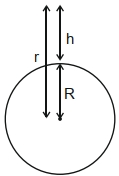
For point outside the surface of earth\(g =\frac{ GM }{ r ^2}\)
I = distance from center of earth
\(\Rightarrow g ( h )=\frac{ GM }{( R + h )^2} \Rightarrow g ( h )=\frac{ GM }{ R ^2\left(1+\frac{ h }{ R }\right)^2}\)
\(\Rightarrow g ( h )=\frac{ GM }{ R ^2}\left(1+\frac{ h }{ R }\right)^{-2}\)
\(\text { If } h \ll R ,\left(1+\frac{ h }{ R }\right)^{-2} \approx 1-\frac{2 h }{ R }\)
\(\Rightarrow g ( h )=\frac{ GM }{ R ^2}\left(1-\frac{2 h }{ R }\right)\)
\(\Rightarrow g ( h )= g _{\text {surface }}\left(1-\frac{2 h }{ R }\right), \frac{ GM }{ R ^2}= g _{\text {surface }}\)
-
- (A) \(\frac{4}{3}\)
- (B) \(\frac{3}{2}\)
- (C) \(\frac{2}{3}\)
- (D) \(\frac{3}{4}\)
Show answer and solution
Correct Answer: (D)
\(V _{ e }=\sqrt{\frac{2 GM }{ R }}=\sqrt{\frac{2 G \rho \frac{4}{3} \pi R ^{ S }}{ R }}= C \sqrt{\rho} \cdot R\)\(\frac{ V _{ e _1}}{ V _{ e _2}}=\frac{ R _1}{ R _2} \sqrt{\frac{\rho_1}{\rho_2}}=\frac{1}{2}\)
\(\frac{ R _1^2}{ R _2^2} \times \frac{\rho_1}{\rho_2}=\frac{1}{4}\)
\(\frac{ R _1}{ R _2}=\frac{1}{3}\)
\(g =\frac{ GM }{ R ^2}=\frac{ G \frac{4}{3} \pi R ^3 \times \rho}{ R ^2} C \cdot \rho R\)
\(\frac{ g _1}{ g _2}=\frac{\rho_1 R _1}{\rho_2 R _2}=\frac{1}{4} \frac{ R _2^2}{ R _1^2} \times \frac{ R _1}{ R _2}\)
\(=\frac{1}{4} \times \frac{ R _2}{ R _1}=\frac{3}{4}\)
-
- (A) \(8\)
- (B) \(4\)
- (C) \(9\)
- (D) \(3\)
Show answer and solution
Correct Answer: (D)
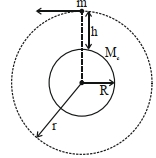
\(L = mvr\)\(v =\sqrt{\frac{ GM _{\odot}}{ r }}\)
\(L=m \sqrt{\frac{ GM _e}{ r }} \cdot r\)
\(L \propto r ^{\frac{1}{2}}\)
Now distance from centre is increased by \(8\) times.
So new distance from centre \(=r+8 r=9 r\)
Now angular momentum \(L^{\prime} \propto(9 r )^{1 / 2}\)
So new distance from centre \(=r+8 r=9 r\)
Now angular momentum \(L^{\prime} \propto(9 r)^{1 / 2}\)
\(\frac{L}{L^{\prime}}=\frac{ r ^{1 / 2}}{(9 r )^{1 / 2}}=\frac{1}{3}\)
\(L^{\prime}=3 L\)
-
- (A) \(1: 16\)
- (B) \(3: 16\)
- (C) \(3: 4\)
- (D) \(4: 3\)
Show answer and solution
Correct Answer: (C)
\(g=\frac{G M}{R^2}=\frac{G}{R^2} \times \rho \times \frac{4 \pi}{3} R^3=\left(\frac{4 \pi}{3} G\right) \rho R\)\(\frac{g_A}{g_B}=\frac{R \times \rho}{4 R \times \frac{\rho}{3}}=\frac{3}{4}\)
-
- (A) \(4:1\)
- (B) \(2:1\)
- (C) \(1: \sqrt{2}\)
- (D) \(1: 4\)
Show answer and solution
Correct Answer: (B)
\(V_{\text {escape }}=\sqrt{\frac{2 G M}{R}}\)\(\therefore V_{\text {escape }} \text { for planet }=\sqrt{\frac{2 G\left(16 M_E\right)}{\left(4 R_E\right)}}=2 \sqrt{\frac{2 G_E}{R_E}}\)
\(=2\left(V_{\text {escape }} \text { for Earth }\right)\)
-
- (A) \(4\)
- (B) \(6\)
- (C) \(12\)
- (D) \(3\)
Show answer and solution
Correct Answer: (D)
\(T ^2 \propto R ^3\)\(\frac{ T _1^2}{ T _2^2}=\frac{ R _1^3}{ R _2^3} \Rightarrow\left(\frac{ T _1}{ T _2}\right)^2=\left(\frac{ R }{\frac{ R }{4}}\right)^3\)
\(\frac{ T _1^2}{ T _2^2}=64\)
\(T _2^2=\frac{ T _1^2}{64}\)
\(T _2=\frac{24}{8}=3\)
-
- (A) \(\sqrt{4 R}\)
- (B) \(\sqrt{8 R }\)
- (C) \(\sqrt{32 R}\)
- (D) \(\sqrt{2 R }\)
Show answer and solution
Correct Answer: (C)
\(\frac{ mv ^2}{2 R }=\frac{ GMm }{(2 R )^2} \Rightarrow v =\sqrt{\frac{ GM }{2 R }}=\sqrt{\frac{ Rg }{2}}\)\(T =\frac{2 \pi(2 R )}{ v }=\frac{4 \pi R \sqrt{2}}{\sqrt{ Rg }}=\sqrt{32 R }\)
-
- (A) \(9.8\)
- (B) \(4.9\)
- (C) \(19.6\)
- (D) \(8\)
Show answer and solution
Correct Answer: (D)
Acceleration due to gravity at height \(h\) \(g ^{\prime}=\frac{ g }{\left[1+\frac{ h }{ R }\right]^2}\)So weight at given height
\(mg ^{\prime}=\frac{ mg }{\left[1+\frac{ h }{ R }\right]^2}=\frac{18}{\left[1+\frac{1}{2}\right]^2}=8\,N\)
-
- (A) \(100\) \(N\)
- (B) \(64\) \(N\)
- (C) \(50\) \(N\)
- (D) \(25\) \(N\)
Show answer and solution
Correct Answer: (B)
\(\Rightarrow g^{\prime}=\frac{g R^2}{r^2}=\frac{g R^2}{\left(R+\frac{R}{4}\right)^2}=\frac{16 g}{25}\)\(\therefore \text { Weight }=\frac{16}{25} \times 100=64\,N\)
-
- (A) \(\sqrt{\frac{G m}{2 a^3}}\)
- (B) \(\sqrt{\frac{G m}{8 a^3}}\)
- (C) \(\sqrt{\frac{G m}{4 a^3}}\)
- (D) \(\sqrt{\frac{G m}{a^3}}\)
Show answer and solution
Correct Answer: (C)
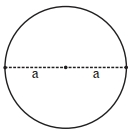
\(F = m \omega^2 r\)\(\Rightarrow \frac{G m m}{(2 a)^2}=m \omega^2 a\)
\(\Rightarrow \omega=\sqrt{\frac{G m}{4 a^3}}\)
-
- (A) \(2: 3\)
- (B) \(2: 1\)
- (C) \(3: 4\)
- (D) \(4: 3\)
Show answer and solution
Correct Answer: (C)
\(g =\frac{ GM }{ R ^2}=\frac{4}{3} \pi G \rho R\)\(\therefore \frac{ g _2}{ g _1}=\frac{\rho_2}{\rho_1} \times \frac{ R _2}{ R _1}=\frac{1}{2} \times 1.5=\frac{3}{4}\)
-
- (A) Potential energy
- (B) Total energy
- (C) Kinetic energy
- (D) Speed
Show answer and solution
Correct Answer: (D)
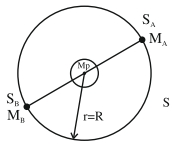
P.E \(=-\frac{G M M_p M_A}{R}\)\(K.E=+\frac{G M_p M_A}{2 R}\)
\(T.E =-\frac{ GM _{ p } M _{ A }}{2 R }\)
Speed \(=v=\sqrt{\frac{G M_p}{R}}\)
Speed of satellite in Independent of mass of satellite.
-
- (A) \(1: 1\)
- (B) \(3: 1\)
- (C) \(\sqrt{3}: 1\)
- (D) \(9: 1\)
Show answer and solution
Correct Answer: (C)
\(v=\sqrt{\frac{ GM }{ r }}\)\(v \propto \frac{1}{\sqrt{r}} \quad \Rightarrow \frac{v_1}{v_2}=\sqrt{\frac{r_2}{ r _1}}=\sqrt{\frac{3 r}{r}}\)
\(=\sqrt{3}: 1\)
No questions on this page match these filters.