


Topics
2 topicsAll P-Block elements - I questions
Newest firstShowing 1–50 of 77 questions
-
- (A) Among the isotopes of carbon, \({}^{13}C\) is a radioactive isotope.
- (B) Carbon exhibits negative oxidation states along with +4 and +2.
- (C) Carbon cannot exceed its covalency more than four.
- (D) \(CO_{2}\) is the most acidic oxide among the dioxides of group of 14 elements.
Show answer and solution
Correct Answer: (A)
\(C^{13}\) is not radioactive
\(C^{14}\) is radioactive -
- (A) Both Statement I and Statement II are true.
- (B) Both Statement I and Statement II are false.
- (C) Statement I is true but Statement II is false.
- (D) Statement I is false Statement II is true.
Show answer and solution
Correct Answer: (A)
\( SiO_{2}, CO_{2}, GeO, GeO_{2} \) are acidic in nature.
SnO, \( SnO_{2}, PbO, PbO_{2} \) are amphoteric in nature.
→ \( BF_{3} \) is lewis acid according to Lewis octet theory and has \( sp^{2} \) hybridization with trigonal planar geometry and it can accept lone pair from ammonia to form adduct. -
- (A) A and C only
- (B) A and D only
- (C) C and D only
- (D) B and D only
Show answer and solution
Correct Answer: (C)
(A) \(B ^{+3}< Al ^{+3}< Ga ^{+3}< In ^{+3}< Tl ^{+3}\) : ionic size
(B) \(B > Tl > In > Ga > Al : EN\)
(C) \(B > Tl > Ga > Al > In :\) IE
(D) Trichlorides and triiodides of group \(13^{\text {th }}\) elements are covalent in nature -
- (A) A and C Only
- (B) B and C Only
- (C) B and D Only
- (D) A and D Only
Show answer and solution
Correct Answer: (C)
The electronegativity of Ge on the Pauling scale is \(1.8\). In Group 13, the electronegativity values are B (\(2.0\)), Al (\(1.5\)), Ga (\(1.6\)), In (\(1.7\)), and Tl (\(1.8\)). Thus, the element 'E' is Thallium (Tl).
Due to the inert pair effect, the \(+1\) oxidation state is much more stable than the \(+3\) oxidation state for the heavier elements of Group 13, especially Thallium. Therefore, \(Tl^+\) is more stable than \(Tl^{3+}\). This makes statement C incorrect.
Since \(Tl^{3+}\) is relatively unstable, it readily accepts two electrons to form the more stable \(Tl^+\) ion (\(Tl^{3+} + 2e^- \rightarrow Tl^+\)). Because it undergoes reduction easily, \(Tl^{3+}\) acts as a strong oxidizing agent. This makes statement A incorrect and statement B correct.
The standard electrode potential for the reduction of \(Tl^{3+}\) to Tl (\(E^{\circ}_{Tl^{3+}/Tl}\)) is \(+1.26\text{ V}\), which is a positive value. This makes statement D correct.
Therefore, only statements B and D are correct. -
- (A) Both \(sp^{3}\)
- (B) \(sp^{2}\) and \(sp^{3}\)
- (C) \(sp^{3}\) and \(sp^{2}\)
- (D) Both \(sp^{2}\)
Show answer and solution
Correct Answer: (B)
\(XF_{3}=BF_{3}; \ sp^{2}\)
\(YF_{3}=NF_{3};\ sp^{3}\) -
- (A) \(+4\) and +1
- (B) +1 and +4
- (C) +4 and +3
- (D) +2 and +3
Show answer and solution
Correct Answer: (C)
Among \(\mathrm{Al}, \mathrm{In}, \mathrm{Tl}, \mathrm{Ge}, \mathrm{Sn}, \mathrm{Pb}\), the metal having highest \(\mathrm{IE}_1\) is Ge and lowest \(\mathrm{IE}_1\) is In .
Most stable oxidation state of Ge is +4 and In is +3 . -
- (A) 6
- (B) 82
- (C) 14
- (D) 50
Show answer and solution
Correct Answer: (D)
Order of M.P. of group 14: \(\mathrm{C}>\mathrm{Si}>\mathrm{Ge}>\mathrm{Pb}>\mathrm{Sn}\)
\(\begin{array}{ll}
\text { element } & \text { M.P. }\left({ }^{\circ} \mathrm{C}\right) \\
\mathrm{Z}=6=\mathrm{C} & 3730 \\
\mathrm{Z}=14=\mathrm{Si} & 1410 \\
\mathrm{Z}=32=\mathrm{Ge} & 937 \\
\mathrm{Z}=50=\mathrm{Sn} & 232 \\
\mathrm{Z}=82=\mathrm{Pb} & 327
\end{array}\) -
- (A) 31
- (B) 49
- (C) 13
- (D) 81
Show answer and solution
Correct Answer: (A)
Size order
\(\begin{aligned}
& \mathrm{Al} \gt \mathrm{Ga} \\
& \mathrm{Al}^{3+} \lt \mathrm{Ga}^{3+}
\end{aligned}\)
Atomic number of Ga is 31 -
- (A) Statement I is correct but Statement II is incorrect
- (B) Statement I is incorrect but Statement II is correct
- (C) Both Statement I and Statement II are incorrect
- (D) Both Statement I and Statement II are correct
Show answer and solution
Correct Answer: (A)
Statement 1 is correct since left to right \(1 E\) increases in general in periodic table.
Statement 2 is incorrect since M.P. of group 14 elements is more than group 13 elements. -
- (A) B and D Only
- (B) A and C Only
- (C) C and D Only
- (D) A and B Only
Show answer and solution
Correct Answer: (A)
Property B Al Ga In Tl Atomic radius (pm) 88 143 135 167 170 Electronegativity 2 1.5 1.6 1.7 1.8 Density (g/cm³) 2.35 2.7 5.9 7.31 11.85 Ionisation Energy (kJ/mol) 801 577 579 558 589
Radius Order \( \mathrm{T} \ell \gt \mathrm{In} \gt \mathrm{A} \ell \gt \mathrm{Ga} \gt \mathrm{B}\)
EN Order \(\mathrm{B} \gt \mathrm{T} \ell \gt \mathrm{In} \gt \mathrm{Ga} \gt \mathrm{Al}\)
Density Order \(\mathrm{T} \ell \gt \mathrm{In} \gt \mathrm{Ga} \gt \mathrm{A} \ell \gt \mathrm{B}\)
\(\mathrm{IE}_1\) Order \(\mathrm{B} \gt \mathrm{T} \ell \gt \mathrm{Ga} \gt \mathrm{A} \ell \gt \mathrm{In}\) - 11. Aluminium chloride in acidified aqueous solution forms an ion having _______ geometry. 2024 Hard
- (A) Octahedral
- (B) Square Planar
- (C) Tetrahedral
- (D) Trigonal bipyramidal
Show answer and solution
Correct Answer: (A)
\(\mathrm{AlCl}_3\) in acidified aqueous solution forms octahedral geometry \(\left[\mathrm{Al}\left(\mathrm{H}_2 \mathrm{O}\right)_6\right]^{3+}\) -
- (A) Both \(A\) and \(R\) are true, but \(R\) is not the correct explanation of \(A.\)
- (B) Both \(A\) and \(R\) are true, but \(R\) is the correct explanation of \(A.\)
- (C) \(A \) is true, but \(R\) is false
- (D) \(A\) is false, but \(R\) is true
Show answer and solution
Correct Answer: (B)
Solid Boron has very strong crystalline lattice so its melting point unusually high in group \(13\) elements -
- (A) \(\mathrm{GeO}, \mathrm{GeO}_2\)
- (B) \(\mathrm{SiO}_2, \mathrm{GeO}_2\)
- (C) \(\mathrm{SnO}_2, \mathrm{PbO}_2\)
- (D) \(\mathrm{SnO}_2, \mathrm{CO}\)
Show answer and solution
Correct Answer: (C)
\(\mathrm{SnO}_2\) and \(\mathrm{PbO}_2\) are amphoteric. -
- (A) \(Br ^{-}\)
- (B) \(I ^{-}\)
- (C) \(Cl ^{-}\)
- (D) \(CO _3{ }^{2-}\)
Show answer and solution
Correct Answer: (A)
\(Ag ^{+}+ I ^{-}\rightarrow AgI\) - Yellow ppt
\(Ag ^{+} Cl ^{-}\rightarrow AgCl\) - White ppt
\(Ag ^{+} Br ^{-}\rightarrow AgBr\) - Pale yellow ppt -
- (A) \((C), (D)\) and \((E)\) Only
- (B) \((A)\) and \((B)\) Only
- (C) \((A), (B)\) and \((C)\) Only
- (D) \((C)\) and \((D)\) Only
Show answer and solution
Correct Answer: (A)
\((A)\) Down the group; radius increases\((B)\) EN does not decrease gradually from \(\mathrm{C}\) to \(\mathrm{Pb}\).
\((C)\) Correct.
\((D)\) Correct.
\((E)\) Range of oxidation state of carbon ; \(-4\) to \(+4\)
-
- (A) Both \(A\) and \(R\) are true and \(R\) is the correct explanation of \(A\).
- (B) \(A\) is true but \(R\) is false.
- (C) Both \(A\) and \(R\) are true but \(R\) is \(NOT\) the correct explanation of \(A\).
- (D) \(A\) is false but \(R\) is true.
Show answer and solution
Correct Answer: (A)
The relative stability of +\(1\) oxidation state progressively increases for heavier elements due to inert pair effect.\(\therefore\) Stability of \(A \ell^{+1}<\mathrm{Ga}^{+1}<\mathrm{In}^{+1}<\mathrm{T} \ell^{+1}\)
-
- (A) Both Statement \(I\) and Statement \(II\) are false.
- (B) Statement \(I\) is false but Statement \(II\) is true.
- (C) Both Statement \(I\) and Statement \(II\) are true.
- (D) Statement \(I\) is true but Statement \(II\) is false.
Show answer and solution
Correct Answer: (D)
Statement - \(I\) \(\Rightarrow\) CorrectStatement - \(II\) \(\Rightarrow\) False
\(\mathrm{Ga}\) is used to measure high temperature
-
- (A) Statement \(I\) is true but statement \(II\) is false
- (B) Statement \(I\) is false but statement \(II\) is true
- (C) Both statement \(I\) and statement \(II\) are false
- (D) Both statement \(I\) and statement \(II\) are true
Show answer and solution
Correct Answer: (D)
In trivalent state most of the compounds being covalent are hydrolysed in water. Trichlorides on hydrolysis in water form tetrahedral \(\left[\mathrm{M}(\mathrm{OH})_4\right]^{-}\) species, the hybridisation state of element \(\mathrm{M}\) is \(\mathrm{sp}^3\).In case of aluminium, acidified aqueous solution forms octahedral \(\left[\mathrm{Al}\left(\mathrm{H}_2 \mathrm{O}\right)_6\right]^{3+}\) ion.
-
- (A) Statement \(I\) is incorrect but Statement \(II\) is correct
- (B) Both Statement \(I\) and Statement \(II\) are correct
- (C) Both Statement \(I\) and Statement \(II\) are incorrect
- (D) Statement \(I\) is correct but Statement \(II\) is incorrect
Show answer and solution
Correct Answer: (D)
Statement \(I\) : Number of \(d\) & f electrons, increases down the group and due to poor shielding of \(d\) & \(f\) \(\mathrm{e}^{-}\), stability of lower oxidation states increases down the groupStatement \(II\) : The atomic size of aluminum is greater than that of gallium.
-
- (A) Both Statement \(I\) and Statement \(II\) are false
- (B) Both Statement \(I\) and Statement \(II\) are true
- (C) Statement \(I\) is true but Statement \(II\) is false
- (D) Statement \(I\) is false but Statement \(II\) is true
Show answer and solution
Correct Answer: (C)
\(\mathrm{SiO}_2\) and \(\mathrm{GeO}_2\) are acidic and \(\mathrm{SnO}, \mathrm{PbO}\) are amphoteric.Carbon does not have d-orbitals so can not form \(\mathrm{p} \pi-\mathrm{d} \pi\) Bond with itself. Due to properties of catenation and \(\mathrm{p} \pi-\mathrm{p} \pi\) bond formation. carbon is able to show allotropic forms.
-
- (A) Statement \(I\) is false but Statement \(II\) is true
- (B) Statement \(I\) is true but Statement \(II\) is false
- (C) Both Statement \(I\) and Statement \(II\) are true
- (D) Both Statement \(I\) and Statement \(II\) are false
Show answer and solution
Correct Answer: (A)
\(Gr-14\) \(EN\)\(C\) \(2.5\)
\(Si\) \(1.8\)
\(Ge\) \(1.8\)
\(Sn\) \(1.8\)
\(Pb\) \(1.9\)
The electronegativity values for elements from \(\mathrm{Si}\) to \(\mathrm{Pb}\) are almost same. So Statement \(\mathrm{I}\) is false.
-
- (A) \(A-III, B-IV, C-I, D-II\)
- (B) \(A-II, B-III, C-IV, D-I\)
- (C) \(A-IV, B-I, C-II, D-III\)
- (D) \(A-I, B-II, C-III, D-IV\)
Show answer and solution
Correct Answer: (C)
Melting point : \(\mathrm{B}>\mathrm{A} \ell>\mathrm{T} \ell>\mathrm{In}>\mathrm{Ga}\)Ionic radius \(\left(\mathrm{M}^{+3} / \mathrm{pm}\right): \mathrm{T} \ell>\mathrm{In}>\mathrm{Ga}>\mathrm{A} \ell>\mathrm{B}\)
\(\left(\Delta_{\mathrm{IE}} \mathrm{H}\right)_1\left[\frac{\mathrm{kJ}}{\mathrm{mol}}\right]: \mathrm{B}>\mathrm{T} \ell>\mathrm{A} \ell \approx \mathrm{Ga}>\mathrm{In}\)
Atomic radius (in \(\mathrm{pm}\) ) : \(\mathrm{T} \ell>\mathrm{In}>\mathrm{A} \ell>\mathrm{Ga}>\mathrm{B}\)
-
- (A) \((C)\) and \((E)\) only
- (B) \((A)\), \((C)\) and \((E)\) only
- (C) \((A)\), \((B)\), \((C)\) and \((E)\) only
- (D) \((A)\) and \((C)\) only
Show answer and solution
Correct Answer: (A)
\(A\). size order \(\mathrm{T} \ell>\mathrm{In}>\mathrm{Al}>\mathrm{Ga}>\mathrm{B}\)\(B\). Electronegativity order \(\mathrm{B}>\mathrm{Al}<\mathrm{Ga}<\operatorname{In}<\mathrm{T} \ell\)
\(D\). \(\mathrm{B}, \mathrm{Al}\) are more stable in \(+3\) oxidation state
So, only \(C, E\) statements are correct.
-
- (A) \(3\)
- (B) \(4\)
- (C) \(1\)
- (D) \(2\)
Show answer and solution
Correct Answer: (D)
Due to inert pair effect; \(\mathrm{T}^{+3}\) and \(\mathrm{Pb}^{-4}\) can behave as oxidising agents. -
- (A) \(4\)
- (B) \(6\)
- (C) \(3\)
- (D) \(9\)
Show answer and solution
Correct Answer: (D)
\(\text { More abundant isotope }=\mathrm{B}^{11}\)\({[\text { Number of neutrons }=6]}\)
\(\mathrm{x}=6\)
\(\mathrm{~B}+\mathrm{O}_2 \rightarrow \mathrm{B}_2 \mathrm{O}_3\)
Oxidation state of \(\mathrm{B}\) in \(\mathrm{B}_2 \mathrm{O}_3=+3\)
So, \(\mathrm{y}=3\)
Hence \(x+y=9\)
- 26. When \(MnO _2\) and \(H _2 SO _4\) is added to a salt \(( A )\), the greenish yellow gas liberated as salt \(( A )\) is _______. 2024 Medium
- (A) \(CaI _2\)
- (B) NaBr
- (C) \(KNO _3\)
- (D) \(NH _4 Cl\)
Show answer and solution
Correct Answer: (D)
\(2 NH _4 Cl + MnO _2+2 H _2 SO _4 \xrightarrow{\Delta} MnSO _4+\left( NH _4\right)_2 SO _4+2 H _2 O +\underset{\substack{\text { greenish } \\ \text { yellow } \\ \text { solution }}}{ Cl _2 \uparrow}\) -
- (A) Germanium
- (B) Graphite
- (C) Silicon
- (D) Copper oxide
Show answer and solution
Correct Answer: (B)
Graphite is conductor - 28. \(Be ( OH )_2\) react with \(Sr ( OH )_2\) to yield an ionic salt. Choose the incorrect option related to this reaction from the following: 2023 Medium
- (A) Be is tetrahedrally coordinated in the ionic salt.
- (B) The reaction is an example of acid - base neutralization reaction.
- (C) Both \(Sr\) and \(Be\) elements are present in the ionic salt.
- (D) The elements \(Be\) is present in the cationic part of the ionic salt.
Show answer and solution
Correct Answer: (D)
\(Be ( OH )_2\) is amphoteric in nature.\(Sr ( OH )_2\) is basic in nature.
These two undergo acid - base reaction to form a salt.
\(Be ( OH )_2+ Sr ( OH )_2 \rightarrow Sr \left[ Be ( OH )_4\right]\)
(salt)
-
- (A) Strong ionic bond in Boric acid
- (B) Strong van der Waal's interaction in Boric acid
- (C) Strong hydrogen bond in Boric acid
- (D) Strong covalent bond in \(BF _3\)
Show answer and solution
Correct Answer: (C)
Boric acid has strong hydrogen bonding while \(BF _3\) does not. Therefore boric acid is solid. -
- (A) \(Cu _3 B _2\)
- (B) \(Cu\)
- (C) \(Cu \left( BO _2\right)_2\)
- (D) \(CuO\)
Show answer and solution
Correct Answer: (C)
Blue green colour is due to formation of \(Cu \left( BO _2\right)_2\)\(CuSO _4 \stackrel{\Delta}{\longrightarrow} CuO + SO _3\)
\(CuO + B _2 O _3 \rightarrow Cu \left( BO _2\right)_2\)
-
- (A) \(3\)
- (B) \(4.5\)
- (C) \(2\)
- (D) \(1.5\)
Show answer and solution
Correct Answer: (A)
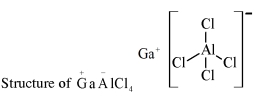
For good quality cement, the ratio of silica \(\left( SlO _2\right)\) to Alumina \(\left( Al _2 O _3\right)\) should be between \(2.5\) to \(4\). - 32. For compound having the formula \(GaAlCl _4\), the correct option from the following is 2023 Medium
- (A) \(Ga\) is more electronegative than \(Al\) and is present as a cationic part of the salt \(GaAlCl _4\)
- (B) Oxidation state of \(Ga\) in the salt \(GaAlC _4\) is \(+3\).
- (C) \(Cl\) forms bond with both \(Al\) and \(Ga\) in \(GaAlCl _4\)
- (D) \(Ga\) is coordinated with \(Cl\) in \(GaAlCl _4\)
Show answer and solution
Correct Answer: (A)
Gallous tetrachloro aluminate \(Ga ^{+} AlCl _4^{-}\)\(2 Ga + Ga ^{+} GaCl _4^{-}+2 Al _2 Cl _6 \stackrel{190^{\circ}}{\longrightarrow} 4 Ga ^{+} AlCl _4^{-}\)
Ga is cationic part of salt \(GaAlCl _4\).
-
- (A) Both \(A\) and \(R\) are correct but \(R\) is NOT the correct explanation of \(A\).
- (B) Both \(A\) and \(R\) are correct and \(R\) is the correct explanation of \(A\).
- (C) \(A\) is not correct but \(R\) is correct.
- (D) \(A\) is correct but \(R\) is not correct.
Show answer and solution
Correct Answer: (B)
The oxide which form acid on dissolving in water is acidic oxide. -
- (A) Statement \(I\) is incorrect but Statement \(II\) is correct
- (B) Both Statement \(I\) and Statement \(II\) is correct
- (C) Statement \(I\) is correct but Statement \(II\) is incorrect
- (D) Both Statement \(I\) and Statement \(II\) is incorrect
Show answer and solution
Correct Answer: (B)
Boron is non- metallic in nature. It is extremely hard and black coloured solid. It exists in many allotropic forms. Due to very strong crystalline lattice, boron has unusually high melting point and boiling point.Element \(B\) \(Al\) \(Ga\) \(In\) \(TI\) Melting point \(2453\) \(933\) \(303\) \(430\) \(576\) Boiling point \(3923\) \(2740\) \(2676\) \(2353\) \(1730\) -
- (A) Both the statements \(I\) and \(II\) are correct
- (B) Statement \(I\) is incorrect but statement \(II\) is correct
- (C) Both the statements \(I\) and \(II\) are incorrect
- (D) Statement \(I\) is correct but statement \(II\) is incorrect
Show answer and solution
Correct Answer: (D)
Statement- \(I\) is correct.\(Ni\) is used in Hydrogenation of unsaturated fat to make edible fats.
Statements\(-II\) is false as hydride of Silicon is electron precise and neither electron deficient nor electron rich.
-
- (A) Statement \(I\) is incorrect but statement \(II\) is correct.
- (B) Both the statements \(I\) and \(II\) are correct
- (C) Statement \(I\) is correct but statement \(II\) is incorrect
- (D) Both the statements \(I\) and \(II\) are incorrect
Show answer and solution
Correct Answer: (B)
The first ionization energies (as in NCERT) are as follows:\(B\) : \(801\,kJ / mol\)
\(Al : 577\,kJ / mol\)
Ga : \(579\,kJ / mol\)
\(Ga :[ Ar ] 3 d ^{10} 4 s ^2 4 p ^1\)
-
- (A) Both Statement \(I\) and Statement \(II\) are true
- (B) Statement \(I\) is true but Statement \(II\) is false
- (C) Both Statement \(I\) and Statement \(II\) are false
- (D) Statement \(I\) is false but Statement \(I\) is true
Show answer and solution
Correct Answer: (C)
(Borax Bead Test)On treatment with metal salt, boric anhydride forms metaborate of the metal which gives different colours in oxidising and reducing flame.
For example, in the case of copper sulphate, following reactions occur.
\(CuSO _4+ B _2 O _3 \longrightarrow Cu \left( BO _2\right)_2+ SO _3\)
Two reactions may take place in reducing flame (Luminous flame)
\((i)\) The blue-green \(Cu \left( BO _2\right)_2\) is reduced to colourless cuprous metaborate as :
\(2 Cu ( BO _2 )_2+2 NaBO _2+ C \underset{\text { flame }}{\stackrel{\text { Luminous }}{\longrightarrow}} 2 CuBO _2+\) \( Na _2 B _4 O _7+ CO\)
\((ii)\) Cupric metaborate may be reduced to metallic copper and bead appears red opaque.
\(2 Cu \left( BO _2\right)_2+4 NaBO _2+2 C \underset{\text { fuminous }}{\stackrel{\text { flame }}{\longrightarrow}} 2 Cu +\) \(2 Na _2 B _4 O _7+2 CO\)
-
- (A) \(A-IV, B-I, C-II, D-III\)
- (B) \(A-IV, B-III, C-I, D-II\)
- (C) \(A-II, B-III, C-IV, D-I\)
- (D) \(A-IV, B-III, C-II, D-I\)
Show answer and solution
Correct Answer: (D)
Cobalt catalyst \(\rightarrow\) Methanol productionSyn gas \(\rightarrow\) Coal gasification
\(\left( C _{\text {(Redhot coke) }}+ H _2 O ( g ) \rightarrow CO + H _2\right)\)
Nickel catalyst \(\rightarrow\) Water gas production
Brine solution \(\rightarrow\) Production
(aq. \(NaCl ) \quad\left(\begin{array}{l} H _2 \rightarrow \text { Cathode } \\ Cl _2 \rightarrow \text { anode }\end{array}\right)\)
-
- (A) \(Si - Si > C - C > Sn - Sn > Ge - Ge\)
- (B) \(Si - Si > C - C > Ge - Ge > Sn - Sn\)
- (C) \(C - C > Si - Si > Sn - Sn > Ge - Ge\)
- (D) \(C - C > Si - Si > Ge - Ge > Sn - Sn\)
Show answer and solution
Correct Answer: (D)
(Bond enthalpy order \(C - C > Si - Si > Ge - Ge > Sn - Sn )\) -
- (A) It has electronic delocalization
- (B) It contains banana bonds.
- (C) It can react with water.
- (D) It is a cyclic compound.
Show answer and solution
Correct Answer: (C)
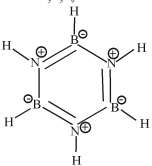
Borazine is \(B _3 N _3 H _8\)\(B _8 N _3 H _6+9 H _2 O \rightarrow 3 NH _3+3 H _8 BO _3+3 H _2\)
-
- (A) \(BBr _3 > BI _3 > BCI _3 > BF _3\)
- (B) \(BCl _3 > BF _3 > BBr _3 > BI _3\)
- (C) \(BF _3 > BCl _3 > BBr _3 > BI _3\)
- (D) \(BI _3 > BBr _3 > BCl _3 > BF _3\)
Show answer and solution
Correct Answer: (D)
Extent of back bonding, reduces down the group leading to more Lewis acidic strength \(BF _3 > BCl _3 > BBr _3 > BI _3\) (extent of back bonding) \((2 p-2 p)(2 p-3 p)(2 p-4 p)(2 p-5 p)\)\(BF _3 < BCl _3 < BBr _3 < BI _3\) (lewis acidic nature)
-
- (A) \(Be + Li \left[ AlCl _{4}\right]+ H _{2}\)
- (B) \(Be + AlH _{3}+ LiCl + HCl\)
- (C) \(BeH _{2}+ LiCl + AlCl _{3}\)
- (D) \(BeH _{2}+ Li \left[ AlCl _{4}\right]\)
Show answer and solution
Correct Answer: (C)
\(2 BeCl _{2}+ LiAlH _{4} \rightarrow 2 BeH _{2}+ LiCl + AlCl _{3}\)This is the method to prepare \(BeH _{2}\)
-
- (A) \(B ( OH )_{3}\) and \(NH _{3}\)
- (B) \(B _{2} H _{6}\) and \(NH _{3}\)
- (C) \(B _{2} H _{6}\) and \(HN _{3}\)
- (D) \(NH _{3}\) and \(B _{2} O _{3}\)
Show answer and solution
Correct Answer: (B)
\(3 B _{2} H _{6}+6 NH _{3} \stackrel{\Delta}{\longrightarrow} 2 B _{3} N _{3} H _{6}+12 H _{2}\) -
- (A) Both \(A\) and \(R\) are correct. and \(R\) is correct explanation of \(A\).
- (B) Both \(A\) and \(R\) are correct. but \(R\) is NOT the correct explanation of \(A\).
- (C) \(A\) is correct \(R\) is not correct.
- (D) \(A\) is not correct. \(R\) is correct.
Show answer and solution
Correct Answer: (B)
From Ellingham diagram given in NCERT, it can be seen that \(Mg , MgO\) line crosses \(Al , Al _{2} O _{3}\) line after \(1350^{\circ} C\) hence assertion is true.Yes, Mg have lower MP and BP than aluminium but it does not explain the above fact.
-
- (A) Both \((A)\) and \((R)\) are true and \((R)\) is the correct explanation of \((A)\)
- (B) Both \((A)\) and \((R)\) are true but \((R)\) is not the correct explanation of \((A)\)
- (C) \((A)\) is true but \((R)\) is false
- (D) \((A)\) is false but \((R)\) is true
Show answer and solution
Correct Answer: (B)
Assertion \((A)\): TrueReason \((R)\): True but not correct explanation.
Correct explanation: Expansion of octet not possible for '\(B\)'.
-
- (A) \((A)\) and \((E)\) only
- (B) \((B), (C)\) and \((E)\) only
- (C) \((C)\) and \((D)\) only
- (D) \((C)\) and \((E)\) only
Show answer and solution
Correct Answer: (C)
\((A)\, (B)\) Two \(3\) centre \(-2\)-electron bonds\((C)\) \(B _{2} H _{6}\) is \(e ^{-}\)deficient species
\((E)\) \(B _{2} H _{6}\) is non - Planar molecule
\((D)\) \(BF _{3}+ LiAlH _{4} \rightarrow 2 B _{2} H _{6}+3 LiF +3 AlF _{3}\)
\(NaBH _{4}+ I _{2} \rightarrow B _{2} H _{6}+2 NaI + H _{2}\)

-
- (A) \((A) - (III), (B) - (II), (C) - (I), (D) - (IV)\)
- (B) \((A) - (IV), (B) - (I), (C) - (II), (D) - (III)\)
- (C) \((A) - (II), (B) - (I), (C) - (IV), (D) - (III)\)
- (D) \((A) - (III), (B) - (IV), (C) - (I), (D) - (II)\)
Show answer and solution
Correct Answer: (D)
\(\left( CH _{3}\right)_{4} Si\) is a silane\(\left( CH _{3}\right) Si ( OH )_{3}\) polymerise to form 2D silicone
\(\left( CH _{3}\right)_{2} Si ( OH )_{2}\) polymerise to form chain silicone
\(\left( CH _{3}\right)_{3} Si ( OH )\) form dimer \(\left( CH _{3}\right)_{3} Si - O - Si \left( CH _{3}\right)_{3}\)
-
- (A) trigonal, planar
- (B) tetrahedral
- (C) pyramidal
- (D) square, planar
Show answer and solution
Correct Answer: (B)
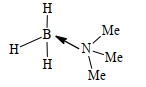
\(BH _{3}+ NaH \stackrel{450 K }{\longrightarrow} \underset{\text { (diborane) }}{ B _{2} H _{6}+ NaF }\)\(B _{2} H _{6}+ NMe _{3} \longrightarrow 2\left[ BH _{3} \leftarrow NMe _{3}\right]\)
- 49. When borax is heated with \(CoO\) on a platinum loop, blue coloured bead formed is largely due to 2022 Medium
- (A) \(B _{2} O _{3}\)
- (B) \(Co \left( BO _{2}\right)_{2}\)
- (C) \(CoB _{4} O _{7}\)
- (D) \(Co [ B _{4} O _{5}( OH )_{4}]\)
Show answer and solution
Correct Answer: (B)
\(Na _{2} B _{4} O _{7} \cdot 10 H _{2} O \stackrel{\Delta}{\longrightarrow} Na _{2} B _{4} O _{7}+10 H _{2} O\)\(Na _{2} B _{4} O _{7} \stackrel{\Delta}{\longrightarrow} 2 NaBO _{2} \text { (sodium meta borate) }+ B _{2} O _{3}\)
\(B _{2} O _{3}+ CoO \rightarrow Co \left( BO _{2}\right)_{2} \text { (cobalt (II) meta borate) }\)
\(\quad\quad\quad\quad\quad\quad\quad\)Blue Bead
-
- (A) \((c)\) and \((d)\) only
- (B) \((c)\) only
- (C) \((a)\) only
- (D) \((a)\) and \((b)\) only
Show answer and solution
Correct Answer: (C)
Diborane is prepared by the reaction of \(\mathrm{NaBH}_{4}\) with \(\mathrm{I}_{2}\).\(2 \mathrm{NaBH}_{4}+\mathrm{I}_{2} \rightarrow \mathrm{B}_{2} \mathrm{H}_{6}+2 \mathrm{NaI}+\mathrm{H}_{2}\)
In diborane, ' \(B^{\prime}\) is \(\mathrm{sp}^{3}\) hybrid, it is Non-planar and two \(3 \mathrm{c}-2 \mathrm{e}^{-}\)bonds are present.
No questions on this page match these filters.
About P-Block elements - I PYQs
P-Block elements - I has 77 questions from 2013–2026. The most came in 2024 (17), 2023 (14) and 2019 (11).
The most asked topics are Carbon family and Boron family.
14% are easy, 44% medium and 42% hard.
P-Block elements - I PYQs by year
Frequently asked
How many P-Block elements - I questions came in JEE Mains?
77 questions from 2013–2026, each with the correct answer and a full solution.
Which P-Block elements - I topic is asked the most?
Carbon family, with 41 questions, followed by Boron family with 36.
Which year had the most P-Block elements - I questions?
2024, with 17 questions.
How difficult are P-Block elements - I questions?
14% are easy, 44% medium and 42% hard.