


Questions
Newest firstShowing 1–36 of 36 questions
- 1. Amongst the following, the total number of compounds soluble in aqueous \(NaOH\) at room temperature is:
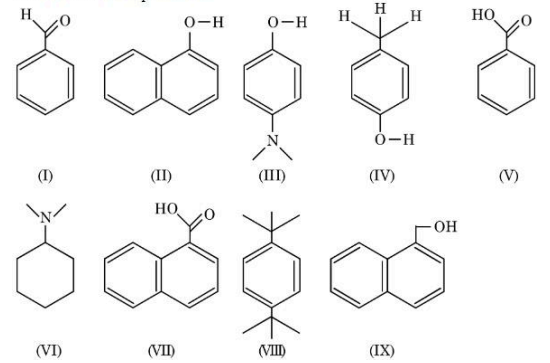 2026 Hard
- (A) \(5\)
- (B) \(4\)
- (C) \(6\)
- (D) \(3\)
Show answer and solution
Correct Answer: (A)
To determine which compounds are soluble in aqueous \(NaOH\), we need to identify the compounds that are sufficiently acidic to react with \(NaOH\) (a strong base) to form water-soluble sodium salts. Generally, carboxylic acids and phenols are acidic enough to dissolve in aqueous \(NaOH\), whereas alcohols, aldehydes, amines, and hydrocarbons are not.
Let us analyze each compound:
(I) Benzaldehyde: It is an aldehyde. It does not have an acidic proton and is insoluble in aqueous \(NaOH\).
(II) 1-Naphthol: It is a phenol derivative. Phenols are acidic and react with \(NaOH\) to form soluble phenoxide salts. (Soluble)
(III) 4-(Dimethylamino)phenol: It contains a phenolic \(-OH\) group. Despite the basic amino group, the acidic phenol group will react with \(NaOH\) to form a soluble salt. (Soluble)
(IV) p-Cresol: It is a phenol derivative. It reacts with \(NaOH\) to form a soluble sodium salt. (Soluble)
(V) Benzoic acid: It is a carboxylic acid, which is highly acidic and readily dissolves in aqueous \(NaOH\). (Soluble)
(VI) N,N-Dimethylcyclohexanamine: It is an aliphatic amine. It is basic in nature and insoluble in aqueous \(NaOH\).
(VII) 1-Naphthoic acid: It is a carboxylic acid and will dissolve in aqueous \(NaOH\). (Soluble)
(VIII) 1,4-Di-tert-butylbenzene: It is a hydrocarbon. It is neutral and insoluble in aqueous \(NaOH\).
(IX) 1-Naphthalenemethanol: It is an alcohol (benzyl-type). Alcohols are generally not acidic enough to react with aqueous \(NaOH\). (Insoluble)
The compounds soluble in aqueous \(NaOH\) are (II), (III), (IV), (V), and (VII).
Total number of soluble compounds = \(5\).
Answer: \(5\) -
- (A) 2-Chloropropanoic acid
- (B) 3-Chloropropanoic acid
- (C) 1-Chloropropane
- (D) 2-Chloropropane
Show answer and solution
Correct Answer: (A)
Step 1: Hydrolysis of the nitrile.
Propanenitrile on basic hydrolysis followed by acidic workup gives propanoic acid:
\(CH_3-CH_2-C \equiv N \xrightarrow[(ii)\ H_3O^+]{(i)\ OH^-/H_2O/\Delta} CH_3-CH_2-COOH\)
Step 2: Hell\(-\)Volhard\(-\)Zelinsky (HVZ) reaction.
Propanoic acid has an \(sp^3\) \(\alpha\)-carbon bearing two \(\alpha\)-hydrogens. In the HVZ reaction, \(Cl_2\) in the presence of red phosphorus selectively replaces one \(\alpha\)-hydrogen by chlorine, giving the \(\alpha\)-chloro acid after aqueous workup:
\(CH_3-CH_2-COOH \xrightarrow[(iv)\ H_2O]{(iii)\ Cl_2/\text{Red P}} CH_3-CH(Cl)-COOH\)
Hence, the major product \(P\) is \(2\)-chloropropanoic acid, which corresponds to option \((1)\). - 3. Consider the following two reactions A and B.
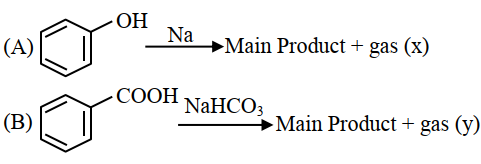
Numerical value of [molar mass of x + molar mass of y] is _____. 2026 Hard- (A) 4
- (B) 88
- (C) 46
- (D) 160
Show answer and solution
Correct Answer: (C)
\( x = H_{2} \) (gas), \( y = CO_{2} \) (gas)
Sum of molar mass = 2 + 44 = 46 -
- (A) A, C and E only
- (B) A and E only
- (C) C and E only
- (D) A, B, D and E only
Show answer and solution
Correct Answer: (A)
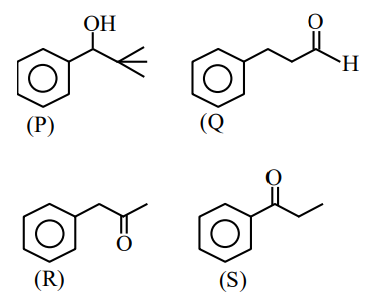
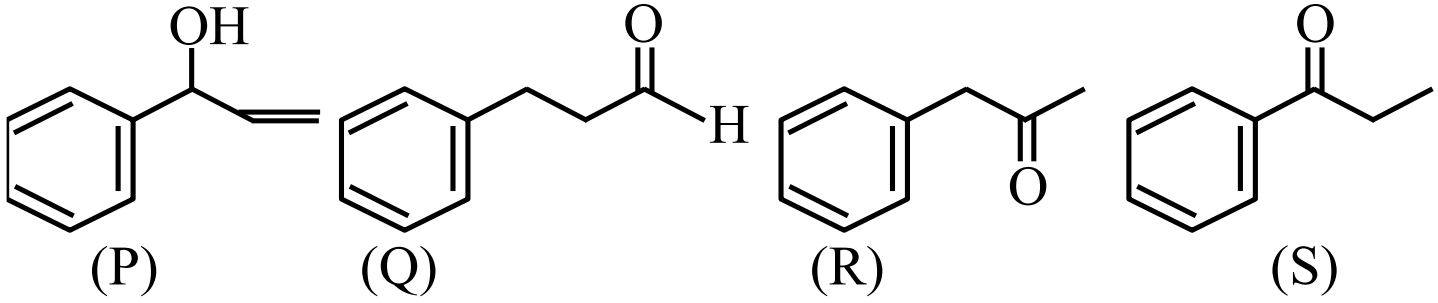
(A) Q, R, S all three give 2, 4 DNP test as they have Aldehyde/ketone group
(C) Q & R gives sooty flame
(E) Q gives Tollens reagent test -
- (A) Statement I is true but Statement II is false
- (B) Statement I is false but Statement II is true
- (C) Both Statement I and Statement II are true
- (D) Both Statement I and Statement II are false
Show answer and solution
Correct Answer: (C)
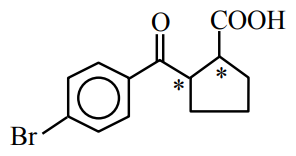
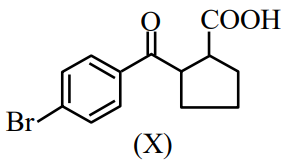
Two chiral centre and due to presence of - COOH compound dissolves in \(NaHCO _3\).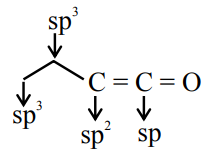
-
- (A) Violet
- (B) Green
- (C) Red
- (D) Colourless
Show answer and solution
Correct Answer: (D)
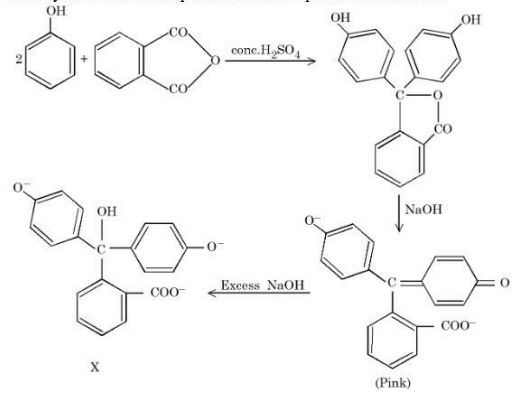
The given reaction sequence represents the synthesis and acid-base behaviour of phenolphthalein.
When phenol reacts with phthalic anhydride in the presence of concentrated \(H_2SO_4\), phenolphthalein is formed. In acidic or neutral medium, phenolphthalein exists in a lactone form which is colourless.
Upon addition of a moderate amount of alkali (NaOH), the lactone ring opens and a proton is removed, forming a dianion with an extended conjugated quinonoid structure. This extended conjugation is responsible for the characteristic pink colour of phenolphthalein in basic medium.
When excess NaOH is added (strongly alkaline medium), a hydroxide ion attacks the central \(sp^2\) hybridized carbon atom of the quinonoid structure. This converts the central carbon to an \(sp^3\) hybridized state, forming a carbinol structure (compound X).
Because the central carbon is now \(sp^3\) hybridized, the extended conjugation is broken. As a result, the compound loses its colour and becomes colourless.
Therefore, compound X is colourless.
Answer: Colourless -
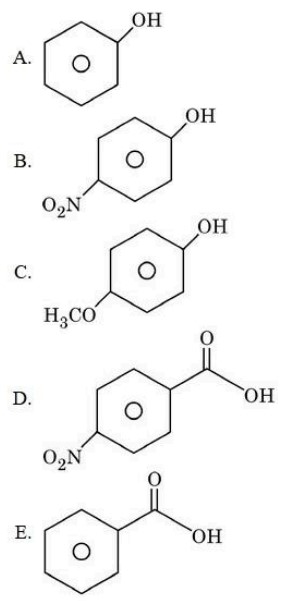
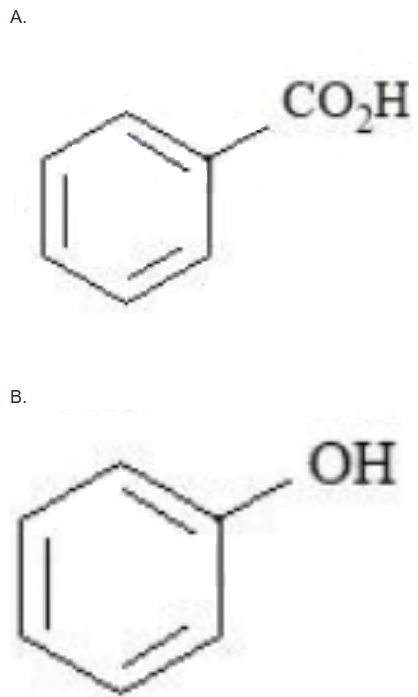
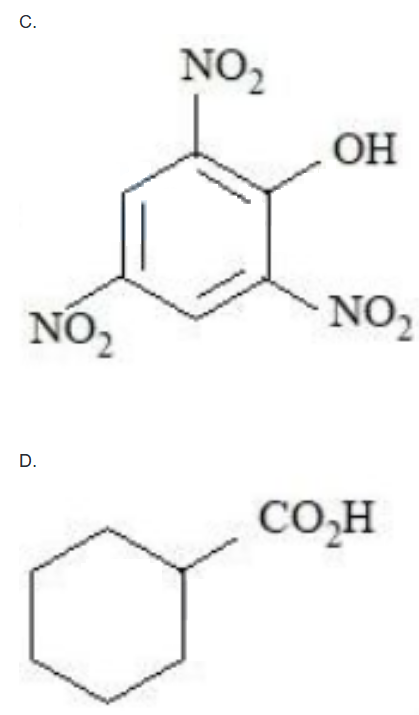
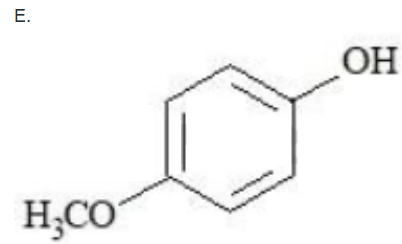
- (A) \(B>D>E>A>C\)
- (B) \(D>B>E>A>C\)
- (C) \(C>A>B>D>E\)
- (D) \(D>E>B>A>C\)
Show answer and solution
Correct Answer: (D)
Carboxylic acids are stronger acids than phenols because the carboxylate anion is stabilized by equivalent resonance structures. Thus, D and E are more acidic than A, B, and C.
For the carboxylic acids, the \(-NO_2\) group in D is an electron-withdrawing group (\(-I, -R\)), which stabilizes the conjugate base, making D more acidic than E.
For the phenols, electron-withdrawing groups increase acidity while electron-donating groups decrease it. The \(-NO_2\) group in B is electron-withdrawing, making it more acidic than A. The \(-OCH_3\) group in C is electron-donating (\(+R > -I\)), making it less acidic than A. Thus, the order for phenols is B \(>\) A \(>\) C.
Combining these, the overall descending order of acidity is D \(>\) E \(>\) B \(>\) A \(>\) C.
Answer: \(D>E>B>A>C\) -
- (A) A, C & E only
- (B) A, B & C only
- (C) A & C only
- (D) B, D & E only
Show answer and solution
Correct Answer: (C)
(A) \( NaOCl + KI \rightarrow NaCl + KOI \)
(B) Incorrect statement
(C)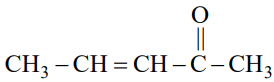 gives iodoform reaction.
(D) Incorrect statement
(E) Incorrect statement - 9. Consider the following molecules :
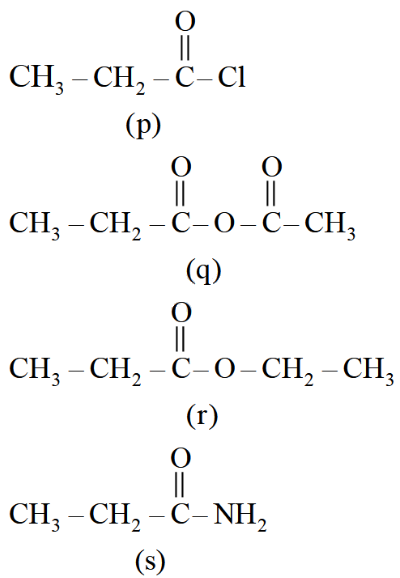
The correct order of rate of hydrolysis is _______. 2025 Medium- (A) \(r>q>p>s\)
- (B) \(q>p>r>s\)
- (C) \(p>r>q>s\)
- (D) \(p>q>r>s\)
Show answer and solution
Correct Answer: (D)
Rate of hydrolysis \(\propto\) Leaving group ability
-
- (A) Both Statement I and Statement II are false
- (B) Statement I is false but Statement II is true
- (C) Statement I is true but Statement II is false
- (D) Both Statement I and Statement II are true
Show answer and solution
Correct Answer: (D)
Statement - I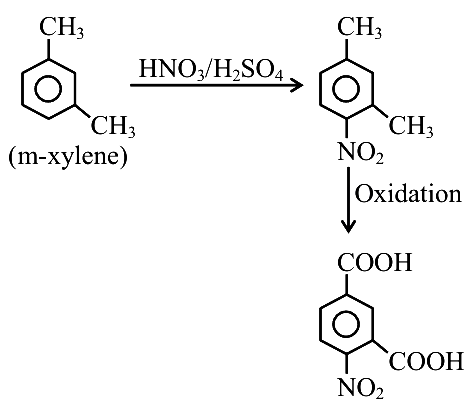
Statement-II \(-\mathrm{CH}_3\) group is o/p directing while \(-\mathrm{NO}_2\) group is meta directing. -
- (A) A, C and D Only
- (B) A, B and E Only
- (C) A and C Only
- (D) A and B Only
Show answer and solution
Correct Answer: (A)
\(A , C , D\) produce \(CO _2\) with aqueous \(NaHCO _3\) solution.
\(A , C , D\) acids are stronger acid than \(H _2 CO _3\) (Carbonic acid) -
- (A) D
- (B) A
- (C) B
- (D) C
Show answer and solution
Correct Answer: (A)
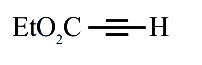
C.B. of terminal alkyne will be sp hybridisation and loculised. In other C.B. will be resonance stablised. -
- (A) 60
- (B) 65
- (C) 61
- (D) 47
Show answer and solution
Correct Answer: (C)
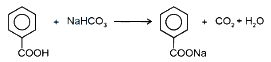
1 mole benzoic acid will release 1 mole \(\mathrm{CO}_2\)
11.2 \(\mathrm{L} \mathrm{CO}_2\) at STP is \(\frac{1}{2} \mathrm{~mole}_{\mathrm{CO}}^2\) which will be released by reaction with \(\frac{1}{2}\) mole benzoic acid
\(\begin{aligned} \text { Mass of benzoic acid } & =\frac{1}{2} \times 122 \\ & =61 \mathrm{gm}\end{aligned}\) - 14. Match List - \(I\) with List -\(II\).
Choose the correct answer from options given below: 2024 Hard
- (A) \(A-(III), (B)-(IV), (C)-(I), (D)-(II)\)
- (B) \(A-(IV), (B)-(II), (C)-(I), (D)-(III)\)
- (C) \(A-(IV), (B)-(II), (C)-(III), (D)-(I)\)
- (D) \(A-(III), (B)-(IV), (C)-(II), (D)-(I)\)
Show answer and solution
Correct Answer: (B)
\(\mathrm{CH}_3\left(\mathrm{CH}_2\right)_5 \mathrm{COOC}_2 \mathrm{H}_5 \xrightarrow{\text { DB. } 4 \text { L-H. } \mathrm{H}_2 \mathrm{O}} \mathrm{CH}_3\left(\mathrm{CH}_2\right)_5 \mathrm{CHO}\)
\(\mathrm{C}_6 \mathrm{H}_5 \mathrm{COC}_6 \mathrm{H}_5 \xrightarrow{\mathrm{Zn}(\mathrm{Hg}) \& \text { conc. } \mathrm{HCl}} \mathrm{C}_6 \mathrm{H}_5 \mathrm{CH}_2 \mathrm{C}_6 \mathrm{H}_5\)
\(\mathrm{C}_0 \mathrm{H}_5 \mathrm{CHO} \xrightarrow[\mathrm{H}, \mathrm{O}]{\mathrm{CH}_3, \mathrm{Mgr}} \mathrm{C}_0 \mathrm{H}_5 \mathrm{CH}(\mathrm{OH}) \mathrm{CH}_5\)
\(\mathrm{CH}_3 \mathrm{COCH}_2 \mathrm{COOC}_2 \mathrm{H}_5 \xrightarrow{\text { Nath }, \mathrm{H}^{+}} \mathrm{CH}_3 \mathrm{CH}(\mathrm{OH}) \mathrm{CH}_2\)\(\mathrm{COOC}_2 \mathrm{H}_5\) -
- (A) \(HCOOH > CH _3 COOH > CH _3 CH _2 COOH > CH _3 CH _2 CH _2 COOH\)
- (B) \(HCOOH > CH _3 CH _2 CH _2 COOH > CH _3 CH _2 COOH > CH _3 COOH\)
- (C) \(CH _3 CH _2 CH _2 COOH > CH _3 CH _2 COOH > CH _3 COOH > HCOOH\)
- (D) \(CH _3 COOH > CH _3 CH _2 COOH > CH _3 CH _2 CH _2 COOH > HCOOH\)
Show answer and solution
Correct Answer: (A)
\(HCOOH > CH _3 COOH > CH _3 CH _2 COOH > CH _3 CH _2 CH _2 COOH\) -
- (A) Both \((A)\) and \((R)\) are correct and \((R)\) is the correct explanation of \((A)\).
- (B) Both \((A)\) and \((R)\) are correct but \((R)\) is not the correct explanation of \((A)\).
- (C) \((A)\) is correct but \((R)\) is not correct.
- (D) \((A)\) is not correct but \((R)\) is correct.
Show answer and solution
Correct Answer: (A)
Theory Based -
- (A) Statement \(I\) is correct but Statement \(II\) is incorrect.
- (B) Both Statement \(I\) and Statement \(II\) are incorrect.
- (C) Both Statement \(I\) and Statement \(II\) are correct.
- (D) Statement \(I\) is incorrect but Statement \(II\) is correct.
Show answer and solution
Correct Answer: (D)
Does not show esterification test.Presence of both sulphur and nitrogen give red colour in Lassigne's test.

- 18. What is the correct order of acidity of the protons marked \(A-D\) in the given compounds?
 2023 Hard
- (A) \(H _{ C } > H _{ D } > H _{ B } > H _{ A }\)
- (B) \(H _{ C } > H _{ D } > H _{ A } > H _{ B }\)
- (C) \(H _{ D } > H _{ C } > H _{ B } > H _{ A }\)
- (D) \(H _{ C } > H _{ A } > H _{ D } > H _{ B }\)
Show answer and solution
Correct Answer: (B)
acidity of an acid depends upon the stability of its conjugate base
-
- (A) \(14\)
- (B) \(13\)
- (C) \(15\)
- (D) \(11\)
Show answer and solution
Correct Answer: (C)
\(150\,g CH _{3} COOH\)\(10.2\,g\) ascorbic acid \(\Rightarrow 0.058\) moles
\(\Delta T _{ f }=\left( x \times 10^{-1}\right)^{\circ} C\)
\(\Delta T _{ f }= k _{ f } \cdot \text { molality }\)
\(=3.9 \times \frac{0.058}{150} \times 1000\)
\(=1.5^{\circ}\,C\)
\(=15 \times 10^{-1 \circ}\,C\)
-
- (A) \(A > B > C > D\)
- (B) \(B > A > C > D\)
- (C) \(D > C > A > B\)
- (D) \(D > C > B > A\)
Show answer and solution
Correct Answer: (A)
The correct order of acid strength is
-
- (A) Both \(A\) and \(R\) are true and \(R\) is the correct explanation of \(A\).
- (B) Both \(A\) and \(R\) are true but \(R\) is NOT the correct explanation of \(A\).
- (C) \(A\) is true but \(R\) is false.
- (D) \(A\) is false but \(R\) is true.
Show answer and solution
Correct Answer: (D)
Benzoic acid and Napthalene can be effectively separated by crystallization. Benzoic acid is soluble in hot water whereas Napthalene is insoluble.Hence assertion is incorrect but reason is correct.
-
- (A) Both Statement \(I\) and Statement \(II\) are correct.
- (B) Both Statement \(I\) and Statement \(II\) are incorrect.
- (C) Statement \(I\) is correct but Statement \(II\) is incorrect.
- (D) Statement \(I\) is incorrect but Statement \(II\) is correct.
Show answer and solution
Correct Answer: (A)
\(R - OH + \begin{matrix} O \\ || \\ R-C-OH \\ \end{matrix} \longrightarrow \begin{matrix} \,\,\,\,\,\,\,\,\,\,\,O \\ \,\,\,\,\,\,\,\,\,\,\,|| \\ R-O-C-R \\ \end{matrix}\)nucleophilic acyl substitution
electron with drawing group on carboxylic acid will increase the rate of esterification
-
- (A) Treating cis-but\(-2-\)enedioic acid with alcohol and acid
- (B) Heating cis-but\(-2-\)enedioic acid
- (C) Treating trans-but\(-2-\)enedioic acid with alcohol and acid
- (D) Heating trans-but\(-2-\)enedioic acid
Show answer and solution
Correct Answer: (B)
Cis but \(2 -\)enoic acid
-
- (A) \((a)-(ii), (b)-(i), (c)-(iv), (d)-(iii)\)
- (B) \((a)-(iii), (b)-(iv), (c)-(i), (d)-(ii)\)
- (C) \((a)-(ii), (b)-(iv), (c)-(i), (d)-(iii)\)
- (D) \((a)-(iii), (b)-(i), (c)-(iv), (d)-(ii)\)
Show answer and solution
Correct Answer: (C)
Match list\(-I\) And list\(-II\)\((a)\) \(\begin{array}{*{20}{c}} O \\ {||} \\ {R - C - Cl} \end{array}\xrightarrow[{Pd - BaS{O_4}}]{{{H_2}}}\begin{array}{*{20}{c}} {\,\,\,\,\,\,\,O} \\ {\,\,\,\,\,\,\,\,||} \\ {R{\text{ }} - {\text{ }}CH} \end{array}\) \((a)-(ii)\)
Rosenmund Reduction
\((b)\) \(R - CH _{2}- COOH\) \(\xrightarrow[{{H_2}O}]{{C{l_2}/P}}\) \(\begin{array}{*{20}{c}} {R - CH - COOH} \\ {|\,\,\,\,\,\,\,\,\,\,\,\,\,\,\,} \\ {Cl\,\,\,\,\,\,\,\,\,\,\,\,} \end{array}\)
\(HVZ\) reaction \((b)-(iv)\)
\((c)\) \(\begin{array}{*{20}{c}} {O\,\,\,\,\,} \\ {||\,\,\,\,\,\,} \\ {R - C - N{H_2}} \end{array}\) \(\xrightarrow[{NaOH}]{{B{r_2}}}\) \(R - NH _{2}\)
Hoffmann Bromamide reaction \((c) - (i)\)
\((d)\) \(\begin{array}{*{20}{c}} {O\,\,\,\,\,\,} \\ {||\,\,\,\,\,\,} \\ {R - C - C{H_3}} \end{array}\xrightarrow[{conc.{\kern 1pt} HCl}]{{Zn(Hg)}}{\mkern 1mu} R - C{H_2} - C{H_3}\)
Clemmenson reduction \((d) - (iii)\)
-
- (A) \(III > II > I > IV\)
- (B) \(IV > III > II > I\)
- (C) \(I > II > III > TV\)
- (D) \(II > III > IV > I\)
Show answer and solution
Correct Answer: (D)
\(2 > 3 > 4 > 1\)
-
- (A) \(CH _{3} CH _{2} OH\) \(\xrightarrow[{573\,\,K}]{{Cu}}\)
- (B) \(CH _{3} CN \frac{( i ) DBAL - H }{( i ) H _{2} O }\) \(\xrightarrow[{(ii)\,{H_2}o}]{{{\text{(i) DIBAL - H}}}}\)
- (C) \(CH _{2}= CH _{2}+ O _{2}\) \(\xrightarrow[{{H_2}O}]{{Pd(II)/Cu(II)}}\)
- (D) \(CH _{3} CH _{2} OH\) \(\xrightarrow{{Cr{O_3} - {H_2}S{O_4}}}\)
Show answer and solution
Correct Answer: (D)
\(C{H_3} - C{H_2} - OH\xrightarrow[{{\text{Strong oxidising agent}}}]{{Cr{O_3} \cdot {H_2}S{O_4}}}\begin{array}{*{20}{c}} O \\ {||} \\ {C{H_3} - C - OH} \\ {{\text{(Carboxylic acid is formed by complete oxidation )}}} \end{array}\) -
- (A) \(b > c > d > a\)
- (B) \(c > b > a > d\)
- (C) \(b > a > c > d\)
- (D) \(c > b > d > a\)
Show answer and solution
Correct Answer: (A)
\(\begin{array}{*{20}{c}} {O\;\;} \\ {||\;\;} \\ {R - C - OH} \end{array} > R - OH > R - C \equiv CH\)Reason: \(\begin{array}{*{20}{c}} O \\ {||} \\ {R - C - {O^\theta }} \end{array}\) stable by equivalent resonance.
Stable:
So answer is \(b > c > d > a\)
- 28. The increasing order of the acidity of the \(\alpha\)\(-\)hydrogen of the following compounds is :
 2020 Medium
- (A) \((C)<(A)<(B)<(D)\)
- (B) \((B)<(C)<(A)<(D)\)
- (C) \(( A )<( C )<( D )<( B )\)
- (D) \((D)<(C)<(A)<(B)\)
Show answer and solution
Correct Answer: (D)
\(D\)
-
- (A) \(LiAlH_4\)
- (B) \(NaBH_4\)
- (C) \(H_2/Pd\)
- (D) \(B_2H_6\)
Show answer and solution
Correct Answer: (D)
Most suitable reagent for given conversion is \(\mathrm{B}_{2} \mathrm{H}_{6}\) (electrophilic reducing agent)
-
- (A) \(NO_2CH_2COOH > FCH_2COOH >\) \( CNCH_2COOH > ClCH_2COOH\)
- (B) \(FCH_2COOH > NCCH_2COOH >\) \(NO_2CH_2COOH > ClCH_2COOH\)
- (C) \(CNCH_2COOH > O_2NCH_2COOH >\) \(FCH_2COOH > ClCH_2COOH\)
- (D) \(NO_2CH_2COOH > NCCH_2COOH >\) \(FCH_2COOH > ClCH_2COOH\)
Show answer and solution
Correct Answer: (D)
Acid strength in this case varies directly with the electron withdrawing power of the groups attached to the \(\alpha - \) carbon of \(CH_3COOH\). The order of electron withdrawing tendency is
\(NO_2 > CN > F > Cl\) -
- (A) \(III > II > IV > I\)
- (B) \(III > II > I > IV\)
- (C) \(IV > II > III > I\)
- (D) \(II > III > I > IV\)
Show answer and solution
Correct Answer: (B)
Electron withdrawing group enhances the rate of hydrolysis - 32. Determination of the molar mass of acetic acid in benzene using freezing point depression is affected by 2015 Hard
- (A) partial ionization
- (B) dissociation
- (C) complex formation
- (D) association
Show answer and solution
Correct Answer: (D)
Acetic acid contain carboxylic group \(-\,COOH\) which can form \(H\,-\) bonding so acetic acid dimerises.
-
- (A) Wolff - Kishner reaction
- (B) Rosenmund reaction
- (C) Etard reaction
- (D) Hell - Volhard - Zelinsky reaction
Show answer and solution
Correct Answer: (D)
Hell - Volhard - Zelinsky Reaction :It is \(\alpha \) - subtitution when a carboxylic acid having \(\alpha \) - hydrogens is treated with chlorine or bromine in presence of small amount of red phosphorous.
\(R-C{{H}_{2}}COOH\,+\,{{X}_{2}}\,\xrightarrow{P}\) \(\begin{matrix}
X\,\,\,\,\,\,\,\,\,\,\,\,\,\,\,\,\,\,\,\,\,\,\,\,\,\,\,\,\,\,\,\,\,\,\,\,\,\, \\
|\,\,\,\,\,\,\,\,\,\,\,\,\,\,\,\,\,\,\,\,\,\,\,\,\,\,\,\,\,\,\,\,\,\,\,\,\,\,\,\,\, \\
RCH-COOH+HX \\
\end{matrix}\) \((X\,=\,Cl,\,Br)\) - 34. In the reaction, \(C{H_3}COOH\xrightarrow{{LiAl{H_4}}}A\xrightarrow{{PC{l_5}}} \) \(B\xrightarrow{{Alc.\,KOH}}C,\) the product \(C\) is : 2014 Medium
- (A) Acetaldehyde
- (B) Acetylene
- (C) Ethylene
- (D) Acetyl chloride
Show answer and solution
Correct Answer: (C)
\(\begin{array}{*{20}{c}}
{\,\,\,O} \\
{\,\,\,||} \\
{C{H_3} - C - OH}
\end{array}\) \(\xrightarrow[{{\text{ Reduction }}}]{{LiAl{H_4}}}{\text{C}}{{\text{H}}_3} - {\text{C}}{{\text{H}}_2} - {\text{OH}}\) \(\xrightarrow{{{\text{PC}}{{\text{l}}_5}}}{\text{C}}{{\text{H}}_3} - {\text{C}}{{\text{H}}_2} - {\text{Cl}}\) \(\xrightarrow[{{\text{ Dehydrohalogenation }}}]{{{\text{Alc}}.{\text{KOH}}}}\) \(\mathrm{CH}_{2}=\mathrm{CH}_{2}\) (Ethylene) -
- (A) Ethane
- (B) Ethyne
- (C) Ethene
- (D) Propene
Show answer and solution
Correct Answer: (C)
Ethane is obtained by electrolysis of dipotassium succinate as follows\(\underset{Dipot.\,\,succinate}{\mathop{\begin{matrix}
C{{H}_{2}}COOK \\
|\,\,\,\,\,\,\,\,\,\,\,\,\,\,\,\,\,\,\,\,\,\,\,\,\,\, \\
C{{H}_{2}}COOK \\
\end{matrix}}}\,\) \(\xrightarrow{ionization}\) \(\begin{matrix}
C{{H}_{2}}CO{{O}^{-}} \\
|\,\,\,\,\,\,\,\,\,\,\,\,\,\,\,\,\,\,\,\,\,\,\,\,\,\,\, \\
C{{H}_{2}}CO{{O}^{-}} \\
\end{matrix}\) \(+2K^+\)\(2{{H}_{2}}O\,\overset{ionization}{\longleftrightarrow}2O{{H}^{-\,}}+\,2{{H}^{+}}\)
At anode :
\(\begin{matrix}
C{{H}_{2}}CO{{O}^{-}} \\
|\,\,\,\,\,\,\,\,\,\,\,\,\,\,\,\,\,\,\,\,\,\,\,\,\,\, \\
C{{H}_{2}}CO{{O}^{-}} \\
\end{matrix}\) \(\xrightarrow{2{{e}^{-}}}\) \(\underset{Unstable}{\mathop{\left[ \begin{matrix}
C{{H}_{2}}COO \\
|\,\,\,\,\,\,\,\,\,\,\,\,\,\,\,\,\,\,\,\,\,\,\, \\
C{{H}_{2}}COO \\
\end{matrix} \right]}}\,\) \(\to \) \(\begin{matrix}
C{{H}_{2}} \\
||\,\,\,\,\,\, \\
C{{H}_{2}} \\
\end{matrix}\) \(+\,2CO_2\)At cathode :
\(2H^+ + 2e^-\to [2H]\to H_2\)
-
- (A) Ethers
- (B) Amines
- (C) Esters
- (D) Alcohols
Show answer and solution
Correct Answer: (C)
Mono-carboxylic acids are functional isomers of esters. e.g.,\(\mathop {C{H_3}COOH}\limits_{{\text{Acetic acid}}} \,\) \(\mathop {HCOOC{H_3}}\limits_{{\text{Methyl formate}}} \,\)
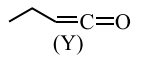
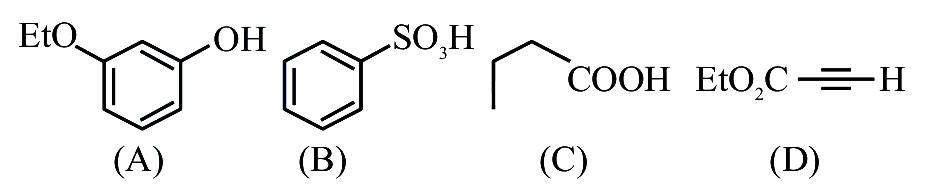
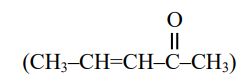 will give iodoform reaction.
 \(\qquad\)\(\qquad\)


No questions on this page match these filters.
Other STD 12 - Carboxylic acids and their derivative topics
Frequently asked
How many Properties of Carboxylic Acids and Their Derivatives questions came in JEE Mains?
36 questions from 2013–2026, each with the correct answer and a full solution.
How difficult are Properties of Carboxylic Acids and Their Derivatives questions?
11% are easy, 44% medium and 44% hard.