


Questions
Newest firstShowing 1–29 of 29 questions
-
- (A) 55
- (B) 222
- (C) 111
- (D) 148
Show answer and solution
Correct Answer: (C)
Eq of \( Cu = Eq \) of \( O_{2} \)
\(\frac{300 \times 10^{-3} \times 2}{63.54}= n _{ O _2} \times 4\)
\(2.36 \times 10^{-3}= n _{ O _2}\)
When current is further passed
\(n _{ O _2} \times 4=\frac{600 \times 28 \times 60}{96500 \times 1000}\)
\(n _{ O _2}=2.611 \times 10^{-3}\)
Total \( O_{2} \) released
\(=\left[10^{-3} \times(2.36+2.611)\right] \times 22400 ml\)
\(=111.35 ml\) -
- (A) 1.660 g
- (B) 0.336 g
- (C) 0.441 g
- (D) 1.007 g
Show answer and solution
Correct Answer: (B)
\(\mathrm{Al}^{1++}+3 \mathrm{e}^{-} \longrightarrow \mathrm{Al}\)
\(\begin{aligned}
\text { Moles of electron } & =\frac{2 \times 30 \times 60}{96500} \\
& =\frac{36}{965}
\end{aligned}\)
\(\begin{aligned}
\text { Moles of } \mathrm{Al} & =\frac{36}{3 \times 965} \\
& =\frac{12}{965}
\end{aligned}\)
\(\text { Mass of } \mathrm{Al}=\frac{12}{965} \times 27\)
\(=0.336 \mathrm{gm}\) -
- (A) 2
- (B) 4
- (C) 6
- (D) 8
Show answer and solution
Correct Answer: (A)
Electrolysis of NaCl is
\(\mathrm{NaCl}+\mathrm{H}_2 \mathrm{O}(\mathrm{aq}) \rightarrow \mathrm{NaOH}(\mathrm{aq})+\frac{1}{2} \mathrm{Cl}_2(\mathrm{~g})+\frac{1}{2} \mathrm{H}_2(\mathrm{~g})\)
Since during electrolysis pH changes to 12
So \(\left[\mathrm{OH}^{\ominus}\right]=10^{-2}\) and \(\left[\mathrm{H}^{+}\right]=10^{-12}\)
So by Faraday law
Gram amount of substance deposited \(=\) Amount of electricity passed
\(\begin{aligned} & 10^{-2} \times \frac{600}{1000} \times 96500=\mathrm{I} \times \mathrm{t} \\ & \frac{10^{-2} \times 600}{1000} \times 96500=\mathrm{I} \times 5 \times 60 \\ & \mathrm{I}=\frac{10^{-2} \times 600 \times 96500}{1000 \times 5 \times 60} \\ & \mathrm{I}=1.93 \text { ampere } \\ & \text { So }, I=2 \text { ampere (nearest integer) }\end{aligned}\) -
- (A) \(7\)
- (B) \(9\)
- (C) \(10\)
- (D) \(11\)
Show answer and solution
Correct Answer: (D)
Volume of silver coating =\(0.05 \times 0.05 \times 10000\)\(=25 \mathrm{~cm}^3\)
Mass of silver deposited=\(25 \times 7.9 \mathrm{~g}\)
Moles of silver atoms =\(\frac{25 \times 7.9}{108}\)
Number of silver atoms =\(\frac{25 \times 7.9}{108} \times 6.023 \times 10^{23}\)
\(=11.01 \times 10^{23}\)
Ans. \(11\)
-
- (A) \(2\)
- (B) \(3\)
- (C) \(4\)
- (D) \(5\)
Show answer and solution
Correct Answer: (A)
\(\frac{\mathrm{W}}{\mathrm{E}}=\frac{\text { ch arge }}{1 \mathrm{~F}} \)\(\frac{1.314}{\frac{197}{3}}=\frac{\mathrm{Q}}{1 \mathrm{~F}}\)
\(\mathrm{Q}=2 \times 10^{-2} \mathrm{~F}\)
- 6. find out the quantity of silver deposited when one coulomb charge is passed through \(\mathrm{AgNO}_3\) solution. 2024 Medium
- (A) \(0.1 \mathrm{~g}\) atom of silver
- (B) \(1\) chemical equivalent of silver
- (C) \(1 \mathrm{~g}\) of silver
- (D) \(1\) electrochemical equivalent of silver
Show answer and solution
Correct Answer: (D)
\(\mathrm{W}=\mathrm{ZIt}\)\(\mathrm{W}=\mathrm{ZQ}\)
\(\mathrm{Q}=\frac{\mathrm{W}}{\mathrm{Z}}\)
\(\mathrm{W}=\mathrm{ZQ}=\text { (electrochemical equivalent) }\)
-
- (A) \(4\)
- (B) \(5\)
- (C) \(6\)
- (D) \(7\)
Show answer and solution
Correct Answer: (B)
\(\mathrm{Cu}^{2+}+2 \mathrm{e}^{-} \rightarrow \mathrm{Cu}\)\(2 \text { Faraday } \rightarrow 1 \mathrm{~mol} \mathrm{Cu}\)
\(1 \text { Faraday } \rightarrow 0.5 \mathrm{~mol} \mathrm{Cu} \text { deposit }\)
\(0.5 \mathrm{~mol}=0.5 \mathrm{~g} \text { atom }=5 \times 10^{-1}\)
\(\mathrm{x}=5\)
-
- (A) \(5\)
- (B) \(8\)
- (C) \(7\)
- (D) \(2\)
Show answer and solution
Correct Answer: (D)
\(2 \mathrm{H}_2 \mathrm{O} \rightarrow \mathrm{O}_2+4 \mathrm{H}^{+}+4 \mathrm{e}^{-}\)\(\frac{\mathrm{W}}{\mathrm{E}}=\frac{\mathrm{Q}}{96500}\)
\(\text { mole } \times \text { n-factor }=\frac{\mathrm{Q}}{96500}\)
\(1 \times 2=\frac{\mathrm{Q}}{96500}\)
\(\mathrm{Q}=2 \times 96500 \mathrm{C}\)
\(=1.93 \times 10^5 \mathrm{C}\)
-
- (A) \(108\)
- (B) \(159\)
- (C) \(189\)
- (D) \(148\)
Show answer and solution
Correct Answer: (A)
Eq. of \(\mathrm{Ag}=\) Eq. of \(\mathrm{O}_2\)Let \(\mathrm{x}\) gm silver displaced,
\(\frac{\mathrm{x} \times 1}{108}=\frac{5.6}{22.7} \times 4\)
(Molar volume of gas at STP \(=22.7\) lit)
\(\mathrm{x}=106.57 \mathrm{gm}\)
Ans. \(107\)
OR,
as per old STP data, molar volume \(=22.4\) lit
\(\frac{\mathrm{x} \times 1}{108}=\frac{5.6}{22.4} \times 4, \mathrm{x}=108 \mathrm{gm} \text {. }\)
Ans. \(108\)
-
- (A) \(47\)
- (B) \(46\)
- (C) \(49\)
- (D) \(41\)
Show answer and solution
Correct Answer: (B)
\( \mathrm{Zn}^{+2}+2 \mathrm{e}^{-} \longrightarrow \mathrm{Zn} \)\( \mathrm{W}=\mathrm{Z} \times \mathrm{i} \times \mathrm{t} \)
\( =\frac{65.4}{2 \times 96500} \times 0.015 \times 15 \times 60 \)
\( =45.75 \times 10^{-4} \mathrm{gm}\)
-
- (A) \(160\)
- (B) \(162\)
- (C) \(161\)
- (D) \(163\)
Show answer and solution
Correct Answer: (C)
\(W = z \times i \times t\)Density \(\times\) volume \(=\frac{E \times i \times t}{96500}\)
\(10 \times 100 \times 0.0001=\frac{\left(\frac{\text { atomic wt. }}{\text { v.f }}\right) \times 2 \times x}{96500}(\text { v.f }=2)\)
\(\therefore x=161\,sec \text {. }\)
-
- (A) \(127\)
- (B) \(1270\)
- (C) \(17\)
- (D) \(452\)
Show answer and solution
Correct Answer: (A)
At anode\(2 H _{2} O \rightarrow O _{2}( g )+4 H ^{+}+4 e ^{-}\)
At cathode
\(2 H ^{+}+2 e ^{-} \rightarrow H _{2}( g )\)
Now number of gm eq. \(=\frac{i \times t }{96500}\)
\(=\frac{0.1 \times 2 \times 60 \times 60}{96500}\)
\(=0.00746\)
\(V _{ O _{2}}=\frac{0.00746}{4} \times 22.7=0.0423\)
\(V _{ H _{2}}=\frac{0.00746}{2} \times 22.7=0.0846\)
\(V _{\text {Total }} \approx 127 \,ml \text { or }\, cc\)
-
- (A) \(10\)
- (B) \(20\)
- (C) \(25\)
- (D) \(35\)
Show answer and solution
Correct Answer: (B)
\(Fe ^{3+}+3 e ^{-} \longrightarrow Fe\)\(3 F \longrightarrow 1\) mole \(Fe\) is deposited
For \(56\, g \longrightarrow 3 \times 96500\) (required charge)
For \(1 \,g \longrightarrow \frac{3 \times 96500}{56}\) (required charge)
For \(0.3482\, g \longrightarrow \frac{3 \times 96500}{56} \times 0.3482\)
\(Q =i\,t\)
\(1800.06=1.5 \,t\)
\(t =20\, min\)
- 14. The amount of charge in \(F\) (Faraday) required to obtain one mole of iron from \(Fe _{3} O _{4}\) is (Nearest Integer) 2022 Easy
- (A) \(3\)
- (B) \(2\)
- (C) \(1\)
- (D) \(0\)
Show answer and solution
Correct Answer: (A)
\(Fe _{3} O _{4} \stackrel{+8 e^{-}}{\longrightarrow} 3\,Fe\)Charge for \(1\,mole\) \(Fe =8 / 3 F\)
\(=2.67\,F\)
-
- (A) \(\Lambda_{m 2}=2 \Lambda_{m 1}\)
- (B) \(\Lambda_{ m 2}=\Lambda_{ m 1} / 2\)
- (C) \(\Lambda_{ m 2}=\Lambda_{ m 1}\)
- (D) \(\Lambda_{ m 2}=4 \Lambda_{ m 1}\)
Show answer and solution
Correct Answer: (A)
\(\Lambda_{ m }=\kappa \times \frac{1000}{ M }\)\(\Lambda_{ m } \propto \frac{1}{ M }\)
\(\frac{\Lambda_{ m _{1}}}{\Lambda_{ m _{2}}}=\frac{ M _{2}}{ M _{1}}=\frac{\frac{20}{80}}{\frac{10}{20}}=\frac{1}{4} \times \frac{2}{1}=\frac{1}{2}\)
\(\Lambda_{ m _{2}}=2 \Lambda_{ m _{1}}\)
- 16. The quantity of electricity in Faraday needed reduce \(1\, mol\) of \(Cr _{2} O _{7}^{2-}\) to \(Cr ^{3+}\) is .... 2022 Medium
- (A) \(50\)
- (B) \(6\)
- (C) \(600\)
- (D) \(300\)
Show answer and solution
Correct Answer: (B)
\(Cr _{2} O _{7}^{-2}+6 e ^{-} \longrightarrow 2 Cr ^{+3}\)\(1 \,mol \quad 6\, mol\)
\(\Rightarrow\) number of faradays \(=\) moles of electrons \(=6\)
-
- (A) \(35\)
- (B) \(25\)
- (C) \(12\)
- (D) \(8\)
Show answer and solution
Correct Answer: (B)
The reaction given is: \(MnO _4^{-}+8 H ^{+}+5 e ^{-} \rightarrow Mn ^{2+}+4 H _2 O\)In this reaction, \(1\, mole\) \(MnO _4{ }^{-}\)reduces to form \(Mn ^{2+}\) and for this reaction \(5 F e^{-}\)are required.
\(MnO _4{ }^{-} \rightarrow Mn ^{2+}\)
\(+7 \quad\quad+2\)
Now,
\(1\, mole \,MnO _4^{-}=5 \,F\)
\(5\, mole \,MnO _4^{-}=(5 \times 5) \,F\)
\(=25 \,F\)
Therefore, the quantity of electricity required to reduce five moles of \(MnO _4{ }^{-}\) is \(25 \,F\).
-
- (A) \(1\)
- (B) \(2\)
- (C) \(3\)
- (D) \(4\)
Show answer and solution
Correct Answer: (A)
Given balanced equation is\(6 \mathrm{OH}^{-}+\mathrm{Cl} ^{-}\rightarrow \mathrm{ClO}_{3}^{-}+3 \mathrm{H}_{2} \mathrm{O}+6 \mathrm{e}^{-}\)
\(\rightarrow 10\, \mathrm{~g}\, \mathrm{KClO}_{3} \Rightarrow \frac{10}{122.6} \,\mathrm{~mol} \,\mathrm{KCO} 3\) in obtained
\(\rightarrow\) From the above reaction, it is concluded that by \(6\, \mathrm{~F}\) charge \(1\, \mathrm{~mol} \,\mathrm{KClO}_{3}\) is obtained.
\(\rightarrow\) By the passage of \(6\, \mathrm{~F}\) charge \(=1\, \mathrm{~mol} \,\mathrm{KClO}_{3}\)
\(\therefore\) By the passage of \(\frac{x \times 10 \times 60 \times 60}{96500}\, \mathrm{~F}\) charge
\(=\frac{1}{6} \times \frac{x \times 10 \times 60 \times 60}{96500}\)
Now \(\frac{x \times 10 \times 60 \times 60}{6 \times 96500}=\frac{10}{122.6}\)
\(\Rightarrow x=\frac{10 \times 965}{60 \times 122.6}=\frac{965}{735.6}=1.311 \simeq 1\)
OR
\(W=\frac{E}{F} \times I \times t\)
\(10=\frac{122.6}{96500 \times 6} \times x \times 10 \times 3600\)
\(X=1.311\)
-
- (A) only silver
- (B) only gold
- (C) silver and gold in equal mass proportion
- (D) silver and gold in proportion to their atomic weights
Show answer and solution
Correct Answer: (D)
As voltage is \({ }^{\prime} 2 V ^{\prime}\) so both \(Ag ^{+} \& Au ^{+}\) will reduce and their equal gm equivalent will reduce so\(gmeq\, Ag = gmeq\) of \(Au\)
\(\frac{ Wt _{ Ag }}{ E _{ qw t _{ Ag }}}=\frac{ Wt _{ Au }}{ E _{ qwt_{ Au}} }\)
So \(\frac{ wt _{ Ag }}{ wt _{ Au }}=\)\(\frac{E_{q w t_{Ag}}}{E_{q w t_{A u}}}\)\(=\frac{A t w t_{A g}}{A t w t_{A u}}\)
-
- (A) \(60\)
- (B) \(56\)
- (C) \(64\)
- (D) \(50\)
Show answer and solution
Correct Answer: (A)
Moles of \(e ^{\ominus}=\left(\frac{8 \times 60 \times 2}{96000}\right)\)Using stoichiometry; theoritically
\(\frac{ n _{ e ^{\ominus}} used }{6}=\)\(\frac{ n _{ cr ^{+3}} \text {produced }}{2}\)
\(\Rightarrow n _{ cr ^{+3}}\) produced \(=\frac{2}{6} \times \frac{8 \times 60 \times 2}{96000}\)
\(=\frac{0.02}{6}\)
\(\Rightarrow wt _{ cr ^{+3}}\) theoritically produced
\(=\left(\frac{0.02}{6} \times 52\right) g\)
\(\Rightarrow \%\) efficiency \(=\frac{0.104 g }{\left(\frac{0.02 \times 52}{6}\right) g } \times 100\)
\(=60 \%\)
-
- (A) \(11\)
- (B) \(8\)
- (C) \(18\)
- (D) \(22\)
Show answer and solution
Correct Answer: (A)
\(\frac{10}{122} \times 6=\frac{2 \times( hr ) \times 3600 \times 60 \%}{96500}\)\(+( hr )=\frac{96500}{122 \times 72}=10.98 hr\)
\(=11\) hours
-
- (A) \(0.20\)
- (B) \(0.05\)
- (C) \(0.10\)
- (D) \(0.15\)
Show answer and solution
Correct Answer: (B)
\(1\,F\) deposits \(1\,g\) equivalent of \(Ni\) or \(1/2\,mole\) of \(Ni\)\(\therefore \,F\) will deposit \(\frac {1}{20}\,=\,0.05\,moles\) of \(Ni\)
-
- (A) \(22.8\)
- (B) \(15.2\)
- (C) \(7.6\)
- (D) \(11.4\)
Show answer and solution
Correct Answer: (C)
\(Pb\,(s)\, + \,SO_4^{2 - }\, \to \,PbS{O_4}\, + \,2{e^ - }\)For \(2\,F\) current passed, \(PdSO_4\) deposited \(=\,303\,g/mol\)
For \(0.05\,F\) \(:\,PdSO_4\) deposited \( = \,\frac{{0.05\, \times \,303}}{2}\, = \,7.6\,g\)
-
- (A) \(109\)
- (B) \(98.1\)
- (C) \(9.81\)
- (D) \(10.9\)
Show answer and solution
Correct Answer: (C)
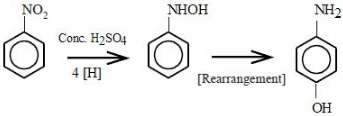
\(9. 65\) ampere current was passed for \(1 .0\) hour ( \(3600\) seconds) Number of moles of electrons passed \( = \frac{{I(A) \times t(s)}}{{96500}} = \frac{{9.65A \times 3600s}}{{96500}} = 0.36\,moles\)\({C_6}{H_5}N{O_2}\, + \,4{e^ - } + 4{H^ + } \to \,{\text{p - Aminophenol}} + {H_2}O\)
\(4\) moles of electrons will reduce \(1\) mole of nitrobenzene to \(p-\) aminophenol. \(0.36\) moles of electrons will reduce \(\frac{{0.36}}{4} = 0.09\) moles of nitrobenzene to \(p-\) aminophenol \(p-\) aminophenol molar mass \(= 109 .14\,\,g/mol\) Mass of \(p-\) aminophenol obtained \(= 109.14\,g/mol \times 0.09\,mol = 9.81\,g\)
-
- (A) \(2.0\)
- (B) \(0.1\)
- (C) \(0.5\)
- (D) \(1.0\)
Show answer and solution
Correct Answer: (D)
Reduction at cathode:\(2{e^ - }\, + \,2{H_2}O\, \to \,{H_2}\, + \,2O{H^ - }\)
(valence factor) \(H_2=2\)
At \(NTP\) \(22400\,mL\) of \(H_2=1\,mole\) of \(H_2\,\,112\,mL\) of
\({H_2}\, = \,\frac{1}{{22400}}\, \times \,112\, = \,0.005\,mole\) of \(H_2\)
Moles of \(H_2\) produced
\( = \frac{{I\, \times t}}{{96500}}\, \times \) mole ratio
\(0.005 = \frac{{I\, \times 965}}{{96500}}\, \times \frac{{1\,\,mole\,\,of\,\,{H_2}}}{{2\,\,mole\,\,of\,\,{e^ - }}}\)
\(I\,=\,1.0\,A\)
-
- (A) \(2\)
- (B) \(127\)
- (C) \(0 \)
- (D) \(63.5\)
Show answer and solution
Correct Answer: (D)
\(C u^{2+}+2 e^{-} \longrightarrow C u\)\(2 F\) i.e. \(2 \times 96500 C\) deposit \(C u=1 \mathrm{mol}=63.5 \mathrm{g}\)
-
- (A) \(1+\)
- (B) \(2+\)
- (C) \(3+\)
- (D) \(4+\)
Show answer and solution
Correct Answer: (C)
According to Faraday's first law of electrolysis\(W\,=\,\frac {E\times i\times t}{96500}\)
Where \(E\,=\) equivqlent weight
\(=\,\frac {mol.\,mass\,of\,metal\,(M)}{oxidation\,state\,of\,metal(x)}\)
Substituting the value in the formula
\(W\,=\,\frac {M}{x}\) \(\times \) \(\frac {i\times t}{96500}\)
or \(x=\frac {M}{W}\) \(\times \) \(\frac {i\times t}{96500}\) \( = \,\frac{{10\, \times \,2 \times 60 \times 60\,}}{{96500\, \times 0.250}} = 3\)
[Given :no . of moles \(=\frac {M}{W}\,=\,0.250\) ]
Hence oxidation state of metals is \((+3)\)
-
- (A) \(\frac{{{N_A}}}{{20}}\)
- (B) \(\frac{{{N_A}}}{{10}}\)
- (C) \(\frac{{{N_A}}}{{5}}\)
- (D) \(\frac{{{N_A}}}{{2}}\)
Show answer and solution
Correct Answer: (C)
\(Cu\, \to \,C{u^{ + + }}\, + \,2{e^ - }\)i.e., to deposit \(1\,mole\) of \(Cu\) at cathode from \(Cu^{2+}\) \(SO_4^{2-}\) solution \(=\,2\,\,mole\) of electrons are required
i.e., To deposit
\(6.35\,g\, = \,\frac{{6.35}}{{63.5}}\, \times 2\, = \,\frac{2}{{10}}\, = \,\frac{1}{5}\,moles\)
Thus total no. of elecrtrons required \(=\,\frac {N_A}{5}\)
-
- (A) \(0.3892\)
- (B) \(0.2938\)
- (C) \(0.2398\)
- (D) \(0.3928\)
Show answer and solution
Correct Answer: (B)
\(W=Zit\)where \(Z\,=\) Electrochemical equivalent
Eq. wt. of copper \(=\,\frac {63}{2}=31.5\)
\(Z\,=\,\frac {31.5}{96500}\)
\(W\, = \,Zit\, = \,\frac{{31.5}}{{96500}}\, \times \,1.5\, \times 10 \times 60\, = \,0.2938\,g\)
No questions on this page match these filters.
Other STD 12 - Electrochemistry topics
Frequently asked
How many Faraday's law of electrolysis questions came in JEE Mains?
29 questions from 2013–2026, each with the correct answer and a full solution.
How difficult are Faraday's law of electrolysis questions?
10% are easy, 31% medium and 59% hard.