


Topics
5 topics- 16Qs Oxidation number and Oxidation state
- 8Qs Oxidizing and Reducing agent
- 5Qs Redox reaction and Method for balancing Redox reaction
- 37Qs Auto oxidation and Disproportionation Most asked
- 1Qs Oxidation, Reduction
All Redox reactions questions
Newest firstShowing 1–50 of 67 questions
-
- (A) 1
- (B) 2
- (C) 3
- (D) 4
Show answer and solution
Correct Answer: (A)
First, we calculate the millimoles of the reactants:
Millimoles of \(\text{MnO}_4^-\) = \(500 \text{ mL} \times 0.2 \text{ M} = 100 \text{ mmol}\)
Millimoles of \(\text{I}^-\) = \(500 \text{ mL} \times 1.5 \text{ M} = 750 \text{ mmol}\)
In a basic medium, \(\text{MnO}_4^-\) is reduced to \(\text{MnO}_2\). The change in oxidation state of Mn is from \(+7\) to \(+4\), so its n-factor is \(3\).
The problem explicitly states that iodide ions are oxidized to molecular iodine (\(\text{I}_2\)). The change in oxidation state for iodine is from \(-1\) to \(0\), so the n-factor for \(\text{I}^-\) is \(1\).
Equivalents of \(\text{MnO}_4^-\) = \(100 \times 3 = 300 \text{ meq}\)
Equivalents of \(\text{I}^-\) = \(750 \times 1 = 750 \text{ meq}\)
Since \(\text{MnO}_4^-\) is the limiting reagent, the equivalents of \(\text{I}_2\) produced will be equal to the equivalents of \(\text{MnO}_4^-\) consumed.
Equivalents of \(\text{I}_2\) formed = \(300 \text{ meq}\)
The liberated iodine is titrated with thiosulphate (\(\text{S}_2\text{O}_3^{2-}\)):
\(\text{I}_2 + 2\text{S}_2\text{O}_3^{2-} \rightarrow 2\text{I}^- + \text{S}_4\text{O}_6^{2-}\)
For thiosulphate, the n-factor is \(1\) (as \(2\) moles of \(\text{S}_2\text{O}_3^{2-}\) lose \(2\) moles of electrons).
From the law of equivalence:
Equivalents of \(\text{S}_2\text{O}_3^{2-}\) = Equivalents of \(\text{I}_2\)
\(\text{Molarity} \times \text{Volume (in mL)} \times \text{n-factor} = 300\)
\(x \times 300 \times 1 = 300\)
\(x = 1\)
Answer: \(1\) -
- (A) \(+3\)
- (B) \(+4\)
- (C) \(+2\)
- (D) \(+7\)
Show answer and solution
Correct Answer: (D)
The group reagent \(H_2S\) in the presence of \(NH_4OH\) is used for the precipitation of Group IV cations in qualitative analysis.
Among the given ions, \(Mn^{2+}\) belongs to Group IV and is precipitated as \(MnS\).
\(Pb^{2+}\) and \(Cu^{2+}\) belong to Group II and are precipitated by \(H_2S\) in an acidic medium.
\(Fe^{3+}\) belongs to Group III and is precipitated as \(Fe(OH)_3\) by \(NH_4OH\) in the presence of \(NH_4Cl\).
The metal corresponding to the precipitated ion is Manganese (\(Mn\)).
The electronic configuration of \(Mn\) is \([Ar] 3d^5 4s^2\). By losing all its valence electrons, it can exhibit a maximum oxidation state of \(+7\) (for example, in \(KMnO_4\)).
Answer: \(+7\) -
- (A) 7.1
- (B) 71
- (C) 21.3
- (D) 14.2
Show answer and solution
Correct Answer: (A)
\(MnO _2+4 HCl \rightarrow MnCl _2+ Cl _2+2 H _2 O\)
\(\frac{8.7}{87} \quad\) Excess
\(=0.1\) mole \(\quad 0.1\) mole
Wt. of \(Cl _2\) obtained \(=0.1 \times 71=7.1 g\) -
- (A) +2 and +2
- (B) +2 and +1
- (C) +1 and +2
- (D) +1 and +1
Show answer and solution
Correct Answer: (B)
\(Na_2 B_4 O_7 \xrightarrow{\Delta}\left(2 NaBO_2\right)+B_2 O_3\)
\(CuSO _4+ B _2 O _3 \xrightarrow[\text { Non-Luminous flame }]{\Delta} \underset{\substack{\text { (Blue bead) } \\( Z )}}{\stackrel{+2}{ Cu }\left( BO _2\right)_2}+ SO _3\)
\(2 Cu \left( BO _2\right)_2+2 NaBO _2+\) \(C \xrightarrow[\text { Luminous Flame }]{\Delta}\)
\(2 \underset{\substack{\text { Colorless } \\( Q )}}{\stackrel{+1}{ Cu }} BO _2+ Na _2 B_4 O _7+ CO\) -
- (A) Both Statement I and Statement II are true
- (B) Both Statement I and Statement II are false
- (C) Statement I is true but Statement II is false
- (D) Statement I is false but Statement II is true
Show answer and solution
Correct Answer: (A)
Statement I is true. The oxidising power of halogens decreases down the group in the order \(F_2 > Cl_2 > Br_2 > I_2\). A stronger oxidising halogen can displace a weaker oxidising halogen from its aqueous halide solution. This principle forms the basis of the layer test.
Statement II is true. In the layer test, chlorine water (\(Cl_2\)) is added to an aqueous solution containing bromide (\(Br^-\)) or iodide (\(I^-\)) ions. Since \(Cl_2\) is a stronger oxidising agent, it oxidises \(Br^-\) to \(Br_2\) and \(I^-\) to \(I_2\). The reaction is given by:
\(Cl_2 + 2X^- \rightarrow 2Cl^- + X_2\) (where \(X = Br, I\))
This is a non-metal displacement redox reaction. The liberated \(Br_2\) or \(I_2\) is then extracted into an organic solvent layer (like \(CHCl_3\) or \(CCl_4\)), where it imparts a characteristic orange-red colour for \(Br_2\) or a violet colour for \(I_2\), thereby identifying them.
Therefore, both Statement I and Statement II are true.
Answer: Both Statement I and Statement II are true -
- (A) \(3\)
- (B) \(2\)
- (C) \(5\)
- (D) \(7\)
Show answer and solution
Correct Answer: (B)
In acidic medium, \(KMnO_4\) acts as an oxidising agent and gets reduced to \(Mn^{2+}\). The n-factor for \(KMnO_4\) is \(5\).
The n-factors for the given reducing agents are calculated based on the total number of moles of electrons lost per mole of the compound:
For \(FeC_2O_4\):
\(Fe^{2+} \rightarrow Fe^{3+} + e^{-}\)
\(C_2O_4^{2-} \rightarrow 2CO_2 + 2e^{-}\)
Total electrons lost \(= 3\), so n-factor \(= 3\).
Equivalents \(= 1 \times 3 = 3\).
For \(Fe_2(C_2O_4)_3\):
\(Fe^{3+}\) is not oxidised.
\(3C_2O_4^{2-} \rightarrow 6CO_2 + 6e^{-}\)
Total electrons lost \(= 6\), so n-factor \(= 6\).
Equivalents \(= 1 \times 6 = 6\).
For \(FeSO_4\):
\(Fe^{2+} \rightarrow Fe^{3+} + e^{-}\)
\(SO_4^{2-}\) is not oxidised.
Total electrons lost \(= 1\), so n-factor \(= 1\).
Equivalents \(= 1 \times 1 = 1\).
For \(Fe_2(SO_4)_3\):
Neither \(Fe^{3+}\) nor \(SO_4^{2-}\) can be oxidised further.
n-factor \(= 0\).
Equivalents \(= 0\).
Total equivalents of the reducing mixture \(= 3 + 6 + 1 + 0 = 10\).
Let the number of moles of \(KMnO_4\) required be \(x\).
Equivalents of \(KMnO_4 = x \times 5\).
Equating the equivalents of the oxidising and reducing agents:
\(5x = 10\)
\(x = 2\)
Answer: \(2\) -
- (A) 0.75 M, 0.75 M, 1 M
- (B) 0.5 M, 0.5 M, 0.5 M
- (C) 0.5 M, 0.5 M, 1 M
- (D) 1 M, 1 M, 1 M
Show answer and solution
Correct Answer: (C)
\(\begin{array}{l}Cl _2+2 KOH \rightarrow KCl + KClO + H _2 O \\ t =0 \quad 1 \text { mole } \quad 4 \text { mole } \\ t _{ f } \quad 0 \quad 2 \text { mole } \quad 1 \text { mole } 1 \text { mole }\end{array}\)
\(\left[ OH ^{-}\right]=1 M\)
\(\left[ Cl ^{-}\right]=\frac{1}{2} M\)
\(\left[ ClO ^{-}\right]=\frac{1}{2} M\) - 8. Which of the following sets includes all the species that will change the orange colour of \(K_2Cr_2O_7\) in acidic medium? 2026 Medium
- (A) \(Fe^{2+}, Sn^{2+}, I^-, S^{2-}\)
- (B) \(S^{2-}, Fe^{3+}, I^-, C_2O_4^{2-}\)
- (C) \(Fe^{2+}, NO_2^-, SO_2, Sn^{4+}\)
- (D) \(Fe^{3+}, SO_4^{2-}, S^{2-}, Sn^{4+}\)
Show answer and solution
Correct Answer: (A)
\(K_2Cr_2O_7\) in acidic medium acts as a strong oxidizing agent. It changes its colour from orange (\(Cr_2O_7^{2-}\)) to green (\(Cr^{3+}\)) when it reacts with a reducing agent.
We need to identify the set in which all species can act as reducing agents (i.e., they can be oxidized to a higher oxidation state).
In option (A), \(Fe^{2+}\) oxidizes to \(Fe^{3+}\), \(Sn^{2+}\) oxidizes to \(Sn^{4+}\), \(I^-\) oxidizes to \(I_2\), and \(S^{2-}\) oxidizes to \(S\). All of these are reducing agents.
In option (B), \(Fe^{3+}\) is already in its maximum stable oxidation state and cannot be oxidized further.
In option (C), \(Sn^{4+}\) cannot be oxidized further.
In option (D), \(Fe^{3+}\), \(SO_4^{2-}\), and \(Sn^{4+}\) cannot be oxidized further.
Thus, only the species in option (A) will change the orange colour of \(K_2Cr_2O_7\).
Answer: \(Fe^{2+}, Sn^{2+}, I^-, S^{2-}\) -
- (A) A-II, B-III, C-I, D-IV
- (B) A-III, B-IV, C-I, D-II
- (C) A-IV, B-I, C-II, D-III
- (D) A-II, B-III, C-IV, D-I
Show answer and solution
Correct Answer: (D)
(A) \(\mathrm{CH}_4(\mathrm{~g})+2 \mathrm{O}_2(\mathrm{~g}) \xrightarrow{\Delta} 2 \mathrm{CO}_2(\mathrm{~g})+\mathrm{H}_2 \mathrm{O}(\mathrm{l}) \Rightarrow\) combination reaction
(B) 2 NaH (s) \(\xrightarrow{\Delta} 2 \mathrm{Na}(\mathrm{s}) \quad+\mathrm{H}_2(\mathrm{~g}) \quad \Rightarrow\) Decomposition reaction
(C) \(\mathrm{V}_2 \mathrm{O}_5(\mathrm{~s})+5 \mathrm{Ca}(\mathrm{s}) \xrightarrow{\Delta} 2 \mathrm{~V}(\mathrm{~s})+5 \mathrm{CaO}(\mathrm{s})\) \(\Rightarrow\) Displacement reaction
(D) \(2 \mathrm{H}_2 \mathrm{O}_2\) (aq.) \(\xrightarrow{\Delta} 2 \mathrm{H}_2 \mathrm{O}(\mathrm{l})+\mathrm{O}_2(\mathrm{~g})\) \(\Rightarrow\) Disproportionation reaction -
- (A) \(+4,+2,0,+2\)
- (B) \(+2,0,+2,+4\)
- (C) \(0,+2,+4,+2\)
- (D) \(+2,0,0,+4\)
Show answer and solution
Correct Answer: (B)
For charging of lead storage battery cell reaction is \(2 \mathrm{PbSO}_4(\mathrm{~s})+2 \mathrm{H}_2 \mathrm{O}(\mathrm{l}) \rightarrow \mathrm{Pb}(\mathrm{s})+\mathrm{PbO}_2(\mathrm{~s})+2 \mathrm{H}_2 \mathrm{SO}_4(\mathrm{aq})\) At anode \(\mathrm{PbSO}_4\) reduced back to Pb and at cathode \(\mathrm{PbSO}_4\) oxidised back to \(\mathrm{PbO}_2\).
\(\begin{aligned}
& \because \quad \mathrm{x}_1=+2, \mathrm{y}_1=0 \\
& \mathrm{x}_2=+2, \mathrm{y}_2=4
\end{aligned}\) -
- (A) 40
- (B) 45
- (C) 50
- (D) 55
Show answer and solution
Correct Answer: (B)
Let moles of \(\mathrm{CO}_2=\mathrm{n}\)
moles of \(\mathrm{Ca}(\mathrm{OH})_2\) total initially \(=2 \mathrm{n}\)
excess \(\mathrm{Ca}(\mathrm{OH})_2=\mathrm{n}\)
gm equivalent of \(\mathrm{Ca}(\mathrm{OH})_2=\mathrm{gm}\) equivalent of HCl
\(\begin{aligned}
& \mathrm{n} \times 2=0.1 \times \frac{40}{1000} \times 1 \\
& \mathrm{n}=2 \times 10^{-3}
\end{aligned}\)
Volume of \(\mathrm{CO}_2=2 \times 10^{-3} \times 22400=44.8 \mathrm{~cm}^3\) -
- (A) both reducing
- (B) both oxidising
- (C) reducing and oxidising
- (D) oxidising and reducing
Show answer and solution
Correct Answer: (C)
As per given information of ionisation energy
\(\mathrm{A}=\mathrm{Sn} \& \mathrm{~B}=\mathrm{Pb}\)
\(\begin{aligned} & \mathrm{A}^{+2}=\mathrm{Sn}^{2+}=\text { Reducing agent } \\ & \mathrm{B}^{+4}=\mathrm{Pb}^{+4}=\text { Oxidising agent }\end{aligned}\) -
- (A) \(\mathrm{ClO}_3^{-}\)
- (B) \(\mathrm{ClO}^{-}\)
- (C) \(\mathrm{ClO}_2^{-}\)
- (D) \(\mathrm{ClO}_4^{-}\)
Show answer and solution
Correct Answer: (D)
\(\mathrm{ClO}_4^{-} \rightarrow x+\{(-2) \times 4\}=-1 \Rightarrow x=+7\)
Chlorine is in its maximum oxidation state, so disproportionation not possible in \(\mathrm{ClO}_4^{-}\). -
- (A) C, D and E Only
- (B) B, C and D Only
- (C) A, D and E Only
- (D) A, B and C Only
Show answer and solution
Correct Answer: (D)
\(\mathrm{I}^{-} \xrightarrow{\mathrm{OH}} \mathrm{IO}_3^{-}\)
\(\mathrm{S}^{-2} \xrightarrow{\mathrm{H}^{+}} \mathrm{S}\)
\(\mathrm{S}_2 \mathrm{O}_3^{2-} \xrightarrow{\mathrm{OH}} \mathrm{SO}_4^{2-}\)
\(\begin{aligned}
& \mathrm{Fe}^{+2} \longrightarrow \mathrm{Fe}^{+3} \\
& \mathrm{~S}_2 \mathrm{O}_3^{2-} \xrightarrow{\mathrm{H}^{+}} \mathrm{S} \downarrow+\mathrm{SO}_4^{2-}
\end{aligned}\) -
- (A) \(4\)
- (B) \(3\)
- (C) \(8\)
- (D) \(7\)
Show answer and solution
Correct Answer: (C)
\( \mathrm{PbS}+4 \mathrm{O}_3 \rightarrow \mathrm{PbSO}_4+4 \mathrm{O}_2 \)\( \mathrm{x}=4, \mathrm{y}=4\)
-
- (A) \(8\)
- (B) \(7\)
- (C) \(6\)
- (D) \(9\)
Show answer and solution
Correct Answer: (A)
Reduction Half Oxidation Half\(2 \mathrm{MnO}_4^{-} \rightarrow 2 \mathrm{MnO}_2\) \(2 \mathrm{I}^{-} \rightarrow \mathrm{I}_2+2 \mathrm{e}^{-}\)
\(2 \mathrm{MnO}_4^{-}+4 \mathrm{H}_2 \mathrm{O}+6 \mathrm{e}^{-} \rightarrow 2 \mathrm{MnO}_2+8 \mathrm{OH}^{-}\) \(6 \mathrm{I}^{-} \rightarrow 3 \mathrm{I}_2+6 \mathrm{e}^{-}\)
Adding oxidation half and reduction half, net reaction is
\(2 \mathrm{MnO}_4^{-}+6 \mathrm{I}^{-}+4 \mathrm{H}_2 \mathrm{O} \rightarrow 3 \mathrm{I}_2+2 \mathrm{MnO}_2+8 \mathrm{OH}^{-}\)
\({z}=8\)
\({ Ans. }8\)
-
- (A) \(1\), \(2\), \(1\) and \(1\)
- (B) \(2\), \(2\), \(1\) and \(3\)
- (C) \(3\),\(4\),\(4\) and \(2\)
- (D) \(2\), \(4\), \(1\) and \(3\)
Show answer and solution
Correct Answer: (A)
\(\Rightarrow \mathrm{Cl}_2+2 \overline{\mathrm{O}} \mathrm{H} \longrightarrow \mathrm{Cl}^{-}+\mathrm{ClO}^{-}+\mathrm{H}_2 \mathrm{O}\)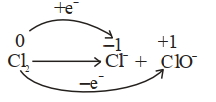
-
- (A) Bromine
- (B) Iodine
- (C) Chlorine
- (D) Fluorine
Show answer and solution
Correct Answer: (D)
Fluorine does not show variable oxidation state. -
- (A) \(2\)
- (B) \(3\)
- (C) \(9\)
- (D) \(11\)
Show answer and solution
Correct Answer: (B)
Compounds \(\mathrm{SO}_3\) \(\mathrm{H}_2 \mathrm{SO}_3\) \(\mathrm{SOCl}_2\) \(\mathrm{SF}_4\) \(\mathrm{BaSO}_4\) \(\mathrm{H}_2 \mathrm{~S}_2 \mathrm{O}_7\) \(O.S.\) of sulphur \(+6\) \(+4\) \(+4\) \(+4\) \(+6\) \(+6\) -
- (A) Statement \(I\) is correct but statement \(II\) is incorrect.
- (B) Statement \(I\) is incorrect but statement \(II\) is correct
- (C) Both statement \(I\) and statement \(II\) are incorrect
- (D) Both statement \(I\) and statement \(II\) are correct
Show answer and solution
Correct Answer: (A)
\(\mathrm{S}_1: \mathrm{S}_{\mathrm{8}}+12 \mathrm{OH}^{\ominus} \rightarrow 4 \mathrm{~S}^{2-}+2 \mathrm{~S}_2 \mathrm{O}_3^{2-}+6 \mathrm{H}_2 \mathrm{O}\)\(\mathrm{S}_2: \mathrm{ClO}_4^{\ominus}\) cannot undergo disproportionation reaction as chlorine is present in it's highest oxidation state.
-
- (A) \(8, 6, 4\) and \(\mathrm{Cr}_2 \mathrm{O}_3\)
- (B) \(14,7,6\) and \(\mathrm{Cr}^{3+}\)
- (C) \(8,4,6\) and \(\mathrm{Cr}_2 \mathrm{O}_3\)
- (D) \(14,6,7\) and \(\mathrm{Cr}^{3+}\)
Show answer and solution
Correct Answer: (D)
The balanced reaction is,\(\mathrm{Cr}_2 \mathrm{O}_7^{2-}+14 \mathrm{H}^{+}+6 \mathrm{e}^{-} \rightarrow 2 \mathrm{Cr}^{3+}+7 \mathrm{H}_2 \mathrm{O}\)
\(\mathrm{X}=14\), \(\mathrm{Y}=6\), \(\mathrm{~Z}=7\), \(\mathrm{A}=\mathrm{Cr}^{3+}\)
-
- (A) \((A)-(I), (B)-(II), (C)-(III), (D)-(IV)\)
- (B) \((A)-(III), (B)-(II), (C)-(I), (D)-(IV)\)
- (C) \((A)-(II), (B)-(III), (C)-(IV), (D)-(I)\)
- (D) \((A)-(IV), (B)-(I), (C)-(II), (D)-(III)\)
Show answer and solution
Correct Answer: (D)
\(\mathrm{A} \rightarrow \text { (IV) }\)
\(\mathrm{B} \rightarrow(\mathrm{I})\)
\(\mathrm{C} \rightarrow \text { (II) }\)
\(\mathrm{D} \rightarrow \text { (III) }\) -
- (A) \(8\)
- (B) \(10\)
- (C) \(15\)
- (D) \(20\)
Show answer and solution
Correct Answer: (A)
\(2 \mathrm{MnO}_4^{-}+5 \mathrm{C}_2 \mathrm{O}_4^{2-}+16 \mathrm{H}^{+} \longrightarrow 2 \mathrm{Mn}^{2+}+10 \mathrm{CO}_2+8 \mathrm{H}_2 \mathrm{O}\)\(\therefore\) Number of moles of \(\mathrm{H}^{+}\)ions required by 1 mole of \(\mathrm{MnO}_4^{-}\)to oxidise oxalate ion to \(\mathrm{CO}_2\) is 8.
- 24. On reaction of Lead Sulphide with dilute nitric acid which of the following is not formed? 2024 Medium
- (A) Nitric oxide
- (B) Nitrous oxide
- (C) Lead nitrate
- (D) Sulphur
Show answer and solution
Correct Answer: (B)
\(PbS + HNO _3 \rightarrow Pb\left( NO _3\right)_2+ NO + S + H _2 O\) Nitrous oxide \(\left( N _2 O \right)\) is not formed during the reaction. -
- (A) 8
- (B) 6
- (C) 5
- (D) 10
Show answer and solution
Correct Answer: (A)
\(\text { eq. }\left(\mathrm{KMnO}_4\right)=\text { eq. }\left(\mathrm{H}_2 \mathrm{C}_2 \mathrm{O}_4\right)\)\(\mathrm{M} \times 2 \times 5=2 \times 20 \times 2\)
\(\mathrm{M}=8 \mathrm{M}\)
-
- (A) Bromine undergoes oxidation and iodine undergoes reduction by iodine in these reactions
- (B) Thiosulphate undergoes oxidation by bromine and reduction by iodine in these reaction
- (C) Bromine is a stronger oxidant than iodine
- (D) Bromine is a weaker oxidant than iodine
Show answer and solution
Correct Answer: (C)
In the reaction of \(\mathrm{S}_2 \mathrm{O}_3{ }^{2-}\) with \(\mathrm{I}_2\), oxidation state of sulphur changes to +\(2\) to +\(2.5\)In the reaction of \(\mathrm{S}_2 \mathrm{O}_3{ }^{2-}\) with \(\mathrm{Br}_2\), oxidation state of sulphur changes from +\(2\) to +\(6\) .
\(\therefore\) Both \(\mathrm{I}_2\) and \(\mathrm{Br}_2\) are oxidant (oxidising agent) and \(\mathrm{Br}_2\) is stronger oxidant than \(\mathrm{I}_2\).
-
- (A) \(4\)
- (B) \(5\)
- (C) \(6\)
- (D) \(7\)
Show answer and solution
Correct Answer: (C)
Intermediate oxidation state of element can undergo disproportionation.\(\mathrm{H}_2 \mathrm{O}_2, \mathrm{ClO}_3^{-}, \mathrm{P}_4, \mathrm{Cl}_2, \mathrm{Cu}^{+1}, \mathrm{NO}_2\)
-
- (A) \(\mathrm{N}^{3-}\)
- (B) \(\mathrm{SO}_4^{2-}\)
- (C) \(\mathrm{BrO}_3^{-}\)
- (D) \(\mathrm{MnO}_4^{-}\)
Show answer and solution
Correct Answer: (A)
In \(\mathrm{N}^{3-}\) ion ' \(\mathrm{N}\) ' is present in its lowest possible oxidation state, hence it cannot be reduced further because of which it cannot act as an oxidizing agent. -
- (A) \((A), (B)\)
- (B) \((B), (C), (D)\)
- (C) \((A), (B), (C)\)
- (D) \((A),(D)\)
Show answer and solution
Correct Answer: (A)
When a particular oxidation state becomes less stable relative to other oxidation state, one lower, one higher, it is said to undergo disproportionation.\(\mathrm{Cu}^{+} \rightarrow \mathrm{Cu}^{2+}+\mathrm{Cu}\)
\(3 \mathrm{MnO}_4^{2-}+4 \mathrm{H}^{+} \rightarrow 2 \mathrm{MnO}_4^{-}+\mathrm{MnO}_2+2 \mathrm{H}_2 \mathrm{O}\)
-
- (A) prevent the hydrolysis of ferrous sulphate
- (B) prevent the hydrolysis of ammonium sulphate
- (C) make the medium strongly acidic
- (D) increase the rate of formation of crystals
Show answer and solution
Correct Answer: (A)
\(Fe ^{+2}\) ions undergoes hydrolysis, therefore while preparing aqueous solution of ferrous sulphate and ammonium sulphate in water dilute sulphuric acid is added to prevent hydrolysis of ferrous sulphate. - 31. \(2 IO _3^{-}+ xI ^{-}+12 H ^{+} \rightarrow 6 I _2+6 H _2 O\) What is the value of \(x\) ? 2023 Easy
- (A) \(12\)
- (B) \(2\)
- (C) \(6\)
- (D) \(10\)
Show answer and solution
Correct Answer: (D)
Number of atoms of iodine on reactant side \(=\) number of atoms of Iodine on product side\(2+ x =6 \times 2\)
\(X =10\)
\(2 IO _3^{-}+10 I ^{-}+12 H ^{+} \rightarrow 6 I _2+6 H _2 O\)
-
- (A) Both statement \(I\) and statement \(II\) are correct.
- (B) Statement \(I\) is incorrect but Statement \(II\) is correct.
- (C) Statement \(I\) is correct but Statement \(II\) is incorrect.
- (D) Both statement \(I\) and statement \(II\) are incorrect.
Show answer and solution
Correct Answer: (D)
In redox titration, indicators are sensitive to oxidation potential and in acid base titration, indicators are sensitive to change in \(pH\) of solution Both statement are false. -
- (A) \(6\)
- (B) \(5\)
- (C) \(4\)
- (D) \(3\)
Show answer and solution
Correct Answer: (A)
\(CrO _2 Cl _2 x -4-2=0\)Oxidation State \(=+6\)
-
- (A) \(22\)
- (B) \(21\)
- (C) \(20\)
- (D) \(23\)
Show answer and solution
Correct Answer: (D)
\(Cr _2 O _7^{2-}+14 H ^{+}+6 Fe ^{2+} \rightarrow 6 Fe ^{3+}+2 Cr ^{3+}+7 H _2 O\)\(x =14\)
\(y =2\)
\(z =7\)
Hence \((x+y+z)=14+2+7=23\)
- 35. The sum of oxidation state of the metals in \(Fe ( CO )_5, VO ^{2+}\) and \(WO _3\) is \(.........\). 2023 Medium
- (A) \(10\)
- (B) \(8\)
- (C) \(6\)
- (D) \(4\)
Show answer and solution
Correct Answer: (A)
So, Sum of oxidation state \(=0+4+6=10\) -
- (A) \(A\) and \(B\) only
- (B) \(A\) only
- (C) \(C\) and \(D\) only
- (D) \(A\) and \(D\) only
Show answer and solution
Correct Answer: (A)
\(2\left[\stackrel{+1}{ Au ( CN )_2}\right]^{-}+\stackrel{0}{ Z } n ( s ) \longrightarrow 2 \stackrel{0}{ Au }+\left[\stackrel{+2}{ Zn }( CN )_4\right]^{-2}\)\(Zn\) displaced \(Au ^{+}\)
Reduction and Oxidation both are taking place.
-
- (A) \(3\)
- (B) \(4\)
- (C) \(5\)
- (D) \(6\)
Show answer and solution
Correct Answer: (B)
\(n _{\text {eq. }}\) of \(I _{2}= n _{ eq }\) of \(Na _{2} S _{2} O _{3}=20 \times 0.002 \times 1\)\(2 \times n _{ mol }\) of \(I _{2}=0.4\)
\(n _{ mol }\) of \(I _{2}=0.2 m mol\)
\(n _{ mol }\) of \(Cu ^{+2}=0.2 \times 2 \times 10^{-3}\)
\(\left[ Cu ^{+2}\right]=\frac{0.4 \times 10^{-3}}{10 \times 10^{-3}}=0.04=4 \times 10^{-2}\)
-
- (A) \(22\)
- (B) \(23\)
- (C) \(24\)
- (D) \(25\)
Show answer and solution
Correct Answer: (C)
Eq. of \(K _{2} Cr _{2} O _{7}=\) Eq. of \(Fe ^{2+}\)\((Molarity\) \(\times\) \(volume\) \(\times\) \(n.f)\) of \(K _{2} Cr _{2} O _{7}=\) (molarity \(\times\) volume \(\times\) n.f ) of \(Fe ^{2+}\)
\(0.02 \times 20 \times 6= M \times 10 \times 1\)
\(M =0.24\)
Molarity \(=24 \times 10^{-2}\)
-
- (A) \(13\)
- (B) \(130\)
- (C) \(65\)
- (D) \(70\)
Show answer and solution
Correct Answer: (A)
\(MnO _{2}+ HCl \longrightarrow Cl _{2}+ Mn ^{+2}\)\(6\, meq\quad\quad\quad\quad\quad\quad\quad 6\, meq\)
\(=3 m mol\)
\(Cl _{2}+ KI \longrightarrow Cl ^{-}+ I _{2}\)
\(6\, meq\quad\quad\quad\quad\quad\quad\quad6\, meq\)
\(I _{2}+ Na _{2} S _{2} O _{3} \longrightarrow I ^{-}+ Na _{2} S _{4} O _{6}\)
\(6\, meq\quad\quad\quad\quad\quad\quad\quad 6\, m\,mol\)
\(\quad=6 meq\)
\(\% \,MnO _{2}=\frac{3 \times 10^{-3} \times 87}{2} \times 100\)
\(=13.05\, \%\)
- 40. In the titration of \(KMnO _{4}\) and oxalic acid in acidic medium, the change in oxidation number of carbon at the end point is 2022 Medium
- (A) \(1\)
- (B) \(0\)
- (C) \(2\)
- (D) \(3\)
Show answer and solution
Correct Answer: (A)
Oxidation state of carbon changes from \(+3\) to \(+4\).\(2 KMnO _{4}+5 H _{2} C _{2} O _{4}+3 H _{2} SO _{4}(\text { dil. }) \)\(\rightarrow K _{2} SO _{4}+2 MnSO _{4}+10 CO _{2}+8 H _{2} O\)
- 41. The difference in oxidation state of chromium in chromate and dichromate salts is .... . 2022 Easy
- (A) \(1\)
- (B) \(0\)
- (C) \(2\)
- (D) \(3\)
Show answer and solution
Correct Answer: (B)
\(Cr=+6\)\(Cr O_{4}^{2-}, Cr _{2} O _{7}^{2-}\) difference is zero.
-
- (A) \(2 H _{2} O _{2} \rightarrow 2 H _{2} O + O _{2}\)
- (B) \(2 NO _{2}+ H _{2} O \rightarrow HNO _{3}+ HNO _{2}\)
- (C) \(MnO _{4}^{-}+4 H ^{+}+3 e ^{-} \rightarrow MnO _{2}+2 H _{2} O\)
- (D) \(3 MnO _{4}{ }^{2-}+4 H ^{+} \rightarrow 2 MnO _{4}{ }^{-}+ MnO _{2}+2 H _{2} O\)
Show answer and solution
Correct Answer: (C)
\(2 NO _{2}+ H _{2} O \rightarrow HNO _{3}+ HNO _{2} : Disproportionation\)\(MnO _{4}^{-}+4 H ^{+}+3 e ^{-} \rightarrow MnO _{2}+2 H _{2} O : reduction\)
\(3 MnO _{4}^{+-}+4 H ^{+} \rightarrow 2 MnO _{4}^{-}+ MnO _{2}^{+4}+2 H _{2} O :Disproportionation\)
-
- (A) \(22\)
- (B) \(10\)
- (C) \(14\)
- (D) \(16\)
Show answer and solution
Correct Answer: (D)
Writting the half reaction oxidation half reaction\(MnO _{4}^{-} \rightarrow Mn ^{2+}\)
balancing oxygen
\(MnO _{4}^{-} \rightarrow Mn ^{2+}+4 H _{2} O\)
balancing Hydrogen
\(8 H ^{+}+ MnO _{4}^{-} \rightarrow Mn ^{2+}+4 H _{2} O\)
balancing charge
\(5 e ^{-}+8 H ^{+}+ MnO _{4}^{-} \rightarrow Mn ^{2+}+4 H _{2} O\)
Reduction half
\(C _{2} O _{4}^{2-} \rightarrow CO _{2}\)
Balancing carbon
\(C _{2} O _{4}^{2-} \rightarrow 2 CO _{2}\)
Balancing charge
\(C _{2} O _{4}^{2-} \rightarrow 2 CO _{2}+2 e ^{-}\)
Net equation
\(16 H ^{+}+2 MnO _{4}^{-}+5 C _{2} O _{4}^{2-} \rightarrow 10 CO _{2}+2 Mn ^{2+}+8 H _{2} O\)
So \(\quad c=16\)
-
- (A) \(H _{2} O _{2}\) acts as reducing and oxidising agent respectively in equation \((A)\) and \((B)\)
- (B) \(H _{2} O _{2}\) acts as oxidising agent in equation \((A)\) and \((B)\)
- (C) \(H _{2} O _{2}\) acts as reducing agent in equation \((A)\) and \(( B )\)
- (D) \(H _{2} O _{2}\) act as oxidizing and reducing agent respectively in equation \((A)\) and \((B)\)
Show answer and solution
Correct Answer: (C)
\((A)\) \(HOCl + H _{2} O _{2} \rightarrow H _{3} O ^{+}+ Cl ^{-}+ O _{2}\)In this equation, \(H _{2} O _{2}\) is reducing chlorine from \(+1\) to \(-1\)
\((B)\) \(I _{2}+ H _{2} O _{2}+2 OH^- \rightarrow 2 I ^{-}+2 H _{2} O + O _{2}\)
In this equation, \(H _{2} O _{2}\) is reducing iodine from \(0\) to \(-1\)
-
- (A) \(\mathrm{C}_{2} \mathrm{O}_{4}^{2-} \rightarrow 2 \mathrm{CO}_{2}\)
- (B) \(\mathrm{CrO}_{4}^{2-} \rightarrow \mathrm{Cr}^{3+}\)
- (C) \(\mathrm{Cr}_{2} \mathrm{O}_{7}^{2-} \rightarrow 2 \mathrm{Cr}^{3+}\)
- (D) \(\mathrm{MnO}_{4}^{-} \rightarrow \mathrm{Mn}^{2+}\)
Show answer and solution
Correct Answer: (D)
\(\underset{(+7)}{\mathrm{MnO}_{4}^{-}} \rightarrow \underset{(+2)}{\mathrm{Mn}^{2+}} 5 \mathrm{e}^{-}\)change -
- (A) \(29\)
- (B) \(17\)
- (C) \(12\)
- (D) \(22\)
Show answer and solution
Correct Answer: (C)
\(16 e ^{\ominus}+ S _{8} \longrightarrow 8 S ^{2-}\)\(\frac{12 H _{2} O + S _{8} \longrightarrow 4 S _{2} O _{3}^{2-}+24 H ^{+}+16 e ^{\circ}}{2 S _{8}+12 H _{2} O \longrightarrow 8 S ^{2-}+4 S _{2} O _{3}^{2-}+24 H }\)
for balancing in basic medium add equal number of \(OH ^{\ominus}\) that of \(H ^{+}\)
\(2 S _{8}+12 H _{2} O +24 OH ^{\ominus} \longrightarrow 8 S ^{2-}+4 S _{2} O _{8}^{2-}\)
\(+24 H _{2} O\)
\(2 S _{8}+24 OH ^{\ominus} \rightarrow 8 S ^{2-}+4 S _{2} O _{8}^{2-}+12 H _{2} O\)
\(S _{8}+12 OH ^{\ominus} \rightarrow 4 S ^{2-}+2 S _{2} O _{8}^{2-}+6 H _{2} O\)
\(a =12\)
-
- (A) \(\mathrm{BrO}_{2}^{-}\)
- (B) \(\mathrm{BrO}_{4}^{-}\)
- (C) \(\mathrm{BrO}^{-}\)
- (D) \(\mathrm{BrO}_{3}^{-}\)
Show answer and solution
Correct Answer: (B)
In \(\mathrm{BrO}_{4}^{\ominus}, \mathrm{Br}\) is in highest oxidation state \((+7),\) Soit cannot oxidise further it only reduced hence it cannot show disproportionation reaction -
- (A) \(14\)
- (B) \(16\)
- (C) \(18\)
- (D) \(20\)
Show answer and solution
Correct Answer: (C)
\(4 \mathrm{NaCl}+\mathrm{K}_{2} \mathrm{Cr}_{2} \mathrm{O}_{7}+6 \mathrm{H}_{2} \mathrm{SO}_{4}\)\(\quad \quad \quad \quad \quad \downarrow\)
\(2 \mathrm{CrO}_{2} \mathrm{Cl}_{2}+4 \mathrm{NaHSO}_{4}+2 \mathrm{KHSO}_{4}+3 \mathrm{H}_{2} \mathrm{O}\)
\((\mathrm{A})\)
\(\mathrm{CrO}_{2} \mathrm{Cl}_{2}+4 \mathrm{NaOH} \longrightarrow \mathrm{Na}_{2} \mathrm{CrO}_{4}+2 \mathrm{NaCl}+2 \mathrm{H}_{2} \mathrm{O}\)
\(\quad \quad \quad \quad \quad \quad \quad \quad \quad \quad \quad (B)\)
\(\mathrm{Na}_{2} \mathrm{CrO}_{4}+2 \mathrm{H}_{2} \mathrm{SO}_{4}+2 \mathrm{H}_{2} \mathrm{O}_{2}\)
\(\mathrm{CrO}_{5}+2 \mathrm{NaHSO}_{4}+3 \mathrm{H}_{2} \mathrm{O}\)
\((\mathrm{C})\)
\(A=C r O_{2} C l_{2}\)
\({B}=\mathrm{Na}_{2} \mathrm{CrO}_{4}\)
\({C}={C r O}_{5}\)
Total number of atom in \(\mathrm{A}+\mathrm{B}+\mathrm{C}=18\)
-
- (A) \(0\)
- (B) \(5\)
- (C) \(2\)
- (D) \(19\)
Show answer and solution
Correct Answer: (D)
\(\left[ Fe ^{2+} \rightarrow Fe ^{3+}+ e ^{-}\right] \times 2\)\(\frac{ H _{2} O _{2}+2 e ^{-} \rightarrow 2 HO ^{\ominus}}{2 Fe ^{2+}+ H _{2} O _{2} \rightarrow 2 Fe ^{3+}+2 HO _{(q\omega)}^{\ominus}}\)
\(x =2 \quad y =2\)
\(\left[8 H ^{+}+ MnO _{4}^{-}+5 e ^{-} \rightarrow Mn ^{2+}+4 H _{2} O \right] \times 2\)
\(\left[ H _{2} O _{2} \rightarrow O _{2( g )}+2 H ^{+}+2 e ^{-}\right] \times 5\)
\(\Rightarrow 16 H ^{+}+2 MnO _{4}^{-}+5 H _{2} O _{2}\)
\(\rightarrow 2 Mn ^{2+}+8 H _{2} O +5 O _{2(g)}+10 H ^{+}\)
\(\Rightarrow 6 H ^{+}+2 MnO _{4}^{-}+5 H _{2} O _{2}\)
\(\rightarrow 2 Mn ^{2+}+8 H _{2} O +5 O _{2( g )}\)
So \(\quad x^{\prime}=2 \quad y^{\prime}=8 \quad z^{\prime}=5\)
so \(\quad x+y+x^{\prime}+y^{\prime}+z^{\prime}\)
\(\Rightarrow 2+2+2+8+5\)
\(\Rightarrow 19\)
-
- (A) \(12\)
- (B) \(25\)
- (C) \(19\)
- (D) \(22\)
Show answer and solution
Correct Answer: (C)
\(K _{2} Cr _{2} O _{7}\)\(2(+1)+2 x+7(-2)=0\)
\(x=+6\)
In \(K _{2} Cr _{2} O _{7},\) Transition metal \(( Cr )\) present in +6
oxidation state.
\(KMnO _{4}\)
\((+1)+y+4(-2)=0\)
\(x=+7\)
In \(KMnO _{4}\), transition metal (Mn) present in \(+7\) oxidation state
\(K _{2} FeO _{4}\)
\(2(+1)+z+4(-2)=0\)
\(x=+6\)
In \(K _{2} FeO _{4},\) transition metal (Fe) present in \(+6\) oxidation state
So \(x=+6\)
\(y=+7\)
\(z=+6\)
____________
\(x+y+z=19\)
No questions on this page match these filters.
About Redox reactions PYQs
Redox reactions has 67 questions from 2013–2026. The most came in 2024 (16), 2026 (8) and 2025 (6).
The most asked topics are Auto oxidation and Disproportionation, Oxidation number and Oxidation state and Oxidizing and Reducing agent.
9% are easy, 43% medium and 48% hard.
Redox reactions PYQs by year
Frequently asked
How many Redox reactions questions came in JEE Mains?
67 questions from 2013–2026, each with the correct answer and a full solution.
Which Redox reactions topic is asked the most?
Auto oxidation and Disproportionation, with 37 questions, followed by Oxidation number and Oxidation state with 16.
Which year had the most Redox reactions questions?
2024, with 16 questions.
How difficult are Redox reactions questions?
9% are easy, 43% medium and 48% hard.