


Topics
6 topics- 70Qs First Order reaction Most asked
- 9Qs Zero order reaction
- 56Qs Collision theory, Energy of activation and Arrhenius equation
- 33Qs Rate law, Rate constant, Order of Reaction and Molecularity
- 14Qs Rate of a reaction
- 2Qs Photochemical reaction
All Chemical kinetics questions
Newest firstShowing 1–50 of 184 questions
-
- (A) 4.5
- (B) 4.9
- (C) 5
- (D) 5.5
Show answer and solution
Correct Answer: (C)
For \(A \xrightarrow{ K _1} B\)
\(\ln (2)=\frac{E_{a_1}}{R}\left[\frac{1}{300}-\frac{1}{500}\right]\)
\(E _{ a _1}=\frac{\ln 2 \times R \times 1500}{2}\)
\(E _{ a _2}=\frac{ E _{ a _1}}{2}=\frac{\ln 2 \times R \times 1500}{4}\)
\(\left( K _1\right)_{ at~500 K}=\frac{\ln 2}{2}\)
\(\left( K _2\right)_{ at~500 K}=\ln 2\)
Now for \(C \xrightarrow{ K _2} D\)
\(\ln \left[\frac{\left( K _2\right)_{\text {at }500K}}{\left( K _2\right)_{\text {at } 300 K}}\right]=\left(\frac{\ln 2 \times R \times 1500}{4}\right) \times \frac{1}{ R } \times\left[\frac{1}{300}-\frac{1}{500}\right]\)
\(\left( K _2\right)_{ at~300 K}=\frac{\ln 2}{\sqrt{2}}=0.49\)
\(\left( K _2\right)_{\text {at }~300 K}=4.9 \times 10^{-1}\) -
- (A) Run 1 = Run 2 = Run 3
- (B) Run 3 < Run 1 = Run 2
- (C) Run 3 < Run 1 < Run 2
- (D) Run 1 < Run 2 < Run 3
Show answer and solution
Correct Answer: (B)
For \(1^{st}\) order reaction,
\(Rate=k[A]\).
with decrease in concentration of A , rate of reaction decreases. -
- (A) 9
- (B) 0.9
- (C) 3
- (D) 30
Show answer and solution
Correct Answer: (A)
\( t = \frac{1}{k} \ln \frac{A_0}{A_t} \)
\( t_{1/8} = \frac{1}{k} \ln \frac{A_0}{A_0/8} = \frac{1}{k} \ln 8 \)
\( t_{1/10} = \frac{1}{k} \ln \frac{A_0}{A_0/10} = \frac{1}{k} \ln 10 \)
\( \frac{t_{1/8}}{t_{1/10}} = \frac{\ln 8}{\ln 10} = \frac{\log 8}{\log 10}\)
\(\frac{t_{1 / 8}}{t_{1 / 10}}=\log 8=3 \log 2=0.9\)
\(\frac{t_{1 / 8}}{t_{1 / 10}} \times 10=9\) -
- (A) 17.41
- (B) 1.741
- (C) 3.482
- (D) 0.1741
Show answer and solution
Correct Answer: (B)
\( \frac{K_{catalyst}}{K_{uncatalyst}} = e^{\frac{\Delta E_{a}}{RT}} \)
\(\ln \frac{ K _{\text {catalyst }}}{ K _{\text {uncatalyst }}}=\frac{\Delta E _{ a }}{ RT }\)
\(\log \frac{ K _{\text {catalyst }}}{ K _{\text {uncatalyst }}}=\frac{\Delta E _{ a }}{2.303 RT }\)
\(=\frac{10 \times 1000}{2.303 \times 8.314 \times 300}\)
\(\log \frac{ K _{\text {catalyst }}}{ K _{\text {uncatalyst }}}=1.741\) -
- (A) 287
- (B) 57
- (C) 114
- (D) 43
Show answer and solution
Correct Answer: (B)
\(\frac{ E _{ a _1}}{2.303 R }=1.5 \times 10^4\)
\(Ea_{1} = 1.5 \times 10^{4} \times 2.303 \times 8.314\)
\(E _{ a _1}=28.7207 \times 10^4 J\)
\(E _{ a _1}=287.207 kJ\)
\(E _{ a _2}=\frac{ E _{ a _1}}{5}=\frac{287.207}{5}=57.44 kJ\) -
- (A) \(1 - e^{k_1 t}\)
- (B) \(1 + e^{k_1 t}\)
- (C) \(1 + e^{-k_1 t}\)
- (D) \(1 - e^{-k_1 t}\)
Show answer and solution
Correct Answer: (D)
For a first order reaction, the concentration of reactant at time \(t\) is given by
\([R]_t = [R]_0 e^{-k_1 t}\)
The amount of reactant decomposed is
\([R]_0 - [R]_t = [R]_0 - [R]_0 e^{-k_1 t} = [R]_0 (1 - e^{-k_1 t})\)
The fraction of molecules decomposed is
\(\dfrac{[R]_0 - [R]_t}{[R]_0} = \dfrac{[R]_0 (1 - e^{-k_1 t})}{[R]_0} = 1 - e^{-k_1 t}\)
Answer: \(1 - e^{-k_1 t}\) -
- (A) 15
- (B) 20
- (C) 25
- (D) 30
Show answer and solution
Correct Answer: (B)
For the given gas phase reaction:
\(2A(g) \rightarrow 4B(g) + C(g)\)
Let the initial pressure of \(A(g)\) be \(P_0\).
At \(t = 0\): \(P_A = P_0\), \(P_B = 0\), \(P_C = 0\)
At \(t = t\): \(P_A = P_0 - 2p\), \(P_B = 4p\), \(P_C = p\)
Total pressure at time \(t\), \(P_t = P_0 - 2p + 4p + p = P_0 + 3p\)
At \(t = \infty\), the reaction is complete, so \(P_A = 0 \Rightarrow 2p = P_0 \Rightarrow p = \dfrac{P_0}{2}\)
Total pressure at \(t = \infty\), \(P_{\infty} = 4\left(\dfrac{P_0}{2}\right) + \dfrac{P_0}{2} = \dfrac{5P_0}{2}\)
Given \(P_{\infty} = 600\) mm Hg:
\(\dfrac{5P_0}{2} = 600 \Rightarrow P_0 = 240\) mm Hg
At \(t = 30\) min, \(P_t = 300\) mm Hg:
\(P_0 + 3p = 300\)
\(240 + 3p = 300 \Rightarrow 3p = 60 \Rightarrow p = 20\) mm Hg
The pressure of \(C(g)\) at \(30\) minutes is \(p = 20\) mm Hg.
Answer: \(20\) -
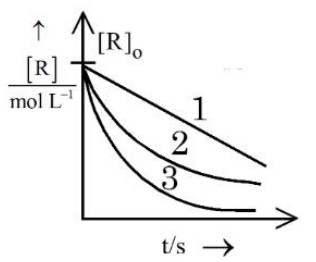
- (A) The order of all the three reactions is same.
- (B) The rate constant of reaction \(3\) is larger than the rate constant of reaction \(2\) if the order of reaction is same for both.
- (C) The SI unit of rate constant of reaction \(1\) is s\(^{-1}\).
- (D) Thermal decomposition of HI on gold surface is an example of reaction \(2\).
Show answer and solution
Correct Answer: (B)
Analysis of the graph:
The graph shows reactant concentration \([R]\) vs time \(t\) for three reactions starting from the same initial concentration.
Curve 1 is a straight line with negative slope. For a zero-order reaction, the integrated rate law is \([R] = [R]_0 - kt\), which is a straight line in \([R]\) vs \(t\). Hence, reaction \(1\) is a zero-order reaction.
Curves 2 and 3 are non-linear (exponential-type decays), so they correspond to reactions of order greater than zero (e.g., first or second order).
Evaluating the options:
\((1)\) The order of all three reactions is the same.
Reaction \(1\) is zero order while reactions \(2\) and \(3\) are of higher order, so this statement is incorrect.
\((2)\) The rate constant of reaction \(3\) is larger than that of reaction \(2\), assuming both have the same order.
Assuming both curves \(2\) and \(3\) correspond to the same order (say first order), the integrated rate law is \([R] = [R]_0 e^{-kt}\). At any given time \(t\), the curve for reaction \(3\) lies below that of reaction \(2\), i.e., \([R]_3 < [R]_2\). Since both start from the same \([R]_0\), reaction \(3\) is decaying faster, which implies a larger rate constant. Hence \(k_3 > k_2\), and this statement is correct.
\((3)\) The SI unit of the rate constant of reaction \(1\) is \(\text{s}^{-1}\).
For a zero-order reaction, \(\text{Rate} = k[R]^0 = k\), so the unit of \(k\) is that of rate, i.e., \(\text{mol L}^{-1}\text{s}^{-1}\). The unit \(\text{s}^{-1}\) corresponds to a first-order reaction, so this statement is incorrect.
\((4)\) Thermal decomposition of \(HI\) on a gold surface is an example of reaction \(2\).
The thermal decomposition of \(HI\) on a gold surface is a well-known zero-order reaction, which corresponds to curve \(1\), not curve \(2\). Hence this statement is incorrect.
Therefore, the correct option is \((2)\). -
- (A) A and B Only
- (B) A, B and C Only
- (C) A, B, D and E Only
- (D) C and D Only
Show answer and solution
Correct Answer: (A)
The unit of the rate constant \(k\) is mol\(^{-1}\) L s\(^{-1}\).
The general unit of the rate constant for an \(n\)-th order reaction is (mol L\(^{-1}\))\(^{1-n}\) s\(^{-1}\).
Equating the powers of the concentration units, we get \(1-n = -1 \Rightarrow n = 2\).
Thus, the reaction is a second-order reaction. Statement B is correct.
For a second-order reaction, Rate \(= k[X]^2\). When the concentration of \(X\) is increased to \(4\) times, the new rate is \(k(4[X])^2 = 16k[X]^2\), which is \(16\) times the original rate. Statement A is correct.
The half-life of a second-order reaction is \(t_{1/2} = \dfrac{1}{k[X]_0}\), which depends inversely on the initial concentration. Statement C is incorrect.
The decomposition of \(N_2O_5\) is a well-known first-order reaction. Statement D is incorrect.
The equation \(\ln\dfrac{[R_o]}{[R]} = kt\) represents the integrated rate law for a first-order reaction, not a second-order reaction. Statement E is incorrect.
Therefore, only statements A and B are correct.
Answer: A and B Only -
- (A) B and D only
- (B) A and B only
- (C) A and C only
- (D) B and C only
Show answer and solution
Correct Answer: (D)
Fact based. -
- (A) 230
- (B) 232
- (C) 234
- (D) 236
Show answer and solution
Correct Answer: (B)
According to the Arrhenius equation, \(k = A e^{-\dfrac{E_a}{RT}}\).
The given equation is \(k = (5.5 \times 10^{11} \text{ s}^{-1}) e^{-\dfrac{28000}{T}}\).
Comparing the exponent of \(e\) in both equations:
\(\dfrac{E_a}{RT} = \dfrac{28000}{T}\)
\(E_a = 28000 \times R\)
Substituting the value of \(R = 8.3 \text{ J K}^{-1} \text{ mol}^{-1}\):
\(E_a = 28000 \times 8.3 \text{ J mol}^{-1}\)
\(E_a = 232400 \text{ J mol}^{-1}\)
\(E_a = 232.4 \text{ kJ mol}^{-1}\)
Rounding to the nearest integer, the activation energy is \(232\).
Answer: \(232\) -
- (A) \(6.9 \times 10^{-1}\)
- (B) \(6.9 \times 10^{-3}\)
- (C) \(6.9 \times 10^{-2}\)
- (D) \(6.9 \times 10^{-4}\)
Show answer and solution
Correct Answer: (B)
\(A_{g} \rightarrow B_{g} + C_{g}\)
\(1 \quad - \quad -\)
\(1- P \quad P \quad P\)
\(P_{\text {total }}=1+P\)
\(1.5=1+P\)
\(P =0.5\)
\(K =\frac{1}{100} \ln \frac{1}{0.5}\)
\(=\frac{0.693}{100}\)
\(=6.9 \times 10^{-3} min^{-1}\) -
- (A) \(\dfrac{1}{t}\ln\dfrac{p_i}{2p_i - p_t}\)
- (B) \(\dfrac{1}{t}\ln\dfrac{2p_i}{p_i - p_t}\)
- (C) \(\dfrac{1}{t}\ln\dfrac{p_i}{3p_i - 2p_t}\)
- (D) \(\dfrac{1}{t}\ln\dfrac{3p_i}{4p_i - p_t}\)
Show answer and solution
Correct Answer: (A)
The given reaction is \(A(g) \rightarrow B(g) + C(g)\)
At \(t = 0\), the initial pressure of A is \(p_i\) and the pressures of B and C are \(0\).
At time \(t\), let the decrease in pressure of A be \(x\).
Pressure of A \(= p_i - x\)
Pressure of B \(= x\)
Pressure of C \(= x\)
Total pressure at time \(t\) is \(p_t = (p_i - x) + x + x = p_i + x\)
From this, we get \(x = p_t - p_i\)
The partial pressure of A at time \(t\) is \(P_A = p_i - x = p_i - (p_t - p_i) = 2p_i - p_t\)
For a first order reaction, the rate constant \(k\) is given by
\(k = \dfrac{1}{t}\ln\dfrac{P_{A,0}}{P_A}\)
Substituting the values, we get
\(k = \dfrac{1}{t}\ln\dfrac{p_i}{2p_i - p_t}\)
Answer: \(\dfrac{1}{t}\ln\dfrac{p_i}{2p_i - p_t}\) -
- (A) 4
- (B) 5
- (C) 6
- (D) 7
Show answer and solution
Correct Answer: (D)
For a first order reaction, the rate constant \(k\) is given by:
\(k = \dfrac{1}{t} \ln \dfrac{[A]_0}{[A]_t}\)
Using the data at \(t = 20\) min:
\(k = \dfrac{1}{20} \ln \dfrac{0.6500}{0.00065} = \dfrac{1}{20} \ln 1000 = \dfrac{3}{20} \ln 10\)
Using the data at \(t = x\) min:
\(k = \dfrac{1}{x} \ln \dfrac{0.6500}{0.0650} = \dfrac{1}{x} \ln 10\)
Equating the two expressions for \(k\):
\(\dfrac{3}{20} \ln 10 = \dfrac{1}{x} \ln 10\)
\(\dfrac{3}{20} = \dfrac{1}{x}\)
\(x = \dfrac{20}{3} = 6.66...\)
Rounding to the nearest integer, we get \(x = 7\).
Answer: \(7\) -
- (A) 70
- (B) 80
- (C) 90
- (D) 100
Show answer and solution
Correct Answer: (C)
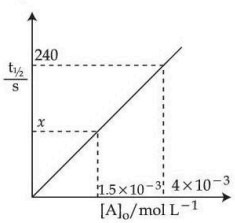
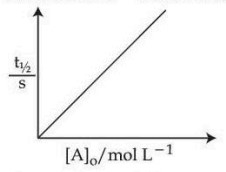
From the given graph, the plot of half-life \(t_{1/2}\) versus initial concentration \([A]_0\) is a straight line passing through the origin.
This indicates that \(t_{1/2}\) is directly proportional to \([A]_0\), which means \(t_{1/2} \propto [A]_0\).
Therefore, the ratio \(\dfrac{t_{1/2}}{[A]_0}\) is constant.
Using the coordinates from the graph, we get:
\(\dfrac{240}{4 \times 10^{-3}} = \dfrac{x}{1.5 \times 10^{-3}}\)
Solving for \(x\):
\(x = \dfrac{240 \times 1.5 \times 10^{-3}}{4 \times 10^{-3}}\)
\(x = 60 \times 1.5 = 90\)
The value of \(x\) is \(90\).
Answer: \(90\) -
- (A) 41
- (B) 42
- (C) 43
- (D) 44
Show answer and solution
Correct Answer: (A)
Using the Arrhenius equation:
\(\log \left( \dfrac{k_2}{k_1} \right) = \dfrac{E_a}{2.3 R} \left( \dfrac{1}{T_1} - \dfrac{1}{T_2} \right)\)
Given:
\(k_1 = 1.5 \times 10^3 \text{ s}^{-1}\)
\(k_2 = 4.5 \times 10^3 \text{ s}^{-1}\)
\(T_1 = 27^\circ\text{C} = 300 \text{ K}\)
\(E_a = 60 \text{ kJ mol}^{-1} = 60000 \text{ J mol}^{-1}\)
\(R = 8.3 \text{ J K}^{-1} \text{ mol}^{-1}\)
Substituting the values into the equation:
\(\log \left( \dfrac{4.5 \times 10^3}{1.5 \times 10^3} \right) = \dfrac{60000}{2.3 \times 8.3} \left( \dfrac{1}{300} - \dfrac{1}{T_2} \right)\)
\(\log 3 = \dfrac{60000}{19.09} \left( \dfrac{1}{300} - \dfrac{1}{T_2} \right)\)
\(0.48 = \dfrac{60000}{19.09} \left( \dfrac{1}{300} - \dfrac{1}{T_2} \right)\)
\(\dfrac{1}{300} - \dfrac{1}{T_2} = \dfrac{0.48 \times 19.09}{60000}\)
\(\dfrac{1}{300} - \dfrac{1}{T_2} = \dfrac{9.1632}{60000} = 1.5272 \times 10^{-4}\)
\(\dfrac{1}{T_2} = \dfrac{1}{300} - 1.5272 \times 10^{-4}\)
\(\dfrac{1}{T_2} = 3.3333 \times 10^{-3} - 0.1527 \times 10^{-3} = 3.1806 \times 10^{-3} \text{ K}^{-1}\)
\(T_2 = \dfrac{1}{3.1806 \times 10^{-3}} \approx 314.4 \text{ K}\)
Converting to Celsius:
\(T_2 = 314.4 - 273 = 41.4^\circ\text{C}\)
The nearest integer is \(41\).
Answer: \(41\) -
- (A) 5
- (B) 10
- (C) 15
- (D) 20
Show answer and solution
Correct Answer: (B)
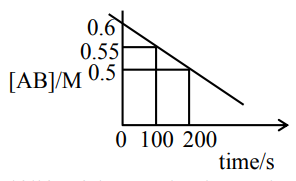
\([AB]_{0}-[AB]_{t}=kt\)
\(0.60-0.55=k(100)\)
\(k =5 \times 10^{-4}\)
Half life \(\left(t_{1 / 2}\right)=\frac{[A B]_0}{2 k}\)
\(=\frac{0.60}{2 \times 5 \times 10^{-4}}\)
\(=600 sec\)
\(=10 min\) -
- (A) 4
- (B) 3
- (C) 2
- (D) 5
Show answer and solution
Correct Answer: (B)
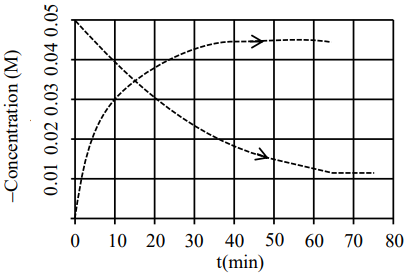
\( A \rightarrow nB \)
\(0.05 \quad 0\)
\(0.04 \quad 0.01 \times n\)
\(0.01 \times n =0.03\)
\(n =3\) -
- (A) Both Statement I and Statement II are true
- (B) Both Statement I and Statement II are false
- (C) Statement I is true but Statement II is false
- (D) Statement I is false but Statement II is true
Show answer and solution
Correct Answer: (C)
For Statement I:
According to the Arrhenius equation:
\(\log \left( \dfrac{k_2}{k_1} \right) = \dfrac{E_a}{2.303 R} \left( \dfrac{T_2 - T_1}{T_1 T_2} \right)\)
Given that the rate constant doubles, \(k_2 = 2k_1\). The temperatures are \(T_1 = 298\) K and \(T_2 = 308\) K.
The gas constant \(R = 8.314\) J K\(^{-1}\) mol\(^{-1} = \dfrac{8.314}{4.2}\) cal K\(^{-1}\) mol\(^{-1} \approx 1.98\) cal K\(^{-1}\) mol\(^{-1}\).
Substituting the values:
\(\log(2) = \dfrac{E_a}{2.303 \times 1.98} \left( \dfrac{308 - 298}{298 \times 308} \right)\)
\(0.301 = \dfrac{E_a}{4.56} \left( \dfrac{10}{91784} \right)\)
\(E_a = \dfrac{0.301 \times 4.56 \times 91784}{10} \approx 12598\) cal/mol \(\approx 12.6\) kcal/mol.
Thus, Statement I is true.
For Statement II:
For a first order reaction, the half-life is given by:
\(t_{1/2} = \dfrac{0.693}{k}\)
This indicates that the half-life of a first order reaction is independent of the initial concentration \([A]_o\). The graph of \(t_{1/2}\) versus \([A]_o\) should be a horizontal line parallel to the concentration axis.
The given graph shows \(t_{1/2}\) directly proportional to \([A]_o\), which corresponds to a zero order reaction (\(t_{1/2} = \dfrac{[A]_o}{2k}\)).
Thus, Statement II is false.
Therefore, Statement I is true but Statement II is false.
Answer: Statement I is true but Statement II is false -
- (A) 46.01
- (B) 46.02
- (C) 46.03
- (D) 46.06
Show answer and solution
Correct Answer: (D)
Explanation:
Let us calculate the time required for 99% completion of the first-order reaction step-by-step:
1. Finding the Rate Constant (\(k\)):
The relation between the half-life (\(t_{1/2}\)) and the rate constant (\(k\)) for a first-order reaction is:
\(k = \frac{2.303 \times \log 2}{t_{1/2}}\)
Using the standard approximation \(2.303 \times \log 2 \approx 0.693\):
\(k = \frac{0.693}{6.93} = 0.1\text{ min}^{-1}\)
2. Using the Integrated Rate Law Equation:
The time expression for a first-order reaction is given by:
\(t = \frac{2.303}{k} \log\left(\frac{a}{a-x}\right)\)
Where:
- \(a\) = Initial concentration = 100
- \(x\) = Reacted concentration = 99
- \(a - x\) = Remaining concentration = \(100 - 99 = 1\)
3. Substituting the Values:
\(t = \frac{2.303}{0.1} \log\left(\frac{100}{1}\right)\)
\(t = 23.03 \times \log(10^2)\)
Since \(\log(10^2) = 2\):
\(t = 23.03 \times 2 = 46.06\text{ minutes}\)
Hence, Option D is the correct choice. -
- (A) \( 2 \times 10^{-3} \)
- (B) \( 10^{-3} \)
- (C) \( 10^{-2} \)
- (D) \( 4 \times 10^{-4} \)
Show answer and solution
Correct Answer: (D)
Rate of reaction II = \( -\frac{1}{5}\frac{\Delta[Br^{-}]}{\Delta t} \)
Rate of reaction II = \( \frac{1}{5} \times (2 \times 10^{-4} \text{ mol L}^{-1} \text{Min}^{-1}) = 4 \times 10^{-5} \text{ mol L}^{-1} \text{Min}^{-1} \)
Rate of reaction I = Rate of reaction II = \( 4 \times 10^{-5} \text{ mol L}^{-1} \text{Min}^{-1} \)
For first order reaction I: Rate = \( k[A] \)
\( k = \frac{\text{Rate}}{[A]} = \frac{4 \times 10^{-5} \text{ mol L}^{-1} \text{Min}^{-1}}{10^{-1} \text{ mol L}^{-1}} \)
\( k = 4 \times 10^{-4} \text{ min}^{-1} \)
-
- (A) 4
- (B) 6
- (C) 8
- (D) 10
Show answer and solution
Correct Answer: (C)
\(A \xrightarrow{ RX ^{ n }(1)}\) product \(E _1\)
\(B \xrightarrow{ RX ^{ n }(2)}\) product \(E _2\)
Assuming 'A' same for both reaction.
\(\ln k _1=\ln A -\frac{ E _1}{300 R }\)
\( ln(\frac{k_{2}}{k_{1}}) = \frac{E_{1}-E_{2}}{RT} = \frac{20 \times 1000}{300 \times 8.3}\)
\(=8.032\) -
- (A) 10
- (B) 15
- (C) 20
- (D) 25
Show answer and solution
Correct Answer: (D)
For a first order reaction, the amount of reactant remaining after \(n\) half-lives is given by \(N_t = \dfrac{N_0}{2^n}\).
Given \(t_{1/2} = 3\) hours and total time \(t = 6\) hours.
Number of half-lives, \(n = \dfrac{t}{t_{1/2}} = \dfrac{6}{3} = 2\).
The amount of sucrose remaining is \(N_t = \dfrac{N_0}{2^2} = \dfrac{N_0}{4}\).
Percentage of sucrose remaining \(= \dfrac{N_t}{N_0} \times 100 = \dfrac{1}{4} \times 100 = 25\).
Answer: \(25\) -
- (A) \(t_{100\%} = (t_{1/2})^2\) and \(t_{100\%} = (t_{1/2})^{-\infty}\)
- (B) \(t_{100\%} = 2t_{1/2}\) and \(t_{100\%} = (t_{1/2})^\infty\)
- (C) \(t_{100\%} = 2t_{1/2}\) and \(t_{100\%} = (2t_{1/2})^2\)
- (D) \(t_{100\%} = (t_{1/2})^\infty\) and \(t_{100\%} = 2t_{1/2}\)
Show answer and solution
Correct Answer: (B)
For a zero-order reaction:
The integrated rate law is given by \(t = \dfrac{[A]_0 - [A]_t}{k}\).
For \(50\%\) completion (\(t_{1/2}\)), \([A]_t = \dfrac{[A]_0}{2}\):
\(t_{1/2} = \dfrac{[A]_0 - \dfrac{[A]_0}{2}}{k} = \dfrac{[A]_0}{2k}\)
For \(100\%\) completion (\(t_{100\%}\)), \([A]_t = 0\):
\(t_{100\%} = \dfrac{[A]_0 - 0}{k} = \dfrac{[A]_0}{k}\)
Comparing the two, we get:
\(t_{100\%} = 2t_{1/2}\)
For a first-order reaction:
The integrated rate law is given by \(t = \dfrac{1}{k} \ln\left(\dfrac{[A]_0}{[A]_t}\right)\).
For \(100\%\) completion (\(t_{100\%}\)), \([A]_t = 0\):
\(t_{100\%} = \dfrac{1}{k} \ln\left(\dfrac{[A]_0}{0}\right) = \infty\)
A first-order reaction takes infinite time for \(100\%\) completion. Among the given choices, this is symbolically represented as \(\infty\) or \((t_{1/2})^\infty\).
Thus, the correct relation is \(t_{100\%} = 2t_{1/2}\) for zero-order and \(t_{100\%} = \infty\) for first-order.
Answer: \(t_{100\%} = 2t_{1/2}\) and \(t_{100\%} = (t_{1/2})^\infty\) -
- (A) C > B > A > D
- (B) A > D > C > B
- (C) A > D > B > C
- (D) C > A > D > B
Show answer and solution
Correct Answer: (D)
Correct order of acidic strength of major product formed in the given reaction is
(A)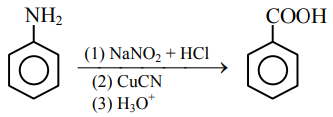
(B) \(CH _3 CH _2- CHO \xrightarrow[\Delta]{ Ag \left( NH _3\right)_2 OH } CH _3- CH _2- COOH\)
(C) \(CH _4+ O _2 \xrightarrow[ Na _2 Cr _2 O _7 / H ^{+}]{ MO _2 O _3} HCOOH\)
(D) \(Ph - CH _2 MgBr + CO _2 \xrightarrow[ H _3 O ^{\oplus}]{\text { Dryether }} Ph - CH _2- COOH\) -
- (A) 102
- (B) 122
- (C) 245
- (D) 61
Show answer and solution
Correct Answer: (A)
\(t _{1 / 2}=\frac{\ell n 2}{K}\)
\(K =\frac{\ell n 2}{245}\)
\(t =\frac{1}{K} \ell n \frac{ a _0}{ a _{ t }}\)
\(t_{25 \%}=\frac{1}{K} \ell n \frac{4}{3}\)
\(t _{25 \%}=\frac{1}{\frac{\ell n 2}{245}} \ell n \frac{4}{3}\)
\(t _{25 \%}=245 \frac{\ell n \frac{4}{3}}{\ell n 2}=245\left[\frac{2 \log 2-\log 3}{\log 2}\right]\)
\(=245\left[\frac{2 \times 0.3010-0.4771}{0.3010}\right]=101.66\) day. -
- (A) \(\frac{2.303R}{\Delta H^{\circ}}, \frac{2.303R}{\Delta S^{\circ}}\)
- (B) \(\frac{\Delta S^{\circ}}{2.303R}, -\frac{\Delta H^{\circ}}{2.303R}\)
- (C) -\(\frac{\Delta S^{\circ}R}{2.303}, \frac{\Delta H^{\circ}R}{2.303}\)
- (D) \(-\frac{\Delta H ^{\circ}}{2.303 R }, \frac{\Delta S ^{\circ}}{2.303 R }\)
Show answer and solution
Correct Answer: (B)
\(log_{10} K = -\frac{\Delta H^{\circ}}{2.303RT} + \frac{\Delta S^{\circ}}{2.303 R}\)
\(y-intercept = \frac{\Delta S^{\circ}}{2.303 R}\)
\(Slope = -\frac{\Delta H^{\circ}}{2.303 R}\) -
- (A) 1100
- (B) 1200
- (C) 1303
- (D) 1405
Show answer and solution
Correct Answer: (C)
\(10^4 e ^{\frac{-24000}{T}}=10^6 e ^{\frac{-30000}{T}}\)
\(e ^{\frac{6000}{T}}=100\)
\(\frac{6000}{T}=2 \ln 10\)
\(T =\frac{6000}{2 \times 2.303}\)
\(T =1302.64 K\)
\(T \approx 1303 K\) -
- (A) 68
- (B) 69
- (C) 70
- (D) 71
Show answer and solution
Correct Answer: (B)
\(\begin{aligned} & \mathrm{t}_{1 / 2}=\frac{0.693}{\mathrm{~K}} \\ & \mathrm{~K}=\mathrm{Ae}^{-\mathrm{Ea} / \mathrm{RT}} \\ & =10^{20} \times \mathrm{e}^{-\frac{191.48 \times 10^3}{8.314 \times 1000}} \\ & =10^{20} \times \mathrm{e}^{-23.031}=10^{20} \times-\mathrm{e}^{\ln 10 \times 10} \\ & =\frac{10^{20}}{10^{10}}=10^{10} \mathrm{sec} . \\ & \mathrm{t}_{1 / 2}=\frac{0.693}{10^{10}}=6.93 \times 10^{-11} \\ & \quad=69.3 \times 10^{-12} \mathrm{sec} .\end{aligned}\) -
- (A) \(\mathrm{k}=\frac{1}{\mathrm{t}} \ln \frac{2\left(\mathrm{p}_{\infty}-\mathrm{P}_{\mathrm{t}}\right)}{\mathrm{P}_{\mathrm{t}}}\)
- (B) \(\mathrm{k}=\frac{1}{\mathrm{t}} \ln \frac{\mathrm{p}_{\infty}}{\mathrm{P}_{\mathrm{t}}}\)
- (C) \(\mathrm{k}=\frac{1}{\mathrm{t}} \ln \frac{\mathrm{p}_{\infty}}{2\left(\mathrm{p}_{\infty}-\mathrm{P}_{\mathrm{t}}\right)}\)
- (D) \(\mathrm{k}=\frac{1}{\mathrm{t}} \ln \frac{\mathrm{p}_{\infty}}{\left(\mathrm{p}_{\infty}-\mathrm{P}_{\mathrm{t}}\right)}\)
Show answer and solution
Correct Answer: (C)
\(\begin{aligned}
& \begin{array}{lllll}
& A_{(g)} & \rightarrow & B_{(g)} & +
C_{(g)} \\
t=0 & P^o & & 0 & 0 \\
t=t & P^o-x & & x & x \\
t=\infty & 0 & & P^o & P^o
\end{array} \\
& \mathrm{P}_{\mathrm{t}}=\mathrm{P}^{\mathrm{o}}+\mathrm{x} \Rightarrow \mathrm{x}=\mathrm{P}_{\mathrm{t}}-\mathrm{P}^{\mathrm{o}}=\mathrm{P}_{\mathrm{t}}-\frac{\mathrm{P}_{\infty}}{2} \\
& \mathrm{P}_{\infty}=2 \mathrm{P}^{\mathrm{o}} \Rightarrow \mathrm{P}^0=\frac{\mathrm{P} \infty}{2} \\
& \mathrm{k}=\frac{1}{\mathrm{t}} \ell \ln \frac{\mathrm{P}^{\mathrm{o}}}{\mathrm{P}^{\mathrm{o}}-\mathrm{x}} \\
& k=\frac{1}{t} \ell n \frac{P_{\infty}}{2\left(P_{\infty}-P_t\right)}
\end{aligned}\) -
- (A) 10
- (B) 20
- (C) 30
- (D) 40
Show answer and solution
Correct Answer: (B)
\(\mathrm{k}_1, \mathrm{k}_2\) and \(\mathrm{k}_3\) are given as rate constants of three steps of a complex reaction. Rate constant (k) of the overall reaction is given as
\(k=\sqrt{\frac{k_1 k_3}{k_2}}\)
Activation energies of the three steps are given as
\(\begin{aligned}
& \mathrm{E}_{\mathrm{a}_1}=60 \mathrm{~kJ} \mathrm{~mol}^{-1}, \mathrm{E}_{\mathrm{a}_2}=30 \mathrm{~kJ} \mathrm{~mol}^{-1}, \\
& \mathrm{E}_{\mathrm{a}_3}=10 \mathrm{~kJ} \mathrm{~mol}^{-1}
\end{aligned}\)
From Arrhenius equation, we know that
\(\mathrm{k}=\mathrm{Ae}^{-\mathrm{Ea} / \mathrm{RT} T}\)
If \(E_a\) is the activation energy of the overall reaction, then
\(\begin{aligned}
& E_a=\frac{1}{2}\left[E_{a_1}+E_{a_3}-E_{a_2}\right] \\
& =\frac{1}{2}[60+10-30]=20 \mathrm{~kJ} \mathrm{~mol}^{-1}
\end{aligned}\) -
- (A) \(3\)
- (B) \(\frac{1}{9}\)
- (C) \(9\)
- (D) \(\frac{1}{3}\)
Show answer and solution
Correct Answer: (C)
Since, the reaction is elementary
\(\text { Rate }=k[A]^1[B]^1\)
When V is reduced to \(\frac{1}{3} \mathrm{~V}\), concentration will be tripled.
Hence, rate \(=9 \times(\text { rate })_{\text {initial }}\)
\(x=9\) -
- (A) \(\mathrm{Ea}_2 \gt \mathrm{Ea}_1 \gt \mathrm{Ea}_3\)
- (B) \(\mathrm{Ea}_1 \gt \mathrm{Ea}_3 \gt \mathrm{Ea}_2\)
- (C) \(\mathrm{Ea}_1 \gt \mathrm{Ea}_2 \gt \mathrm{Ea}_3\)
- (D) \(\mathrm{Ea}_3 \gt \mathrm{Ea}_2 \gt \mathrm{Ea}_1\)
Show answer and solution
Correct Answer: (A)
\(\begin{aligned}
& \mathrm{K}=\mathrm{A} \mathrm{e}^{-\mathrm{E} a \mathrm{RT}} \\
& \operatorname{logk}=\log \mathrm{A}-\frac{\mathrm{Ea}}{2.303 \mathrm{RT}}
\end{aligned}\)
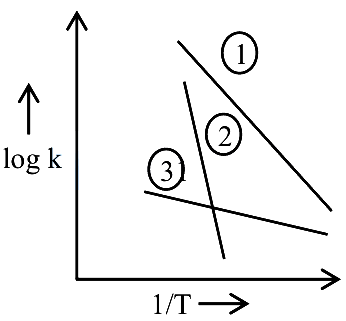
For graph between logk with \(\frac{1}{\mathrm{~T}}\)
\(\mid \text { Slope of curve } \left\lvert\,=\frac{\mathrm{Ea}}{2.303 \mathrm{R}}\right.\)
From given graph
Magnitude of slope \(\Rightarrow(2) \gt (1) \gt (3)\)
Hence \(\mathrm{Ea}_2 \gt \mathrm{Ea}_1 \gt \mathrm{Ea}_3\) -
- (A) A, C and D Only
- (B) B , D and E Only
- (C) B and C Only
- (D) A and B Only
Show answer and solution
Correct Answer: (C)
Arrhenious equation hold true for elementary as well as complex reactions.
Unit of A is same as unit of k. Rate of reaction is high if activation energy is low,
A and Ea are temperature independent. -
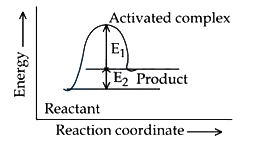
- (A) Activation energy of both forward and backward reaction is \(\mathrm{E}_1+\mathrm{E}_2\) and reactant is more stable than product.
- (B) Activation energy of forward reaction is \(\mathrm{E}_1+\mathrm{E}_2\) and product is less stable than reactant.
- (C) Activation energy of backward reaction is \(\mathrm{E}_1\) and product is more stable than reactant.
- (D) Activation energy of forward reaction is \(\mathrm{E}_1+\mathrm{E}_2\) and product is more stable than reactant.
Show answer and solution
Correct Answer: (B)
Activation energy of forward reaction \(=E_1+E_2\)
Energy of product \(>\) Energy of reactant
Stability
Reactant \(>\) Product -
- (A) 2
- (B) 6
- (C) 12
- (D) 3
Show answer and solution
Correct Answer: (B)
Drug \(\mathrm{X} \xrightarrow{\text { 1st order }}\) Product
Initial concentration of drug \(=16 \mathrm{mg} / \mathrm{mL}\)
Concentration of drug after 12 months \(=4 \mathrm{mg} / \mathrm{mL}\)
Half life of drug = 6 months
Drug become ineffective after 50\% decomposition. The expiry time of drug \(=6\) months -
- (A) Catalyst does not alter the Gibbs energy change of a reaction.
- (B) Catalyst can cause non-spontaneous reactions to occur.
- (C) The enthalpy change for the reaction is \(+20 \mathrm{~kJ} \mathrm{~mol}^{-1}\).
- (D) The enthalpy change for the catalysed reaction is different from that of uncatalysed reaction.
Show answer and solution
Correct Answer: (A)
\(\mathrm{A}_2+\mathrm{B}_2 \rightleftharpoons 2 \mathrm{AB}\)
\(\mathrm{E}_{\mathrm{f}}=180 \mathrm{~kJ} \mathrm{~mol}^{-1}\)
\(\mathrm{E}_{\mathrm{b}}=200 \mathrm{~kJ} \mathrm{~mol}^{-1}\)
\(\Delta \mathrm{H}=\mathrm{E}_{\mathrm{f}}-\mathrm{E}_{\mathrm{b}}=-20 \mathrm{~kJ} \mathrm{~mol}^{-1}\)
In presence of catalyst :
\(\begin{aligned}
& \mathrm{E}_{\mathrm{f}}=180-100=80 \mathrm{~kJ} \mathrm{~mol}^{-1} \\
& \mathrm{E}_{\mathrm{b}}=200-100=100 \mathrm{~kJ} \mathrm{~mol}^{-1}
\end{aligned}\)
Catalyst does not change \(\Delta \mathrm{H}\) or \(\Delta \mathrm{G}\) of a reaction. -
- (A) A and C Only
- (B) A, B and D Only
- (C) C and D Only
- (D) A and B Only
Show answer and solution
Correct Answer: (B)
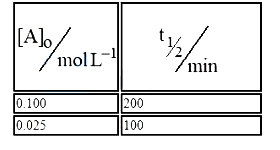
\(\frac{t_1}{2} \propto\left(C_0\right)^{1-\eta}\)
\(\frac{t_1}{t_2}=\left(\frac{C_1}{C_2}\right)^{1-\eta} \)
\( \Rightarrow \frac{200}{100}=\left(\frac{0.100}{0.025}\right)^{1-\eta} \)
\( \Rightarrow 2=(4)^{1-\eta} \)
\( (1-\eta)=\frac{1}{2} \)
\( \eta=\frac{1}{2} \)
\( \text { For } \eta=\frac{1}{2} \)
\( \frac{-d A}{d t}=k(A)^{\frac{1}{2}} \)
\( \int_{C_0}^C \frac{d A}{(A)^{\frac{1}{2}}}=-\int_0^t k d t \)
\( \Rightarrow 2 \mathrm{~A}^{\frac{1}{2}}=-\mathrm{kt} \)
\( \Rightarrow \sqrt{\mathrm{C}}-\sqrt{\mathrm{C}_0}=\frac{-\mathrm{kt}}{2} \)
\( \sqrt{\mathrm{C}}-\sqrt{\mathrm{C}_0}-\frac{\mathrm{kt}}{2} \)
\( \text { For } \mathrm{C}_0=0.1 \Rightarrow \mathrm{t}_{\frac{1}{2}}=200 \mathrm{~min} \)
\( \sqrt{\frac{c_0}{2}}=\sqrt{c_0}-\frac{k t}{2} \)
\( \frac{\mathrm{kt}}{2}=\sqrt{\mathrm{c}_0}-\sqrt{\frac{\mathrm{c}_0}{2}} \)
\( \frac{\mathrm{kt}}{2}=\sqrt{\mathrm{c}_0}\left(\frac{\sqrt{2}-1}{\sqrt{2}}\right) \)
\( t_{\frac{1}{2}}=\frac{2 \sqrt{c_0}}{k}\left(\frac{\sqrt{2}-1}{\sqrt{2}}\right) \)
\( 200=\frac{2 \sqrt{0.1}}{k}\left(\frac{\sqrt{2}-1}{\sqrt{2}}\right) \)
\(\mathrm{k}=\frac{\sqrt{0.1}}{100}\left(\frac{\sqrt{2}-1}{\sqrt{2}}\right)\)
For \(\mathrm{C}_0=1 \mathrm{M}\)
\(t_{\frac{1}{2}}=\frac{2 \times 100(\sqrt{2})}{\sqrt{0.1}(\sqrt{2}-1)} \times \frac{(\sqrt{2}-1)}{\sqrt{2}}\)
\(\Rightarrow 200 \sqrt{10} \mathrm{~min}\).
\(\Rightarrow B\) is correct
C is incorrect
For \(\mathrm{C}_0=1.6 \mathrm{M}\)
\(\mathrm{t}_{\frac{1}{2}}=\frac{2 \sqrt{1.6}(\sqrt{2})(\sqrt{2}-1) \times 100}{\sqrt{0.1}(\sqrt{2}-1)(\sqrt{2})} \)
\( \mathrm{t}_{\frac{1}{2}}=400 \times 2 \mathrm{~min} \)
\( \mathrm{t}_{\frac{1}{2}}=800 \mathrm{~min}\) -
- (A) 43
- (B) 46
- (C) 49
- (D) 50
Show answer and solution
Correct Answer: (A)
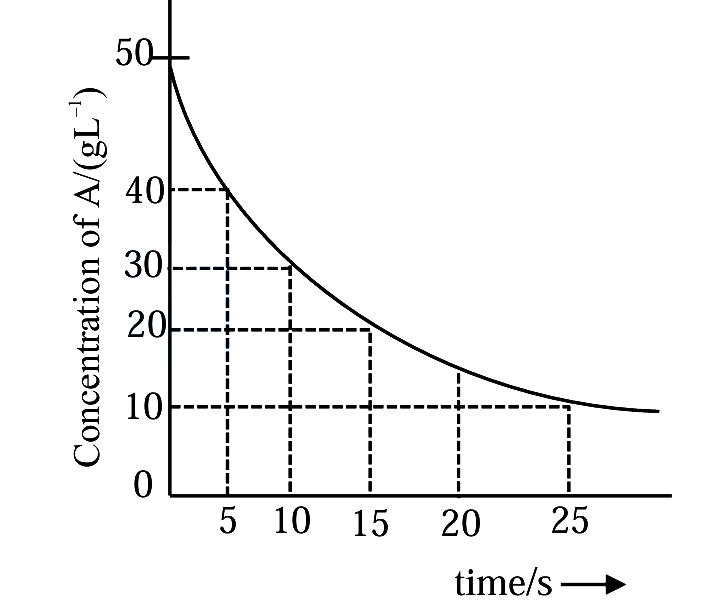
As it is difficult to predict order using data provided in graph.
For specific time interval \(0-5 \mathrm{sec}, 5-10 \mathrm{sec}\) and \(10-15 \mathrm{sec}\). order comes to be zero, but graph is not a straight line.
Assuming \(1^{\text {st }}\) order kinetics
\(\begin{aligned}
& \mathrm{K}=\frac{1}{\mathrm{t}} \ln \frac{\mathrm{~A}_0}{\mathrm{~A}_{\mathrm{t}}} \\
& \mathrm{~K}=\frac{1}{10} \ln \frac{40}{20}
\end{aligned}\)
Time required to reduce to \(2.5 \mathrm{~g} / \mathrm{L}\)
\(\begin{aligned}
& \mathrm{K}=\frac{1}{\mathrm{t}} \ln \frac{50}{2.5} \\
& \frac{1}{10} \ln 2=\frac{1}{\mathrm{t}} \ln 20 \\
& \mathrm{t}=\frac{1.3010 \times 10}{0.3010}=43.3 \mathrm{sec}
\end{aligned}\) -
- (A) 2435
- (B) 2400
- (C) 2541
- (D) 1254
Show answer and solution
Correct Answer: (A)
\(\begin{aligned}
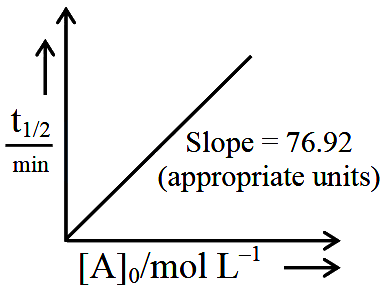
& \mathrm{t}_{1 / 2} \propto[\mathrm{A}]_0 \Rightarrow \text { Order }=\text { zero } \\
& \mathrm{t}_{1 / 2}=\frac{\mathrm{A}_0}{2 \mathrm{~K}} \Rightarrow \text { Slope }=\frac{1}{2 \mathrm{~K}}=76.92 \\
& \mathrm{~K}=\frac{1}{2 \times 76.92} \\
& {[\mathrm{A}]_{10}=-\mathrm{Kt}+\mathrm{A}_0=-\frac{1}{2 \times 76.92} \times 10+2.5=2.435} \\
& =2435 \times 10^{-3} \mathrm{~mol} / \mathrm{L}
\end{aligned}\) -
- (A) 800
- (B) 547
- (C) 897
- (D) 874
Show answer and solution
Correct Answer: (C)
\(2 \mathrm{~N}_2 \mathrm{O}_5(\mathrm{~g}) \rightarrow 2 \mathrm{~N}_2 \mathrm{O}_4(\mathrm{~g})+\mathrm{O}_2(\mathrm{~g})\)
\(\begin{aligned} & k=\frac{2.303}{t} \log \frac{0.9-0.6}{(0.9-x)} \\ & 2 \times 10^{-2} \times 100=\log \frac{0.3}{(0.9-x)} \\ & 100=\frac{0.3}{(0.9-x)} \\ & =\frac{0.9-x}{0.3}=0.01 \\ & 0.9-X=0.003 \\ & =897 \times 10^{-3}\end{aligned}\) - 42. Given below are two statements :
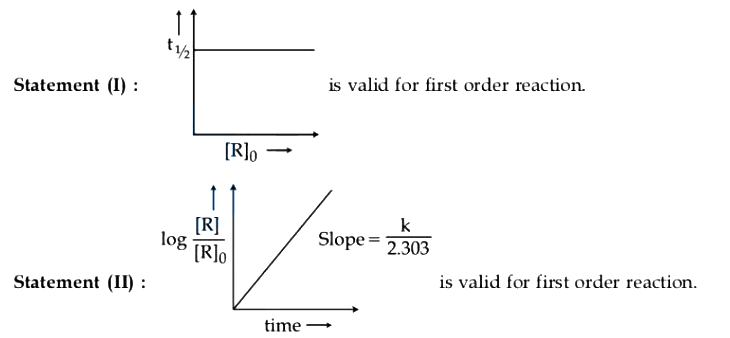
In the light of the above statements, choose the correct answer from the options given below : 2025 Medium- (A) Both Statement I and Statement II are true
- (B) Statement I is false but Statement II is true
- (C) Statement I is true but Statement II is false
- (D) Both Statement I and Statement II are false
Show answer and solution
Correct Answer: (C)
For first order reaction \(\mathrm{t}_{1 / 2}=\frac{\ell \mathrm{n} 2}{\mathrm{k}}\)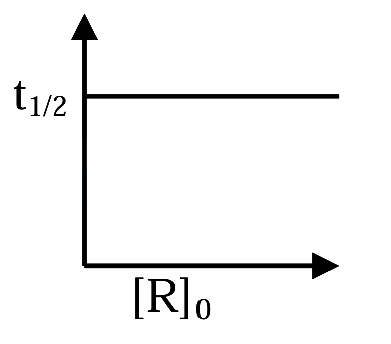
For first order reaction
\(\begin{aligned}
& \log \frac{[R]_0}{[R]}=\frac{1}{2.303} \mathrm{kt} \\
& \log \frac{[\mathrm{R}]_0}{[\mathrm{R}]}=\left(\frac{\mathrm{k}}{2.303}\right) \times \mathrm{t}
\end{aligned}\)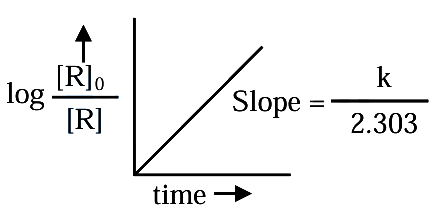
-
- (A) 0.5 hour
- (B) 4 hour
- (C) 15 min
- (D) 60 min
Show answer and solution
Correct Answer: (C)
For zero order reaction
\(\begin{aligned}
& \text { Half life }=\frac{A_o}{2 k} \\
& 60 \min =\frac{2}{2 k} \\
& k=\frac{1}{60} \mathrm{M} / \min
\end{aligned}\)
Now
\(\begin{aligned} & \mathrm{A}_{\mathrm{t}}=\mathrm{A}_{\mathrm{o}}-\mathrm{kt} \\ & \mathrm{t}=\frac{\mathrm{A}_{\mathrm{o}}-\mathrm{A}_{\mathrm{t}}}{\mathrm{k}} \\ & =\frac{0.5-0.25}{1 / 60} \\ & 0.25 \times 60\end{aligned}\)
\(\mathrm{t}=15 \mathrm{~min}\) -
- (A) \(\frac{4}{3}\)
- (B) \(\frac{3}{2}\)
- (C) \(\frac{3}{4}\)
- (D) \(\frac{2}{3}\)
Show answer and solution
Correct Answer: (D)
For \(\mathrm{I}^{\text {st }}\) order reaction
When \(\mathrm{C}_{\mathrm{t}}=\mathrm{Co} / 4\)
\(\begin{aligned}
& \mathrm{t}_1=2 \mathrm{t}_{50 \%}. \\
& \text { when } \mathrm{C}_{\mathrm{t}}=\mathrm{Co} / 8 \\
& \mathrm{t}_2=3 \mathrm{t}_{50 \%} \\
& \text { so } \frac{\mathrm{t}_1}{\mathrm{t}_2}=\frac{2}{3}
\end{aligned}\) -
- (A) 60 min
- (B) 80 min
- (C) 20 min
- (D) 40 min
Show answer and solution
Correct Answer: (D)
Given : \([\mathrm{A}]_0=8[\mathrm{~B}]_0\)
\(\left[\mathrm{t}_{1 / 2}\right]_{\mathrm{A}}=10 \mathrm{~min}\).
\(\left[\mathrm{t}_{1 / 2}\right]_{\mathrm{B}}=40 \mathrm{~min}\).
\(\mathrm{I}^{\text {st }}\) order kinetics
\(\mathrm{t}=\) ?
\([\mathrm{A}]_{\mathrm{t}}=[\mathrm{B}]_{\mathrm{t}}\)
\(-\mathrm{k}_{\mathrm{A}} \times \mathrm{t} \quad-\mathrm{k}_{\mathrm{B}} \times \mathrm{t}\)
\(\Rightarrow \quad[\mathrm{A}]_0 \mathrm{e}=[\mathrm{B}]_0 \mathrm{e}\)
\(\Rightarrow \quad \frac{[\mathrm{A}]_0}{[\mathrm{~B}]_0}=\mathrm{e}^{\left(\mathrm{k}_{\mathrm{A}}-\mathrm{k}_{\mathrm{B}}\right) \mathrm{t}}\)
\(\Rightarrow \quad 8=\mathrm{e}^{\left(\mathrm{k}_{\mathrm{A}}-\mathrm{k}_{\mathrm{B}}\right) \times \mathrm{t}}\)
\(\Rightarrow \quad \ell \mathrm{n} 8=\left(\mathrm{k}_{\mathrm{A}}-\mathrm{k}_{\mathrm{B}}\right) \times \mathrm{t}\)
\(\Rightarrow \quad \ln 8=\ln 2\left(\frac{1}{\left(\operatorname{ta}_2\right)_{\mathrm{A}}}-\frac{1}{\left(\operatorname{ta}_2\right)_{\mathrm{B}}}\right) \times \mathrm{t}\) -
- (A) \(2^{(n-m)}\)
- (B) \((n-m)\)
- (C) \((m+n)\)
- (D) \(\frac{1}{2^{m+n}}\)
Show answer and solution
Correct Answer: (A)
\(\mathrm{r}_1=\mathrm{k}[\mathrm{~A}]^{\mathrm{n}}[\mathrm{~B}]^{\mathrm{m}}\)
Now A is doubled \& B is halved in concentration
\(\Rightarrow \mathrm{r}_2=\mathrm{k} 2^{\mathrm{n}}[\mathrm{~A}]^{\mathrm{n}} \cdot \frac{[\mathrm{~B}]^{\mathrm{m}}}{2^{\mathrm{m}}}\)
Now \(\frac{r_2}{r_1}=2^{(n-m)}\) -
- (A) Initial pressure of A is 80 mm Hg
- (B) The reaction never goes to completion
- (C) Rate constant of the reaction is \(1.693 \mathrm{~min}^{-1}\)
- (D) Partial pressure of A after 10 minute is 40 mm Hg
Show answer and solution
Correct Answer: (C)
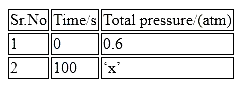
\(\mathrm{A}(\mathrm{g}) \longrightarrow 2 \mathrm{~B}(\mathrm{~g})+\mathrm{C}(\mathrm{g})\)
\(\begin{array}{llll}\mathrm{t}=0 & \mathrm{P}_0 & & \\ \mathrm{t} \rightarrow \infty & 0 & 2 \mathrm{P}_0 & \mathrm{P}_0\end{array}\)
\(\begin{aligned} \mathrm{P}_{\infty}=3 \mathrm{P}_0 & =240 \\ \mathrm{P}_0 & =80 \mathrm{~mm} \text { of } \mathrm{Hg}\end{aligned}\)
\(\mathrm{Kt}=\ln \left(\frac{\mathrm{P}_{\infty}-\mathrm{P}_0}{\mathrm{P}_{\infty}-\mathrm{Pt}}\right)\)
\(K \times 10=\ln \left(\frac{240-80}{240-160}\right)\)
\(\mathrm{K}=\frac{\ell \mathrm{n} 2}{10}=0.0693 \mathrm{~min}^{-1}\)
Option (3) is incorrect -
- (A) 2
- (B) 2.5
- (C) 3
- (D) 1.5
Show answer and solution
Correct Answer: (D)
\(\begin{aligned}
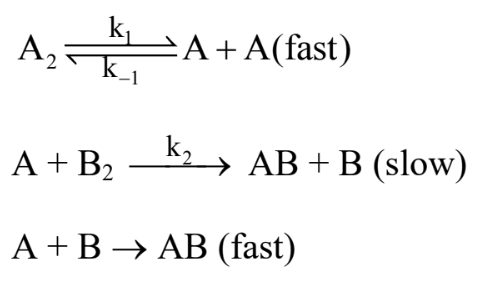
& \text { rate }=\mathrm{k}_2[\mathrm{~A}]\left[\mathrm{B}_2\right] \ldots \ldots \\
& \left(\frac{\mathrm{k}_1}{\mathrm{k}_{-1}}\right)=\left(\frac{[\mathrm{A}]^2}{\left[\mathrm{~A}_2\right]}\right) \\
& \Rightarrow[\mathrm{A}]=\sqrt{\frac{\mathrm{k}_1}{\mathrm{k}_{-1}}} \cdot \sqrt{\left[\mathrm{~A}_2\right]}
\end{aligned}\)
Substituting in (1) ; we get
\(\begin{aligned} & \text { Rate }=\mathrm{k}_2 \sqrt{\frac{\mathrm{k}_1}{\mathrm{k}_{-1}}} \cdot\left[\mathrm{~A}_2\right]^{\frac{1}{2}} \cdot\left[\mathrm{~B}_2\right] \\ & \therefore \text { order }=\left(\frac{3}{2}\right)=1.5\end{aligned}\) -
- (A) Decay constant increases with increase in temperature.
- (B) Amount of radioactive substance remained after three half lives is \(\frac{1}{8}\) th of original amount.
- (C) Decay constant does not depend upon temperature.
- (D) Half life is ln 2 times of \(\frac{1}{\text { rate constant }}\).
Show answer and solution
Correct Answer: (A)
For radioactive decay, decay constant does not depend upon temperature because for radioactive decay activation energy is zero. -
- (A) \(1\)
- (B) \(2\)
- (C) \(3\)
- (D) \(4\)
Show answer and solution
Correct Answer: (B)
Let, \(\mathrm{R}=\mathrm{k}[\mathrm{HI}]^{\mathrm{n}}\)
using any two of given data,
\( \frac{3 \times 10^{-3}}{7.5 \times 10^{-4}}=\left(\frac{0.01}{0.005}\right)^{\mathrm{n}} \)
\( \mathrm{n}=2\)
No questions on this page match these filters.
About Chemical kinetics PYQs
Chemical kinetics has 184 questions from 2013–2026. The most came in 2026 (28), 2021 (23) and 2022 (22).
The most asked topics are First Order reaction, Collision theory, Energy of activation and Arrhenius equation and Rate law, Rate constant, Order of Reaction and Molecularity.
13% are easy, 49% medium and 38% hard.
Chemical kinetics PYQs by year
Frequently asked
How many Chemical kinetics questions came in JEE Mains?
184 questions from 2013–2026, each with the correct answer and a full solution.
Which Chemical kinetics topic is asked the most?
First Order reaction, with 70 questions, followed by Collision theory, Energy of activation and Arrhenius equation with 56.
Which year had the most Chemical kinetics questions?
2026, with 28 questions.
How difficult are Chemical kinetics questions?
13% are easy, 49% medium and 38% hard.