


Questions
Newest firstShowing 1–49 of 49 questions
- 1. A cylinder with adiabatic walls is closed at both ends and is divided into two compartments by a frictionless adiabatic piston. Ideal gas is filled in both (left and right) the compartments at same \(P, V, T\). Heating is started from left side until pressure changes to \(\dfrac{27P}{8}\). If initial volume of each compartment was \(9\) litres then the final volume in right-hand side compartment is __________ litres. (for this ideal gas \(C_P/C_V = 1.5\)) 2026 Hard
- 2. A vessel contains \(0.15\) m\(^3\) of a gas at pressure \(8\) bar and temperature \(140°\)C with \(c_p = 3R\) and \(c_v = 2R\). It is expanded adiabatically till pressure falls to \(1\) bar. The work done during this process is _______ kJ. (\(R\) is gas constant) 2026 Hard
- 3. Initial pressure and volume of a monoatomic ideal gas are \(P\) and \(V\). The change in internal energy of this gas in adiabatic expansion to volume \(V_{final}=27V\) is ________ J. 2026 Medium
- 4. One mole of an ideal diatomic gas expands from volume V to 2 V isothermally at a temperature \(27^{\circ} C\) and does W joule of work. If the gas undergoes same magnitude of expansion adiabatically from \(27^{\circ} C\) doing the same amount of work W , then its final temperature will be (close to) ___________ \({ }^{\circ} C\). 2026 Hard
- 5. The volume of an ideal gas increases 8 times and temperature becomes (1/4) of initial temperature during a reversible change. If there is no exchange of heat in this process (\( \Delta Q=0 \)) then identify the gas from the following options: 2026 Easy
- 6. A gas is kept in a container having walls which are thermally non-conducting. Initially the gas has a volume of \(800 \mathrm{~cm}^3\) and temperature \(27^{\circ} \mathrm{C}\). The change in temperature when the gas is adiabatically compressed to \(200 \mathrm{~cm}^3\) is :
(Take \(\gamma=1.5: \gamma\) is the ratio of specific heats at constant pressure and at constant volume) 2025 Medium - 7. A monoatomic gas having \(\gamma=\frac{5}{3}\) is stored in a thermally insulated container and the gas is suddenly compressed to \(\left(\frac{1}{8}\right)^{\text {th }}\) of its initial volume. The ratio of final pressure and initial pressure is: ( \(\gamma\) is the ratio of specific heats of the gas at constant pressure and at constant volume) 2025 Medium
- 8. An ideal gas initially at \(0^{\circ} \mathrm{C}\) temperature, is compressed suddenly to one fourth of its volume. If the ratio of specific heat at constant pressure to that at constant volume is \(3 / 2\), the change in temperature due to the thermodynamic process is _____ K. 2025 Medium
- 9. Given below are two statements. One is labelled as Assertion (A) and the other is labelled as Reason (R).
Assertion (A) : With the increase in the pressure of an ideal gas, the volume falls off more rapidly in an isothermal process in comparison to the adiabatic process.
Reason (R) : In isothermal process, \(\mathrm{PV}=\) constant, while in adiabatic process \(\mathrm{PV}^\gamma=\) constant. Here \(\gamma\) is the ratio of specific heats, P is the pressure and V is the volume of the ideal gas.
In the light of the above statements, choose the correct answer from the options given below : 2025 Medium - 10. Given below are two statements. One is labelled as Assertion (A) and the other is labelled as Reason (R).
Assertion (A) : In an insulated container, a gas is adiabatically shrunk to half of its initial volume. The temperature of the gas decreases.
Reason (R): Free expansion of an ideal gas is an irreversible and an adiabatic process.
In the light of the above statements, choose the correct answer from the options given below : 2025 Easy - 11. Identify the characteristics of an adiabatic process in a monoatomic gas.
(A) Internal energy is constant.
(B) Work done in the process is equal to the charge in internal energy.
(C) The product of temperature and volume is a constant.
(D) The product of pressure and volume is a constant.
(E) The work done to change the temperature from \(\mathrm{T}_1\) to \(\mathrm{T}_2\) is proportional to \(\left(\mathrm{T}_2-\mathrm{T}_1\right)\)
Choose the correct answer from the options given below : 2025 Medium - 12. In an adiabatic process, which of the following statements is true? 2025 Easy
- 13. Match List-I with List-II.
List-I List-II (A) Isothermal (I) \(\Delta W(\text{work done}) = 0\) (B) Adiabatic (II) \(\Delta Q(\text{supplied heat}) = 0\) (C) Isobaric (III) \(\Delta U(\text{change in internal energy}) \neq 0\) (D) Isochoric (IV) \(\Delta U = 0\)
Choose the correct answer from the options given below : 2025 Easy - 14. Match List-I with List-II.
LIST - I LIST - II (A) Isobaric (I) ΔQ = ΔW (B) Isochoric (II) ΔQ = ΔU (C) Adiabatic (III) ΔQ = zero (D) Isothermal (IV) ΔQ = ΔU + PΔV
\(\Delta \mathrm{Q}=\) Heat supplied
\(\Delta \mathrm{W}=\) Work done by the system
\(\Delta \mathrm{U}=\) Change in internal energy
\(\mathrm{P}=\) Pressure of the system
\(\Delta \mathrm{V}=\) Change in volume of the system
Choose the correct answer from the options given below: 2025 Easy - 15. Match the LIST-I with LIST-II
Choose the correct answer from the options given below: 2025 EasyLIST-I LIST-II A. Pressure varies inversely with volume of an ideal gas I. Adiabatic process B. Heat absorbed goes partly to increase internal energy and partly to do work II. Isochoric process C. Heat is neither absorbed nor released by a system III. Isothermal process D. No work is done on or by a gas IV. Isobaric process - 16. The workdone in an adiabatic change in an ideal gas depends upon only : 2025 Easy
- 17. A sample of \(1\) mole gas at temperature \(\mathrm{T}\) is adiabatically expanded to double its volume. If adiabatic constant for the gas is \(\gamma=\frac{3}{2}\), then the work done by the gas in the process is _______. 2024 Hard
- 18. A sample of gas at temperature \(\mathrm{T}\) is adiabatically expanded to double its volume. Adiabatic constant for the gas is \(\gamma=3 / 2\). The work done by the gas in the process is _______. \((\mu=1 \mathrm{~mole})\) 2024 Hard
- 19. During an adiabatic process, if the pressure of a gas is found to be proportional to the cube of its absolute temperature, then the ratio of \(\frac{C_p}{C_V}\) for the gas is _______. 2024 Hard
- 20. The pressure and volume of an ideal gas are related as \(\mathrm{PV}^{3 / 2}=\mathrm{K}\) (Constant). The work done when the gas is taken from state \(A\left(P_1, V_1, T_1\right)\) to state \(\mathrm{B}\left(\mathrm{P}_2, \mathrm{~V}_2, \mathrm{~T}_2\right)\) is _______. 2024 Hard
- 21. The volume of an ideal gas \((\gamma=1.5)\) is changed adiabatically from \(5\) litres to \(4\) litres. The ratio of initial pressure to final pressure is _______. 2024 Hard
- 22. Two different adiabatic paths for the same gas intersect two isothermal curves as shown in\(P-V\) diagram. The relation between the ratio \(\frac{V_a}{V_d}\) and the ratio \(\frac{V_b}{V_c}\) is _______.
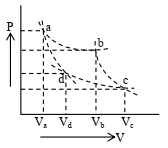 2024 Hard
- 23. A sample of gas at temperature \(T\) is adiabatically expanded to double its volume. The work done by the gas in the process is \(\left(\right.\) given, \(\left.\gamma=\frac{3}{2}\right)\) : 2023 Medium
- 24. Consider two containers \(A\) and \(B\) containing monoatomic gases at the same Pressure \((P)\), Volume \((V)\) and Temperature \((T)\). The gas in \(A\) is compressed isothermally to \(\frac{1}{8}\) of its original volume while the gas \(B\) is compressed adiabatically to \(\frac{1}{8}\) of its original volume. The ratio of final pressure of gas in \(B\) to that of gas in \(A\) is ........... 2023 Medium
- 25. Match List \(I\) with List \(II\) :
Choose the correct answer from the options given below : 2023 MediumList \(I\) List \(II\) \(A\) Isothermal Process \(I\) Work done by the gas decreases internal energy \(B\) Adiabatic Process \(II\) No change in internal energy \(C\) Isochoric Process \(III\) The heat absorbed goes partly to increase internal energy and partly to do work \(D\) Isobaric Process \(IV\) No work is done on or by the gas - 26. The initial pressure and volume of an ideal gas are \(P_0\) and \(V_0\). The final pressure of the gas when the gas is suddenly compressed to volume \(\frac{ V _0}{4}\) will be (Given \(\gamma=\) ratio of specific heats at constant pressure and at constant volume) 2023 Medium
- 27. A certain amount of gas of volume \(V\) at \(27^{o}\,C\) temperature and pressure \(2 \times 10^{7} \;Nm ^{-2}\) expands isothermally until its volume gets doubled. Later it expands adiabatically until its volume gets redoubled. The final pressure of the gas will be (Use \(\gamma=1.5\) ) 2022 Medium
- 28. A monoatomic gas at pressure \(P\) and volume \(V\) is suddenly compressed to one eighth of its original volume. The final pressure at constant entropy will be \(.....P\) 2022 Hard
- 29. Given below are two statement Statement \(-I\) : What \(\mu\) amount of an ideal gas undergoes adiabatic change from state \(\left( P _{1}, V _{1}, T _{1}\right)\) to state \(\left( P _{2}, V _{2}, T _{2}\right)\), the work done is \(W =\frac{1 R \left( T _{2}- T _{1}\right)}{1-\gamma}\), where \(\gamma=\frac{ C _{ P }}{ C _{ V }}\) and \(R =\) universal gas constant, Statement \(-II\) : In the above case. when work is done on the gas. the temperature of the gas would rise. Choose the correct answer from the options given below 2022 Medium
- 30. Starting with the same initial conditions, an ideal gas expands from volume \(V_{1}\) to \(V_{2}\) in three different ways. The work done by the gas is \(W_{1}\) if the process is purely isothermal. \(W _{2}\). if the process is purely adiabatic and \(W _{3}\) if the process is purely isobaric. Then, choose the coned option 2022 Medium
- 31. The pressure \(P_{1}\) and density \(d_{1}\) of diatomic gas \(\left(\gamma=\frac{7}{5}\right)\) changes suddenly to \(P _{2}\left(> P _{1}\right)\) and \(d _{2}\) respectively during an adiabatic process. The temperature of the gas increases and becomes \(......\) times of its initial temperature.\(\left(\right.\) given \(\left.\frac{ d _{2}}{ d _{1}}=32\right)\) 2022 Medium
- 32. A sample of gas with \(\gamma=1.5\) is taken through an adiabatic process in which the volume is compressed from \(1200\, {cm}^{3}\) to \(300\, {cm}^{3}\). If the initial pressure is \(200\, {kPa}\). The absolute value of the workdone by the gas in the process \(= \,..... J.\) 2021 Hard
- 33. For an adiabatic expansion of an ideal gas, the fractional change in its pressure is equal to (where \(\gamma\) is the ratio of specific heats): 2021 Medium
- 34. In the reported figure, there is a cyclic process \(ABCDA\) on a sample of \(1\, {mol}\) of a diatomic gas. The temperature of the gas during the process \({A} \rightarrow {B}\) and \({C} \rightarrow {D}\) are \({T}_{1}\) and \({T}_{2}\left({T}_{1}\,>\,{T}_{2}\right)\) respectively. Choose the correct option out of the following for work done if processes \(B C\) and \(D A\) are adiabatic.
 2021 Medium
- 35. Match List\(-I\) with List\(-II\)
Choose the correct answer from the options given below 2021 MediumList\(-I\) List\(-II\) \((a)\) Isothermal \((i)\) Pressure constant \((b)\) Isochoric \((ii)\) Temperature constant \((c)\) Adiabatic \((iii)\) Volume constant \((d)\) Isobaric \((iv)\) Heat content is constant - 36. Which one is the correct option for the two different thermodynamic processes ?
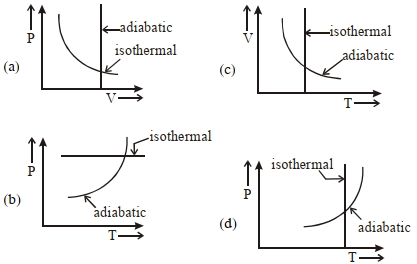 2021 Medium
- 37. A balloon filled with helium \(\left(32^{\circ} C \right.\) and \(1.7\; atm\).) bursts. Immediately afterwards the expansion of helium can be considered as 2020 Medium
- 38. A litre of dry air at \(STP\) expands adiabatically to a volume of \(3\) litres. If \(\gamma=1.40,\) the work done by air is\((3^{1.4}=4.6555)\) [Take air to be an ideal gas \(]\) 2020 Medium
- 39. An engine takes in \(5\) moles of air at \(20\,^{\circ} C\) and \(1\) \(atm,\) and compresses it adiabaticaly to \(1 / 10^{\text {th }}\) of the original volume. Assuming air to be a diatomic ideal gas made up of rigid molecules, the change in its internal energy during this process comes out to be \(X\, kJ\). The value of \(X\) to the nearest integer is 2020 Hard
- 40. In an adiabatic process, the density of a diatomic gas becomes \(32\) times its initial value. The final pressure of the gas is found to be \(n\) times the initial pressure. The value of \(n\) is 2020 Medium
- 41. Match the thermodynamic processes taking place in a system with the correct conditions. In the table: \(\Delta Q\) is the heat supplied, \(\Delta W\) is the work done and \(\Delta U\) is change in internal energy of the system
2020 MediumProcess Condition \((I)\) Adiabatic \((A)\; \Delta W =0\) \((II)\) Isothermal \((B)\; \Delta Q=0\) \((III)\) Isochoric \((C)\; \Delta U \neq 0, \Delta W \neq 0 \Delta Q \neq 0\) \((IV)\) Isobaric \((D)\; \Delta U =0\) - 42. Starting at temperature \(300\; \mathrm{K},\) one mole of an ideal diatomic gas \((\gamma=1.4)\) is first compressed adiabatically from volume \(\mathrm{V}_{1}\) to \(\mathrm{V}_{2}=\frac{\mathrm{V}_{1}}{16} .\) It is then allowed to expand isobarically to volume \(2 \mathrm{V}_{2} \cdot\) If all the processes are the quasi-static then the final temperature of the gas (in \(\left. \mathrm{K}\right)\) is (to the nearest integer) 2020 Hard
- 43. A rigid diatomic ideal gas undergoes an adiabatic process at room temperature. The rational between temperature and volume for the process is \(TV^x =\) constant, then \(x\) is 2019 Medium
- 44. The given diagram shows four processes i.e., isochoric, isobaric, isothermal and adiabatic. The correct assignment of the processes, in the same order is given by
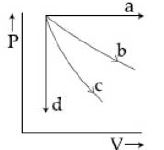 2019 Medium
- 45. Two moles of an ideal monoatomic gas occupies a volume \(V\) at \(27^o C\). The gas expands adiabatically to a volume \(2\ V\). Calculate \((a)\) the final temperature of the gas and \((b)\) change in its internal energy. 2018 Medium
- 46. Consider a spherical shell of radius \(R\) at temperature \(T\). The black body radiation inside it can be considered as an ideal gas of photons with internal energy per unit volume\(E=\) \(\frac{U}{V} \propto {T^4}\) and pressure \(P = \frac{1}{3}\left( {\frac{U}{V}} \right)\) If the shell now undergoes an adiabatic expansion the relation between \(T\) and \(R\) is 2015 Hard
- 47. During an adiabatic compression, \(830\, J\) of work is done on \(2\, moles\) of a diatomic ideal gas to reduce its volume by \(50\%\). The change in its temperahture is nearly..... \(K\) \((R\, = 8.3\, J\,K^{-1}\, mol^{-1} )\) 2014 Medium
- 48. The equation of state for a gas is given by \(PV = nRT + \alpha V\), where \(n\) is the number of moles and \(\alpha \) is a positive constant. The initial temperature and pressure of one mole of the gas contained in a cylinder are \(T_o\) and \(P_o\) respectively. The work done by the gas when its temperature doubles isobarically will be 2014 Hard
- 49. An ideal gas at atmospheric pressure is adiabatically compressed so that its density becomes \(32\) times of its initial value. If the final pressure of gas is \(128\) atmosphers, the value of \(\gamma\) the gas is 2013 Medium
No questions on this page match these filters.
Other STD 11 - Thermodynamics topics
Frequently asked
How many Adiabatic Process questions came in JEE Mains?
49 questions from 2013–2026, each with the correct answer and a full solution.
How difficult are Adiabatic Process questions?
14% are easy, 55% medium and 31% hard.