


Questions
Newest firstShowing 1–50 of 55 questions
-
- (A) \(12\)
- (B) \(16\)
- (C) \(14\)
- (D) \(18\)
Show answer and solution
Correct Answer: (D)
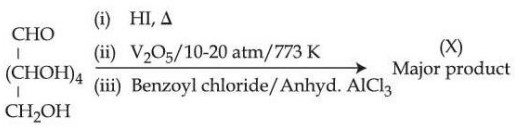
Step 1: The starting material is an aldohexose (like D-glucose). On prolonged heating with \(HI\), it undergoes reduction to form n-hexane. This indicates that all six carbon atoms are linked in a straight chain.
\(\text{CHO}-(\text{CHOH})_4-\text{CH}_2\text{OH} \xrightarrow{\text{HI, } \Delta} \text{CH}_3-\text{CH}_2-\text{CH}_2-\text{CH}_2-\text{CH}_2-\text{CH}_3\) (n-hexane)
Step 2: n-Hexane, when passed over heated \(V_2O_5\) at \(773 \text{ K}\) and \(10-20 \text{ atm}\) pressure, undergoes aromatization (dehydrogenation and cyclization) to form benzene.
\(\text{n-hexane} \xrightarrow{V_2O_5, \text{ 773 K, 10-20 atm}} \text{C}_6\text{H}_6\) (Benzene)
Step 3: Benzene reacts with benzoyl chloride (\(\text{C}_6\text{H}_5\text{COCl}\)) in the presence of anhydrous \(\text{AlCl}_3\) to form benzophenone. This is a Friedel-Crafts acylation reaction.
\(\text{C}_6\text{H}_6 + \text{C}_6\text{H}_5\text{COCl} \xrightarrow{\text{Anhyd. AlCl}_3} \text{C}_6\text{H}_5-\text{CO}-\text{C}_6\text{H}_5\) (Benzophenone)
Step 4: Analyze the product (X), which is benzophenone.
The structure of benzophenone consists of two phenyl rings attached to a carbonyl group.
- Each phenyl ring contains \(3\) \(\pi\) bonds, so two rings have \(6\) \(\pi\) bonds.
- The carbonyl group (\(\text{C=O}\)) contains \(1\) \(\pi\) bond.
- Total number of \(\pi\) bonds = \(6 + 1 = 7\).
- Total number of \(\pi\) electrons = \(7 \times 2 = 14\).
- The oxygen atom in the carbonyl group has \(2\) lone pairs of electrons.
- Total number of lone pair electrons = \(2 \times 2 = 4\).
Total number of electrons in the \(\pi\) bonds and lone pairs = \(14 + 4 = 18\).
Answer: \(18\) - 2. From the given following \(( A\) to D \()\) cyclac structures, those which will not react with Tollen's reagent are :
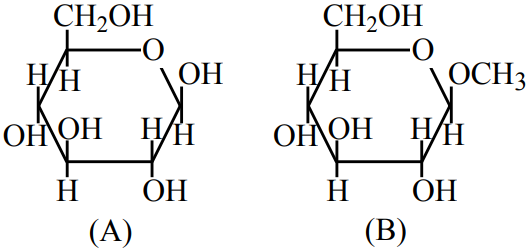
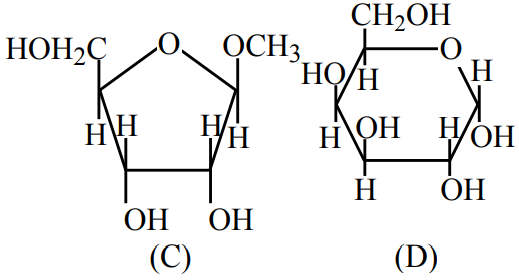 2026 Medium
- (A) B and D
- (B) A and D
- (C) A and B
- (D) B and C
Show answer and solution
Correct Answer: (D)
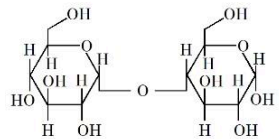
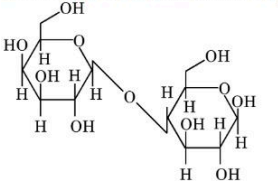
Compounds in option (B) and (C) are acetals (i.e. not having anomeric -OH). Hence they do not give Tollen's test. -
- (A) Statement I is false but Statement II is true.
- (B) Both Statement I and Statement II are false.
- (C) Both Statement I and Statement II are true.
- (D) Statement I is true but Statement II is false.
Show answer and solution
Correct Answer: (D)
\(\begin{array}{r} C _{12} H _{22} O _{11}+ H _2 O \xrightarrow{ HCl } C _6 H _{12} O _6+ C _6 H _{12} O _6 \\ \text { D- Glucose + D fructose }\end{array}\)
\([\alpha]_{D \text {-sucrose }}=+66.5^{\circ}, \quad[\alpha]_{D \text {-Glucose }}=+52.5^{\circ}\),
\([\alpha]_{\text {D-Fructose }}=-92.4^{\circ}\)
⇒ Sucrose is dextrorotatory and hydrolysed product is laevorotatory. -
- (A) Both Statement I and Statement II are true
- (B) Both Statement I and Statement II are false
- (C) Statement I is true but Statement II is false
- (D) Statement I is false but Statement II is true
Show answer and solution
Correct Answer: (D)
Maltose is a disaccharide composed of two \(\alpha\)-D-glucose units linked by an \(\alpha(1 \rightarrow 4)\) glycosidic bond. The anomeric carbon (C1) of the second glucose unit has a free hemiacetal group, which can open to form an aldehyde. Therefore, maltose can reduce Tollens' and Fehling's reagents, making it a reducing sugar. Statement I claims that maltose is a non-reducing sugar, so it is false.
Lactose is a disaccharide composed of \(\beta\)-D-galactose and D-glucose linked by a \(\beta(1 \rightarrow 4)\) glycosidic bond. Similar to maltose, the anomeric carbon (C1) of the glucose unit in lactose has a free hemiacetal group. This allows it to act as a reducing agent. Statement II correctly identifies lactose as a reducing sugar, so it is true.
Therefore, Statement I is false but Statement II is true.
Answer: Statement I is false but Statement II is true -
- (A) Both Statement I and Statement II are true
- (B) Both Statement I and Statement II are false
- (C) Statement I is true but Statement II is false
- (D) Statement I is false but Statement II is true
Show answer and solution
Correct Answer: (A)
Statement I is true because the \(\alpha\) and \(\beta\) forms of D-(+)-glucose are cyclic hemiacetals that differ only in the configuration of the hydroxyl group at C1, which is the anomeric carbon. Such isomers are called anomers.
Statement II is true because the open chain structures of D-glucose and D-fructose have identical configurations at C3, C4, and C5. D-glucose is an aldohexose with chiral centers at C2, C3, C4, and C5, while D-fructose is a ketohexose with chiral centers at C3, C4, and C5. The stereochemistry at C3 (hydroxyl group on the left), C4 (hydroxyl group on the right), and C5 (hydroxyl group on the right) is exactly the same in both sugars.
Therefore, both Statement I and Statement II are true.
Answer: Both Statement I and Statement II are true -
- (A) A and B Only
- (B) B and C Only
- (C) A, B and D Only
- (D) A, B and E Only
Show answer and solution
Correct Answer: (D)
Statement A is correct because glucose exists in two anomeric forms, \(\alpha\)-D-glucose and \(\beta\)-D-glucose.
Statement B is correct because the two anomers differ only in the configuration of the hydroxyl group at C\(-1\), which is the anomeric carbon in the cyclic hemiacetal structure.
Statement C is incorrect because the melting point of the \(\alpha\)-anomer is \(419\) K, which is less than the melting point of the \(\beta\)-anomer (\(423\) K).
Statement D is incorrect because the specific rotation of the \(\alpha\)-anomer is \(+112^{\circ}\) and that of the \(\beta\)-anomer is \(+19^{\circ}\).
Statement E is correct because the \(\alpha\)-form is obtained by crystallization from a concentrated solution of glucose at \(303\) K, while the \(\beta\)-form is obtained by crystallization from a hot and saturated aqueous solution at \(371\) K.
Thus, statements A, B, and E are correct.
Answer: A, B and E Only -
- (A) All monosaccharides are reducing sugars.
- (B) The monosaccharide units obtained from hydrolysis of oligosaccharides are always the same.
- (C) Starch and cellulose are typical examples of polysaccharides, which are very high molecular weight compounds of more than ten monosaccharide units.
- (D) Open chain and cyclic structures co-exist at equilibrium that are responsible for certain properties as in the case of \(D-(+)\)-glucose.
Show answer and solution
Correct Answer: (B)
Statement (A) is correct because all monosaccharides contain a free aldehyde or ketonic group (or exist in equilibrium with it) and act as reducing sugars.
Statement (B) is incorrect because the hydrolysis of oligosaccharides can yield either the same or different monosaccharide units. For example, sucrose is an oligosaccharide (disaccharide) that yields one molecule of glucose and one molecule of fructose upon hydrolysis, whereas maltose yields two molecules of glucose.
Statement (C) is correct as polysaccharides like starch and cellulose are high molecular weight polymers containing more than ten monosaccharide units.
Statement (D) is correct because in an aqueous solution, \(D-(+)\)-glucose exists in an equilibrium between its open-chain form and its cyclic hemiacetal forms (\(\alpha\) and \(\beta\) anomers), which explains its mutarotation and other properties.
Answer: The monosaccharide units obtained from hydrolysis of oligosaccharides are always the same. -
- (A) Statement I is false but Statement II is true
- (B) Both Statement I and Statement II are false
- (C) Both Statement I and Statement II are true
- (D) Statement I is true but Statement II is false
Show answer and solution
Correct Answer: (A)
- D-glucose pentaacetate do not react with 2.4 DNP
- Starch \(\frac{\text { conc. } \mathrm{H}_2 \mathrm{SO}_4}{\Delta}\) Glucose
\(\begin{gathered}2-3 \mathrm{~atm} \\ 100^{\circ} \mathrm{C}\end{gathered}\) -
- (A) Both Statement I and Statement II are true.
- (B) Statement I is false but Statement II are true.
- (C) Statement I is true but Statement II is false.
- (D) Both Statement I and Statement II are false.
Show answer and solution
Correct Answer: (B)
On hydrolysis of sucrose gives D-(+)-glucose and D-(-)-fructose while in Statement (1) D-(+)-fructose is given evince Statement-(1) is incorrect.
Statement II - It is correct because sucrose on hydrolysis gives invert sugar -
- (A) Statement I is false but Statement II is true
- (B) Statement I is true but Statement II is false
- (C) Both Statement I and Statement II are true
- (D) Both Statement I and Statement II are false
Show answer and solution
Correct Answer: (B)
Cellulose derivcative has more number of hydroxy groups, so more H -bonding is present with water in cellulose derivatives cotton cloths. -
- (A) (A), (B) and (C) only
- (B) (B), (C) and (E) only
- (C) (C), (D) and (E) only
- (D) (B), (C) and (D) only
Show answer and solution
Correct Answer: (B)
\((\mathrm{A})\) Starch \(\xrightarrow{\mathrm{H}^{+} / \mathrm{H}_2 \mathrm{O}}\) Glucose
(B) Cane sugar \(\xrightarrow{\mathrm{H}^{+} / \mathrm{H}_2 \mathrm{O}}\) glucose + fructose (Sucrose) \(50 \% \quad 50 \%\)
(C) Milk sugar \(\xrightarrow{\mathrm{H}^{+} / \mathrm{H}_2 \mathrm{O}}\) glucose + galactose (Lactose)
(D) Amylopectin \(\xrightarrow{\mathrm{H}^{+} / \mathrm{H}_2 \mathrm{O}}\) Glucose
(E) Amylose \(\xrightarrow{\mathrm{H}^{+} / \mathrm{H}_2 \mathrm{O}}\) Glucose
So, correct options are B,C,and E only. - 12. Identify the number of structures from the following which can be correlated to D-glyceraldehyde.
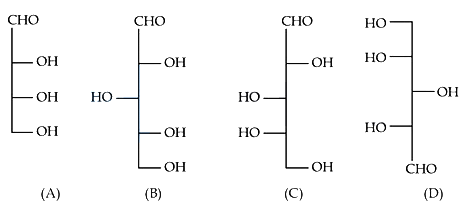 2025 Medium
- (A) four
- (B) one
- (C) two
- (D) three
Show answer and solution
Correct Answer: (D)
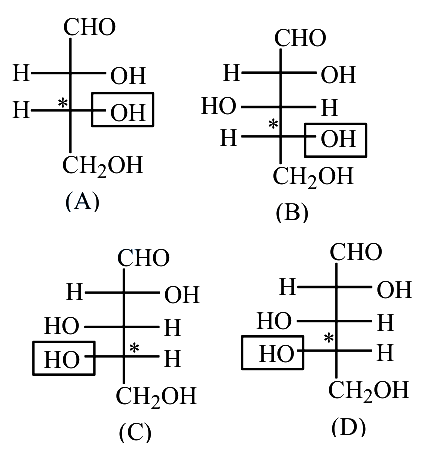
In \(\mathrm{A}, \mathrm{B}, \mathrm{D}^*-\mathrm{OH}\) group in right hand side then D-configuration is assign -
- (A) (A)-(IV), (B)-(I), (C)-(III), (D)-(II)
- (B) (A)-(III), (B)-(II), (C)-(I), (D)-(IV)
- (C) (A)-(II), (B)-(III), (C)-(I), (D)-(IV)
- (D) (A)-(IV), (B)-(I), (C)-(II), (D)-(III)
Show answer and solution
Correct Answer: (D)
Amylose \(\Rightarrow \mathrm{It}\) is a plant based starch it has \(\alpha-\mathrm{C}_1-\mathrm{C}_4\) glycosidic linkage.
Cellulose \(\Rightarrow\) It has \(\beta-\mathrm{C}_1-\mathrm{C}_4\) glycosidic linkage
Glycogen \(\Rightarrow\) It has \(\alpha-\mathrm{C}_1-\mathrm{C}_4\) and glycosidic linkage (animal starch)
Amylopectin \(\Rightarrow\) It is a plant based with \(\alpha-\mathrm{C}_1-\mathrm{C}_4\) and \(\mathrm{C}_1-\mathrm{C}_6\) glycosidic linkage -
- (A) (A)-(IV), (B)-(II), (C)-(I), (D)-(III)
- (B) (A)-(I), (B)-(II), (C)-(III), (D)-(IV)
- (C) (A)-(III), (B)-(I), (C)-(IV), (D)-(II)
- (D) (A)-(II), (B)-(IV), (C)-(III), (D)-(I)
Show answer and solution
Correct Answer: (C)
(A) Sucrose \(\rightarrow \alpha_1-\beta_2\) Glycosidic linkage
(B) Maltose \(\rightarrow \alpha\) 1-4 Glycosidic linkage
(C) Lactose \(\rightarrow \beta\) 1-4 Glycosidic linkage
(D) Amylopectin \(\rightarrow \alpha 1-4\) and \(\alpha 1-6\)
Glycosidic linkage
A-III, B-I, C-IV, D-II -
- (A) A, D and E Only
- (B) A, C and D Only
- (C) A, B and E Only
- (D) B, D and E Only
Show answer and solution
Correct Answer: (B)
In Ribose carbohydrate present in DNA is \(\beta-2-\) Deoxy-D-Ribose whose structure is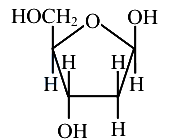
which is a reducing \(D\)-sugar in \(\beta\) anomeric form & it is a pentose sugar. -
- (A) \(A-IV, B-I, C-III, D-II\)
- (B) \(A-II, B-IV, C-III, D-I\)
- (C) \(A-III, B-II, C-I, D-IV\)
- (D) \(A-I, B-IV, C-III, D-II\)
Show answer and solution
Correct Answer: (B)
Glucose \(\xrightarrow[\Delta]{\mathrm{NaHCO}_3}\) no reactionGlucose \(\xrightarrow[\Delta]{\mathrm{HNO}_3}\) saccharic acid
Glucose \(\xrightarrow[\Delta]{\mathrm{HI}}\) n-hexane
Glucose \(\xrightarrow[\Delta]{\mathrm{Br}_2}\) Gluconic acid
-
- (A) \(A-III, B-IV, C-II, D-I\)
- (B) \(A-III, B-IV, C-I, D-II\)
- (C) \(A-IV, B-III, C-I, D-II\)
- (D) \(A-IV, B-III, C-II, D-I\)
Show answer and solution
Correct Answer: (C)
Based on biomolecules theory and structure of these named compounds -\((A)\) \(\alpha\)-Glucose and \(\alpha\)-Galactose (\(IV\)) Epimers.
\((B)\) \(\alpha\)-Glucose and \(\beta\)-Glucose (\(III\)) Anomers
\((C)\) \(\alpha\)-Glucose and \(\alpha\)-Fructose (\(I\)) Functional isomers
\((D)\) \(\alpha\)-Glucose and \(\alpha\)-Ribose
\((II)\) Homologous
- 18. Sugar which does not give reddish brown precipitate with Fehling's reagent is _______. 2024 Hard
- (A) Sucrose
- (B) Lactose
- (C) Glucose
- (D) Maltose
Show answer and solution
Correct Answer: (A)
Sucrose do not contain hemiacetal group.Hence it does not give test with Fehling solution.
While all other give positive test with Fehling solute.
-
- (A) Glucose is soluble in water because of having aldehyde functional group
- (B) Glucose remains in multiple isomeric form in its aqueous solution
- (C) Glucose is an aldohexose
- (D) Glucose is one of the monomer unit in sucrose
Show answer and solution
Correct Answer: (A)
Glucose is soluble in water due to presence of alcohol functional group and extensive hydrogen bonding.Glucose exist is open chain as well as cyclic forms in its aqueous solution.
Glucose having \(6 \mathrm{C}\) atoms so it is hexose and having aldehyde functional group so it is aldose.
Thus, aldohexose.
Glucose is monomer unit in sucrose with fructose.
-
- (A) Can be oxidized to a dicarboxylic acid with \(\mathrm{Br}_2\) water
- (B) despite the presence of - \(\mathrm{CHO}\) does not give Schiff's test
- (C) has \(4\)-asymmetric carbon atom
- (D) will coexist in equilibrium with \(2\) other cyclic structure
Show answer and solution
Correct Answer: (A)
statement \(1\) is incorrect (monocarboxylic acid)
\((2)\) correct
\((3)\) \(c.c.\) is \(4\) (correct)
-
- (A) \(P \rightarrow iv,Q \rightarrow iii,R \rightarrow i, S \rightarrow ii\)
- (B) \(P \rightarrow i , Q \rightarrow\) ii, \(R \rightarrow\) iii, \(S \rightarrow\) iv
- (C) \(P \rightarrow iii, i \rightarrow iv , R \rightarrow ii, S \rightarrow i\)
- (D) \(P \rightarrow iii, Q \rightarrow iv, R \rightarrow i, S \rightarrow ii\)
Show answer and solution
Correct Answer: (D)
(from the given options best answer is \(D\))
-
- (A) \(2\)
- (B) \(4\)
- (C) \(3\)
- (D) \(5\)
Show answer and solution
Correct Answer: (A)
Both Amylose and Sucrose does not give Benedict's test.
-
- (A) starch
- (B) cellulose
- (C) amylose
- (D) amylopectin
Show answer and solution
Correct Answer: (B)
Cellulose contains \(\beta-\) glycosidic linkages only -
- (A) amylose
- (B) maltose
- (C) glycogen
- (D) amylopectin
Show answer and solution
Correct Answer: (C)
Glycogen -
- (A) \(A-III, B-IV. C-II. D-I\)
- (B) \(A-III. B-II. C-I. D-IV\)
- (C) \(A-IV, B-IIL C-I. D-II\)
- (D) \(A-IV, B-II. C-III. D-I\)
Show answer and solution
Correct Answer: (C)
Invertase : Cane sugar \(\rightarrow\) Glucose and fructoseZymase : Glucose \(\rightarrow\) Ethanol and \(CO _{2}\)
Diastase : Starch \(\rightarrow\) Maltose
Maltase : Maltose \(\rightarrow\) Glucose
-
- (A) Maltose
- (B) Sucrose
- (C) Lactose
- (D) Strach
Show answer and solution
Correct Answer: (B)
\(C _{12} H _{22} O _{11}+ H _{2} O \stackrel{ H ^{+}}{\longrightarrow} C _{6} H _{12} O _{6}+ C _{6} H _{12} O _{6}\)\([\alpha]=66.6^{\circ} \quad\quad\quad\quad\quad\) \(D-\)Glucose \(\quad D-\)Fructose
\(\quad\quad\quad\quad\quad\quad\quad\quad\quad[\alpha]=+52.7^{\circ}_{(A)} \quad[\alpha]=-92.2^{\circ}_{(B)}\)

- 27. A non-reducing sugar \("A"\) hydrolyses to give two reducing mono saccharides. Sugar \(A\) is 2021 Medium
- (A) Fructose
- (B) Galactose
- (C) Glucose
- (D) Sucrose
Show answer and solution
Correct Answer: (D)
Sucrose \(\quad \stackrel{ H _{2} O }{\longrightarrow}\) glucose \(+\) Fructose(Non reducing sugar) \(\quad\) (Re ducing sugar) \(\quad\) (Reducing sugar)
-
- (A) Amylase and Invertase
- (B) Invertase and Amylase
- (C) Invertase and Zymase
- (D) Zymase and Invertase
Show answer and solution
Correct Answer: (C)
Informative\(OR\)
\(C _{12} H _{22} O _{11}+ H _{2} O \stackrel{\text { Invertase }}{\longrightarrow} C _{6} H _{12} O _{6}+ C _{6} H _{12} O _{6}\)
\(\quad \quad\quad\quad\quad\quad\quad\quad\quad\quad\quad\)Glucose \(\quad\quad\) Fructose
\(C _{6} H _{12} O _{6} \stackrel{\text { Zymase }}{\longrightarrow} 2 C _{6} H _{5} OH +2 CO _{2}\)
- 29. Compound \(A\) gives \(D-\)Galactose and \(D-\)Glucose on hydrolysis. The compound \(A\) is: 2021 Medium
- (A) Lactose
- (B) Amylose
- (C) Sucrose
- (D) Maltose
Show answer and solution
Correct Answer: (A)
Lactose : It is a disaccharide of \(\beta\)-D-Galactose and \(\beta\)-D-Glucose with \(\mathrm{C}_{1}\) of galactose and \(\mathrm{C}_{4}\) of glucoselink.Lactose : \(\beta-D-\)Galactose \(+\beta-D-\)Glucose.
-
- (A) Pyranose
- (B) Ketohexose
- (C) Aldohexose
- (D) Heptose
Show answer and solution
Correct Answer: (B)
Fructose is a ketohexose.
-
- (A) Both \((A)\) and \((R)\) are true but \((R)\) is not the true explanation of \((A)\)
- (B) \((A)\) is false but \((R)\) is true.
- (C) \((A)\) is true but \((R)\) is false
- (D) Both \((A)\) and \((R)\) are true and \((R)\) is the true explanation of \((A)\)
Show answer and solution
Correct Answer: (C)
Surcrose is example of disaccharide and non reducing sugarAssertion : correct
Sucrose involves glycosidic linkage between \(\mathrm{C}_{1}\) of \(\alpha-\mathrm{D}\)-glucose \(\mathrm{C}_{2}\) of \(\beta\)-D-fructose
Reason : Incorrect
-
- (A) \(\alpha-\mathrm{D}-(-)\)-Glucose and \(\beta-\mathrm{D}-(-)\)-Fructose
- (B) \(\alpha-\mathrm{D}-(+)\)-Glucose and \(\alpha-\mathrm{D}-(-)\)-Fructose
- (C) \(\alpha-\mathrm{D}-(-)\)-Glucose and \(\alpha-\mathrm{D}-(+)\)-Fructose
- (D) \(\alpha\)-D-(+)-Glucose and \(\beta-D-(-)\)-Fructose
Show answer and solution
Correct Answer: (D)
Sucrose is formed by \(\alpha-\mathrm{D}(+) .\) Glucose \(+\beta-\mathrm{D}(-)\) Fructose.we obtain these monomers on hydrolysis.
-
- (A) Glycogen is called as animal starch
- (B) \(\beta\)-Glycosidic linkage makes cellulose polymer
- (C) Amylose is a branched chain polymer of glucose
- (D) Starch is a polymer of \(\alpha-D\) glucose
Show answer and solution
Correct Answer: (C)
Amylose is a linear chain polymer of \(\alpha-D-\)glucosewhile amylopectine is branched chain polymer of \(\alpha-D-\)glucose. -
- (A) \(( a ) \rightarrow( i ),( b ) \rightarrow( iii ),( c ) \rightarrow( ii )\)
- (B) \(( a ) \rightarrow( iii ),( b ) \rightarrow( i ),( c ) \rightarrow( iii )\)
- (C) \((a) \rightarrow (ii), (b) \rightarrow (i), (c) \rightarrow (iii)\)
- (D) \((a) \rightarrow (iii), (b) \rightarrow (ii), (c) \rightarrow (i)\)
Show answer and solution
Correct Answer: (C)
\((1)\) Sucrose \(\rightarrow \alpha\) -D-Glucose and \(\beta\) -D-Fructose\((2)\) Lactose \(\rightarrow \beta-D\) -Galactose and \(\beta-D\) -Glucose
\((3)\) Maltose \(\rightarrow \alpha\) -D-Glucose and \(\alpha\) -D-Glucose
\(a \rightarrow II\)
\(b \rightarrow I\)
\(c \rightarrow III\)
-
- (A) \(C -1\) of galactose and \(C -4\) of glucose
- (B) \(C -1\) of glucose and \(C -6\) of galactose
- (C) \(C -1\) of glucose and \(C -4\) of galactose
- (D) \(C -1\) of galactose and \(C -6\) of glucose
Show answer and solution
Correct Answer: (A)
In lactose linkage is formed between \(C _{1}\) of galactose and \(C _{4}\) of gluocse.
- 36. Which one among the following chemical tests is used to distinguish monosaccharide from disaccharide? 2021 Easy
- (A) Barfoed test
- (B) Seliwanoff's test
- (C) Tollen's test
- (D) Iodine test
Show answer and solution
Correct Answer: (A)
Barford test is used for distinguish mono-saccharide from disaccharide - 37. Which one of the following compounds contains \(\beta-\mathrm{C}_{1}-\mathrm{C}_{4}\) glycosidic linkage ? 2021 Easy
- (A) Lactose
- (B) Sucrose
- (C) Maltose
- (D) Amylose
Show answer and solution
Correct Answer: (A)
In Lactose it is \(\beta\, \mathrm{C}_{1}-\mathrm{C}_{4}\) glycosidic linkage.In Maltose, Amylose \(\alpha \,\mathrm{C}_{1}-\mathrm{C}_{4}\) glycosidic linkage is present
-
- (A) \(A =\) Glucose, \(B =\) Fructose, \(C =\) Albumin
- (B) \(A =\) Lactose, \(B =\) Fructose, \(C =\) Alanine
- (C) \(A =\) Lactose, \(B =\) Glucose, \(C =\) Alanine
- (D) \(A =\) Lactose, \(B =\) Glucose, \(C =\) Albumin
Show answer and solution
Correct Answer: (D)
Alanine does not show Biuret test because Biuret test is used for deduction of peptide linkage & alanine is amino acid.Albumine is protein so have paptide linkage so it gives positive Biuret test.
Positive Barfoed test is shown by monosaccharide but not disaccharide. Positive Molisch's test is shown by glucose.
-
- (A) \(A \): Aspartame ; \(B \): Saccharin ; \(C \): Sucralose ;\( D \); Alitame
- (B) \(A\) : Alitame ; \(B \): Saccharin ; \(C\) : Aspartame ; \(D\) ; Sucralose
- (C) \(A\) : Saccharin ; \(B\) : Alitame ; \(C\) : Sucralose ; \(D\) ; Aspartame
- (D) \(A\) : Aspartame ; \(B\) : Alitame ; \(C\) : Saccharin ;\( D\) ; Sucralose
Show answer and solution
Correct Answer: (A)
(i) Blue voilet color with Ninhydrine \(\rightarrow\) amino acid derivative. So it cannot be saccharide or sucralose.(ii) Lassaigne extract give + ve test with \(\mathrm{AgNO}_{3} .\) So \(\mathrm{Cl}\) is present, -ve test with \(\mathrm{Fe}_{4}\left[\mathrm{Fe}(\mathrm{CN})_{6}\right]_{3}\) means \(\mathrm{N}\) is absent. So it can't be Aspartame or Saccharine or Alitame, so \(\mathrm{C}\) is sucralose.
(iii) Lassaigne solution of \(B\) and \(D\) given \(+ve\) sodium nitroprusside test, so it is having \(S\), so it is Saccharine and Alitame.

-
- (A) \(5,6, \& 5\)
- (B) \(4,5 \& 5\)
- (C) \(5,4 \& 5\)
- (D) \(4,6 \& 5\)
Show answer and solution
Correct Answer: (D)
\((i)\) Glucose \(+\) dry \(HCl\) \(\xrightarrow{{ROH}}\) Acetal \(\xrightarrow[{{{\left( {C{H_3}CO} \right)}_2}O}]{{x\,\,Eq}}\) acetyl derivative\((ii)\) Glucose \(\xrightarrow{{Ni/{H_2}}}A\xrightarrow[{{{\left( {C{H_3}CO} \right)}_2}O}]{{y\,Eq}}\) Acetyl derivative
\((iii)\) Glucose \(\xrightarrow[{{{\left( {C{H_3}CO} \right)}_2}O}]{{z\,Eq}}\) Acetyl derivative due to presence of \(- OH\) group in Glucose the reaction is
\((ii)\)\(\begin{array}{*{20}{c}} {CH = O\,\,\,\,\,\,\,\,\,\,\,\,\,} \\ {|\,\,\,\,\,\,\,\,\,\,\,\,\,\,\,\,\,\,\,\,\,\,\,\,\,\,\,\,\,\,\,\,\,} \\ {{{\left( {CH - OH} \right)}_4}} \\ {|\,\,\,\,\,\,\,\,\,\,\,\,\,\,\,\,\,\,\,\,\,\,\,\,\,\,\,\,\,\,} \\ {C{H_2} - OH\,\,\,\,\,\,} \end{array}\)\(\xrightarrow[{{H_2}}]{{Ni}}\begin{array}{*{20}{c}} {C{H_2} - OH\,\,\,\,\,\,\,\,\,\,} \\ {|\,\,\,\,\,\,\,\,\,\,\,\,\,\,\,\,\,\,\,\,\,\,\,\,\,\,\,\,\,\,\,\,\,\,\,\,\,\,} \\ {{{\left( {CH - OH} \right)}_4}\,\xrightarrow[{A{c_2}O}]{{6\,Eq.}}} \\ {|\,\,\,\,\,\,\,\,\,\,\,\,\,\,\,\,\,\,\,\,\,\,\,\,\,\,\,\,\,\,\,\,\,\,\,\,\,\,\,\,} \\ {C{H_2} - OH\,\,\,\,\,\,\,\,\,\,\,\,\,} \end{array}\)
\(\begin{array}{*{20}{c}} {C{H_2} - OAc\,\,\,\,\,\,\,} \\ {|\,\,\,\,\,\,\,\,\,\,\,\,\,\,\,\,\,\,\,\,\,\,\,\,\,\,\,\,\,\,\,\,\,\,} \\ {\left( {C{H_2} - OAc} \right)} \\ {|\,\,\,\,\,\,\,\,\,\,\,\,\,\,\,\,\,\,\,\,\,\,\,\,\,\,\,\,\,\,\,\,\,} \\ {C{H_2} - OAc\,\,\,\,\,\,} \end{array}\)

-
- (A) Formation of blue colour
- (B) Formation of violet colour
- (C) Formation of red colour
- (D) Gives no colour
Show answer and solution
Correct Answer: (C)
Seliwanoff's test is used to distinguish between aldose and ketone sugars; when added to a solution containing ketose, red colour is formed rapidlySucrose.\(\xrightarrow{{{\text{Hydrolysis}}}}\)\(\begin{array}{*{20}{c}} {{\text{Glucose}}} \\ + \\ {{\text{Fructose}}} \end{array}\)\(\xrightarrow[{{\text{reagent}}}]{{{\text{Seliwanoff's}}}}\,\)Red colour
-
- (A) \(\alpha-D-\) glucose and \(\beta-\mathrm{D}-\) glucose
- (B) \(\alpha-D-\) glucose and \(\alpha -D-\)Fructose
- (C) \(\alpha-D-\) glucose and \(\alpha -D-\)glucose
- (D) \(\alpha-D-\) glucose and \(\alpha -D-\)galactose
Show answer and solution
Correct Answer: (C)
Two monomers in maltose are \(\alpha\) -D-glucose and \(\alpha\) -D-glucose -
- (A) The pentaacetate of glucose does not react with hydroxylamine to give oxime
- (B) Glucose gives Schiff's test for aldehyde
- (C) Glucose exists in two crystalline forms \(\alpha\) and \(\beta\)
- (D) Glucose reacts with hydroxylamine to form oxime
Show answer and solution
Correct Answer: (B)
Glucose gives negative test with Schiff reagent -
- (A) \(\alpha-D-\) glucose, \(C_1-C_4\) and \(C_2-C_6\) linkages
- (B) \(\beta-D-\) glucose, \(C_1-C_4\) and \(C_2-C_6\) linkages
- (C) \(\alpha-D-\) glucose, \(C_1-C_4\) and \(C_1-C_6\) linkages
- (D) \(\beta-D-\) glucose, \(C_1-C_4\) and \(C_1-C_6\) linkages
Show answer and solution
Correct Answer: (C)
Amylopetcin is a homopolymer of \(a-D-\) glucose where \(C_1-C_4\) linkage and \(C_1 -C_6\) linkage are present -
- (A) Benedict’s test
- (B) Fehling’s test
- (C) Barfoed’s test
- (D) Seliwanoff’s test
Show answer and solution
Correct Answer: (D)
Barfoed's test \(\to \) Detecting presence of monosaccharidesFehling's test \(\to \) For aldehyes
Benedict's test \(\to \) For reduving sugars
Seliwanoff's test \(\to \) Differentiate between aldose and ketose
-
- (A) The glycosidic linkage is present between \(C_1\) of \(\alpha -\) glucose and \(C_1\) of \(\beta -\) fructose
- (B) It is a non-reducing sugar
- (C) It is also named as invert sugar
- (D) On hydrolysis it produces glucose and fructose
Show answer and solution
Correct Answer: (A)
\(C_1\) of \(\alpha -\) glucose and \(C_2\) of \(\beta -\) fructose -
- (A) It is present in some yeast and fungi
- (B) It is present in animal cells
- (C) Only \(\alpha -\) linkages are present in the molecule
- (D) It is a straight chain polymer similar to amylase
Show answer and solution
Correct Answer: (D)
Glycogen is a multibranched polysaccharide. -
- (A) Cellulose and amylose have \(1,4-\) glycosidic linkage
- (B) Lactose contains \(\beta -D-\) galactose and \(\beta -D-\) glucose
- (C) Maltose and lactose have \(1,4-\) glycosidic linkage
- (D) Sucrose and amylose have \(1 ,2-\) glycosidic linkage
Show answer and solution
Correct Answer: (D)
In amylose \(1, 4-\alpha -\) glycosidic linkage is present - 49. Accumulation of which of the following molecules in the muscles occurs as a result of vigorous exercise ? 2015 Hard
- (A) Glycogen
- (B) Glucose
- (C) Pyruvic acid
- (D) \(L-\) lactic acid
Show answer and solution
Correct Answer: (D)
\(\underset{\begin{smallmatrix}
stored\,\,in \\
the\,\,form\,\,of\,\,\downarrow
\\
Glycogen
\end{smallmatrix}}{\mathop{Glu\cos e}}\,\,\xrightarrow[\begin{smallmatrix}
(does\,\,not\,\,need\,\,oxygen; \\
enzymes\,\,are\,\,need\,\,only)
\end{smallmatrix}]{1}\)\(\underset{\underset{Lactic\,\,acid}{\mathop{\downarrow }}\,}{\mathop{Pyruvic\,\,acid}}\,\xrightarrow{{{O}_{2}}}C{{O}_{2}}\,+\,{{H}_{2}}O\)
During vigorous exercise suffcient oxygen is not available to meet the energy demand so, energy is derived through conversion of pyruvic acid to lactic acid.
-
- (A) glucose only
- (B) galactose and fructose in equimolar amounts
- (C) glucose and galactose in equimolar amounts
- (D) glucose and fructose in equimolar amounts
Show answer and solution
Correct Answer: (A)
Starch is a mixture of amylose and amylopectin polysaccharides and monomer is glucose. Thus on complete hydrolysis it gives only glucose.


No questions on this page match these filters.
Other STD 12 - Biomolecules topics
Frequently asked
How many Carbohydrates questions came in JEE Mains?
55 questions from 2013–2026, each with the correct answer and a full solution.
How difficult are Carbohydrates questions?
24% are easy, 55% medium and 22% hard.