


Questions
Newest firstShowing 1–28 of 28 questions
-
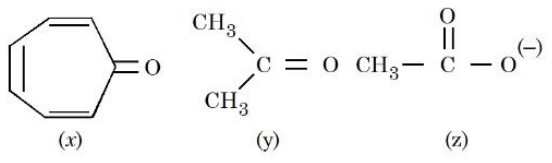
- (A) \(x>y>z\)
- (B) \(y>z>x\)
- (C) \(z>x>y\)
- (D) \(x>z>y\)
Show answer and solution
Correct Answer: (C)
In acetone \((y)\), the carbon-oxygen bond is a localized double bond with a bond order of approximately \(2\).
In the acetate ion \((z)\), there are two equivalent resonance structures that delocalize the negative charge equally over both oxygen atoms. This results in a carbon-oxygen bond order of exactly \(1.5\).
In tropone \((x)\), the carbon-oxygen double bond is conjugated with the \(\pi\) system of the seven-membered ring. Polarization of the \(C=O\) bond leads to a resonance structure with a single \(C-O^{-}\) bond and a positive charge on the ring, forming an aromatic tropylium cation. This aromatic stabilization gives the \(C=O\) bond significant single-bond character. However, because this resonance structure involves charge separation, its contribution is less than that of the neutral structure. Thus, the bond order in tropone is between \(1.5\) and \(2\).
Since bond length is inversely proportional to bond order, the carbon-oxygen bond length is longest for the acetate ion (bond order \(1.5\)), followed by tropone (bond order between \(1.5\) and \(2\)), and shortest for acetone (bond order \(2\)).
Therefore, the correct order of carbon-oxygen bond length is \(z > x > y\).
Answer: \(z>x>y\) -
- (A) A, D & E only
- (B) B, D & E only
- (C) A, C & D only
- (D) B & D only
Show answer and solution
Correct Answer: (D)
Statement B & D are not true -
- (A) \(c < b < d < a\)
- (B) \(c < a < b < d\)
- (C) \(d < b < a < c\)
- (D) \(a < b < c < d\)
Show answer and solution
Correct Answer: (C)
The electron withdrawing power (\(-I\) effect) of various functional groups follows the standard experimental order:
\(-NO_2 > -CN > -COOH > -F > -Cl > -Br > -I\)
Based on this series, the increasing order of electron withdrawing power for the given groups is:
\(-I < -COOH < -CN < -NO_2\)
This corresponds to the sequence \(d < b < a < c\).
Answer: \(d < b < a < c\) -
- (A) II, IV
- (B) III, II
- (C) I, IV
- (D) II, I
Show answer and solution
Correct Answer: (D)
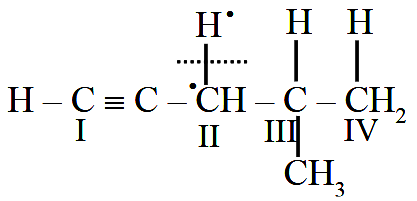
II most stable carbon radical due to resonance stablise
I least stable carbon radical due to no stabilising factor. -
- (A) Statement I is true but Statement II is false
- (B) Both Statement I and Statement II are false
- (C) Statement I is false but Statement II is true
- (D) Both Statement I and Statement II are true
Show answer and solution
Correct Answer: (C)
Hyper conjugation is permanent effect because external reagent is not required, so Statement-I is false and Statement-II is true. because moore alkyl group, more \(\alpha-H\), so more hyperconjugation which results more stability of carbocation. -
- (A) Statement I is false but Statement II is true
- (B) Both Statement I and Statement II are false
- (C) Statement I is true but Statement II is false
- (D) Both Statement I and Statement II are true
Show answer and solution
Correct Answer: (C)
Statement-I :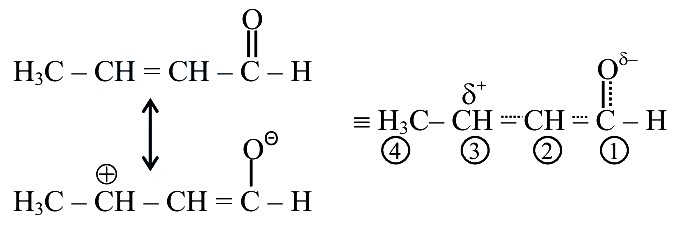
\(\mu=\mathrm{q} \times \mathrm{d}\)
More charges and more distance between charges than other compound so more dipole moment. Statement-I is true.
Statement-II :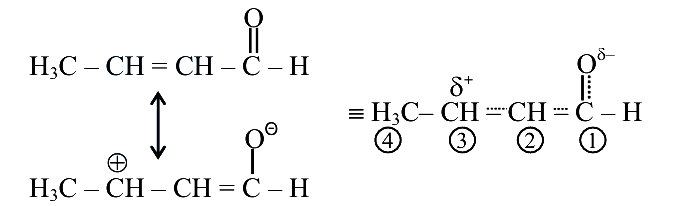
\(\mathrm{C}_1-\mathrm{C}_2\) bond has partial double bond character that means lesser bond length than \(\mathrm{C}_1-\mathrm{C}_2\) bond of other compound. Statement-II is false. -
- (A) \(3\)
- (B) \(2\)
- (C) \(4\)
- (D) \(1\)
Show answer and solution
Correct Answer: (C)
\(-\mathrm{NO}_2,-\mathrm{C} \equiv \mathrm{N},-\mathrm{COR},-\mathrm{COOH}\)are meta directing.
- 8. For the given compounds, the correct order of increasing \(\mathrm{pK}_{\mathrm{a}}\) value:
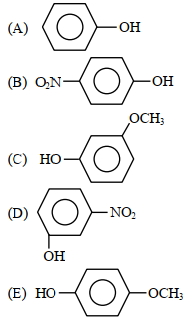 2024 Medium
- (A) (E) < (D) < (C) < (B) < (A)
- (B) (D) < (E) < (C) < (B) < (A)
- (C) (E) < (D) < (B) < (A) < (C)
- (D) (B) < (D) < (C) < (A) < (E)
Show answer and solution
Correct Answer: (D)
Acidic strength order :-\(\mathrm{B}>\mathrm{D}>\mathrm{C}>\mathrm{A}>\mathrm{E}\)
Correct \(\mathrm{pKa}\) Order :
\(\text { B }<\text { D }<\text { C }<\text { A }<\text { E }\)
-
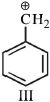
- (A) \((I) \)>\( (III) \)>\( (II)\)
- (B) \((I) \)>\( (II) \)>\( (III)\)
- (C) \((II) \)>\( (I) \)>\( (III)\)
- (D) \((III) \)>\( (II) \)>\( (I)\)
Show answer and solution
Correct Answer: (B)
\((1)\) Neutral structures are more stable than charged ones. Therefore \(I\) is more stable than \(II\) and \(III\).\((2)\) +ve charge on less electronegative atom is more stable i.e., \(\mathrm{C}^{\oplus}\) is more stable than \(\mathrm{O}^{\oplus}\)
\(\therefore\) Order is \(\mathrm{I}>\) II \(>\) \(III\)
-
- (A) \(C < D < B < A\)
- (B) \(A < B < C < D\)
- (C) \(A < B < D < C\)
- (D) \(D < C < B < A\)
Show answer and solution
Correct Answer: (A)
\(Image\)Stability of conjugate base \(\alpha\) acidic strength \(\mathrm{C}<\mathrm{D}<\mathrm{B}<\mathrm{A}\)

-
- (A) \(\left(\mathrm{CH}_3\right)_3 \mathrm{C}^{+}>\mathrm{CH}_3-\stackrel{+}{\mathrm{C}} \mathrm{H}_2>\left(\mathrm{CH}_3\right)_2 \stackrel{+}{\mathrm{C}} \mathrm{H}>\stackrel{+}{\mathrm{C}} \mathrm{H}_3\)
- (B) \(\stackrel{+}{\mathrm{C}} \mathrm{H}_3>\left(\mathrm{CH}_3\right)_2 \stackrel{+}{\mathrm{C}} \mathrm{H}>\mathrm{CH}_3-\stackrel{+}{\mathrm{C}} \mathrm{H}_2>\left(\mathrm{CH}_3\right)_3 \stackrel{+}{\mathrm{C}}\)
- (C) \(\left(\mathrm{CH}_3\right)_3 \stackrel{+}{\mathrm{C}}>\left(\mathrm{CH}_3\right)_2 \stackrel{+}{\mathrm{C}} \mathrm{H}>\mathrm{CH}_3-\stackrel{+}{\mathrm{C}} \mathrm{H}_2>\stackrel{+}{\mathrm{C}} \mathrm{H}_3\)
- (D) \(\stackrel{+}{\mathrm{C}} \mathrm{H}_3>\mathrm{CH}_3-\stackrel{+}{\mathrm{C}} \mathrm{H}_2>\mathrm{CH}_3-\stackrel{+}{\mathrm{C}} \mathrm{H}>\left(\mathrm{CH}_3\right) \mathrm{C}^{+}\stackrel{+}{\mathrm{C}} \mathrm{H}_3\)
Show answer and solution
Correct Answer: (C)
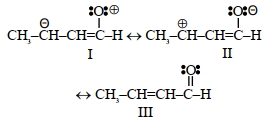
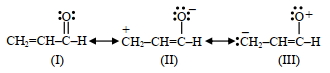
More no. of hyperconjugable Hydrogens, more stable is the carbocations. - 12. The correct stability order of the following resonance structures of \(\mathrm{CH}_3-\mathrm{CH}=\mathrm{CH}-\mathrm{CHO}\) is _______.
 2024 Medium
- (A) \(II\) \(>\) \(III\) \(>\) \(I\)
- (B) \(III\) \(>\) \(II\) \(>\) \(I\)
- (C) \(I\) \(>\) \(II\) \(>\) \(III\)
- (D) \(II\) \(>\) \(I\) \(>\) \(III\)
Show answer and solution
Correct Answer: (B)
\(Image\)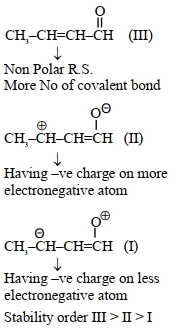
-
- (A) electromeric energy
- (B) resonance energy
- (C) ionization energy
- (D) hyperconjugation energy
Show answer and solution
Correct Answer: (B)
The difference in energy between the actual structure and the lowest energy resonance structure for the given compound is known as resonance energy. - 14. The interaction between \(\pi\) bond and lone pair of electrons present on an adjacent atom is responsible for: 2024 Hard
- (A) Hyperconjugation
- (B) Inductive effect
- (C) Electromeric effect
- (D) Resonance effect
Show answer and solution
Correct Answer: (D)
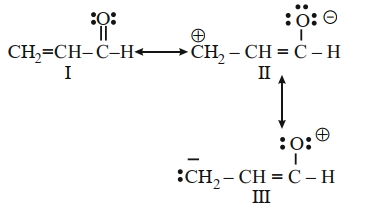
It is a type of conjugation responsible for resonance. - 15. The order of relative stability of the contributing structure is: Choose the correct answer from the options given below:
 2024 Hard
- (A) \( I > II > III\)
- (B) \(II > I > III\)
- (C) \(\mathrm{I}=\mathrm{II}=\mathrm{III}\)
- (D) \(III > II > I\)
Show answer and solution
Correct Answer: (A)
\(I\) \(>\) \(II\) \(>\) \(III\), since neutral resonating structures are more stable than charged resonating structure. \(II\) \(>\) \(III\), since stability of structure with -ve charge on more electronegative atom is higher. -
- (A) \(-\mathrm{CN},-\mathrm{NH}_2,-\mathrm{NHR},-\mathrm{OCH}_3\)
- (B) \(-\mathrm{NO}_2,-\mathrm{NH}_2,-\mathrm{COOH},-\mathrm{COOR}\)
- (C) \(-\mathrm{NO}_2,-\mathrm{CHO},-\mathrm{SO}_3 \mathrm{H},-\mathrm{COR}\)
- (D) \(-\mathrm{CN},-\mathrm{CHO},-\mathrm{NHCOCH}_3,-\mathrm{COOR}\)
Show answer and solution
Correct Answer: (C)
All are \(-\mathrm{M}\), Hence meta directing groups.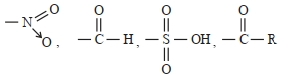
-
- (A) \(\mathrm{C} \overline{1}>\mathrm{OH}>\mathrm{R} \overline{\mathrm{O}}>\mathrm{CH}_3 \mathrm{CO} \overline{\mathrm{O}}\)
- (B) \(\mathrm{R} \overline{\mathrm{O}}>-\mathrm{OH}>\mathrm{CH}_3 \mathrm{CO} \overline{\mathrm{O}}>\mathrm{C} \overline{1}\)
- (C) \({ }^{-} \mathrm{OH}>\mathrm{R} \overline{\mathrm{O}}>\mathrm{CH}_3 \mathrm{CO} \overline{\mathrm{O}}>\mathrm{C} \overline{1}\)
- (D) \(\mathrm{C}_{\overline{1}}>\mathrm{R} \overline{\mathrm{O}}>-{ }^{-} \mathrm{OH}>\mathrm{CH}_3 \mathrm{CO} \overline{\mathrm{O}}\)
Show answer and solution
Correct Answer: (B)
Strong acid have weak conjugate base Acidic strength :\(\mathrm{H}-\mathrm{Cl}>\mathrm{CH}_3 \mathrm{COOH}>\mathrm{H}_2 \mathrm{O}>\mathrm{R}-\mathrm{OH}\)
Conjugate base strength :
\(\mathrm{Cl}^{-}<\mathrm{CH}_3 \mathrm{COO}^{-}<\overline{\mathrm{O}} \mathrm{H}<\mathrm{RO}^{-}\)
-
- (A) Electromeric effect dominates over inductive effect
- (B) The electromeric effect is, temporary effect
- (C) The organic compound shows electromeric effect in the presence of the reagent only
- (D) Hydrogen ion \(\left(\mathrm{H}^{+}\right)\)shows negative electromeric effect
Show answer and solution
Correct Answer: (D)
Hydrogen ion \(\left(\mathrm{H}^{+}\right)\)shows positive electromeric effect. -
- (A) \(A\) is false but \(R\) is true
- (B) Both \(A\) and \(R\) are correct and \(R\) is the correct explanation of \(A\)
- (C) Both \(A\) and \(R\) are correct but \(R\) is NOT the correct explanation of \(A\)
- (D) \(A\) is true but \(R\) is false
Show answer and solution
Correct Answer: (C)
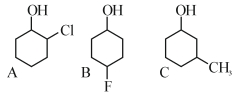
Acidic strength \(\alpha-\) I effect\(\alpha \frac{1}{+ I }\) effect
\(F , Cl\) exerts \(- I\) effect, Methyl exerts \(+ I\) effect, \(C\) is least acidic.
Among \(A\) and \(B\); since inductive effect is distance dependent, Extent of \(- I\) effect is higher in \(A\) followed by \(B\) even though \(F\) is stronger electron withdrawing group than \(Cl\). Thus, \(A\) is more acidic than \(B\).
-
- (A) \(C < D < E < A < B\)
- (B) \(D < B < E < A < C\)
- (C) \(D < C < E < A < B\)
- (D) \(C < D < E < B < A\)
Show answer and solution
Correct Answer: (B)
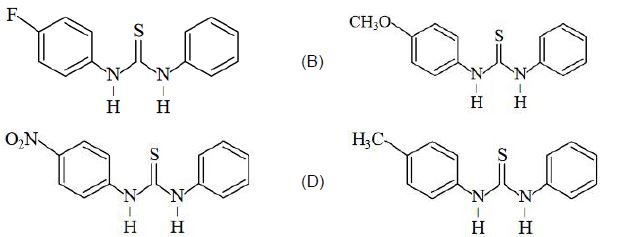
\(- NO _{2}\) is strongly deactivating \(- Br -\) deactivating \(- CH _{3}\)-activating group \(D < B < E < A < C\)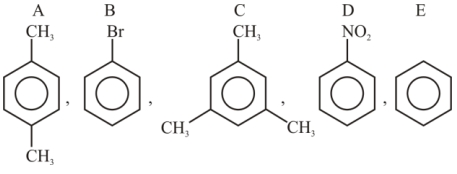
-
- (A) \((C)\) and \((D)\) only
- (B) \((A), (B)\) and \((C)\) only
- (C) \((A), (B)\) and \((D)\) only
- (D) \((A)\) and \((B)\) only
Show answer and solution
Correct Answer: (D)
\((A)\) and \((B)\) only in Resonance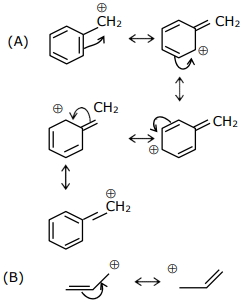
-
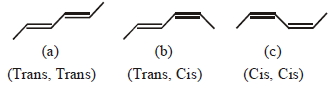
- (A) \((a) < (b) < (c)\)
- (B) \((b) < (c) < (a)\)
- (C) \((c) < (b) < (a)\)
- (D) \((a) < (c) < (b)\)
Show answer and solution
Correct Answer: (A)
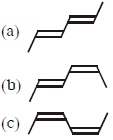
Generally trans is more stable then cis formHeat of combustion (HOC) \(\propto \frac{1}{\text { Stability }}\)
Stability : \(a>b>c\)
\(\mathrm{HOC}: \mathrm{c}>\mathrm{b}>\mathrm{a}\)
-
- (A) \((v) < (i) < (iv) < (ii) < (iii)\)
- (B) \((iii) < (i) < (ii) < (iv) < (v)\)
- (C) \((v) < (iii) < (ii) < (iv) < (i)\)
- (D) \((iii) < (iv) < (ii) < (i) < (v)\)
Show answer and solution
Correct Answer: (C)
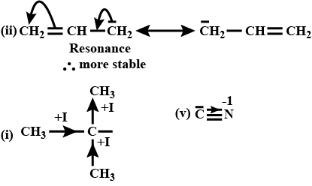
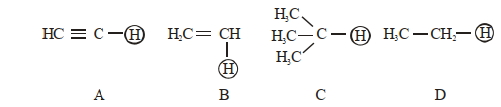
Basicity \(\propto \frac{1}{\text { Stability }}\)\((v)\) In figure \(5 , sp\) hybridised carbon is more electronegative. -ve charge on more electronegative atom makes it more stable. [ref. image]
Also, there is \(-I\) effect.
\(\therefore\) It is most stable.
\((iii)\) \(H - C \equiv \overline{ C }\)
sp hybridized carbon carry -ve charge.
\(\therefore\) Hence, it is also more stable
\((ii)\) In figure \(2\), resonance is taking place. [ref. image]
\(\therefore\) It is more stable.
\((iv)\) \(\overline{ C } H _3\)
-ve charge is carried by \(sp ^3\) hybridised carbon.
\(\therefore\) It is less stable.
\((i)\) In figure \(1\) , the central \(C\) is surrounded by \(CH _3\) and hence it shows \(+ I\) effect from \(3\) sides. [ref. image]
\(\therefore\) Hence, it is least stable.
\(\therefore \text { (v) }\,<\,\text { (iii) }\,<\,\text { (ii) }\,<\,\text { (iv) }\,<\,\text { (i) }\)
- 24. The correct order for acid strength of compounds \(CH \equiv CH,\,C{H_3} - C \equiv CH,\,C{H_2} = C{H_2}\) is as follows 2019 Medium
- (A) \(CH \equiv CH > C{H_2} = C{H_2} > C{H_3} - C \equiv CH\)
- (B) \(C{H_3} - C \equiv CH > CH \equiv CH > C{H_2} = C{H_2}\)
- (C) \(C{H_3} - C \equiv CH > C{H_2} = C{H_2} > CH \equiv CH\)
- (D) \(CH \equiv CH > \,C{H_3} - C \equiv CH > \,C{H_2} = C{H_2}\)
Show answer and solution
Correct Answer: (D)
Acidic strength \( \propto \) Stability of conjugate base \(E.N. \to sp\, carbon > sp^2\, carbon > sp^3\, carbon\) -
- (A) \((c) < (a) < (d) < (b)\)
- (B) \((b) < (d) < (a) < (c)\)
- (C) \((a) < (c) < (d) < (b)\)
- (D) \((b) < (d) < (c) < (a)\)
Show answer and solution
Correct Answer: (C)
\(CH_3O-, CH_3-, H\) is electron donating, But \(-NO_2\) is electron withdrawing group. -
- (A) \(CHBr_3\)
- (B) \(CHI_3\)
- (C) \(CH(CN)_3\)
- (D) \(CHCl_3\)
Show answer and solution
Correct Answer: (C)
\(CH{\left( {CN} \right)_3} \rightleftharpoons \mathop C\limits^ - {\left( {CN} \right)_3} + {H^ + }\)Negative charge of the conjugate base \(\mathop C\limits^ - {\left( {CN} \right)_3}\) in extensively delocalized through the \(C \equiv N\) group.
- 27. Arrange in the correct order of stability (decreasing order) for the following molecules
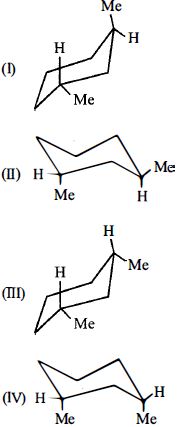 2013 Hard
- (A) \((I) > (II) > (III) >(IV)\)
- (B) \((IV) > (III) > (II) \approx (I)\)
- (C) \((I) > (II) \approx (III) > (IV)\)
- (D) \((III) > (I) \approx (II) > (IV)\)
Show answer and solution
Correct Answer: (C)
Disequatorial cis \(-1,\,3-\) Dimethylcyclohexane is more stable as both methyl groups are equatorial and are away from each other. (Refer to Image \(I\))It is followed by trans \(-1,\,3-\) Dimethylcyclohexane where one \(-C H_{3}\) group is equatorial and other is axial (Refer to Image \(II\))
Diaxial cis \(-1,\,3-\) Dimethylcyclohexane is less stable due to large amount of steric strain due to the interaction of axial - \(\mathrm{CH}_{3}\) groups. (Refer to Image \(III\) )
\((I) > (II) \approx (III) > (IV)\)
-
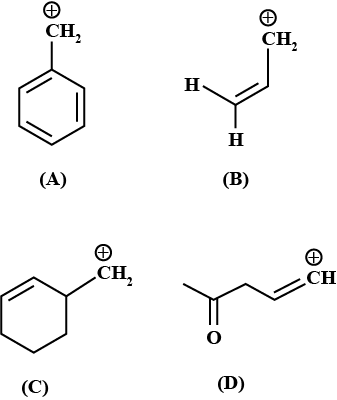
- (A) \(III > II > I\)
- (B) \(I > II > III\)
- (C) \(II > III > I\)
- (D) \(III > I > II\)
Show answer and solution
Correct Answer: (D)
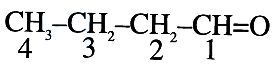
Stability due to resonance - More the no of resonating structure more is the stability.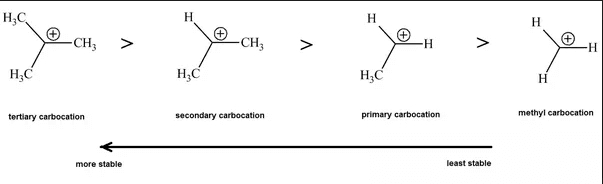
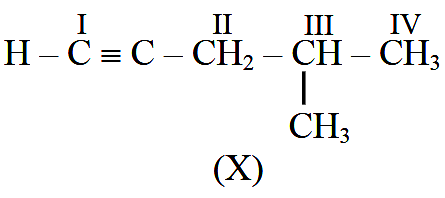
No questions on this page match these filters.
Other STD 11 - Organic chemistry reaction mechanism topics
Frequently asked
How many Electronic Displacement in covalent bond questions came in JEE Mains?
28 questions from 2013–2026, each with the correct answer and a full solution.
How difficult are Electronic Displacement in covalent bond questions?
7% are easy, 50% medium and 43% hard.