


Questions
Newest firstShowing 1–10 of 10 questions
- 1. Consider following statements:
A. Surface tension arises due to extra energy of the molecules at the interior as compared to the molecules at the surface, of a liquid.
B. As the temperature of liquid rises, the coefficient of viscosity increases.
C. As the temperature of gas increases, the coefficient of viscosity increases
D. The onset of turbulence is determined by Reynold's number.
E. In a steady flow two stream lines never intersect.
Choose the correct answer from the options given below: 2025 Medium - 2. If \(\rho\) is the density and \(\eta\) is coefficient of viscosity of fluid which flows with a speed \(v\) in the pipe of diameter \(d\), the correct formula for Reynolds number \(R _{ e }\) is .............. 2022 Easy
- 3. The velocity of a small ball of mass \(0.3\,g\) and density \(8\,g / cc\) when dropped in a container filled with glycerine becomes constant after some time. If the density of glycerine is \(1.3\,g / cc\), then the value of viscous force acting on the ball will be \(x \times 10^{-4}\,N\), the value of \(x\) is [use \(g=10\,m / s ^{2}\) ] 2022 Medium
- 4. The velocity of a small ball of mass ' \(m\) ' and density \(d _{1}\), when dropped in a container filled with glycerine, becomes constant after some time. If the density of glycerine is \(d _{2}\), then the viscous force acting on the ball, will be 2022 Medium
- 5. Suppose you have taken a dilute solution of oleic acid in such a way that its concentration becomes \(0.01 \,cm ^{3}\) of oleic acid per \(cm ^{3}\) of the solution. Then you make a thin film of this solution (monomolecular thickness) of area \(4\, cm ^{2}\) by considering \(100\) spherical drops of radius \(\left(\frac{3}{40 \pi}\right)^{\frac{1}{3}} \times 10^{-3}\, cm .\) Then the thickness of oleic acid layer will be \(x \times 10^{-14} \,m\). Where \(x\) is ...... . 2021 Hard
- 6. What will be the nature of flow of water from a circular tap, when its flow rate increased from \(0.18\, L / min\) to \(0.48\, L / min\) ? The radius of the tap and viscosity of water are \(0.5\, cm\) and \(10^{-3}\, Pa s\), respectively. (Density of water : \(10^{3}\, kg / m ^{3}\) ) 2021 Medium
- 7. Water from a pipe is coming at a rate of \(100\, litres\) per minute. If the radius of the pipe is \(5\, cm\), the Reynolds number for the flow is of the order of : (density of water \(= 1000\, kg/m^3\), coefficient of viscosity of water \(= 1\, mPa\, s\)) 2019 Hard
- 8. Two tubes of radii \(r_1\) and \(r_2\), and lengths \(l_1\) and \(l_2\), respectively, are connected in series and a liquid flows through each of them in streamline conditions. \(P_1\) and \(P_2\) are pressure differences across the two tubes. If \(P_2\) is \(4P_1\) and \(l_2\) is \( \frac{l_1}{4}\) , then the radius \(r_2\) will be equal to 2017 Hard
- 9. If it takes \(5\,minutes\) to fill a \(15\,litre\) bucket from a water tap of diameter \(\frac{2}{{\sqrt \pi }}cm\) then the Reynolds number for the flow is (density of water \(= 10^3\,kg/m^3\) ) and viscosity of water \(= 10^{-3}\,Pa.s\) ) close to 2015 Hard
- 10. A thin tube sealed at both ends is \(100\, cm\) long. It lies horizontally, the middle \(20\, cm\) containing mercury and two equal ends containing air at standard atmospheric pressure . If the tube is now turned to a vertical position, by what amount will the mercury be displaced ? (Given : cross-section of the tube can be assumed to be uniform) ........ \(cm\)
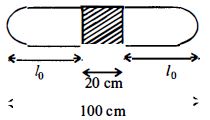 2013 Hard
No questions on this page match these filters.
Other STD 11 - Fluid mechanics topics
- 12Qs Buoyancy, Archimedes' Principle and Laws of Floatation
- 7Qs Newton's Law of Viscosity
- 7Qs Types of Flow, Equation of Continuity and Flow Rate
- 9Qs Velocity of Efflux and Torricelli's law
- 22Qs Bernoulli's Theorem and Applications of Bernoulli's Theory
- 23Qs Viscosity and Stoke's Law and Terminal
- 10Qs Pressure and Density
- 5Qs Pascal's Law
- 10Qs Pressure due to Liquid Column and Barometer
Frequently asked
How many Reynold's Number and Poiseuille's Equation questions came in JEE Mains?
10 questions from 2013–2025, each with the correct answer and a full solution.
How difficult are Reynold's Number and Poiseuille's Equation questions?
10% are easy, 40% medium and 50% hard.