


Questions
Newest firstShowing 1–27 of 27 questions
- 1. A spring of force constant \(15 N / m\) is cut into two pieces. If the ratio of their length is \(1: 3\), then the force constant of smaller piece is _________ N/m 2026 Easy
- 2. A spring stretches by \(2\) mm when it is loaded with a mass of \(200\) g. From equilibrium position the mass is further pulled down by \(2\) mm and released. The frequency associated with the system and maximum energy in the spring are __________ Hz and __________ J, respectively. (Take g \(= 10\) m/s\(^2\)) 2026 Hard
- 3. As shown in the figure, a spring is kept in a stretched position with some extension by holding the masses 1 kg and 0.2 kg with a separation more than spring natural length and are released. Assuming the horizontal surface to be frictionless, the angular frequency (in SI unit) of the system is :
 2026 Hard
- 4. The frequency of oscillation of a mass \(m\) suspended by a spring is \(v_1\). If the length of the spring is cut to half, the same mass oscillates with frequency \(v_2\). The value of \(v_2/v_1\) is ________. 2026 Medium
- 5. Two blocks of masses \(m\) and \(M,(M \gt m)\), are placed on a frictionless table as shown in figure. A massless spring with spring constant k is attached with the lower block. If the system is slightly displaced and released then
(\(\mu=\) coefficient of friction between the two blocks)
(A) The time period of small oscillation of the two blocks is \(\mathrm{T}=2 \pi \sqrt{\frac{(\mathrm{~m}+\mathrm{M})}{\mathrm{k}}}\)
(B) The acceleration of the blocks is \(\mathrm{a}=\frac{\mathrm{kx}}{\mathrm{M}+\mathrm{m}}\) (\(\mathrm{x}=\) displacement of the blocks from the mean position)
(C) The magnitude of the frictional force on the upper block is \(\frac{m \mu|x|}{M+m}\)
(D) The maximum amplitude of the upper block, if it does not slip, is \(\frac{\mu(M+m) g}{k}\)
(E) Maximum frictional force can be \(\mu(\mathrm{M}+\mathrm{m}) \mathrm{g}\).
Choose the correct answer from the options given below: 2025 Hard - 6. A mass \(\mathrm{m}\) is suspended from a spring of negligible mass and the system oscillates with a frequency \(f_1\). The frequency of oscillations if a mass \(9 \mathrm{~m}\) is suspended from the same spring is \(f_2\). The value of \(\frac{f_1}{f_{.2}}\) is _______. 2024 Hard
- 7. The time period of simple harmonic motion of mass \(\mathrm{M}\) in the given figure is \(\pi \sqrt{\frac{\alpha M}{5 K}}\), where the value of \(\alpha\) is _______.
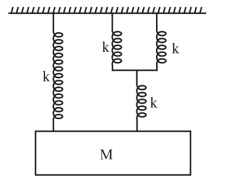 2024 Hard
- 8. A block of mass \(2\,kg\) is attached with two identical springs of spring constant \(20\,N / m\) each. The block is placed on a frictionless surface and the ends of the springs are attached to rigid supports (see figure). When the mass is displaced from its equilibrium position, it executes a simple harmonic motion. The time period of oscillation is \(\frac{\pi}{\sqrt{x}}\) in SI unit. The value of \(x\) is \(..........\)
 2023 Medium
- 9. A mass \(m\) is attached to two springs as shown in figure. The spring constants of two springs are \(K _1\) and \(K _2\). For the frictionless surface, the time period of oscillation of mass \(m\) is
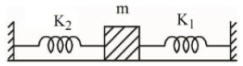 2023 Medium
- 10. In the figure given below. a block of mass \(M =490\,g\) placed on a frictionless table is connected with two springs having same spring constant \(\left( K =2 N m ^{-1}\right)\). If the block is horizontally displaced through ' \(X\) 'm then the number of complete oscillations it will make in \(14 \pi\) seconds will be \(.........\)
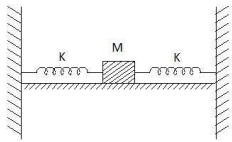 2023 Medium
- 11. As per given figures, two springs of spring constants \(K\) and \(2\,K\) are connected to mass \(m\). If the period of oscillation in figure \((a)\) is \(3 s\), then the period of oscillation in figure \((b)\) will be \(\sqrt{ x }\) s. The value of \(x\) is\(.........\)
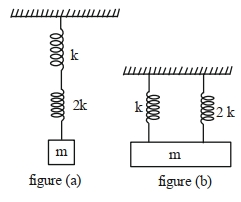 2022 Medium
- 12. In figure \((A),\) mass ' \(2 m\) ' is fixed on mass ' \(m\) ' which is attached to two springs of spring constant \(k\). In figure \((B),\) mass ' \(m\) ' is attached to two spring of spring constant ' \(k\) ' and ' \(2 k\) '. If mass ' \(m\) ' in \((A)\) and \((B)\) are displaced by distance ' \(x\) ' horizontally and then released, then time period \(T_{1}\) and \(T_{2}\) corresponding to \((A)\) and \((B)\) respectively follow the relation.
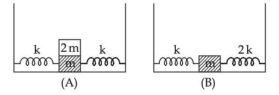 2022 Medium
- 13. A mass of \(5\, {kg}\) is connected to a spring. The potential energy curve of the simple harmonic motion executed by the system is shown in the figure. A simple pendulum of length \(4\, {m}\) has the same period of oscillation as the spring system. What is the value of acceleration due to gravity on the planet where these experiments are performed? (In \({m} / {s}^{2}\))
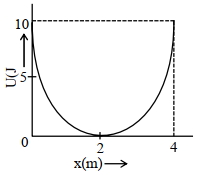 2021 Hard
- 14. Consider two identical springs each of spring constant \(k\) and negligible mass compared to the mass \(M\) as shown. Fig. \(1\) shows one of them and Fig. \(2\) shows their series combination. The ratios of time period of oscillation of the two \(SHM\) is \(\frac{ T _{ b }}{ T _{ a }}=\sqrt{ x },\) where value of \(x\) is (Round off to the Nearest Integer)
 2021 Medium
- 15. In the given figure, a body of mass \(M\) is held between two massless springs, on a smooth inclined plane. The free ends of the springs are attached to firm supports. If each spring has spring constant \(k,\) the frequency of oscillation of given body is :
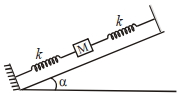 2021 Hard
- 16. In the given figure, a mass \(M\) is attached to a horizontal spring which is fixed on one side to a rigid support. The spring constant of the spring is \(k\). The mass oscillates on a frictionless surface with time period \(T\) and amplitude \(A\). When the mass is in equilibrium position, as shown in the figure, another mass \(m\) is gently fixed upon it. The new amplitude of oscillation will be
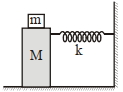 2021 Medium
- 17. In the reported figure, two bodies \(A\) and \(B\) of masses \(200\, {g}\) and \(800\, {g}\) are attached with the system of springs. Springs are kept in a stretched position with some extension when the system is released. The horizontal surface is assumed to be frictionless. The angular frequency will be \(.....\,{rad} / {s}\) when \({k}=20 \,{N} / {m} .\)
 2021 Hard
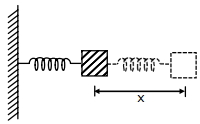
- 18. The motion of a mass on a spring, with spring constant \({K}\) is as shown in figure. The equation of motion is given by \(x(t)= A sin \omega t+ Bcos\omega t\) with \(\omega=\sqrt{\frac{K}{m}}\) Suppose that at time \(t=0\), the position of mass is \(x(0)\) and velocity \(v(0)\), then its displacement can also be represented as \(x(t)=C \cos (\omega t-\phi)\), where \(C\) and \(\phi\) are
 2021 Hard
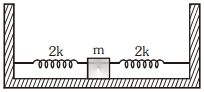
- 19. Two identical springs of spring constant \('2k'\) are attached to a block of mass \(m\) and to fixed support (see figure). When the mass is displaced from equilibrium position on either side, it executes simple harmonic motion. The time period of oscillations of this sytem is ...... .
 2021 Medium
- 20. Two particles \(A\) and \(B\) of equal masses are suspended from two massless springs of spring constants \(K _{1}\) and \(K _{2}\) respectively.If the maximum velocities during oscillations are equal, the ratio of the amplitude of \(A\) and \(B\) is 2021 Medium
- 21. A block of mass \(m\) attached to massless spring is performing oscillatory motion of amplitude \('A'\) on a frictionless horizontal plane. If half of the mass of the block breaks off when it is passing through its equilibrium point, the amplitude of oscillation for the remaining system become \(fA.\) The value of \(f\) is 2020 Medium
- 22. When a particle of mass \(m\) is attached to a vertical spring of spring constant \(k\) and released, its motion is described by \(y ( t )= y _{0} \sin ^{2} \omega t ,\) where \('y'\) is measured from the lower end of unstretched spring. Then \(\omega\) is 2020 Hard
- 23. A spring whose unstretched length is \(\ell \) has a force constant \(k\). The spring is cut into two pieces of unstretched lengths \(\ell_1\) and \(\ell_2\) where, \(\ell_1 = n\ell_2\) and \(n\) is an integer. The ratio \(k_1/k_2\) of the corresponding force constants, \(k_1\) and \(k_2\) will be 2019 Medium
- 24. A \(1 \,kg\) block attached to a spring vibrates with a frequency of \(1\, Hz\) on a frictionless horizontal table. Two springs identical to the original spring are attached in parallel to an \(8\, kg\) block placed on the same table. So, the frequency of vibration of the \(8\, kg\) block is ..... \(Hz\) 2017 Medium
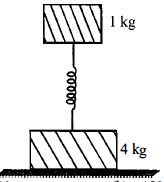
- 25. Two bodies of masses \(1\, kg\) and \(4\, kg\) are connected to a vertical spring, as shown in the figure. The smaller mass executes simple harmonic motion of angular frequency \(25\, rad/s\), and amplitude \(1.6\, cm\) while the bigger mass remains stationary on the ground. The maximum force exerted by the system on the floor is ..... \(N\) ( take \(g = 10\, ms^{-2}\))
 2014 Hard
- 26. A mass \(m = 1.0\,kg\) is put on a flat pan attached to a vertical spring fixed on the ground. The mass of the spring and the pan is negligible. When pressed slightly and released, the mass executes simple harmonic motion. The spring constant is \(500\,N/m.\) What is the amplitude \(A\) of the motion, so that the mass \(m\) tends to get detached from the pan ? (Take \(g = 10\,m/s^2\) ). The spring is stiff enough so that it does not get distorted during the motion.
 2013 Medium
- 27. A uniform cylinder of length \(L\) and mass \(M\) having cross-sectional area \(A\) is suspended, with its length vertical, from a fixed point by a massless spring, such that it is half submerged in a liquid of density \(\sigma \) at equilibrium position. When the cylinder is given a downward push and released, it starts oscillating vertically with a small amplitude. The time period \(T\) of the oscillations of the cylinder will be 2013 Hard
No questions on this page match these filters.
Other STD 11 - Oscillations topics
- 19Qs Velocity of Simple Harmonic Motion
- 6Qs Periodic, Oscillatory motion and its characteristics and types of SHM
- 29Qs Energy of Simple Harmonic Motion
- 19Qs Method to determine Time Period and Frequency
- 23Qs Simple Pendulum
- 8Qs Superposition of S.H.M.
- 12Qs Position of a Particle in SHM, Displacement and Phase
- 8Qs Acceleration of Simple Harmonic Motion
- 7Qs Different types of oscillations (Free, Damped, Forced Oscillation and Resonance)
Frequently asked
How many Spring-Mass System questions came in JEE Mains?
27 questions from 2013–2026, each with the correct answer and a full solution.
How difficult are Spring-Mass System questions?
4% are easy, 52% medium and 44% hard.