


All JEE Mains 2023 Physics questions
32 chaptersShowing 201–250 of 644 questions
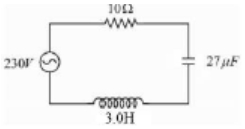
- 201. In the circuit shown in the figure, the ratio of the quality factor and the band width is \(.............\) s.
 2023 Medium
- (A) \(10\)
- (B) \(0.1\)
- (C) \(6\)
- (D) \(8\)
Show answer and solution
Correct Answer: (A)
\(\Delta \omega=\frac{ R }{ L }\)\(Q =\frac{\omega_0}{\Delta \omega}=\omega_0 \frac{ L }{ R }\)
\(\omega_0=\frac{1}{\sqrt{3 \times 27 \times 10^{-6}}}=\frac{1}{9 \times 10^{-3}}\)
\(\frac{ Q }{\Delta \omega}=\frac{\omega_0 \frac{ L }{ R }}{\frac{ R }{ L }}=\omega_0 \frac{ L ^2}{ R ^2}=\sqrt{\frac{1}{ LC } \frac{ L ^2}{ R ^2}}\)
\(=\frac{1}{9 \times 10^{-3}} \times \frac{9}{100}=10\,s\)
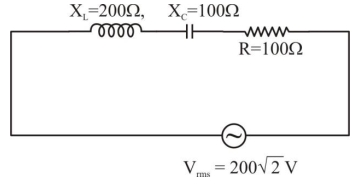
- 202. In the given circuit, rms value of current \(\left( I _{ rms }\right)\) through the resistor \(R\) is :\(..........\,A\)
 2023 Medium
- (A) \(2\)
- (B) \(\frac{1}{2}\)
- (C) \(20\)
- (D) \(2 \sqrt{2}\)
Show answer and solution
Correct Answer: (A)
\(z =\sqrt{100^2+(200-100)^2}\)\(=100 \sqrt{2}\,\Omega\)
\(i _{ rms }=\frac{ V _{ rms }}{ z }=\frac{200 \sqrt{2}}{100 \sqrt{2}}\)
\(=2\,A\)
-
- (A) \(A-IV, B-II, C-I, D-III\)
- (B) \(A-II, B-I, C-III, D-IV\)
- (C) \(A-II, B-IV, C-I, D-III\)
- (D) \(A-IV, B-III, C-I, D-II\)
Show answer and solution
Correct Answer: (C)
Based on theory. -
- (A) \(80\) \(N\)
- (B) \(50\) \(N\)
- (C) \(100\) \(N\)
- (D) \(40\) \(N\)
Show answer and solution
Correct Answer: (D)
\(\omega=\frac{2 \pi}{3.14}=2\,rad / s\)\(\left|\bar{f}_{\text {centrifiugal }}\right|=\left|-m \bar{a}_{\operatorname{Re} f .}\right|\)
\(=M \omega^2 R\)
\(=40\,N\)
-
- (A) \(3\)
- (B) \(6\)
- (C) \(9\)
- (D) \(12\)
Show answer and solution
Correct Answer: (A)
\(KE =\frac{ L ^2}{2 I } \Rightarrow \frac{ KE _{\text {fimpl }}}{ KE _{\text {initial }}}=\frac{ I _{\text {intitial }}}{ I _{\text {final }}} \Rightarrow \frac{ KE _{\text {fimpl }}}{ E }=\frac{1}{3}\)\(\Rightarrow KE _{\text {fimel }}=\frac{E}{3}\)
-
- (A) \(1\)
- (B) \(2\)
- (C) \(3\)
- (D) \(4\)
Show answer and solution
Correct Answer: (C)
\(\tau=\vec{r} \times \vec{F}\)\(\text { Where } \overrightarrow{ r }=-2 \hat{ i }+3 \hat{ j }\)
\(\tau=(-2 \hat{ i }+3 \hat{ j }) \times(- Pk )\)
\(= P (-2 \hat{ j }-3 \hat{ i })= P (-3 \hat{ i }-2 \hat{ j })\)
\(\Rightarrow \text { So } a =-3, b =-2\)
\(\frac{ a }{ b }=\frac{3}{2}\)
-
- (A) \(75\)
- (B) \(74\)
- (C) \(73\)
- (D) \(72\)
Show answer and solution
Correct Answer: (A)
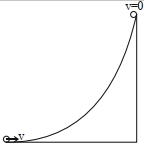
At highest point \(KE _{ f }=0\)Initial \(KE =\) Translational \(KE +\) Rotational \(KE\)
\(=\frac{1}{2} mv ^2+\frac{1}{2} I \omega^2\)
In case of rolling \(v = R \omega\)
\(=\frac{1}{2} m v^2+\frac{1}{2} \times \frac{2}{3} m R^2 \times \frac{v^2}{R^2}\)
\(=\frac{5}{6} m v^2\)
Apply energy conservation
\(KE _{ i }+ PE _{ i }= KE _{ f }+ PE _{ f }\)
\(\frac{5}{6} mv ^2= mgh\)
\(h =\frac{5}{6 \times 10} \times 9\,m =\frac{15}{20} m =75\,cm\)
-
- (A) \(14\)
- (B) \(15\)
- (C) \(13\)
- (D) \(12\)
Show answer and solution
Correct Answer: (B)
\(\tau= I \alpha\)\(\Rightarrow FR = mR ^2 \alpha\)
\(\alpha=\frac{ F }{ mR }=\frac{52.5}{5 \times 0.7}=15\,rad\,s ^{-2}\)
-
- (A) \(4\)
- (B) \(3\)
- (C) \(5\)
- (D) \(2\)
Show answer and solution
Correct Answer: (C)
For ring \(I=m R_1^2=m K_1^2\)\(\therefore\) Radius of gyration \(K_1=R_1\)
For solid sphere
\(I^{\prime}=\frac{2}{5} m^{\prime} R_2^2=m^{\prime} K_2^2\)
\(\therefore \text { Its radius of gyration }=K_2=\sqrt{\frac{2}{5}} R_2\)
\(\because K_1=K_2\)
\(\therefore R_1=\sqrt{\frac{2}{5}} R_2\)
\(\therefore \frac{R_1}{R_2}=\sqrt{\frac{2}{5}}\)
\(\therefore x=5\)
-
- (A) \(3\)
- (B) \(2\)
- (C) \(4\)
- (D) \(8\)
Show answer and solution
Correct Answer: (B)
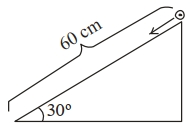
\(v=\sqrt{\frac{2 g h}{1+\frac{k^2}{R^2}}}\)Where \(h=60 \sin 30^{\circ}=30\,cm\)
\(k^2=\frac{R^2}{2}\)
\(v=2\,ms ^{-1}\)
-
- (A) \(5\)
- (B) \(10\)
- (C) \(15\)
- (D) \(20\)
Show answer and solution
Correct Answer: (A)
For solid sphere \(\frac{2}{5} mR ^2= mk _{ mph }^2\)\(k _{ sph }=\sqrt{\frac{2}{5}} R\)
For solid cylinder \(\frac{ mR ^2}{2}= mk _{ cyl }^2\)
\(\Rightarrow k _{ cyl }=\frac{ R }{\sqrt{2}}\)
\(\frac{ k _{ rph }}{ k _{ cyl }}=\frac{\sqrt{\frac{2}{5}}}{\frac{1}{\sqrt{2}}}=\frac{2}{\sqrt{5}}=\frac{2}{\sqrt{ x }}\)
\(\therefore x =5\)
-
- (A) \(2\)
- (B) \(6\)
- (C) \(4\)
- (D) \(8\)
Show answer and solution
Correct Answer: (C)
\(L =\left( I _{\text {com }}\right)(\omega) \text { and } K =\frac{1}{2}\left( I _{\text {com }}\right)\left(\omega^2\right)+\frac{1}{2} MV _{\text {com }}^2\)\(L =\frac{2}{5} M^2 \frac{V_{\text {com }}}{R} \quad K=\frac{1}{2}\left(\frac{2}{5} M R^2\right) \frac{V_{\text {com }}^2}{ R ^2}+\frac{1}{2} M V_{\text {com }}^2\)
\(L =\frac{2 MRV _{\text {com }}}{5} \quad K =\frac{7}{10} MV _{\text {com }}^2\)
\(\text { Ratio } \frac{ L }{ K }=\frac{4}{7} \frac{ R }{ V _{\text {com }}}=\frac{\pi}{22}\)
\(\Rightarrow \omega=\frac{4}{7} \times \frac{22}{22} \times 7=4\)
-
- (A) \(10\)
- (B) \(9\)
- (C) \(8\)
- (D) \(7\)
Show answer and solution
Correct Answer: (A)
\(\frac{1}{2} mv ^2+\frac{1}{2} I \omega^2=7 \times 10^{-3}\)\(\frac{1}{2} mv ^2+\frac{1}{2}\left(\frac{2}{5} MR ^2\right)\left(\frac{ V }{ R }\right)^2=7 \times 10^{-3}\)
\(\frac{1}{2} MV ^2\left[1+\frac{2}{5}\right]=7 \times 10^{-3}\)
\(\frac{1}{2}(1)\left( V ^2\right)\left(\frac{7}{5}\right)=7 \times 10^{-3}\)
\(V ^2=10^{-2}\)
\(V =10^{-1}=0.1\,m / s =10\,cm / s\)
-
- (A) \(40\)
- (B) \(38\)
- (C) \(37\)
- (D) \(36\)
Show answer and solution
Correct Answer: (A)
\(KE =\frac{1}{2} mv ^2+\frac{1}{2} I \omega^2\)\(2240=\frac{1}{2} 2( v )^2+\frac{1}{2} \frac{2}{5}(2) R ^2 \cdot\left(\frac{ v }{ R }\right)^2\)
\(2240= v ^2+\frac{2}{5} v ^2\)
\(\Rightarrow v =40\,m / s\)
-
- (A) \(34\)
- (B) \(35\)
- (C) \(36\)
- (D) \(38\)
Show answer and solution
Correct Answer: (B)
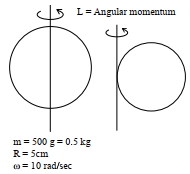
\(I _{ t }= x \times 10^{-2}\,L\)
\(\frac{7}{5} mR ^2= x \times 10^{-2} \frac{2}{5} mR ^2 \omega\)\(\frac{7}{2 \omega}= x \times 10^{-2}=\frac{7}{2 \times 10}\)
-
- (A) \(2\)
- (B) \(1\)
- (C) \(4\)
- (D) \(3\)
Show answer and solution
Correct Answer: (D)
\(( KE )_{\text {Rotational }}=\frac{1}{2} I \omega^2= E\)\(E =\frac{1}{2} \frac{ m \ell^2}{12} \omega^2\)
\(E =\frac{1}{2} \frac{ dA \ell^3}{12} \omega^2\)
\(E =\frac{ dA (2)^3}{24} \omega^2\)
\(\sqrt{\frac{3 E }{ dA }}=\omega\)
\(\alpha=3 \text { Ans. }\)
-
- (A) \(53\)
- (B) \(52\)
- (C) \(54\)
- (D) \(51\)
Show answer and solution
Correct Answer: (C)
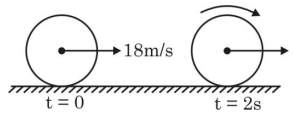
\(a =-\mu_{ k } g =-3\)\(V =18-3 \times 2\)
\(V =12\,m / s\)
\(KE =\frac{1}{2} mv ^2+\frac{1}{2} \frac{ mr ^2}{2} \frac{ v ^2}{ r ^2}\)
\(KE =\frac{3}{4} mv ^2\)
\(KE =3 \times 18=54\,J\)
-
- (A) \(30\)
- (B) \(31\)
- (C) \(32\)
- (D) \(33\)
Show answer and solution
Correct Answer: (C)
\(I_1=\frac{ m _1 R ^2}{2} \quad I_2=\frac{ m _2( R / 2)^2}{2}\)\(\frac{I_1}{I_2}=\frac{4 m_1}{m_2}=\frac{4 \cdot \rho \pi R^2 \ell}{\rho \cdot \frac{\pi R^2}{4} \times \frac{\ell}{2}} \Rightarrow \frac{I_1}{I_2}=32\)
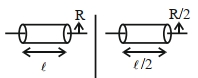
-
- (A) 240 N
- (B) 90 N
- (C) 300 N
- (D) 30 N
Show answer and solution
Correct Answer: (C)
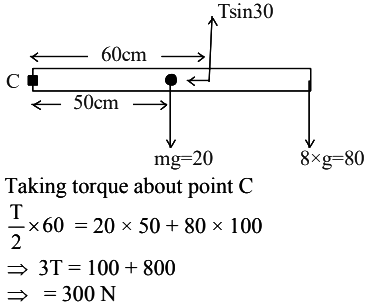
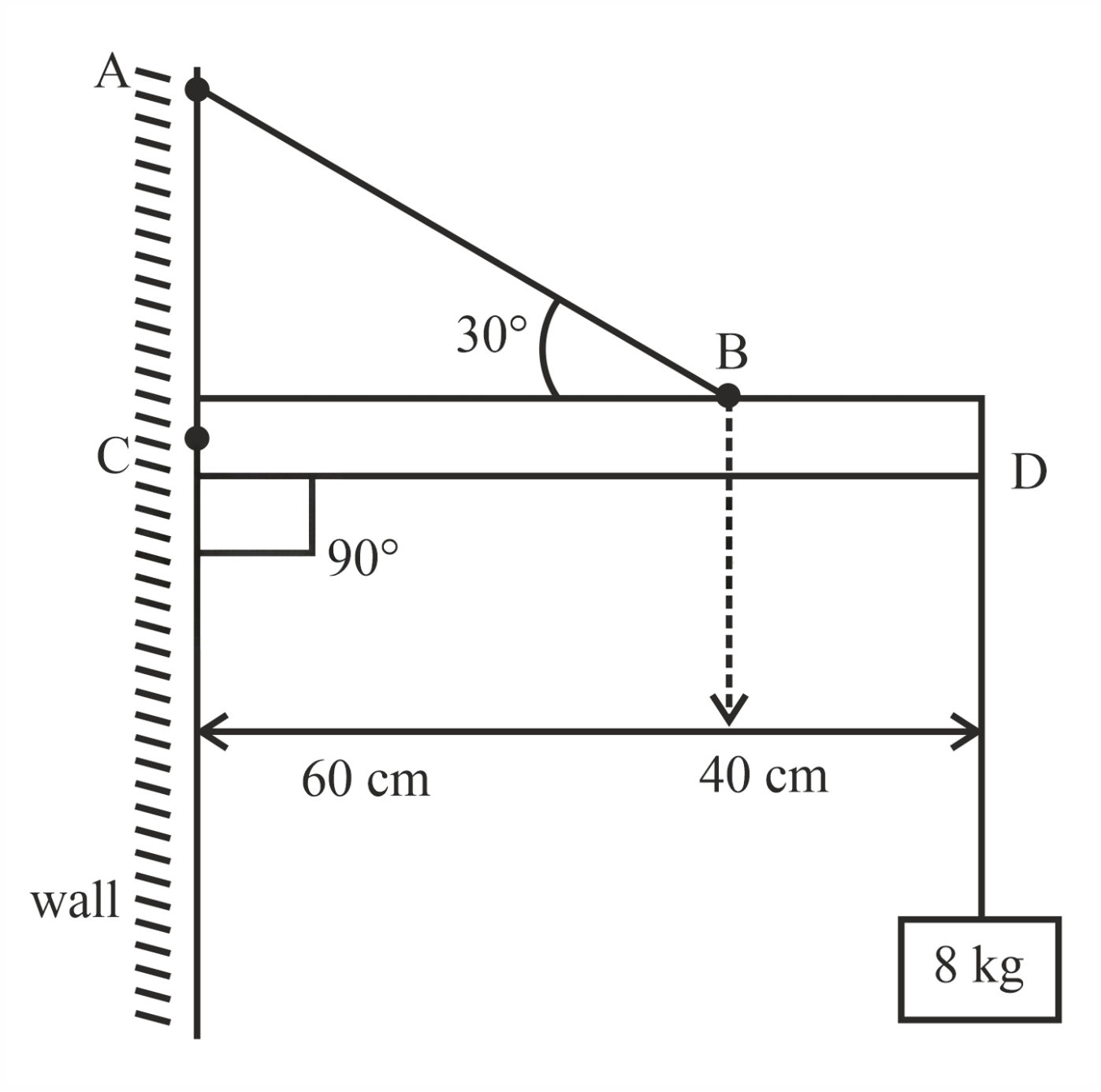
Taking torque about point C
\(\frac{\text T}{2} \times 60=20 \times 50+80 \times 100\)
\(\Rightarrow 3 \text T=100+800\)
\(\Rightarrow=300\text N\) - 220. For a rolling spherical shell, the ratio of rotational kinetic energy and total kinetic energy is \(\frac{x}{5}\). The value of \(x\) is ................ 2023 Medium
- (A) \(4\)
- (B) \(6\)
- (C) \(8\)
- (D) \(2\)
Show answer and solution
Correct Answer: (D)
\(\frac{ K _{\text {rot }}}{ K _{\text {Total }}}=\frac{\frac{1}{2}\left(\frac{2}{3} mR ^2\right)\left(\frac{ V }{ R }\right)^2}{\frac{1}{2} mv ^2+\frac{1}{2}\left(\frac{2}{3} mR ^2\right)\left(\frac{ V }{ R }\right)^2}\)\(\Rightarrow \frac{ x }{5}=\frac{2}{5} \Rightarrow x =2\)
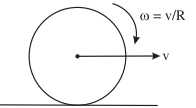
-
- (A) \(15\)
- (B) \(16\)
- (C) \(18\)
- (D) \(17\)
Show answer and solution
Correct Answer: (D)
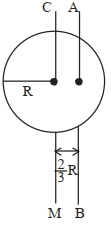
\(I _{ cm }=\frac{ mR ^2}{2}\)\(I _{ AB }=\frac{ mR ^2}{2}+ m \left(\frac{2 R }{3}\right)^2=\frac{17}{18} mR ^2\)
\(\frac{ I _{ AB }}{ I _{ cm }}=\frac{17}{9}\)
\(\Rightarrow x =17\)
-
- (A) \(4\)
- (B) \(5\)
- (C) \(3\)
- (D) \(2\)
Show answer and solution
Correct Answer: (B)
\(I _1=\frac{2}{5} m _1 R ^2+ m _1 R ^2\)\(I _1= m _1 R ^2\left(\frac{7}{5}\right)\)
\(I _1=7 R ^2\)
\(I _2=\frac{ m _2 R ^2}{4}+ m _2 R ^2\)
\(I _2=\frac{5}{4} m _2 R ^2\)
\(I _2=5 R ^2\)
\(\frac{ I _2}{ I _1}=\frac{5}{7}\)
\(x =5\)
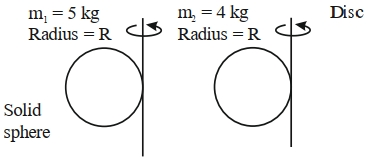
-
- (A) \(1.5\)
- (B) \(6\)
- (C) \(9\)
- (D) \(3\)
Show answer and solution
Correct Answer: (D)
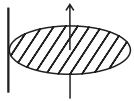
\(I = I _{ cm }+ Md ^2\)\(=\frac{ MR ^2}{2}+ MR ^2\)
\(=\frac{3}{2} MR ^2\)
\(x =3\)
-
- (A) \(110\)
- (B) \(55\)
- (C) \(10.48\)
- (D) \(100\)
Show answer and solution
Correct Answer: (A)
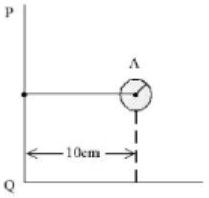
\(I _{ cm }=\frac{2}{5} MR ^2\)\(I _{ PQ }= I _{ cm }+ md ^2\)
\(I _{ PQ }=\frac{2}{5} mR ^2+ m (10\,cm )^2\)
For radius of gyration
\(I _{ PQ }= mk ^2\)
\(k ^2=\frac{2}{5} R ^2+(10\,cm )^2\)
\(=\frac{2}{5}(5)^2+100\)
\(=10+100=110\)
\(k =\sqrt{110}\,cm\)
\(x =110\)
-
- (A) \(2\)
- (B) \(1\)
- (C) \(3\)
- (D) \(4\)
Show answer and solution
Correct Answer: (B)
The moment of inertia of semicircular ring about axis passing through centre of ring and perpendicular to plane of ring is \(= MR ^2\) so \(x=1\) -
- (A) \(177\)
- (B) \(178\)
- (C) \(198\)
- (D) \(176\)
Show answer and solution
Correct Answer: (D)
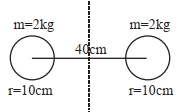
\(I =2\left( I _{ cm }+ md ^2\right)\)\(=2\left(\frac{2}{5} mr ^2+ md ^2\right)\)
\(=\frac{4}{5} \times 2 \times(0.1)^2+2(2)(0.20)^2\)
\(=\frac{8}{5} \times 10^{-2}+16 \times 10^{-2}\)
\(=(1.6+16) \times 10^{-2}\)
\(=17.6 \times 10^{-2}\)
\(I =176 \times 10^{-3}\,kg\,m ^2\)
-
- (A) \(40\)
- (B) \(45\)
- (C) \(80\)
- (D) \(90\)
Show answer and solution
Correct Answer: (A)
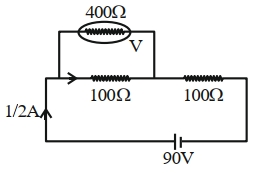
\(R _{ eq }=\frac{400 \times 100}{500}+100\)\(=180\,\Omega\)
\(i =\frac{90}{180}=\frac{1}{2}\,A\)
\(\text { Reading }=\frac{1}{2} \times \frac{400}{500} \times 100\)
\(=40\,volt\)
-
- (A) helical path with the axis perpendicular to the direction of magnetic field \(B\)
- (B) straight along the direction of magnetic field \(B\)
- (C) helical path with the axis along magnetic field \(B\)
- (D) circular path
Show answer and solution
Correct Answer: (C)
Due to component \(v_1\),magnetic force \(F = qv _1 B \sin \theta=0\)
So \(v _1\) remains unchanged
but due to component \(v_2\) magnetic force act towards centre i.e. moving it circular. So path is helical with the axis parallel to magnetic field \(B\).

-
- (A) \(142\)
- (B) \(144\)
- (C) \(141\)
- (D) \(140\)
Show answer and solution
Correct Answer: (B)
\(=\frac{m v}{q B}=\frac{\sqrt{2 k m}}{q B}, m=\frac{r^2 q^2 B^2}{2 k}\)\(m = \frac{\frac{1}{100} \times \frac{3}{100} \times 2 \times 2 \times 4 \times 10^{-3} \times 4 \times 10^{-3} \times 10^{-12}}{2 \times(100) \times 10^{-6}}\)
\(=144 \times 10^{-18}\,kg\)
-
- (A) \(1: 3 \sqrt{2}\)
- (B) \(3 \sqrt{2}: 2\)
- (C) \(2 \sqrt{2}: 1\)
- (D) \(1: \sqrt{2}\)
Show answer and solution
Correct Answer: (C)
Magnetic field due to current carrying circular loop on its axis is given as\(\frac{\mu_0 ir ^2}{2\left( r ^2+ x ^2\right)^{3 / 2}}\)
At centre, \(x=0, B_1=\frac{\mu_0 i }{2 r }\)
At \(x=r, B_2=\frac{\mu_0 i}{2 \times 2 \sqrt{2 r}}\)
\(\frac{ B _1}{ B _2}=2 \sqrt{2}\)
-
- (A) \(1: 2\)
- (B) \(1: 4\)
- (C) \(1: 5\)
- (D) \(1: 3\)
Show answer and solution
Correct Answer: (B)
\(F \propto I _1 I _2\)\(F _{ I }: F _{2 I }=1: 4\)
-
- (A) \(1232\)
- (B) \(176\)
- (C) \(352\)
- (D) \(88\)
Show answer and solution
Correct Answer: (B)
\(B =\mu_0 nI\)\(=4 \pi \times 10^{-7} \times 70 \times 10^2 \times 2\)
\(=56 \pi \times 10^{-4}\,T\)
\(=176 \times 10^{-4}\,T\)
-
- (A) Zero in the region \(r < a\) and inversely proportional to \(r\) in the region \(r > a\)
- (B) Inversely proportional to \(r\) in the region \(r < a\) and uniform throughout in the region \(r > a\)
- (C) Directly proportional to \(r\) in the region \(r < a\) and inversely proportional to \(r\) in the region \(r > a\)
- (D) Uniform in the region \(r < a\) and inversely proportional to distance \(r\) from the axis, in the region \(r > a\)
Show answer and solution
Correct Answer: (C)
\(B = \begin{cases}\frac{\mu_0 Ir }{\pi a ^2} & r \leq a \\ \frac{\mu_0 I }{\pi r ^2} & r \geq a \end{cases}\) -
- (A) \(\frac{1}{10}\,V\)
- (B) \(1\,V\)
- (C) \(100\,V\)
- (D) \(10\,V\)
Show answer and solution
Correct Answer: (D)
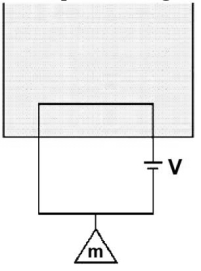
\(F _{ m }= mg\)\(\therefore \quad ILB = mg\)
\(\therefore \quad\left(\frac{ V }{ R }\right) LB = mg\)
\(\therefore \quad V =\frac{ mgR }{ LB }\)
\(=\frac{\left(1 \times 10^{-3}\,kg \right)\left(10\,m / s ^2\right)(10 \Omega)}{(0.1\,m )\left(10^3 \times 10^{-4}\,T \right)}=10\,V\)
-
- (A) \(38\)
- (B) \(41\)
- (C) \(40\)
- (D) \(42\)
Show answer and solution
Correct Answer: (C)
\(B=\frac{\pi}{2} \times 10^{-3}\)\(K E=\frac{1}{2} m V^2\)
\(\Rightarrow V=\sqrt{\frac{2 K E}{m}}\)
\(=v \cos 60^{\circ} \times \frac{2 \pi m}{e B}\)
\(=\sqrt{\frac{2 \times 2 \times 1.6 \times 10^{-19}}{1.6 \times 10^{-27}}} \times \cos 60^{\circ} \times \frac{2 \pi \times 1.6 \times 10^{-27}}{1.6 \times 10^{-19} \times \frac{\pi}{2} \times 10^{-3}}\)
\(=2 \times 10^4 \times \frac{1}{2} \times 4 \times 10^{-5}\)
\(=4 \times 10^{-1} m =40\,cm\)
-
- (A) \(8\)
- (B) \(7\)
- (C) \(9\)
- (D) \(6\)
Show answer and solution
Correct Answer: (C)
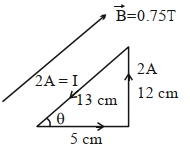
Force on \(5 cm\) side is\(|\overrightarrow{ F }|= ILB \sin \theta\)
\(=(2)\left(5 \times 10^{-2}\right) \times \frac{3}{4} \times \frac{12}{13}=\frac{9}{130}\,N\)
So, \(x=9\)
-
- (A) \(2.5\)
- (B) \(1.0\)
- (C) \(10\)
- (D) \(5\)
Show answer and solution
Correct Answer: (B)
\(\ell=50\,cm\)\(t =1\,sec\)
\(\therefore V =\frac{0.05}{1}=0.05\,m / s\)
\(i =\frac{40 \times 0.05 \times 0.05}{10}=0.01\,A\)
\(F = B { i } l=40 \times 0.01 \times 0.05\)
\(F =0.02\,N\)
\(\therefore \quad W =0.02 \times l=0.02 \times .05\)
\(\therefore \quad W =1 \times 10^{-3}\,J\)
-
- (A) \(4\)
- (B) \(2\)
- (C) \(6\)
- (D) \(8\)
Show answer and solution
Correct Answer: (B)
For equilibrium\(Mg = I \ell B\)
\(I =\frac{ mg }{\ell B }=\frac{40 \times 10^{-3} \times 10}{50 \times 10^{-2} \times 0.4}=2\,A\)
-
- (A) \(4\)
- (B) \(6\)
- (C) \(2\)
- (D) \(8\)
Show answer and solution
Correct Answer: (C)
\(B _{\text {at } 0}=\frac{\mu_0 I }{4 R }=\frac{4 \pi \times 10^{-7} \times 14}{4 \times 2.2 \times 10^{-2}}\)\(=2 \times 10^{-4}\,T\)
-
- (A) \(40\)
- (B) \(50\)
- (C) \(30\)
- (D) \(20\)
Show answer and solution
Correct Answer: (A)
Magnetic field due to moving charge\(B =\frac{\mu_0}{4 \pi} \frac{ q \sin \theta}{ r ^2}\)
\(B =\frac{\mu_0}{4 \pi} \frac{ ev \sin (\pi / 2)}{ r ^2}\)
\(B =\frac{10^{-7} \times 1.6 \times 10^{-19} \times 6.76 \times 10^6}{0.52 \times 0.52 \times 10^{-20}}\)
\(B =40\,T\)
-
- (A) \(B, C\) and \(D\) only
- (B) \(B\) and \(C\) only
- (C) \(A\) and \(D\) only
- (D) \(B\) and \(E\) only
Show answer and solution
Correct Answer: (B)
\(\overrightarrow{ F }= q (\overrightarrow{ v } \times \overrightarrow{ B })\) as angle between \(\overrightarrow{ v }\) and \(\overrightarrow{ B }\) is \(0^{\circ}\)\(\overrightarrow{ F }=0\)
-
- (A) \(B\) and \(E\) only
- (B) \(A\) and \(E\) only
- (C) \(C\) and \(D\) only
- (D) \(B\) and \(D\) only
Show answer and solution
Correct Answer: (A)
\(\overrightarrow{ F }=- e (\overrightarrow{ v } \times \overrightarrow{ B })\)Force will be along \(-ve\) \(y-\)axis.
As magnetic force is \(\perp\) to velocity, path of electron must be a circle.
-
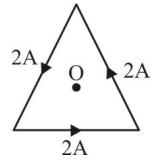
- (A) \(4 \sqrt{3} \times 10^{-4} \,T\)
- (B) \(4 \sqrt{3} \times 10^{-5} \,T\)
- (C) \(\sqrt{3} \times 10^{-4}\, T\)
- (D) \(3 \sqrt{3} \times 10^{-5}\,T\)
Show answer and solution
Correct Answer: (D)
\(d \tan 60^{\circ}=2 \sqrt{3}\)\(d =2\,cm\)
\(B =3 \times \frac{\mu_0 i }{2 \pi d } \sin 60^{\circ}\)
\(=3 \times \frac{2 \times 10^{-7} \times 2}{2 \times 10^{-2}} \times \frac{\sqrt{3}}{2}\) \(=3 \sqrt{3} \times 10^{-5}\)
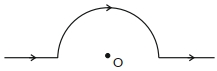
- 244. Find the magnetic field at the point \(P\) in figure. The curved portion is a semicircle connected to two long straight wires.
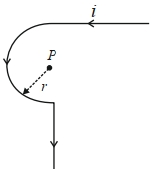 2023 Medium
- (A) \(\frac{\mu_0 i}{2 r}\left(1+\frac{2}{\pi}\right)\)
- (B) \(\frac{\mu_0 i}{2 r}\left(1+\frac{1}{\pi}\right)\)
- (C) \(\frac{\mu_0 i}{2 r}\left(\frac{1}{2}+\frac{1}{2 \pi}\right)\)
- (D) \(\frac{\mu_0 i}{2 r}\left(\frac{1}{2}+\frac{1}{\pi}\right)\)
Show answer and solution
Correct Answer: (C)
\(B_{ P }=\left(\frac{\mu_0 i}{4 r}+\frac{\mu_0 i}{4 \pi r}\right)=\frac{\mu_0 i}{2 r}\left(\frac{1}{2}+\frac{1}{2 \pi}\right)\) -
- (A) \(2\)
- (B) \(1\)
- (C) \(1.5\)
- (D) \(0.5\)
Show answer and solution
Correct Answer: (B)
\(\tau= K \theta\)\(NiAB = K \theta\)
\(A =\frac{ K \theta}{ NiB }=\frac{4 \times 10^{-5} \times 0.05}{200 \times 10 \times 10^{-3} \times 0.01}\)
On solving \(A =10^{-4}\,m ^2=1\,cm ^2\)
-
- (A) \((C)\) and \((E)\)
- (B) \((C)\) and \((D)\)
- (C) \((A)\) and \((C)\)
- (D) \((A)\) and \((B)\)
Show answer and solution
Correct Answer: (C)
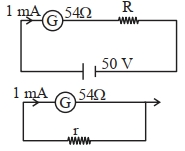
For voltmeter\(R =\frac{ V }{ I _{ g }}- G\)
\(=\frac{50}{10^{-3}}-54 \approx 50\,k \Omega\)
For ammeter
\(S=\frac{I_g G}{I-I_g}=\frac{10^{-3} \times 54}{(10-1) \times 10^{-3}}=6 \Omega( C )\)
-
- (A) Statement \(I\) is false but Statement \(II\) is true
- (B) Both Statement \(I\) and Statement \(II\) are true
- (C) Both Statement \(I\) and Statement \(II\) are false
- (D) Statement \(I\) is true but Statement \(II\) is false
Show answer and solution
Correct Answer: (D)
For a moving coil galvanometer\(\text { BiNA }= k \theta\)
\(\theta=\left(\frac{ BNA }{ k }\right) i ; \text { Current sensitive }=\frac{ BNA }{ k }\)
So, if \(N\) is doubled then current sensitivity is doubled.
Voltage sensitivity
\(B \frac{ V }{ R } NA = k \theta\)
\(V =\frac{ BNA }{ Rk } \theta, \text { as } N \text { is doubled } R \text { is also doubled. }\)
So, no change in voltage sensitivity.
-
- (A) \(A\) is not correct but \(R\) is correct
- (B) Both \(A\) and \(R\) are correct and \(R\) is the correct explanation of \(A\)
- (C) Both \(A\) and \(R\) are correct but \(R\) is not the correct explanation of \(A\)
- (D) \(A\) is correct but \(R\) is not correct
Show answer and solution
Correct Answer: (A)
Error of voltmeter decreases with increase in its resistance. - 249. Math List \(I\) with List \(II\) Choose the correct answer from the option given below:
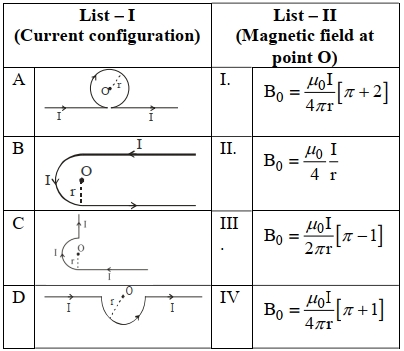 2023 Medium
- (A) \(A-III, B-IV, C-I, D-II\)
- (B) \(A-I, B-III, C-IV, D-II\)
- (C) \(A-III, B-I, C-IV, D-II\)
- (D) \(A-II, B-I, C-IV, D-III\)
Show answer and solution
Correct Answer: (C)
(A)\(B _{ ab }=\frac{\mu_0}{4 \pi} \frac{ I }{ r } \text { (out of the plane) }\)
\(B _{ bcd }=\frac{\mu_0}{4 \pi} \frac{ I }{ r }(2 \pi) \text { (in the plane) }\)
\(B _{ de }=\frac{\mu_0}{4 \pi} \frac{ I }{ r } \text { (out of the plane) }\)
Hence magnetic field at \(O\) is
\(B _0=-\frac{\mu_0}{4 \pi} \frac{ I }{ r }+\frac{\mu_0}{4 \pi} \frac{ I }{ r }(2 \pi)-\frac{\mu_0}{4 \pi} \frac{ I }{ r }\)
\(B _0=\frac{\mu_0}{2 \pi} \frac{ I }{ r }(\pi-1) \ldots \ldots . . \text { (III) }\)
(B)
\(B _{ ab }=\frac{\mu_0}{4 \pi} \frac{ I }{ r } \text { (out of the plane) }\)
\(B _{ bcd }=\frac{\mu_0}{4 \pi} \frac{ I }{ r }(\pi) \text { (out of the plane) }\)
\(B _{ de }=\frac{\mu_0}{4 \pi} \frac{ I }{ r } \text { (out of the plane) }\)
Hence magnetic field at \(O\) is
\(B _0=\frac{\mu_0}{4 \pi} \frac{ I }{ r }+\frac{\mu_0}{4 \pi} \frac{ I }{ r }(\pi)+\frac{\mu_0}{4 \pi} \frac{ I }{ r }\)
\(B _0=\frac{\mu_0}{4 \pi} \frac{ I }{ r }(\pi+2) \ldots .( I )\)
(C)
\(B _{ ab }=\frac{\mu_0}{4 \pi} \frac{ I }{ r } \text { (in the plane) }\)
\(B _{ bcd }=\frac{\mu_0}{4 \pi} \frac{ I }{ r }(\pi) \text { (in the plane) }\)
\(B _{ de }=0 \text { (at the axis) }\)
Hence magnetic field at \(O\) is
\(B _0=\frac{\mu_0}{4 \pi} \frac{ I }{ r }(1+\pi) \ldots(IV)\)
\(B _{ ab }=0 \text { (at the axis) }\)
\(B _{ bcd }=\frac{\mu_0}{4 \pi} \frac{ I }{ r }(\pi) \text { (out of the plane) }\)
\(B _{ de }=0 \text { (at the axis) }\)
Hence magnetic field at \(O\) is
\(B _0=\frac{\mu_0 I }{4 r } \ldots \text { (II) }\)
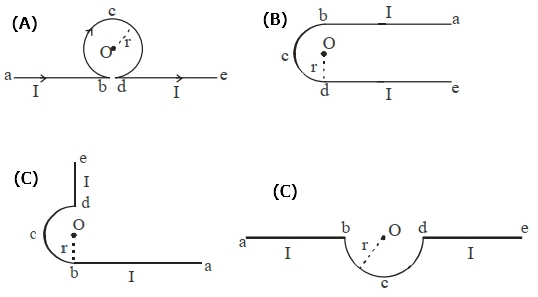
-
- (A) \(+25\)
- (B) \(-50\)
- (C) \(0\)
- (D) \(-25\)
Show answer and solution
Correct Answer: (A)
\(I _{ s }=\frac{ NBA }{ C } \& V _{ s }=\frac{ NBA }{ CG }\)\(\Rightarrow V_{ s }=\frac{I_s}{G}\), If \(G\) (galvanometer resistance) is constant, then \(V _{ S } \propto I_S\)
so percentage change in \(V_S\) is also \(25 \%\).
No questions on this page match these filters.