


Questions
25 questionsShowing 1–25 of 25 questions
-
- (A) \(3.82\)
- (B) \(5.9\)
- (C) \(2.12\)
- (D) \(4.25\)
Show answer and solution
Correct Answer: (D)
\(=\left(m_A-m_B-m_D\right) \times 931.5\,MeV\)\(=(238.05079-234.04363-4.00260) \times 931.5\)
\(\Rightarrow 4.25\,Mev\)
-
- (A) \(3\)
- (B) \(2\)
- (C) \(1\)
- (D) \(4\)
Show answer and solution
Correct Answer: (D)
Energy released \(=(\Delta m )_{ amu } \times 931.5\,MeV\)\(=\left( m _{ u }- m _{ Th }- m _{ He }\right)_{ amu } \times 931.5\,MeV\)
\(=0.0044 \times 931.5\,MeV =4.0986\,MeV\)
- 3. A free neutron decays into a proton but a free proton does not decay into neutron. This is because 2023 Medium
- (A) neutron is an uncharged particle
- (B) proton is a charged particle
- (C) neutron is a composite particle made of a proton and an electron
- (D) neutron has larger rest mass than proton
Show answer and solution
Correct Answer: (D)
As neutron has more rest mass than proton it will require energy to decay proton into neutron. -
- (A) \(2\)
- (B) \(4\)
- (C) \(6\)
- (D) \(8\)
Show answer and solution
Correct Answer: (A)
\(\frac{ v _1}{ v _2}=\frac{ m _2}{ m _1}=\frac{ A _2}{ A _1}=\frac{2}{1}\) -
- (A) \(1\)
- (B) \(2\)
- (C) \(3\)
- (D) \(4\)
Show answer and solution
Correct Answer: (B)
\(\frac{ v _1}{ v _2}=\frac{3}{2}\)\(m _1 v _1= m _2 v _2 \Rightarrow \frac{ m _1}{ m _2}=\frac{2}{3}\)
Since, Nuclear mass density is constant
\(\frac{ m _1}{\frac{4}{3} \pi r _1^3}=\frac{ m _2}{\frac{4}{3} \pi r _2^3}\)
\(\left(\frac{ r _1}{ r _2}\right)^3=\frac{ m _1}{ m _2}\)
\(\frac{ r _1}{ r _2}=\left(\frac{2}{3}\right)^{\frac{1}{3}}\)
\(\text { So, } x =2\)
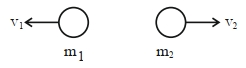
-
- (A) \(120\)
- (B) \(121\)
- (C) \(122\)
- (D) \(159\)
Show answer and solution
Correct Answer: (B)
Initial binding energy \(=242 \times 7.6\,MeV\)Final binding energy
\(=121 \times 8.1\,MeV +121 \times 8.1\,MeV\)
\(=242 \times 8.1\,MeV\)
Total gain in binding energy
\(=242(8.1-7.6)=121\,MeV\)
-
- (A) \(64\)
- (B) \(40\)
- (C) \(32\)
- (D) \(256\)
Show answer and solution
Correct Answer: (D)
\(N = N _0\left(\frac{1}{2}\right)^{ n }\)\(\frac{ N _0}{8}= N _0\left(\frac{1}{2}\right)^{ n }\)
\(n =3\)
\(3 \text { half lives }=3 \text { days }\)
\(1 \text { half life }=1 \text { day }\)
\(5 \text { days }=5 \text { half life }\)
\(N = N _0\left(\frac{1}{2}\right)^{ n }\)
\(8 \times 10^{-3}= N _0\left(\frac{1}{2}\right)^5\)
\(N _0=256 \times 10^{-3}\,kg\)
\(N _0=256\,g\)
-
- (A) \(87\)
- (B) \(88\)
- (C) \(80\)
- (D) \(86\)
Show answer and solution
Correct Answer: (A)
\(P =92-2-2+1-1-1\)\(P =92-5\)
\(P=87\)
-
- (A) \(301\)
- (B) \(302\)
- (C) \(300\)
- (D) \(303\)
Show answer and solution
Correct Answer: (C)
\(\frac{ dN _1}{ dt }=-\lambda_1 N \quad \frac{ dN _2}{ dt }=-\lambda_2 N\)\(\frac{ dN }{ dt }=-\left(\lambda_1+\lambda_2\right) N\)
\(\Rightarrow \lambda_{\text {eq }}=\lambda_1+\lambda_2\)
\(\Rightarrow \frac{1}{t_{1 / 2}}=\frac{1}{300}+\frac{1}{30}=\frac{11}{300}\)
\(\Rightarrow t _{1 / 2}=\frac{300}{11}\)
-
- (A) \(11\)
- (B) \(12\)
- (C) \(14\)
- (D) \(16\)
Show answer and solution
Correct Answer: (A)
\(\text { density of nuclei }=\frac{\text { mass of nuclei }}{\text { volume of nuclei }}\)\(\rho=\frac{1.6 \times 10^{-27} A }{\frac{4}{3} \pi\left(1.5 \times 10^{-15}\right)^3 A } \)
\(=\frac{1.6 \times 10^{-27}}{14.14 \times 10^{-45}}=0.113 \times 10^{18}\)
\(\rho_{ W }=10^3\)
\(\text { Hence } \frac{\rho}{\rho_w}=11.31 \times 10^{13}\)
-
- (A) \(210\) and \(82\)
- (B) \(210\) and \(84\)
- (C) \(210\) and \(80\)
- (D) \(211\) and \(80\)
Show answer and solution
Correct Answer: (C)
\({ }_{84}^{218} A \stackrel{\alpha}{\longrightarrow}{ }_{82}^{214} A _1 \stackrel{\beta^{-}}{\longrightarrow}{ }_{83}^{214} A _2 \stackrel{\gamma}{\longrightarrow}{ }_{83}^{214} A _3\)\({ }_{83}^{214} A _3 \stackrel{\alpha}{\longrightarrow}{ }_{81}^{210} A _4 \stackrel{\beta^{+}}{\longrightarrow}{ }_{80}^{210} A _5 \stackrel{\gamma}{\longrightarrow}{ }_{80}^{210} A _6\)
-
- (A) \(15\)
- (B) \(14\)
- (C) \(16\)
- (D) \(13\)
Show answer and solution
Correct Answer: (C)
Binding energy of system \(=\frac{k e^2}{2 r}\) joule and \(\frac{k e^2}{2 r}=12.8\,ev\)\(\frac{9 \times 10^9 \times\left(1.6 \times 10^{-19}\right)^2}{2 r}=12.8 \times 1.6 \times 10^{-19}\)
\(\Rightarrow r=\frac{9 \times 10^9 \times 1.6 \times 10^{-19}}{12.8 \times 2}\)
\(\Rightarrow r=\frac{9 \times 10^{-10}}{16}\)
-
- (A) \(C, D\) only
- (B) \(B, C, E\) only
- (C) \(A, B, C, D\) only
- (D) \(B, C\) only
Show answer and solution
Correct Answer: (A)
Surface energy per nucleon \(\propto \frac{r^2}{A} \propto \frac{A^{2 / 3}}{A} \propto \frac{1}{A^{1 / 3}}\) \(\left(\right.\) Mass number \(\left.A \propto r^3 \Rightarrow r \propto A^{1 / 3}\right)\).A is incorrect
Contribution to binding energy by columbic forces is
\(=\frac{-a_2 Z(Z-1)}{A^{1 / 3}}\)
\(B\) is incorrect
Volume energy \(\propto A\)
\(C\) is correct
For \((D)\) ,if we consider only surface energy contribution then option is correct.
For \((E)\) only \(3\) interactions contribute to surface energy.
-
- (A) Both \(A\) and \(R\) are true and \(R\) is the correct explanation of \(A\)
- (B) \(A\) is false but \(R\) is true
- (C) \(A\) is true but \(R\) is false
- (D) Both \(A\) and \(R\) are true but \(R\) is \(NOT\) the correct explanation of \(A\)
Show answer and solution
Correct Answer: (B)
Nuclear density is independent of \(A\). -
- (A) Both \(A\) and \(R\) are true but \(R\) is NOT the correct explanation of \(A\)
- (B) \(A\) is true but \(R\) is false
- (C) \(A\) is false but \(R\) is true
- (D) Both \(A\) and \(R\) are true and \(R\) is the correct explanation of \(A\)
Show answer and solution
Correct Answer: (D)
Binding energy per nucleon is almost same for nuclei of mass number ranging \(30\) to \(170\). -
- (A) \(\frac{1}{8}\)
- (B) \(\frac{1}{16}\)
- (C) \(\frac{1}{4}\)
- (D) \(\frac{1}{2}\)
Show answer and solution
Correct Answer: (A)
\(\frac{ N }{ N _0}=\left(\frac{1}{2}\right)^{ t / t \frac{1}{2}}=\left(\frac{1}{2}\right)^{\frac{90}{30}}\)\(\frac{ N }{ N _0}=\left(\frac{1}{2}\right)^3=\frac{1}{8}\)
-
- (A) \(3\)
- (B) \(2\)
- (C) \(8\)
- (D) \(6\)
Show answer and solution
Correct Answer: (D)
For \(A\) mass number \(=34\)Total binding energy \(=1.2 \times 34=40.8\,MeV\)
For \(B\) mass number \(=26\)
total binding energy \(=1.8 \times 26\,MeV\)
\(=46.8\,MeV\)
Difference of \(BE =6\,MeV\)
-
- (A) \(3.38\)
- (B) \(6.76\)
- (C) \(67.6\)
- (D) \(1.69\)
Show answer and solution
Correct Answer: (A)
\(\left( N _0\right) A =\frac{320}{16}=20 \text { moles }\)\(\left( N _0\right) B =\frac{320}{32}=10 \text { moles }\)
\(N _{ A }=\frac{\left( N _0\right)_{ A }}{(2)^{2 / 1}}=\frac{20}{4}=5\)
\(N _{ B }=\frac{\left( N _0\right)_{ B }}{(2)^{2 / 5}}=\frac{10}{2^4}=0.625\)
Total \(N =5.625\)
No. of atoms \(=5.625 \times 6.023 \times 10^{23}\)
-
- (A) \(14\)
- (B) \(13\)
- (C) \(12\)
- (D) \(15\)
Show answer and solution
Correct Answer: (D)
\(\lambda=1.5 \times 10^{-5} s ^{-1}\)No. of mole \(=\frac{1 \times 10^{-6}}{60}=\frac{10^{-7}}{6}\)
No. of atoms \(=\) no. of moles \(\times N _{ A }\) \(=\frac{10^{-7}}{6} \times 6 \times 10^{23}=10^{16}\)
\(A=N_0 \lambda e^{-\lambda t}\)
For, \(t =0, A = A _0= N _0 \lambda\)
\(=1.5 \times 10^{-5} \times 10^{16}=15 \times 10^{10} Bq .\)
-
- (A) \(5\)
- (B) \(4\)
- (C) \(6\)
- (D) \(3\)
Show answer and solution
Correct Answer: (C)
\(\text { No. of mole }=\frac{120}{240}=\frac{1}{2}\)\(\text { No. of molecules }=\frac{1}{2} \times N _{ A }\)
\(\text { Energy released }=\frac{1}{2} \times 6 \times 10^{23} \times 200\)
\(=6 \times 10^{25}\,MeV\)
- 21. The half-life of a radioactive nucleus is \(5\) years, The fraction of the original sample that would decay in \(15\) years is 2023 Medium
- (A) \(\frac{1}{8}\)
- (B) \(\frac{1}{4}\)
- (C) \(\frac{7}{8}\)
- (D) \(\frac{3}{4}\)
Show answer and solution
Correct Answer: (C)
\(15\) year \(=3\) half livesNumber of active nuclei \(=\frac{N_0}{8}\)
Number of decay \(=\frac{7 N _0}{8}\)
- 22. The half-life of a radioactive substance is \(T\). The time taken, for disintegrating \(\frac{7}{8}\) th part of its original mass will be 2023 Medium
- (A) \(3T\)
- (B) \(8T\)
- (C) \(T\)
- (D) \(2T\)
Show answer and solution
Correct Answer: (A)
\(t _{1 / 2}= T\)\(1 \underset{ T }{\longrightarrow} \frac{ T }{2} \underset{ T }{\longrightarrow} \frac{1}{4} \underset{ T }{\longrightarrow} \frac{1}{8}\)
\(t _{7 / 8}=3 T\)
-
- (A) \(14.2\)
- (B) \(28.4\)
- (C) \(56.8\)
- (D) \(7.1\)
Show answer and solution
Correct Answer: (B)
\(\text { B.E of Helium }=\left(2 m_P+2 m_N-m_{H e}\right) c^2\)\(=28.4\,MeV\)
- 24. The ratio of the density of oxygen nucleus \(\left({ }_8^{16} O \right)\) and helium nucleus \(\left({ }_2^4 He \right)\) is 2023 Medium
- (A) \(4:1\)
- (B) \(8:1\)
- (C) \(1:1\)
- (D) \(2:1\)
Show answer and solution
Correct Answer: (C)
Nuclear density is independent of mass number As nuclear density \(=\frac{ Au }{\frac{4}{3} \pi R ^3}\)Also , \(R = R _0 A ^{\frac{1}{3}}\)
And \(R ^3= R _0^3 A\)
\(\Rightarrow\) Nuclear density \(=\frac{ Au }{\frac{4}{3} \pi R _0^3 A }\)
Nuclear density \(=\frac{3 u }{4 \pi R _0^3}\)
\(\Rightarrow\) Nuclear density is independent of \(A\)
-
- (A) \(\lambda_{ A }=\lambda_{ B }\)
- (B) \(\lambda_{ A }=2 \lambda_{ B }\)
- (C) \(\lambda_{ A }=\lambda_{ B } \ln 2\)
- (D) \(\lambda_{ A } \ln 2=\lambda_{ B }\)
Show answer and solution
Correct Answer: (C)
\(T_{1 / 2}(A)=T_{w N}(B)\)\(\frac{\ln 2}{\lambda_{ A }}=\frac{1}{\lambda_{ B }}\)
\(\lambda_{ A }=\lambda_{ B } \ell 2\)
No questions on this page match these filters.