


Questions
29 questionsShowing 1–29 of 29 questions
-
- (A) \(9\)
- (B) \(45\)
- (C) \(16\)
- (D) \(18\)
Show answer and solution
Correct Answer: (D)
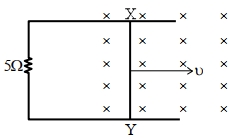
\(F = i \ell B\)\(=\left(\frac{\varepsilon}{ R }\right) \ell B =\left(\frac{ vB \ell}{ R }\right) \ell B =\frac{ vB ^2 \ell^2}{ R }=\frac{4}{5} \times\left(\frac{15}{100}\right)^2 \times 1^2\)
\(=\frac{4}{5} \times \frac{225}{10^4}\)
\(=\frac{180}{10^4}=0.018\,N\)
\(=18 \times 10^{-3}\,N\)
-
- (A) \(5\)
- (B) \(12\)
- (C) \(8\)
- (D) \(10\)
Show answer and solution
Correct Answer: (D)
Induced emf \(=- L \frac{ dI }{ dt }\)\(\Rightarrow 20=- L \frac{(0-2)}{10^{-3}}\)
\(\Rightarrow L =10\,mH\)
-
- (A) \(88\)
- (B) \(66\)
- (C) \(55\)
- (D) \(44\)
Show answer and solution
Correct Answer: (A)
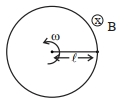
Here \(\omega=210\,rpm\)\(=210 \times \frac{2 \pi}{60}\,rad / s\)
\(\Rightarrow \omega=7 \pi\,rad / s\)
\(\ell=0.2\,w\)
\(B =0.2\,T\)
\(\text { emf developed across rod is }=\frac{1}{2} B \omega \ell^2\)
\(\frac{1}{2} \times 0.2 \times 7 \pi \times(0.2)^2\)
\(=88\,mV\)
- 4. A bar magnet is released from rest along the axis of a very long vertical copper tube. After some time the magnet will 2023 Medium
- (A) Move down with almost constant speed
- (B) Oscillate inside the tube
- (C) Move down with an acceleration greater than \(g\)
- (D) Move down with an acceleration equal to \(g\)
Show answer and solution
Correct Answer: (A)
After some time both force becomes equal. -
- (A) \(10\)
- (B) \(11\)
- (C) \(12\)
- (D) \(13\)
Show answer and solution
Correct Answer: (A)
\(EMF =\frac{ d }{ dt }\left( B \pi r ^2\right)\)\(=2 B \pi r \frac{ dr }{ dt }=2 \times \pi \times 0.1 \times 0.8 \times 2 \times 10^{-2}\) \(=2 \pi \times 1.6= 1 0 . 0 6 \text { [round off } 1 0 . 0 6 = 1 0 ]\)
-
- (A) \(625\)
- (B) \(624\)
- (C) \(623\)
- (D) \(621\)
Show answer and solution
Correct Answer: (A)
\(I =\frac{ V }{ R }=\frac{5}{2}\,A\)\(E =\frac{1}{2} LI ^2=\frac{1}{2} \times 2 \times\left(\frac{5}{2}\right)^2\)
\(E =625 \times 10^{-2}\,J\)
-
- (A) \(A\) and \(B\) only
- (B) \(A, B\) and \(C\) only
- (C) \(A, B\) and \(D\) only
- (D) \(A\) and \(C\) only
Show answer and solution
Correct Answer: (B)
\(\phi=\vec{B} \cdot \vec{A}\)\(= BA \cos \theta\)
Most suitable ans is \(2\) [Otherwise \(ABCD\) ]
-
- (A) \(40\)
- (B) \(30\)
- (C) \(20\)
- (D) \(50\)
Show answer and solution
Correct Answer: (D)
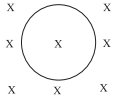
\(\frac{ dr }{ dt }=10^{-3}\,m / s\)\(\frac{ dA }{ dt }=2 \pi r \frac{ dr }{ dt }\)
\(\varepsilon=\left|\frac{- d \phi}{ dt }\right|=\left|\frac{ BdA }{ dt }\right|\)
\(=0.4 \times 2 \times \pi \times 2 \times 10^{-2} \times 10^{-3}\,V\)
\(=16 \pi\, \mu V =50.24\,\mu V\)
-
- (A) \(emf =1\,mV\)
- (B) \(emf =10\,mV\)
- (C) \(emf =100\,mV\)
- (D) \(emf =5\,mV\)
Show answer and solution
Correct Answer: (B)
\(EMF =\frac{ d \phi}{ dt }=\frac{ BA -0}{ t }\)\(A =\pi r ^2=\pi\left(\frac{0.1^2}{\pi}\right)=0.01\)
\(B =0.5\)
\(EMF =\frac{(0.5)(0.01)}{0.5}=0.01\,V =10\,mV\)
-
- (A) \(\frac{1}{4} B ^2 L \omega\)
- (B) \(\frac{1}{4} BL ^2 \omega\)
- (C) \(\frac{1}{2} BL ^2 \omega\)
- (D) \(\frac{1}{2} B ^2 L ^2 \omega\)
Show answer and solution
Correct Answer: (C)
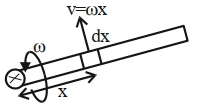
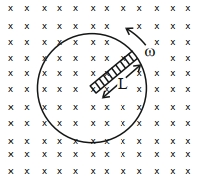
\(\int d \varepsilon=\int B (\omega x ) dx\)\(\varepsilon= B \omega \int \limits_0^{ L } x dx =\frac{ B \omega L ^2}{2}\)
-
- (A) \(12.5\)
- (B) \(\frac{32}{5}\)
- (C) \(125\)
- (D) \(\frac{5}{16}\)
Show answer and solution
Correct Answer: (C)
\(\phi=\mu_{ r } \mu_{ o } \frac{ N }{\ell} I \times A\)\(\mu_{ r }=125\)
-
- (A) \(43\)
- (B) \(42\)
- (C) \(44\)
- (D) \(41\)
Show answer and solution
Correct Answer: (C)
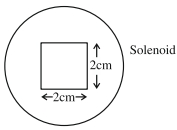
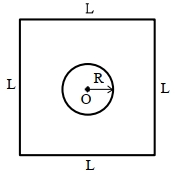
\(B _{\text {due to solenoid }}=\mu_0 nI\)\(\Phi_{\text {through square }}=\mu_0 nI \times A \quad( A =\text { Area })\)
\(Emf =\mu_0 nA \times \frac{ dI }{ dt }\)
\(=\mu_0 n A \times I _0 \omega \cos \omega t\)
\(\text { Emf amplitude }=\mu_0 n A \times I _0 \omega\)
\(=4 \pi \times 10^{-7} \times \frac{50}{10^{-2}} \times 4 \times 10^{-4} \times 2.5 \times 700\)
\(=44 \times 10^{-4}\,V\)
-
- (A) \(40\)
- (B) \(42\)
- (C) \(46\)
- (D) \(44\)
Show answer and solution
Correct Answer: (D)
\(\omega = 2\pi f = 2\pi \left(\frac{500}{60}\right) = \frac{50\pi}{3}\,rad/s\)
\(\theta = 90^{\circ} - 60^{\circ} = 30^{\circ}\)
\(e = NBA\omega \sin\theta\)
\(e = 600 \times 0.4 \times (70 \times 10^{-4}) \times \frac{50\pi}{3} \times \sin(30^{\circ})\)
\(e = 600 \times 0.4 \times 0.0070 \times \frac{50\pi}{3} \times \frac{1}{2}\)
\(e = 14\pi\)
\(e = 14 \times \frac{22}{7} = 44\,V\)
-
- (A) \(20\)
- (B) \(8\)
- (C) \(12\)
- (D) \(16\)
Show answer and solution
Correct Answer: (D)
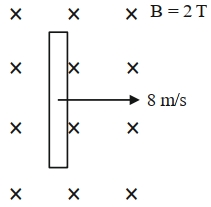
Induced emf across the ends \(= Bv \ell\)\(=2 \times 8 \times 1=16\,V\)
-
- (A) \(2\)
- (B) \(3.2\)
- (C) \(0.5\)
- (D) \(20\)
Show answer and solution
Correct Answer: (A)
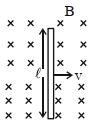
Induced emf \(= Blv\)\(\Rightarrow 0.08=0.4\left(\frac{10}{100}\right) v\)
\(\Rightarrow v =\left(\frac{0.08 \times 10}{0.4}\right) \quad \Rightarrow v =2\,m / s\)
-
- (A) \(250\)
- (B) \(260\)
- (C) \(290\)
- (D) \(240\)
Show answer and solution
Correct Answer: (D)
\(v _{ p }=12 \times 10^3 \text { volts }\)\(v _5=120 \text { volts }\)
\(p _{ s }=60\,KW = v _5 \times i _5\)
\(i _5=\frac{60 \times 10^3}{120}=5 \times 10^2\,A\)
\(R _{ L }=\frac{ v _5}{ i _5}=\frac{120}{5 \times 10^2}=24 \times 10^{-2}=240 \times 10^{-3} \Omega\)
\(=240\,m\,\Omega\)
-
- (A) \(50\)
- (B) \(60\)
- (C) \(40\)
- (D) \(30\)
Show answer and solution
Correct Answer: (B)
\(\Delta Q =-\frac{\Delta \phi}{ R }=-\left(\frac{\phi_2-\phi_1}{ R }\right)\)\(\phi_1= NBA\)
\(\phi_2= NBA\)
\(\therefore \Delta Q =\frac{2 NBA }{ R }=\frac{2 \times 100 \times 1.5 \times 24 \times 10^{-4}}{12}\)
\(=6 \times 10^{-2}\,C =60\,mC\)
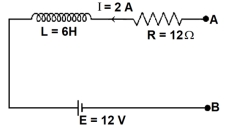
- 18. As per the given figure, if \(\frac{ dI }{ dt }=-1 A / s\) then the value of \(V _{ AB }\) at this instant will be \(................V\).
 2023 Medium
- (A) \(31\)
- (B) \(32\)
- (C) \(33\)
- (D) \(30\)
Show answer and solution
Correct Answer: (D)
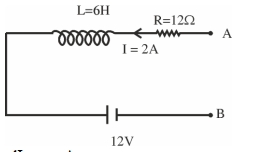
\(\frac{ dI }{ dt }=-1 \frac{ A }{ sec }\)\(V _{ A }- IR - L \frac{ dI }{ dt }-12= V _{ B }\)
\(V _{ A }-2 \times 12-6(-1)-12= V _{ B }\)
\(V _{ A }- V _{ B }=36-6=30\,volt\)
- 19. Certain galvanometers have a fixed core made of non magnetic metallic material. The function of this metallic material is 2023 Easy
- (A) to oscillate the coil in magnetic field for longer period of time
- (B) to bring the coil to rest quickly
- (C) to produce large deflecting torque on the coil
- (D) to make the magnetic field radial
Show answer and solution
Correct Answer: (B)
Due to motion of the coil eddy current develops thus bringing the coil to rest. -
- (A) \(M =\frac{\sqrt{2} \mu_0 R ^2}{ L }\)
- (B) \(M =\frac{2 \sqrt{2} \mu_0 R }{ L ^2}\)
- (C) \(M =\frac{2 \sqrt{2} \mu_0 R ^2}{ L }\)
- (D) \(M =\frac{\sqrt{2} \mu_0 R }{ L ^2}\)
Show answer and solution
Correct Answer: (C)
\(\phi= Mi\)\(\phi=( B A )\)
\(\phi=\pi R ^2\left(4 \frac{\mu_0}{4 \pi} \frac{1}{\left(\frac{ L }{2}\right)} \sqrt{2}\right)\)
\(\Rightarrow M =\frac{2 \sqrt{2} \mu_0 R ^2}{ L }\)
-
- (A) Both \(A\) and \(R\) are true but \(R\) is NOT the correct explanation of \(A\)
- (B) \(A\) is true but \(R\) is false
- (C) Both \(A\) and \(R\) are true and \(R\) is the correct explanation of \(A\)
- (D) \(A\) is false but \(R\) is true
Show answer and solution
Correct Answer: (C)
Both \(A\) and \(R\) are true and \(R\) is the correct explanation of \(A\)
-
- (A) \(1583\)
- (B) \(1528\)
- (C) \(1584\)
- (D) \(1580\)
Show answer and solution
Correct Answer: (C)
\(\varepsilon_{\max }= NAB \omega\)\(=100 \times 14 \times 10^{-2} \times 3 \times \frac{360 \times 2 \pi}{60}\)
\(=1584\,V\)
-
- (A) \(24\)
- (B) \(23\)
- (C) \(25\)
- (D) \(22\)
Show answer and solution
Correct Answer: (C)
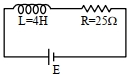
\(E=\frac{1}{2} L I^2\)Rate of energy storing \(=\frac{d E}{d t}=L I \frac{d I}{d t}\)
Now we Know for \(R-L\) circuit
\(I=\frac{E}{R}\left(1-e^{-t \frac{R}{L}}\right)\)
So \(\frac{d I}{d t}=\frac{E}{L} e^{-\frac{t R}{L}}\)
\(\frac{d E}{d t}=\frac{E^2}{R}\left(1-e^{-\frac{t R}{L}}\right)\left(e^{-t \frac{R}{L}}\right)\)
Time at which rate of power storing will be \(\max\)
\(t =\frac{L}{R \ln 2}\)
So \(\frac{d E}{d t}=\frac{E^2}{R}\left(1-\frac{1}{2}\right) \times \frac{1}{2}\)
\(\Rightarrow \frac{E^2}{4 R}=\frac{E^2}{100}=\frac{E^2}{2 \times 50}\)
\(a=2, b=50\)
So \(\frac{b}{a}=25\)
-
- (A) Time taken by them to reach the earth's surface will be independent of the properties of their materials
- (B) Insulating ball will reach the earth's surface earlier than the metal ball
- (C) Both will reach the earth's surface simultaneously
- (D) Metal ball will reach the earth's surface earlier than the insulating ball.
Show answer and solution
Correct Answer: (B)
When metal is passing through magnetic field, eddy current will produce and it will oppose the motion, so it will take more time. -
- (A) \(B\) and \(D\) only
- (B) \(B\) and \(C\) only
- (C) \(A\) and \(C\) only
- (D) \(C\) and \(D\) only
Show answer and solution
Correct Answer: (D)
Moving a coil inside a uniform magnetic field either with uniform or non-uniform speed doesn't changes flux, so, no emf is induced.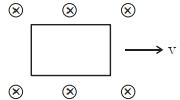
-
- (A) \(5\)
- (B) \(8\)
- (C) \(6\)
- (D) \(7\)
Show answer and solution
Correct Answer: (B)
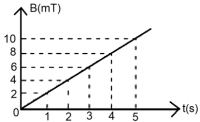
\(m =\tan \theta=\frac{10}{5}=2\)\(B = mt\)
\(B =2 t\)
\(\varepsilon=\left|\frac{ d \phi}{ dt }\right|=\frac{ d ( BA )}{ dt }=\frac{ AdB }{ dt }\)
\(\varepsilon=\frac{4 d (2 t )}{ dt }=4 \times 2=8\,mVolt\)
-
- (A) \((D)\) only
- (B) \((C)\) and \((E)\) only
- (C) \((A)\) only
- (D) \((B)\) and \((D)\) only
Show answer and solution
Correct Answer: (A)
Source of time varying magnetic field may be\(\rightarrow\) accelerated or retarded charge which produces varying electric and magnetic fields.
\(\rightarrow\) An electric field varying linearly with time will not produce variable magnetic field as current will be constant
-
- (A) 1A
- (B) 3A
- (C) 5A
- (D) 7A
Show answer and solution
Correct Answer: (B)
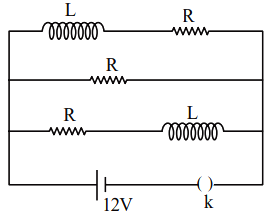
After long time an inductor behaves as a resistance-less path.
So current through cell
\(I =\frac{12}{ R / 3}=3 A\{\because R =12 \Omega\}\) -
- (A) \(3\)
- (B) \(2\)
- (C) \(4\)
- (D) \(0\)
Show answer and solution
Correct Answer: (C)
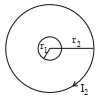
\(r_1=1\,cm , N_1=10\)\(r_2=1000\,cm , N_2=200\)
\(\phi_{1.2}=M I_2\)
\(N_2 \vec{B}_2 \cdot N_1 \vec{A}_1=M I_2\)
\(\Rightarrow N_1 N_2 \frac{\mu_0 I_2}{2 r_2} \cdot \pi r_1^2=M I_2\)
\(\Rightarrow M=\frac{10 \times 200 \times 4 \pi \times 10^{-7} \times \pi \times(0.01)^2}{2 \times 10}\)
\(\Rightarrow M=4 \times 10^{-8}\)
No questions on this page match these filters.