


Questions
Newest firstShowing 1–21 of 21 questions
-
- (A) Both Statement I and Statement II are correct
- (B) Both Statement I and Statement II are incorrect
- (C) Statement I is correct but Statement II is incorrect
- (D) Statement I is incorrect but Statement II is correct
Show answer and solution
Correct Answer: (B)
Statement I is incorrect because first row transition metals utilise both 3d and 4s electrons for the formation of bonds between reactant molecules and atoms on the surface of the catalyst.
Statement II is incorrect because the increase in the concentration of reactants on the surface of the catalyst weakens the bonds in the reacting molecules, which lowers the activation energy.
Therefore, both Statement I and Statement II are incorrect.
Answer: Both Statement I and Statement II are incorrect -
- (A) Statement I is true but Statement II is false
- (B) Statement I is false but Statement II is true
- (C) Both Statement I and Statement II are false
- (D) Both Statement I and Statement II are true
Show answer and solution
Correct Answer: (C)
\(Sc ^{3+} Ti ^{4+}\) and \(Zn ^{2+}\) are colourless
\(Th ^{4+}\) cannot act as a reducing agent. -
- (A) NO and \([\text{Fe(NO)}]\text{SO}_4\)
- (B) NO\(_2\) and \([\text{Fe(NO}_2)]\text{SO}_4\)
- (C) N\(_2\)O and \([\text{Fe(N}_2\text{O})]\text{SO}_4\)
- (D) N\(_2\)O\(_4\) and \([\text{Fe(N}_2\text{O}_4)]\text{SO}_4\)
Show answer and solution
Correct Answer: (A)
The brown ring test is used for the detection of nitrate (\(\text{NO}_3^-\)) or nitrite (\(\text{NO}_2^-\)) ions.
In this test, nitric oxide (NO) gas is evolved which reacts with the freshly prepared ferrous sulphate (\(\text{FeSO}_4\)) solution to form a brown ring of nitroso ferrous sulphate.
The gas \(X\) is NO.
The reaction is given by:
\(\text{FeSO}_4 + \text{NO} \rightarrow [\text{Fe(NO)}]\text{SO}_4\)
The actual composition of the brown ring complex is \([\text{Fe(H}_2\text{O})_5(\text{NO})]\text{SO}_4\), which is often represented as \([\text{Fe(NO)}]\text{SO}_4\).
Thus, \(X\) is NO and \(Y\) is \([\text{Fe(NO)}]\text{SO}_4\).
Answer: NO and \([\text{Fe(NO)}]\text{SO}_4\) -
- (A) 5
- (B) 6
- (C) 7
- (D) 8
Show answer and solution
Correct Answer: (B)
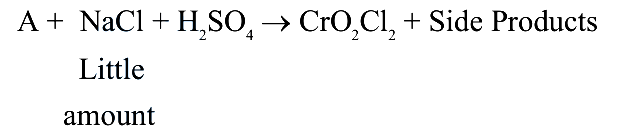
\(\begin{aligned} & \mathrm{Cr}_2 \mathrm{O}_7^{2-}+\mathrm{NaCl}+\mathrm{H}_2 \mathrm{SO}_4 \rightarrow \mathrm{CrO}_2 \mathrm{Cl}_2 \\ & \mathrm{CrO}_2 \mathrm{Cl}_2(\text { Vapour })+\mathrm{NaOH} \rightarrow \mathrm{Na}_2 \mathrm{CrO}_4+\mathrm{NaCl}+\mathrm{H}_2 \mathrm{O}\end{aligned}\)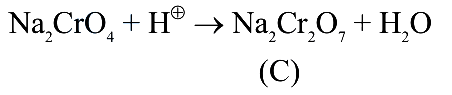
\(\mathrm{Na}_2 \mathrm{Cr}_2 \mathrm{O}_7 \rightarrow 2 \mathrm{Na}^{\oplus}+\mathrm{Cr}_2 \mathrm{O}_7^{2-}\)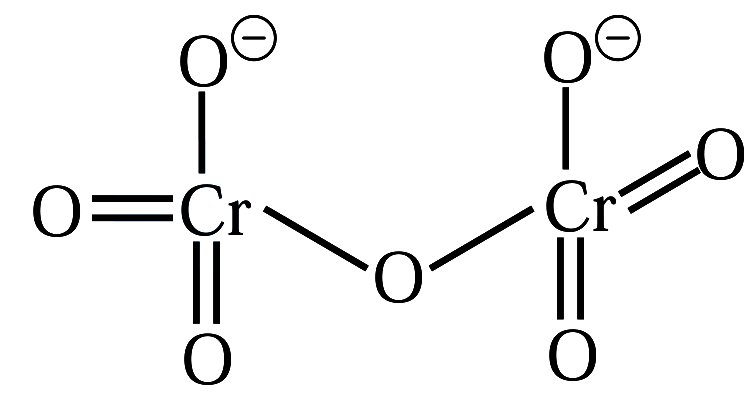
No of terminal "O" = 6 -
- (A) Statement I is false but Statement II is true
- (B) Statement I is true but Statement II is false
- (C) Both Statement I and Statement II are true
- (D) Both Statement I and Statement II are false
Show answer and solution
Correct Answer: (B)
Statement-I is true but statement II is false.
\(\mathrm{Cr}(\mathrm{VI})\) is less stable than \(\mathrm{Mo}(\mathrm{VI})\)
Hence, \(\mathrm{CrO}_3\) easily reduce into \(\mathrm{Cr}^{+3}\) as compared to \(\mathrm{MoO}_3\) and show stronger oxidizing nature. -
- (A) Both Statement I and Statement II are false
- (B) Both Statement I and Statement II are true
- (C) Statement I is false but Statement II is true
- (D) Statement I is true but Statement II is false
Show answer and solution
Correct Answer: (B)
Heating is required in oxalic acid filtration due to High activation energy.
Heating is not required in FAS vs \(\mathrm{KMnO}_4\) titration because \(\mathrm{Fe}^{2+}\) will get converted into \(\mathrm{Fe}^{3+}\) by oxygen of air and error may be introduced in the experiment.
Both Statement-I and Statement-II are correct. -
- (A) 20
- (B) 10
- (C) 15
- (D) 25
Show answer and solution
Correct Answer: (B)
\(\underset{(\mathrm{O}. \mathrm{A})}{\stackrel{+7}{\mathrm{KMnO}}} \xrightarrow{\text { Acidic medium }} \mathrm{Mn}^{2+}\)
X is difference in oxidation state.
\(6 \mathrm{CH}_3 \mathrm{COO}^{\ominus}+\mathrm{Fe}^{3+}+\mathrm{H}_2 \mathrm{O} \rightarrow\left[\mathrm{Fe}_3\left(\mathrm{OH}_2\right)\left(\mathrm{CH}_3 \mathrm{COO}\right)_6\right]^{\oplus}+2 \mathrm{H}^{\oplus}\)
\(\left[\mathrm{Fe}_3(\mathrm{OH})_2\left(\mathrm{CH}_3 \mathrm{COO}\right)_6\right]^{\oplus} \text{(Brown red ppt)} +4 \mathrm{H}_2 \mathrm{O}\rightarrow\left[\mathrm{Fe}(\mathrm{OH})_2\left(\mathrm{CH}_3 \mathrm{COO}\right]+\mathrm{CH}_3 \mathrm{COOH}+\mathrm{H}^{\oplus}\right.\)
\(\mathrm{Fe}^{3+} \Rightarrow 3 \mathrm{~d}^5 4 \mathrm{~s}^0\) contains 5 d electrons
So \(Y=5\)
\(X+Y=5+5=10\) -
- (A) \(\mathrm{K}_3 \mathrm{MnO}_4\)
- (B) \(\mathrm{K}_4\left[\mathrm{Mn}(\mathrm{OH})_6\right]\)
- (C) \(\mathrm{KMnO}_4\)
- (D) \(\mathrm{K}_2 \mathrm{MnO}_4\)
Show answer and solution
Correct Answer: (D)
Preparation of \(\mathrm{KMnO}{ }_4\)
\(\mathrm{MnO}_2 \xrightarrow[\mathrm{KNO}_3]{\mathrm{KOH}} \mathrm{K}_2 \mathrm{MnO}_4 \xrightarrow[\substack{\text { Oxidation in } \\ \text { Alkaline solution }}]{\text { Elecrolta }} \mathrm{KMnO}_4\) -
- (A) \(+3\)
- (B) \(+4\)
- (C) \(+7\)
- (D) \(+5\)
Show answer and solution
Correct Answer: (D)
\(\mathrm{V}_2 \mathrm{O}_5\) is amphoteric oxide.
\(\mathrm{V}_2 \mathrm{O}_5\) gives \(\mathrm{VO}_4{ }^{3-}\) on reaction with alkali oxidation state of V in \(\mathrm{VO}_4{ }^{3-}=+5\) -
- (A) \(\mathrm{Cu}^{+} \gt \mathrm{Cu}^{2+} \gt \mathrm{Cr}^{3+} \gt \mathrm{Cr}^{2+}\)
- (B) \(\mathrm{Cu}^{2+} \gt \mathrm{Cu}^{+} \gt \mathrm{Cr}^{2+} \gt \mathrm{Cr}^{3+}\)
- (C) \(\mathrm{Cr}^{2+} \gt \mathrm{Cr}^{3+} \gt \mathrm{Cu}^{2+} \gt \mathrm{Cu}^{+}\)
- (D) \(\mathrm{Cr}^{3+} \gt \mathrm{Cr}^{2+} \gt \mathrm{Cu}^{+} \gt \mathrm{Cu}^{2+}\)
Show answer and solution
Correct Answer: (C)
\(\mathrm{Cu}^{+}:[\mathrm{Ar}] 3 \mathrm{~d}^{10}\), Spin only magnetic moment \(=0\)
B.M.
\(\mathrm{Cu}^{+2}:[\mathrm{Ar}] 3 \mathrm{~d}^9\), Spin only magnetic moment \(=\sqrt{3}\)
B.M.
\(\mathrm{Cr}^{+2}:[\mathrm{Ar}] 3 \mathrm{~d}^4\), Spin only magnetic moment \(=\sqrt{24}\)
B.M.
\(\mathrm{Cr}^{+3}:[\mathrm{Ar}] 3 \mathrm{~d}^3\), Spin only magnetic moment \(=\sqrt{15}\)
B.M.
Order of \(\mu\) : \(\mathrm{Cr}^{+2} \gt \mathrm{Cr}^{+3} \gt \mathrm{Cu}^{+2} \gt \mathrm{Cu}^{+}\) -
- (A) (A), (B), (C), (D) and (E)
- (B) (A), (B), (D) and (E) only
- (C) (B), (D) and (E) only
- (D) (A), (C) and (D) only
Show answer and solution
Correct Answer: (B)
(i) True, \(\mathrm{T} \ell^{+}\)is more stable than \(\mathrm{T} \ell^{3+}\), due to inert pair effect. So \(\mathrm{T} \ell^{3+}\) is a powerful oxidising agent.
(ii) True, \(\mathrm{E}_{\mathrm{Al}^{3+/ A 1}}^0=-1.66 \mathrm{~V}\). So it is difficult to reduce \(\mathrm{A} \ell^{3+}\). So \(\mathrm{A} \ell^{3+}\) is highly stable.
(iii) False, as \(\mathrm{T} \ell^{3+}\) is unstable
(iv) True, \(\mathrm{T} \ell^{+}\)is more stable than \(\mathrm{T} \ell^{3+}\)
(v) True, \(\mathrm{A} \ell^{3+}\) and \(\mathrm{T} \ell^{+}\)are highly stable -
- (A) 120
- (B) 140
- (C) 160
- (D) 180
Show answer and solution
Correct Answer: (C)
\(\mathrm{FeCr}_2 \mathrm{O}_4+\mathrm{Na}_2 \mathrm{CO}_3+\mathrm{O}_2 \rightarrow \mathrm{Na}_2 \mathrm{CrO}_4+\mathrm{Fe}_2 \mathrm{O}_3+\mathrm{CO}_2\)
Insoluble product will be \(\mathrm{Fe}_2 \mathrm{O}_3\)
molar mass \(=56 \times 2+16 \times 3\)
\(\begin{aligned}
& =112+48 \\
& =160
\end{aligned}\) -
- (A) \(\mathrm{Eu}^{2+}\)
- (B) \(\mathrm{Tb}^{4+}\)
- (C) \(\mathrm{Lu}^{3+}\)
- (D) \(\mathrm{Ce}^{3+}\)
Show answer and solution
Correct Answer: (B)
\(\mathrm{Tb}^{4+}\) is strongest oxidising agent as it will reduce to \(\mathrm{Tb}^{3+}\) (common O.S. of Ln) -
- (A) 5
- (B) 4
- (C) 2
- (D) 3
Show answer and solution
Correct Answer: (A)
\(\begin{aligned} & \mathrm{CrO}_3=\text { Acidic } \\ & \mathrm{Mn}_2 \mathrm{O}_7=\text { Acidic } \\ & \therefore \mathrm{x}=2\end{aligned}\)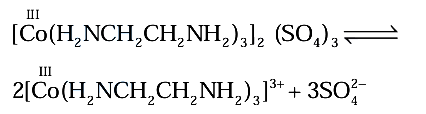
\(\begin{aligned} & \therefore \text { Primary valency }=3 \\ & \therefore \mathrm{x}+\mathrm{y}=5\end{aligned}\) -
- (A) Acidic
- (B) Neutral
- (C) Basic
- (D) Amphoteric
Show answer and solution
Correct Answer: (D)
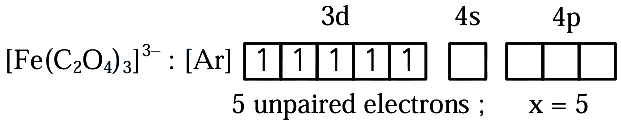
Explanation:
1. Identifying the Most Stable Complex: Among the given coordination complexes, \( \text{[Fe(C}_2\text{O}_4\text{)}_3\text{]}^{3-} \) is the most stable due to the chelation effect. The oxalate ion (\( \text{C}_2\text{O}_4^{2-} \)) is a bidentate ligand that binds to the central metal ion at two sites, forming three stable five-membered rings. Chelated complexes are significantly more stable than similar non-chelated complexes containing monodentate ligands.
2. Finding the Value of X: In the most stable complex \( \text{[Fe(C}_2\text{O}_4\text{)}_3\text{]}^{3-} \), the oxidation state of iron (\( \text{Fe} \)) is \( +3 \).
- Atomic number of \( \text{Fe} = 26 \)
- Ground state configuration of \( \text{Fe} = \text{[Ar] } 3d^6 4s^2 \)
- Configuration of \( \text{Fe}^{3+} = \text{[Ar] } 3d^5 4s^0 \)
Thus, the total number of electrons present in the \( d \)-orbitals of the central metal ion is \( X = 5 \).
3. Determining the Nature of the Oxide: Substituting \( X = 5 \) into the general oxide formula \( \text{V}_2\text{O}_X \) gives Vanadium Pentoxide (\( \text{V}_2\text{O}_5 \)). As the oxidation state of a transition metal increases, its oxides shift from basic to amphoteric/acidic characters. \( \text{V}_2\text{O}_5 \) is classically amphoteric because it reacts with both non-oxidizing acids and alkalis to form corresponding salts.
Hence, Option D is the correct choice. -
- (A) 2
- (B) 4
- (C) 6
- (D) 8
Show answer and solution
Correct Answer: (C)
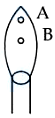
\(Fe ^{+3}\) will give green coloured bead when heated at point \(B\).
Number of unpaired \(e^{-}\)in \(Fe ^{+3}=5\)
\(\mu=5.92\)
Nearest integer = 6 -
- (A) A, B, D only
- (B) C and E only
- (C) A and E only
- (D) A, B and E only
Show answer and solution
Correct Answer: (C)
(1) \(Na > Cs > Li\) - true \{If considered with sign\}
The low solubility of Csl is due to smaller hydration enthalpy of it's two ions.
\(Li _2 CO _3\) is highly stable to heat - false.
In Conc. \(NH _3, K\) formed blue solution - true
All the alkali metal hydrides are ionic solid (True). -
- (A) \(Mn ^{3+}\)
- (B) \(Fe ^{3+}\)
- (C) \(Ti ^{3}\)
- (D) \(Cr ^{3+}\)
Show answer and solution
Correct Answer: (A)
Strongest oxidising agent have highest reduction potential value\(E _{ Mn ^{+3} / Mn ^{+2}}^{0}=1.51 \,V\) (highest)
- 19. In \(3 d\) series, the metal having the highest \(M ^{2+} / M\) standard electrode potential is .... . 2022 Easy
- (A) \(Cr\)
- (B) \(Fe\)
- (C) \(Cu\)
- (D) \(Zn\)
Show answer and solution
Correct Answer: (C)
\(Cr ^{-2} / Cr \rightarrow-0.90 \,V\)\(Fe ^{-2} / Fe \rightarrow-0.44\, V\)
\(Cu ^{+2} / Cu \rightarrow+0.34\, V\)
\(Zn ^{+2} / Zn \rightarrow-0.76 \,V\)
-
- (A) \(Sc ^{3+}, Zn ^{2+}\)
- (B) \(Ti ^{4+}, Cu ^{2+}\)
- (C) \(V ^{2+}, Ti ^{3+}\)
- (D) \(Zn ^{2+}, Mn ^{2+}\)
Show answer and solution
Correct Answer: (A)
(A) \(Sc ^{3+}, Zn ^{2+}\)\(3 d ^{0} \quad 3 d ^{10}\)
(B) \(Ti ^{4+}, Cu ^{2+}\)
\(3 d ^{0} \quad 3 d ^{9}\)
(C) \(V ^{2+}, Ti ^{3+}\)
\(3 d^{3} \quad 3 d^{1}\)
(D) \(Zn ^{2+}, Mn ^{2+}\)
\(3 d^{10} 3 d^{5}\)
No \(d-d\) transitions in ions with \(d^{0}\) and \(d^{10}\) configuration. Therefore they are colourless.
- 21. The electrode potential of \(M ^{2+} / M\) of \(3 d-\) series elements shows positive value of 2021 Easy
- (A) \(Zn\)
- (B) \(Fe\)
- (C) \(Co\)
- (D) \(Cu\)
Show answer and solution
Correct Answer: (D)
Only copper shows positive value for electrode potential of \(M ^{2+} / M\) of \(3 d-\)series elements.\(E ^{\Theta} / V _{\left( Cu ^{2+} / Cu \right)}:+0.34\)
No questions on this page match these filters.
Other STD 12 - D and f- block elements topics
Frequently asked
How many Chemical properties questions came in JEE Mains?
21 questions from 2021–2026, each with the correct answer and a full solution.
How difficult are Chemical properties questions?
29% are easy, 57% medium and 14% hard.