


Questions
Newest firstShowing 1–29 of 29 questions
-
- (A) 2
- (B) 3
- (C) 4
- (D) 5
Show answer and solution
Correct Answer: (B)
The energy of a photon is given by the relation:
\(E = \dfrac{hc}{\lambda}\)
For the two radiations, the energies are \(E_1 = \dfrac{hc}{\lambda_1}\) and \(E_2 = \dfrac{hc}{\lambda_2}\).
The ratio of their energies is:
\(\dfrac{E_1}{E_2} = \dfrac{\lambda_2}{\lambda_1}\)
Substituting the given values \(\lambda_1 = 2000\) and \(\lambda_2 = 6000\):
\(\dfrac{E_1}{E_2} = \dfrac{6000}{2000} = 3\)
Answer: \(3\) -
- (A) Both Statement I and Statement II are true
- (B) Both Statement I and Statement II are false
- (C) Statement I is false but Statement II is true
- (D) Statement I is true but Statement II is false
Show answer and solution
Correct Answer: (A)
\( \frac{1}{\lambda}=RZ^{2}(\frac{1}{n_{1}^{2}}-\frac{1}{n_{2}^{2}}) \)
For 1st line of Lyman series in H-atom:
\( \frac{1}{\lambda}=R(1)^{2}(\frac{1}{1^{2}}-\frac{1}{2^{2}}) = \frac{3R}{4} \)
For 2nd line of Balmer series of \(He ^{+}\)
\( \frac{1}{\lambda'}=R(2)^{2}(\frac{1}{2^{2}}-\frac{1}{4^{2}}) = \frac{3R}{4} \)
As \(\lambda\) and \(\lambda'\) is equal so frequency of these lines will be also equal. -
- (A) A and D only
- (B) A and C only
- (C) A and B only
- (D) B and C only
Show answer and solution
Correct Answer: (B)
(A) \( {}_{12}Mg^{24} \) represents 12 protons and 12 neutrons.
(B) \( \lambda = \frac{C}{\nu} = \frac{3 \times 10^{8}}{4.5 \times 10^{15}} = 6.67 \times 10^{-8} m \).
(C) \(\begin{array}{l}\frac{ E _1}{ E _2}=\frac{ hC / \lambda_1}{ hC / \lambda_2}=\frac{\lambda_2}{\lambda_1} \\ \frac{ E _1}{ E _2}=\frac{300}{900}=\frac{1}{3} \text { (false) }\end{array}\)
(D) No. of photons \( = \frac{\text{Energy}}{hC/\lambda} = 10^{16} \). (True) -
- (A) 5
- (B) 10
- (C) 15
- (D) 20
Show answer and solution
Correct Answer: (A)
The work function of sodium in Joules is:
\(\Phi = 2.3 \times 1.6 \times 10^{-19} = 3.68 \times 10^{-19}\) J
The kinetic energy of the ejected electrons is:
\(K = 2.8 \times 10^{-20} = 0.28 \times 10^{-19}\) J
Using the photoelectric equation, the energy of the incident photon is:
\(E = \Phi + K\)
\(E = 3.68 \times 10^{-19} + 0.28 \times 10^{-19} = 3.96 \times 10^{-19}\) J
The wavelength of the incident radiation is calculated using \(E = \dfrac{hc}{\lambda}\):
\(\lambda = \dfrac{hc}{E} = \dfrac{6.6 \times 10^{-34} \times 3.0 \times 10^8}{3.96 \times 10^{-19}}\)
\(\lambda = \dfrac{19.8 \times 10^{-26}}{3.96 \times 10^{-19}} = 5 \times 10^{-7}\) m
Converting the wavelength to nanometers:
\(\lambda = 500 \times 10^{-9}\) m \(= 500\) nm
Given that the wavelength is \(x\) nm, we get \(x = 500\).
Expressing \(x\) in the required format:
\(x = 5 \times 10^2\)
The value to be filled in the blank is \(5\).
Answer: \(5\) -
- (A) \(C > B > A\)
- (B) \(B > A > C\)
- (C) \(A > B > C\)
- (D) \(A > C > B\)
Show answer and solution
Correct Answer: (B)
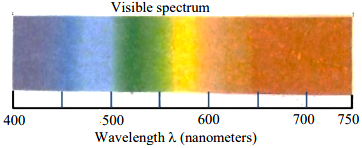
(1) Wavelength of \(A = 400 nm.\)
(2) Wavelength of B \((\lambda) = \frac{C}{\nu} = \frac{3 \times 10^{8}}{10^{16}}\)
\(=3 \times 10^{-8}=30 \times 10^{-9}=30 nm\).
(3) Wavelength of C \((\lambda) = \frac{1}{\bar{\nu}} = \frac{1}{10^{4}} = 10^{-4} cm\)
\(=10^{-6} m=1000 nm\)
Here \(\lambda_{C} > \lambda_{A} > \lambda_{B}\)
\(Energy (E) \propto \frac{1}{\lambda}\)
So \(E_{B} > E_{A} > E_{C}\) -
- (A) 3.1, 6.2
- (B) 2.3, 4.6
- (C) 1.4, 2.8
- (D) 1.5, 3.0
Show answer and solution
Correct Answer: (B)
\( KE_{max} = E - \phi \)
\( (KE_{max})_{1} = 6 - \phi_{1} \)\(\quad\) ... (1)
\( (KE_{max})_{2} = 6 - \phi_{2} \) \(\quad\)... (2)
By eq. (1) divide eq. (2)
\(\frac{\left( KE _{\max }\right)_1}{\left( KE _{\max }\right)_2}=\frac{2.642}{1}=\frac{6-\phi_1}{6-\phi_2}\)
\(\frac{2.642}{1}=\frac{6-\phi_1}{6-2 \phi_1}\)
\( \phi_{1} = 2.3 \text{ eV} \)
\( \phi_{2} = 4.6 \text{ eV} \). -
- (A) A, D and E Only
- (B) B, C and D Only
- (C) A, C, D and E Only
- (D) A, B, D and E Only
Show answer and solution
Correct Answer: (D)
\(\begin{aligned} & \lambda=\frac{\mathrm{C}}{\mathrm{v}}=\frac{3 \times 10}{5.16 \times 10^{14}} \\ & \lambda=581.39 \mathrm{~nm}\end{aligned}\)
* \(\lambda_{\text {Photon }}\) is near \(\&\) below yellow light it can show photoelectric effect.
* If intensity of light decreases photocurrent decreases.
* Red light will not produce photoelectric effect.
* \(v_{\text {Blue }} \gt v_{\text {yellow }}\) so photoelectric current will be produced.
* White light contain all frequencies so it will show photo electric current.
Correct statements are \(\mathrm{~A~B~D~} \& \mathrm{~E}\). -
- (A) \(5\)
- (B) \(7\)
- (C) \(9\)
- (D) \(10\)
Show answer and solution
Correct Answer: (A)
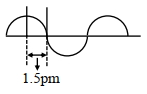
\(\lambda=1.5 \times 4 \mathrm{pm}\)\(=6 \times 10^{-12} \text { meter }\)
\(\lambda v=\mathrm{C}\)
\(6 \times 10^{-12} \times v=3 \times 10^8\)
\(v=5 \times 10^{19} \mathrm{~Hz}\)
-
- (A) \(540\) and \(\frac{1}{683}\)
- (B) \(540\) and \(683\)
- (C) \(450\) and \(\frac{1}{683}\)
- (D) \(450\) and \(683\)
Show answer and solution
Correct Answer: (B)
The candela is the luminous intensity of a source that emits monochromatic radiation of frequency radiation of frequency \(540 \times 10^{12} \mathrm{~Hz}\) and has a radiant intensity in that direction of \(\frac{1}{683} \mathrm{w} / \mathrm{sr}\). It is unit of Candela. -
- (A) \(494\)
- (B) \(490\)
- (C) \(499\)
- (D) \(445\)
Show answer and solution
Correct Answer: (A)
\(\mathrm{E}=\frac{1240}{\lambda(\mathrm{nm})} \mathrm{eV}\)\(=\frac{1240}{242} \mathrm{eV}\)
\(=5.12 \mathrm{eV}\)
\(=5.12 \times 1.6 \times 10^{-19}\)
\(=8.198 \times 10^{-19} \mathrm{~J} / \text { atom }\)
\(=494 \mathrm{~kJ} / \mathrm{mol}\)
- 11. Wavenumber for a radiation having \(5800 \mathring A\) wavelength is \(x \times 10 \mathrm{~cm}^{-1}\). The value of \(x\) is _______. 2024 Medium
- (A) \(1724\)
- (B) \(1725\)
- (C) \(1727\)
- (D) \(1730\)
Show answer and solution
Correct Answer: (A)
\(\bar{v} \text { (wave no.) }=\frac{1}{\lambda}=\frac{1}{5800 \times 10^{-8} \mathrm{~cm}}=17241\)OR
\(1724 \times 10 \mathrm{~cm}^{-1} \Rightarrow \mathrm{x}=1724\)
-
- (A) \(2\)
- (B) \(3\)
- (C) \(1\)
- (D) \(4\)
Show answer and solution
Correct Answer: (A)
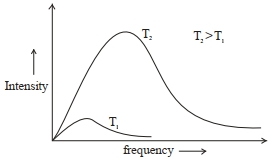
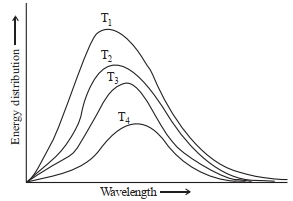
The spectrum of Black body radiation is explained using quantization of energy. With increase in temperature, peak of spectrum shifts to shorter wavelength or higher frequency. For above graph\(\rightarrow T _1 > T _2 > T _3 > T _4 \text {. }\)
-
- (A) Both \(A\) and \(R\) are correct but \(R\) is NOT the correct explanation of \(A\)
- (B) \(A\) is correct but \(R\) is not correct
- (C) Both \(A\) and \(R\) are correct and \(R\) is the correct explanation of \(A\)
- (D) \(A\) is not correct but \(R\) is correct
Show answer and solution
Correct Answer: (B)
There is a characteristic minimum frequency, or "threshold frequency," for each metal below which the photoelectric effect is not seen. The ejected electrons leave with a specific amount of kinetic energy at a frequency \(v > v _0\) with an increase in light frequency of these electron kinetic energies also rise. -
- (A) \(796\)
- (B) \(798\)
- (C) \(797\)
- (D) \(785\)
Show answer and solution
Correct Answer: (B)
For one photon \(E = hv\)For one mole photon,
\(E=6 \cdot 023 \times 10^{23} \times 6.626 \times 10^{-34} \times 2 \times 10^{12}\)
-
- (A) \(1\)
- (B) \(0\)
- (C) \(2\)
- (D) \(3\)
Show answer and solution
Correct Answer: (B)
A blackbody can emit and absorb all the wavelengths in electromagnetic spectrum \(\Rightarrow(A)\) is correct\(\Rightarrow(B),(C),(D)\) correct
-
- (A) \(300\)
- (B) \(30\)
- (C) \(45\)
- (D) \(100\)
Show answer and solution
Correct Answer: (A)
\(\phi=6.63 \times 10^{-19} \,J =\frac{ hc }{\lambda}=\frac{6.63 \times 10^{-34} \times 3 \times 10^{8}}{\lambda}\)\(\Rightarrow \lambda=3 \times 10^{-7} m =300\, nm\)
-
- (A) \(235\)
- (B) \(325\)
- (C) \(399\)
- (D) \(435\)
Show answer and solution
Correct Answer: (C)
Energy of one mole of photons \(=\frac{ hc }{\lambda} \times N _{ A }\)\(\frac{6.63 \times 10^{-34} \times 3 \times 10^{8}}{300 \times 10^{-9}} \times 6.02 \times 10^{23}\)
\(=399.13 \times 10^{3} \,Joule / mole\)
\(=399\, kJ / mole\)
-
- (A) \(32.1\)
- (B) \(0.624\)
- (C) \(8.58\)
- (D) \(976\)
Show answer and solution
Correct Answer: (C)
\(W = h v\)\(=6.6 \times 10^{-34} \times 1.3 \times 10^{15}\)
\(=8.58 \times 10^{-19} \,J\)
-
- (A) \(1\)
- (B) \(4\)
- (C) \(2\)
- (D) \(3\)
Show answer and solution
Correct Answer: (C)
Total energy per sec. \(=50\, \mathrm{~J}\)\(50=\frac{\mathrm{n} \times 6.63 \times 10^{-34} \times 3 \times 10^{8}}{795 \times 10^{-9}}\)
\(\mathrm{n}=1998.49 \times 10^{17}[\mathrm{n}=\mathrm{no} .\) of photons per second \(]\)
\(=1.998 \times 10^{20}\)
\(\simeq 2 \times 10^{20}\)
\(=\mathrm{x} \times 10^{20}\)
\(\mathrm{x}=2\)
-
- (A) \(7\)
- (B) \(5\)
- (C) \(1\)
- (D) \(500\)
Show answer and solution
Correct Answer: (B)
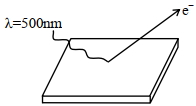
\(v:\) speed of electron having max. K.E.\(\Rightarrow\) from Einstein equation : \(\mathrm{E}=\phi+\mathrm{K} \cdot \mathrm{E}_{\cdot \max }\)
\(\Rightarrow \frac{\mathrm{hc}}{\lambda}=\mathrm{h} v_{0}+\frac{1}{2} \mathrm{mv}^{2}\)
\(\Rightarrow \frac{6.63 \times 10^{-34} \times 3 \times 10^{8}}{500 \times 10^{-9}}=6.63 \times 10^{-34} \times 4.3 \times 10^{14}\)\(+\frac{1}{2} \mathrm{mv}^{2}\)
\(\Rightarrow \frac{6.63 \times 30 \times 10^{-20}}{5}=6.63 \times 4.3 \times 10^{-20}+\frac{1}{2} \mathrm{mv}^{2}\)
\(\Rightarrow 11.271 \times 10^{-20} \mathrm{~J}=\frac{1}{2} \times 9 \times 10^{-31} \times \mathrm{v}^{2}\)
\(\Rightarrow \mathrm{v}=5 \times 10^{5} \,\mathrm{~m} / \mathrm{sec}\)
-
- (A) \(2\)
- (B) \(4\)
- (C) \(6\)
- (D) \(8\)
Show answer and solution
Correct Answer: (A)
Total energy provided bySource per second \(=\frac{1000}{10}=100 \,\mathrm{~J}\)
Energy required to eject electron \(=\frac{h c}{\lambda}\)
\(=\frac{6.626 \times 10^{-34}}{400 \times 10^{-9}} \times 3 \times 10^{8}\)
Number of electrons ejected
\(=\frac{\frac{100}{6.626 \times 10^{-34} \times 3 \times 10^{8}}}{400 \times 10^{-9}}\)
\(=\frac{400 \times 10^{-7} \times 10^{26}}{6.626 \times 3}\)
\(=\frac{40 \times 10^{-20}}{6.626 \times 3}\)
\(=2.01 \times 10^{20}\)
-
- (A) \(145\)
- (B) \(90\)
- (C) \(40\)
- (D) \(180\)
Show answer and solution
Correct Answer: (D)
\(E=\frac{ hc }{\lambda} \times \frac{ N _{ A }}{1000}\)\(=\frac{6.63 \times 10^{-34} \times 3 \times 10^{8} \times 6.02 \times 10^{23}}{663 \times 10^{-9} \times 1000}\)
\(=3 \times 6.02 \times 10\, kJ\)
\(=180.6\, kJ\)
-
- (A) \(50\)
- (B) \(500\)
- (C) \(5\)
- (D) \(663\)
Show answer and solution
Correct Answer: (A)
Energy emitted in \(0.1\, \mathrm{sec}\).\(=0.1\, \mathrm{sec} \cdot \times 10^{-3} \,\frac{\mathrm{J}}{\mathrm{s}}\)
\(=10^{-4}\, \mathrm{~J}\)
If \('n'\) photons of \(\lambda=1000\, \mathrm{~nm}\) are emitted,
\(\text { then ; } 10^{-4}=\mathrm{n} \times \frac{\mathrm{hc}}{\lambda}\)
\(\Rightarrow 10^{-4}=\frac{\mathrm{n} \times 6.63 \times 10^{-34} \times 3 \times 10^{8}}{1000 \times 10^{-9}}\)
\(\Rightarrow \mathrm{n}=5.02 \times 10^{14}=50.2 \times 10^{13}\)
\(\Rightarrow 50\) (nearest integer)
-
- (A) \(\frac{3}{4}\lambda \)
- (B) \(\frac{1}{2}\lambda \)
- (C) \(\frac{4}{9}\lambda \)
- (D) \(\frac{2}{3}\lambda \)
Show answer and solution
Correct Answer: (C)
\(K.E = \frac{1}{2}m{u^2} = \frac{1}{2}\frac{{{m^2}{u^2}}}{m} = \frac{1}{2}\frac{{{P^2}}}{m}\)\(\frac{{hc}}{{{\lambda _1}}} = Wo + {(K.E)_1} = Wo + \frac{1}{2}\frac{{{P^2}}}{m}\)
\(\frac{{hc}}{{{\lambda _2}}} = Wo + {(K.E)_2} = Wo + \frac{1}{2}\frac{{{{(1.5P)}^2}}}{m}\)
On solving
\({\lambda _2} = \frac{4}{9}{\lambda _1}\)
Since the \(K.E\) is very high is comparison to work function, then we can assume that \(K.E+Wo = K.E\)
-
- (A) \(0.9\)
- (B) \(3.1\)
- (C) \(2.1\)
- (D) \(4\)
Show answer and solution
Correct Answer: (C)
\(hv = \phi + h{v^o}\)\(\frac{1}{2}m{v^2} = hc\left( {\frac{1}{\lambda } - \frac{1}{{{\lambda _0}}}} \right)\)
\(hv = \phi + \frac{1}{2}m{v^2}\)
\(\phi = \frac{{6.626 \times {{10}^{ - 34}} \times 3 \times {{10}^8}}}{{4000 \times {{10}^{ - 10}}}}\) \( - \frac{1}{2} \times 9 \times {10^{ - 31}} \times {(6 \times {10^5})^2}\)
\(\phi = 3.35 \times {10^{ - 19}}\,J\)
\( \Rightarrow \phi \simeq 2.1\,eV\)
-
- (A) \(4\)
- (B) \(5.5\)
- (C) \(4.5\)
- (D) \(5\)
Show answer and solution
Correct Answer: (C)
\(\lambda = 250\,nm = 2500\,\mathop A\limits^o \)\(E = \frac{{hc}}{\lambda } = \frac{{12400}}{{2500}} = 4.96\,eV\)
\(KE = \) stopping potential \( = 0.5\,eV\)
\(E = {W_0} + K.E.\)
\(4.96 = {W_0} + 0.5\)
\({W_0} = 4.46 \approx 4.5\,eV\)
-
- (A) \(8.041 \times 10^{-40}\,J\)
- (B) \(2.680 \times 10^{-19}\,J\)
- (C) \(1.640 \times 10^{-18}\,J\)
- (D) \(6.111 \times 10^{-17}\,J\)
Show answer and solution
Correct Answer: (C)
\(E = hv\)
\(= 6.63 \times 10^{-34} \times 2.47 \times 10^{15}\)
\(= 1 .640 \times 10^{-18}\,J\) -
- (A) \(\sqrt {\frac{{2h}}{m}\left( {{\lambda _0} - \lambda } \right)} \)
- (B) \(\sqrt {\frac{{2hc}}{m}\left( {{\lambda _0} - \lambda } \right)} \)
- (C) \(\sqrt {\frac{{2hc}}{m}\left( {\frac{{{\lambda _0} - \lambda }}{{\lambda {\lambda _0}}}} \right)} \)
- (D) \(\sqrt {\frac{{2h}}{m}\left( {\frac{1}{{{\lambda _0}}} - \frac{1}{\lambda }} \right)} \)
Show answer and solution
Correct Answer: (C)
The kinetic enegry of the ejected electron is given by the equation\(hv = h{v_0} + \frac{1}{2}m{v^2}\,\,\,\because \,v = \frac{c}{\lambda }\)
or \(\frac{{hc}}{\lambda } = \frac{{hc}}{{{\lambda _0}}} + \frac{1}{2}m{v^2}\)
\(\frac{1}{2}m{v^2} = \frac{{hc}}{\lambda } - \frac{{hc}}{{{\lambda _0}}}\)
\( = hc\left( {\frac{{{\lambda _0} - \lambda }}{{\lambda {\lambda _0}}}} \right)\)
\(\therefore \,\,{v^2} = \frac{{2hc}}{m}\left( {\frac{{{\lambda _0} - \lambda }}{{\lambda {\lambda _0}}}} \right)\)
or \(v = \sqrt {\frac{{2hc}}{m}\left( {\frac{{{\lambda _0} - \lambda }}{{\lambda {\lambda _0}}}} \right)} \)
-
- (A) \(7.50\times10^4\, s^{-1}\)
- (B) \(4.76\times10^{14}\, s^{-1}\)
- (C) \(3.15\times10^{15}\, s^{-1}\)
- (D) \(1.24\times10^{15}\, s^{-1}\)
Show answer and solution
Correct Answer: (D)
Energy \(= N_A\,hv\)\(495.5 = 6.023 \times 10^{23} \times 6.6 \times 10^{-34} \times v\)
\(v = \frac{{495.5 \times {{10}^3}\,J}}{{6.023 \times {{10}^{23}} \times 6.6 \times {{10}^{ - 34}}}} = 12.4 \times {10^{14}}\)
\( = 1.24 \times {10^{15}}\,{s^{ - 1}}\)
No questions on this page match these filters.
Other STD 11 - Structure of atom topics
Frequently asked
How many Nature of radiation questions came in JEE Mains?
29 questions from 2014–2026, each with the correct answer and a full solution.
How difficult are Nature of radiation questions?
14% are easy, 55% medium and 31% hard.