


Questions
Newest firstShowing 1–50 of 70 questions
- 1. Angular momentum of an electron in a hydrogen atom is \(\dfrac{3h}{\pi}\), then the energy of the electron is _______ eV. 2026 Easy
- 2. An electron in the hydrogen atom initially in the fourth excited state makes a transition to \(\mathrm{n}^{\text {th }}\) energy state by emitting a photon of energy 2.86 eV. The integer value of \(n\) will be ____. 2025 Easy
- 3. During the transition of electron from state A to state C of a Bohr atom, the wavelength of emitted radiation is \(2000 Å\) and it becomes \(6000 Å\) when the electron jumps from state B to state C. Then the wavelength of the radiation emitted during the transition of electrons from state A to state B is _______. 2025 Medium
- 4. In a hydrogen like ion, the energy difference between the \(2^{\text {nd }}\) excitation energy state and ground is 108.8 eV. The atomic number of the ion is 2025 Medium
- 5. A particular hydrogen - like ion emits the radiation of frequency \(3 \times 10^{15} \mathrm{~Hz}\) when it makes transition from \(n=2\) to \(n=1\). The frequency of radiation emitted in transition from \(n=3\) to \(n=1\) is \(\frac{x}{9} \times 10^{15} \mathrm{~Hz}\), when \(x=\) = _____. 2024 Hard
- 6. According to Bohr's theory, the moment of momentum of an electron revolving in \(4^{\text {th }}\) orbit of hydrogen atom is _______. 2024 Hard
- 7. Given below are two statements : \(Statement\) \(I\) : Most of the mass of the atom and all its positive charge are concentrated in a tiny nucleus and the electrons revolve around it, is Rutherford's model. \(Statement\) \(II\) : An atom is a spherical cloud of positive charges with electrons embedded in it, is a special case of Rutherford's model. In the light of the above statements, choose the most appropriate from the options given below. 2024 Hard
- 8. Hydrogen atom is bombarded with electrons accelerated through a potential different of \(\mathrm{V}\), which causes excitation of hydrogen atoms. If the experiment is being formed at \(\mathrm{T}=0 \mathrm{~K}\). The minimum potential difference needed to observe any Balmer series lines in the emission spectra will be \(\frac{\alpha}{10} \mathrm{~V}\), where \(\alpha=\) _______. 2024 Hard
- 9. If Rydberg's constant is \(R\), the longest wavelength of radiation in Paschen series will be \(\frac{\alpha}{7 R}\), where \(\alpha=\)____________ 2024 Hard
- 10. The minimum energy required by a hydrogen atom in ground state to emit radiation in Balmer series is nearly _______. 2024 Hard
- 11. The ratio of the magnitude of the kinetic energy to the potential energy of an electron in the \(5^{\text {th }}\) excited state of a hydrogen atom is _______. 2024 Hard
- 12. The ratio of the shortest wavelength of Balmer series to the shortest wavelength of Lyman series for hydrogen atom is _______. 2024 Hard
- 13. A light of energy \(12.75 \;eV\) is incident on a hydrogen atom in its ground state. The atom absorbs the radiation and reaches to one of its excited states. The angular momentum of the atom in the excited state is \(\frac{x}{\pi} \times 10^{-17} \;eVs\). The value of \(x\) is \(........\) (use \(h=4.14 \times 10^{-15} \;eVs , c=3 \times 10^8\;\left.ms ^{-1}\right)\) 2023 Medium
- 14. A monochromatic light is incident on a hydrogen sample in ground state. Hydrogen atoms absorb a fraction of light and subsequently emit radiation of six different wavelengths. The frequency of incident light is \(x \times 10^{15}\,Hz\). The value of \(x\) is (Given \(h =4.25 \times 10^{-15}\,eVs\) ) 2023 Medium
- 15. A photon is emitted in transition from \(n =4\) to \(n =1\) level in hydrogen atom. The corresponding wavelength for this transition is \(.........\,nm\) \(\text { (given, } h =4 \times 10^{-15} eVs \text { ) : }\) 2023 Medium
- 16. An atom absorbs a photon of wavelength \(500\,nm\) and emits another photon of wavelength \(600\,nm\). The net energy absorbed by the atom in this process is \(n \times 10^{-4}\,eV\). The value of \(n\) is ............ [Assume the atom to be stationary during the absorption and emission process] \(\left(\right.\)Take \(h =6.6 \times 10^{-34}\,Js\) and \(\left.c =3 \times 10^8\,m / s \right)\) 2023 Medium
- 17. An electron of a hydrogen like atom, having \(Z=4\), jumps from \(4^{\text {th }}\) energy state to \(2^{\text {nd }}\) energy state, The energy released in this process, will be \(.........eV\) \((\) Given \(Rch =13.6\,eV )\) Where \(R =\) Rydberg constant \(c=\) Speed of light in vacuum \(h =\) Planck's constant 2023 Medium
- 18. As per given figure \(A , B\) and \(C\) are the first, second and third excited energy level of hydrogen atom respectively. If the ratio of the two wavelengths \(\left(\right.\) i.e. \(\left.\frac{\lambda_1}{\lambda_2}\right)\) is \(\frac{7}{4 n}\), then the value of \(n\) will be
 2023 Hard
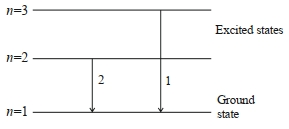
- 19. For hydrogen atom, \(\lambda_1\) and \(\lambda_2\) are the wavelengths corresponding to the transitions \(1\) and \(2\) respectively as shown in figure. The ratio of \(\lambda_1\) and \(\lambda_2\) is \(\frac{x}{32}\). The value of \(x\) is \(..........\)
 2023 Medium
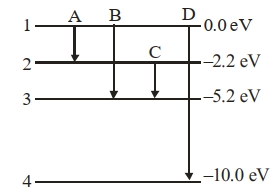
- 20. The energy levels of an atom is shown is figure. Which one of these transitions will result in the emission of a photon of wavelength \(124.1\,nm\) ?Given \(\left( h =6.62 \times 10^{-34}\,Js \right)\)
 2023 Medium
- 21. The energy levels of an hydrogen atom are shown below. The transition corresponding to emission of shortest wavelength is
 2023 Medium
- 22. The energy of \(He ^{+}\)ion in its first excited state is \(......eV\) (The ground state energy for the Hydrogen atom is \(-13.6\,eV )\) 2023 Easy
- 23. The wavelength of the radiation emitted is \(\lambda_0\) when an electron jumps from the second excited state to the first excited state of hydrogen atom. If the electron jumps from the third excited state to the second orbit of the hydrogen atom, the wavelength of the radiation emitted will be \(\frac{20}{x} \lambda_0\). The value of \(x\) is \(........\) 2023 Medium
- 24. A beam of monochromatic light is used to excite the electron in \(Li ^{++}\)from the first orbit to the third orbit. The wavelength of monochromatic light is found to be \(x \times 10^{-10} \; m\). The value of \(x\) is \(\dots.\) [Given hc \(=1242 \; eV nm ]\) 2022 Medium
- 25. A hydrogen atom in is ground state absorbs \(10.2\;eV\) of energy. The angular momentum of electron of the hydrogen atom will increase by the value of ............... \(\times 10^{-34} \; J {s}\) (Given, Plank's constant \(\left.=6.6 \times 10^{-34} Js \right)\) 2022 Medium
- 26. A hydrogen atom in its ground state absorbs \(10.2\ eV\) of energy. The orbital angular momentum is increased by (Given Planck constant \(h = 6.6 \times {10^{ - 34}}J - sec\)) 2022 Medium
- 27. Find the ratio of energies of photons produced due to transition of an election of hydrogen atom from its \((i)\) second permitted energy level to the first level, and \((ii)\) the highest permitted energy level to the first permitted level. 2022 Medium
- 28. Given below are two statements: Statement \(I\) : In hydrogen atom, the frequency of radiation emitted when an electron jumps from lower energy orbit \(\left( E _{1}\right)\) to higher energy orbit \(\left( E _{2}\right)\), is given as \(hf = E _{1}- E _{2}\). Statement \(II\) : The jumping of electron from higher energy orbit \(\left(E_{2}\right)\) to lower energy orbit \(\left(E_{1}\right)\) is associated with frequency of radiation given as \(f\) \(=\left( E _{2}- E _{1}\right) / h\) This condition is Bohr's frequency condition. In the light of the above statements, choose the correct answer from the options given below 2022 Medium
- 29. Hydrogen atom from excited state comes to the ground by emitting a photon of wavelength \(\lambda\). The value of principal quantum number ' \(n\) ' of the excited state will be: (\(R\): Rydberg constant) 2022 Hard
- 30. The momentum of an electron revolving in \(n ^{\text {th }}\) orbit is given by: (Symbols have their usual meanings) 2022 Easy
- 31. The ratio for the speed of the electron in the \(3^{ rd }\) orbit of \(He ^{+}\)to the speed of the electron in the \(3^{\text {ad }}\) orbit of hydrogen atom will be 2022 Medium
- 32. \(\frac{x}{x+4}\) is the ratio of energies of photons produced due to transition of an electron of hydrogen atom from its \((i)\) third permitted energy level to the second level and \((ii)\) the highest permitted energy level to the second permitted level. The value of \(x\) will be. 2022 Medium
- 33. A free electron of \(2.6\, {eV}\) energy collides with a \({H}^{+}\) ion. This results in the formation of a hydrogen atom in the first excited state and a photon is released. Find the frequency of the emitted photon. \(\left({h}=6.6 \times 10^{-34}\, {J} {s}\right)\) 2021 Hard
- 34. A particle of mass \(m\) moves in a circular orbit in a central potential field \(U ( r )= U _{0} r ^{4}\). If Bohr's quantization conditions are applied, radii of possible orbitals \(r _{ n }\) vary with \(n ^{1 / \alpha}\), where \(\alpha\) is ....... . 2021 Hard
- 35. A particular hydrogen like ion emits radiation of frequency \(2.92 \times 10^{15}\, {Hz}\) when it makes transition from \({n}=3\) to \({n}=1 .\) The frequency in \({Hz}\) of radiation emitted in transition from \({n}=2\) to \({n}=1\) will be : (in \(\,\times 10^{15}\)) 2021 Medium
- 36. According to Bohr atom model, in which of the following transitions will the frequency be maximum ? 2021 Hard
- 37. If an electron is moving in the \(n ^{\text {th }}\) orbit of the hydrogen atom, then its velocity \(\left( v _{ n }\right)\) for the \(n ^{\text {th }}\) orbit is given as 2021 Medium
- 38. Imagine that the electron in a hydrogen atom is replaced by a muon \((\mu) .\) The mass of muon particle is \(207\) times that of an electron and charge is equal to the charge of an electron. The ionization potential of this hydrogen atom will be ............. \(eV\) 2021 Hard
- 39. In Bohr's atomic model, the electron is assumed to revolve in a circular orbit of radius \(0.5 \times 10^{-10}\,m\). If the speed of electron is \(2.2 \times 10^{6} \;{m} / {s}\), then the current associated with the electron will be \(....\,\times 10^{-2} \;{mA}\). [Take \(\pi\) as \(\left.\frac{22}{7}\right]\) 2021 Hard
- 40. The first three spectral lines of \(H\) -atom in the Balmer series are given \(\lambda_{1}, \lambda_{2}, \lambda_{3}\) considering the Bohr atomic model, the wave lengths of first and third spectral lines \(\left(\frac{\lambda_{1}}{\lambda_{3}}\right)\) are related by a factor of approximately 'x' \(\times 10^{-1}\). The value of \(x\), to the nearest integer, is 2021 Hard
- 41. The recoil speed of a hydrogen atom after it emits a photon in going from \(n =5\) state to \(n =1\) state will be ..... \(m/s\) 2021 Hard
- 42. The wavelength of the photon emitted by a hydrogen atom when an electron makes a transition from \(n =2\) to \(n =1\) state is ...... \(nm.\) 2021 Medium
- 43. Which level of the single ionized carbon has the same energy as the ground state energy of hydrogen atom ? 2021 Medium
- 44. A particle of mass \(200 \,MeV / c ^{2}\) collides with a hydrogen atom at rest. Soon after the collision the particle comes to rest, and the atom recoils and goes to its first excited state. The initial kinetic energy of the particle (in \(eV\) ) is \(\frac{ N }{4} .\) The value of \(N\) is : (Given the mass of the hydrogen atom to be \(\left.1\, GeV / c ^{2}\right)\) 2020 Medium
- 45. In a hydrogen atom the electron makes a transition from \(( n +1)^{\text {th }}\) level to the \(n ^{\text {th }}\) level. If \(n>>1,\) the frequency of radiation emitted is proportional to 2020 Hard
- 46. The energy required to ionise a hydrogen like ion in its ground state is \(9\) Rydbergs. What is the wavelength of the radiation emitted when the electron in this ion jumps from the second excited state to the ground state ? ........\(nm\) 2020 Hard
- 47. The time period of revolution of electron in its ground state orbit in a hydrogen atom is \(1.6 \times 10^{-16} \;\mathrm{s}\). The frequency of revolution of the electron in its first excited state (in \(s^{-1}\) ) is: 2020 Hard
- 48. A hydrogen atom, initially in the ground state is excited by absorbing a photon of wavelength \(980\,\mathop A\limits^o \). The radius of the atom in the excited state, in terms of Bohr radius \(a_0,\) will be \((hc\,=\,12500\,eV-\mathop A\limits^o)\) 2019 Hard
- 49. A particle of mass \(m\) moves in a circular orbit in a central potential field \(U\left( r \right) = \frac{1}{2}k{r^2}\). If Bohr’s quantization conditions are applied, radii of possible orbits and energy levels vary with quantum number \(n\) as 2019 Hard
- 50. A particle \(P\) is formed due to a completely inelastic collision of particles \(x\) and \(y\) having de -Broglie wavelengths \({\lambda _x}\) and \({\lambda _y}\) respectively. If \(x\) and \(y\) were moving in opposite directions, then the de -Broglie wavelength of \(P\) is 2019 Medium
No questions on this page match these filters.
Other STD 12 - Atoms topics
Frequently asked
How many Electron Energy and Electron Energy Levels in Hydrogen Atom questions came in JEE Mains?
70 questions from 2013–2026, each with the correct answer and a full solution.
How difficult are Electron Energy and Electron Energy Levels in Hydrogen Atom questions?
6% are easy, 47% medium and 47% hard.