


Questions
Newest firstShowing 1–50 of 97 questions
-
- (A) 70
- (B) 75
- (C) 78
- (D) 80
Show answer and solution
Correct Answer: (C)
We have considered
\(E _{\left[ Sn ( OH )_6\right]^{2-} / HSnO _2^{-}}^{ o }=-0.9 V\)
\(Pt \left| HSnO _2^{-}(aq ),\left[ Sn ( OH )_6\right]^{2-}( aq ), OH ^{-}( aq )\right| Bi _2 O _3(s) \\ | Bi ( s )|\)
\(\quad \quad\quad0.5 M \quad\quad\quad 0.05 M\)
\(E _{\text {cell }}^{\circ}=+0.9-0.44=0.46 V\)
Oxidation Half :
\(HSnO _2^{-}+ H _2 O +3 OH ^{-} \rightarrow\left[ Sn ( OH )_6\right]^{2-}+2 e ^{-}\)
Reduction Half :
\(\frac{ Bi _2 O _3+3 H _2 O +6 e ^{-} \rightarrow 2 Bi +6 OH ^{-}}{3 HSnO _2^{-}( aq )+ Bi _2 O _3(s)+6 H _2 O +3 OH ^{-}( aq )}\)
\(\rightarrow 3\left[ Sn ( OH )_6\right]^{-}( aq )+2 Bi ( s )\)
\(E _{\text {cell }}= E _{\text {cell }}^{ o }-\frac{0.059}{6} \log \frac{(0.5)^3}{(0.05)^3 \times\left[ OH ^{-}\right]^3}\)
\(0.2353=0.46-\frac{0.059}{6} \times 3 \log \left[\frac{10}{\left[ OH ^{-}\right]}\right]\)
\(\log \left[\frac{10}{ OH ^{-}}\right]=\frac{2 \times 0.2247}{0.059}=7.6\)
\(I + pOH =7.6\)
\(pOH =6.6\)
\(pH =14-6.6=7.4\)
\(pH = pK _{ a _1}+\log \frac{\left[ HCO _3^{-}\right]}{\left[ H _2 CO _3\right]}\)
\(7.4=6.11+\log \frac{5 x}{20}\)
\(1.29=\log \frac{x}{4}\)
\(\frac{x}{4}=19.5\)
\(x=78\) -
- (A) 0
- (B) 1
- (C) 2
- (D) 4
Show answer and solution
Correct Answer: (C)
Given standard reduction potentials:
\(E^{\ominus}_{M^{x+}/M} = +0.15\) V
\(E^{\ominus}_{Fe^{3+}/Fe} = -0.036\) V
Since \(E^{\ominus}_{M^{x+}/M} > E^{\ominus}_{Fe^{3+}/Fe}\), reduction occurs at the \(M^{x+}/M\) electrode (cathode) and oxidation occurs at the \(Fe^{3+}/Fe\) electrode (anode).
Cathode reaction: \((M^{x+} + x e^{-} \rightarrow M) \times 3\)
Anode reaction: \((Fe \rightarrow Fe^{3+} + 3 e^{-}) \times x\)
Overall balanced cell reaction:
\(3 M^{x+} + x Fe \rightarrow 3 M + x Fe^{3+}\)
The number of electrons transferred in the balanced reaction is \(n = 3x\).
Standard cell potential \(E^{\ominus}_{cell}\) is:
\(E^{\ominus}_{cell} = E^{\ominus}_{cathode} - E^{\ominus}_{anode}\)
\(E^{\ominus}_{cell} = 0.15 - (-0.036) = 0.186\) V
Using the Nernst equation:
\(E_{cell} = E^{\ominus}_{cell} - \dfrac{2.303RT}{nF} \log Q\)
Substitute the given values (\(E_{cell} = 0.2057\) V, \(Q = 10^{-2}\), and \(\dfrac{2.303RT}{F} = 0.059\) V):
\(0.2057 = 0.186 - \dfrac{0.059}{3x} \log(10^{-2})\)
\(0.2057 - 0.186 = -\dfrac{0.059}{3x} \times (-2)\)
\(0.0197 = \dfrac{0.118}{3x}\)
\(3x = \dfrac{0.118}{0.0197}\)
\(3x \approx 6\)
\(x = 2\)
Answer: \(2\) -
- (A) Overall reaction \(Fe(s) + 2OH^-(aq) + 2AgBr(s) \rightleftharpoons Fe(OH)_2(s) + 2Ag(s) + 2Br^-(aq)\)
- (B) \(E^\theta_{cell} = -0.95\) V
- (C) Fe is reduced in the electrochemical cell
- (D) \(E^\theta_{cell}\) is an extensive property
Show answer and solution
Correct Answer: (A)
For a spontaneous reaction, the cell potential \(E^{\theta}_{cell}\) must be positive. The half-cell with the higher standard reduction potential acts as the cathode (reduction), and the one with the lower standard reduction potential acts as the anode (oxidation).
Given standard reduction potentials:
\(E^{\theta}_{AgBr/Ag} = +0.07\) V
\(E^{\theta}_{Fe(OH)_2/Fe} = -0.88\) V
Since \(+0.07\) V \(> -0.88\) V, \(AgBr\) undergoes reduction at the cathode and \(Fe\) undergoes oxidation at the anode.
Cathode reaction: \(2AgBr(s) + 2e^{-} \rightarrow 2Ag(s) + 2Br^{-}(aq)\)
Anode reaction: \(Fe(s) + 2OH^{-}(aq) \rightarrow Fe(OH)_2(s) + 2e^{-}\)
Overall cell reaction:
\(Fe(s) + 2OH^{-}(aq) + 2AgBr(s) \rightleftharpoons Fe(OH)_2(s) + 2Ag(s) + 2Br^{-}(aq)\)
Standard cell potential:
\(E^{\theta}_{cell} = E^{\theta}_{cathode} - E^{\theta}_{anode} = 0.07 - (-0.88) = +0.95\) V
\(E^{\theta}_{cell}\) is an intensive property, and \(Fe\) is oxidized in the cell. Thus, only the overall reaction given in the first option is correct.
Answer: Overall reaction \(Fe(s) + 2OH^-(aq) + 2AgBr(s) \rightleftharpoons Fe(OH)_2(s) + 2Ag(s) + 2Br^-(aq)\) -
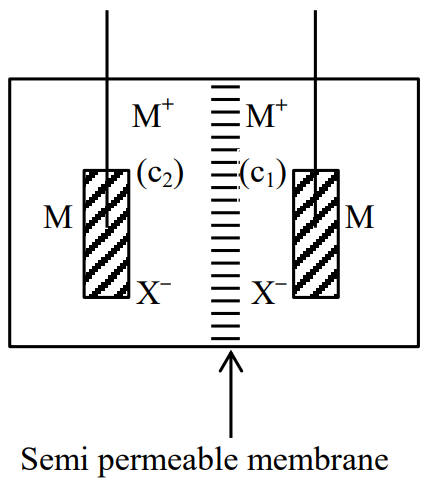
- (A) If \( c_{1} \) is present at anode, then \( c_{1} = c_{2} \)
- (B) If \( c_{1} \) is present at cathode, then \( c_{1} < c_{2} \)
- (C) If \( c_{1} \) is present at cathode, then \( c_{1} > c_{2} \)
- (D) If \( c_{1} \) is present at anode, then \( c_{1} > c_{2} \)
Show answer and solution
Correct Answer: (C)
(1) If \(C _1\) is at anode ⇒ cell reaction
\( M^{+}(C_{2}) \rightarrow M^{+}(C_{1}) \)
\( E_{cell} = -0.059 \log \frac{C_{1}}{C_{2}} \)
\(\therefore E_{cell} > 0 \Rightarrow C_{1} < C_{2} \)
(2) If \( C_{1} \) is at cathode
\( M^{+}(C_{1}) \rightarrow M^{+}(C_{2}) \)
\( E_{cell} = -0.059 \log \frac{C_{2}}{C_{1}} > 0 \)
\( C_{2} < C_{1} \) -
- (A) 2
- (B) 4
- (C) 6
- (D) 8
Show answer and solution
Correct Answer: (B)
For spontaneity \(E_{cell} > 0\).
At limiting condition:
\(E_{oxi}(anode) = -E_{red}(cathode)\)
\(H_{2}O \rightarrow 2H^{+} + \frac{1}{2}O_{2} + 2e^{-}\)
\(E = E ^{\circ}-\frac{0.059}{2} \log \left[\frac{\left[ H ^{+}\right]^2 \times P _{ O _2}^{1 / 2}}{1}\right]\)
\(-0.997 = -1.23 + 0.059 \times pH\)
\(pH = 3.94\)
\(pH \simeq 4\) -
- (A) 2
- (B) 3
- (C) 4
- (D) 5
Show answer and solution
Correct Answer: (C)
\(E_{cell}^{\circ} = -0.44 - (-0.90)\)
\(= +0.46 V\)
Applying Nernst equation :-
\(E_{\text {cell }}=E_{\text {cell }}^{\circ}-\frac{0.06}{n} \log Q\)
\(E _{\text {cell }}=0.46-\frac{0.06}{6} \log 10^6\)
\(E _{\text {cell }}=4 \times 10^{-1}\)
\(x = 4\) -
- (A) 6
- (B) 12
- (C) 24
- (D) 8
Show answer and solution
Correct Answer: (C)
\( 3BH_{4}^{-}+4ClO_{3}^{-} \rightarrow 4Cl^{-}+3H_{2}BO_{3}^{-}+3H_{2}O \)
n -factor \(=8\)
moles \(=3\)
\(\therefore n =3 \times 8=24\) -
- (A) \(Al > Cr > Fe^{2+} > Co^{2+}\)
- (B) \(Al > Fe^{2+} > Cr > Co^{2+}\)
- (C) \(Al > Cr > Co^{2+} > Fe^{2+}\)
- (D) \(Cr > Fe^{2+} > Al > Co^{2+}\)
Show answer and solution
Correct Answer: (A)
Reducing power \(\propto \frac{1}{\text { Reduction potential }}\) -
- (A) The overall reaction can be written as \(n_2\text{Red}_1 + n_1\text{Ox}_2 \rightleftharpoons n_2\text{Ox}_1^{n_1^+} + n_1\text{Red}_2^{n_2^-}\)
- (B) The electrons do not appear in the overall reaction because electrons produced at the anode are consumed at the cathode.
- (C) Here \(n\) is the number of electrons transferred in redox reaction.
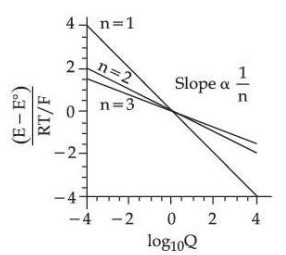
- (D) If the reaction is carried out reversibly, the electrical work done is equal to the ratio of charge and potential difference through which charge is moved.
Show answer and solution
Correct Answer: (D)
For the given redox reaction, the half-cell reactions are:
Anode: \(\text{Red}_1 \rightarrow \text{Ox}_1^{n_1^+} + n_1 e^-\)
Cathode: \(\text{Ox}_2 + n_2 e^- \rightarrow \text{Red}_2^{n_2^-}\)
To obtain the overall balanced chemical equation, we multiply the anode reaction by \(n_2\) and the cathode reaction by \(n_1\) so that the number of electrons lost equals the number of electrons gained:
\(n_2\text{Red}_1 \rightarrow n_2\text{Ox}_1^{n_1^+} + n_1 n_2 e^-\)
\(n_1\text{Ox}_2 + n_1 n_2 e^- \rightarrow n_1\text{Red}_2^{n_2^-}\)
Adding these gives the overall reaction:
\(n_2\text{Red}_1 + n_1\text{Ox}_2 \rightleftharpoons n_2\text{Ox}_1^{n_1^+} + n_1\text{Red}_2^{n_2^-}\)
Thus, statement (A) is correct.
In the overall reaction, electrons do not appear because the electrons produced at the anode are exactly consumed at the cathode. Thus, statement (B) is correct.
From the Nernst equation:
\(E = E^\circ - \dfrac{RT}{nF} \ln Q = E^\circ - \dfrac{2.303 RT}{nF} \log_{10} Q\)
\(\dfrac{E - E^\circ}{RT/F} = -\dfrac{2.303}{n} \log_{10} Q\)
The graph of \(\dfrac{E - E^\circ}{RT/F}\) versus \(\log_{10} Q\) is a straight line with a slope of \(-\dfrac{2.303}{n}\), where \(n\) is the number of electrons transferred in the balanced redox reaction. Thus, statement (C) is correct.
The electrical work done by a galvanic cell is given by the product of the total charge transferred and the cell potential (potential difference), not their ratio.
\(W_{\text{electrical}} = \text{Charge} \times \text{Potential difference} = nF E_{\text{cell}}\)
Thus, statement (D) is incorrect.
Answer: If the reaction is carried out reversibly, the electrical work done is equal to the ratio of charge and potential difference through which charge is moved. -
- (A) \(2X-3Y\)
- (B) \(3Y-2X\)
- (C) \(3Y+2X\)
- (D) \(Y+X\)
Show answer and solution
Correct Answer: (B)
The half-reactions and their standard Gibbs free energy changes are given by:
\(Fe^{2+} + 2e^{-} \rightarrow Fe\)
\(\Delta G^{\ominus}_{1} = -2FX\)
\(Fe^{3+} + 3e^{-} \rightarrow Fe\)
\(\Delta G^{\ominus}_{2} = -3FY\)
The required half-reaction is:
\(Fe^{3+} + e^{-} \rightarrow Fe^{2+}\)
\(\Delta G^{\ominus}_{3} = -1FE^{\ominus}_{Fe^{3+}/Fe^{2+}}\)
This reaction is obtained by subtracting the first reaction from the second reaction:
\(\Delta G^{\ominus}_{3} = \Delta G^{\ominus}_{2} - \Delta G^{\ominus}_{1}\)
\(-FE^{\ominus}_{Fe^{3+}/Fe^{2+}} = -3FY - (-2FX)\)
\(-FE^{\ominus}_{Fe^{3+}/Fe^{2+}} = -3FY + 2FX\)
\(E^{\ominus}_{Fe^{3+}/Fe^{2+}} = 3Y - 2X\)
Answer: \(3Y-2X\) -
- (A) A and B only
- (B) A and E only
- (C) B only
- (D) C, D and E only
Show answer and solution
Correct Answer: (D)
\(Cl_{aq}^{-}+Ag_{(S)}+Fe_{aq}^{+3}\rightarrow Fe_{aq}^{+2}+AgCl_{(S)}\)
\(E_{cell}=E_{cell}^{o}-\frac{0.059}{1}log\frac{[Fe^{2+}]}{[Cl^{-}][Fe^{3+}]}\) -
- (A) 200
- (B) 790
- (C) 590
- (D) 1380
Show answer and solution
Correct Answer: (A)
\(E _{ X ^{-} / MX ( s ) / M }^{ o }= E _{ M ^{+} / M }^{ o }+\frac{0.0591}{ n } \log K _{ sp }\)
\(=0.79+\frac{0.059}{1} \log 10^{-10}\)
\(=0.79-0.59\)
\(=0.20 V=200 mV\) -
- (A) \(\dfrac{2}{3.9}\)
- (B) \(\dfrac{4}{5.9}\)
- (C) \(\dfrac{2.9}{2}\)
- (D) \(\dfrac{5.9}{4}\)
Show answer and solution
Correct Answer: (B)
The cell reaction is \(Zn(s) + 2Ag^+(aq) \rightarrow Zn^{2+}(aq) + 2Ag(s)\)
The standard cell potential is given by:
\(E^\circ_{cell} = E^\circ_{cathode} - E^\circ_{anode} = 0.80 - (-0.76) = 1.56\text{ V}\)
Using the Nernst equation:
\(E_{cell} = E^\circ_{cell} - \dfrac{0.059}{n} \log \dfrac{[Zn^{2+}]}{[Ag^+]^2}\)
Substituting the given values (\(n = 2\), \([Zn^{2+}] = 1\text{ M}\), \(E_{cell} = 1.60\text{ V}\)):
\(1.60 = 1.56 - \dfrac{0.059}{2} \log \dfrac{1}{x^2}\)
\(0.04 = - \dfrac{0.059}{2} (-2 \log x)\)
\(0.04 = 0.059 \log x\)
\(\log x = \dfrac{0.04}{0.059} = \dfrac{4}{5.9}\)
Answer: \(\dfrac{4}{5.9}\) -
- (A) 100
- (B) 200
- (C) 300
- (D) 400
Show answer and solution
Correct Answer: (D)
\(\mathrm{Cu}^{+2}+2 \mathrm{e}^{-} \longrightarrow \mathrm{Cu}\)
\(\begin{aligned}& (1 \text { faraday }=\text { charge on } 1 \text { mole electron }) \\& \mathrm{t}=0 \quad 1.5 \quad 1 \mathrm{~mole} \\& \mathrm{t}=\mathrm{t} \quad 1 \quad-\quad 0.5 \text { mole }\end{aligned}\)
\(\left[\mathrm{Cu}^{+2}\right]=1 \mathrm{M}\) after electrolysis
* \(\mathrm{Ag} \oplus+\mathrm{e}^{-} \quad \longrightarrow \mathrm{Ag}\)
\(\begin{array}{lll}\mathrm{t}=0 & 0.2 & 0.1 \text { mole } \\ \mathrm{t}=\mathrm{t} & 0.1 & - \qquad -\end{array}\)
\(\left[\mathrm{Ag}^{+}\right]=0.1 \mathrm{M}\) after electrolysis
Cell \(\quad \mathrm{Cu}_{(\mathrm{s})}+2 \mathrm{Ag}_{(\mathrm{aq})}^{+} \rightarrow \mathrm{Cu}_{(\mathrm{aq})}^{+2}+2 \mathrm{Ag}_{(\mathrm{s})}\)
reaction
\(\begin{aligned} & \mathrm{E}=\mathrm{E}^{\circ}-\frac{0.06}{\mathrm{n}} \log \frac{\left[\mathrm{Cu}^{+2}\right]}{\left[\mathrm{Ag}^{+}\right]^2} \\ & \mathrm{E}=(0.8-0.34)-\frac{0.06}{2} \log \frac{1}{(0.1)^2}=0.4 \mathrm{~V}\end{aligned}\)
Correct answer \(=400 \mathrm{mV}\) -
- (A) 2
- (B) 4
- (C) 6
- (D) 8
Show answer and solution
Correct Answer: (C)
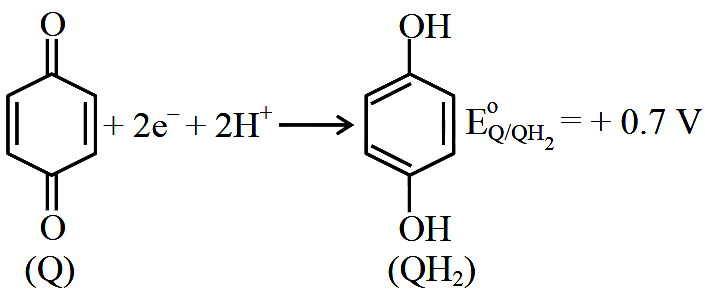
\(\begin{aligned}
& \mathrm{QH}_2+2 \mathrm{Ag}^{+} \rightarrow 2 \mathrm{Ag}+\mathrm{Q}+2 \mathrm{H}^{+} \\
& \mathrm{E}=\mathrm{E}^{\circ}-\frac{0.06}{2} \log \left[\mathrm{H}^{+}\right]^2 \\
& \mathrm{E}=\mathrm{E}^{\circ}-0.06 \times \log \left[\mathrm{H}^{+}\right] \\
& \mathrm{pH}=-\log \left(\mathrm{H}^{+}\right)=\frac{\mathrm{E}-\mathrm{E}^{\mathrm{o}}}{0.06}=\frac{0.4-0.1}{0.06} \\
& =\frac{0.3}{0.06}=5
\end{aligned}\)
\(\begin{aligned} & \mathrm{pH}+\mathrm{NH}_4 \mathrm{X}=7-\frac{1}{2} \mathrm{pK}_{\mathrm{b}}-\frac{1}{2} \log \mathrm{C} \\ & 5=7-\frac{1}{2} \times \mathrm{pK}_{\mathrm{b}}-\frac{1}{2} \log \left(10^{-2}\right) \\ & \mathrm{pK}_{\mathrm{b}}=6\end{aligned}\) -
- (A) 10
- (B) 20
- (C) 30
- (D) 40
Show answer and solution
Correct Answer: (A)
\(\begin{aligned} & \mathrm{Cr}_2 \mathrm{O}_{7 \text { (aq) }}^{-2}+14 \mathrm{H}_{(\mathrm{aq})}^{+}+6 \mathrm{e}^{-} \rightarrow 2 \mathrm{Cr}_{(\mathrm{aq})}^{+3}+7 \mathrm{H}_2 \mathrm{O}_{(\ell)} \\ & \mathrm{E}_{\mathrm{R}}=\mathrm{E}_{\mathrm{R}}^0-\frac{0.059}{6} \log \frac{\left[\mathrm{Cr}^{+3}\right]^2}{\left[\mathrm{Cr}_2 \mathrm{O}_7^{-2}\right]\left[\mathrm{H}^{+}\right]^{14}} \\ & 0=1.33-\frac{0.059}{6} \log \frac{10^{-6}}{\left[\mathrm{H}^{+}\right]^{14}} \\ & \frac{1.33 \times 6}{0.059}=\log \frac{10^{-6}}{[\mathrm{H}]^{14}} \\ & 135.254=-6-14 \log \left[\mathrm{H}^{+}\right] \\ & 141.254=14 \mathrm{pH} \\ & \mathrm{pH}=\frac{141.254}{14}=10.08\end{aligned}\) -
- (A) 2.1 V
- (B) 1 .7 V
- (C) 1 .4 V
- (D) 1 .2 V
Show answer and solution
Correct Answer: (B)
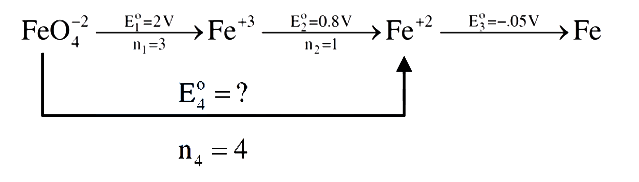
\(\begin{aligned} & \Delta \mathrm{G}_4^{\mathrm{o}}=\Delta \mathrm{G}_1^{\mathrm{o}}+\Delta \mathrm{G}_2^{\mathrm{o}} \\ \Rightarrow & -\mathrm{n}_4 \mathrm{FE}_4^{\mathrm{o}}=-\mathrm{n}_1 \mathrm{FE}_1^0-\mathrm{n}_2 \mathrm{FE}_2^{\mathrm{o}} \\ \Rightarrow & +4 \mathrm{E}_4^{\mathrm{o}}=3 \times 2+(1 \times 0.8) \\ \Rightarrow & \mathrm{E}_4^{\mathrm{o}}=\frac{6.8}{4} \mathrm{~V} \\ \Rightarrow & \mathrm{E}_4^{\mathrm{o}}=1.7 \mathrm{~V}\end{aligned}\) -
- (A) \(\mathrm{E}_{\text {cell }}=\mathrm{E}_{\text {cell }}^{\mathrm{o}}-\frac{\mathrm{RT}}{2 \mathrm{~F}} \ln \frac{\left[\mathrm{Ag}^{+}\right]}{\left[\mathrm{Mg}^{2+}\right]}\)
- (B) \(\mathrm{E}_{\text {cell }}=\mathrm{E}_{\text {cell }}^{\mathrm{o}}+\frac{\mathrm{RT}}{2 \mathrm{~F}} \ln \frac{\left[\mathrm{Ag}^{+}\right]^2}{\left[\mathrm{Mg}^{2+}\right]}\)
- (C) \(\mathrm{E}_{\text {cell }}=\mathrm{E}_{\text {cell }}^{\mathrm{o}}-\frac{\mathrm{RT}}{2 \mathrm{~F}} \ln \frac{\left[\mathrm{Ag}^{+}\right]^2}{\left[\mathrm{Mg}^{2+}\right]}\)
- (D) \(\mathrm{E}_{\text {cell }}=\mathrm{E}_{\text {cell }}^{\mathrm{o}}-\frac{\mathrm{RT}}{2 \mathrm{~F}} \ln \frac{\left[\mathrm{Mg}^{2+}\right]}{\left[\mathrm{Ag}^{+}\right]}\)
Show answer and solution
Correct Answer: (B)
\(\begin{array}{lll}\text { Cathode } & \left(\mathrm{Ag}+(\mathrm{aq})+\mathrm{e}^{-}\right. & \rightarrow \mathrm{Ag}) \times 2 \\ \text { Anode } & \mathrm{Mg} & \rightarrow \mathrm{Mg}^{2+}(\mathrm{aq})+2 \mathrm{e}^{-}\end{array}\)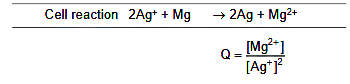
By Nernst equation
\(\begin{aligned}
& \mathrm{E}_{\text {cell }}=\mathrm{E}_{\mathrm{cell}}^{\circ}-\frac{\mathrm{RT}}{\mathrm{nF}} \ln \mathrm{Q} \\
& \mathrm{E}_{\text {cell }}=\mathrm{E}_{\mathrm{cell}}^{\circ}-\frac{\mathrm{RT}}{\mathrm{nF}} \ln \frac{\left[\mathrm{Mg}^{2+}\right]}{\left[\mathrm{Ag}^{+}\right]^2} \\
& =\mathrm{E}_{\text {cell }}^{\circ}+\frac{\mathrm{RT}}{2 \mathrm{~F}} \ln \frac{\left[\mathrm{Ag}^{+}\right]^2}{\left[\mathrm{Mg}^{2+}\right]}
\end{aligned}\) -
- (A) \(x+y-z\)
- (B) \(x+2 y\)
- (C) \(x+2 y-3 z\)
- (D) \(y-2 x\)
Show answer and solution
Correct Answer: (C)
\(\mathrm{Fe}^{2+}(\mathrm{aq})+\mathrm{Ag}^{+}(\mathrm{aq}) \rightarrow \mathrm{Fe}^{3+}(\mathrm{aq})+\mathrm{Ag}(\mathrm{s})\)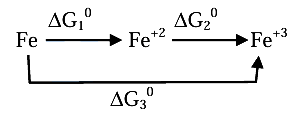
\(\begin{aligned}
& \Delta \mathrm{G}_3^0=\Delta \mathrm{G}_1^0+\Delta \mathrm{G}_2^0 \\
& -3 \mathrm{~F}(-\mathrm{z})=-2 \mathrm{~F}(-\mathrm{y})+\Delta \mathrm{G}_2{ }^0 \\
& \Delta \mathrm{G}_2^0=3 \mathrm{Fz}-2 \mathrm{Fy}
\end{aligned}\)
Also \(\Delta \mathrm{G}_2^0=-\mathrm{nFE}_{\mathrm{Fe}^{+2} / \mathrm{Fe}^{t^{43}}}^0\)
\(\begin{aligned}
& 3 \mathrm{Fz}-2 \mathrm{Fy}=-1 \mathrm{~F}\left(\mathrm{E}_{\mathrm{Fe}^{t^2} / \mathrm{Fe}^{43}}^0\right) \\
& \mathrm{E}_{\mathrm{Fe}^{2+2} / \mathrm{Fe}^{t^3}}^0=2 \mathrm{y}-3 \mathrm{z}
\end{aligned}\)
\(\mathrm{E}_{\text {Cell }}^0\) for reaction will be
\(\begin{aligned}
& \mathrm{E}_{\mathrm{Ag}^{+} / \mathrm{Ag}}^0+\mathrm{E}_{\mathrm{Fe}^{t^2 / \mathrm{Fe}}}^{03} \\
& =\mathrm{x}+2 \mathrm{y}-3 \mathrm{z}
\end{aligned}\) -
- (A) Both statement I and statement II are incorrect
- (B) Statement I is correct but statement II is incorrect
- (C) Both statement I and statement II are correct
- (D) Statement I is incorrect but statement II is correct
Show answer and solution
Correct Answer: (B)
Statement-II \(\Rightarrow\) At cathode, instead of \(\mathrm{Mg}, \mathrm{H}_2 \mathrm{O}_{(\ell)}\) will reduce & evolve \(\mathrm{H}_2\) gas. -
- (A) \(\mathrm{Zn}\left|\mathrm{Zn}^{2+}(1 \mathrm{M})\right|\left|\mathrm{Ag}^{+}(1 \mathrm{M})\right| \mathrm{Ag}\)
- (B) \(\mathrm{Zn}\left|\mathrm{Zn}^{2+}(1 \mathrm{M})\right|\left|\mathrm{Mg}^{2+}(1 \mathrm{M})\right| \mathrm{Mg}\)
- (C) \(\mathrm{Ag}\left|\mathrm{Ag}^{+}(1 \mathrm{M})\right|\left|\mathrm{Mg}^{2+}(1 \mathrm{M})\right| \mathrm{Mg}\)
- (D) \(\mathrm{Cu}\left|\mathrm{Cu}^{2+}(1 \mathrm{M}) \| \mathrm{Ag}^{+}(1 \mathrm{M})\right| \mathrm{Ag}\)
Show answer and solution
Correct Answer: (A)
\(\begin{gathered}\because \Delta \mathrm{G}^{\circ}=-\mathrm{nFE}^{\circ} \\ \text { Option }(1) \mathrm{E}^{\circ}=0.8+0.76 \\ =1.56 \mathrm{~V} \\ \therefore \Delta \mathrm{G}^{\circ}=-2 \times \mathrm{F} \times 1.56 \\ =-3.12 \mathrm{~V} \\ \text { Option (2) } \mathrm{E}^{\circ}=-2.37+0.76 \\ =-1.61 \mathrm{~V} \\ \therefore \Delta \mathrm{G}^{\circ}=-2 \times \mathrm{F} \times(-1.61) \\ =+3.22 \mathrm{~V} \\ \text { Option (3) } \mathrm{E}^{\circ}=-2.37-0.8 \\ =-3.17 \mathrm{~V} \\ \left.\begin{array}{c}\Delta \mathrm{G}^{\circ}=-2\end{array}\right) \times \mathrm{F} \times(-3.17) \\ =+6.34 \\ \text { Option }(4) \mathrm{E}^{\circ}=0.8-0.34 \\ =0.46 \mathrm{~V} \\ \Delta \mathrm{G}^{\circ}=-2 \times \mathrm{F} \times 0.46 \\ =-0.92 \mathrm{~V}\end{gathered}\) -
- (A) The standard half cell reduction potential for the reduction of \(\mathrm{CO}_2\left(\mathrm{E}_{\mathrm{CO}_2 / \mathrm{CH}_3 \mathrm{OH}}^0\right)\) is 19 mV
- (B) Oxygen is formed at the anode.
- (C) Reactants are fed at one go to each electrode.
- (D) Reduction of methanol takes place at the cathode.
Show answer and solution
Correct Answer: (A)
\(\begin{aligned}
\because \mathrm{E}_{\text {cell }}^{\mathrm{o}} & =\mathrm{E}_{\text {cathode }}^{\mathrm{o}}-\mathrm{E}_{\text {Anode }}^{\mathrm{o}} \\
1.21 & =1.229-\mathrm{E}_{\text {Anode }}^{\mathrm{o}}
\end{aligned}\)
\(\because\) Fuel cell involves oxidation of methanol which will occur at anode and reduction of \(\mathrm{O}_2\) will occur at cathode. - 23. The standard reduction potential values of some of the p-block ions are given below. Predict the one with the strongest oxidising capacity. 2025 Medium
- (A) \(\mathrm{E}_{\mathrm{Pb}^{4+} / \mathrm{Pb}^{2+}}^{\ominus}=+1.67 \mathrm{~V}\)
- (B) \(\mathrm{E}_{\mathrm{Sn}^{4+} / \mathrm{Sn}^{2+}}^{\ominus}=+1.15 \mathrm{~V}\)
- (C) \(\mathrm{E}_{\mathrm{Al}^{3+} / \mathrm{Al}}^{\ominus}=-1.66 \mathrm{~V}\)
- (D) \(\mathrm{E}_{\mathrm{Tl}^{3+}\mathrm{/Tl}}^{\ominus}=1.26 \mathrm{~V}\)
Show answer and solution
Correct Answer: (A)
The element having strongest oxidising capacity will have highest value of standard reduction potential. -
- (A) Dilute solution of sodium sulphate.
- (B) Acidified dilute solution of sodium sulphate.
- (C) Dilute solution of sulphuric acid
- (D) Concentrated solution of sulphuric acid
Show answer and solution
Correct Answer: (D)
Theory based.
At anode :
\(2 \mathrm{HSO}_4^{-} \rightarrow \mathrm{H}_2 \mathrm{~S}_2 \mathrm{O}_8+2 \mathrm{e}^{-}\) -
- (A) increasing concentration of \(\mathrm{T1}^{+}\)ions
- (B) increasing concentration of both \(\mathrm{T1}^{+}\)and \(\mathrm{Cu}^{2+}\) ions
- (C) decreasing concentration of both \(\mathrm{T1}^{+}\)and \(\mathrm{Cu}^{2+}\) ions
- (D) increasing concentration of \(\mathrm{Cu}^{2+}\) ions
Show answer and solution
Correct Answer: (D)
\(\mathrm{E}_{\text {cell }}\) increases by increasing concentration of \(\left[\mathrm{Cu}^{+2}\right]\) ions.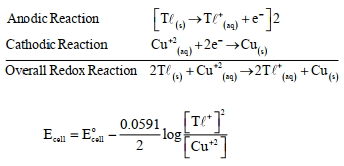
-
- (A) \(339\)
- (B) \(350\)
- (C) \(390\)
- (D) \(340\)
Show answer and solution
Correct Answer: (A)
Cell \(\mathrm{Rx}^{\mathrm{n}} ; \mathrm{MnO}_4^{-}+\mathrm{H}_2 \mathrm{C}_2 \mathrm{O}_4 \rightarrow \mathrm{Mn}^{2+}+\mathrm{CO}_2\)\(\mathrm{E}_{\text {coll }}^{\mathrm{c}}=\mathrm{E}_{\mathrm{op}}^{\circ} \text { of anode }+\mathrm{E}_{\mathrm{RP}}^{\circ} \text { of cathode }\)
\(=0.49+1.51=2.00 \mathrm{~V}\)
At equilibrium
\(\mathrm{E}_{\text {cell }}=0,\)
\(\mathrm{E}_{\text {cell }}^{\circ}=\frac{0.059}{\mathrm{n}} \log \mathrm{K}\)
\(\text { (As per NCERT } \frac{\mathrm{RT}}{\mathrm{F}}=0.059 \text { But } \frac{\mathrm{RT}}{\mathrm{F}}=0.0591\)can also be taken.)
\(2=\frac{0.059}{10} \log \mathrm{K}\)
\(\log \mathrm{K}=338.98\)
-
- (A) \(\mathrm{E}_{\text {cell }}=-0.80 \mathrm{~V}\)
- (B) \(\mathrm{M}+\mathrm{X} \rightarrow \mathrm{M}^2+\mathrm{X}^2\) is a spontaneous reaction
- (C) \(\mathrm{M}^{2+}+\mathrm{X}^{2-} \rightarrow \mathrm{M}+\mathrm{X}\) is a spontaneous reaction
- (D) \(\mathrm{E}_{\text {eell }}=0.80 \mathrm{~V}\)
Show answer and solution
Correct Answer: (C)
\(\mathrm{M} \mid \mathrm{M}^{+2} \| \mathrm{X} / \mathrm{X}^{2-}\)\(\mathrm{E}_{\text {cell }}^{\circ}=\mathrm{E}_{\mathrm{M} / \mathrm{M}^{+2}}^{\circ}+\mathrm{E}_{\mathrm{X} / \mathrm{X}^{-2}}^{\circ}\)
\(=-0.46+0.34=-0.12 \mathrm{~V}\)
As \(\mathrm{E}_{\text {cell }}^{\circ}\) is negative so anode becomes cathode and cathode become anode. Spontaneous reaction will be
\(\mathrm{M}^{+2}+\mathrm{X}^{2-} \longrightarrow \mathrm{M}+\mathrm{X}\)
-
- (A) Applying an external opposite potential greater than \(\mathrm{E}_{\text {cell }}^0\)
- (B) Reversing the flow of ions in salt bridge.
- (C) Applying an external opposite potential lower than \(\mathrm{E}_{\text {cell }}^0\).
- (D) Exchanging the electrodes at anode and cathode.
Show answer and solution
Correct Answer: (A)
Applied external potential should be greater than \(\mathrm{E}_{\text {cell }}^0\) in opposite direction. -
- (A) \(\mathrm{ClO}_4^{-}>\mathrm{IO}_4^{-}>\mathrm{BrO}_4^{-}\)
- (B) \(\mathrm{BrO}_4^{-}>\mathrm{IO}_4^{-}>\mathrm{ClO}_4^{-}\)
- (C) \(\mathrm{BrO}_4^{-}>\mathrm{ClO}_4^{-}>\mathrm{IO}_4^{-}\)
- (D) \(\mathrm{IO}_4^{-}>\mathrm{BrO}_4^{-}>\mathrm{ClO}_4^{-}\)
Show answer and solution
Correct Answer: (B)
Higher the value of \(\oplus\) ve \(SRP\) (Std. reduction potential) more is tendency to undergo reduction, so better is oxidising power of reactant.\(Hence, ox. Power:- \mathrm{BrO}_4^{-}>\mathrm{IO}_4^{-}>\mathrm{ClO}_4^{-}\)
-
- (A) \(30\)
- (B) \(75\)
- (C) \(45\)
- (D) \(18\)
Show answer and solution
Correct Answer: (D)
\( 2 \mathrm{H}_{\text {(aq.) }}^{+}+2 \mathrm{e}^{-} \rightarrow \mathrm{H}_2(\mathrm{~g}) \)\( \mathrm{E}_{\text {cell }}=\mathrm{E}_{\text {cell }}^0-\frac{0.059}{2} \log \frac{\mathrm{P}_{\mathrm{H}_2}}{\left[\mathrm{H}^{+}\right]^2} \)
\( =0-0.059 \times 3=-0.177 \text { volts. }=-17.7 \times 10^{-2} \mathrm{~V} .\)
-
- (A) 2
- (B) 3
- (C) 1
- (D) 0
Show answer and solution
Correct Answer: (B)
The ions \(Ti ^{+2}, V^{+2}, Cr ^{+2}\) are strong reducing agents and will liberate hydrogen from a dilute acid,
eg. \(2 Cr _{(\text {aq. })}^{+2}+2 H _{(\text {aq. })}^{+} \rightarrow 2 Cr _{(\text {aq. })}^{+3}+ H _2(g)\) -
- (A) \(0\)
- (B) \(1\)
- (C) \(3\)
- (D) \(4\)
Show answer and solution
Correct Answer: (B)
\(E=E_{\mathrm{H}^{+} / \mathrm{H}_2}^0-\frac{0.06}{2} \log \frac{\mathrm{P}_{\mathrm{H}_2}}{\left[\mathrm{H}^{+}\right]^2}\)\(\mathrm{E}=0.00-\frac{0.06}{2} \log \frac{2}{[1]^2}\)
\(E=-0.03 \times 0.3=-0.9 \times 10^{-2} \mathrm{~V}\)
-
- (A) \(\mathrm{Pt}\left|\mathrm{H}_{2(\mathrm{~g})}\right| \mathrm{HCl}_{(\text {soln.) }}\left|\mathrm{AgCl}_{(\mathrm{s})}\right| \mathrm{Ag}\)
- (B) \(\mathrm{Pt}\left|\mathrm{H}_{2(\mathrm{~g})}\right| \mathrm{HCl}_{\text {(solm) }}\left|\mathrm{AgNO}_{3(2 \mathrm{~g})}\right| \mathrm{Ag}\)
- (C) \(\mathrm{Pt}\left|\mathrm{H}_{2(\mathrm{~g})}\right| \mathrm{KCl}_{\text {(solm. } .)}\left|\mathrm{AgCl}_{(\mathrm{s})}\right| \mathrm{Ag}\)
- (D) \(\mathrm{Ag}\left|\mathrm{AgCl}_{(5)}\right| \mathrm{KCl}_{(50 \mathrm{~m} .)}\left|\mathrm{AgNO}_{3(\mathrm{mq} .)}\right| \mathrm{Ag}\)
Show answer and solution
Correct Answer: (A)
The given cell reaction is:
\( \frac{1}{2}\text{H}_{2(g)} + \text{AgCl}_{(s)} \rightarrow \text{H}^{+}_{(aq)} + \text{Cl}^{-}_{(aq)} + \text{Ag}_{(s)} \)
Let us break this down into the two half-cell reactions:
1. Anodic half-cell reaction (Oxidation at Pt electrode):
\( \frac{1}{2}\text{H}_{2(g)} \rightarrow \text{H}^{+}_{(aq)} + e^{-} \)
This represents a hydrogen gas electrode, where \( \text{H}^{+} \) ions are released into the solution.
2. Cathodic half-cell reaction (Reduction at Ag electrode):
\( \text{AgCl}_{(s)} + e^{-} \rightarrow \text{Ag}_{(s)} + \text{Cl}^{-}_{(aq)} \)
This represents a metal-insoluble salt anion electrode, where \( \text{Cl}^{-} \) ions are released into the solution.
Combining both reactions, the net products in the solution are \( \text{H}^{+}_{(aq)} \) and \( \text{Cl}^{-}_{(aq)} \), which together form hydrochloric acid (\( \text{HCl} \)). Therefore, the common electrolyte solution must be \( \text{HCl}_{(soln.)} \), not \( \text{KCl}_{(soln.)} \).
The standard cell representation for this cell without a liquid junction is:
\( \text{Pt} \mid \text{H}_{2(g)} \mid \text{HCl}_{(soln.)} \mid \text{AgCl}_{(s)} \mid \text{Ag} \)
Hence, the correct option is (A). -
- (A) \(5\)
- (B) \(6\)
- (C) \(2\)
- (D) \(3\)
Show answer and solution
Correct Answer: (D)
\(\mathrm{Fe}, \mathrm{Ni}, \mathrm{Ag}\) will be oxidized due to lower \(S.R.P\). - 35. What pressure (bar) of \(\mathrm{H}_2\) would be required to make emf of hydrogen electrode zero in pure water at \(25^{\circ} \mathrm{C}\) ? 2024 Medium
- (A) \(10^{-14}\)
- (B) \(10^{-7}\)
- (C) \(1\)
- (D) \(0.5\)
Show answer and solution
Correct Answer: (A)
\(2 \mathrm{e}^{-}+2 \mathrm{H}^{+}(\mathrm{aq}) \rightarrow \mathrm{H}_2(\mathrm{~g})\)\(\mathrm{E}=\mathrm{E}^0-\frac{0.059}{\mathrm{n}} \log \frac{\mathrm{P}_{\mathrm{H}_2}}{\left[\mathrm{H}^{+}\right]^2}\)
\(0=0-\frac{0.059}{2} \log \frac{\mathrm{P}_{\mathrm{H}_2}}{\left(10^{-7}\right)^2}\)
\(\log \frac{\mathrm{P}_{\mathrm{H}_2}}{\left(10^{-7}\right)^2}=0\)
\(\frac{\mathrm{P}_{\mathrm{H}_2}}{10^{-14}}=1\)
\(\mathrm{P}_{\mathrm{H}_2}=10^{-14} \text { bar }\)
-
- (A) \(916\)
- (B) \(915\)
- (C) \(917\)
- (D) \(914\)
Show answer and solution
Correct Answer: (C)
\(Cr _2 O _7^{2-}+14 H ^{+}+6 e ^{-} \rightarrow 2 Cr ^{3+}+7 H _2 O\)\(E =1.33-\frac{0.059}{6} \log \frac{(0.1)^2}{\left(10^{-2}\right)\left(10^{-3}\right)^{14}}\)
\(E =1.33-\frac{0.059}{6} \times 42=0.917\)
\(E =917 \times 10^{-3}\)
\(x =917\)
-
- (A) \(24\)
- (B) \(23\)
- (C) \(22\)
- (D) \(25\)
Show answer and solution
Correct Answer: (D)
\(Cu ( OH )_2( s ) \rightleftharpoons Cu ^{2+}( aq )+2 OH ^{-}( aq )\)\(Ksp =\left[ Cu ^{2+}\right]\left[ OH ^{-}\right]^2\)
\(pH =14 ; pOH =0 ;\left[ OH ^{-}\right]=1\,M\)
\({\left[ Cu ^{2+}\right]=\frac{ Ksp }{[1]^2}=10^{-20} M }\)
\(Cu ^{2+}( aq )+2 e ^{-} \rightarrow Cu ( s )\)
\(E = E ^{\circ}-\frac{0.059}{2} \log _{10} \frac{1}{\left[ Cu ^{2+}\right]}\)
\(=0.34-\frac{0.059}{2} \log _{10} \frac{1}{10^{-20}}\)
\(=-0.25=-25 \times 10^{-2}\)
-
- (A) \(30\)
- (B) \(10\)
- (C) \(20\)
- (D) \(50\)
Show answer and solution
Correct Answer: (B)
\(Pt _{( s )}\left| H _2( g , 1 atm )\right| H ^{+}( aq , 1 M ) \| Fe ^{3+}( aq ), Fe ^{2+}( aq )| Pt |( s )\)\(\text { at anode } H _2 \longrightarrow 2 H ^{+}+2 e ^{-}\)
\(\text {At cathode } Fe _{ aq }^{3+}+ e ^{-} \longrightarrow Fe _{ aq }^{2+}\)
\(E ^{\circ}= E _{ H _2 / H ^{+}}^{\circ}+ E _{ Fe ^{3+} Fe ^{2+}}^{\circ}=0 \cdot 771\,V\)
\(E = E ^{\circ}-\frac{0 \cdot 06}{1} \log \frac{ Fe ^{2+}}{ Fe ^{3+}}\)
\(0 \cdot 712=(0+0 \cdot 771)-\frac{0 \cdot 06}{1} \log \frac{ Fe ^{2+}}{ Fe ^{3+}}\)
\(\log \frac{ Fe ^{2+}}{ Fe ^{3+}}=\frac{0 \cdot 059}{0 \cdot 06} \approx 1\)
\(\frac{ Fe ^{2+}}{ Fe ^{3+}}=10\)
-
- (A) \(100\)
- (B) \(10\)
- (C) \(105\)
- (D) \(852\)
Show answer and solution
Correct Answer: (B)
\(\frac{1}{2} H _2( g )+ Fe ^{3+} \text { (aq.) } \longrightarrow H ^{+}( aq )+ Fe ^{2+}( aq .)\)\(E = E ^{\circ}-\frac{0.059}{1} \log \frac{\left[ Fe ^{2+}\right]}{\left\lfloor Fe ^{3+}\right\rfloor}\)
\(\Rightarrow \quad 0.712=(0.771-0)-\frac{0.059}{1} \log \frac{\left[ Fe ^{2+}\right]}{\left[ Fe ^{3+}\right]}\)
\(\Rightarrow \quad \log \frac{\left[ Fe ^{2+}\right]}{\left[ Fe ^{3+}\right]}=\frac{(0.771-0712)}{0.059}=1\)
\(\Rightarrow \frac{\left[ Fe ^{2+}\right]}{\left[ Fe ^{3+}\right]}=10\)
-
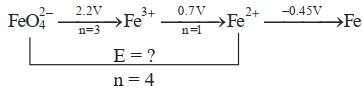
- (A) \(1824\)
- (B) \(1825\)
- (C) \(1823\)
- (D) \(1822\)
Show answer and solution
Correct Answer: (B)
\(4 \times E =3 \times 2.2+1 \times 0.7\)\(E =\frac{7.3}{4}=1.825 V =1825 \times 10^{-3}\,V\)
-
- (A) A is correct but R is not correct
- (B) Both A and R are correct and R is the correct explanation of A
- (C) A is not correct but R is correct
- (D) Both A and R are correct and R is NOT the correct explanation of A
Show answer and solution
Correct Answer: (B)
Be has less negative value compared to other AEM. However it's reducing nature is due to large hydration energy associated with the small size of \(Be ^{2+}\) ion and relatively large value of the atomization enthalpy of metal. -
- (A) \(4\)
- (B) \(6\)
- (C) \(8\)
- (D) \(2\)
Show answer and solution
Correct Answer: (D)
\(Pb ^{2+}+2 e ^{-} \rightarrow Pb \quad \Delta G _1^0=-2 FE _1^0\)\(Pb ^{4+}+4 e ^{-} \rightarrow Pb \quad \Delta G _2^0=-4 FE _2^0\)
\(Pb ^{2+} \rightarrow Pb ^{4+}+2 e ^{-} \quad \Delta G _3^0=-2 FE _3^0\)
\(\Delta G _3^0=\Delta G _1^0-\Delta G _2^0\)
\(-2 FE _3^0=2 F (2 n - m )\)
\(E _3^0= m -2 n = m - xn\)
Hence \(x=2\)
-
- (A) \(2\)
- (B) \(6\)
- (C) \(8\)
- (D) \(3\)
Show answer and solution
Correct Answer: (D)
Overall reaction :-\(H _{2( g )}+ M _{( aq )}^{3+} \longrightarrow M _{( aq )}^{+}+2 H _{( aq )}^{+}\)
\(E _{\text {Coll }}= E _{\text {Cathode }}^{\circ}- E _{\text {amode }}^{\circ}-\frac{0.059}{2} \log \frac{\left[ M ^{+}\right] \times 1^2}{\left[ M ^{+3}\right] 1}\)
\(0.1115=0.2-\frac{0.059}{2} \log \frac{\left[ M ^{+}\right]}{\left[ M ^{+3}\right]}\)
\(\quad 3=\log \frac{\left[ M ^{+}\right]}{\left[ M ^{+3}\right]}\)
\(\therefore a =3\)
-
- (A) \(274\)
- (B) \(273\)
- (C) \(272\)
- (D) \(275\)
Show answer and solution
Correct Answer: (D)
\(X + Y ^{2+} \rightarrow Y + X ^{2+}\)\(E _{\text {Cell }}^0=0.36-(-2.36)=2.72\,V\)
\(E _{\text {Cell }}=2.72-\frac{0.06}{2} \log \frac{0.001}{0.01}\)
\(=2.72+0.03=2.75\,V\)
\(=275 \times 10^{-2}\,V\)
-
- (A) \(16\)
- (B) \(15\)
- (C) \(17\)
- (D) \(14\)
Show answer and solution
Correct Answer: (C)
\(Zn ( s )+ Sn ^{2+}( aq ) \rightleftharpoons Zn ^{2+}( aq )+ Sn ( s )\)\(\Delta G ^0=-2.303\,RT \log _{10} Keq\)
\(- nF \left( E _{ cell }^0\right)=-2.303\,RT \log _{10} Keq\)
\(E _{ Zn / Zn ^{2+}}^0+ E _{ Sn ^{2+} / Sn }^0=\frac{0.059}{2} \log _{10} Keq\)
\(0.76+ E _{ Sn ^{2+} / Sn }^0=\frac{0.059}{2} \log _{10} 10^{20}\)
\(0.76+ E _{ Sn ^{2+} / Sn }^0=\frac{0.059 \times 20}{2}\)
\(E _{ Sn 2+/ Sn }^0=0.59-0.76=-0.17\)
\(E _{ Sn / Sn ^{2+}}^0=17 \times 10^{-2}\,V\)
\(=17\)
-
- (A) \(3\)
- (B) \(4\)
- (C) \(12\)
- (D) \(6\)
Show answer and solution
Correct Answer: (D)
\(\Delta G ^{\circ}=- RT \ell nK\)\(- nFE\)
\(\text { cell }=- RT \times 2.303\left(\log _{10} K \right)\)
\(\frac{ E _{ Cell }^{ o }}{0.06} \times n =\log K\)
\(Pd ^{+2}( aq .)+ 2 e ^{-} \rightleftharpoons Pd ( s ), E _{\text {cat,red }}^{ o }=0.83\)
\(\left. Pd ( s )+4 Cl ^{-} \text {(aq. }\right) \rightleftharpoons PdCl _4^{2-},( aq )+2 e ^{-}, E _{\text {Anode,Oxid }}^0=0.65\)
Net Reaction \(\rightarrow Pd ^{2+}\) (aq.) \(+4 Cl ^{-}\)(aq.) \(\rightleftharpoons PdCl _4^{2-}\) (aq.)
\(E _{\text {cell }}^{\circ}= E _{\text {cat,reed }}^0- E _{\text {Andode,oxid }}^0\)
\(E _{\text {cell }}^{\circ}=0.83-0.65\)
\(E _{\text {cell }}^{\circ}=0.18\)
Also \(n =2\)
Using equation \((1),(2)\) and \((3)\) \(\log K=6\)
-
- (A) \(4\)
- (B) \(3\)
- (C) \(2\)
- (D) \(1\)
Show answer and solution
Correct Answer: (A)
Given statements \(A, B, C\) and \(D\) are correct. -
- (A) \(Pt \mid H _2\) (g) \(\left| KCl \left( sol ^{ n }\right)\right| \operatorname{AgCl}( s ) \mid Ag\)
- (B) \(Pt \left| H _2( g )\right| HCl \left( sol ^{ n }\right)| AgCl ( s )| Ag\)
- (C) \(Ag | AgCl ( s )| KCl \left( sol ^{ I }\right)| AgCl ( s )| Ag\)
- (D) \(Pt \left| H _2( g )\right| HCl \left( sol ^{ n }\right)\left| AgNO _3\left( sol ^{ n }\right)\right| Ag\)
Show answer and solution
Correct Answer: (B)
Anode : \(\frac{1}{2} H _2( g ) \rightleftharpoons H ^{+}( aq )+ e ^{-}\)Cathode : \(AgCl ( s )+ e ^{-} \rightarrow Ag ( s )+ Cl ^{-}( aq )\)
-
- (A) \(V ^{2+}\) and \(Mn ^{2+}\)
- (B) \(Cr ^{2+}\) and \(CO ^{2+}\)
- (C) \(V ^{2+}\) and \(Cr ^{2+}\)
- (D) \(Mn ^{2+}\) and \(Co ^{2+}\)
Show answer and solution
Correct Answer: (C)
Metal cation with \((-)\) value of reduction potential \(\left( M ^{+3} / M ^{+2}\right)\) or with \((+)\) value of oxidation potential \(\left( M ^{+2} / M ^{+3}\right)\) will liberate \(H _2\) Therefore they will reduce \(H ^{+}\) i.e \(V { }^{+2}\) and \(Cr ^{+2}\) -
- (A) \(123\)
- (B) \(983\)
- (C) \(552\)
- (D) \(631\)
Show answer and solution
Correct Answer: (C)
\(Cu _{( s )} + Sn ^{2+}(0.001\, M ) \rightarrow Cu ^{2+}(0.01\, M )+ Sn _{( s )}\)\(E _{\text {cell }} = E _{\text {cathode }}^{\circ}- E _{\text {anode }}^{\circ}\)
\(=-0.14-(0.34)\)
\(=-0.48 \,V\)
\(E _{\text {cell }} = E _{\text {cell }}^{\circ}-\frac{0.059}{2} \log \frac{\left[ Cu ^{2+}\right]}{\left[ Sn ^{2+}\right]}\)
\(=-0.48-\frac{0.059}{2} \log \frac{0.01}{0.001}\)
\(=-0.509\)
\(\Delta G =- nF E _{\text {cell }}\)
\(=-2 \times 96500 \times(-0.5095)\)
\(=98333.5\, J / mol\)
\(=98.335\, kJ / mol\)
\(=983.35 \times 10^{-1} \,kJ / mol\)
\(\text { Nearest Integer : } 983\)


No questions on this page match these filters.
Other STD 12 - Electrochemistry topics
Frequently asked
How many Electrode potential, ECell, Nernst equation and ECS questions came in JEE Mains?
97 questions from 2013–2026, each with the correct answer and a full solution.
How difficult are Electrode potential, ECell, Nernst equation and ECS questions?
8% are easy, 39% medium and 53% hard.