


Questions
Newest firstShowing 1–17 of 17 questions
- 1. Benzyl isocyanide can be obtained from
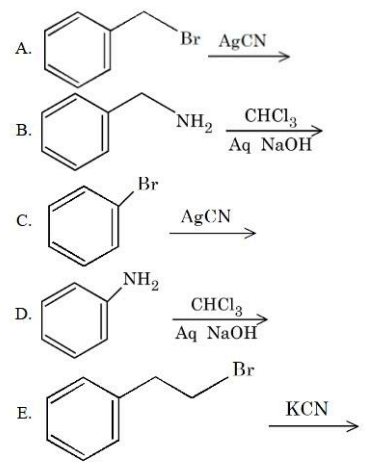
Choose the correct answer from the options given below: 2026 Medium- (A) A and B Only
- (B) A and C Only
- (C) B and D Only
- (D) D and E Only
Show answer and solution
Correct Answer: (A)
Reaction A: \(C_6H_5CH_2Br + AgCN \rightarrow C_6H_5CH_2NC + AgBr\)
\(AgCN\) is predominantly covalent, so the nucleophilic attack occurs through the nitrogen atom, forming benzyl isocyanide.
Reaction B: \(C_6H_5CH_2NH_2 + CHCl_3 + 3NaOH \rightarrow C_6H_5CH_2NC + 3NaCl + 3H_2O\)
This is the carbylamine reaction. Primary amines react with chloroform and alkali to form isocyanides. Benzyl amine gives benzyl isocyanide.
Reaction C: \(C_6H_5Br + AgCN \rightarrow\) No reaction
Aryl halides are generally unreactive towards nucleophilic substitution under normal conditions due to the partial double bond character of the C-Br bond.
Reaction D: \(C_6H_5NH_2 + CHCl_3 + 3NaOH \rightarrow C_6H_5NC + 3NaCl + 3H_2O\)
Aniline undergoes the carbylamine reaction to form phenyl isocyanide, not benzyl isocyanide.
Reaction E: \(C_6H_5CH_2CH_2Br + KCN \rightarrow C_6H_5CH_2CH_2CN + KBr\)
\(KCN\) is predominantly ionic, so the nucleophilic attack occurs through the carbon atom, forming a cyanide (nitrile) rather than an isocyanide.
Thus, benzyl isocyanide is obtained from reactions A and B only.
Answer: A and B Only -
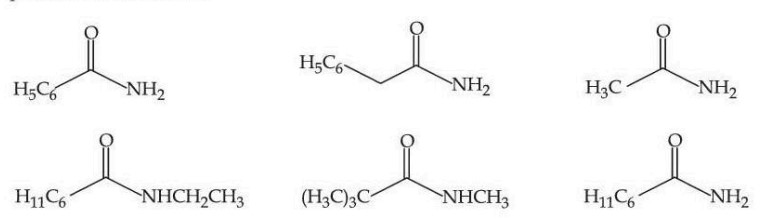
- (A) \(5\)
- (B) \(4\)
- (C) \(3\)
- (D) \(6\)
Show answer and solution
Correct Answer: (C)
The reaction of an amide with \(\text{Br}_2/\text{KOH}\) (alcoholic) is the Hoffmann bromamide degradation reaction. This reaction is specific to primary amides (\(R-\text{CONH}_2\)) and produces primary amines (\(R-\text{NH}_2\)) with one less carbon atom.
Among the given compounds, the primary amides are:
1. Benzamide (\(\text{C}_6\text{H}_5\text{CONH}_2\))
2. 2-Phenylacetamide (\(\text{C}_6\text{H}_5\text{CH}_2\text{CONH}_2\))
3. Acetamide (\(\text{CH}_3\text{CONH}_2\))
4. Cyclohexanecarboxamide (\(\text{C}_6\text{H}_{11}\text{CONH}_2\))
The other two compounds (N-ethylcyclohexanecarboxamide and N-methylpivalamide) are secondary amides and do not undergo this reaction.
The primary amines formed from the degradation of the four primary amides are:
1. Aniline (\(\text{C}_6\text{H}_5\text{NH}_2\))
2. Benzylamine (\(\text{C}_6\text{H}_5\text{CH}_2\text{NH}_2\))
3. Methylamine (\(\text{CH}_3\text{NH}_2\))
4. Cyclohexylamine (\(\text{C}_6\text{H}_{11}\text{NH}_2\))
The Gabriel phthalimide synthesis is used for the preparation of aliphatic primary amines. It cannot be used to prepare aromatic primary amines (like aniline) because aryl halides do not undergo nucleophilic substitution with the phthalimide anion.
Therefore, aniline cannot be prepared by Gabriel phthalimide synthesis. The remaining three amines (benzylamine, methylamine, and cyclohexylamine) are aliphatic primary amines and can be prepared by this method.
Thus, there are \(3\) compounds that satisfy both conditions.
Answer: \(3\) -
- (A) A, C and E only
- (B) B, C and D only
- (C) C and E only
- (D) C, D and E only
Show answer and solution
Correct Answer: (C)
The balanced chemical equation for Hoffmann bromamide degradation is:
\(\text{R-CONH}_2 + \text{Br}_2 + 4\text{NaOH} \rightarrow \text{R-NH}_2 + \text{Na}_2\text{CO}_3 + 2\text{NaBr} + 2\text{H}_2\text{O}\)
Statement A is false because \(1\) mole of \(\text{Br}_2\) and \(4\) moles of \(\text{NaOH}\) are consumed per mole of amide.
Statement B is false because primary alkyl amides readily undergo this reaction.
Statement C is true as the primary product of this reaction is a primary amine.
Statement D is false because the reaction is strictly given by primary amides (\(\text{R-CONH}_2\)), not secondary amides.
Statement E is true as the by-products formed are \(\text{Na}_2\text{CO}_3\), \(\text{NaBr}\), and \(\text{H}_2\text{O}\).
Therefore, only statements C and E are true.
Answer: C and E only -
- (A) 325
- (B) 287
- (C) 151
- (D) 244
Show answer and solution
Correct Answer: (B)
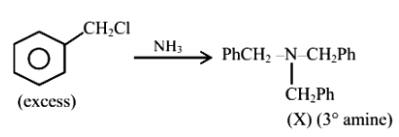
Molar Mass of \((X)\) is \(287 g mol ^{-1}\) -
- (A) \(7\)
- (B) \(8\)
- (C) \(9\)
- (D) \(10\)
Show answer and solution
Correct Answer: (B)
Total number of \(\pi\)-bonds present in product \(P\) is \(8\)
-
- (A) \(1\)
- (B) \(2\)
- (C) \(3\)
- (D) \(3\)
Show answer and solution
Correct Answer: (D)
\(4\)
-
- (A) Both Statement\(-I\) and Statement\(-II\) are correct
- (B) Both Statement\(-I\) and Statement\(-II\) are incorrect
- (C) Statement\(-I\) is correct but Statement\(-II\) is incorrect
- (D) Statement\(-I\) is incorrect but Statement\(-II\) is correct
Show answer and solution
Correct Answer: (D)
\(R - CO - NH _{2}+ Br _{2}+ NaOH \rightarrow\)\(R - NH _{2}+ Na _{2} CO _{3}+ NaBr + H _{2} O\)
\(R - CO - NH _{2}+\overline{ O }H \rightarrow R - CO -\overline{ N }H \stackrel{ Br _{2}}{\longrightarrow}\)
\(R - CO - NH - Br \stackrel{ OH ^{-}}{\longrightarrow} R - CO -\overline{ N }- Br\)
\(\stackrel{\text { migration of } \overline{ R }}{\longrightarrow} R - NCO \stackrel{2 \overline{O}H}{\longrightarrow} RNH _{2}+ CO _{3}^{2-}\)
In this reaction of alkyl as well as aryl group can migrate to electron deficient nitrogen atom.
-
- (B) \(R - NH - Br\)
- (C) \(R - N = C = O\)
Show answer and solution
Correct Answer: (C)
The given reaction is Hoffmann-Bromide degradation method.
-
- (A) \((A)\) and \((C)\) are correct statements.
- (B) \((A)\) and \((D)\) are correct statements.
- (C) \((B)\) and \((D)\) are correct statements.
- (D) \((B)\) and \((C)\) are correct statements.
Show answer and solution
Correct Answer: (C)
\(\underset{\text { Base }}{ HNO _{3}}+\underset{\text { Acid }}{ H _{2} SO _{4}} \rightarrow NO _{2}^{+}\)
-
- (B) \(CH _{3} CH _{2} NH _{2}\)
- (C) \(CH _{3} CH _{2} CH _{2} NHCH _{3}\)
- (D) \(C{H_3}C{H_2}C{H_2}\mathop N\limits^H - C{H_2}C{H_3}\)
Show answer and solution
Correct Answer: (D)
It has to be \(2^{\circ}\) amine because on reaction with benzene sulphonylchloride it gives water in soluble product. As it is formed by ammonolysis of ethylchloride, so it has to be \(R-NH-Et\) type.
-
- (A) \(C _{6} H _{5}- N -( CH _{3})_{2}\)
- (B) \(C _{6} H _{5}- NHCH _{2} -CH _{3}\)
- (C) \(C _{6} H _{5}- CH _{2} NHCH _{3}\)
- (D) \(\begin{array}{*{20}{c}} {{C_6}{H_5} - CH - N{H_2}} \\ | \\ {\,\,\,\,\,\,C{H_3}} \end{array}\)
Show answer and solution
Correct Answer: (D)
Hinsberg reagent (Benzene sulphonyl chloride) gives reaction product with \(1^{\circ}\) amine and it is soluble in dil. \(NaOH\).
-
- (A) \((A)\) is true but \((R)\) is flase
- (B) \((A)\) is false but \((R)\) is true
- (C) Both \((A)\) and \((R)\) are true but \((R)\) is not the correct explanation of \((A).\)
- (D) Both \((A)\) and \((R)\) are true and \((R)\) is correct explanation of \((A).\)
Show answer and solution
Correct Answer: (D)
Gabriel pthalamide synthesis:Aromatic halide does not gives \(\mathrm{SN}_{2}\) reaction

-
- (A) Para-Toluene sulphonyl chloride
- (B) Chloroform and \(KOH\)
- (C) Benzene sulphonic acid
- (D) Acetyl amide
Show answer and solution
Correct Answer: (A)
Primary amines react with Para Toluene sulfonyl chloride to form a precipitate that is soluble in \(NaOH\).Secondary amines reacts with para toluene sulfonyl chloride to give a precipitate that is insoluble in \(NaOH\).
Tertiary amines do not react with para toluen.
- 14. The total number of amines among the following which can be synthesized by Gabriel synthesis is ..... .
 2021 Medium
- (A) \(3\)
- (B) \(4\)
- (C) \(2\)
- (D) \(0\)
Show answer and solution
Correct Answer: (A)
Gabriel phthalimide synthesis is used to prepare \(1^{\circ}\) aliphatic/alicyclic amine in common.Hence amine which can synthesised by Gabriel phthalimide synthesis method is :
\((A)\) \(Me _{2} CH - CH _{2}- NH _{2}\)
\((B)\) \(CH _{3} CH _{2} NH _{2}\)
\((C)\) \(Ph - CH _{2}- NH _{2}\)
-
- (A) \(3\)
- (B) \(4\)
- (C) \(6\)
- (D) \(5\)
Show answer and solution
Correct Answer: (D)
\((i)\) \(\mathrm{Sn}+\mathrm{HCl}\)\((ii)\) \(\mathrm{Fe}+\mathrm{HCl}\)
\((iii)\) \(\mathrm{Zn}+\mathrm{HCl}\)
\((iv)\) \(\mathrm{H}_{2}-\mathrm{Pd}\)
\((v)\) \(\mathrm{H}_{2}\) (Raney Ni)

- 16. What is the correct sequence of reagents used for converting nitrobenzene into \(m\) -dibromobenzene?
 2021 Easy
- (A) \(\stackrel{ NaNO _{2}}{\longrightarrow} / \stackrel{ HCl}{\longrightarrow} / \stackrel{ KBr}{\longrightarrow} /\stackrel{ H^+}{\longrightarrow}\)
- (B) \(\stackrel{ Br_2/Fe}{\longrightarrow} / \stackrel{Sn/ HCl}{\longrightarrow} / \stackrel{ NaNO_2/ HCl}{\longrightarrow} /\stackrel{ CuBR/Hbr}{\longrightarrow}\)
- (C) \(\stackrel{ Sn/ HCl}{\longrightarrow} / \stackrel{KBr}{\longrightarrow} / \stackrel{ Br_2}{\longrightarrow} /\stackrel{ H^+}{\longrightarrow}\)
- (D) \(\stackrel{ Sn/ HCl}{\longrightarrow} / \stackrel{Br_2}{\longrightarrow} / \stackrel{ NaNO_2}{\longrightarrow} /\stackrel{ NaBR}{\longrightarrow}\)
Show answer and solution
Correct Answer: (B)
Correct sequence of reagents for the following conversion.
- 17. In the Hoffmann bromamide degradation reaction, the number of moles of \(NaOH\) and \(Br_2\) used per mole of amine produced are : 2016 Medium
- (A) Two moles of \(NaOH\) and two moles of \(Br_2.\)
- (B) Four moles of \(NaOH\) and one mole of \(Br_2.\)
- (C) One mole of \(NaOH\) and one mole of \(Br_2.\)
- (D) Four moles of \(NaOH\) and two moles of \(Br_2.\)
Show answer and solution
Correct Answer: (B)
Hofmann-bromamide degradation reaction is given as\(\mathrm{RCONH}_{2}+4 \mathrm{NaOH}+\mathrm{Br}_{2} \rightarrow \)\(\mathrm{RNH}_{2}+\mathrm{Na}_{2} \mathrm{CO}_{3}+2 \mathrm{NaBr}+2 \mathrm{H}_{2} \mathrm{O}\)
Hence four moles of \(\mathrm{NaOH}\) and one mole of \(\mathrm{Br}_{2}\) are used.


No questions on this page match these filters.
Other STD 12 - Amines topics
Frequently asked
How many Preparation of Amines questions came in JEE Mains?
17 questions from 2016–2026, each with the correct answer and a full solution.
How difficult are Preparation of Amines questions?
12% are easy, 65% medium and 24% hard.