


Topics
7 topics- 5Qs Equilibrium state and Characteristics of K
- 14Qs Standard free energy
- 6Qs Degree of dissociation and Vapour density
- 50Qs Law of equilibrium and Equilibrium constant Most asked
- 10Qs Le-Chaterlier principle and It's application
- 14Qs Kp and Kc Relationship
- 1Qs Law of mass action
All Equilibrium - 1 (chemical Equilibrium) questions
Newest firstShowing 1–50 of 100 questions
-
- (A) \((2.7 \times 10^{-5})^3\)
- (B) \(6 \times 10^{-2}\)
- (C) \(\sqrt{2.7 \times 10^{-5}}\)
- (D) \(3 \times 10^{-2}\)
Show answer and solution
Correct Answer: (D)
For the reaction \(A_2(g) + B_2(g) \rightleftharpoons C(g)\), the equilibrium constant is \(K_1 = 2.7 \times 10^{-5}\).
When a reaction is multiplied by a factor \(n\), the new equilibrium constant becomes \(K^n\).
The given reaction is multiplied by \(\dfrac{1}{3}\) to obtain the reaction \(\dfrac{1}{3}A_2(g) + \dfrac{1}{3}B_2(g) \rightleftharpoons \dfrac{1}{3}C(g)\).
The new equilibrium constant \(K_2\) is given by:
\(K_2 = (K_1)^{1/3}\)
\(K_2 = (2.7 \times 10^{-5})^{1/3}\)
\(K_2 = (27 \times 10^{-6})^{1/3}\)
\(K_2 = 3 \times 10^{-2}\)
Answer: \(3 \times 10^{-2}\) -
- (A) 2.67, 2.67, 2.67
- (B) 1.21, 2.24, 1.56
- (C) 1.66, 1.66, 1.66
- (D) 2.56, 1.62, 2.24
Show answer and solution
Correct Answer: (A)
\(\underset {t = t_{eq}}{} ~\underset {2 ~mole}{P_2(g)} +~\underset {2 ~mole}{Q_2(g)} \rightleftharpoons ~\underset {2 ~mole}{2PQ(g)}\)
\(K _{ eq }=\frac{2^2}{2.2}=1\)
Now 1 mole of each \(P_2\) and \(Q_2\) is added
So reaction will move in forward direction
\(\underset {t = t'_{eq}}{} ~\underset {3 ~-~x}{P_2(g)} +~\underset {3 ~-~x}{Q_2(g)} \rightleftharpoons ~\underset {2 ~+~2x}{2PQ(g)}\)
\(K_{c}=1=\frac{(2+2x)^{2}}{(3-x)(3-x)}\)
\(\frac{2+2x}{3-x}=1\)
\(2+2x=3-x\)
\(x=\frac{1}{3}\)
At new equilibrium
Moles of \(P_{2}=\frac{8}{3}=2.67\)
Moles of \(Q_{2}=\frac{8}{3}=2.67\)
Moles of \(PQ=\frac{8}{3}=2.67\) -
- (A) \(2.5\times 10^{-3}\)
- (B) \(2.5\times 10^{3}\)
- (C) \(1.0\times 10^{-5}\)
- (D) \(5\times 10^{-3}\)
Show answer and solution
Correct Answer: (C)
The given reactions are:
\(2xy \rightleftharpoons x_2 + y_2 \quad K_1 = 2.5 \times 10^5\)
\(xy + \dfrac{1}{2}z_2 \rightleftharpoons xyz \quad K_2 = 5 \times 10^{-3}\)
We need to find the equilibrium constant \(K_3\) for the reaction:
\(\dfrac{1}{2}x_2 + \dfrac{1}{2}y_2 + \dfrac{1}{2}z_2 \rightleftharpoons xyz\)
Reversing the first reaction and multiplying it by \(\dfrac{1}{2}\), we get:
\(\dfrac{1}{2}x_2 + \dfrac{1}{2}y_2 \rightleftharpoons xy\)
The equilibrium constant for this modified reaction is:
\(K' = \left(\dfrac{1}{K_1}\right)^{\dfrac{1}{2}} = \dfrac{1}{\sqrt{K_1}}\)
Adding this modified reaction to the second reaction:
\(\dfrac{1}{2}x_2 + \dfrac{1}{2}y_2 \rightleftharpoons xy \quad (K')\)
\(xy + \dfrac{1}{2}z_2 \rightleftharpoons xyz \quad (K_2)\)
---------------------------------------------------
\(\dfrac{1}{2}x_2 + \dfrac{1}{2}y_2 + \dfrac{1}{2}z_2 \rightleftharpoons xyz\)
The equilibrium constant \(K_3\) for the overall reaction is the product of the equilibrium constants of the added reactions:
\(K_3 = K' \times K_2 = \dfrac{K_2}{\sqrt{K_1}}\)
Substituting the given values:
\(K_3 = \dfrac{5 \times 10^{-3}}{\sqrt{2.5 \times 10^5}}\)
\(K_3 = \dfrac{5 \times 10^{-3}}{\sqrt{25 \times 10^4}}\)
\(K_3 = \dfrac{5 \times 10^{-3}}{5 \times 10^2}\)
\(K_3 = 1.0 \times 10^{-5}\)
Answer: \(1.0\times 10^{-5}\) -
- (A) (i) 3, 1; (ii) 3, 1
- (B) (i) 4, 1; (ii) 4, 1
- (C) (i) 1, 3; (ii) 2, 1
- (D) (i) 1, 2; (ii) 2, 1
Show answer and solution
Correct Answer: (D)
For reaction (i): \(K _{ p }> K _{ c }\)
\(\Delta n _{ g }>0\)
\(y-x>0\)
\(85.87=2.586(0.0821 \times 400)^{y \times}\)
Solving \(y-x \simeq 1\)
For reaction (ii) : \(K _{ p }< K _{ c }\)
\( y-x<0\). -
- (A) 100
- (B) 125
- (C) 150
- (D) 200
Show answer and solution
Correct Answer: (B)
\(NH _{3(g)} \rightleftharpoons \frac{1}{2} N_{2(g)}+\frac{3}{2} H _{2(g)}\)
\(t=0\)\(\quad\)1mole\(\quad\quad\)—\(\quad\quad\)—
\(t = t _{ eq }\)\(\quad\)\(1-\alpha\)\(\quad\)\(\alpha / 2\)\(\quad\)\(3 \alpha / 2\)
\(k _{ p }=\frac{\left(\frac{\alpha}{2}\right)^{1 / 2}\left(\frac{3 \alpha}{2}\right)^{3 / 2}}{(1-\alpha)}\left[\frac{ P _{ T }}{1+\alpha}\right]^1\)\(\quad\)\(\left[\because P _{ T }=\sqrt{3} atm\right]\)
\(9=\frac{\left(\frac{\alpha}{2}\right)^{1 / 2}\left(\frac{3 \alpha}{2}\right)^{3 / 2}}{(1-\alpha)} \times \frac{(3)^{1 / 2}}{1+\alpha}\)
\(9=\frac{9\left(\frac{\alpha}{2}\right)^2}{1-\alpha^2}\)
\(1-\alpha^2=\frac{\alpha^2}{4}\)
\(\frac{5 \alpha^2}{4}=1\)
\(\alpha^2=0.8\)
\(\alpha=(0.8)^{1 / 2}\)
\(\alpha=\left[\frac{1}{0.8}\right]^{-1 / 2}\)
\(\begin{array}{l}\alpha=\left[125 \times 10^{-2}\right]^{-1 / 2} \\ x=125\end{array}\) -
- (A) 2472
- (B) 2473
- (C) 2474
- (D) 2475
Show answer and solution
Correct Answer: (C)
Let the initial moles of \(N_2O_5\) be \(2\).
The given reaction is:
\(2N_2O_5(g) \rightleftharpoons 2N_2O_4(g) + O_2(g)\)
Since \(N_2O_5\) is \(50\%\) dissociated (degree of dissociation \(\alpha = 0.5\)), the moles at equilibrium are:
Moles of \(N_2O_5 = 2(1 - 0.5) = 1\)
Moles of \(N_2O_4 = 2(0.5) = 1\)
Moles of \(O_2 = 0.5\)
Total moles at equilibrium \(= 1 + 1 + 0.5 = 2.5\)
Given the total pressure \(P = 2\) atm, the partial pressures of the gases are:
\(P_{N_2O_5} = \dfrac{1}{2.5} \times 2 = 0.8\) atm
\(P_{N_2O_4} = \dfrac{1}{2.5} \times 2 = 0.8\) atm
\(P_{O_2} = \dfrac{0.5}{2.5} \times 2 = 0.4\) atm
The equilibrium constant \(K_p\) is:
\(K_p = \dfrac{(P_{N_2O_4})^2 \cdot P_{O_2}}{(P_{N_2O_5})^2} = \dfrac{(0.8)^2 \times 0.4}{(0.8)^2} = 0.4\)
The standard free energy change \(\Delta G^\circ\) is given by:
\(\Delta G^\circ = -RT \ln K_p\)
Using the given values:
\(\ln(0.4) = 2.303 \log(0.4) = 2.303 (\log 4 - \log 10)\)
\(\ln(0.4) = 2.303 (2 \log 2 - 1) = 2.303 (2 \times 0.30 - 1) = 2.303 (-0.4) = -0.9212\)
Now, substituting the values into the \(\Delta G^\circ\) equation (\(T = 50^\circ C + 273 = 323\) K):
\(\Delta G^\circ = -8.314 \times 323 \times (-0.9212)\)
\(\Delta G^\circ = 2473.81\) J mol\(^{-1}\)
The magnitude of the standard free energy change to the nearest integer is \(2474\) J mol\(^{-1}\).
Answer: \(2474\) -
- (A) D and E only
- (B) C and E only
- (C) A and D only
- (D) B and C only
Show answer and solution
Correct Answer: (A)

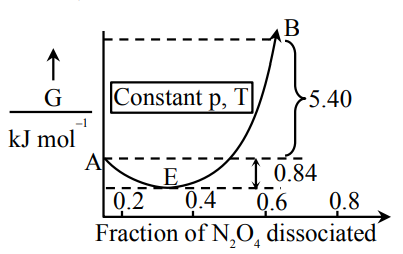
(A) \( \Delta_{r}G^{\circ} = G^{\circ}_{B} - G^{\circ}_{A} = +ve \)
(B) \( \Delta_{r}G^{\circ} = +ve \). \( N_{2}O_{4} \) will partially dissociate into \( NO_{2} \).
(C) For reverse reaction, It is partially completed as there is equilibrium at E.
(D) For 1 mole \( N_{2}O_{4} \) ; \( \Delta_{r}G^{\circ} = -0.84 \, kJ \, mol^{-1} \).
(E) For 2 mole \( NO_{2} \) ; \( \Delta G^{\circ} = -5.4 - 0.84 = -6.24 \, kJ \, mol^{-1} \). -
- (A) 8
- (B) 10
- (C) 12
- (D) 14
Show answer and solution
Correct Answer: (A)
The given equilibrium reaction is:
\(\text{X}_2\text{Y}_4(g) \rightleftharpoons 2\text{XY}_2(g)\)
Initial moles: \(1\)
Degree of dissociation, \(\alpha = 0.75\)
Moles of \(\text{X}_2\text{Y}_4\) at equilibrium \(= 1 - \alpha = 1 - 0.75 = 0.25\)
Moles of \(\text{XY}_2\) at equilibrium \(= 2\alpha = 2 \times 0.75 = 1.5\)
Total moles at equilibrium \(= 0.25 + 1.5 = 1.75\)
Given total pressure, \(P = 1\) atm.
Partial pressure of \(\text{X}_2\text{Y}_4\), \(P_{\text{X}_2\text{Y}_4} = \dfrac{0.25}{1.75} \times 1 = \dfrac{1}{7}\) atm
Partial pressure of \(\text{XY}_2\), \(P_{\text{XY}_2} = \dfrac{1.5}{1.75} \times 1 = \dfrac{6}{7}\) atm
The equilibrium constant \(K_p\) is given by:
\(K_p = \dfrac{(P_{\text{XY}_2})^2}{P_{\text{X}_2\text{Y}_4}} = \dfrac{(\dfrac{6}{7})^2}{\dfrac{1}{7}} = \dfrac{36}{7}\)
The standard Gibbs free energy change is:
\(\Delta_r G^{\ominus} = -RT \ln K_p = -2.3 RT \log K_p\)
Calculating \(\log K_p\):
\(\log \left(\dfrac{36}{7}\right) = \log 36 - \log 7 = \log (2^2 \times 3^2) - \log 7\)
\(\log \left(\dfrac{36}{7}\right) = 2 \log 2 + 2 \log 3 - \log 7\)
\(\log \left(\dfrac{36}{7}\right) = 2(0.3) + 2(0.48) - 0.84 = 0.6 + 0.96 - 0.84 = 0.72\)
Substituting the values into the \(\Delta_r G^{\ominus}\) equation:
\(\Delta_r G^{\ominus} = -2.3 \times 8.3 \times 600 \times 0.72\)
\(\Delta_r G^{\ominus} = -8246.88 \text{ J mol}^{-1} = -8.24688 \text{ kJ mol}^{-1}\)
The magnitude of \(\Delta_r G^{\ominus}\) is \(8.24688 \text{ kJ mol}^{-1}\).
Rounding to the nearest integer, we get \(8\).
Answer: \(8\) -
- (A) 0.367, 0.275
- (B) 0.53, 0.4
- (C) 0.742, 0.557
- (D) 0.557, 0.418
Show answer and solution
Correct Answer: (D)
\(\begin{array}{ccc} A & \rightleftharpoons & B \\ 0.5 M & & 0.375 M \end{array} \quad\) (At equilibrium)
\(K_{eq} = \frac{[B]_{eq}}{[A]_{eq}} = \frac{0.375}{0.5} = 0.75\)
Now 0.1 mole of A is added so reaction will move in forward direction.
\(A \rightleftharpoons B\)
\(0.6 - x\) \(0.375 + x\)
\(K_{eq} = 0.75 = \frac{0.375 + x}{0.6 - x}\)
\(0.45 - 0.75x = 0.375 + x\)
\(1.75x = 0.075\)
\(x = \frac{0.075}{1.75} = \frac{3}{70} = 0.043\)
Moles of \(A =0.043=0.557\)
Moles of \(B =0.418\) -
- (A) \(3.28, 2.624\)
- (B) \(2.624, 3.28\)
- (C) \(3.28, 0.656\)
- (D) \(0.656, 6.56\)
Show answer and solution
Correct Answer: (A)
The given reaction is \(A(g) \rightleftharpoons B(g)\).
Let the initial moles of \(A\) be \(1\) and at equilibrium, let \(x\) moles of \(A\) dissociate.
Moles at equilibrium:
\(n_A = 1 - x\)
\(n_B = x\)
Since \(\Delta n_g = 0\), the equilibrium constant \(K_c\) can be written in terms of moles:
\(K_c = \dfrac{n_B}{n_A} = \dfrac{x}{1 - x} = 4.0\)
\(x = 4 - 4x \Rightarrow 5x = 4 \Rightarrow x = 0.8\)
At equilibrium, the moles of the gases are:
\(n_{He} = 1\)
\(n_B = 0.8\)
Using the ideal gas equation \(P = \dfrac{nRT}{V}\), the partial pressures are calculated as follows:
Partial pressure of He:
\(P_{He} = \dfrac{1 \times 0.082 \times 400}{10} = 3.28\) atm
Partial pressure of \(B(g)\):
\(P_B = \dfrac{0.8 \times 0.082 \times 400}{10} = 2.624\) atm
Answer: \(3.28, 2.624\) -
- (A) 2
- (B) 4
- (C) 6
- (D) 8
Show answer and solution
Correct Answer: (B)
For the first equilibrium:
\(\text{CaCO}_3(s) \rightleftharpoons \text{CaO}(s) + \text{CO}_2(g)\)
\(K_{p_1} = P_{\text{CO}_2} = 0.08 \text{ atm}\)
For the second equilibrium:
\(\text{C}(s) + \text{CO}_2(g) \rightleftharpoons 2\text{CO}(g)\)
\(K_{p_2} = \dfrac{(P_{\text{CO}})^2}{P_{\text{CO}_2}} = 2 \text{ atm}\)
Substituting the value of \(P_{\text{CO}_2}\):
\(\dfrac{(P_{\text{CO}})^2}{0.08} = 2\)
\((P_{\text{CO}})^2 = 0.16\)
\(P_{\text{CO}} = 0.4 \text{ atm} = 4 \times 10^{-1} \text{ atm}\)
Answer: \(4\) -
- (A) 100
- (B) 10
- (C) 1
- (D) 0.1
Show answer and solution
Correct Answer: (A)
\(H _2 X \rightleftharpoons H ^{+}+ HX ^{-}\),
\(0.1-x \quad x+y \quad x-y\)
\(2.5 \times 10^{-8}=\frac{(x+y)(x-y)}{0.1-x}\)
\(HX ^{-} \rightleftharpoons H ^{+}+ X ^{2-}\)
\(x-y \quad x+y \quad y\)
\(1 \times 10^{-13}=\frac{( x + y )( y )}{ x - y }\)
Approximate : \(K _{ a _1} \gg K_{ a _2} \Rightarrow\) So \(x \gg y\).
\(x + y \approx x , x - y \approx x\)
\(10^{-13}=\frac{x \cdot y}{x}\)
\(y=10^{-13}\)
\(\left[ X ^{2-}\right]=10^{-13}\)
\(\left[ X ^{2-}\right]=100 \times 10^{-15}\) -
- (A) \(\dfrac{x^2}{a^2 + x^2} \times p\)
- (B) \(\dfrac{x^2}{a^2 - x^2} \times p\)
- (C) \(\dfrac{a + x^2}{x^2} \times p\)
- (D) \(\dfrac{a^2 - x^2}{x^2} \times p\)
Show answer and solution
Correct Answer: (B)
The reaction is \(A(g) \rightleftharpoons B(g) + C(g)\)
Initial moles: \(a\) for \(A\), \(0\) for \(B\), \(0\) for \(C\)
Moles at equilibrium: \((a - x)\) for \(A\), \(x\) for \(B\), \(x\) for \(C\)
Total moles at equilibrium \(= (a - x) + x + x = a + x\)
Partial pressures at equilibrium:
\(p_A = \dfrac{a - x}{a + x} p\)
\(p_B = \dfrac{x}{a + x} p\)
\(p_C = \dfrac{x}{a + x} p\)
The equilibrium constant \(K_p\) is given by:
\(K_p = \dfrac{p_B \cdot p_C}{p_A}\)
\(K_p = \dfrac{\left(\dfrac{x}{a + x} p\right) \left(\dfrac{x}{a + x} p\right)}{\dfrac{a - x}{a + x} p}\)
\(K_p = \dfrac{x^2}{(a + x)(a - x)} p\)
\(K_p = \dfrac{x^2}{a^2 - x^2} p\)
Answer: \(\dfrac{x^2}{a^2 - x^2} \times p\) -
- (A) 215
- (B) 220
- (C) 225
- (D) 230
Show answer and solution
Correct Answer: (D)
According to the van 't Hoff equation:
\(\log_{10} K_p = -\dfrac{\Delta H^\circ}{2.303 R} \left(\dfrac{1}{T}\right) + \dfrac{\Delta S^\circ}{2.303 R}\)
This represents a linear equation \(y = mx + c\), where \(y = \log_{10} K_p\) and \(x = \dfrac{1}{T}\). The slope \(m\) of the line is given by:
\(m = -\dfrac{\Delta H^\circ}{2.303 R}\)
From the given data table, we can calculate the slope \(m\) using any two points, for example \((0.05, 3.5)\) and \((0.06, 2.5)\):
\(m = \dfrac{y_2 - y_1}{x_2 - x_1} = \dfrac{2.5 - 3.5}{0.06 - 0.05} = \dfrac{-1.0}{0.01} = -100\)
Equating the calculated slope to the theoretical slope:
\(-\dfrac{\Delta H^\circ}{2.303 R} = -100\)
\(\dfrac{\Delta H^\circ}{R} = 100 \times 2.303 = 230.3\)
The magnitude of \(\dfrac{\Delta H^\circ}{R}\) is \(230.3\). Rounding to the nearest integer, we get \(230\).
Answer: \(230\) -
- (A) 60
- (B) 70
- (C) 80
- (D) 90
Show answer and solution
Correct Answer: (B)
\(A _2+ B _2 \xrightarrow{500 K} 2 AB \log K =2.2\)
\(\Delta H ^{\circ}=(2 \times 32)-(6+ x )=(58- x ) kJ\)
\(\Delta S ^{\circ}=(2 \times 222)-(146+280)=18\) Joule
\(\Delta G ^{\circ}=- RT \ln K\)
\(\Delta G ^{\circ}=-\frac{8.314 \times 500 \times 2.2 \times 2.303}{1000}\)
\(\Delta G ^{\circ}=-21.06\)
\(58-x-500\left(\frac{18}{1000}\right)=-21.06\)
\(x =70.06 KJ / mol\) -
- (A) 12
- (B) 15
- (C) 18
- (D) 20
Show answer and solution
Correct Answer: (B)
\(X _2(g)+ Y _2(g) \rightleftharpoons 2 Z ( g )\)
\(K_C=\frac{(9)^2}{3 \times 3}=9\)
Now 10 moles of \(Z\) are added then reaction will move in backward direction.
\(X _2(g)+ Y _2(g) \rightleftharpoons 2 Z ( g )\)
\(3+X \quad 3+X \quad 19-2 X\)
\(K_c=\frac{(19-2 X)^2}{(3+X)(3+X)}=9\)
\(\frac{19-2 X}{3+X}=3\)
\(19-2 X=9+3 X\)
\(\begin{array}{l}10=5 X \\ X=2\end{array}\)
At equilibrium ⇒ moles of \(Z=19-2 \times 2\)
\(=15\) moles -
- (A) 900
- (B) 950
- (C) 962
- (D) 942
Show answer and solution
Correct Answer: (C)
Initial pressure of \(\mathrm{N}_2 \mathrm{O}_5\)
\(\begin{aligned}
& =\frac{\frac{37.8}{108} \times 0.082 \times 500}{1}=14.35 \text { bar } \\
& 2 \mathrm{~N}_2 \mathrm{O}_5 \rightleftharpoons 2 \mathrm{~N}_2 \mathrm{O}_4+\mathrm{O}_2
\end{aligned}\)
\(\begin{array}{lll}\mathrm{t}=0 & 14.35 \\ \mathrm{t}=\mathrm{eq} & 14.35-2 \mathrm{P} & 2 \mathrm{P}\end{array}\)
\(\begin{aligned} & \mathrm{P}_{\text {Total }} \text { at eqb }=14.35+\mathrm{P}=18.65 \\ & \mathrm{P}=4.3 \\ & \mathrm{P}_{\mathrm{N}_2 \mathrm{O}_5}=5.75 \text { bar } \\ & \mathrm{P}_{\mathrm{N}_2 \mathrm{O}_4}=8.6 \mathrm{bar} \\ & \mathrm{P}_{\mathrm{O}_2}=4.3 \text { bar } \\ & \mathrm{k}_{\mathrm{p}}=\frac{(8.6)^2 \times(4.3)}{(5.75)^2}=9.619=\mathrm{x} \times 10^{-2} \\ & \mathrm{x}=961.9 \approx 962\end{aligned}\) -
- (A) 1.8 atm
- (B) 0.3 atm
- (C) 3 atm
- (D) 0.18 atm
Show answer and solution
Correct Answer: (A)
\(\begin{array}{lc}\mathrm{CO}_2(\mathrm{~g})+\mathrm{C}(\mathrm{s}) \rightleftharpoons & 2 \mathrm{CO}(\mathrm{g}) \\ 0.5 & - \\ 0.5-\mathrm{x} & 2 \mathrm{x}\end{array}\)
\(\begin{aligned}\mathrm{P}_{\text {total }}=0.5+\mathrm{x}=0.8 \\ \mathrm{x}=0.3 \\ \mathrm{~K}_{\mathrm{P}}=\frac{(0.6)^2}{0.2}=1.8\end{aligned}\) -
- (A) \(\sqrt[4]{\frac{2 K_p}{p}}\)
- (B) \(\sqrt[3]{\frac{2 K_{\mathrm{p}}}{\mathrm{p}}}\)
- (C) \(\sqrt[3]{\frac{2 \mathrm{~K}_{\mathrm{p}}^2}{\mathrm{p}}}\)
- (D) \(\sqrt{K_p}\)
Show answer and solution
Correct Answer: (C)
\(\begin{array}{lcc}
& \mathrm{AB}_2(\mathrm{g}) & \rightleftharpoons & \mathrm{AB}(\mathrm{g}) & + & \frac{1}{2} \mathrm{~B}_2(\mathrm{g}) \\
t=0 & p_0 & \\
t=t_{\text {eq }} & p_0(1-x) & & p_0 x & & \frac{p_0 x}{2}
\end{array}\)
\(\mathrm{p}=\mathrm{p}_0 \mathrm{x}-\mathrm{p}_0 \mathrm{x}+\mathrm{p}_0 \mathrm{x}+\frac{\mathrm{p}_0 \mathrm{x}}{2}\)
\(\begin{gathered}p=p_0\left(1+\frac{x}{2}\right) \\ p_0=\frac{p}{\left(1+\frac{x}{2}\right)} \\ K_p=\frac{\left(p_{A B}\right)\left(p_{B_2}\right)^{1 / 2}}{\left(p_{\mathrm{AB}_2}\right)} \\ K_p=\frac{\left(p_0 x\right)\left(\frac{p_0 x}{2}\right)^{1 / 2}}{p_0(1-x)}\end{gathered}\)
\(\mathrm{K}_{\mathrm{p}}=\frac{\frac{\mathrm{px}}{\left(1+\frac{x}{2}\right)}\left(\frac{\mathrm{p}}{1+\frac{x}{2}} \times \frac{\mathrm{x}}{2}\right)^{1 / 2}}{\frac{\mathrm{p}(1-\mathrm{x})}{\left(1+\frac{x}{2}\right)}}\)
Since \(x \ll 1\)
\(\begin{aligned}
& K_p=\frac{\mathrm{p}^{1 / 2} \mathrm{x}^{3 / 2}}{2^{1 / 2}} \\
& \mathrm{x}=\sqrt[3]{\frac{2 \mathrm{~K}_{\mathrm{p}}^2}{\mathrm{p}}}
\end{aligned}\) -
- (A) (A), (B) and (C) only
- (B) (A) and (B) only
- (C) (A), (B) and (D) only
- (D) (B) and (C) only
Show answer and solution
Correct Answer: (B)
\(\begin{aligned} & \mathrm{CO}(\mathrm{g})+3 \mathrm{H}_2 \rightleftharpoons \mathrm{CH}_4(\mathrm{~g})+\mathrm{H}_2 \mathrm{O}(\mathrm{g}) \\ & \Delta \mathrm{n}_{\mathrm{g}}=-2\end{aligned}\)
If pressure of system increases then according to Le-Chatelier's principle reaction will move in forward direction.
Concentration of reactant and products both increases but concentration of product increases more. -
- (A) If p value is extremely high compared to \(\mathrm{K}_{\mathrm{p}}, \alpha \approx 1\)
- (B) When \(p\) increases \(\alpha\) decreases
- (C) If \(k_p\) value is extremely high compared to \(p, \alpha\) becomes much less than unity
- (D) When \(p\) increases \(\alpha\) increases
Show answer and solution
Correct Answer: (B)
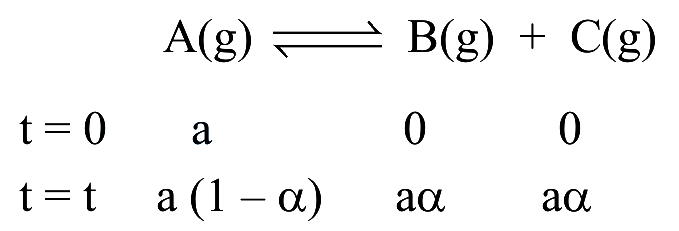
a moles of \(A(g)\) taken initially and at time Now moles fraction of \(\mathrm{A}(\mathrm{g}), \mathrm{B}(\mathrm{g})\) and \(\mathrm{C}(\mathrm{g})\) are
\(\begin{aligned}
& X_A=\frac{a-a \alpha}{a+a \alpha}=\frac{1-\alpha}{1+\alpha} \\
& X_B=\frac{a \alpha}{a+a \alpha}=\frac{\alpha}{1+\alpha} \\
& X_C=\frac{a \alpha}{a+a \alpha}=\frac{\alpha}{1+\alpha}
\end{aligned}\)
Now if \(P\) is total pressure then partial pressure o \(\mathrm{A}(\mathrm{g}), \mathrm{B}(\mathrm{g})\) and \(\mathrm{C}(\mathrm{g})\) are
\(\begin{aligned}
& \mathrm{P}_{\mathrm{A}}=\left(\frac{1-\alpha}{1+\alpha}\right) \mathrm{P} \\
& \mathrm{P}_{\mathrm{B}}=\left(\frac{\alpha}{1+\alpha}\right) \mathrm{P} \\
& \mathrm{P}_{\mathrm{C}}=\left(\frac{\alpha}{1+\alpha}\right) \mathrm{P} \\
& \mathrm{~K}_{\mathrm{P}}=\frac{\left(\frac{\alpha}{1+\alpha}\right) \mathrm{P}\left(\frac{\alpha}{1+\alpha}\right) \mathrm{P}}{\left(\frac{1-\alpha}{1+\alpha}\right) \mathrm{P}} \\
& \mathrm{~K}_{\mathrm{P}}=\frac{\alpha^2 \mathrm{P}}{1-\alpha^2}
\end{aligned}\)
As \(K_P\) is only function of temperature.
So as P \(\uparrow \quad \alpha \downarrow\) -
- (A) 70
- (B) 74
- (C) 76
- (D) 78
Show answer and solution
Correct Answer: (B)
\(\begin{array}{llll}
& \mathrm{CO}(\mathrm{g}) & + & 2 \mathrm{H}_2(\mathrm{g}) & \rightleftharpoons & \mathrm{CH}_3 \mathrm{OH}(\mathrm{g}) \\
\mathrm{t}=0 & 0.1 \mathrm{~mol} & & \mathrm{a} \mathrm{~mol} & & - \\
\mathrm{t}_{\text {eq }} & 0.1-\mathrm{x} & & \mathrm{a}-2 \mathrm{x} & & \mathrm{x}=0.04 \\
& =0.06 & & =\mathrm{a}-0.08 & \\
& & & =0.23-0.08 \\
& & & =0.15 \mathrm{~mole}
\end{array}\)
\(\begin{aligned} & \mathrm{V}=2 \mathrm{~L} \\ & \mathrm{~T}=500 \mathrm{~K} \\ & \mathrm{P}_{\text {total }}=5 \mathrm{bar} \\ & \mathrm{n}_{\text {Total }}=0.25=\frac{1}{4} \mathrm{~mol} \\ & \mathrm{P}_{\text {total }}=\mathrm{n}_{\text {total }} \times \frac{\mathrm{RT}}{\mathrm{V}} \\ & \Rightarrow 5=(0.06+\mathrm{a}-0.08+0.04) \times \frac{0.08 \times 500}{2} \\ & \Rightarrow 10=(0.02+\mathrm{a}) \times 0.08 \times 500\end{aligned}\)
\(\Rightarrow \mathrm{a}=0.25-0.02=0.23 \mathrm{~mol}.\)
\(\begin{aligned}
& \mathrm{K}_{\mathrm{P}}=\frac{\mathrm{X}_{\mathrm{CH}_3 \mathrm{OH}}}{\mathrm{X}_{\mathrm{CO}} \times \mathrm{X}_{\mathrm{H}_2}^2} \times \frac{1}{\left(\mathrm{P}_{\mathrm{T}}\right)^2}=\frac{0.04}{0.06 \times(0.15)^2} \times\left[\frac{1 / 4}{5}\right]^2 \\
& =\frac{4}{6 \times(0.15)^2 \times 16} \times \frac{1}{25} \\
& =\frac{100 \times 100}{24 \times 225 \times 25}=\frac{100 \times 100}{135000} \\
& =0.074=74 \times 10^{-3}
\end{aligned}\) -
- (A) \(x=\sqrt[3]{\frac{2 \mathrm{Kp}}{\mathrm{p}}}\)
- (B) \(x=\sqrt[3]{\frac{2 \mathrm{Kp}^2}{\mathrm{p}}}\)
- (C) \(x=\sqrt[3]{\frac{\mathrm{Kp}}{\mathrm{p}}}\)
- (D) \(x=\sqrt[3]{\frac{K \mathrm{p}}{2 \mathrm{p}}}\)
Show answer and solution
Correct Answer: (B)
\(\begin{aligned} & 1 \mathrm{~mol} \\ & \mathrm{X}_2 \mathrm{Y}(\mathrm{g}) \rightarrow \underset{\mathrm{x}}{\mathrm{X}} \mathrm{X}_2(\mathrm{~g})+\frac{1}{2} \mathrm{Y}_2(\mathrm{~g}) \\ & \frac{\mathrm{x}}{2} \\ & \therefore \quad P_{\mathrm{x}_2 \mathrm{y}} \\ & =\frac{1-\mathrm{x}}{1+\frac{x}{2}} \times \mathrm{p} \\ & P_{x_2}=\frac{x}{1+\frac{x}{2}} \times p\end{aligned}\)
\(\begin{aligned}
& P_{y_2}=\frac{x / 2}{1+\frac{x}{2}} \times p \\
\therefore \quad K_p= & \frac{\left(\frac{x}{1+\frac{x}{2}} p\right)\left(\frac{x}{2\left(1+\frac{x}{2}\right)} p\right)^{1 / 2}}{\left(\frac{1-x}{1+\frac{x}{2}}\right) \times p} \\
\therefore \quad & K_p=\left(\frac{x}{1-x}\right)\left(\frac{x}{2\left(1+\frac{x}{2}\right)}\right)^{1 / 2} \times p^{1 / 2}
\end{aligned}\)
\(\therefore \quad \mathrm{x}\) to be very small
\(\begin{aligned}
\therefore & K_p=\frac{x^{3 / 2}}{2^{(1 / 2)}} \times p^{1 / 2} \\
\therefore & x^{3 / 2}=\frac{K_p \times 2^{1 / 2}}{p^{1 / 2}} \\
& x^3=\frac{K_p^2 \times 2}{p} \\
& x=\left(\frac{K_p^2 \times 2}{p}\right)^{1 / 3}
\end{aligned}\) -
- (A) 5 times of initial pressure
- (B) \(5 / 2\) times of initial pressure
- (C) \(7 / 2\) times of initial pressure
- (D) \(7 / 4\) times of initial pressure
Show answer and solution
Correct Answer: (D)
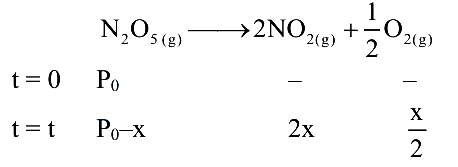
\(\begin{gathered}x=\frac{P_0}{2} \\ P_{\text {total }}=P_0-\frac{P_0}{2}+P_0+\frac{P_0}{4}=\frac{7}{4} P_0\end{gathered}\) -
- (A) Statement I is false but Statement II is true
- (B) Both Statement I and Statement II are true
- (C) Both Statement I and Statement II is false
- (D) Statement I is true but Statement II is false
Show answer and solution
Correct Answer: (B)
A catalyst can change equilibrium composition if it is added at constant pressure, but it can not change equilibrium constant. -
- (A) \(\mathrm{PCl}_5\) will increase
- (B) \(\mathrm{Cl}_2\) will decrease
- (C) \(\mathrm{PCl}_5, \mathrm{PCl}_3 \& \mathrm{Cl}_2\) remain constant
- (D) \(\mathrm{PCl}_3\) will increase
Show answer and solution
Correct Answer: (D)
On addition of inert gas at constant P & T, reaction moves in the direction of greater no. of moles so it will shift in forward direction, so \(\left[\mathrm{PCl}_5\right]\) decrease and \(\left[\mathrm{PCl}_3\right] \&\left[\mathrm{Cl}_2\right]\) will increase. -
- (A) 10
- (B) 15
- (C) 5
- (D) 20
Show answer and solution
Correct Answer: (C)
\(\begin{aligned} & \mathrm{H}_2 \mathrm{O}(\mathrm{g}) \rightleftharpoons \mathrm{H}_{2(\mathrm{~g})}+\frac{1}{2} \mathrm{O}_{2(\mathrm{~g})} \\ & \mathrm{t}=0 \quad 1 \mathrm{~mole} \\ & \mathrm{t}=\mathrm{t}_{\mathrm{eq}} \quad 1-\alpha \quad \alpha \quad \frac{\alpha}{2} \\ & \mathrm{n}_{\mathrm{T}}=1+\frac{\alpha}{2} \simeq 1(\alpha \ll 1) \\ & \mathrm{k}_{\mathrm{P}}=\frac{\mathrm{P}_{\mathrm{H}_2} \cdot \mathrm{P}_{\mathrm{O}_2}^{1 / 2}}{\mathrm{P}_{\mathrm{H}_2 \mathrm{O}}}=\frac{(\alpha \cdot \mathrm{P})\left(\frac{\alpha}{2} \mathrm{P}\right)^{\frac{1}{2}}}{(1-\alpha) \mathrm{P}} \\ & 8 \times 10^{-3}=\frac{\alpha^{3 / 2}}{\sqrt{2}} \\ & \alpha^{3 / 2}=8 \sqrt{2} \times 10^{-3} \\ & \alpha^3=128 \times 10^{-6} \\ & \alpha=\sqrt[3]{128} \times 10^{-2} \\ & =5.03 \times 10^{-2}\end{aligned}\) -
- (A) 20
- (B) 25
- (C) 30
- (D) 35
Show answer and solution
Correct Answer: (B)
\(\begin{aligned}
& \quad \mathrm{HX}_{(\mathrm{aq)}} \rightleftharpoons \mathrm{H}_{(\mathrm{aq})}^{+}+\mathrm{X}_{(\mathrm{aq})}^{-} \quad \mathrm{K}_{\mathrm{a}}=4 \times 10^{-10} \\
& 0.01(1-\alpha) \quad 0.01 \alpha \quad 0.01 \alpha \quad \text { Not justified } \\
& \Rightarrow 0.01 \alpha=10^{-5} \Rightarrow \alpha=10^{-3} \\
& \mathrm{~K}_{\mathrm{a}}=0.01 \alpha^2=10^{-8}
\end{aligned}\)
On dilution let final concentration of \(\mathrm{HX}=\mathrm{c} \mathrm{M}\)
\(\begin{aligned}
& \mathrm{Hx}_{(\mathrm{an})} \rightleftharpoons \mathrm{H}_{(\mathrm{aq})}^{+}+\mathrm{X}_{(\mathrm{an})}^{-} \\
& \mathrm{C}(1-\alpha) \quad \mathrm{C} \alpha \quad \mathrm{C} \alpha \\
& \Rightarrow \mathrm{C} \alpha=10^{-6}...(1) \\
& \quad \frac{\mathrm{C} \alpha^{2}}{1-\alpha}=\mathrm{K}_{\mathrm{a}}=10^{-8}...(2) \\
& \Rightarrow \frac{10^{-6} \alpha}{1-\alpha}=10^{-8}
\end{aligned}\)
Data given is inconsistent \& contradictory. This should be bonus. -
- (A) \(K_P=\frac{\alpha^{1 /_2} P^{1 / 2}}{(2+\alpha)^{1 /_2}}\)
- (B) \(K_P=\frac{\alpha^{3 /_2} P^{1 / 2}}{(2+\alpha)^{1 / 2}(1-\alpha)}\)
- (C) \(K_P=\frac{\alpha^{1 /_2} P^{3 / 2}}{(2+\alpha)^{3 /_2}}\)
- (D) \(K_P=\frac{\alpha^{1 /_2} P^{1 / 2}}{(2+\alpha)^{3 /_2}}\)
Show answer and solution
Correct Answer: (B)
Sol:-\(A_{(g)} \rightleftharpoons B_{(g)}+\frac{C}{2}(g)\)
\(t=t_{e q}(1-\alpha) \quad \alpha \quad \frac{\alpha}{2}\)
\(\mathrm{P}_{\mathrm{B}}=\frac{\alpha}{\left(1+\frac{\alpha}{2}\right)} . \mathrm{P}, \mathrm{P}_{\mathrm{A}}=\frac{(1-\alpha)}{\left(1+\frac{\alpha}{2}\right)} \cdot \mathrm{P}, \mathrm{P}_{\mathrm{C}}=\frac{\frac{\alpha}{2}}{\left(1+\frac{\alpha}{2}\right)} \cdot \mathrm{P}\)
\(K_P=\frac{P_B \cdot P_C^{\frac{1}{2}}}{P_A}\)
\(=\frac{(\alpha)^{\frac{3}{2}}(P)^{\frac{1}{2}}}{(1-\alpha)(2+\alpha)^{\frac{1}{2}}}\)
-
- (A) \(2\)
- (B) \(1\)
- (C) \(10\)
- (D) \(0.01\)
Show answer and solution
Correct Answer: (C)
\(\Delta \mathrm{n}_{\mathrm{g}}=0 \mathrm{~K}_{\mathrm{p}}=\frac{\left(\mathrm{n}_{\mathrm{HI}}\right)^2}{\mathrm{n}_{\mathrm{H}_2} \mathrm{n}_{\mathrm{I}_2}}\left(\frac{\mathrm{P}_{\mathrm{T}}}{\mathrm{n}_{\mathrm{T}}}\right)^{\Delta \mathrm{ng}_{\mathrm{g}}}\)\(\mathrm{n}_{\mathrm{HI}}=\mathrm{n}_{\mathrm{H}_2}=\mathrm{n}_{\mathrm{I}_2} \text { so } \mathrm{K}_{\mathrm{P}}=1\)
\(1=\mathrm{x} \times 10^{-1} \mathrm{x}=10\)
-
- (A) \(150\)
- (B) \(165\)
- (C) \(160\)
- (D) \(163\)
Show answer and solution
Correct Answer: (D)
\(\frac{3}{2} \mathrm{O}_{2(\mathrm{~g})} \rightleftharpoons \mathrm{O}_{3(\mathrm{~g})} \cdot \mathrm{K}_{\mathrm{P}}=2.47 \times 10^{-29}\)\(\Delta_{\mathrm{r}} \mathrm{G}^{\ominus}=-\mathrm{RT} \ln \mathrm{K}_{\mathrm{P}}\)
\(=-8.314 \times 10^{-3} \times 298 \times \ln \left(2.47 \times 10^{-29}\right)\)
\(=-8.314 \times 10^{-3} \times 298 \times(-65.87)\)
\(=163.19 \mathrm{~kJ}\)
-
- (A) \(70\)
- (B) \(60\)
- (C) \(80\)
- (D) \(57\)
Show answer and solution
Correct Answer: (D)
\(\Delta \mathrm{G}^{\circ}=-\mathrm{RT}(\mathrm{n} \mathrm{K}\)\(=-8.314 \times 300 \ell \mathrm{n}(10)\)
\(=5744.14 \mathrm{~J} / \mathrm{mole}\)
\(=57.44 \times 10^{-1} \mathrm{~kJ} / \mathrm{mole}\)
-
- (A) \(6.0\)
- (B) \(12.0\)
- (C) \(8.0\)
- (D) \(7.0\)
Show answer and solution
Correct Answer: (C)
\(\mathrm{X} \rightleftharpoons \mathrm{Y} \mathrm{k}_1=1\)\(\mathrm{Y} \rightleftharpoons \mathrm{Z} \mathrm{k}_2=2\)
\(\mathrm{Z} \rightleftharpoons \omega \mathrm{k}_3=4\)
\(\mathrm{X} \rightleftharpoons \omega \mathrm{k}_1 \cdot \mathrm{k}_2 \cdot \mathrm{k}_3\)
\(\mathrm{k}=1 \times 2 \times 4\)
\(\mathrm{k}=8\)
-
- (A) \(\mathrm{K}_{\mathrm{C}}=\frac{\left[\mathrm{FeSCN}^{2+}\right]}{\left[\mathrm{Fe}^{3+}\right]\left[\mathrm{SCN}^{-}\right]}\)
- (B) \(\mathrm{K}_{\mathrm{C}}=\frac{\left[\mathrm{Fe}^{3+}\right]\left[\mathrm{SCN}^{-}\right]}{\left[\mathrm{FeSCN}^{2+}\right]}\)
- (C) \(\mathrm{K}_{\mathrm{C}}=\frac{\left[\mathrm{FeSCN}^{2+}\right]}{\left[\mathrm{Fe}^{3+}\right]^2\left[\mathrm{SCN}^{-}\right]^2}\)
- (D) \(\mathrm{K}_{\mathrm{C}}=\frac{\left[\mathrm{FeSCN}^{2+}\right]^2}{\left[\mathrm{Fe}^{3+}\right]\left[\mathrm{SCN}^{-}\right]}\)
Show answer and solution
Correct Answer: (A)
\(\mathrm{K}_{\mathrm{C}}=\frac{\text { Products ion conc. }}{\text { Reactants ion conc. }}\)\(\mathrm{K}_{\mathrm{C}}=\frac{\left[\mathrm{FeSCN}^{2+}\right]}{\left[\mathrm{Fe}^{3+}\right]\left[\mathrm{SCN}^{-}\right]}\)
-
- (A) \(1\)
- (B) \(4\)
- (C) \(3\)
- (D) \(2\)
Show answer and solution
Correct Answer: (D)
\( \mathrm{K}_{\mathrm{P}}=\mathrm{K}_{\mathrm{C}} \cdot(\mathrm{RT})^{\Delta \mathrm{n}_{\mathrm{g}}} \)\( \Delta \mathrm{n}_{\mathrm{g}}=1 \)
\( \Rightarrow \mathrm{K}_{\mathrm{c}}=\frac{\mathrm{K}_{\mathrm{P}}}{\mathrm{RT}}=\frac{0.492}{0.082 \times 300}=2 \times 10^{-2}\)
-
- (A) 40
- (B) 50
- (C) 60
- (D) 70
Show answer and solution
Correct Answer: (A)
The reaction takes place as follows,
\(H _2 C _2 O _4+2 NaOH \rightarrow Na _2 C _2 O _4+2 H _2 O\)
Molarity \(=\frac{\text { Number of moles }}{\text { Volume of solution (in } L \text { ) }}\)
Calculation:
Now, 50 mL of \(0.5 M H _2 C _2 O _4\) is needed to neutralize 25 mL of NaOH
\(\therefore M _{\text {eq }}\) of \(H _2 C _2 O _4= M _{\text {eq }}\) of NaOH
\(50 \times 0.5 \times 2=25 \times M _{ NaOH } \times 1\)
\(M _{ NaOH }=2 M\)
Now, molarity \(=\frac{\text { Number of moles }}{\text { Volume of solution (in } L \text { ) }}\)
\(=\frac{\text { weight/molecular mass }}{\text { Volume of solution (in } L \text { ) }}\)
\(2=\frac{w_{ NaOH }}{40} \times \frac{1000}{50}\)
\(w _{ NaOH }=\frac{2 \times 40 \times 50}{1000}=4 g\). -
- (A) \(4.9\)
- (B) \(41.6\)
- (C) \(49\)
- (D) \(416\)
Show answer and solution
Correct Answer: (D)
\(\mathrm{K}_{\mathrm{C}}^{\prime}=\left(\frac{1}{\mathrm{~K}_{\mathrm{C}}}\right)^2=\left(\frac{1}{4.9 \times 10^{-2}}\right)^2\)\(\mathrm{~K}_{\mathrm{C}}^{\prime}=416.49\)
-
- (A) \(419\)
- (B) \(418\)
- (C) \(417\)
- (D) \(455\)
Show answer and solution
Correct Answer: (C)
\( \mathrm{K}_{\mathrm{C}}=\frac{\left[\mathrm{NH}_3\right]^2}{\left[\mathrm{~N}_2\right]\left[\mathrm{H}_2\right]^3} \)\( \mathrm{~K}_{\mathrm{C}}=\frac{\left(1.5 \times 10^{-2}\right)^2}{\left(2 \times 10^{-2}\right) \times\left(3 \times 10^{-2}\right)^3} \)
\( \mathrm{~K}_{\mathrm{C}}=417\)
-
- (A) Addition of \(\mathrm{Fe}_2 \mathrm{O}_3\)
- (B) Addition of \(\mathrm{CO}_2\)
- (C) Removal of \(\mathrm{CO}\)
- (D) Removal of \(\mathrm{CO}_2\)
Show answer and solution
Correct Answer: (A)
When solid added no effect on equilibrium. - 40. The ratio \(\frac{K_P}{K_C}\) for the reaction : \(CO _{( g )}+\frac{1}{2} O _{2(g)} \rightleftharpoons CO _{2(g)}\) is _______. 2024 Medium
- (A) \(\frac{1}{\sqrt{ RT }}\)
- (B) \(( RT )^{1 / 2}\)
- (C) RT
- (D) 1
Show answer and solution
Correct Answer: (A)
\(\Delta n_g = n_{products, g} - n_{reactants, g}\)
\(\Delta n_g = 1 - (1 + \frac{1}{2})\)
\(\Delta n_g = 1 - 1.5 = -0.5\)
\(\frac{K_P}{K_C} = (RT)^{\Delta n_g}\)
\(\frac{K_P}{K_C} = (RT)^{-0.5}\)
\(\frac{K_P}{K_C} = \frac{1}{\sqrt{RT}}\)
-
- (A) \(1\)
- (B) \(2\)
- (C) \(3\)
- (D) \(4\)
Show answer and solution
Correct Answer: (A)
\(H _{2( g )}+ I _{2( g )} \rightleftharpoons 2 HI _{( g )}\)\(K _{ c }=\frac{[ HI ]^2}{\left[ H _2\right]\left[ I _2\right]}=\frac{(3)^2}{3 \times 3}=\frac{9}{9}=1\)
-
- (A) \(2\)
- (B) \(4\)
- (C) \(3\)
- (D) \(5\)
Show answer and solution
Correct Answer: (C)
\(A _{( g )} \rightleftharpoons 2 B _{( g )}+ C _{( g )}\)\(t=0 \quad 450\)
\(\text { timet } 450-x \quad 2 x\)
\(P_T=P_A+P_B+P_C\)
\(720=450-x+2 x+x\)\(2 x=270\)
\(x=135\)
Fraction of A decomposed \(=\frac{135}{450}=0.3=3 \times 10^{-1}\)
So, \(x=3\)
-
- (A) \(41\)
- (B) \(42\)
- (C) \(43\)
- (D) \(44\)
Show answer and solution
Correct Answer: (D)
\(CO _{( g )}+ H _2 O _{( g )} \rightleftharpoons CO _{2( g )}+ H _{2( g )}\)\(\begin{array}{lllll} t =0 & 1\,mol & 1\,mol & 0 & 0\end{array}\)
at equ. \(1- x \quad 1- x \quad x \quad x\)
at equilibrium \(40 \%\) by mass water reacts with \(CO\)
\(x=0.4 \quad 1-x=0.6\)
\(K _{ C }=\frac{\left[ CO _2\right]\left[ H _2\right]}{[ CO ]\left[ H _2 O \right]}=\frac{0.4 \times 0.4}{0.6 \times 0.6}=0.44\)
\(K _{ C } \times 10^2=44\)
-
- (A) \(2\)
- (B) \(6\)
- (C) \(5\)
- (D) \(3\)
Show answer and solution
Correct Answer: (D)
The yield of \(SO _3\) at equilibrium will be due to:\(B.\) Increasing pressure
\(C.\) Adding more \(SO _2\)
\(D.\) Adding more \(O _2\)
-
- (A) \(2\)
- (B) \(3\)
- (C) \(4\)
- (D) \(1\)
Show answer and solution
Correct Answer: (D)
\(SO _{2( g )}+\frac{1}{2} O _{2( g )} \rightleftharpoons SO _{3( g )}\)\(K _{ P }=2 \times 10^{12} \text { at } 300\,K\)
\(K _{ P }= K _{ C } \times( RT )^{\Delta n _{ g }}\)
\(2 \times 10^{12}= K _{ C } \times(0.082 \times 300)^{-1 / 2}\)
\(K _{ C }=9.92 \times 10^{12}\)
\(K _{ C }=0.992 \times 10^{13}\)
-
- (A) \(2\)
- (B) \(4\)
- (C) \(6\)
- (D) \(8\)
Show answer and solution
Correct Answer: (A)
\(H _2 O ( g ) \rightleftharpoons H _2( g )+\frac{1}{2} O _2( g )\)\(P _0[1-\alpha] \quad P _0 \alpha \quad \frac{ P _0 \alpha}{2} \quad \text { partial pr. at eq }\)
\(P _0\left[1+\frac{\alpha}{2}\right]=1\)
\(K _{ p }=\frac{\left( P _{ H _2}\right)\left( P _{ O _2}\right)^{1 / 2}}{ P _{ H _2 O }}\)
\(\frac{\left( P _0 \alpha\right)\left(\frac{ P _0 \alpha}{2}\right)^{1 / 2}}{ P _0[1-\alpha]}=2 \times 10^{-3}\)
since \(\alpha\) is negligible w.r.t 1 so \(P _0=1\) and \(1-\alpha \approx 1\)
\(\frac{\alpha \sqrt{\alpha}}{\sqrt{2}}=2 \times 10^{-3}\)
\(\alpha^{3 / 2}=2^{3 / 2} \times 10^{-3}\)
\(\alpha=2^{3 / 2 \times 2 / 3} \times 10^{-3 \times 2 / 3}\)
\(\alpha=2 \times 10^{-2} \quad \% \alpha=2 \%\)
-
- (A) \(150\)
- (B) \(125\)
- (C) \(175\)
- (D) \(25\)
Show answer and solution
Correct Answer: (B)
\(\,\quad\quad\quad\quad 2 NOCl ( g ) \rightleftharpoons 2 NO ( g )+ Cl _{2}( g )\)\(t =0 \quad\quad 2 M \quad\quad\quad\quad\quad -\quad\quad\quad\quad -\)
\(t = t _{ eq }\quad(2- x ) M\quad\quad\quad\quad xM \quad\quad \frac{ x }{2} M\)
\(\because x =0.4 \,M\)
\(\therefore[ NOCl ]_{ eq }=1.6\, M\)
\({[ NO ]_{ eq }=0.4 \,M }\)
\({\left[ Cl _{2}\right]_{ eq }=0.2 \,M }\)
\(\Rightarrow K _{ c }=\frac{[ NO ]^{2}\left[ Cl _{2}\right]}{[ NOCl ]^{2}}=\frac{[0.4]^{2}[0.2]}{[1.6]^{2}}\)
\(K _{ c }=\frac{32}{2.56} \times 10^{-3}\)
\(K _{ c }=12.5 \times 10^{-3}\)
\(K _{ c }=125 \times 10^{-4}\)
-
- (A) \(102\)
- (B) \(243\)
- (C) \(747\)
- (D) \(545\)
Show answer and solution
Correct Answer: (C)
\(2 O _{3} \rightleftharpoons 3 O _{2}( g )\)\(\frac{2}{5} \quad\quad\quad \frac{3}{5}\)
\(k _{ p }=\frac{ P _{ O _{2}}^{3}}{ P _{ O _{3}}^{2}}\)
\(k_{p}=1.35\)
\(\Delta G ^{\circ}=- RT \ln k _{ p }\)
\(=-8.3 \times 300 \times \ln 1.35\)
\(=-747 \,J / mol\)
-
- (A) \(2.25\)
- (B) \(6.24\)
- (C) \(12.13\)
- (D) \(15.24\)
Show answer and solution
Correct Answer: (A)
\(PCl _{5}=5\) \(mole\)\(Ar =4\) \(mole\)
\(P _{\text {Total }}=\frac{9 \times 0.82 \times 610}{100}=4.5 \,atm\)
\(P _{ PCI _{5}}=\frac{5 \times 4.5}{9}=2.5 ; P _{ Ar }=\frac{4 \times 4.5}{9}=2\)
\(PCl _{5} \rightleftharpoons PCl _{3}+ Cl _{2}\)
\(2.5- P \quad P \quad P\)
\(P_{\text {total }}=2.5-P+P+P+P_{A r}=6\)
\(P =1.5\)
\(K_{p}=\frac{1.5 \times 1.5}{1}=2.25\)
-
- (A) \(8945\)
- (B) \(945\)
- (C) \(1400\)
- (D) \(2735\)
Show answer and solution
Correct Answer: (D)
\(\quad\quad HI \quad\quad\quad\rightleftharpoons \frac{1}{2} H _{2}+\frac{1}{2} I _{2}\)\(t _{ i } \,\quad\quad 1\)
\(\text { teq } \quad 1-0.4 \quad\quad \frac{0.4}{2} \quad\quad\quad \frac{0.4}{2}\)
\(K _{ p }= \frac{(0.2)^{\frac{1}{2}}(0.2)^{\frac{1}{2}}}{1-0.4}=\frac{0.2}{0.6}=\frac{1}{3}\)
\(\Delta G =\Delta G ^{\circ}+ RT \ln K =0\)
\(\Delta G ^{\circ} =- RT \ln K \Rightarrow-8.31 \times 300 \times 2.3 \times \log \left(\frac{1}{3}\right)\)
\(=2735\, J / mol\)
No questions on this page match these filters.
About Equilibrium - 1 (chemical Equilibrium) PYQs
Equilibrium - 1 (chemical Equilibrium) has 100 questions from 2013–2026. The most came in 2026 (16), 2021 (15) and 2025 (12).
The most asked topics are Law of equilibrium and Equilibrium constant, Standard free energy and Kp and Kc Relationship.
8% are easy, 55% medium and 37% hard.
Equilibrium - 1 (chemical Equilibrium) PYQs by year
Frequently asked
How many Equilibrium - 1 (chemical Equilibrium) questions came in JEE Mains?
100 questions from 2013–2026, each with the correct answer and a full solution.
Which Equilibrium - 1 (chemical Equilibrium) topic is asked the most?
Law of equilibrium and Equilibrium constant, with 50 questions, followed by Standard free energy with 14.
Which year had the most Equilibrium - 1 (chemical Equilibrium) questions?
2026, with 16 questions.
How difficult are Equilibrium - 1 (chemical Equilibrium) questions?
8% are easy, 55% medium and 37% hard.