


Topics
4 topicsAll Aldehydes and ketones questions
Newest firstShowing 1–50 of 71 questions
-
- (A) A, B and C Only
- (B) B and C Only
- (C) C and D Only
- (D) A and D Only
Show answer and solution
Correct Answer: (D)
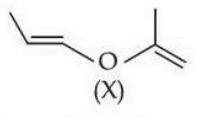
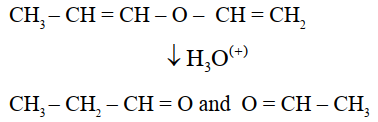
Molecule \((X)\) is an ether with two enol ether functional groups attached to the central oxygen atom. On mild acidic hydrolysis, an enol ether cleaves to give a carbonyl compound and an alcohol.
The \(1\)-propenyl side \((CH_3-CH=CH-O-)\) hydrolyses to propanal, \(CH_3CH_2CHO\).
The isopropenyl side \((-O-C(CH_3)=CH_2)\) hydrolyses to the enol of acetone, which tautomerises to acetone, \(CH_3COCH_3\).
Therefore, \((Y)\) and \((Z)\) are propanal and acetone.
Statement A: Both \((Y)\) and \((Z)\) have the same molar mass.
Propanal and acetone are functional isomers with the same molecular formula \(C_3H_6O\) and hence the same molar mass \((58\text{ g mol}^{-1})\).
Statement A is true.
Statement B: \((Y)\) and \((Z)\) can be distinguished by \(NaHCO_3\).
\(NaHCO_3\) reacts only with carboxylic acids (releasing \(CO_2\)). Neither an aldehyde nor a ketone reacts with \(NaHCO_3\), so it cannot distinguish between them.
Statement B is false.
Statement C: \((Y)\) and \((Z)\) react with HCN at the same rate.
In nucleophilic addition to carbonyls, aldehydes react faster than ketones due to lower steric hindrance and a more electrophilic carbonyl carbon (fewer \(+I\) alkyl groups). So propanal reacts faster than acetone.
Statement C is false.
Statement D: \((Y)\) and \((Z)\) undergo addition reaction with \(2,4\)-DNP.
Both aldehydes and ketones react with \(2,4\)-DNP (Brady's reagent) by nucleophilic addition followed by loss of water to give coloured \(2,4\)-dinitrophenylhydrazone precipitates.
Statement D is true.
Hence, the correct statements are A and D only, which corresponds to option \((4)\). -
- (A) \(CH_2 = CH - \overset{O}{\underset{\|}{C}} - OH\)
- (B) \(CH_3 - CH = CH - CH = O\)
- (C) \(O = C - OH, \, CH_2 - OH\) (with C-C bond)
- (D) \(CH_3 - \overset{O}{\underset{\|}{C}} - OH\)
Show answer and solution
Correct Answer: (C)
Given the molar ratio of C, O, and H in compound \(x\) is equal, the empirical formula is \(CHO\).
Empirical mass \(= 12 + 1 + 16 = 29\) g mol\(^{-1}\).
Since the molar mass of \(x\) is \(58\) g mol\(^{-1}\), the molecular formula is \((CHO)_2\) or \(C_2H_2O_2\).
The structure of \(x\) is glyoxal, \(OHC-CHO\).
Treatment of glyoxal with \(50\%\) KOH under reflux results in an intramolecular Cannizzaro reaction. One aldehyde group is oxidized to a carboxylate ion, and the other is reduced to a primary alcohol.
\(OHC-CHO \xrightarrow{50\% \text{ KOH}} HOCH_2-COO^{-}K^{+}\)
Subsequent acidification yields glycolic acid (\(y\)).
\(HOCH_2-COO^{-}K^{+} \xrightarrow{H^{+}} HOCH_2-COOH\)
The structure of \(y\) is \(HO-CH_2-COOH\).
Answer: \(O = C - OH, \, CH_2 - OH\) (with C-C bond) -
- (A) Both Statement I and Statement II are false
- (B) Statement I is false but Statement II is true
- (C) Both Statement I and Statement II are true
- (D) Statement I is true but Statement II is false
Show answer and solution
Correct Answer: (A)
Statement I: False
Cross aldol can give 2 or 4 products
Statement II: False
Benzaldehyde & Acetone both react with semi carbazide -
- (A) Both Statement I and Statement II are true
- (B) Both Statement I and Statement II are false
- (C) Statement I is true but Statement II is false
- (D) Statement I is false but Statement II is true
Show answer and solution
Correct Answer: (A)
Statement I is true because the \(-OCH_3\) group is an electron-donating group. It donates electron density through resonance (\(+R\) effect), which delocalizes the positive charge of the carbocation and stabilizes it.
Statement II is true because the \(-NO_2\) group is a strong electron-withdrawing group. It withdraws electron density through resonance (\(-R\) effect), which delocalizes the negative charge of the carbanion and stabilizes it.
Therefore, both Statement I and Statement II are true.
Answer: Both Statement I and Statement II are true -
- (A) Both Statement I and Statement II are true
- (B) Both Statement I and Statement II are false
- (C) Statement I is true but Statement II is false
- (D) Statement I is false but Statement II is true
Show answer and solution
Correct Answer: (A)
Statement I: Semicarbazide is \(H_2N-NH-C(=O)-NH_2\). The lone pair on the \(-NH_2\) group attached to the carbonyl carbon is involved in resonance with the \(C=O\) group, making it less nucleophilic. Therefore, the \(-NH_2\) group attached to the \(-NH-\) group acts as the nucleophile. The condensation of acetaldehyde (\(CH_3-CH=O\)) with semicarbazide under optimum pH (around 3.5) yields acetaldehyde semicarbazone, \(CH_3-CH=N-NH-C(=O)-NH_2\). Thus, Statement I is true.
Statement II: The molecule \(Ph-CH(OH)(OCH_3)\) is a hemiacetal. Hemiacetals are unstable and readily undergo hydrolysis in the presence of dilute acid to yield the corresponding aldehyde and alcohol. Hydrolysis of \(Ph-CH(OH)(OCH_3)\) gives benzaldehyde (\(Ph-CH=O\)) and methanol (\(CH_3OH\)). Thus, Statement II is also true.
Both Statement I and Statement II are true.
Answer: Both Statement I and Statement II are true -
- (A) 8
- (B) 10
- (C) 12
- (D) 14
Show answer and solution
Correct Answer: (B)
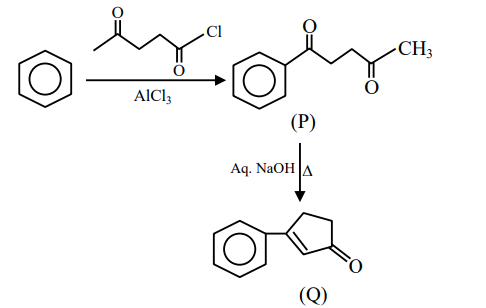
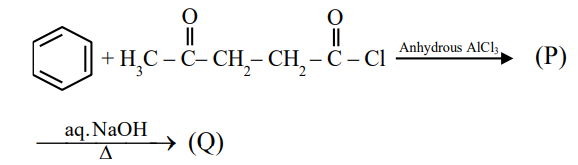
Molecular mass of Q is \(=157\)
\(\%\) of oxygen in product ' \(Q\) ' is \(=\frac{16}{157} \times 100=10.19 \%\) -
- (A) A-II, B-III, C-IV, D-I
- (B) A-IV, B-III, C-I, D-II
- (C) A-IV, B-I, C-II, D-III
- (D) A-II, B-IV, C-I, D-III
Show answer and solution
Correct Answer: (D)
A-II, B-IV, C-I, D-III -
- (A) A-III, B-I, C-IV, D-II
- (B) A-II, B-I, C-IV, D-III
- (C) A-IV, B-III, C-II, D-I
- (D) A-III, B-IV, C-I, D-II
Show answer and solution
Correct Answer: (A)
Theoretical (NCERT Based) -
- (A) 2-hydroxy acetophenone
- (B) 4-methoxy benzaldehyde
- (C) 4-hydroxy benzaldehyde
- (D) 4-methyl benzoic acid
Show answer and solution
Correct Answer: (B)
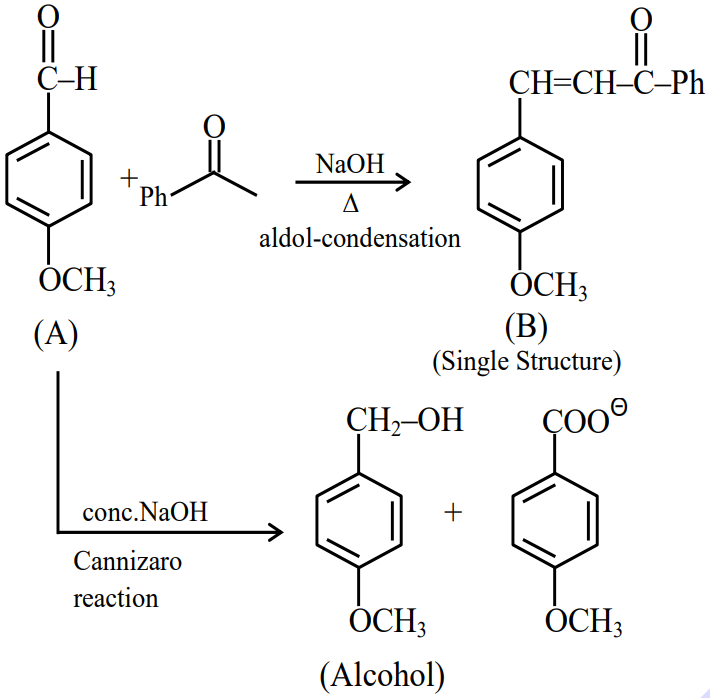
(On cross aldol reaction, a single structure is obtained but it can show geometrical isomerism). -
- (A) Lucas reagent
- (B) 2,4 - DNP reagent
- (C) Saturated \(NaHSO_{3}\) solution
- (D) Fehling solution
Show answer and solution
Correct Answer: (D)

'P' and 'Q' can be differentiated by Fehling's test.
P gives positive Fehling test
Q gives negative Fehling test -
- (A) 2-Methylpent-4-en-3-one
- (B) 4-Methylpent-3-en-2-one
- (C) 4-Methylpent-1-ene
- (D) 2-Methylpent-3-one
Show answer and solution
Correct Answer: (B)
Hydrolysis of prop-1-yne in the presence of \(HgSO_4\) and dilute \(H_2SO_4\) yields acetone.
\(CH_3-C \equiv CH + H_2O \xrightarrow{Hg^{2+}, H^+} CH_3-CO-CH_3\)
Thus, \(x\) is acetone.
Reaction of ethane nitrile (\(CH_3CN\)) with methyl magnesium bromide (\(CH_3MgBr\)) followed by hydrolysis also yields acetone.
\(CH_3-C \equiv N + CH_3MgBr \rightarrow CH_3-C(CH_3)=NMgBr \xrightarrow{H_3O^+} CH_3-CO-CH_3\)
Thus, \(y\) is acetone.
Reaction of \(x\) and \(y\) (both acetone) in the presence of \(Ba(OH)_2\) followed by heating results in an aldol condensation.
\(2 CH_3-CO-CH_3 \xrightarrow{Ba(OH)_2} CH_3-C(OH)(CH_3)-CH_2-CO-CH_3\)
Heating causes dehydration to form an unsaturated ketone.
\(CH_3-C(OH)(CH_3)-CH_2-CO-CH_3 \xrightarrow{\Delta} CH_3-C(CH_3)=CH-CO-CH_3\)
Numbering the principal carbon chain to give the lowest locant to the ketone group, the IUPAC name of the product is 4-methylpent-3-en-2-one.
Answer: 4-Methylpent-3-en-2-one -
- (A) 4
- (B) 8
- (C) 16
- (D) 32
Show answer and solution
Correct Answer: (C)
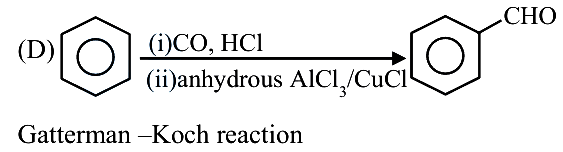
Benzene reacts with \(CO\) and \(HCl\) in the presence of \(CuCl\) to give benzaldehyde (\(x\)) via the Gattermann-Koch reaction.
Benzene reacts with ethanoyl chloride (\(CH_3COCl\)) in the presence of anhydrous \(AlCl_3\) to give acetophenone (\(y\)) via Friedel-Crafts acylation.
Heating benzaldehyde (\(x\)) and acetophenone (\(y\)) in the presence of alkali results in a crossed aldol condensation to form benzalacetophenone (\(z\)).
\(C_6H_5CHO + CH_3COC_6H_5 \xrightarrow{OH^-, \Delta} C_6H_5-CH=CH-CO-C_6H_5 + H_2O\)
The structure of \(z\) (\(C_6H_5-CH=CH-CO-C_6H_5\)) contains two phenyl rings (\(6\) \(\pi\) bonds), one \(C=C\) double bond (\(1\) \(\pi\) bond), and one \(C=O\) double bond (\(1\) \(\pi\) bond).
Total number of \(\pi\) bonds = \(6 + 1 + 1 = 8\)
Total number of \(\pi\) electrons = \(8 \times 2 = 16\)
Answer: \(16\) -
- (A) A, B and D Only
- (B) C and E Only
- (C) A, C and E Only
- (D) B, C and D Only
Show answer and solution
Correct Answer: (C)
Name of Reaction Acetaldehyde Acetone A. Iodoform reaction ✓ ✓ B. Cannizaro reaction × × C. Aldol reaction ✓ ✓ D. Tollen's test ✓ × E. Clemmensen reduction ✓ ✓ -
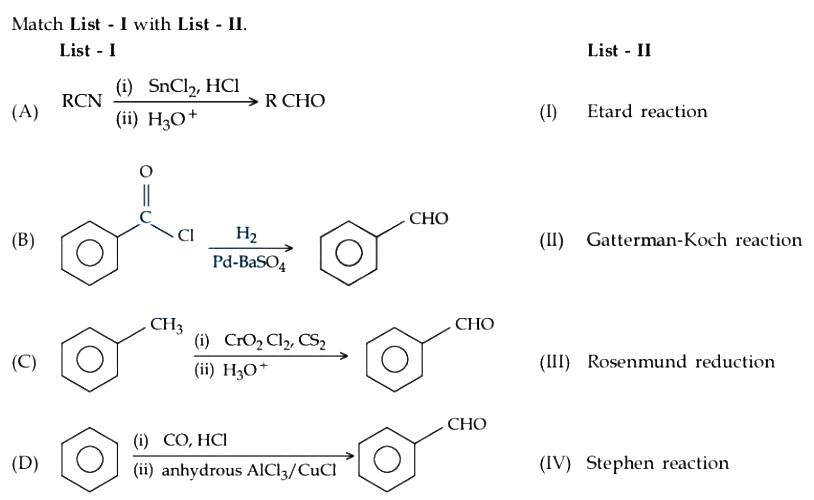
- (A) (A)-(III), (B)-(IV), (C)-(II), (D)-(I)
- (B) (A)-(I), (B)-(III), (C)-(II), (D)-(IV)
- (C) (A)-(III), (B)-(IV), (C)-(I), (D)-(II)
- (D) (A)-(IV), (B)-(III), (C)-(I), (D)-(II)
Show answer and solution
Correct Answer: (D)
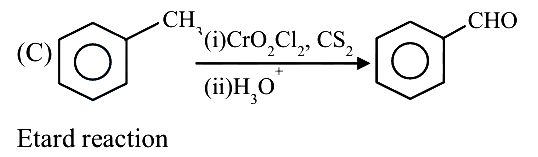
(A) \(\mathrm{RCN} \xrightarrow[\text { (i) } \mathrm{H}_3 \mathrm{O}^{+}]{\text {(i) } \mathrm{SnCl}_2, \mathrm{HCl}} \mathrm{RCHO}\)
Stephen reaction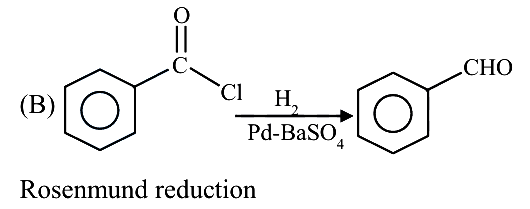
-
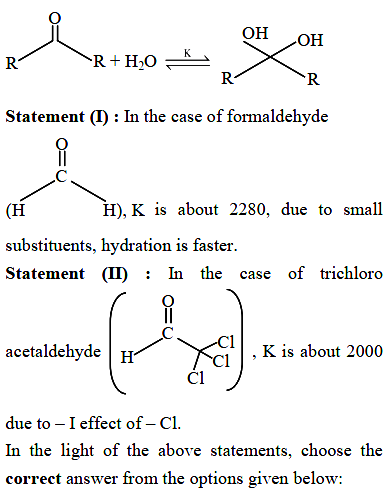
- (A) Both Statement I and Statement II are false
- (B) Statement I is true but Statement II is false
- (C) Statement I is false but Statement II is true
- (D) Both Statement I and Statement II are true
Show answer and solution
Correct Answer: (D)
\(\mathrm{k}_{\mathrm{eq}}=2280\) is for HCHO
\(\mathrm{k}_{\text {eq }}=2000\) is for chloral
Both data is given in clayden and warren book.
\(\mathrm{k}_{\mathrm{eq}}>1\) because HCHO and chloral are more electrophilic. -
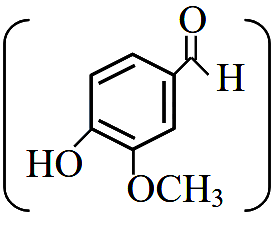
- (A) Statement I is incorrect but Statement II is correct
- (B) Statement I is correct but Statement II is incorrect
- (C) Both Statement I and Statement II are incorrect
- (D) Both Statement I and Statement II are correct
Show answer and solution
Correct Answer: (B)
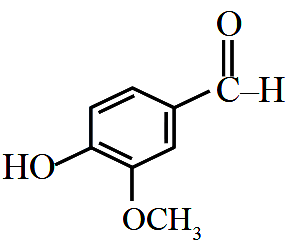
Phenolic group soluble in NaOH
Benzaldehyde derivative react with Tollen's reagent.
Vanillin does not give self-aldol reaction due to lack of acidic H for condensation. -
- (A) 5
- (B) 6
- (C) 7
- (D) 8
Show answer and solution
Correct Answer: (C)
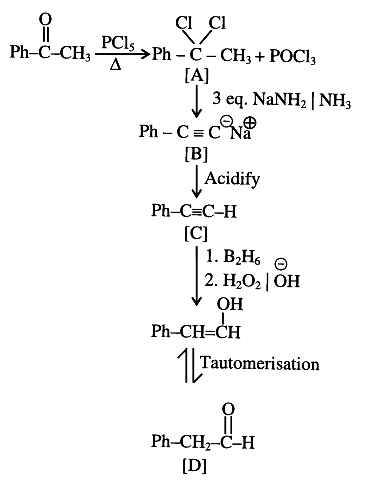
\(\Rightarrow\) Number of \(\mathrm{sp}^2 \mathrm{C}\)-atoms in product \(\mathrm{D}=7\)
NTA Ans. \(=7\)
ALLEN Ans. \(=7\) -
- (A) 5
- (B) 4
- (C) 3
- (D) 2
Show answer and solution
Correct Answer: (B)
Following will not give iodoform reaction/test.
(1) Butanal
(2) 3-Pentanone
(3) Pentanal
(4) 3-Pentanol -
- (A) (A), (D) and (E) Only
- (B) (C), (D) and (E) Only
- (C) (A), (C) and (D) Only
- (D) (A), (B) and (C) Only
Show answer and solution
Correct Answer: (B)
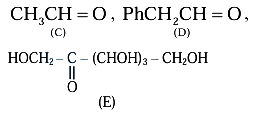
All gives positive Fehling test - 20. Which of the following arrangements with respect to their reactivity in nucleophilic addition reaction is correct? 2025 Easy
- (A) acetophenone \( \lt \) benzaldehyde \( \lt \) p-tolualdehyde \( \lt \) p- nitrobenzaldehyde
- (B) benzaldehyde \( \lt \) acetophenone \( \lt \) p- nitrobenzaldehyde \( \lt \) p-tolualdehyde
- (C) p- nitrobenzaldehyde \( \lt \) benzaldehyde \( \lt \) p-tolualdehyde \( \lt \) acetophenone
- (D) acetophenone \( \lt \) p-tolualdehyde \( \lt \) benzaldehyde \( \lt \) p- nitrobenzaldehyde
Show answer and solution
Correct Answer: (D)
Reactivity \(\propto+\mathrm{ve}\) charge on electrophilic carbon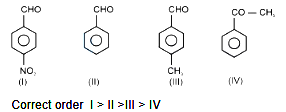
- 21. For the compounds :

The increasing order of boiling point is :
Choose the correct answer from the options given below : 2024 Medium- (A) \((\mathrm{A})<(\mathrm{B})<(\mathrm{C})<(\mathrm{D})\)
- (B) \((\mathrm{B})<(\mathrm{C})<(\mathrm{C})<(\mathrm{D})\)
- (C) \((\mathrm{D})<(\mathrm{C})<(\mathrm{A})<(\mathrm{B})\)
- (D) \((\mathrm{B})<(\mathrm{A})<(\mathrm{D})<(\mathrm{C})\)
Show answer and solution
Correct Answer: (B)
Compounds having same number of carbon atoms follow the boiling point order as:(Boiling point \()_{\text {Hydogen bending }}>\) (Boiling point \()_{\text {iigh polarity }}>\) \((\text { Boiling point })_{1 \text { or polarity }}>(\text { Boiling point })_{\text {nou polar }}\)
-
- (A) \(3\)
- (B) \(4\)
- (C) \(10\)
- (D) \(6\)
Show answer and solution
Correct Answer: (A)
Acetaldehyde \(\left(\mathrm{CH}_3 \mathrm{CHO}\right)\), Methanal \((\mathrm{HCHO})\), andcyclohexane carbaldehyde
-
- (A) Both Statement \(I\) and Statement \(II\) are correct.
- (B) Both Statement \(I\) and Statement \(II\) are incorrect.
- (C) Statement \(I\) is incorrect but Statement \(II\) is correct.
- (D) Statement \(I\) is correct but Statement \(II\) is incorrect.
Show answer and solution
Correct Answer: (D)
Aldehyde and ketones having acidic \(\alpha\)-hydrogen show aldol reaction
-
- (A) Stephen reaction
- (B) Etard reaction
- (C) Gatterman-koch reaction
- (D) Rosenmund reduction
Show answer and solution
Correct Answer: (C)
Gatterman-Koch reaction
- 25. In the above chemical reaction sequence " \(\mathrm{A}\) " and " \(\mathrm{B}\) " respectively are :
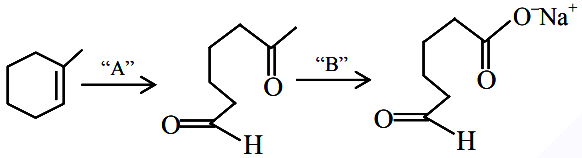 2024 Medium
- (A) \(\mathrm{O}_3, \mathrm{Zn} / \mathrm{H}_2 \mathrm{O}\) and \(\mathrm{NaOH}_{\text {(alc.). }} / \mathrm{I}_2\)
- (B) \(\mathrm{H}_2 \mathrm{O}, \mathrm{H}^{+}\)and \(\mathrm{NaOH}_{\text {(alc.) }} / \mathrm{I}_2\)
- (C) \(\mathrm{H}_2 \mathrm{O}, \mathrm{H}^{+}\)and \(\mathrm{KMnO}_4\)
- (D) \(\mathrm{O}_3, \mathrm{Zn} / \mathrm{H}_2 \mathrm{O}\) and \(\mathrm{KMnO}_4\)
Show answer and solution
Correct Answer: (A)
Explanation:
To determine the identity of reagents "A" and "B", we analyze each transformation step in the reaction pathway:
1. First Transformation (Identification of "A"):
The starting reactant is an unsymmetrical cyclic alkene, 1-methylcyclohexene. Under the action of reagent "A", the carbon-carbon double bond (\( \text{C}=\text{C} \)) undergoes oxidative cleavage to open the ring, generating a dicarbonyl product containing both a ketone group and an aldehyde group (6-oxoheptanal). This specific cleavage with a reductive workup that preserves aldehydes without further oxidation to carboxylic acids is known as reductive ozonolysis. Therefore, reagent "A" must be:
\( \text{O}_3 \text{ followed by } \text{Zn/H}_2\text{O} \)
2. Second Transformation (Identification of "B"):
The intermediate contains a methyl ketone group (\( -\text{COCH}_3 \)). Upon treatment with reagent "B" in the presence of iodine (\( \text{I}_2 \)), the methyl ketone group undergoes a haloform cleavage to form a bright yellow precipitate of iodoform (\( \text{CHI}_3 \)) alongside the corresponding sodium carboxylate salt. This confirmation test for methyl ketones requires a strong base. Therefore, reagent "B" is:
\( \text{NaOH} \)
Combining both components, "A" and "B" correspond perfectly to option A. -
- (A) \(317\)
- (B) \(318\)
- (C) \(320\)
- (D) \(325\)
Show answer and solution
Correct Answer: (B)
Claisen Schmidt reaction(Image)
\(\mathrm{mw}\) of benzaldehyde \(=106\)
\(106 \times 3=318 \mathrm{gm}\). Benzaldehyde is required to give \(1.5 \mathrm{~mole}\) (or \(351 \mathrm{gm}\) ) product

-
- (A) \(1\)
- (B) \(10\)
- (C) \(15\)
- (D) \(0\)
Show answer and solution
Correct Answer: (A)

Explanation:
To find the correct product P and the number of hydroxyl groups, we analyze the competitive reaction pathways of Grignard reagents:
1. Acid-Base vs. Nucleophilic Addition: The starting material is 4-hydroxybenzaldehyde, which contains two functional groups: a carbonyl group (\( -\text{CHO} \)) and a phenolic hydroxyl group (\( -\text{OH} \)). Grignard reagents (\( \text{PhMgBr} \)) are exceptionally strong nucleophiles, but they are also extremely strong bases. Because acid-base proton transfer reactions are kinetically much faster than nucleophilic addition reactions to carbonyl groups, the Grignard reagent will preferentially act as a base.
2. First Step (Deprotonation): Since only 1 equivalent of \( \text{PhMgBr} \) is added, it completely reacts with the highly acidic proton of the phenolic \( -\text{OH} \) group instead of attacking the aldehyde group:
\( \text{H-O-C}_6\text{H}_4\text{-CHO} + \text{PhMgBr} \rightarrow \text{BrMg-O-C}_6\text{H}_4\text{-CHO} + \text{Ph-H} \)
This step yields a magnesium phenoxide salt and leaves the carbonyl group (\( -\text{CHO} \)) completely untouched.
3. Second Step (Acidic Workup): The addition of aqueous ammonium chloride (\( \text{aq. NH}_4\text{Cl} \)) neutralizes the mixture and protonates the phenoxide salt back to its original form:
\( \text{BrMg-O-C}_6\text{H}_4\text{-CHO} + \text{NH}_4\text{Cl} \rightarrow \text{H-O-C}_6\text{H}_4\text{-CHO} + \text{Mg(OH)Br} + \text{NH}_3 \)
4. Hydroxyl Group Count: Consequently, the principal organic product P recovered after workup is the unaltered starting material, 4-hydroxybenzaldehyde. Looking at its chemical structure, it contains exactly 1 phenolic hydroxyl (\( -\text{OH} \)) group.
Hence, Option A is the correct choice. -
- (A) Rosenmund reduction
- (B) Wolff-Kishner reduction
- (C) Stephen reduction
- (D) Etard reduction
Show answer and solution
Correct Answer: (A)
It is known as rosenmund reduction that is the partial reduction of acid chloride to aldehyde.
- 29. The total number of 'sigma' (σ) and 'Pi' (π) bonds in 2-oxohex-4-ionic acid is ______. 2024 Medium
- (A) 12
- (B) 14
- (C) 16
- (D) 18
Show answer and solution
Correct Answer: (D)
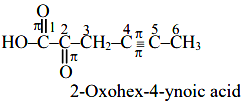
Number of \(\sigma\)-bonds \(=14\)
Number of \(\pi\)-bonds \(=4\)
Total number of bonds \(=18\) - 30. Vanillin compound obtained from vanilla beans, has total sum of oxygen atoms and \(\pi\) electrons is _______. 2024 Medium
- (A) \(10\)
- (B) \(11\)
- (C) \(15\)
- (D) \(20\)
Show answer and solution
Correct Answer: (B)
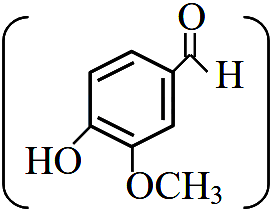
Vanillin compound is an organic compound molecular formula \(\mathrm{C}_3 \mathrm{H}_5 \mathrm{O}_3\). It is a phenolic aldehyde. Its functional compounds include aldehyde, hydroxyl and ether. It is the primary component of the extract of the vanilla beans.(Image)
Total sum of oxygen atoms and \(\pi\)-electrons is \(3+8=11\)
Total number of oxygen atoms \(=3\)
Total number of \(\pi\)-bonds \(=4\)
\(\therefore\) Total number of \(\pi\)-electrons \(=8\)

-
- (A) \(\mathrm{CH}_3 \mathrm{CH}_2 \mathrm{CH}_2 \mathrm{CH}_3\)
- (B) \(\mathrm{CH}_3 \mathrm{CH}_2 \mathrm{CH}_2 \mathrm{CH}_2-\mathrm{OH}\)
- (C) \(\mathrm{CH}_3 \mathrm{CH}_2 \mathrm{CH}_2 \mathrm{CHO}\)
- (D) \(\mathrm{H}_5 \mathrm{C}_2-\mathrm{O}-\mathrm{C}_2 \mathrm{H}_5\)
Show answer and solution
Correct Answer: (B)
Due to \(H\)-bonding boiling point of alcohol is High. -
- (A) \(C\) and \(D\) only
- (B) \(A\), \(B\) and \(C\) only
- (C) \(A\) only
- (D) \(B\) and \(C\) only
Show answer and solution
Correct Answer: (B)
Apart from aldehyde, Formic acid also gives silver mirror test with ammonical silver nitrate.
-
- (A) optically active and adds one mole of bromine
- (B) racemic mixture and is neutral
- (C) racemic mixture and gives a gas with saturated \(NaHCO _3\) solution
- (D) optically active alcohol and is neutrall
Show answer and solution
Correct Answer: (C)
Carboxylic acid will give \(CO _2\) gas, with \(NaHCO _3\) solution
- 34. Given below are two statements, one is labelled as Assertion \(A\) and the other is labelled as Reason \(R\).
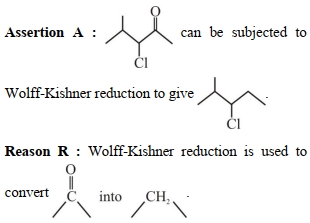 2023 Medium
- (A) Both \(A\) and \(R\) are true but \(R\) is NOT the correct explanation of \(A\).
- (B) \(A\) is true but \(R\) is false.
- (C) \(A\) is false but \(R\) is true.
- (D) Both \(A\) and \(R\) are true and \(R\) is the correct explanation of \(A.\)
Show answer and solution
Correct Answer: (C)
Wolff-Kishner reduction is not suitable for base sensitive group.
- 35. Match List\(-I\) with List\(-II\) : Choose the correct answer from the options given below:
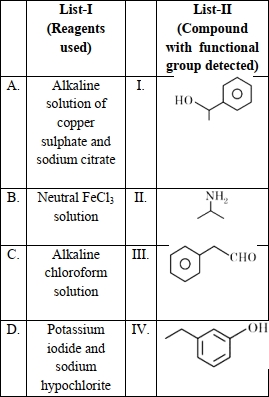 2023 Hard
- (A) \(A-II, B-IV, C-III, D-I\)
- (B) \(A-IV, B-I, C-II, D-III\)
- (C) \(A-III, B-IV, C-I, D-II\)
- (D) \(A-III, B-IV, C-II, D-I\)
Show answer and solution
Correct Answer: (D)
\(A.\) Alkaline solution of copper sulphate and sodium citrate is known as Benedict's solution and it is used to test aliphatic aldehydes. Hence it can be used to test compound \((III)\)\(B.\) Neutral \(FeCl _3\) solution is used to test phenolic compound \((IV)\)
\(C.\) Alkaline chloroform solution is used to test primary amines \((II)\)
\(D.\) \(2 KI + NaOCl + H _2 O \rightarrow NaCl + I _2+2 KOH\)
Potassium iodide and sodium hypochlorite gives \(\left( I _2+ KOH \right)\) which is used to test those compounds which have \(image\) group (iodoform test). Hence the compound is \(image\)

-
- (A) \(A-III, B-II, C-I, D-IV\)
- (B) \(A-III, B-I, C-IV, D-II\)
- (C) \(A-I, B-II, C-III, D-IV\)
- (D) \(A-III, B-I, C-II, D-IV\)
Show answer and solution
Correct Answer: (D)
\(HVZ\) reactions \(= Br _2 / \operatorname{red} P\)Iodoform reaction \(= NaOH + I _2\)
Etard reaction \(=\) (i) \(CrO _2 Cl _2, CS _2\) (ii) \(H _2 O\)
Gatterman-Koch Reaction \(= CO , HCl\), Anhydrous, \(AlCl _3\)
-
- (A) \((A) - III, (B) - IV, (C) - II, (D) - I\)
- (B) \((A) - II, (B) - IV, (C) - I, (D) - III\)
- (C) \((A) - III, (B) - IV, (C) - I, (D) - II\)
- (D) \((A) - II, (B) - I, (C) - III, (D) - IV\)
Show answer and solution
Correct Answer: (C)
NCERT Based -
- (A) \(4\)
- (B) \(5\)
- (C) \(6\)
- (D) \(3\)
Show answer and solution
Correct Answer: (D)
Compound \(2,3,7\) -
- (A) \(61\)
- (B) \(60\)
- (C) \(62\)
- (D) \(63\)
Show answer and solution
Correct Answer: (B)
\(W _{ NH _3}=\frac{131.8 \times 1000}{112} \times 3 \times 17\)\(=60\,Kg\)

-
- (A) \(a\) only
- (B) \(c\) only
- (C) Both \(a\) and \(c\)
- (D) \(b\) only
Show answer and solution
Correct Answer: (A)
Most easily deprotonation
-
- (A) \(PCC\) oxidation
- (B) Ozonolysis
- (C) \(BH _{3}, H _{2} O _{2} /{ }^{-} OH\) followed by \(PCC\) oxidation
- (D) \(HBr\), hydrolysis followed by oxidation by \(K _{2} Cr _{2} O _{7}\).
Show answer and solution
Correct Answer: (C)
\(BH _{3}, H _{2} O _{2} / OH\) followed by \(PCC\) oxidation.
-
- (A) Amine
- (B) Aldehyde
- (C) Ether
- (D) Halogens
Show answer and solution
Correct Answer: (B)
\(2,4 -DNP\) test is useful for the identification of carbonyl compounds. -
- (A) \(1\)
- (B) \(2\)
- (C) \(4\)
- (D) \(6\)
Show answer and solution
Correct Answer: (B)
\(AgNO _{3}+ NaOH \rightarrow AgOH + NaNO _{3}\)\(2 AgOH \rightarrow Ag _{2} O + H _{2} O\)
\(Ag _{2} O +4 NH _{3}+ H _{2} O \rightarrow 2 Ag \left( NH _{3}\right)_{2}^{+}+2 O H\)
\([Image]\)
Total \(2 e ^{-}\) transfer to Tollen's reagent.

-
- (A) \(2,4 -\) Dimethyl pentan-\(3-\)one
- (B) \(3-\)Methyl cyclohexane carbaldehyde
- (C) \(2 -\)Methyl cyclohexanone
- (D) \(4 -\)Methyl pent\(- 3-en- 2 -\)one
Show answer and solution
Correct Answer: (D)
\(IUPAC [4-\)Methylpent\(-3-\)en\(-2-\)one]
-
- (A) \(- CHO\)
- (B) \(-\mathrm{CONH}_{2}\)
- (C) \(-\mathrm{CH}_{2} \mathrm{NH}_{2}\)
- (D) \(-\mathrm{COOH}\)
Show answer and solution
Correct Answer: (A)
\(\mathrm{R}-\mathrm{C} \equiv \mathrm{N} \xrightarrow[\text { (ii) } \mathrm{H}_{2} \mathrm{O}]{\text { (i) DIBAL-H }}\) \(\begin{array}{*{20}{c}} {{\rm{R}} - {\rm{C}} - {\rm{H}}}\\ {||}\\ O \end{array}\)Here \(Y\) is \(\begin{array}{*{20}{c}} { - {\rm{C}} - {\rm{H}}}\\ {||\,\,\,\,\,\,}\\ {O\,\,\,\,\,\,} \end{array}\) Aldehyde.
-
- (A) \((D)>(B)>(A)>(C)\)
- (B) \((D)>(A)>(B)>(C)\)
- (C) \((A)>(B)>(C)>(D)\)
- (D) \((A)>(C)>(B)>(D)\)
Show answer and solution
Correct Answer: (C)
Reactivity Hydrolysis towards \(A>B>C>D\)
- 47. The major product of the following reaction is: \(CH _{3} CH _{2} CH = CH _{2}\) \(\xrightarrow[{Rh\,\,catalyst}]{{{H_2}/CO}}\) 2021 Medium
- (A) \(CH _{3} CH _{2} CH = CH - CHO\)
- (B) \(\begin{array}{*{20}{c}} {C{H_3}C{H_2}C = C{H_2}} \\ {\,\,\,\,\,\,\,\,|} \\ {\,\,\,\,\,\,\,\,\,\,\,\,\,\,\,\,\,CHO} \end{array}\)
- (C) \(CH _{3} CH _{2} CH _{2} CH _{2} CHO\)
- (D) \(CH _{3} CH _{2} CH _{2} CHO\)
Show answer and solution
Correct Answer: (C)
OXO PROCESS (Hydroformylation) :\(CH _{3}- CH _{2}- CH = CH _{2}+ CO + H _{2}\) \(\xrightarrow[{Catalyst}]{{Rh}}\) \([Image]\)

- 48. Which among the above compound/s does/do not form Silver mirror when treated with Tollen's reagent?
 2021 Medium
- (A) Only \((II)\)
- (B) \((I), (III)\) and \((IV)\) only
- (C) \((III)\) and \((IV)\) only
- (D) Only \((IV)\)
Show answer and solution
Correct Answer: (A)
Aldehydes and hemiacetal give \(\oplus\) \(ve\) Tollen's Test (Silver mirror test)
- 49. Which of the following reagent is suitable for the preparation of the product in the above reaction?
 2021 Easy
- (A) \(NaBH _{4}\)
- (B) \(NH _{2}- NH _{2} / C _{2} H _{5} \stackrel{\ominus}{ O }\stackrel{\oplus}{Na }\)
- (C) \(Ni / H _{2}\)
- (D) \(\operatorname{Red} P + Cl _{2}\)
Show answer and solution
Correct Answer: (B)
To reduce the carbonyl groups into alkane wolf - kischner reduction is used, without affecting the double bond.
-
- (A) Manganese acetate
- (B) Copper at high temperature and pressure
- (C) Molybdenum oxide
- (D) Potassium permanganate
Show answer and solution
Correct Answer: (C)
\(CH _{3}- CH _{2}- CH _{3} \stackrel{ M 0_{2} O _{3}}{\longrightarrow} CH _{3}- CH _{2}- CH = O\)The reagent used will be \(MO _{2} O _{3}\)



No questions on this page match these filters.
About Aldehydes and ketones PYQs
Aldehydes and ketones has 71 questions from 2013–2026. The most came in 2026 (12), 2024 (12) and 2021 (10).
The most asked topics are Properties, Preparation and Introduction.
7% are easy, 44% medium and 49% hard.
Aldehydes and ketones PYQs by year
Frequently asked
How many Aldehydes and ketones questions came in JEE Mains?
71 questions from 2013–2026, each with the correct answer and a full solution.
Which Aldehydes and ketones topic is asked the most?
Properties, with 53 questions, followed by Preparation with 15.
Which year had the most Aldehydes and ketones questions?
2026, with 12 questions.
How difficult are Aldehydes and ketones questions?
7% are easy, 44% medium and 49% hard.