


Questions
Newest firstShowing 1–50 of 72 questions
-
- (A) \(Cr^{3+}>Fe^{3+}>Co^{3+}>Mn^{3+}\)
- (B) \(Mn^{3+}>Fe^{3+}>Co^{3+}>Cr^{3+}\)
- (C) \(Fe^{3+}>Co^{3+}>Mn^{3+}>Cr^{3+}\)
- (D) \(Cr^{3+}>Mn^{3+}>Fe^{3+}>Co^{3+}\)
Show answer and solution
Correct Answer: (D)
\(Co^{3+}\rightarrow3d^{6}\Rightarrow t_{2g}^{2,2,2}e_{g}^{0,0}\), unpaired electron \(=0\)
\(Fe^{3+}\rightarrow3d^{5}\Rightarrow t_{2g}^{2,2,1}e_{g}^{0,0}\) unpaired electron \(=1\)
\(Cr^{3+}\rightarrow3d^{3}\Rightarrow t_{2g}^{1,1,1}e_{g}^{0,0}\) unpaired electron \(=3\)
\(Mn^{3+}\rightarrow3d^{4}\Rightarrow t_{2g}^{2,1,1}e_{g}^{0,0}\) unpaired electron \(=2\) -
- (A) Both Statement I and Statement II are correct
- (B) Both Statement I and Statement II are incorrect
- (C) Statement I is correct but Statement II is incorrect
- (D) Statement I is incorrect but Statement II is correct
Show answer and solution
Correct Answer: (A)
Statement I: The enthalpy of atomisation of transition metals depends on the strength of metallic bonding. A greater number of unpaired electrons in the d-orbitals leads to stronger metallic bonding, which results in a higher enthalpy of atomisation. Thus, Statement I is correct.
Statement II: \([Fe(H_2O)_6]^{3+}\) is an octahedral complex. In an octahedral crystal field, the d-orbitals split such that the \(t_{2g}\) set of orbitals (\(d_{xy}, d_{xz}, d_{yz}\)) has lower energy than the \(e_g\) set of orbitals (\(d_{x^2-y^2}, d_{z^2}\)). Therefore, \(d_{xy} = d_{xz} = d_{yz} < d_{x^2-y^2} = d_{z^2}\).
\([Ni(Cl)_4]^{2-}\) is a tetrahedral complex because \(Cl^{-}\) is a weak field ligand and the coordination number is \(4\). In a tetrahedral crystal field, the splitting is reversed compared to the octahedral field. The \(e\) set of orbitals (\(d_{x^2-y^2}, d_{z^2}\)) has lower energy than the \(t_2\) set of orbitals (\(d_{xy}, d_{xz}, d_{yz}\)). Therefore, \(d_{x^2-y^2} = d_{z^2} < d_{xy} = d_{xz} = d_{yz}\). Thus, Statement II is also correct.
Both Statement I and Statement II are correct.
Answer: Both Statement I and Statement II are correct -
- (A) Both Statement-I and Statement-II are false.
- (B) Statement-I is true but Statement-II is false.
- (C) Both Statement-I and Statement-II are true.
- (D) Statement-I is false but Statement-II is true.
Show answer and solution
Correct Answer: (B)
\(Cr = (Ar)3d^{5}4s^{1}\)
\(Mn = (Ar)3d^{5}4s^{2}\)
\(IE_{1}(Cr) < IE_{1}(Mn)\)
\(IE_{2}(Cr) > IE_{2}(Mn)\)
\(IE_{3}(Cr) < IE_{3}(Mn)\) -
- (A) Both Statement I and Statement II are correct
- (B) Both Statement I and Statement II are incorrect
- (C) Statement I is correct but Statement II is incorrect
- (D) Statement I is incorrect but Statement II is correct
Show answer and solution
Correct Answer: (A)
For Statement I:
The electronic configurations of the given transition metal ions are:
\(\text{Ti}^{4+} : 3d^0\) (colourless due to absence of unpaired electrons)
\(\text{V}^{2+} : 3d^3\) (coloured)
\(\text{Mn}^{2+} : 3d^5\) (coloured)
\(\text{Fe}^{3+} : 3d^5\) (coloured)
\(\text{Cr}^{2+} : 3d^4\) (coloured)
The pairs in which both ions are coloured are \([\text{V}^{2+}, \text{Mn}^{2+}]\), \([\text{Mn}^{2+}, \text{Fe}^{3+}]\), and \([\text{V}^{2+}, \text{Cr}^{2+}]\). The pair \([\text{Ti}^{4+}, \text{V}^{2+}]\) contains \(\text{Ti}^{4+}\) which is colourless. Thus, there are exactly \(3\) pairs where both ions are coloured. Statement I is correct.
For Statement II:
The electronic configurations of the given f-block ions are:
\(\text{La}^{3+} : [\text{Xe}] 4f^0\) (diamagnetic)
\(\text{Yb}^{2+} : [\text{Xe}] 4f^{14}\) (diamagnetic)
\(\text{Lu}^{3+} : [\text{Xe}] 4f^{14}\) (diamagnetic)
\(\text{Ce}^{4+} : [\text{Xe}] 4f^0\) (diamagnetic)
\(\text{Ac}^{3+} : [\text{Rn}] 5f^0\) (diamagnetic)
\(\text{Lr}^{3+} : [\text{Rn}] 5f^{14}\) (diamagnetic)
All the given ions have either an \(f^0\) or \(f^{14}\) configuration, meaning they have no unpaired electrons and are diamagnetic. Therefore, in all \(3\) pairs, both ions are diamagnetic. Statement II is correct.
Both Statement I and Statement II are correct.
Answer: Both Statement I and Statement II are correct -
- (A) 7
- (B) 5
- (C) 9
- (D) 4
Show answer and solution
Correct Answer: (A)
\(V^{3+}=(A r)_{18} 3 d^2\)
\(Ti ^{2+}=( Ar )_{18} 3 d^2\)
\(Ni ^{2+}=( Ar )_{18} 3 d^8\)
\(Fe ^{2+}=( Ar )_{18} 3 d^6\)
\(Co ^{2+}=( Ar )_{18} 3 d^7\)
Only for \(Fe ^{2+}\) and \(Co ^{2+} \mu\) is more than 3.0 B.M.
\(Fe ^{2+} 3 d^6\)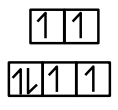 \(n =4, \mu>3\)
\(Co ^{2+} 3 d^7\)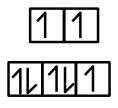 \(n =3, \mu>3\)
\(\therefore\) Number of unpaired electrons = 4 + 3 = 7 -
- (A) A and B only
- (B) B and C only
- (C) A and D only
- (D) C and D only
Show answer and solution
Correct Answer: (B)
The electronic configuration of Cr is \([Ar] 3d^5 4s^1\) and Mn is \([Ar] 3d^5 4s^2\).
For the first ionization enthalpy, the electron is removed from the \(4s\) orbital. Mn has a fully filled \(4s^2\) configuration and a higher effective nuclear charge compared to Cr. Thus, the first ionization enthalpy of Mn is greater than that of Cr (\(\Delta_i H_1 :\) Mn \(>\) Cr). This makes statement C correct.
After the first ionization, the electronic configurations become:
\(Cr^+ : [Ar] 3d^5\)
\(Mn^+ : [Ar] 3d^5 4s^1\)
For the second ionization enthalpy, the electron is removed from the highly stable half-filled \(3d^5\) subshell in \(Cr^+\), whereas in \(Mn^+\), it is removed from the \(4s^1\) orbital. Removing an electron from a stable half-filled configuration requires significantly more energy. Thus, the second ionization enthalpy of Cr is greater than that of Mn (\(\Delta_i H_2 :\) Cr \(>\) Mn). This makes statement B correct.
Therefore, the correct statements are B and C.
Answer: B and C only -
- (A) 4
- (B) 5
- (C) 6
- (D) 7
Show answer and solution
Correct Answer: (A)
Sc Mn Co Cu Enthalpy of Atomisation (kJ/mole) 326 281 425 339 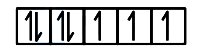
\(\begin{aligned}
& \mathrm{n}=3 \\
& \mu=\sqrt{15}=3.87
\end{aligned}\)
Nearest integer \(=4\) -
- (A) (A) and (D) only
- (B) (B) and (C) only
- (C) (A) and (B) only
- (D) (B) and (E) only
Show answer and solution
Correct Answer: (C)
\(\begin{aligned} & { }_{63} \mathrm{Eu}^{2+}-[\mathrm{Xe}] 4 \mathrm{f}^7 6 \mathrm{~s}^0 \\ & { }_{64} \mathrm{Gd}^{3+}-[\mathrm{Xe}] 4 \mathrm{f}^7 5 \mathrm{~d}^0 6 \mathrm{~s}^0 \\ & { }_{63} \mathrm{Eu}^{3+}-[\mathrm{Xe}] 4 \mathrm{f}^6 6 \mathrm{~s}^0 \\ & { }_{65} \mathrm{~Tb}^{3+}-[\mathrm{Xe}] 4 \mathrm{f}^8 6 \mathrm{~s}^0 \\ & { }_{62} \mathrm{Sm}^{2+}-[\mathrm{Xe}] 4 \mathrm{f}^6 6 \mathrm{~s}^0 \\ & \mathrm{Eu}^{2+} \& \mathrm{Gd}^{3+}\end{aligned}\) -
- (A) (A) \(-(\mathrm{III}),(\mathrm{B})-(\mathrm{I}),(\mathrm{C})-(\mathrm{IV}),(\mathrm{D})-(\mathrm{II})\)
- (B) (A) \(-(\mathrm{III}),(\mathrm{B})-(\mathrm{I}),(\mathrm{C})-(\mathrm{II}),(\mathrm{D})-(\mathrm{IV})\)
- (C) (A) \(-(\mathrm{IV}),(\mathrm{B})-(\mathrm{II}),(\mathrm{C})-(\mathrm{III}),(\mathrm{D})-(\mathrm{I})\)
- (D) \((\mathrm{A})-(\mathrm{II}),(\mathrm{B})-(\mathrm{IV}),(\mathrm{C})-(\mathrm{I}),(\mathrm{D})-(\mathrm{III})\)
Show answer and solution
Correct Answer: (A)
\(\begin{array}{lc}\mathrm{Sc}^{+3}=3 \mathrm{~d}^{\mathrm{o}} & \therefore \mu_{\text {spin }}=0 \\ \mathrm{~V}^{+2}=3 \mathrm{~d}^3 & \therefore \mu_{\text {spin }}=3.87 \mathrm{~B} \cdot \mathrm{M} . \\ \mathrm{Ni}^{+2}=3 \mathrm{~d}^8 & \therefore \mu_{\text {spin }}=2.84 \mathrm{~B} \cdot \mathrm{M} . \\ \mathrm{Ti}^{+3}=3 \mathrm{~d}^1 & \therefore \mu_{\text {spin }}=1.73 \text { B.M. }\end{array}\) -
- (A) 11
- (B) 22
- (C) 33
- (D) 44
Show answer and solution
Correct Answer: (A)
\(\begin{aligned} & \mathrm{Z}=41 \rightarrow \mathrm{Nb} \text { (Niobium) : }[\mathrm{Kr}]_{36} 4 \mathrm{~d}^4 5 \mathrm{~s}^1 \\ & \text { Number of electron in } 4 \mathrm{~d}=4=\mathrm{x} \\ & \mathrm{Z}=44 \rightarrow \mathrm{Ru} \text { (Ruthenium) }[\mathrm{Kr}]_{36} 4 \mathrm{~d}^7 5 \mathrm{~s}^1 \\ & \text { Number of electron in } 4 \mathrm{~d}=7=\mathrm{y} \\ & \mathrm{x}+\mathrm{y}=11\end{aligned}\) - 11. Pair of transition metal ions having the same number of unpaired electrons is _______. 2025 Medium
- (A) \(\mathrm{V}^{2+}, \mathrm{Co}^{2+}\)
- (B) \(\mathrm{Ti}^{i+}, \mathrm{Co}^{2+}\)
- (C) \(\mathrm{Fe}^{3+}, \mathrm{Cr}^{2+}\)
- (D) \(\mathrm{Ti}^{3+}, \mathrm{Mn}^{2+}\)
Show answer and solution
Correct Answer: (A)
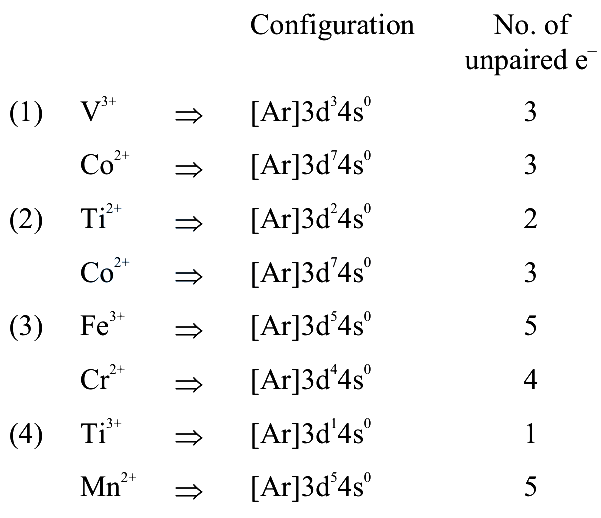
So \(\mathrm{V}^{2+} \& \mathrm{Co}^{2+}\) same number of unpaired electron. -
- (A) 3.87 and 4.90 B.M.
- (B) 4.90 and 5.92 B.M.
- (C) 4.90 and 4.90 B.M.
- (D) 5.92 and 4.90 B.M.
Show answer and solution
Correct Answer: (D)
\(\begin{aligned}
& \mathrm{K}_3\left[\mathrm{Fe}(\mathrm{OH})_6\right] \\
& \mathrm{Fe}^{3+} \Rightarrow 3 \mathrm{~d}^5 \\
& \mathrm{Fe}^{3+} \text { with } \mathrm{OH}^{-}(\mathrm{WFL}) \\
& =\mathrm{t}_{29}{ }^3 \mathrm{e}_{\mathrm{g}}{ }^2
\end{aligned}\)
Number of unpaired electron ( \(n\) ) \(=5\)
\(\mu\) spin only \(=5.92 \mathrm{BM}\)
\(\begin{aligned}
& \mathrm{K}_4\left[\mathrm{Fe}(\mathrm{OH})_6\right] \\
& \mathrm{Fe}^{2+} \Rightarrow \mathrm{OH}^{-} \mathrm{(WFL)} \\
& \mathrm{Fe}^{2+} \Rightarrow 3 \mathrm{~d}^6=\mathrm{t}_{2 \mathrm{~g}}^4 \mathrm{e}_{\mathrm{g}}^2 \\
& \mathrm{n}=4
\end{aligned}\)
\(\mu_{\text {spin only }}=4.90 \mathrm{BM}\) -
- (A) \(\mathrm{Fe} \lt \mathrm{Mn}, \mathrm{Ru} \lt \mathrm{Tc}\) and \(\mathrm{Re} \lt \mathrm{Os}\)
- (B) \(\mathrm{Mn} \lt \mathrm{Fe}, \mathrm{Tc} \lt \mathrm{Ru}\) and \(\mathrm{Os} \lt \mathrm{Re}\)
- (C) \(\mathrm{Mn} \lt \mathrm{Fe}, \mathrm{Tc} \lt \mathrm{Ru}\) and \(\mathrm{Re} \lt \mathrm{Os}\)
- (D) \(\mathrm{Fe} \lt \mathrm{Mn}, \mathrm{Ru} \lt \mathrm{Tc}\) and \(\mathrm{Os} \lt \mathrm{Re}\)
Show answer and solution
Correct Answer: (B)
Melting point order
\(\begin{aligned}
& \mathrm{Fe}>\mathrm{Mn} \\
& \mathrm{Ru}>\mathrm{Tc} \\
& \mathrm{Re}>\mathrm{Os}
\end{aligned}\) - 14. The correct set of ions (aqueous solution) with same colour from the following is which? 2025 Easy
- (A) \(\mathrm{Sc}^{3+}, \mathrm{Ti}^{3+}, \mathrm{Cr}^{2+}\)
- (B) \(\mathrm{V}^{2+}, \mathrm{Cr}^{3+}, \mathrm{Mn}^{3+}\)
- (C) \(\mathrm{Ti}^{4+}, \mathrm{V}^{4+}, \mathrm{Mn}^{2+}\)
- (D) \(\mathrm{Zn}^{2+}, \mathrm{V}^{3+}, \mathrm{Fe}^{3+}\)
Show answer and solution
Correct Answer: (B)
(1) \(\mathrm{V}^{2+}\) (Violet), \(\mathrm{Cr}^{3+}\) (Violet), \(\mathrm{Mn}^{3+}(\) Violet \()\)
(2) \(\mathrm{Zn}^{2+}\) (Colourless), \(\mathrm{V}^{3+}\) (Green), \(\mathrm{Fe}^{3+}\) (Yellow)
(3) \(\mathrm{Ti}^{4+}\) (Colourless), \(\mathrm{V}^{4+}\) (Blue), \(\mathrm{Mn}^{2+}\) (Pink)
(4) \(\mathrm{Sc}^{3+}(\) Colourless \(), \mathrm{Ti}^{3+}\) (Purple), \(\mathrm{Cr}^{2+}\) (Blue) -
- (A) neutral
- (B) acidic
- (C) basic
- (D) amphoteric
Show answer and solution
Correct Answer: (C)
In 3d series Vanadium has highest enthalpy of atomization and colour of \(\mathrm{V}^{+3}\) is green.
* Oxide form by \(\mathrm{V}^{+3}\) is \(\mathrm{V}_2 \mathrm{O}_3\) (Basic oxide) - 16. The incorrect relationship in the following pairs in relation to ionisation enthalpies is _______. 2025 Medium
- (A) \(\mathrm{Mn}^{+} \lt \mathrm{Cr}^{+}\)
- (B) \(\mathrm{Mn}^{+} \lt \mathrm{Mn}^{2+}\)
- (C) \(\mathrm{Fe}^{2+} \lt \mathrm{Fe}^{3+}\)
- (D) \(\mathrm{Mn}^{2+} \lt \mathrm{Fe}^{2+}\)
Show answer and solution
Correct Answer: (D)
\(\mathrm{Mn}^{2+}:[\mathrm{Ar}] 3 \mathrm{~d}^5\)
Half filled stability
More 1 E than \(\mathrm{Fe}^{2+}\)
\(\mathrm{Fe}^{2+}:[\mathrm{Ar}] 3 \mathrm{~d}^6\) -
- (A) \(\mathrm{Mn}^{2+}\)
- (B) \(\mathrm{Cr}^{3+}\)
- (C) \(\mathrm{Ni}^{2+}\)
- (D) \(\mathrm{Ti}^{3+}\)
Show answer and solution
Correct Answer: (C)
\(\mathrm{Ni}^{2+}\) gives violet colour with borax bead test in nonluminous flame under hot conditions. \(\mathrm{Ni}^{2+}\) has \(\mathrm{d}^8\) configuration which does not depend on nature of ligand present in octahedral field.
\(\mathrm{Ni}^{2+} \Rightarrow \mathrm{t}_{2 g}^6 \mathrm{eg}^2\) -
- (A) A, C and E only
- (B) A, D and E only
- (C) B and E only
- (D) A, B and E only
Show answer and solution
Correct Answer: (D)
Given magnetic moment \(=4.9\) B.M.
We know M.M \(=\sqrt{\mathrm{n}(\mathrm{n}+2)}\) B.M.
Where, \(\mathrm{n} \rightarrow\) No. of unpaired \(\mathrm{e}^{-}\)
\(4.9=\sqrt{\mathrm{n}(\mathrm{n}+2)}\)
We get \(\mathrm{n}=4\)
(A) \({ }_{24} \mathrm{Cr}^{2+} \Rightarrow[\mathrm{Ar}] 3 \mathrm{~d}^4\) (4 unpaired e)
(B) \({ }_{26} \mathrm{Fe}^{2+} \Rightarrow[\mathrm{Ar}] 3 \mathrm{~d}^6\) (4 unpaired e)
(C) \({ }_{26} \mathrm{Fe}^{3+} \Rightarrow[\mathrm{Ar}] 3 \mathrm{~d}^5\) (5 unpaired e)
(D) \({ }_{27} \mathrm{Co}^{2+} \Rightarrow[\mathrm{Ar}] 3 \mathrm{~d}^7\) (3 unpaired \(\mathrm{e}^{-}\))
(E) \({ }_{25} \mathrm{Mn}^{3+} \Rightarrow[\mathrm{Ar}] 3 \mathrm{~d}^4 \left(4\right.\) unpaired \(\left.\mathrm{e}^{-}\right)\) -
- (A) \(8\)
- (B) \(9\)
- (C) \(6\)
- (D) \(10\)
Show answer and solution
Correct Answer: (C)
Out of \(\mathrm{Cr}, \mathrm{Co}, \mathrm{Fe}\) and \(\mathrm{Ni}\)
Chromium has lowest heat of atomisation.
\(\mathrm{Cr}=[\mathrm{Ar}] 3 \mathrm{~d}^5 4 \mathrm{~s}^1\)
\(\because\) Total six valence \(\mathrm{e}^{-}\)in \(\mathrm{Cr}\). -
- (A) 10
- (B) 15
- (C) 5
- (D) 20
Show answer and solution
Correct Answer: (C)
Strongest oxidising power among the option is \(\mathrm{Mn}_2 \mathrm{O}_3\) because of \(\mathrm{E}^{\circ}\) value
\(\begin{aligned}
& \mathrm{E}_{\mathrm{Mn}^{+3} / \mathrm{Mn}^{+2}}^{\circ}=+1.57 \mathrm{~V} \\
& \mathrm{Mn}^{+3} \rightarrow \mathrm{~d}^4 \text { configuration } \\
& \mu=\sqrt{24} \mathrm{BM} \\
& =4.89 \mathrm{BM} \\
& \Rightarrow 5
\end{aligned}\) -
- (A) \(0\)
- (B) 1
- (C) 2
- (D) 3
Show answer and solution
Correct Answer: (A)
\(\mathrm{K}_2\left[\mathrm{NiCl}_4\right] \Rightarrow \mathrm{sp}^3\), Paramagnetic
\(\left[\mathrm{Zn}\left(\mathrm{H}_2 \mathrm{O}\right)_6\right] \mathrm{Cl}_2 \Rightarrow \mathrm{sp}^3 \mathrm{~d}^2\), Diamagnetic
\(\mathrm{K}_3\left[\mathrm{Mn}(\mathrm{CN})_6\right] \Rightarrow \mathrm{d}^2 \mathrm{sp}^3\), Paramagnetic
\(\left[\mathrm{Cu}\left(\mathrm{PPh}_3\right)_3 \mathrm{I}\right] \Rightarrow \mathrm{sp}^3\), Diamagnetic
Hence the value of \(n\) is 2
Least value of enthalpy of atomisation among Ni ,
\(\mathrm{Zn}, \mathrm{Mn}\) and Cu is of Zn
\(\begin{aligned}
& \mathrm{Zn}^{+2}:-[\mathrm{Ar}] 3 \mathrm{~d}^{10} \\
& \mu=0
\end{aligned}\) -
- (A) \(25\)
- (B) \(26\)
- (C) \(22\)
- (D) \(23\)
Show answer and solution
Correct Answer: (D)
\({ }_{22} \mathrm{Ti}^{+2} \Rightarrow[\mathrm{Ar}] 3 \mathrm{~d}^2\)\({ }_{23} \mathrm{~V}^{-2} \Rightarrow[\mathrm{Ar}] 3 \mathrm{~d}^3\)
\({ }_{25} \mathrm{Mn}^{+2} \Rightarrow[\mathrm{Ar}] 3 \mathrm{~d}^5\)
\({ }_{26} \mathrm{Fe}^{+2} \Rightarrow[\mathrm{Ar}] 3 \mathrm{~d}^0\)
-
- (A) \(1\)
- (B) \(2\)
- (C) \(3\)
- (D) \(0\)
Show answer and solution
Correct Answer: (D)
\(\mathrm{V}\) ' has highest enthalpy of atomisation ( \(515 \mathrm{~kJ} / \mathrm{mol}\) ) among first row transition elements.\(\mathrm{V}_2 \mathrm{O}_5\)
Here ' \(\mathrm{V}\) ' is in \(+5\) oxidation state
\(\mathrm{V}^{-5} \Rightarrow 1 \mathrm{~s}^2 2 \mathrm{~s}^2 2 \mathrm{p}^6 3 \mathrm{~s}^2 3 \mathrm{p}^6 \text { (no unpaired electrons) }\)
-
- (A) \(5\)
- (B) \(6\)
- (C) \(9\)
- (D) \(10\)
Show answer and solution
Correct Answer: (B)
Among given metals, \(\mathrm{Cr}\) has maximum \(\mathrm{IE}_2\)because Second electron is removed from stable
configuration \(3 \mathrm{~d}^5\)
\(\mathrm{Cr}^{+}:[\mathrm{Ar}] 3 \mathrm{~d}^5 4 \mathrm{~s}^0\)
\(\therefore\) No of unpaired \(\mathrm{e}^{-}\)in \(\mathrm{Cr}^{+}\)is \(5, \mathrm{n}=5\)
\(\text { So, Magnetic moment } =\sqrt{\mathrm{n}(\mathrm{n}+2)} \text { B.M }\)
\(=\sqrt{5(5+2)}=5.92 \mathrm{BM} \approx 6\)
-
- (A) \(877\)
- (B) \(879\)
- (C) \(880\)
- (D) \(881\)
Show answer and solution
Correct Answer: (A)
CrO Basic oxide\(\mathrm{Cr}_2 \mathrm{O}_3\) Amphoteric oxide
In \(\mathrm{CrO}, \mathrm{Cr}\) exist as \(\mathrm{Cr}^{+2}\) and have \(\mu\) only \(=4.90\)
In \(\mathrm{Cr}_2 \mathrm{O}_3, \mathrm{Cr}\) exist as \(\mathrm{Cr}^{+3}\) and have \(\mu\) only \(=3.87\)
Sum of spin only magnetic moment
\(=4.90+3.87=8.77\)
\(\mu_{\text {only }}=877 \times 10^{-2}\)
Ans. \(877\)
-
- (A) \(1\)
- (B) \(0\)
- (C) \(5\)
- (D) \(8\)
Show answer and solution
Correct Answer: (B)
For \(3\)d transition series;Oxidising power : \(\mathrm{V}^{+5}<\mathrm{Cr}^{+6}<\mathrm{Mn}^{+7}\)
\(\mathrm{V}^{-5}:[\mathrm{Ar}] 4 \mathrm{~s}^0 3 \mathrm{~d}^0\)
Number of unpaired electron \(=0\)
\(u=0\)
-
- (A) \(3\)
- (B) \(4\)
- (C) \(5\)
- (D) \(7\)
Show answer and solution
Correct Answer: (B)
\(\mathrm{MnO}_2+\mathrm{KOH}+\mathrm{O}_2 \rightarrow \mathrm{K}_2 \mathrm{MnO}_4+\mathrm{H}_2 \mathrm{O}\)\((A)\)
\({K}_2 \mathrm{MnO}_4 \xrightarrow{\text { Neutral/acidic solution }} \mathrm{KMnO}_4+\mathrm{MnO}_2\)
\(\mathrm{Mn}^{+4}:-[\mathrm{Ar}] 3 \mathrm{~d}^3\)
\(\mathrm{n}=3, \mu=\sqrt{3(3+2)}=3.87 \text { B.M. }\)
Nearest integer is (4)
-
- (A) \(5\)
- (B) \(6\)
- (C) \(8\)
- (D) \(10\)
Show answer and solution
Correct Answer: (B)
\(4 \mathrm{FeCr}_2 \mathrm{O}_4+8 \mathrm{Na}_2 \mathrm{CO}_3+7 \mathrm{O}_2 \rightarrow\)\(8 \mathrm{Na}_2 \mathrm{CrO}_4+2 \mathrm{Fe}_2 \mathrm{O}_3+8 \mathrm{CO}_2\)
\(\mathrm{~A} \quad \text { B }\)
Spin only magnetic moment
\(\text { For } \mathrm{Na}_2 \mathrm{CrO}_4 \mu_{\mathrm{B}}=0\)
\(\text { For } \mathrm{Fe}_2 \mathrm{O}_3 \mu_{\mathrm{B}}=5.9\)
\(\text { sum }=5.9\)
-
- (A) \(\mathrm{Fe}\)
- (B) \(\mathrm{Mn}\)
- (C) \(\mathrm{Ti}\)
- (D) \(\mathrm{Co}\)
Show answer and solution
Correct Answer: (B)
Mn shows highest oxidation state \(\left(\mathrm{Mn}^{+7}\right)\) in \(3 \mathrm{d}\) series metals. -
- (A) 5
- (B) 10
- (C) 15
- (D) 20
Show answer and solution
Correct Answer: (A)
(A) \(SrSO _4\) - white
(B) \(Mg \left( NH _4\right) PO _4\) - white
(C) \(BaCrO _4\) - yellow
(D) \(Mn ( OH )_2\) - white
(E) \(PbSO _4\) - white
(F) \(PbCrO _4\) - yellow
(G) \(A g B r\)-pale yellow
(H) \(PbI _2\) - yellow
(I) \(CaC _2 O _4\) - white
(J) \(\left[ Fe ( OH )_2\left( CH _3 COO \right)\right]\) - Brown Red -
- (A) \(0\)
- (B) \(5\)
- (C) \(8\)
- (D) \(9\)
Show answer and solution
Correct Answer: (A)
Metal having least metallic radii among \(\mathrm{Sc}, \mathrm{T} i, \mathrm{~V}\),\(\mathrm{Cr}, \mathrm{Mn} \& \mathrm{Zn}\) is \(\mathrm{Cr}\).
Spin only magnetic moment of \(\mathrm{CrO}_4{ }^{2-}\).
Here \(\mathrm{Cr}^{+0}\) is in \(\mathrm{d}^0\) configuration (diamagnetic).
-
- (A) \(5\)
- (B) \(8\)
- (C) \(10\)
- (D) \(15\)
Show answer and solution
Correct Answer: (A)
Strong oxidising agent \(=\mathrm{Co}^{+3}\)No. of unpaired \(\mathrm{e}^{-}\)in \(\mathrm{Co}^{+3}\left[3 \mathrm{~d}^6\right]=4\)
Hence \(\mu=\sqrt{n(n+2)}=\sqrt{24} B M\)
Nearest integer \(=5\)
- 33. The transition metal having highest \(3^{\text {rd }}\) ionisation enthalpy is _______. 2024 Hard
- (A) \(\mathrm{Cr}\)
- (B) \(\mathrm{Mn}\)
- (C) \(\mathrm{V}\)
- (D) \(\mathrm{Fe}\)
Show answer and solution
Correct Answer: (B)
\(3\)rd Ionisation energy : [\(NCERT\) Data]\(\mathrm{V}: 2833\ \mathrm{KJ} / \mathrm{mol}\)
\(\mathrm{Cr}: 2990\ \mathrm{KJ} / \mathrm{mol}\)
\(\mathrm{Mn}: 3260\ \mathrm{KJ} / \mathrm{mol}\)
\(\mathrm{Fe}: 2962\ \mathrm{KJ} / \mathrm{mol}\)
alternative
\(Mn\) : \(3 d^5 4 s^2\)
\(\mathrm{Fe}: 3 \mathrm{~d}^6 4 \mathrm{~s}^2\)
\(\mathrm{Cr}: 3 \mathrm{~d}^5 4 \mathrm{~s}^1\)
\(V: 3 d^3 4 s^2\)
So Mn has highest \(3rd\) IE among all the given elements due to \(d^5\) configuration.
-
- (A) \(\mathrm{CuSO}_4 .5 \mathrm{H}_2 \mathrm{O}\)
- (B) \(\mathrm{K}_2 \mathrm{Cr}_2 \mathrm{O}_7\)
- (C) \(\mathrm{K}_2 \mathrm{CrO}_4\)
- (D) \(\mathrm{KMnO}_4\)
Show answer and solution
Correct Answer: (A)
\(\mathrm{CuSO}_4 \cdot 5 \mathrm{H}_2 \mathrm{O}\)\(\mathrm{Cu}^{2+}: 3 \mathrm{~d}^9 4 \mathrm{~s}^0\)
unpaired electron present so it show colour due to \(d-d\) transition.
- 35. Which of the following electronic configuration would be associated with the highest magnetic moment? 2024 Hard
- (A) \([\mathrm{Ar}] 3 \mathrm{~d}^7\)
- (B) \([\mathrm{Ar}] 3 \mathrm{~d}^8\)
- (C) \([\mathrm{Ar}] 3 \mathrm{~d}^3\)
- (D) \([\mathrm{Ar}] 3 \mathrm{~d}^6\)
Show answer and solution
Correct Answer: (D)
\(3\text{ d}^7\) \(3\text{ d}^8\) \(3\text{ d}^3\) \(3\text{ d}^6\) No. of. unpaired \(e^{-}\) \(3\) \(2\) \(3\) \(4\) Spin only Magnetic moment \(\sqrt{15}\text{ BM}\) \(\sqrt{8}\text{ BM}\) \(\sqrt{15}\text{ BM}\) \(\sqrt{24}\text{ BM}\) -
- (A) \(B\), \(D\) only
- (B) \(B\), \(C\) only
- (C) \(A\), \(D\) only
- (D) \(C\), \(D\) only
Show answer and solution
Correct Answer: (A)
\((A)\) \(\mathrm{Zn}, \mathrm{Cd}, \mathrm{Hg}\) exhibit lowest enthalpy of atomization in respective transition series.\((C)\) Compounds of \(\mathrm{Zn}, \mathrm{Cd}\) and \(\mathrm{Hg}\) are diamagnetic in nature.
-
- (A) Both \(A\) and \(R\) are true but \(R\) is NOT the correct explanation of \(A\)
- (B) \(A\) is false but \(R\) is true
- (C) \(A\) is true but \(R\) is false
- (D) Both \(A\) and \(R\) are true and \(R\) is the correct explanation of \(A\)
Show answer and solution
Correct Answer: (A)
Unpaired electron \(=1\)\(\mu=\sqrt{ n ( n +2)}=\sqrt{1 \times 3}=1.74 \text { B.M. }\)
\(\left[ Fe \left( H _2 O \right)_6\right]^{3+}\) No pairing because \(H _2 O\) is WFL Number of unpaired electrons \(=5, \mu=5.92\,BM\) Assertion is true, Reason is true but not correct explanation.
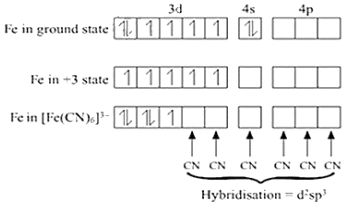
-
- (A) \({\left[ Fe ( CN )_6\right]^{3-} < \left[ CoF _6\right]^{3-} < \left[ MnBr _4\right]^{2-}} < \left[ Mn ( CN )_6\right]^{3-}\)
- (B) \({\left[ Fe ( CN )_6\right]^{3-} < \left[ Mn ( CN )_6\right]^{3-} < \left[ CoF _6\right]^{3-}} < \left[ MnBr _4\right]^{2-}\)
- (C) \({\left[ MnBr _4\right]^{2-} < \left[ CoF _6\right]^{3-} < \left[ Fe ( CN )_6\right]^{3-}} < \left[ Mn ( CN )_6\right]^{3-}\)
- (D) \({\left[ CoF _6\right]^{3-} < \left[ MnBr _4\right]^{2-} < \left[ Fe ( CN )_6\right]^{3-}} < \left[ Mn ( CN )_6\right]^{3-}\)
Show answer and solution
Correct Answer: (B)
Spin magnetic moment \(\mu=\sqrt{n(n+2)}\) B.M - 39. The magnetic moment of a transition metal compound has been calculated to be \(3.87\) \(B.M.\) The metal ion is 2023 Medium
- (A) \(Cr ^{2+}\)
- (B) \(Mn ^{2+}\)
- (C) \(V ^{2+}\)
- (D) \(Ti ^{2+}\)
Show answer and solution
Correct Answer: (C)
\(Cr ^{+2}:[ Ar ], 3 d ^4, 4 s ^0 n =4, \mu=\sqrt{4(4+2)}=\sqrt{24}\)\(=4.89\,BM\)
\(Mn ^{+2}:[ Ar ], 3 d ^5, 4 s ^0 n =5, \mu=\sqrt{5(5+2)}=\sqrt{35}\)
\(=5.91\,BM\)
\(V ^{+2}:[ Ar ], 3 d ^3, 4 s ^0 n =3, \mu=\sqrt{3(3+2)}=\sqrt{15}\)
\(=3.87\,BM\)
\(Ti ^{+2}:[ Ar ], 3 d ^2, 4 s ^0 n =2, \mu=\sqrt{2(2+2)}=\sqrt{8}\)
\(=2.82\,BM\)
-
- (A) \((ii)\) and \((iii)\)
- (B) \((i), (ii)\) and \((iv)\)
- (C) \((i)\) and \((iii)\)
- (D) \((ii), (iii)\) and \((iv)\)
Show answer and solution
Correct Answer: (B)
\((i), (ii)\) and \((iv)\) correct.Manganese exhibits \(+7\) oxidation state in its oxide. \(\left( Mn _2 O _7\right)\)
\(Ru\) and \(Os\) from \(RuO _4\) and \(OsO _4\) oxide in \(+8\) oxidation state
\(Cr\) in \(+6\) oxidation act is oxidizing.
\(Sc\) does not show \(+4\) oxidation state.
-
- (A) \((B), (C)\) only
- (B) \((A), (B), (D)\) only
- (C) \((C), (D)\) only
- (D) \((A), (B)\) only
Show answer and solution
Correct Answer: (A)
\((A)\) The \(M ^{3+} / M ^{2+}\) reduction potential formanganese is greater than iron
\((B)\) \(E _{ Fe ^{+3} / Fe ^{+2}}^0=+0.77\)
\(E _{ Mn ^{+3} / Mn ^{+2}}^0=+1.57\)
(C) \(E _{ Cr ^{+3} / Cr ^{+2}}^0=-0.26\)
\(\therefore \quad Cr ^{2 \oplus}+ H ^{\oplus} \longrightarrow Cr ^{3 \oplus}+\frac{1}{2} H _2\)
(D) \(V ^{2 \oplus}=3\) unpaired electron
Magnetic Moment \(=3.87\) B.M
-
- (A) \(C\) only
- (B) \(D\) only
- (C) \(A\) and \(B\) only
- (D) \(C\) and \(D\) only
Show answer and solution
Correct Answer: (D)
\(Ce ^{+4}\) and \(Tb ^{+4}\) act as oxidising agent. -
- (A) \(6\)
- (B) \(5\)
- (C) \(3\)
- (D) \(4\)
Show answer and solution
Correct Answer: (B)
\(Co ^{3+}\) can't liberate \(H _{2}\).It has \(d ^{6}\) configuration,
Number of unpaired electrons \(=4\)
\(\mu=\sqrt{4 \times 6}=4.92\) \(B.M.\)
-
- (A) \(2\)
- (B) \(56\)
- (C) \(10\)
- (D) \(0\)
Show answer and solution
Correct Answer: (D)
\(3 MnO _{4}^{2-}+4 H ^{+} \longrightarrow 2 MnO _{4}^{-}+ MnO _{2}^{+7}+2 H _{2} O\)\(Mn ^{+7}=\) no. of unpaired electrons is \(' 0 '\)
\(\mu=0\, \text { B.M. }\)
-
- (A) \(Hg\)
- (B) \(Ag\)
- (C) \(Ga\)
- (D) \(Cs\)
Show answer and solution
Correct Answer: (B)
\(Hg , Ga , Cs\) are liquid near room temperature But \(Ag\) (silver) is solid. - 46. Spin only magnetic moment of \(\left[ MnBr _{6}\right]^{4-}\) is \(.....\,B.M.\) (round off to the closest integer) 2022 Medium
- (A) \(65\)
- (B) \(6\)
- (C) \(12\)
- (D) \(81\)
Show answer and solution
Correct Answer: (B)
\(Mn ^{2+} \rightarrow t _{2 g ^{ 111 }} e _{ g ^{11}}\)\(\mu_{s}=\sqrt{35}\)
\(=5.91\)
\(=6\)
- 47. The spin only magnetic moment of the complex present in Fehling's reagent is \(B.M.\)(Nearest integer). 2022 Medium
- (A) \(3\)
- (B) \(0\)
- (C) \(1\)
- (D) \(2\)
Show answer and solution
Correct Answer: (D)
Fehling solution is a complex of \(Cu ^{++}\)\(Cu ^{++}=3 d ^{9}\)
No. of unpaired \(e ^{-}=1\)
\(M \cdot M=\sqrt{1(1+2)}=\sqrt{3}=1.73\,BM\)
-
- (A) \(4\)
- (B) \(2\)
- (C) \(3\)
- (D) \(1\)
Show answer and solution
Correct Answer: (A)
\(\left. E _{ Cr ^{+3}}^{0}\right|_{ Cr ^{+2}}=-0.41\,V\)\({\left[ Cr ^{+3}\right]=4 s ^{0} 3 d ^{3} }\)
\(\mu=\sqrt{ n ( n +2)}\,B.M\)
\(=\sqrt{15}\) B.M \(\sim 4\,B.M\)
-
- (A) \(4\)
- (B) \(3\)
- (C) \(2\)
- (D) \(5\)
Show answer and solution
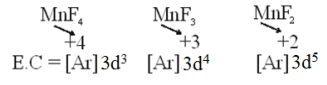
Correct Answer: (D)
Hence \(MnF _{3} \Rightarrow\) strongest O.A\(\mu=\sqrt{4(4+2)}=\sqrt{24}=4.89=5\)
- 50. Which of the following \(3 d -m e t a l\) ion will give the lowest enthalpy of hydration \((\Delta_{ hyd } H )\) when dissolved in water? 2022 Medium
- (A) \(Cr ^{2+}\)
- (B) \(Mn ^{2+}\)
- (C) \(Fe ^{2+}\)
- (D) \(Co ^{2+}\)
Show answer and solution
Correct Answer: (B)
Enthalpy of hydration increases with increase in charge density. \(Mn ^{+2}\) has least charge density (as \(Mn\) has highest size among the given options) so it will have least enthalpy of hydration.
No questions on this page match these filters.
Other STD 12 - D and f- block elements topics
Frequently asked
How many Physical properties questions came in JEE Mains?
72 questions from 2013–2026, each with the correct answer and a full solution.
How difficult are Physical properties questions?
13% are easy, 61% medium and 26% hard.