


Questions
Newest firstShowing 1–33 of 33 questions
-
- (A) The order of all the three reactions is same.
- (B) The rate constant of reaction \(3\) is larger than the rate constant of reaction \(2\) if the order of reaction is same for both.
- (C) The SI unit of rate constant of reaction \(1\) is s\(^{-1}\).
- (D) Thermal decomposition of HI on gold surface is an example of reaction \(2\).
Show answer and solution
Correct Answer: (B)
Analysis of the graph:
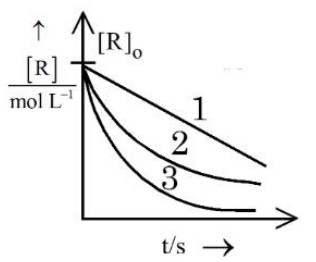
The graph shows reactant concentration \([R]\) vs time \(t\) for three reactions starting from the same initial concentration.
Curve 1 is a straight line with negative slope. For a zero-order reaction, the integrated rate law is \([R] = [R]_0 - kt\), which is a straight line in \([R]\) vs \(t\). Hence, reaction \(1\) is a zero-order reaction.
Curves 2 and 3 are non-linear (exponential-type decays), so they correspond to reactions of order greater than zero (e.g., first or second order).
Evaluating the options:
\((1)\) The order of all three reactions is the same.
Reaction \(1\) is zero order while reactions \(2\) and \(3\) are of higher order, so this statement is incorrect.
\((2)\) The rate constant of reaction \(3\) is larger than that of reaction \(2\), assuming both have the same order.
Assuming both curves \(2\) and \(3\) correspond to the same order (say first order), the integrated rate law is \([R] = [R]_0 e^{-kt}\). At any given time \(t\), the curve for reaction \(3\) lies below that of reaction \(2\), i.e., \([R]_3 < [R]_2\). Since both start from the same \([R]_0\), reaction \(3\) is decaying faster, which implies a larger rate constant. Hence \(k_3 > k_2\), and this statement is correct.
\((3)\) The SI unit of the rate constant of reaction \(1\) is \(\text{s}^{-1}\).
For a zero-order reaction, \(\text{Rate} = k[R]^0 = k\), so the unit of \(k\) is that of rate, i.e., \(\text{mol L}^{-1}\text{s}^{-1}\). The unit \(\text{s}^{-1}\) corresponds to a first-order reaction, so this statement is incorrect.
\((4)\) Thermal decomposition of \(HI\) on a gold surface is an example of reaction \(2\).
The thermal decomposition of \(HI\) on a gold surface is a well-known zero-order reaction, which corresponds to curve \(1\), not curve \(2\). Hence this statement is incorrect.
Therefore, the correct option is \((2)\). -
- (A) A and B Only
- (B) A, B and C Only
- (C) A, B, D and E Only
- (D) C and D Only
Show answer and solution
Correct Answer: (A)
The unit of the rate constant \(k\) is mol\(^{-1}\) L s\(^{-1}\).
The general unit of the rate constant for an \(n\)-th order reaction is (mol L\(^{-1}\))\(^{1-n}\) s\(^{-1}\).
Equating the powers of the concentration units, we get \(1-n = -1 \Rightarrow n = 2\).
Thus, the reaction is a second-order reaction. Statement B is correct.
For a second-order reaction, Rate \(= k[X]^2\). When the concentration of \(X\) is increased to \(4\) times, the new rate is \(k(4[X])^2 = 16k[X]^2\), which is \(16\) times the original rate. Statement A is correct.
The half-life of a second-order reaction is \(t_{1/2} = \dfrac{1}{k[X]_0}\), which depends inversely on the initial concentration. Statement C is incorrect.
The decomposition of \(N_2O_5\) is a well-known first-order reaction. Statement D is incorrect.
The equation \(\ln\dfrac{[R_o]}{[R]} = kt\) represents the integrated rate law for a first-order reaction, not a second-order reaction. Statement E is incorrect.
Therefore, only statements A and B are correct.
Answer: A and B Only -
- (A) 10
- (B) 20
- (C) 30
- (D) 40
Show answer and solution
Correct Answer: (B)
\(\mathrm{k}_1, \mathrm{k}_2\) and \(\mathrm{k}_3\) are given as rate constants of three steps of a complex reaction. Rate constant (k) of the overall reaction is given as
\(k=\sqrt{\frac{k_1 k_3}{k_2}}\)
Activation energies of the three steps are given as
\(\begin{aligned}
& \mathrm{E}_{\mathrm{a}_1}=60 \mathrm{~kJ} \mathrm{~mol}^{-1}, \mathrm{E}_{\mathrm{a}_2}=30 \mathrm{~kJ} \mathrm{~mol}^{-1}, \\
& \mathrm{E}_{\mathrm{a}_3}=10 \mathrm{~kJ} \mathrm{~mol}^{-1}
\end{aligned}\)
From Arrhenius equation, we know that
\(\mathrm{k}=\mathrm{Ae}^{-\mathrm{Ea} / \mathrm{RT} T}\)
If \(E_a\) is the activation energy of the overall reaction, then
\(\begin{aligned}
& E_a=\frac{1}{2}\left[E_{a_1}+E_{a_3}-E_{a_2}\right] \\
& =\frac{1}{2}[60+10-30]=20 \mathrm{~kJ} \mathrm{~mol}^{-1}
\end{aligned}\) -
- (A) \(1\)
- (B) \(2\)
- (C) \(3\)
- (D) \(4\)
Show answer and solution
Correct Answer: (B)
Let, \(\mathrm{R}=\mathrm{k}[\mathrm{HI}]^{\mathrm{n}}\)
using any two of given data,
\( \frac{3 \times 10^{-3}}{7.5 \times 10^{-4}}=\left(\frac{0.01}{0.005}\right)^{\mathrm{n}} \)
\( \mathrm{n}=2\) -
- (A) \(318\)
- (B) \(317\)
- (C) \(315\)
- (D) \(319\)
Show answer and solution
Correct Answer: (C)
\(2 \mathrm{~A}(\mathrm{~g})+\mathrm{B}(\mathrm{g}) \longrightarrow \mathrm{C}(\mathrm{g})\)\(\mathrm{r}_1 \quad 1.5 \mathrm{~atm} \quad 0.7 \mathrm{~atm}\)
\(\mathrm{r}_2 \quad 0.5 \mathrm{~atm} \quad 0.2 \mathrm{~atm} \quad 0.5 \mathrm{~atm}\)
\(\because \mathrm{r}=\mathrm{K}\left[\mathrm{P}_{\mathrm{A}}\right]^2\left[\mathrm{P}_{\mathrm{B}}\right]\)
\(\mathrm{r}_1=\mathrm{K}[1.5]^2[0.7]\)
\(\mathrm{r}_2=\mathrm{K}[0.5]^2[0.2]\)
\(\frac{\mathrm{r}_1}{\mathrm{r}_2}=9 \times \frac{7}{2}=31.5=315 \times 10^{-1}\)
Ans. \(315\)
-
- (A) \(2\)
- (B) \(3\)
- (C) \(4\)
- (D) \(5\)
Show answer and solution
Correct Answer: (B)
\(\mathrm{r}=\mathrm{K}[\mathrm{A}]^{\mathrm{x}}[\mathrm{B}]^{\mathrm{y}}\)\((I)\) \(6 \times 10^{-3}=\mathrm{K}[0.1]^{\mathrm{x}}[0.1]^{\mathrm{y}}\)
\((IV)\) \(2.4 \times 10^{-2}=\mathrm{K}[0.4]^{\mathrm{x}}[0.1]^{\mathrm{y}}\)
\((IV)/(I)\)
\(4=(4)^{\mathrm{x}}\)
\(\mathrm{x}=1\)
\(\mathrm{r}=\mathrm{K}[\mathrm{A}]^{\mathrm{x}}[\mathrm{B}]^{\mathrm{y}}\)
\((III)\) \(2.88 \times 10^{-1}=\mathrm{K}[0.3]^{\mathrm{x}}[0.4]^{\mathrm{y}}\)
\((II)\) \(7.2 \times 10^{-2}=\mathrm{K}[0.3]^{\mathrm{x}}[0.2]^{\mathrm{y}}\)
\((III)/(II)\)
\(4=2^y\)
\(y=2\)
Overall order \(=x+y=1+2=3\)
-
- (A) \(\mathrm{K}_1 \mathrm{~K}_2[\mathrm{~A}]\)
- (B) \(\left(\mathrm{K}_1-\mathrm{K}_2\right)[\mathrm{A}]\)
- (C) \(\left(\mathrm{K}_1+\mathrm{K}_2\right)[\mathrm{A}]\)
- (D) \(\left(\mathrm{K}_1 / \mathrm{K}_2\right)[\mathrm{A}]\)
Show answer and solution
Correct Answer: (D)
Rate of formation of \(B\) is\(\frac{\mathrm{d}[\mathrm{B}]}{\mathrm{dt}}=\mathrm{k}_1[\mathrm{~A}]-\mathrm{k}_2[\mathrm{~B}]\)
\(0=\mathrm{k}_1[\mathrm{~A}]-\mathrm{k}_2[\mathrm{~B}]\)
\(\left(\frac{\mathrm{k}_1}{\mathrm{k}_2}\right)[\mathrm{A}]=[\mathrm{B}]\)
-
- (A) \(20\)
- (B) \(10\)
- (C) \(30\)
- (D) \(45\)
Show answer and solution
Correct Answer: (C)
\( \mathrm{K}=\frac{\mathrm{K}_1 \cdot \mathrm{K}_2}{\mathrm{~K}_3}=\frac{\mathrm{A}_1 \cdot \mathrm{A}_2}{\mathrm{~A}_3} \cdot \mathrm{e}^{-\frac{\left(\mathrm{E}_{\mathrm{a}_1}+\mathrm{E}_{\mathrm{a}_2}-\mathrm{E}_{\mathrm{a}_3}\right)}{R T}} \)\( \mathrm{~A} \cdot \mathrm{e}^{-\mathrm{E}_{\mathrm{a}} / \mathrm{RT}}=\frac{\mathrm{A}_1 \mathrm{~A}_2}{\mathrm{~A}_3} \cdot \mathrm{e}^{-\frac{\left(\mathrm{E}_{\mathrm{a}_1}+\mathrm{E}_{\mathrm{a}_2}-\mathrm{E}_{\mathrm{a}_3}\right)}{R T}}\)
\(\mathrm{E}_{\mathrm{a}}=\mathrm{E}_{\mathrm{a}_1}+\mathrm{E}_{\mathrm{a}_2}-\mathrm{E}_{\mathrm{a}_3}=40+50-60=30 \mathrm{~kJ} / \mathrm{mole}\)
-
- (A) \(0.5\)
- (B) \(2\)
- (C) \(1\)
- (D) \(0\)
Show answer and solution
Correct Answer: (B)
\(t _{1 / 2} \propto\left( P _0\right)^{1- n }\)\(\frac{\left( t _{1 / 2}\right)_1}{\left( t _{1 / 2}\right)_2}=\frac{\left( P _0\right)_1^{1- n }}{\left( P _{0_2}\right)_2^{1- n }}\)
\(\Rightarrow\left(\frac{4}{2}\right)=\left(\frac{50}{100}\right)^{1- n }\)
\(\Rightarrow 2=\left(\frac{1}{2}\right)^{1- n }\)
\(\Rightarrow 2=(2)^{ n -1}\)
\(\Rightarrow n -1=1\)
\(\Rightarrow=2\)
-
- (A) \(80\) and \(2\)
- (B) \(40\) and \(4\)
- (C) \(160\) and \(4\)
- (D) \(80\) and \(4\)
Show answer and solution
Correct Answer: (A)
\(r = K [ A ]^1[ B ]^1\)\(0.1= K (20)^1(0.5)^1\)
\(0.40= K ( x )^1(0.5)^1\)
\(0.80= K (40)^1( y )^1\)
\(\text { From (i) and (ii) }\)
\(x=80\)
\(\text { From (i) and (iii) }\)
\(y=2\)
-
- (A) \(4\)
- (B) \(6\)
- (C) \(2\)
- (D) \(8\)
Show answer and solution
Correct Answer: (C)
As unit of rate constant is (conc.) \({ }^{1-n}\) time \(^{-1}\)\(n =2\)
-
- (A) \(4\)
- (B) \(3\)
- (C) \(5\)
- (D) \(6\)
Show answer and solution
Correct Answer: (B)
\(RDS : NOBr _2+ NO \rightarrow 2 NOBr\)\(\left. r = K \left[ NOBr _2\right] NO \right] \quad--- \text { (i) }\)
\(Keq =\frac{\left[ NOBr _2\right]}{[ NO ]\left[ Br _2\right]}----- \text { (ii) }\)
\(\text { From (i) and (ii) }\)
\(r = K \cdot Keq \cdot[ NO ]\left[ Br _2\right][ NO ]\)
\(r = K ^{\prime}[ NO ]^2\left[ Br _2\right]\)
\(\text { Overall order }=3\)
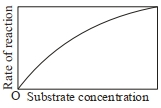
- 13. The variation of the rate of an enzyme catalyzed reaction with substrate concentration is correctly represented by graph 2023 Medium
- (A) \(b\)
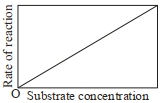
- (B) \(c\)
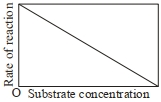
- (C) \(d\)
- (D) \(a\)
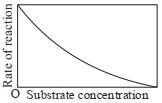
Show answer and solution
Correct Answer: (B)
Fact base - (A) \(b\)
-
- (A) \(1\)
- (B) \(0\)
- (C) \(2\)
- (D) \(3\)
Show answer and solution
Correct Answer: (C)
On decreasing pressure of \(NO\) by a factor of '\(2\)' the rate of reaction decreases by a factor of '\(4\)'.\(\therefore\) Order of reaction w.r.t. 'NO' \(=2\)
-
- (A) \(4\)
- (B) \(3\)
- (C) \(2\)
- (D) \(1\)
Show answer and solution
Correct Answer: (D)
\(\left( t _{1 / 2}\right)_{500 \text { torr }}=240\,sec =4\,min\).\(\left( t _{1 / 2}\right)_{250 \text { torr }}=4\,min\)
\(t _{1 / 2} \propto a ^{1- n }\)
As \(t _{1 / 2}\) is independent of initial pressure. Hence, order is \(1^{st}\) order.
-
- (A) \(1\)
- (B) \(2\)
- (C) \(3\)
- (D) \(4\)
Show answer and solution
Correct Answer: (C)
\(r = k [ NO ]^{ m }\left[ Cl _{2}\right]^{ n }\)\(= k (0.1)^{ m }(0.1)^{ n } \quad \ldots . .(1)\)
\(= k (0.1)^{ m }(0.2)^{ n } \quad \ldots . .(2)\)
\(= k (0.2)^{ m }(0.2)^{ n } \ldots \ldots(3)\)
\(n =1\)
\(m =2\)
\(m + n =3\)
-
- (A) \(1\)
- (B) \(2\)
- (C) \(3\)
- (D) \(4\)
Show answer and solution
Correct Answer: (D)
\(\mathrm{A} \rightarrow \mathrm{B}\)\(\mathrm{t}=0 \quad\quad\quad\quad 0\)
\(\mathrm{t}=30\, \mathrm{~min}\quad\quad 0.2 \,\mathrm{M}\)
Av. Rate of reaction \(=-\frac{\Delta[\mathrm{A}]}{\Delta \mathrm{t}}=\frac{\Delta[\mathrm{B}]}{\Delta \mathrm{t}}=\frac{(0.2-0)}{\frac{1}{2}}\)
\(=0.4=4 \times 10^{-1} \,\mathrm{~mol} / \mathrm{L} \times \mathrm{hr}\)
-
- (A) \(\mathrm{mol}^{1-\mathrm{n}} \mathrm{L}^{1-\mathrm{n}} \mathrm{s}^{-1}\)
- (B) \(\mathrm{mol}^{1-\mathrm{n}} \mathrm{L}^{\mathrm{n}-1} \mathrm{~s}^{-1}\)
- (C) \(\mathrm{mol}^{1-\mathrm{n}} \mathrm{L}^{1-\mathrm{n}} \mathrm{s}\)
- (D) \(\mathrm{mol}^{1-\mathrm{n}} \mathrm{L}^{2 \mathrm{n}} \mathrm{s}^{-1}\)
Show answer and solution
Correct Answer: (B)
Rate \(=\mathrm{k}[\mathrm{A}]^{\mathrm{n}}\)comparing units
\((\mathrm{mol} / \ell)\) \({\mathrm{sec}}=\mathrm{k}\left(\frac{\mathrm{mol}}{\ell}\right)^{\mathrm{n}}\)
\(\Rightarrow \mathrm{k}=\mathrm{mol}^{(1-\mathrm{n})} \ell^{(\mathrm{n}-1)} \mathrm{s}^{-1}\)
-
- (A) \(1\)
- (B) \(4\)
- (C) \(2\)
- (D) \(3\)
Show answer and solution
Correct Answer: (A)
\(7 \times 10^{-9}=\mathrm{K} \times\left(8 \times 10^{-5}\right)^{\mathrm{x}}\left(8 \times 10^{-5}\right)^{\mathrm{y}} \ldots \ldots . .(1)\)\(2.1 \times 10^{-8}=\mathrm{K} \times\left(24 \times 10^{-5}\right)^{\mathrm{x}}\left(8 \times 10^{-5}\right)^{\mathrm{y}} \ldots \ldots (2)\)
\(\frac{1}{3}=\left(\frac{1}{3}\right)^{\mathrm{x}} \Rightarrow \mathrm{x}=1\)
-
- (A) \(27\)
- (B) \(37\)
- (C) \(47\)
- (D) \(57\)
Show answer and solution
Correct Answer: (A)
Reaction : \(2 A + B _{2} \longrightarrow 2 AB\)As the reaction is elementary, the rate of reaction is \(r = K \cdot[ A ]^{2}\left[ B _{2}\right]\)
on reducing the volume by a factor of \(3,\) the concentrations of \(A\) and \(B _{2}\) will become \(3\) times and hence, the rate becomes \(3^{2} \times 3=27\) times of initial rate.
-
- (A) \(3\)
- (B) \(2\)
- (C) \(4\)
- (D) \(1\)
Show answer and solution
Correct Answer: (C)
\(\left(\frac{\text { Rate of disappearance of } \mathrm{C}_{2} \mathrm{H}_{6} \mathrm{O}}{3}\right)\)\(=\left(\frac{\text { Rate of appearance of } \mathrm{Cr}_{2}\left(\mathrm{SO}_{4}\right)_{3}}{2}\right)\)
\(\Rightarrow\left(\frac{2.67 \mathrm{~mol} / \mathrm{min} \times 3}{2}\right)=\) rate of disappearance of \(\mathrm{C}_{2} \mathrm{H}_{6} \mathrm{O} .\)
\(\Rightarrow\) Rate of disappearance of \(\mathrm{C}_{2} \mathrm{H}_{6} \mathrm{O}=4.005\) \(\mathrm{~mol} / \mathrm{min}\)
-
- (A) \(\mathrm{k}_{\mathrm{b}}\left[\mathrm{N}_{2}\right]\left[\mathrm{H}_{2} \mathrm{O}\right]^{2} /[\mathrm{NO}]\)
- (B) \(\mathrm{k}_{\mathrm{b}}\left[\mathrm{N}_{2}\right]\left[\mathrm{H}_{2} \mathrm{O}\right]\)
- (C) \(\mathrm{k}_{\mathrm{b}}\left[\mathrm{N}_{2}\right]\left[\mathrm{H}_{2} \mathrm{O}\right]^{2}\)
- (D) \(\mathrm{k}_{\mathrm{b}}\left[\mathrm{N}_{2}\right]\left[\mathrm{H}_{2} \mathrm{O}\right]^{2} /\left[\mathrm{H}_{2}\right]\)
Show answer and solution
Correct Answer: (D)
\(\mathrm{K}_{\mathrm{eq}}=\frac{\mathrm{k}_{\mathrm{f}}}{\mathrm{k}_{\mathrm{b}}}=\frac{\left[\mathrm{N}_{2}\right]\left[\mathrm{H}_{2} \mathrm{O}\right]^{2}}{\left[\mathrm{H}_{2}\right]^{2}[\mathrm{NO}]^{2}}\)At equilibrium \(\mathrm{r}_{\mathrm{f}}=\mathrm{r}_{\mathrm{b}}\)
\(\mathrm{k}_{\mathrm{f}}\left[\mathrm{H}_{2}\right][\mathrm{NO}]^{2}=\mathrm{k}_{\mathrm{b}} \frac{\left[\mathrm{N}_{2}\right]\left[\mathrm{H}_{2} \mathrm{O}\right]^{2}}{\left[\mathrm{H}_{2}\right]}\)
Hence, rate expression for reverse reaction.
\(=\mathrm{k}_{\mathrm{b}} \frac{\left[\mathrm{N}_{2}\right]\left[\mathrm{H}_{2} \mathrm{O}\right]^{2}}{\left[\mathrm{H}_{2}\right]}\)
-
- (A) \(0.3,0.4\)
- (B) \(0.4,0.3\)
- (C) \(0.4,0.4\)
- (D) \(0.3,0.3\)
Show answer and solution
Correct Answer: (A)
From rate law\(= K [ A ]^{ x }[ B ]^{ y }\)
\(6 \times 10^{-3}= K (0.1)^{ x }(0.1)^{ y }\)\(.....(1)\)
\(2.4 \times 10^{-2}= K (0.1)^{ x }(0.2)^{ y } \ldots \ldots(2)\)
\(1.2 \times 10^{-2}= K (0.2)^{ x }(0.1)^{ y }\)\(......(3)\)
\((3) \div(1) \Rightarrow x=1\)
\((2) \div(3) \Rightarrow x=2\)
So, other with respect to \(A=1\)
Order with respect to \(B =2\)
\((4)\) \(\div(3)\)
\(\left(\frac{ x }{0.2}\right) \times\left(\frac{0.2}{0.1}\right)^{2}=\frac{7.2 \times 10^{-2}}{1.2 \times 10^{-2}}\)
\(x =\frac{6 \times 0.2}{4}\)
\(x=0.3 M\)
(5) \(\div(4)\)
\(\left(\frac{y}{0.2}\right)^{2}=\frac{2.88 \times 10^{-1}}{7.2 \times 10^{-2}}\)
\(y^{2}=4 \times 0.2^{2}\)
\(y=0.4 M\)
-
- (A) \(\left( {\frac{{{k_1}}}{{{k_2}}}} \right)\left[ A \right]\)
- (B) \(\left( {{k_1} - {k_2}} \right)\left[ A \right]\)
- (C) \({k_1}{k_2}\left[ A \right]\)
- (D) \(\left( {{k_1} + {k_2}} \right)\left[ A \right]\)
Show answer and solution
Correct Answer: (A)
Applying steady state of approximation\(\frac{d}{{dt}}[B]\, = \,{K_1}[A]\, - \,{K_2}[B]\)
\(O\, = \,{K_1}[A]\, - \,{K_2}[B]\)
\(\frac{{{K_1}}}{{{K_2}}}[A]\, = \,[B]\)
-
- (A) \({k_1}\left[ {{A_2}} \right] - {k_{ - 1}}{\left[ A \right]^2}\)
- (B) \(2{k_1}\left[ {{A_2}} \right] - {k_{ - 1}}{\left[ A \right]^2}\)
- (C) \({k_1}\left[ {{A_2}} \right] + {k_{ - 1}}{\left[ A \right]^2}\)
- (D) \(2{k_1}\left[ {{A_2}} \right] - {2k_{ - 1}}{\left[ A \right]^2}\)
Show answer and solution
Correct Answer: (D)
\(\frac{1}{2}\frac{{d[A]}}{{dt}}\, = \, - \,{K_1}\,{[A]_2}\, + \,{K_{ - 1}}\,{[A]^2}\)\(\frac{{d[A]}}{{dt}}\, = \,2{K_1}\,{[A]_2}\, - \,2{K_{ - 1}}\,{[A]^2}\)
-
- (A) Rate \(= k[A]^2[B]^2\)
- (B) Rate \(= k[A][B]^2\)
- (C) Rate \(= k[A][B]\)
- (D) Rate \(= k[A]^2[B]\)
Show answer and solution
Correct Answer: (B)
\(r\, = \,K{[A]^x}\,{[B]^y}\)\(0.045\, = \,K{(0.05)^x}{(0.05)^y}\) ...... \((1)\)
\(0.090\, = \,K{(0.10)^x}{(0.05)^y}\) .......\((2)\)
\(0.72\, = \,K{(0.20)^x}{(0.10)^y}\) ........\((3)\)
Diving \((1)\) by \((2)\) We get
\(\frac{{0.045}}{{0.090}}\, = \,{\left( {\frac{{0.05}}{{0.10}}} \right)^x}\, \Rightarrow \,x = 1\)
Diving \((2)\) by \((3)\)
\(\frac{{0.090}}{{0.720}}\, = \,{\left( {\frac{{0.10}}{{0.20}}} \right)^x}\,{\left( {\frac{{0.05}}{{0.10}}} \right)^y}\, \Rightarrow \,y = 2\,\)
Hence, \(r\, = \,K[A]\,{[B]^2}\)
-
- (A) Total order of the reaction is \(4\)
- (B) Order of the reaction with respect to \(B\) is \(2\)
- (C) Order of the reaction with respect to \(B\) is \(1\)
- (D) Order of the reaction with respect to \(A\) is \(2\)
Show answer and solution
Correct Answer: (B)
\(2A+B\to \) productsRate \(=\,K\,[A]^x[B]^y\)
\(r\,=\,K\,[A]^x[B]^y\) ..... \((i)\)
\(0.3\,=\,K\,[A]^x[B]^y\) ..... \((1)\)
\(2.4\, = \,K{[2A]^x}\,{[2B]^y}\) ...... \((2)\)
\(0.6\, = \,K{[2A]^x}\,{[B]^y}\) ...... \((3)\)
From \((1)\,(2)\) and \((3)\)
\(X\,=\,1,\) \(Y\,=\,2\)
Overall order \(=\,2+1\,=3\)
Order w.r.t \(A=1\)
Order w.r.t \(B=2\)
-
- (A) \(5\)
- (B) \(10\)
- (C) \(1\)
- (D) \(100\)
Show answer and solution
Correct Answer: (B)
\(R\,\, = \,k{[A]^x}\,{[B]^y}\)\(6.93\, \times \,{10^{ - 3}}\, = \,k\,{(0.1)^x}\,{(0.2)^y}\) ...... \((i)\)
\(6.93\, \times \,{10^{ - 3}}\, = \,k\,{(0.1)^x}\,{(0.25)^y}\) ...... \((ii)\)
\(1.386 \times \,{10^{ - 2}}\, = \,k\,{(0.2)^x}\,{(0.3)^y}\) . .... \((iii)\)
\( \Rightarrow \,y = 0\) (from \((i)\) and \((ii)\)), zero order w.r.t. \(B\)
\(x=1\) (from \((i)\) and \((ii)\))
\( \Rightarrow \,\) First order wrt \(A\)
\( \Rightarrow 6.93\times 10^{-3}\,=\,k(0.1)\)
\( \Rightarrow k=6.93\times 10^{-3}\,min^{-1}\)
-
- (A) \(1,1\)
- (B) \(0,2\)
- (C) \(0,1\)
- (D) \(1,0\)
Show answer and solution
Correct Answer: (D)
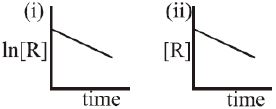
For first order reaction\(\ln \,{[R]_t}\, = \, - \,Kt\, + \,\ln \,{[R]_0}\)
For zero oeder reaction
\({[R]_t}\, = \, - \,Kt\, + \,{[R]_0}\)
Where \('R'\) is reactant.
-
- (A) \(2\)
- (B) \(3\)
- (C) \(0\)
- (D) \(1\)
Show answer and solution
Correct Answer: (D)
First order reaction as halflife is constant.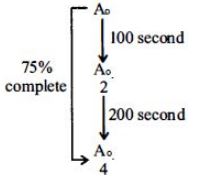
-
- (A) \(3k\)
- (B) \(9k\)
- (C) \(k/3\)
- (D) \(k\)
Show answer and solution
Correct Answer: (D)
Rate constant is independent of concentration -
- (A) \(1.4 \times {10^{20}}\)
- (B) \(3.1 \times {10^{10}}\)
- (C) \(5.2 \times {10^9}\)
- (D) \(2.6 \times {10^{10}}\)
Show answer and solution
Correct Answer: (A)
On adding eq. \((i)\) and eq. \((ii)\) we get\({{O}_{3}}(g)+O(g)\to 2{{O}_{2}}(g)\)
Hence overall rate constant \(=\,K_i\times K_{ii}\)
\( = \,5.2 \times \,{10^9}\, \times \,2.6\, \times \,{10^{10}}\, \approx \,\) \(1.4\, \times \,{10^{20}}\,mo{l^{ - 1}}\,L{s^{ - 1}}\)
\({{O}_{3}}(g)+C{{l}^{*}}(g)\to {{O}_{2}}(g)+Cl{{O}^{*}}(g),\,\,{{K}_{i}}\)
\(Cl{{O}^{*}}(g)+{{O}^{*}}(g)\to {{O}_{2}}(g)+C{{l}^{*}}(g),\,\,{{K}_{ii}}\)
\({{O}_{3}}(g)+{{O}^{*}}(g)\to 2{{O}_{2}}(g),\) \(K_{Rate}\,=\,K_i\times K_{ii}\)
-
- (A) halved
- (B) the same
- (C) doubled
- (D) quadrupled
Show answer and solution
Correct Answer: (C)
Rate \(= K[A][B]=R\)\(R'\, = \,K\left[ A \right]\left[ {2B} \right]\)
\(\frac{R}{{R'}}\, = \,\frac{{k[A][B]}}{{k[A][2B]}}\, = \,\frac{{k[A][B]}}{{2k[A][B]}}\)
\( \Rightarrow \,2R\, = \,R'\) i.e., rate become doubles.
No questions on this page match these filters.
Other STD 12 - Chemical kinetics topics
Frequently asked
How many Rate law, Rate constant, Order of Reaction and Molecularity questions came in JEE Mains?
33 questions from 2015–2026, each with the correct answer and a full solution.
How difficult are Rate law, Rate constant, Order of Reaction and Molecularity questions?
6% are easy, 55% medium and 39% hard.