


Questions
Newest firstShowing 1–50 of 61 questions
-
- (A) \(C < D < B < A < E\)
- (B) \(B < A < E < C < D\)
- (C) \(E < C < D < B < A\)
- (D) \(E < B < A < D < C\)
Show answer and solution
Correct Answer: (D)
The energy of an atomic orbital in a multi-electron atom is determined by the \((n + l)\) rule. Orbitals with a lower value of \((n + l)\) have lower energy. If two orbitals have the same \((n + l)\) value, the one with the lower \(n\) value has lower energy.
Calculating the \((n + l)\) value for each given orbital:
A. \(n = 3, l = 2 \Rightarrow n + l = 5\)
B. \(n = 4, l = 0 \Rightarrow n + l = 4\)
C. \(n = 6, l = 1 \Rightarrow n + l = 7\)
D. \(n = 5, l = 1 \Rightarrow n + l = 6\)
E. \(n = 2, l = 1 \Rightarrow n + l = 3\)
Arranging the orbitals in increasing order of their \((n + l)\) values, we get:
\(3 < 4 < 5 < 6 < 7\)
This corresponds to the order:
\(E < B < A < D < C\)
Answer: \(E < B < A < D < C\) -
- (A) B
- (B) D
- (C) C
- (D) A
Show answer and solution
Correct Answer: (A)
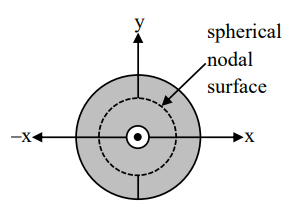
At spherical node
\(\psi_r=0\) -
- (A) 26 and 1
- (B) 4 and 1
- (C) 2 and 4
- (D) 8 and 1
Show answer and solution
Correct Answer: (D)
Explanation:
Let us determine the maximum number of electrons for each set of quantum numbers step-by-step based on the rules governing quantum numbers from the Structure of Atom chapter in the NCERT Class 11 Chemistry textbook:
1. Analyzing Set (A): \(n = 5, m_l = -1\)
For a principal quantum number \(n = 5\), the possible values of the azimuthal quantum number (\(l\)) range from \(0\) to \((n-1)\), i.e., \(l = 0, 1, 2, 3, 4\).
Now let's find which subshells can host a magnetic quantum number value of \(m_l = -1\):
- For \(l = 0\) (\(s\)-subshell): \(m_l = 0\) (No \(m_l = -1\) orbital exists)
- For \(l = 1\) (\(p\)-subshell): \(m_l = -1, 0, +1\) → Contains 1 orbital with \(m_l = -1\)
- For \(l = 2\) (\(d\)-subshell): \(m_l = -2, -1, 0, +1, +2\) → Contains 1 orbital with \(m_l = -1\)
- For \(l = 3\) (\(f\)-subshell): \(m_l = -3, -2, -1, 0, +1, +2, +3\) → Contains 1 orbital with \(m_l = -1\)
- For \(l = 4\) (\(g\)-subshell): \(m_l = -4, -3, -2, -1, 0, +1, +2, +3, +4\) → Contains 1 orbital with \(m_l = -1\)
Thus, there are a total of \(1 + 1 + 1 + 1 = 4\) distinct orbitals in the \(n = 5\) shell that have \(m_l = -1\).
According to Pauli's Exclusion Principle, each orbital can hold a maximum of 2 electrons with opposite spins.
\(\text{Maximum electrons} = 4 \text{ orbitals} \times 2 \text{ electrons/orbital} = 8 \text{ electrons}\).
2. Analyzing Set (B): \(n = 3, l = 2, m_l = -1, m_s = +\frac{1}{2}\)
Here, all four quantum numbers are explicitly specified:
- \(n = 3, l = 2\) defines a unique subshell (\(3d\)).
- \(m_l = -1\) uniquely defines one specific orbital inside that subshell.
- \(m_s = +\frac{1}{2}\) defines a single, specific clockwise electron spin state inside that orbital.
According to Pauli's exclusion principle, no two electrons in an atom can have the exact same set of all 4 quantum numbers. Therefore, this fully specified combination can correspond to exactly 1 electron.
Combining the findings gives 8 and 1.
Hence, Option D is the correct choice. -
- (A) A, B and C Only
- (B) A, B and D Only
- (C) B, C and D Only
- (D) A, C and D Only
Show answer and solution
Correct Answer: (B)
Statement A is correct. Heisenberg's uncertainty principle is applicable to microscopic particles such as electrons.
Statement B is correct. The size of an orbital increases with an increase in the principal quantum number \(n\). Thus, the size of the \(3p_x\) orbital is greater than that of the \(2p_x\) orbital.
Statement C is incorrect. The energy of an orbital depends on the effective nuclear charge. Since the nuclear charge of Li (\(Z=3\)) is greater than that of H (\(Z=1\)), the energy of the \(2s\) orbital of Li is lower than that of the \(2s\) orbital of H.
Statement D is correct. Chromium (\(Z=24\)) has an anomalous electronic configuration of \([\text{Ar}] 3d^5 4s^1\) due to the extra stability of the half-filled \(d\)-subshell.
Therefore, statements A, B, and D are correct.
Answer: A, B and D Only -
- (A) A-IV, B-I, C-III, D-II
- (B) A-IV, B-II, C-III, D-I
- (C) A-III, B-I, C-IV, D-II
- (D) A-IV, B-III, C-II, D-I
Show answer and solution
Correct Answer: (D)
The number of radial nodes is given by the formula \(n - l - 1\).
The number of nodal planes (angular nodes) is given by \(l\).
For \(2s\) orbital: \(n = 2\), \(l = 0\).
Radial nodes = \(2 - 0 - 1 = 1\).
Nodal planes = \(0\).
This matches A with IV.
For \(3s\) orbital: \(n = 3\), \(l = 0\).
Radial nodes = \(3 - 0 - 1 = 2\).
Nodal planes = \(0\).
This matches B with III.
For \(3p\) orbital: \(n = 3\), \(l = 1\).
Radial nodes = \(3 - 1 - 1 = 1\).
Nodal planes = \(1\).
This matches C with II.
For \(4d\) orbital: \(n = 4\), \(l = 2\).
Radial nodes = \(4 - 2 - 1 = 1\).
Nodal planes = \(2\).
This matches D with I.
The correct matching is A-IV, B-III, C-II, D-I.
Answer: A-IV, B-III, C-II, D-I -
- (A) \(n = 3, l = 2, m = +2, s = +\dfrac{1}{2}\)
- (B) \(n = 3, l = 2, m = -2, s = +\dfrac{1}{2}\)
- (C) \(n = 4, l = 1, m = 0, s = +\dfrac{1}{2}\)
- (D) \(n = 4, l = 0, m = 0, s = +\dfrac{1}{2}\)
Show answer and solution
Correct Answer: (D)
The atomic number of Chromium is \(24\).
According to the Aufbau principle, the order of filling of electrons is \(1s, 2s, 2p, 3s, 3p, 4s, 3d\).
The electronic configuration of the first \(18\) electrons is \(1s^2 2s^2 2p^6 3s^2 3p^6\).
The \(19^{th}\) electron enters the \(4s\) orbital.
For the \(4s\) orbital, the quantum numbers are:
Principal quantum number, \(n = 4\)
Azimuthal quantum number, \(l = 0\)
Magnetic quantum number, \(m = 0\)
Spin quantum number, \(s = +\dfrac{1}{2}\) or \(-\dfrac{1}{2}\)
This matches the set given in the fourth option.
Answer: \(n = 4, l = 0, m = 0, s = +\dfrac{1}{2}\) -
- (A) A, B and C only
- (B) A and C only
- (C) C and D only
- (D) A only
Show answer and solution
Correct Answer: (B)
Statement A: According to the \((n+l)\) rule, if two orbitals have the same \((n+l)\) value, the orbital with the lower value of \(n\) has lower energy. This statement is true.
Statement B: As the atomic number increases, the effective nuclear charge (\(Z_{eff}\)) increases. The energy of an orbital is proportional to \(-\dfrac{Z_{eff}^2}{n^2}\). Thus, the energy becomes more negative, meaning the energy of the orbitals in the same subshell decreases with an increase in atomic number. This statement is false.
Statement C: The size of an orbital increases with an increase in the principal quantum number \(n\). Therefore, the size of the \(2p_x\) orbital is less than the size of the \(3p_x\) orbital. This statement is true.
Statement D: The number of radial nodes is given by the formula \(n - l - 1\).
For \(5f\): \(5 - 3 - 1 = 1\)
For \(6s\): \(6 - 0 - 1 = 5\)
For \(4d\): \(4 - 2 - 1 = 1\)
For \(5p\): \(5 - 1 - 1 = 3\)
For \(5d\): \(5 - 2 - 1 = 2\)
Since the \(5d\) orbital has exactly \(2\) radial nodes, the statement that none of the orbitals have \(2\) radial nodes is false.
Therefore, only statements A and C are true.
Answer: A and C only -
- (A) 12 and 4
- (B) 16 and 4
- (C) 12 and 5
- (D) 16 and 5
Show answer and solution
Correct Answer: (C)
\(\begin{aligned} & \mathrm{Cr}: 1 \mathrm{~s}^2 2 \mathrm{~s}^2 2 \mathrm{p}^6 3 \mathrm{~s}^2 3 \mathrm{p}^6 3 \mathrm{~d}^5 4 \mathrm{~s}^1 \\ & \ell=1 \quad \ell=1 \quad \ell=2 \\ & \text { electrons having } \ell=1 \Rightarrow 12 \\ & \text { electrons having } \ell=2 \Rightarrow 5\end{aligned}\) -
- (A) C and D Only
- (B) A and C Only
- (C) A, C and D Only
- (D) A and B Only
Show answer and solution
Correct Answer: (B)
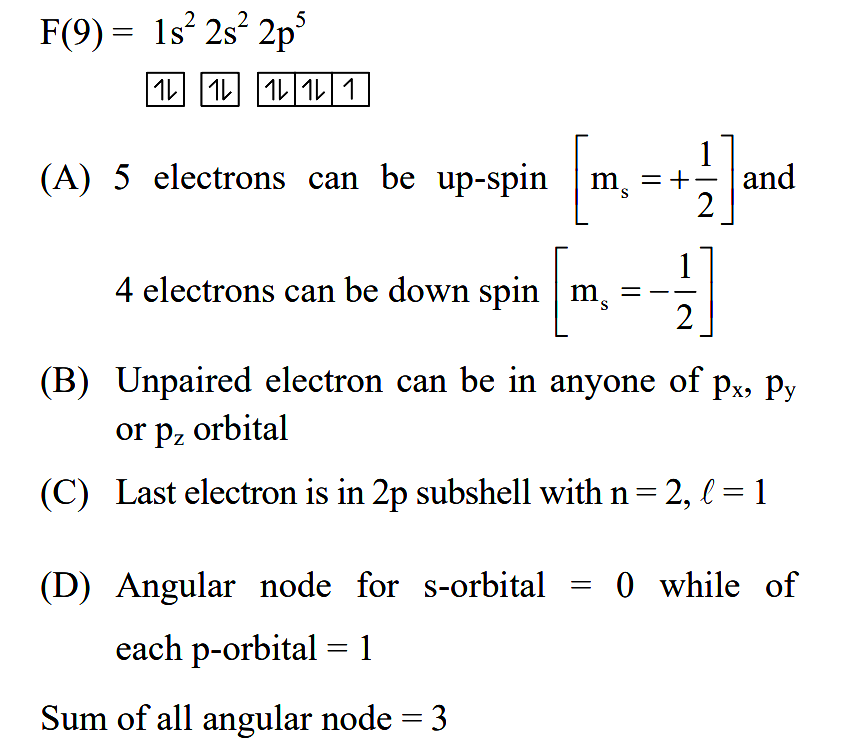
Explanation:
The element with atomic number 9 is Fluorine (\( \text{F} \)). Its ground-state electronic configuration is \( 1s^2 2s^2 2p^5 \). Let us analyze each statement:
1. Statement A is Correct: In the fully filled \( 1s^2 \) and \( 2s^2 \) subshells, there are 2 spin-up and 2 spin-down electrons. For the \( 2p^5 \) subshell, following Hund's rule, the distribution contains 3 spin-up and 2 spin-down electrons (or vice-versa). Therefore, a maximum of \( 2 + 3 = 5 \) electrons can have \( m_s = +\frac{1}{2} \) and \( 2 + 2 = 4 \) electrons can have \( m_s = -\frac{1}{2} \).
2. Statement B is Incorrect: The three \( 2p \) orbitals (\( 2p_x, 2p_y, 2p_z \)) are completely degenerate (equal in energy). The 5 valence electrons fill these orbitals such that two orbitals are completely paired and one remains unpaired. Because these orbitals are degenerate, the single unpaired electron can occupy any one of the three orbitals arbitrarily, not exclusively the \( p_z \) orbital.
3. Statement C is Correct: The last incoming electron enters the \( 2p \) subshell. For any electron occupying a \( 2p \) orbital, the principal quantum number is \( n = 2 \) and the azimuthal quantum number is \( l = 1 \).
4. Statement D is Incorrect: The number of angular nodes for any atomic orbital is given by its azimuthal quantum number (\( l \)). For Fluorine, the angular nodes for the occupied orbitals are: \( 1s \) has 0, \( 2s \) has 0, and each of the three active \( 2p \) orbitals (\( 2p_x, 2p_y, 2p_z \)) has 1 angular node. The total sum of angular nodes across all occupied atomic orbitals is \( 0 + 0 + 1 + 1 + 1 = 3 \).
Hence, Option B is the correct choice. - 10. For electron in ' 2 s ' and ' 2 p ' orbitals, the orbital angular momentum values, respectively are : 2025 Easy
- (A) \(\sqrt{2} \frac{\mathrm{~h}}{2 \pi}\) and 0
- (B) \(\frac{\mathrm{h}}{2 \pi}\) and \(\sqrt{2} \frac{\mathrm{~h}}{2 \pi}\)
- (C) 0 and \(\sqrt{6} \frac{\mathrm{~h}}{2 \pi}\)
- (D) 0 and \(\sqrt{2} \frac{\mathrm{~h}}{2 \pi}\)
Show answer and solution
Correct Answer: (D)
\(\begin{aligned} & \text { Orbital angular momentum }=\sqrt{\ell(\ell+1)} \frac{\mathrm{h}}{2 \pi} \\ & \therefore \quad \text { For } 2 \mathrm{~s} \text { orbital }: \ell=0 \\ & \text { Orbital angular momentum }=0 \\ & \therefore \quad \text { For } 2 \mathrm{p} \text { orbital }: \ell=1 \\ & \quad \begin{aligned} \text { Orbital angular momentum } & =\sqrt{1(1+2)} \frac{\mathrm{h}}{2 \pi} \\ & =\sqrt{2} \frac{\mathrm{~h}}{2 \pi}\end{aligned}\end{aligned}\) -
- (A) (B), (C) and (D) only
- (B) (A) and (E) only
- (C) (A) only
- (D) (B) only
Show answer and solution
Correct Answer: (A)
For hydrogen atom and one electron species, the energy of orbitals is decided by the value of principal quantum number. Higher the value of principal quantum number, higher will be the energy of orbital.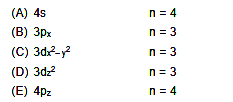
\(\therefore (B),(C)\) and (D) have orbitals with the lowest energy. -
- (A) Both Statement I and Statement II are true
- (B) Statement I is false but Statement II is true
- (C) Both Statement I and Statement II are false
- (D) Statement I is true but Statement II is false
Show answer and solution
Correct Answer: (B)
\(2 p_{\mathrm{x}}\) and \(2 \mathrm{p}_{\mathrm{y}}\) are degenerated orbitals hence having equal energy and therefore no spectral line will be observed for \(2 p_x \rightarrow 2 p_y\) transition. -
- (A) Both Statement I and Statement II are false
- (B) Statement I is true but Statement II is false
- (C) Both Statement I and Statement II are true
- (D) Statement I is false but Statement II is true
Show answer and solution
Correct Answer: (C)
For a shell total number of orbitals \(=n^2\)
Magnetic quantum number have values \((-\ell\) to \(+\ell)\) including 0 . -
- (A) B and C Only
- (B) A and B Only
- (C) C and D Only
- (D) D and E Only
Show answer and solution
Correct Answer: (D)
\(\begin{array}{lc} \mathrm{A}: \mathrm{n}=1, \ell=0, \mathrm{~m}_{\ell}=0 & 1 \mathrm{~s} \\ \mathrm{B}: \mathrm{n}=2, \ell=0, \mathrm{~m}_{\ell}=0 & 2 \mathrm{~s} \\ \mathrm{C}: \mathrm{n}=2, \ell=1, \mathrm{~m}_{\ell}=1 & 3 \mathrm{p} \\ \mathrm{D}: \mathrm{n}=3, \ell=2, \mathrm{~m}_{\ell}=1 & 3 \mathrm{~d} \\ \mathrm{E}: \mathrm{n}=3, \ell=2, \mathrm{~m}_{\ell}=0 & 3 \mathrm{~d} \\ \end{array}\)
In absence of electric and magnetic fields, all orbitals of 3d are degenerate. -
- (A) (A) and (C) only
- (B) (B) and (D) only
- (C) (C) and (D) only
- (D) (A) and (B) only
Show answer and solution
Correct Answer: (C)
For single electron species energy only depends on ' n ' (principal quantum number)
So energy of \(2 \mathrm{~s}=2 \mathrm{p}\)
and energy of \(3 \mathrm{~d} < 4 \mathrm{~s}\) -
- (A) (B) and (D) only
- (B) (A), (B) and (C) only
- (C) (C) and (D) only
- (D) (A) and (B) only
Show answer and solution
Correct Answer: (D)
(A) Azimuthal quantum number \((\ell)\) indicates the shape of orbital occupied by the electron
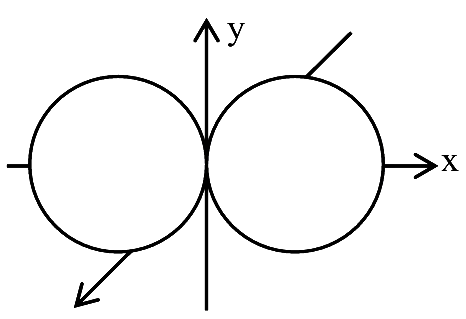
(B)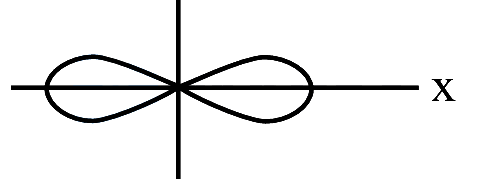
\(\mathrm{p}_{\mathrm{x}}\) orbital
(C) The + and - sign in the wave function of \(2 p_x\) orbital refer to the sign (Phase) of the wave function, not the charge
(D) The wave function of \(2 p_x\) orbital will be zero in yz plane (Nodal plane). -
- (A) The probability density of finding the electron is maximum at the nucleus
- (B) The electron can be found at a distance \(2 \mathrm{a}_0\) from the nucleus
- (C) The 1 s orbital is spherically symmetrical
- (D) The total energy of the electron is maximum when it is at a distance \(a_0\) from the nucleus
Show answer and solution
Correct Answer: (D)
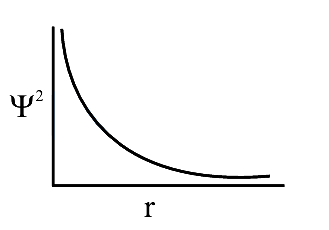
1. \(\Psi^2=\) Probability density is maximum at nucleus.
2. Electron can exist upto infinity from nucleus.
3. True
4. Energy of electron is maximum at infinite distance from nucleus. -
- (A) \((\mathrm{B})>(\mathrm{A})>(\mathrm{C})>\text { (E) }>\text { (D) }\)
- (B) \((\mathrm{E})>(\mathrm{C})<\text { (D) }<\text { (A) }<\text { (B) }\)
- (C) \({ (E) }>\text { (C) }>\text { (A) }>\text { (D) }>\text { (B) }\)
- (D) \((\mathrm{C})<\text { (E) }<\text { (D) }<\text { (A) }<\text { (B) }\)
Show answer and solution
Correct Answer: (D)
Energy level can be determined by comparing ( \(\mathrm{n}+\ell\) ) values\((A)\) \(\mathrm{n}=4, \ell=1 \Rightarrow(\mathrm{n}+\ell)=5\)
\((B)\) \(\mathrm{n}=4, \ell=2 \Rightarrow(\mathrm{n}+\ell)=6\)
\((C)\) \(\mathrm{n}=3, \ell=1 \Rightarrow(\mathrm{n}+\ell)=4\)
\((D\)) \(\mathrm{n}=3, \ell=2 \Rightarrow(\mathrm{n}+\ell)=5\)
\((E)\) \(\mathrm{n}=4, \ell=0 \Rightarrow(\mathrm{n}+\ell)=4\)
For same value of \((n+\ell)\), orbital having higher value of \(n\), will have more energy.
\((B) \)>\( (A) \)>\( (D) \)>\( (E) \)>\( (C)\)
-
- (A) Statement-\(I\) is true but Statement-\(II\) is false
- (B) Both Statement-\(I\) and Statement-\(II\) are true.
- (C) Both Statement-\(I\) and Statement-\(II\) are false
- (D) Statement-\(I\) is false but Statement-\(II\) is true
Show answer and solution
Correct Answer: (A)
For single electron species the energy depends upon principal quantum number ' \(n\) ' only. So, statement \(II\) is false.
Statement \(I\) is correct definition of degenerate orbitals. -
- (A) \(4\)
- (B) \(7\)
- (C) \(8\)
- (D) \(6\)
Show answer and solution
Correct Answer: (D)
\(\mathrm{n}=4\)l \(\quad \mathrm{m}_{\ell}\)
\(0 \quad 0\)
\(1-1,0,+1\)
\(2-2,-1,0,+1,+2,+3\)
So number of orbital associated with
\(\mathrm{n}=4,\left|\mathrm{~m}_{\mathrm{l}}\right|=1\) are \(6\)
Now each orbital contain one \(e^{-}\)with \(\mathrm{m}_x=-\frac{1}{2}\)
-
- (A) \(A-IV, B-III, C-II, D-I\)
- (B) \(A-III, B-II, C-I, D-IV\)
- (C) \(A-I, B-IV, C-III, D-II\)
- (D) \(A-II, B-I, C-IV, D-III\)
Show answer and solution
Correct Answer: (B)
(\(A\)) \({ }_7 \mathrm{~N}:[\mathrm{He}] 2 \mathrm{~s}^2 2 \mathrm{p}^3\)(\(B\)) \({ }_{16} \mathrm{~S}:[\mathrm{Ne}] 2 \mathrm{~s}^2 3 \mathrm{p}^4\)
(\(C\)) \({ }_{35} \mathrm{Br}:[\mathrm{Ar}] 3 \mathrm{~d}^{10} 4 \mathrm{~s}^2 4 \mathrm{p}^5\)
(\(D\)) \({ }_{36} \mathrm{Kr}:[\mathrm{Ar}] 3 \mathrm{~d}^{10} 4 \mathrm{~s}^2 4 \mathrm{p}^6\)
- 22. The correct set of four quantum numbers for the valence electron of rubidium atom \((Z=37)\) is _______. 2024 Hard
- (A) \(5,0,0,+\frac{1}{2}\)
- (B) \(5,0,1,+\frac{1}{2}\)
- (C) \(5,1,0,+\frac{1}{2}\)
- (D) \(5,1,1,+\frac{1}{2}\)
Show answer and solution
Correct Answer: (A)
\( \mathrm{Rb}=[\mathrm{Kr}] 5 \mathrm{~s}^1 \)\( \mathrm{n}=5 \)
\( l=0 \)
\( \mathrm{~m}=0 \)
\( \mathrm{~s}=+1 / 2 \text { or }-1 / 2\)
- 23. The four quantum numbers for the electron in the outer most orbital of potassium (atomic no. \(19\)) are _______. 2024 Hard
- (A) \(\mathrm{n}=4, l=2, \mathrm{~m}=-1, s=+\frac{1}{2}\)
- (B) \(\mathrm{n}=4, l=0, \mathrm{~m}=0, s=+\frac{1}{2}\)
- (C) \(\mathrm{n}=3, l=0, \mathrm{~m}=1, s=+\frac{1}{2}\)
- (D) \(\mathrm{n}=2, l=0, \mathrm{~m}=0, s=+\frac{1}{2}\)
Show answer and solution
Correct Answer: (B)
\({ }_{19} \mathrm{K} \quad 1 \mathrm{~s}^2, 2 \mathrm{~s}^2, 2 \mathrm{p}^6, 3 \mathrm{~s}^2, 3 \mathrm{p}^6, 4 \mathrm{~s}^1 \text {. }\)Outermost orbital of potassium is \(4 \mathrm{~s}\) orbital
\(\mathrm{n}=4, \mathrm{l}=0, \mathrm{~m}_1=0, \mathrm{~s}= \pm \frac{1}{2}\)
-
- (A) \(14\)
- (B) \(35\)
- (C) \(18\)
- (D) \(16\)
Show answer and solution
Correct Answer: (D)
\(n=4\) can have,
So, Ans.\(16\)\(4\text s\) \(4\text q\) \(4\text d\) \(4\text f\) Total \(\text e^{-}\) \(2\) \(6\) \(10\) \(14\) Total \(\text e ^{-}\)with \(\text S =+\frac{1}{2}\) \(1\) \(3\) \(5\) \(7\) -
- (A) \(1\)
- (B) \(4\)
- (C) \(2\)
- (D) \(3\)
Show answer and solution
Correct Answer: (A)
For \(3 \mathrm{p}: \mathrm{n}=3, \ell=1\)Number of radial node \(=n-\ell-1\)
\(=3-1-1=1\)
-
- (A) \(2\)
- (B) \(7\)
- (C) \(9\)
- (D) \(11\)
Show answer and solution
Correct Answer: (A)
\( \text { Noble gas configuration }=\mathrm{ns}^2 \mathrm{np}^6 \)\( {\left[\mathrm{Sr}^{2+}\right]=[\mathrm{Kr}\rfloor} \)
\( {\left[\mathrm{Cs}^{+}\right]=[\mathrm{Xe}]} \)
\( {\left[\mathrm{Yb}^{2+}\right]=[\mathrm{Xe}] 4 \mathrm{f}^{14}}\)
\( {\left[\mathrm{La}^{2+}\right]=[\mathrm{Xe}] 5 \mathrm{~d}^1} \)
\( {\left[\mathrm{~Pb}^{2+}\right]=[\mathrm{Xe}] 4 \mathrm{f}^{14} 5 \mathrm{~d}^{10} 6 \mathrm{~s}^2} \)
\( {\left[\mathrm{Fe}^{2+}\right]=[\mathrm{Ar}] 3 \mathrm{~d}^6}\)
-
- (A) \(B > D > C > A\)
- (B) \(D > B > C > A\)
- (C) \(A > C > B > D\)
- (D) \(D > B > A > C\)
Show answer and solution
Correct Answer: (B)
\((A)\) \(n =3 ; 1=0 ; m =0 ; 3 s\) orbital\((B)\) \(n =4 ; 1=0 ; m =0 ; 4 s\) orbital
\((C)\) \(n =3 ; 1=1 ; m =0 ; 3 p\) orbital
\((D)\) \(n =3 ; 1=2 ; m =0 ; 3 d\) orbital
As per Hund's rule energy is given by \(( n +l)\) value.
If value of \(( n +l)\) remains same then energy is given by \(n\) only.
-
- (A) Both \(A\) and \(R\) are true but \(R\) is NOT the correct explanation of \(A\)
- (B) Both \(A\) and \(R\) are true and \(R\) is the correct explanation of \(A\)
- (C) \(A\) is false but \(R\) is true
- (D) \(A\) is true but \(R\) is false
Show answer and solution
Correct Answer: (B)
\(5 f\) orbital not buried as \(4 f\) orbitals so \(e ^{-}\) present in \(5 f\) orbital experience less nuclear attraction than \(e ^{-}\)present in \(4 f\) orbital. Hence electrons of 5 f orbital can take part in bonding to a far greater extent. -
- (A) \(16\)
- (B) \(32\)
- (C) \(50\)
- (D) \(72\)
Show answer and solution
Correct Answer: (B)
The number of electrons in the orbitals of sub-shell of \(n=4\) are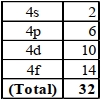
- 30. The number of atomic orbitals from the following having \(5\) radial nodes is \(.......\). \(7 s , 7 p , 6 s , 8 p , 8 d\) 2023 Medium
- (A) \(3\)
- (B) \(2\)
- (C) \(1\)
- (D) \(4\)
Show answer and solution
Correct Answer: (A)
Radial node \(= n -\ell-1\)\(7 s \Rightarrow R \cdot N =7-0-1=6\)
\(7 p \Rightarrow R \cdot N =7-1-1=5\)
\(6 s \Rightarrow R \cdot N =6-0-1=5\)
\(8 p \Rightarrow R \cdot N =8-1-1=6\)
\(8 d \Rightarrow R \cdot N =8-2-1=5\)
So, Answer is \(3\)
-
- (A) \(3\)
- (B) \(4\)
- (C) \(2\)
- (D) \(5\)
Show answer and solution
Correct Answer: (A)
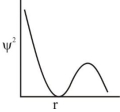
\(A, D\) and \(E\) statements are correct.For \(2 s\) orbital, the probability density first decreases and then increases.
At any distance from nucleus the probability density of finding electron is never zero and it always have some finite value.
- 32. The number of s-electrons present in an ion with \(55\) protons in its unipositive state is 2023 Hard
- (A) \(8\)
- (B) \(9\)
- (C) \(12\)
- (D) \(10\)
Show answer and solution
Correct Answer: (D)
\(Z =55[ Cs ] \Rightarrow[ Xe ] 6 s ^1\)\(\left[ Cs ^{+}\right] \Rightarrow[ Xe ]\) i.e. upto \(5 s\) count \(e ^{-}\)of s-subshell i.e. \(1 s , 2 s , 3 s , 4 s , 5 s \Rightarrow 10\) electrons
-
- (A) \(r_0=a_0\)
- (B) \(r_0=4 a_0\)
- (C) \(r _0=\frac{ a _0}{2}\)
- (D) \(r_0=2 a_0\)
Show answer and solution
Correct Answer: (D)
At node \(\Psi_{2 s }=0\)\(\therefore 2-\frac{ r _0}{ a _0}=0\)
\(\therefore r _0=2 a _0\)
-
- (A) Only \(A\)
- (B) Only \(B\)
- (C) Only \(C\)
- (D) \((B)\) and \((C)\)
Show answer and solution
Correct Answer: (B)
Based on \(" n+1 "\) rule only \((B)\) has pair of electron in degenerate orbitals -
- (A) \(4\)
- (B) \(1\)
- (C) \(2\)
- (D) \(3\)
Show answer and solution
Correct Answer: (C)
Quantum no. of set \((B)\) and \((C)\) can be correct.\((A)\) and \((D)\) are wrong as \(n=\ell\) is not possible.
-
- (A) \(( A ),( B )\) and \(( C )\)
- (B) \(( A ),( C ),( D )\) and \(( E )\)
- (C) \(( A ),( C )\) and \(( D )\)
- (D) \(( A ),( B ),( C )\) and \(( D )\)
Show answer and solution
Correct Answer: (C)
\((A)\) Number of values of \(n =1,2,3 \ldots \infty\)\((B)\) Number of values of \(\ell=0\) to \(( n -1)\)
\((C)\) Number of values of \(m =-\ell\) to \(+\ell\)
Total values \(=2 \ell+1\)
\((D)\) Values of \(\operatorname{spin}=\pm \frac{1}{2}\)
\((E)\) For \(\ell=5\) number of orbitals \(=2 \ell+1=11\)
-
- (A) \(D < B < A < C\)
- (B) \(D < A < B < C\)
- (C) \(B < D < A < C\)
- (D) \(B < D < C < A\)
Show answer and solution
Correct Answer: (B)
Energy order of subshell decided by \(( n +\lambda)\) rule.\(A \Rightarrow 3 d \Rightarrow n +1=5\)
\(B \Rightarrow 4 p \Rightarrow n +\lambda=5\)
\(C \Rightarrow 4 d \Rightarrow n +\ell \Rightarrow 6\)
\(D \Rightarrow 3 s \Rightarrow( n +\ell)=4\)
\(D < A < B < C\)
-
- (A) Both \(A\) and \(R\) are true and \(R\) is the correct explanation of \(A\).
- (B) Both \(A\) and \(R\) are true but \(R\) is NOT the correct explanation of \(A\).
- (C) \(A\) is true but \(R\) is false.
- (D) \(A\) is false but \(R\) is true.
Show answer and solution
Correct Answer: (A)
Energy of orbitals decreases on increasing the atomic number. -
- (A) A circular path around the nucleus in which an electron moves is proposed as Bohr's orbit.
- (B) An orbital is the one electron wave function \((\Psi)\) in an atom.
- (C) The existence of Bohr's orbits is supported by hydrogen spectrum.
- (D) Atomic orbital is characterised by the quantum numbers \(n\) and \(l\) only
Show answer and solution
Correct Answer: (D)
Atomic orbital is characterised by \(n , l,m\). -
- (A) \(( D )>( B )>( C )>( A )\)
- (B) \((B) >( D )>( C )>( A )\)
- (C) \(( C )>( B )>( D )>( A )\)
- (D) \((B) >( C )>( D )>( A )\)
Show answer and solution
Correct Answer: (A)
\((A)\) \(n+\ell=3+0=3\)\((B)\) \(n+\ell=4+0=4\)
\((C)\) \(n+\ell=3+1=4\)
\((D)\) \(n+\ell=3+2=5\)
Higher \(n+\ell\) value, higher the energy if same \(n +\ell\) value, then higher \(n\) value, higher the energy.Thus: \(D > B > C > A\).
- 41. The number of radial and angular nodes in \(4 d\) orbital are, respectively ........ . 2022 Easy
- (A) \(1\) and \(2\)
- (B) \(3\) and \(2\)
- (C) \(1\) and \(0\)
- (D) \(2\) and \(1\)
Show answer and solution
Correct Answer: (A)
Radial node \(= n - l -1\)\(=4-2-1\)
\(=1\)
Angular node \((l)=2\)
-
- (A) \(n=3,1=2, m_{1}=0, s=+\frac{1}{2}\)
- (B) \(n=3,1=2, m_{1}=-2, s=+\frac{1}{2}\)
- (C) \(n=3,1=3, m_{1}=-3, s=-\frac{1}{2}\)
- (D) \(n =3,1=0, m _{1}=0, s =-\frac{1}{2}\)
Show answer and solution
Correct Answer: (C)
\(1=0,1,2 \ldots(n-1)\)\(\therefore\) for \(n=3\)
\(1=0,1,2\)
\(1=3 \text {, }\)
not possible for \(n=3\)
- 43. A certain orbital has \(n =4\) and \(m _{ L }=-3\). The number of radial nodes in this orbital is .......... (Round off to the Nearest Integer). 2021 Medium
- (A) \(1\)
- (B) \(0\)
- (C) \(3\)
- (D) \(5\)
Show answer and solution
Correct Answer: (B)
\(n =4\) and \(m _{\ell}=-3\)Hence, \(\ell\) value must be \(3\).
Now, number of radial nodes \(= n -\ell-1\)
\(=4-3-1=0\)
-
- (A) \(2\, s\)
- (B) \(3\, s\)
- (C) \(3\, p\)
- (D) \(2\, p\)
Show answer and solution
Correct Answer: (B)
\(1=0 \Rightarrow\) \('s'\) orbital\(n-l-1=2\)
\(n-1=2\)
\(n =3\)
- 45. The number of orbitals with \(n =5, m _{l}=+2\) is ...... . (Round off to the Nearest Integer) 2021 Medium
- (A) \(3\)
- (B) \(2\)
- (C) \(1\)
- (D) \(0\)
Show answer and solution
Correct Answer: (A)
For, \(n =5\)\(\ell=(0,1,2,3,4)\)
If \(\ell=0, m =0\)
\(\ell=1, m =\{-1,0,+1\}\)
\(\ell=2, m =\{-2,-1,0,+1,+2\}\)
\(\ell=3, m =\{-3,-2,-1,0,+1,+2,+3\}\)
\(\ell=4, m =\{-4,-3,-2,-1,0,+1,+2,+3,+4\}\)
\(5 d , 5 f\) and \(5 g\) subshell contain one-one orbital having \(m _{\ell}=+2\)
-
- (A) \(3 p\)
- (B) \(4 f\)
- (C) \(4 d\)
- (D) \(5 d\)
Show answer and solution
Correct Answer: (D)
\(n-l-1=2\)\(1=2\)
\(n-2-1=2\)
\(n=5\)
-
- (A) \((B)\)
- (B) \((A)\)
- (C) \((D)\)
- (D) \((C)\)
Show answer and solution
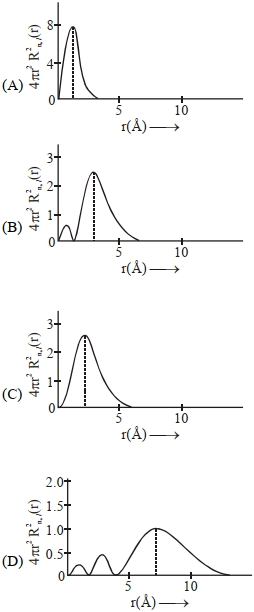
Correct Answer: (C)
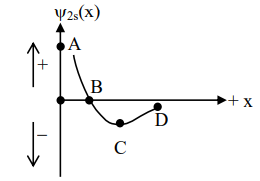
Number of radial nodes \(= n -\ell-1\)\(=3-0-1=2\)
Therefor corresponding graph is \((D)\)
Hence answer is (3)
- 48. The value of magnetic quantum number of the outermost electron of \(\mathrm{Zn}^{+}\)ion is ..... . 2021 Medium
- (A) \(1\)
- (B) \(0\)
- (C) \(3\)
- (D) \(2\)
Show answer and solution
Correct Answer: (B)
\(\mathrm{Zn}^{+} \rightarrow 1 \mathrm{~s}^{2} 2 \mathrm{~s}^{2} 2 \mathrm{p}^{6} 3 \mathrm{~s}^{2} 3 \mathrm{p}^{6} 3 \mathrm{~d}^{10} 4 \mathrm{~s}^{1}\)Outermost electron is in \(4 \,\mathrm{~s}\) subshell \(\mathrm{m}=0\)
-
- (A) \(13\) has a half\(-\)filled valence subshell
- (B) \(9\) is the first alkali metal
- (C) \(8\) is the first noble gas
- (D) \(6\) has a \(2 p-\) valence subshell
Show answer and solution
Correct Answer: (A)
\(l=0\) to \(( n +1)\)\(n =1 \quad n =2\)
\(l=0,1,2 \quad l=0,1,2,3\)
\((n+l) \Rightarrow \frac{1 s}{1} \frac{1 p}{2} \frac{1 d}{3} \quad \frac{2 s}{2} \frac{2 p}{3} \frac{2 d}{4} \frac{2 f}{5}\)
\(n=3\)
\(l=0,1,2,3,4\)
\(\frac{3 s }{3} \frac{3 p }{4} \frac{3 d }{5} \frac{3 f }{6} \frac{3 g }{7}\)
Now, in order to write electronic configuration, we need to apply \(( n +l)\) rule
Energy order : \(1 s <1 p <2 s <1 d <2 p <3 s <2 d\)
Option 1) \(13: 1 s^{2} 1 p^{6} 2 s^{2} 1 d^{3}\) is not half filled
Option 2) \(9: \quad 1 s^{2} 1 p^{6} 2 s^{1}\) is the first alkali metal because after losing one electron, it will achieve first noble gas configuration
Option \(3)\) \(8: \quad 1 s^{2} 1 p^{6}\) is the first noble gas because after \(1 p ^{6} e ^{-}\) will
Option \(4)\) \(6: \quad 1 s ^{2} 1 p ^{4}\) has \(1 p\) valence subshell.
-
- (A) \(6 s, 5 f, 6 d, 6 p\)
- (B) \(6 s, 6 p, 6 d, 6 f\)
- (C) \(6 s, 5 d, 5 f, 6 p\)
- (D) \(6 s, 4 f, 5 d, 6 p\)
Show answer and solution
Correct Answer: (D)
As per \(( n +\ell)\) rule in \(6^{th}\) period, order of orbitals filling is \(6 s, 4 f, 5 d, 6 p\)
No questions on this page match these filters.
Other STD 11 - Structure of atom topics
Frequently asked
How many Quantum number, Electronic configuration and Shape of orbitals questions came in JEE Mains?
61 questions from 2013–2026, each with the correct answer and a full solution.
How difficult are Quantum number, Electronic configuration and Shape of orbitals questions?
20% are easy, 54% medium and 26% hard.