


Questions
Newest firstShowing 1–12 of 12 questions
-
- (A) 78.21
- (B) 78.23
- (C) 78.25
- (D) 78.26
Show answer and solution
Correct Answer: (C)
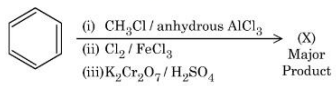
Step 1: The first reaction is a Friedel-Crafts alkylation. Benzene reacts with \(CH_3Cl\) in the presence of anhydrous \(AlCl_3\) to form toluene.
Step 2: The second reaction is electrophilic aromatic substitution. Toluene reacts with \(Cl_2\) in the presence of \(FeCl_3\) to form a mixture of o-chlorotoluene and p-chlorotoluene. Due to steric hindrance at the ortho position, the major product is p-chlorotoluene.
Step 3: The third reaction is the oxidation of the alkyl side chain. p-chlorotoluene is oxidized by \(K_2Cr_2O_7 / H_2SO_4\) to form p-chlorobenzoic acid, which is the major product \((X)\).
The molecular formula of p-chlorobenzoic acid is \(C_7H_5ClO_2\).
Molar mass of \((X) = (7 \times 12) + (5 \times 1) + 35.5 + (2 \times 16) = 84 + 5 + 35.5 + 32 = 156.5 \text{ g mol}^{-1}\).
Step 4: Reaction of p-chlorobenzoic acid with \(NaHCO_3\) liberates \(CO_2\) gas:
\(C_6H_4ClCOOH + NaHCO_3 \rightarrow C_6H_4ClCOONa + H_2O + CO_2 \uparrow\)
From the stoichiometry, \(1\) mole of p-chlorobenzoic acid produces \(1\) mole of \(CO_2\) gas.
Volume of \(CO_2\) liberated at STP = \(11.2 \text{ dm}^3\).
Moles of \(CO_2\) liberated = \(\dfrac{11.2}{22.4} = 0.5 \text{ mol}\).
Therefore, moles of p-chlorobenzoic acid reacted = \(0.5 \text{ mol}\).
Mass of \((X)\) reacted, \(P = 0.5 \text{ mol} \times 156.5 \text{ g mol}^{-1} = 78.25 \text{ g}\).
Answer: \(78.25\) -
- (A) 6
- (B) 16
- (C) 4
- (D) 60
Show answer and solution
Correct Answer: (A)
\(1.4 dm ^3\) (or 1.4 mL ) occupied by 1 gm
\(\therefore \) Molecular weight of \(Q =\frac{22.4}{1.4}=16\)
\(\therefore Q\) is \(CH _4\) gas and Grignard reagent is \(CH _3 MgBr\)
\(CH_3 MgBr \xrightarrow[\text { (ii) } H_3 O^{+}]{\text {(i) } CO_2 \text { (dryice) }} CH_3 COOH\)
(Molecular weight 60 )
\(\therefore \) Weight of 0.1 mole of \(CH _3 COOH =6\) -
- (A) A and D only
- (B) A,B and E only
- (C) B,C and E only
- (D) B and E only
Show answer and solution
Correct Answer: (D)
(A) \(\mathrm{R}-\mathrm{C} \equiv \mathrm{N} \xrightarrow[\text { mild condition }]{\text { (i) } \mathrm{H}^{+} / \mathrm{H}_2 \mathrm{O}} \mathrm{R}-\mathrm{CONH}_2\)
Under mild condition amide is formed because this reaction is typically slow if further more heat will supplied then it gets convert in to -COOH.
(B) \(\mathrm{R}-\mathrm{MgX} \xrightarrow[\text { (ii) } \mathrm{H}_3 \mathrm{O}^{+}]{\text {(i) } \mathrm{CO}_2} \mathrm{R}-\mathrm{COOH}\)
(C) \(\mathrm{R}-\mathrm{C} \equiv \mathrm{N} \xrightarrow[\text { (ii) } \mathrm{H}_3 \mathrm{O}^{+}]{\text {(i) } \mathrm{SnCl}_2 / \mathrm{HCl}} \mathrm{R}-\mathrm{CHO}\)
(D) \(\mathrm{R} \cdot \mathrm{CH}_2 \cdot \mathrm{OH} \xrightarrow{\mathrm{PCC}} \mathrm{R}-\mathrm{CHO}\)
(E)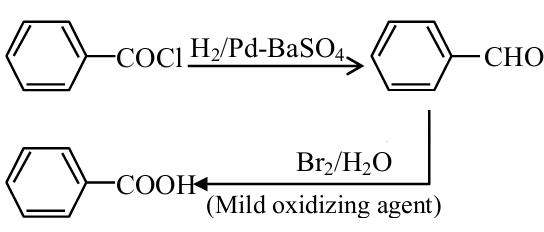
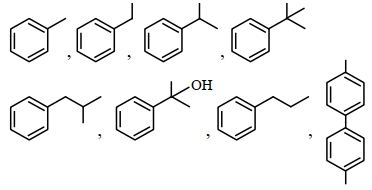
- 4. The total number of compounds from below when treated with hot \(\text{KMnO} _4\) giving benzoic acid is _______.
 2025 Medium
- (A) 3
- (B) 4
- (C) 6
- (D) 5
Show answer and solution
Correct Answer: (D)
Compounds having at least \(1 \alpha- H\) will react with \(KMnO _4\) and give benzoic acid.
Total 5 compounds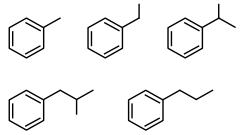
-
- (A) \(5\)
- (B) \(4\)
- (C) \(10\)
- (D) \(11\)
Show answer and solution
Correct Answer: (A)
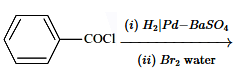
Major product \(B\) is \(\rightarrow\)(Image)
Total number of \(\pi\) bonds in \(B\) are \(5\)

-
- (A) \(2\)
- (B) \(3\)
- (C) \(8\)
- (D) \(4\)
Show answer and solution
Correct Answer: (D)
\(\pi\) bonds \(=4\)
- 7. \(2-\) hexene \(\xrightarrow[(ii)H_2O]{(i) O_3}\) Products The two products formed in above reaction are - 2023 Medium
- (A) Butanoic acid and acetic acid
- (B) Butanal and acetic acid
- (C) Butanal and acetaldehyde
- (D) Butanoic acid and acetaldehyde
Show answer and solution
Correct Answer: (A)

Explanation:
1. Determine the type of Ozonolysis:
The reaction involves treating 2-hexene with ozone followed by water (\( \text{H}_2\text{O} \)) alone, without any reducing agent like \( \text{Zn} \) or \( \text{Me}_2\text{S} \). This represents an oxidative ozonolysis pathway.
2. Identify initial intermediate cleavage:
The structural formula of 2-hexene is:
\( \text{CH}_3-\text{CH}=\text{CH}-\text{CH}_2-\text{CH}_2-\text{CH}_3 \)
Cleaving the double bond initially forms two aldehydes:
- Acetaldehyde (\( \text{CH}_3\text{CHO} \)) from the 2-carbon fragment.
- Butanal (\( \text{CH}_3\text{CH}_2\text{CH}_2\text{CHO} \)) from the 4-carbon fragment.
3. Oxidation of intermediates:
During the reaction with water, hydrogen peroxide (\( \text{H}_2\text{O}_2 \)) is produced. Since no zinc is available to neutralize it, the \( \text{H}_2\text{O}_2 \) oxidizes the aldehydes to their corresponding carboxylic acids:
- Acetaldehyde (\( \text{CH}_3\text{CHO} \)) \( \rightarrow \) Acetic acid (\( \text{CH}_3\text{COOH} \))
- Butanal (\( \text{CH}_3\text{CH}_2\text{CH}_2\text{CHO} \)) \( \rightarrow \) Butanoic acid (\( \text{CH}_3\text{CH}_2\text{CH}_2\text{COOH} \))
Hence, Option A is the correct choice. -
- (A) \(4\)
- (B) \(3\)
- (C) \(1\)
- (D) \(2\)
Show answer and solution
Correct Answer: (C)
\([Image]\)no. of carbon atoms present in \(B\) is \(1\)

-
- (A) Compound \('A'\) is dicarboxylic acid and compound \('B'\) is diol
- (B) Compound \('A'\) is diol and compound \('B'\) is dicarboxylic acid
- (C) Both compound \('A'\) and compound \(' B'\) are diols
- (D) Both compound \('A'\) and compound \('B'\) are dicarboxylic acids
Show answer and solution
Correct Answer: (A)
\(\mathrm{KMnO}_{4} / \mathrm{H}_{2} \mathrm{SO}_{4} / \Delta\) act as a strong oxidising agent where as \(\mathrm{KMnO}_{4} / \mathrm{H}_{2} \mathrm{O} / 273\, \mathrm{~K}\) is a mild oxidising agent.
-
- (A) \(\mathrm{CH}_{3} \mathrm{CH}_{2} \mathrm{COCH}_{3}+\mathrm{OI}^{-} / \mathrm{H}_{3} \mathrm{O}^{+}\)
- (B) \(\mathrm{CH}_{3} \mathrm{CH}_{2} \mathrm{CH}_{3}+\mathrm{KMnO}_{4}(\mathrm{Heat}), \mathrm{OH} / \mathrm{H}_{3} \mathrm{O}^{+}\)
- (C) \(\mathrm{CH}_{3} \mathrm{CH}_{2} \mathrm{CCl}_{3}+\mathrm{OH}^{-} / \mathrm{H}_{3} \mathrm{O}^{+}\)
- (D) \(\mathrm{CH}_{3} \mathrm{CH}_{2} \mathrm{CH}_{2} \mathrm{Br}+\mathrm{Mg}, \mathrm{CO}_{2}\) dry ether \(/ \mathrm{H}_{3} \mathrm{O}^{+}\)
Show answer and solution
Correct Answer: (D)
All gives propanoic acid as product but option \(4\) gives butanoic as product
- 11. But \(-2-\) ene on reaction with alkaline \(KMnO_4\) at elevated temperature followed by acidification will give 2019 Hard
- (A) One molecule of \(CH_3CHO\) and one molecule of \(CH_3COOH\)
- (B) \(2\) molecules of \(CH_3CHO\)
- (C) \(2\) molecules of \(CH_3COOH\)
- (D) \(\begin{array}{*{20}{c}}
{C{H_3} - CH - CH - C{H_3}}\\
{\,\,\,\,\,\,|\,\,\,\,\,\,\,\,\,\,\,\,\,\,\,\,\,\,\,|\,\,\,\,\,\,\,\,\,}\\
{OH\,\,\,\,\,\,\,\,OH}
\end{array}\)
Show answer and solution
Correct Answer: (C)
\(C{H_3} - CH = CH - C{H_3}\xrightarrow[\Delta ]{{KMn{O_4}}}\) \(Images\) \( \to \,2C{H_3} - CHO\,\xrightarrow{{[O]}}2C{H_3} - COOH\)
- 12. The major product formed when \(1, 1, 1-\) trichloro propane is treated with aqueous potassium hydroxide is 2014 Hard
- (A) Propyne
- (B) \(1-\) Propanol
- (C) \(2-\) Propanol
- (D) Propionic acid
Show answer and solution
Correct Answer: (D)
\(C{l_3}C - C{H_2}C{H_3} + KOH\xrightarrow{{heat}}\) \({\left( {OH} \right)_3}C - C{H_2}C{H_3} + 3KCl \to \) \(\begin{array}{*{20}{c}}
{\,\,\,\,\,\,O} \\
{\,\,\,\,\,\,||} \\
{C{H_3}C{H_2}C - OH}
\end{array}\)


No questions on this page match these filters.
Other STD 12 - Carboxylic acids and their derivative topics
Frequently asked
How many Preparation of Carboxylic Acids and Their Derivatives questions came in JEE Mains?
12 questions from 2014–2026, each with the correct answer and a full solution.
How difficult are Preparation of Carboxylic Acids and Their Derivatives questions?
17% are easy, 50% medium and 33% hard.