


Topics
11 topics- 25Qs Depression of freezing point of the solvent
- 4Qs Colligative properties
- 23Qs Osmosis and Osmotic pressure of the solution
- 25Qs Lowering of vapour pressure
- 32Qs Method of expressing concentration of solution Most asked
- 25Qs Solubility
- 20Qs Elevation of boiling point of the solvent
- 2Qs Colligative properties of electrolyte
- 28Qs Abnormal molecular mass
- 2Qs Azeotropic mixture
- 2Qs Ideal and Non-ideal solution
All Solution and colligative properties questions
Newest firstShowing 1–50 of 188 questions
-
- (A) \(10^{-6}\)
- (B) \(4 \times 10^{-4}\)
- (C) \(3 \times 10^{-5}\)
- (D) \(3 \times 10^{-3}\)
Show answer and solution
Correct Answer: (D)
The molality of the solution is given by:
\(m = \dfrac{\text{Mass of solute}}{\text{Molar mass of solute} \times \text{Mass of solvent in kg}}\)
\(m = \dfrac{19.5}{78 \times 0.5} = 0.5 \text{ mol kg}^{-1}\)
The depression in freezing point is given by:
\(\Delta T_f = i \times K_f \times m\)
Substituting the given values:
\(1 = i \times 1.86 \times 0.5\)
\(1 = i \times 0.93\)
\(i = \dfrac{1}{0.93} = \dfrac{100}{93}\)
For the dissociation of a weak acid \(HA \rightleftharpoons H^+ + A^-\), the van 't Hoff factor is \(i = 1 + \alpha\), where \(\alpha\) is the degree of dissociation.
\(1 + \alpha = \dfrac{100}{93}\)
\(\alpha = \dfrac{100}{93} - 1 = \dfrac{7}{93}\)
The acid dissociation constant \(K_a\) is given by:
\(K_a = \dfrac{C \alpha^2}{1 - \alpha}\)
Since molarity and molality have the same values, \(C = 0.5 \text{ M}\).
\(K_a = \dfrac{0.5 \times \left(\dfrac{7}{93}\right)^2}{1 - \dfrac{7}{93}}\)
\(K_a = \dfrac{0.5 \times \dfrac{49}{93^2}}{\dfrac{86}{93}} = \dfrac{0.5 \times 49}{93 \times 86}\)
\(K_a = \dfrac{24.5}{7998} \approx 3.06 \times 10^{-3}\)
The closest value is \(3 \times 10^{-3}\).
Answer: \(3 \times 10^{-3}\) -
- (A) 60
- (B) 61
- (C) 62
- (D) 63
Show answer and solution
Correct Answer: (C)
The osmotic pressure \(\pi\) of the solution is balanced by the hydrostatic pressure of the liquid column.
\(\pi = \rho g h\)
Given:
Density of solution, \(\rho = 1000 \text{ kg m}^{-3}\)
Acceleration due to gravity, \(g = 10 \text{ m s}^{-2}\)
Height difference, \(h = 80.0 \text{ mm} = 0.08 \text{ m}\)
\(\pi = 1000 \times 10 \times 0.08 = 800 \text{ Pa} = 0.8 \text{ kPa}\)
From the van 't Hoff equation for osmotic pressure:
\(\pi = C R T = \dfrac{n}{V} R T\)
Given:
Volume of solution, \(V = 1 \text{ L} = 1 \text{ dm}^3\)
Gas constant, \(R = 8.3 \text{ kPa dm}^3 \text{ K}^{-1} \text{mol}^{-1}\)
Temperature, \(T = 300 \text{ K}\)
Substituting the values:
\(0.8 = \dfrac{n}{1} \times 8.3 \times 300\)
\(n = \dfrac{0.8}{2490} \text{ mol}\)
The mass of hemoglobin is \(w = 20 \text{ g} = 0.02 \text{ kg}\).
The molar mass \(M\) in \(\text{kg mol}^{-1}\) is:
\(M = \dfrac{w}{n} = \dfrac{0.02}{\dfrac{0.8}{2490}}\)
\(M = \dfrac{0.02 \times 2490}{0.8} = \dfrac{49.8}{0.8} = 62.25 \text{ kg mol}^{-1}\)
Rounding to the nearest integer, we get \(62\).
Answer: \(62\) -
- (A) 5
- (B) 10
- (C) 15
- (D) 20
Show answer and solution
Correct Answer: (A)
From the relative lowering of vapour pressure, we have:
\(\dfrac{P^0 - P_s}{P_s} = \dfrac{n_B}{n_A}\)
where \(n_B\) is the number of moles of solute and \(n_A\) is the number of moles of solvent.
Substituting the given values:
\(\dfrac{760 - 750}{750} = \dfrac{n_B}{n_A}\)
\(\dfrac{10}{750} = \dfrac{n_B}{n_A} \Rightarrow n_A = 75 n_B\)
The elevation in boiling point is given by:
\(\Delta T_b = T_b - T_b^0 = 320 - 319.5 = 0.5\) K
We also know that \(\Delta T_b = K_b \times m\), where \(m\) is the molality of the solution.
\(m = \dfrac{n_B}{\text{Mass of solvent in kg}} = \dfrac{n_B}{0.04}\)
Substituting the values into the elevation in boiling point equation:
\(0.5 = 0.3 \times \dfrac{n_B}{0.04}\)
\(n_B = \dfrac{0.5 \times 0.04}{0.3} = \dfrac{0.02}{0.3} = \dfrac{1}{15}\) mol
Now, substituting \(n_B\) back to find the number of moles of the solvent \(n_A\):
\(n_A = 75 \times \dfrac{1}{15} = 5\) mol
Answer: \(5\) -
- (A) 1.23 atm
- (B) 2.46 atm
- (C) 0.82 atm
- (D) 1.47 atm
Show answer and solution
Correct Answer: (B)
Mass of solute 'A' = 0.3 g
Moles of solute 'A' = \( \frac{0.3g}{60g/mol} = \frac{1}{200} \) mol
Mass of solute 'B' = 0.9 g
Moles of solute 'B' = \( \frac{0.9g}{180g/mol} = \frac{1}{200} \) mol
Total molarity of all solutes
= \( \frac{2/200}{100} \times 1000 = \frac{1}{10}M \)
\( \therefore\pi = \frac{1}{10} \times 0.082 \times 300 \)
\( \pi = 2.46 \) atm. -
- (A) 3
- (B) 1
- (C) 5
- (D) 2
Show answer and solution
Correct Answer: (A)
\(\Delta T _{ b }= i \times K _{ b } \times m\)
\(0.5= i \times m \times 5\)
\(i \times m =\frac{0.5}{5}=0.1\)
\(i \times a =\frac{15}{1000}\)
(where \(a=\) moles of solute)
Now,
\(\frac{P_o-P_S}{P^o}=i X_{\text {solute }}=i \times \frac{a}{a+\frac{150}{300}}\)
\(= i \times \frac{ a }{1 / 2}=\frac{15 / 1000}{1 / 2}=\frac{30}{1000}=3 \times 10^{-2}=3\) -
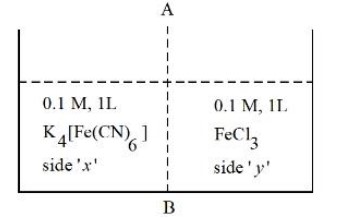
- (A) Blue color is formed on both sides.
- (B) Ionic solutes in aqueous solution can pass through semi-permeable membrane.
- (C) Solution on side '\(y\)' is hypotonic.
- (D) To cause the reverse flow of solvent during osmosis, external pressure (any value) should be applied to side '\(x\)'.
Show answer and solution
Correct Answer: (C)
For complete dissociation, the van 't Hoff factor \(i\) is equal to the number of ions produced per formula unit.
For side 'x' containing \(K_4[Fe(CN)_6]\):
\(K_4[Fe(CN)_6] \rightarrow 4K^+ + [Fe(CN)_6]^{4-}\)
Number of ions, \(i_x = 5\)
Effective concentration (osmolarity) \(= i_x \times C = 5 \times 0.1 = 0.5\) M
For side 'y' containing \(FeCl_3\):
\(FeCl_3 \rightarrow Fe^{3+} + 3Cl^-\)
Number of ions, \(i_y = 4\)
Effective concentration (osmolarity) \(= i_y \times C = 4 \times 0.1 = 0.4\) M
Since the effective concentration of side 'y' (\(0.4\) M) is less than that of side 'x' (\(0.5\) M), the solution on side 'y' has a lower osmotic pressure and is therefore hypotonic with respect to side 'x'.
Evaluating the other options:
A semi-permeable membrane (SPM) only allows solvent molecules to pass, not solute ions. Thus, \(Fe^{3+}\) and \([Fe(CN)_6]^{4-}\) cannot mix, and no blue color is formed.
To cause reverse osmosis, the external pressure applied to the hypertonic side (side 'x') must be strictly greater than the osmotic pressure difference (\(\Delta \pi = \pi_x - \pi_y\)), not just any value.
Answer: Solution on side '\(y\)' is hypotonic. -
- (A) \(1.23 \times 10^{-7}\)
- (B) \(1.17 \times 10^{-4}\)
- (C) \(9.35 \times 10^{5}\)
- (D) \(9.35 \times 10^{-5}\)
Show answer and solution
Correct Answer: (D)
\(P _{ N _2}= K _{ H } \cdot X _{ N _2}\)
\(P_{N_{2}} = 0.8 \times 10 = 8\) atm
\(8 \times 760 = 6.5 \times 10^{7} \times X_{N_{2}}\)
\(X _{ N _2}=\frac{8 \times 760}{6.5 \times 10^7}\)
\(X _{ N _2}=9.35 \times 10^{-5}\) -
- (A) 300, 200
- (B) 600, 400
- (C) 400, 300
- (D) 500, 200
Show answer and solution
Correct Answer: (D)
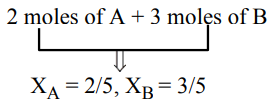
\(P_S=X_A P_A^{\circ}+X_B P_B^{\circ}\)
\(320= P _{ A }^{\circ}\left(\frac{2}{5}\right)+ P _{ B }^{\circ}\left(\frac{3}{5}\right)\)
\(2 P_{A}^{\circ}+3 P_{B}^{\circ}=1600\) ...(I)
Now 1 mole of A & 1 mole of B is added
\(X _{ A }^{\prime}=\frac{3}{7}, X _{ B }^{\prime}=\frac{4}{7}\)
\(P _{ S }^{\prime}=328.6= P _{ A }^{\circ}\left(\frac{3}{7}\right)+ P _{ B }^{\circ}\left(\frac{4}{7}\right)\)
\(3 P _{ A }^{\circ}+4 P _{ B }^{\circ}=2300.2\) ....(II)
Now eq \(( I ) \times 3-\) eq \(( II ) \times 2\)
\(6 P _{ A }^{\circ}+9 P _{ B }^{\circ}=4800\)
\(6 P _{ A }^{\circ}+8 P _{ B }^{\circ}=4600.4\)
\(P _{ B }^{\circ} \simeq 200 mm\) of Hg
\(P _{ A }^{\circ} \simeq 500 mm\) of Hg -
- (A) I < II < III < IV
- (B) III < II < I < IV
- (C) II < III < IV < I
- (D) II < III < I < IV
Show answer and solution
Correct Answer: (A)
\(\Delta T_{b} = i \cdot k_{b} \cdot m\)
For dilute solution ( \(M=m\) )Molarity \(i \times m\) (I) \(M _{\text {glucose }}=\frac{2.2}{180} \times \frac{1000}{125}=0.098\) \(0.098 \times 1\) (II) \(M _{ CaCl _2}=\frac{1.9}{111} \times \frac{1000}{250}=0.068\) \(0.068 \times 3\) (III) \(M _{\text {urea }}=\frac{9}{60} \times \frac{1000}{500}=0.3\) \(0.3 \times 1\) (IV) \(M _{ Al _2\left( SO _4\right)_2}=\frac{20.5}{342} \times \frac{1000}{750} \simeq 0.08\) \(0.08 \times 5\)
Order of \(\Delta T _{ b }= Al _2\left( SO _4\right)_3>\) Urea \(> CaCl _2>\) Glucose
So order of \(BP = Al _2\left( SO _4\right)_3>\) Urea \(> CaCl _2>\) Glucose
So Answer will be I \(<\) II \(<\) III \(<\) IV -
- (A) 70, 110
- (B) 65, 145
- (C) 60, 25
- (D) 25, 60
Show answer and solution
Correct Answer: (D)
\( (\Delta T_{b})_{PQ} = K_{b}m \)
\( 1.176 = 5 \times \frac{1}{M_{1}} \times \frac{1000}{50} \)
\( M_{1} = 85.03 \)
\( (\Delta T_{b})_{PQ_{2}} = 5 \times \frac{1}{M_{2}} \times \frac{1000}{50} = 0.689 \)
\( M_{2} = 145.13 \)
Let molar mass of \(P \& Q\) are \(M_P\) and \(M_Q\) respectively
\( M_{P} + M_{Q} = 85.03 \)
\( M_{P} + 2M_{Q} = 145.13 \)
\( M_{P} = 24.93 \approx 25 \)
\( M_{Q} = 60.1 \approx 60 \), -
- (A) Both Statement I and Statement II are true
- (B) Both Statement I and Statement II are false
- (C) Statement I is true but Statement II is false
- (D) Statement I is false but Statement II is true
Show answer and solution
Correct Answer: (A)
Statement I:
\(30\%\) (w/w) solution of methanol in CCl\(_4\) means \(30\) g of methanol is present in \(70\) g of CCl\(_4\).
Molar mass of methanol (CH\(_3\)OH) \(= 12 + 4 \times 1 + 16 = 32\) g mol\(^{-1}\)
Molar mass of CCl\(_4 = 12 + 4 \times 35.5 = 154\) g mol\(^{-1}\)
Moles of methanol \(= \dfrac{30}{32} = 0.9375\) mol
Moles of CCl\(_4 = \dfrac{70}{154} = 0.4545\) mol
Mole fraction of CCl\(_4 = \dfrac{0.4545}{0.9375 + 0.4545} = \dfrac{0.4545}{1.392} \approx 0.326 \approx 0.33\)
Thus, Statement I is true.
Statement II:
In pure methanol, molecules are held together by strong intermolecular hydrogen bonding. On adding CCl\(_4\), its molecules come between methanol molecules and break the hydrogen bonds. This decreases the intermolecular attractive forces, leading to an increase in vapour pressure. Hence, the mixture shows a positive deviation from Raoult's law.
Thus, Statement II is true.
Both Statement I and Statement II are true.
Answer: Both Statement I and Statement II are true -
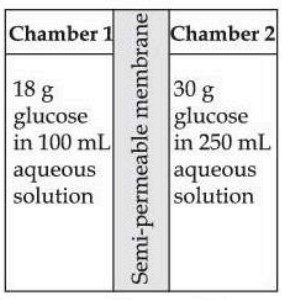
- (A) Both Statement I and Statement II are true
- (B) Both Statement I and Statement II are false
- (C) Statement I is true but Statement II is false
- (D) Statement I is false but Statement II is true
Show answer and solution
Correct Answer: (D)
For Statement I:
Molarity of the solution in Chamber 1 (\(M_1\)) = \(\dfrac{18 / 180}{100 / 1000} = 1\) M
Molarity of the solution in Chamber 2 (\(M_2\)) = \(\dfrac{30 / 180}{250 / 1000} = \dfrac{1/6}{1/4} = 0.667\) M
Since \(M_1 > M_2\), the solution in Chamber 1 has a higher solute concentration. During osmosis, the solvent (water) moves from the region of lower solute concentration to the region of higher solute concentration across a semi-permeable membrane. Thus, water will move from Chamber 2 to Chamber 1. Statement I is false.
For Statement II:
The osmotic pressure is given by \(\pi = iCRT\)
For \(K_2SO_4\), assuming complete dissociation (\(K_2SO_4 \rightarrow 2K^+ + SO_4^{2-}\)), the van't Hoff factor \(i = 3\).
Concentration \(C = \dfrac{50 \times 10^{-3}}{174 \times 2}\) mol/L
\(\pi = 3 \times \left( \dfrac{50 \times 10^{-3}}{174 \times 2} \right) \times 0.083 \times 300\)
\(\pi = \dfrac{3 \times 0.05 \times 24.9}{348} = \dfrac{3.735}{348} \approx 0.0107\) bar
Statement II is true.
Therefore, Statement I is false but Statement II is true.
Answer: Statement I is false but Statement II is true -
- (A) Statement I is false but Statement II is true.
- (B) Statement I is true but Statement II is false.
- (C) Both Statement I and Statement II are true.
- (D) Both Statement I and Statement II are false.
Show answer and solution
Correct Answer: (B)
\(K_{H}\) depends on the nature of gas and the solvent. -
- (A) \(9.96 \times 10^{-4}; 9.96 \times 10^{-4}; 9.96 \times 10^{-4}\)
- (B) \(9.96 \times 10^{-4}; 9.96 \times 10^{-4}; 19.92 \times 10^{-4}\)
- (C) \(4.98 \times 10^{-4}; 4.98 \times 10^{-4}; 9.96 \times 10^{-4}\)
- (D) \(4.98 \times 10^{-4}; 4.98 \times 10^{-4}; 4.98 \times 10^{-4}\)
Show answer and solution
Correct Answer: (A)
Osmotic pressure is given by \(\pi = CRT = \dfrac{w}{MV}RT\)
For solution A:
\(x = \dfrac{1}{50000 \times 0.5} \times 0.083 \times 300\)
\(x = \dfrac{1}{25000} \times 24.9 = 9.96 \times 10^{-4}\) bar
For solution B:
\(y = \dfrac{2}{50000 \times 1} \times 0.083 \times 300\)
\(y = \dfrac{2}{50000} \times 24.9 = 9.96 \times 10^{-4}\) bar
For the resultant solution (mixture of A and B):
Total mass of protein \(= 1 + 2 = 3\) g
Total volume of solution \(= 0.5 + 1 = 1.5\) L
\(z = \dfrac{3}{50000 \times 1.5} \times 0.083 \times 300\)
\(z = \dfrac{3}{75000} \times 24.9 = 9.96 \times 10^{-4}\) bar
Therefore, \(x = y = z = 9.96 \times 10^{-4}\) bar.
Answer: \(9.96 \times 10^{-4}; 9.96 \times 10^{-4}; 9.96 \times 10^{-4}\) -
- (A) 15
- (B) 30
- (C) 7.5
- (D) 58.5
Show answer and solution
Correct Answer: (A)
\(\pi= iCRT\)
\(12=2 \times C \times 0.08 \times 300\)
\(12=2 \times C \times 24\)
\(C =\frac{1}{4} mole / L\)
then strength of NaCl solution
\(=\frac{1}{4} \times 58.5 g / L\)
\(=14.625 g / L\)
\(=15 g / L\) -
- (A) 0.5217
- (B) 0.480
- (C) 0.663
- (D) 0.340
Show answer and solution
Correct Answer: (A)
\(\frac{Y_{A}}{Y_{B}}=\frac{P_{A}^{0}}{P_{B}^{0}}.\frac{X_{A}}{X_{B}}\)
\(\frac{0.8}{0.2}=\frac{55}{15}\times\frac{X_{A}}{X_{B}}\)
\(\frac{X_{A}}{X_{B}}=\frac{60}{55}=\frac{12}{11}\)
\(X_{A}=\frac{12}{23}=0.5217\) -
- (A) 100
- (B) 200
- (C) 300
- (D) 400
Show answer and solution
Correct Answer: (B)
\(X _{ A }=\frac{3}{4}, X _{ B }=\frac{1}{4}\)
\(P_S=P_A^o X_A+P_B^o X_B\)
\(500= P _{ A }^{ o } \times \frac{3}{4}+ P _{ B }^{ o } \times \frac{1}{4}\)
\(3 P _{ A }^{ o }+ P _{ B }^{ o }=2000\)\(\quad\)....(1)
Now 1 moles of A is further added so \(n _{ A }=4\) mole,
\(n _{ B }=1\) mole
\(X _{ A }^{\prime}=\frac{4}{5}, X _{ B }^{\prime}=\frac{1}{5}\)
\(P _{ s }=520= P _{ A }^{ o } \times \frac{4}{5}+ P _{ B }^{ o } \times \frac{1}{5}\)
\(4 P _{ A }^{ o }+ P _{ B }^{ o }=2600\)\(\quad\)...(2)
By equation (2) - equation (1)
\(P _{ A }^{ o }=600 mm Hg\)
\(P _{ B }^{ o }=200 mm Hg\) -
- (A) \( \frac{1.3}{8} \times \frac{W}{M} \)
- (B) \( \frac{16}{2.6} \times \frac{W}{M} \)
- (C) \( \frac{2.6}{16} \times \frac{M}{W} \)
- (D) \( \frac{1.3}{8} \times \frac{M}{W} \)
Show answer and solution
Correct Answer: (A)
P° = 640 mm Hg
\(P_S = 600 mm Hg\)
\( \Delta p = 40 \) mm Hg
moles of solute = \( \frac{W}{M} \)
\( \frac{\Delta P}{P^{\circ}}=i.X_{solute} \)
Again:
\( \Delta T_{b}=i \times k_{b} \times m \)
\( 2=i \times 0.52 \times \frac{W/M}{100} \times 1000 \)
\( i=\frac{2}{5.2} \times \frac{M}{W} \)
\(\begin{array}{l}X_{\text {solute }}=\frac{40}{640} \times \frac{1}{i}=\frac{1}{16} \times \frac{5.2}{2} \times \frac{W}{M} \\ X_{\text {solute }}=\frac{1.3}{8} \times \frac{W}{M}\end{array}\) -
- (A) \(50\%\)
- (B) \(60\%\)
- (C) \(70\%\)
- (D) \(80\%\)
Show answer and solution
Correct Answer: (D)
Moles of solute, \(n_B = 0.25\)
Moles of solvent, \(n_A = 1\)
Mole fraction of solvent, \(X_A = \dfrac{n_A}{n_A + n_B} = \dfrac{1}{1 + 0.25} = \dfrac{1}{1.25} = 0.8\)
According to Raoult's law, the vapor pressure of the solution is given by \(P_s = P^0 X_A\)
\(P_s = 0.8 P^0 = 80\% \text{ of } P^0\)
Thus, the vapor pressure of the solution is \(80\%\) of the vapor pressure of the pure solvent.
Answer: \(80\%\) -
- (A) A and B only
- (B) A and D only
- (C) A, B and D only
- (D) A, C and D only
Show answer and solution
Correct Answer: (C)
For water, the molal elevation constant \(K_b = 0.52 \text{ K kg mol}^{-1}\) and the molal depression constant \(K_f = 1.86 \text{ K kg mol}^{-1}\). Thus, \(K_b < K_f\). Statement A is incorrect.
For a solution with a given molality \(m\) of a non-volatile solute, the elevation in boiling point is \(\Delta T_b = K_b m\) and the depression in freezing point is \(\Delta T_f = K_f m\). Since \(K_b < K_f\), it follows that \(\Delta T_b < \Delta T_f\). Statement B is incorrect.
Osmotic pressure measurement is preferred for determining the molar mass of macromolecules such as proteins and polymers because the measurement is done at room temperature and the magnitude of osmotic pressure is significant even for very dilute solutions. Statement C is correct.
In benzene, benzoic acid undergoes dimerization through intermolecular hydrogen bonding, forming a cyclic dimer with two hydrogen bonds. The structure given in statement D represents a linear association with only one hydrogen bond. Statement D is incorrect.
Therefore, statements A, B, and D are incorrect.
Answer: A, B and D only -
- (A) (A) and (D) only
- (B) (C) and (D) only
- (C) (B) and (C) only
- (D) (A) and (B) only
Show answer and solution
Correct Answer: (A)
\(\begin{aligned} & \mathrm{E}_{\mathrm{KIO}_3}=\frac{\text { Molecular welght }}{\mathrm{n}_{\mathrm{f}}} \\ & \mathrm{n}_{\mathrm{f}}=5 \\ & \mathrm{E}_{\mathrm{KIO}_3}=\frac{\text { Molecular welght }}{5}\end{aligned}\)
(D) is correct meq of \(\mathrm{KI}=0.1 \times 200=20\) meq of \(\mathrm{KIO}_3=4 \times 5=20\)
\((\mathrm{A})\) is correct -
- (A) \(\mathrm{AX}_2\) is fully ionised while \(\mathrm{AY}_2\) is completely unionised.
- (B) \(\mathrm{AX}_2\) is completely unionised while \(\mathrm{AY}_2\) is fully ionised.
- (C) \(\mathrm{AX}_2\) and \(\mathrm{AY}_2\) (both) are completely unionised.
- (D) \(\mathrm{AX}_2\) and \(\mathrm{AY}_2\) (both) are fully ionised.
Show answer and solution
Correct Answer: (A)
For \(\mathrm{AX}_2\)
\(\begin{aligned}
& \Delta \mathrm{T}_{\mathrm{b}}=\mathrm{i} \mathrm{~K} \mathrm{~m} \\
& 0.0156=\mathrm{i} \times 0.52 \times \frac{1.24}{124 \times 1} \\
& 3=\mathrm{i} \\
& 3=1+2 \alpha \\
& 1=\alpha
\end{aligned}\)
For \(\mathrm{AY}_2\)
\(\begin{aligned}
& \Delta \mathrm{T}_{\mathrm{b}}=\mathrm{i} \mathrm{~K}_{\mathrm{b}} \mathrm{~m} \\
& 0.0260=\mathrm{i} \times 0.52 \times \frac{25.4}{250 \times 2} \\
& \mathrm{i} \approx 1
\end{aligned}\)
\(\therefore A X_2\) is completely ionised \(\& A Y_2\) is completely unionised -
- (A) 0.2 M NaCl solution
- (B) 20 M HCl solution
- (C) 10 M HCl solution
- (D) Neutral solution
Show answer and solution
Correct Answer: (B)
When \(10 \mathrm{ml}, 2 \mathrm{M} \mathrm{NaOH}\) solution is added to 20 ml of 1 M HCl solution :
\(\mathrm{NaOH}+\mathrm{HCl} \rightarrow \mathrm{NaCl}+\mathrm{H}_2 \mathrm{O}\)
Initial : MV \(=2 \times 0.1 \quad \mathrm{MV}=1 \times 0.2\)
\(=0.2 \text { mole } \quad=0.2 \mathrm{~mole}\)
Final \(0 \quad 0\)
\(\therefore\) Resulting solution becomes neutral.
Now when 10 mol of above solution is poured into a flask containing 2 mole HCl and made solution 100 ml will distilled water.
Molarity of \(\mathrm{HCl}=\frac{2}{100} \times 1000=20\) -
- (A) 379.2 K
- (B) 377.3 K
- (C) 375.3 K
- (D) 277.3 K
Show answer and solution
Correct Answer: (B)
\(\begin{aligned} & \Delta \mathrm{T}_{\mathrm{b}}=\mathrm{i}_1 \mathrm{~m}_1 \mathrm{k}_{\mathrm{b}}+\mathrm{i}_2 \mathrm{~m}_2 \mathrm{k}_{\mathrm{b}} \\ & =1 \times \frac{2}{0.5} \times 0.52+\frac{1 \times 2}{0.5} \times 0.52=4.16 \\ & \left(\mathrm{~T}_{\mathrm{b}}\right)_{\text {solution }}=373.16+4.16=377.3 \mathrm{~K}.\end{aligned}\) -
- (A) 50
- (B) 57
- (C) 43
- (D) 63
Show answer and solution
Correct Answer: (B)
\(\begin{aligned} & M_F=\frac{M_1 V_1+M_2 V_2}{V_1+V_2} \\ & =\frac{2 \times 20+0.5 \times 400}{420}=0.571 \mathrm{M} \\ & =57.1 \times 10^{-2} \mathrm{M} \\ & =57\end{aligned}\) -
- (A) 5
- (B) 4
- (C) 3
- (D) 1
Show answer and solution
Correct Answer: (D)
\(\begin{aligned}
& \mathrm{NaI}_{(\mathrm{aq})}+\mathrm{AgNO}_{3(\mathrm{aq)}} \rightarrow \mathrm{AgI}_{(\mathrm{s})}+\mathrm{NaNO}_3(\mathrm{aq}) \\
& \mathrm{M}, 20 \mathrm{ml} \text { excess } \\
& 4.74 \mathrm{~g}
\end{aligned}\)
\(\text { Moles of } \mathrm{I}^{-} \text {in } \mathrm{NaI}=\text { Moles of }\left(\mathrm{I}^{-}\right) \text {in } \mathrm{AgI}=\frac{4.74}{235}\)
\(\text { Moles of } \mathrm{NaI}=\frac{4.74}{235}\)
\(\text { Molarity }[\mathrm{NaI}]=\frac{4.74}{235 \times 0.02}=1.008\) -
- (A) \(1400 \mathrm{~mm} \mathrm{Hg}, \mathrm{A}\)
- (B) \(1400 \mathrm{~mm} \mathrm{Hg}, \mathrm{B}\)
- (C) \(600 \mathrm{~mm} \mathrm{Hg}, \mathrm{B}\)
- (D) \(600 \mathrm{~mm} \mathrm{Hg}, \mathrm{A}\)
Show answer and solution
Correct Answer: (D)
\(\begin{aligned}
& \mathrm{P}_{\mathrm{S}}=\mathrm{P}_{\mathrm{A}}^{\mathrm{o}} \cdot \mathrm{X}_{\mathrm{A}}+\mathrm{P}_{\mathrm{B}}^{\mathrm{o}} \cdot \mathrm{X}_{\mathrm{B}} \\
& 500=200 \times \frac{1}{4}+\mathrm{P}_{\mathrm{B}}^{\mathrm{o}} \cdot \frac{3}{4} \\
& \mathrm{P}_{\mathrm{B}}^{\mathrm{o}}=600 \mathrm{~mm} \mathrm{Hg}
\end{aligned}\)
As \(\mathrm{P}_{\mathrm{A}}^{\mathrm{o}} \lt \mathrm{P}_{\mathrm{B}}^{\mathrm{o}} \Rightarrow \mathrm{A}\) is least volatile. -
- (A) (i) < (ii) < (iii) < (iv)
- (B) (iv) < (iii) < (i) < (ii)
- (C) (ii) < (i\() \equiv(\)iii) < (iv)
- (D) (ii) < (i) < (iii) < (iv)
Show answer and solution
Correct Answer: (D)
\(\Delta \mathrm{T}_{\mathrm{b}}=\mathrm{i} \mathrm{~K}_{\mathrm{b}} . \mathrm{m} . \propto \mathrm{i} . \mathrm{C} .\)
where \(\mathrm{C}=\) concentration
\(\begin{array}{|l|c|}
\hline \text { Options } & \text { i.C. } \\
\hline \text { (i) } & 2 \times 10^{-4} \\
\hline \text { (ii) } & 1 \times 10^{-4} \\
\hline \text { (iii) } & 2 \times 10^{-3} \\
\hline \text { (iv) } & 2 \times 10^{-2} \\
\hline
\end{array}\)
B.P. order :
\(\text { (ii) } < \text { (i) } < \text { (iii) } < \text { (iv) }\) -
- (A) show no change in volume since solution is \(0.9 \%(\omega / \omega)\)
- (B) shrink since solution is \(0.5 \%(\omega / \omega)\)
- (C) swell up since solution is \(1 \%(\omega / \omega)\)
- (D) None of these
Show answer and solution
Correct Answer: (D)
Living cell \(=0.9 \mathrm{gm}\) in 100 gm of solution
\(\% \mathrm{w} / \mathrm{w}=0.9\)
Solution is have equal moles of glucose and water \(=0.5\)
Weight of solution \(=0.5 \times 180+0.5 \times 18=99 \mathrm{gm}\) \(\% \mathrm{w} / \mathrm{w} \simeq 90 \%\)
Concentrated solution = Cell will shrink. -
- (A) \(4.26,19.3\)
- (B) \(2.59,11.85\)
- (C) \(5.46,17.8\)
- (D) \(2.96,11.2\)
Show answer and solution
Correct Answer: (D)
\(\frac{\mathrm{P}_{\mathrm{N}_2}}{\mathrm{Po}_2}=\frac{\mathrm{x}_{\mathrm{N}_2} \cdot \mathrm{P}_{\mathrm{T}}}{\mathrm{x}_{\mathrm{O}_2} \cdot \mathrm{P}_{\mathrm{T}}}=\frac{\mathrm{n}_{\mathrm{N}_2}}{\mathrm{n}_{\mathrm{O}_2}}\) {using Dalton's law of partial pressure}
\(\begin{aligned} & =\frac{70 / 28}{27 / 32}=2.96 \\ & \frac{\mathrm{P}_{\mathrm{O}_2}}{\mathrm{P}_{\mathrm{Ar}}}=\frac{\mathrm{n}_{\mathrm{O}_2}}{\mathrm{n}_{\mathrm{Ar}}}=\frac{27 / 32}{3 / 40}=11.25\end{aligned}\) -
- (A) \(40\)
- (B) \(32\)
- (C) \(45\)
- (D) \(55\)
Show answer and solution
Correct Answer: (B)
\(75 \%\) by mass means :
\(\because \quad 75 \mathrm{~g} \mathrm{HNO}_3\) in 100 g solution.
\(\therefore \quad 30 \mathrm{~g} \mathrm{HNO}_3\) in \(\frac{100}{75} \times 30 \mathrm{~g}\) solution.
\(\begin{aligned}
& \mathrm{m}_{\text {solution }}=\frac{100 \times 30}{75} \mathrm{~g} \\
\because \quad & \mathrm{~V}_{\text {sol }}=\frac{\mathrm{m}_{\text {sol }}}{\mathrm{d}_{\text {sol }}}=\frac{100 \times 30}{75 \times 1.25}=32 \mathrm{~mL}
\end{aligned}\) -
- (A) \(\frac{\mathrm{P}_2^0}{\mathrm{P}_1^0}, \frac{\mathrm{P}_2^0-\mathrm{P}_1^0}{\mathrm{P}_2^0}\)
- (B) \(\frac{\mathrm{P}_1^0}{\mathrm{P}_2^0}, \frac{\mathrm{P}_2^0-\mathrm{P}_1^0}{\mathrm{P}_2^0}\)
- (C) \(\frac{\mathrm{P}_1^0}{\mathrm{P}_2^0}, \frac{\mathrm{P}_1^0-\mathrm{P}_2^0}{\mathrm{P}_2^0}\)
- (D) \(\frac{\mathrm{P}_2^0}{\mathrm{P}_1^0}, \frac{\mathrm{P}_1^0-\mathrm{P}_2^0}{\mathrm{P}_2^0}\)
Show answer and solution
Correct Answer: (B)
Given mole fraction of liquid 1 in liquid and vapour phase is \(x_1\) and \(y_1\) respectively.
\(\begin{aligned} & \mathrm{P}_1=\mathrm{P}_{\mathrm{T}} y_1=\mathrm{P}_1^0 x_1 \\ & \frac{\mathrm{P}_{\mathrm{T}}}{x_1}=\frac{\mathrm{P}_1^0}{y_1} \\ & \frac{\mathrm{P}_2^0+x_1\left(\mathrm{P}_1^0+\mathrm{P}_2^0\right)}{x_1}=\frac{\mathrm{P}_1^0}{y_1} \\ & \frac{\mathrm{P}_2^0}{x_1}+\left(\mathrm{P}_1^0+\mathrm{P}_2^0\right)=\frac{\mathrm{P}_1^0}{y_1} \\ & \frac{\mathrm{P}_2^0}{x_1}=\frac{\mathrm{P}_1^0}{y_1}-\left(\mathrm{P}_1^0+\mathrm{P}_2^0\right) \\ & \frac{1}{x_1}=\frac{1}{y_2}\left(\frac{\mathrm{P}_1^0}{\mathrm{P}_2^0}\right)-\frac{\left(\mathrm{P}_1^0+\mathrm{P}_2^0\right)}{\mathrm{P}_2^0}\end{aligned}\)
\(\begin{aligned} & \frac{1}{x_1}=\frac{1}{y_2}\left(\frac{P_1^0}{P_2^0}\right)+\frac{\left(P_2^0-P_1^0\right)}{P_2^0} \\ & y=m x+c \\ & \text { Slope }=\frac{P_1^0}{P_2^0} ; \text { Intercept }=\frac{P_2^0-P_1^0}{P_2^0}\end{aligned}\) - 33. Density of 3 M NaCl solution is \(1.25 \mathrm{~g} / \mathrm{mL}\). The molality of the solution is _______. 2025 Medium
- (A) 1.79 m
- (B) 2.79 m
- (C) 2 m
- (D) 3 m
Show answer and solution
Correct Answer: (B)
\(\begin{aligned} & 3 \mathrm{M} \mathrm{NaCl}, \mathrm{d}_{\text {sol }}=1.25 \mathrm{gm} / \mathrm{mol} \\ & \begin{aligned} \text { Molality } & =\frac{\mathrm{M} \times 1000}{1000 \mathrm{~d}-\mathrm{M} \times \mathrm{M}_{\mathrm{W}}} \\ & =\frac{3000}{1250-175.5}=2.79\end{aligned}\end{aligned}\) -
- (A) 9
- (B) 10
- (C) 11
- (D) 12
Show answer and solution
Correct Answer: (A)
\(\begin{aligned}
& \text { Let mass of iron }=\mathrm{wg} \\
& \Rightarrow \frac{\mathrm{w}}{150 \times 10^3} \times 10^6=12 \\
& \Rightarrow \mathrm{w}=150 \times 12 \times 10^{-3}=1.8 \mathrm{gm}
\end{aligned}\)
Let mass of \(\mathrm{FeSO}_4 \cdot 7 \mathrm{H}_2 \mathrm{O}=\mathrm{w}_1 \mathrm{gm}\)
\(\begin{aligned}
& \Rightarrow \text { Moles of } \mathrm{Fe}=\frac{1.8}{56}=\left(\frac{\mathrm{w}_1}{56+96+7 \times 18}\right) \\
& \Rightarrow \mathrm{w}_1=8.935 \mathrm{gm}
\end{aligned}\) -
- (A) Statement I is incorrect but Statement II is correct
- (B) Both Statement I and Statement II are incorrect
- (C) Both Statement I and Statement II are correct
- (D) Statement I is correct but Statement II is incorrect
Show answer and solution
Correct Answer: (D)
Statement-I
Molar depression constant \(\mathrm{k}_f=\frac{\mathrm{M}_1 \mathrm{RT}_{\mathrm{f}}^2}{\Delta \mathrm{H}_{\text {fus }}}\)
\(\begin{aligned}
& \mathrm{k}_f=\frac{\mathrm{M}_1 \mathrm{RT}_{\mathrm{f}}}{\left[\frac{\Delta \mathrm{H}_{\text {fus }}}{\mathrm{T}_{\mathrm{f}}}\right]} \\
& \mathrm{k}_f=\frac{\mathrm{M}_1 \mathrm{RT}_f}{\Delta \mathrm{~S}_{\text {fus }}}
\end{aligned}\)
Hence statement-I is correct
\(\text { but } \mathrm{k}_{\mathrm{f}} \text { for benzene }=5.12 \frac{{ }^{\circ} \mathrm{C}}{\mathrm{molal}}\)
\(\mathrm{k}_{\mathrm{f}}\) for water \(=1.86 \frac{{ }^{\circ} \mathrm{C}}{\text { molal }}\) Hence statement- II is incorrect -
- (A) Both Statement I and Statement II are false
- (B) Statement I is false but Statement II is true
- (C) Statement I is true but Statement II is false
- (D) Both Statement I and Statement II are true
Show answer and solution
Correct Answer: (D)
A mixture of salt and ice is known as freezing mixture. Freezing mixture decreases freezing point of ice. Both statements are true. -
- (A) Volume of system increases .
- (B) The solid phase (ice) disappears completely.
- (C) Liquid phase disappears completely.
- (D) The amount of ice decreases.
Show answer and solution
Correct Answer: (B)
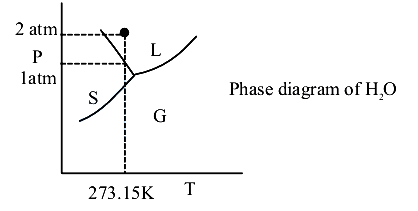
If pressure is made two time then mixture of ice and water will completely convert into water (liquid) form. -
- (A) 12
- (B) 14
- (C) 16
- (D) 18
Show answer and solution
Correct Answer: (C)
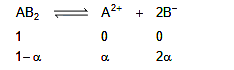
\(\begin{aligned} & \mathrm{i}=1+2 \alpha \\ & =1+2 \times(0.3) \\ & =1.6 \\ & =16 \times 10^{-1}\end{aligned}\) -
- (A) \(\frac{\mathrm{x}_{\mathrm{A}}}{\mathrm{x}_{\mathrm{B}}} \lt \frac{\mathrm{y}_{\mathrm{A}}}{\mathrm{y}_{\mathrm{B}}}\)
- (B) \(\frac{\mathrm{x}_{\mathrm{A}}}{\mathrm{x}_{\mathrm{B}}}=\frac{\mathrm{y}_{\mathrm{A}}}{\mathrm{y}_{\mathrm{B}}}\)
- (C) \(\frac{\mathrm{x}_{\mathrm{A}}}{\mathrm{x}_{\mathrm{B}}} \gt \frac{\mathrm{y}_{\mathrm{A}}}{\mathrm{y}_{\mathrm{B}}}\)
- (D) \(\left(\mathrm{x}_{\mathrm{A}}-\mathrm{y}_{\mathrm{A}}\right) \lt \left(\mathrm{x}_{\mathrm{B}}-\mathrm{y}_{\mathrm{B}}\right)\)
Show answer and solution
Correct Answer: (C)
\(\begin{aligned} & \mathrm{P}_{\mathrm{A}}^{\mathrm{o}} \lt \mathrm{P}_{\mathrm{B}}^{\mathrm{o}} \\ & \frac{\mathrm{P}_{\mathrm{A}}^o}{\mathrm{P}_{\mathrm{B}}^o} \lt 1 \\ & \frac{\mathrm{y}_{\mathrm{A}}}{\mathrm{y}_{\mathrm{B}}}=\frac{\mathrm{P}_{\mathrm{A}}^o}{\mathrm{P}_{\mathrm{B}}^o} \frac{\mathrm{x}_{\mathrm{A}}}{\mathrm{x}_{\mathrm{B}}} \\ & \frac{\mathrm{y}_{\mathrm{A}}}{\mathrm{y}_{\mathrm{B}}} \\ & \frac{\mathrm{x}_{\mathrm{A}}}{\mathrm{x}_{\mathrm{B}}}\end{aligned}\) -
- (A) (A)-(III), (B)-(I), (C)-(IV), (D)-(II)
- (B) (A)-(II), (B)-(IV), (C)-(I), (D)-(III)
- (C) (A)-(III), (B)-(IV), (C)-(I), (D)-(II)
- (D) (A)-(II), (B)-(I), (C)-(IV), (D)-(III)
Show answer and solution
Correct Answer: (A)
(A) Solution of chloroform and acetone shows -ve deviation, so maximum boiling azeotrope.
(B) Solution of ethanol \& water shows +ve deviation. So minimum boiling azeotrope.
(C) Solution of benzene and toluene form ideal solution. \(\Delta \mathrm{V}_{\text {mix }}=0\).
(D) Acetic acid in benzene form dimer. -
- (A) 1
- (B) 2
- (C) 3
- (D) 4
Show answer and solution
Correct Answer: (B)
Sea water is 6 Molar in NaCl , So 1000 ml of sea water contains 6 mol of NaCl.
mass of solution \(=\) Volume \(\times\) density
\(=1000 \times 2\)
mass of solution \(=2000 \mathrm{~g}\)
\(\begin{aligned}
& \text { ppm }=\frac{\text { mass of } \mathrm{O}_2}{2000} \times 10^6 \\
& \text { mass of } \mathrm{O}_2=5.8 \times 2 \times 10^{-3} \\
& \quad=1.16 \times 10^{-2} \mathrm{~g}
\end{aligned}\)
molality for \(\mathrm{O}_2=\frac{1.16 \times 10^{-2} / 32}{(2000-6 \times 58.5)} \times 1000\)
\(\begin{aligned} & =\frac{1.16 \times 10}{32 \times 1649} \\ = & 0.000219 \\ = & 2.19 \times 10^{-4}\end{aligned}\)
Correct answer \(\Rightarrow 2\) -
- (A) 120
- (B) 122
- (C) 124
- (D) 125
Show answer and solution
Correct Answer: (D)
Moles of solute \(=\frac{70}{70}=1\)
Volume of solution \(=\frac{100}{1.25}=80 \mathrm{~mL}\)
\(\begin{aligned}
& M=\frac{1}{80} \times 1000=12.5 \\
& M=125 \times 10^{-1}
\end{aligned}\) -
- (A) 25
- (B) 50
- (C) 75
- (D) 100
Show answer and solution
Correct Answer: (C)
Normal molar mass of \(\mathrm{MX}_2=164.0 \mathrm{~g} \mathrm{~mol}^{-1}\)
Observed molar mass of \(\mathrm{MX}_2=65.6 \mathrm{~g} \mathrm{~mol}^{-1}\)
\(\begin{aligned}
& \text { Van't Hoff factor }(\mathrm{i})=\frac{\text { Normal molar mass }}{\text { Observed molar mass }} \\
& =\frac{164}{65.6}=2.5
\end{aligned}\)
If \(\alpha\) is the degree of ionisation, then
\(\begin{aligned}
& \underset{1-\alpha}{\mathrm{MX}_2} \rightleftharpoons \mathrm{M}_\alpha^{2+}+\underset{2 \alpha}{2 \mathrm{X}^{-}} \\
& \mathrm{i}=1-\alpha+\alpha+2 \alpha=1+2 \alpha \\
& 1+2 \alpha=2.5 \\
& \alpha=0.75
\end{aligned}\)
\(\therefore\) Percent degree of ionisation \(=75 \%\) -
- (A) 11
- (B) 22
- (C) 33
- (D) 44
Show answer and solution
Correct Answer: (C)
\(\mathrm{MX}_3 \rightarrow \mathrm{M}^{+3}+3 \mathrm{X}^{\ominus}\)
\(\begin{aligned} & \mathrm{i}=1+(\mathrm{n}-1) \alpha \\ & \mathrm{i}=1+(4-1) \alpha=2\end{aligned}\)
\(\alpha=\frac{1}{3}=33.33 \% \approx 33 \%\) -
- (A) \(3.72 \mathrm{~K} \mathrm{~kg} \mathrm{~mol}^{-1}\)
- (B) \(1.86 \mathrm{~K} \mathrm{~kg} \mathrm{~mol}^{-1}\)
- (C) \(4.43 \mathrm{~K} \mathrm{~kg} \mathrm{~mol}^{-1}\)
- (D) \(5.12 \mathrm{~K} \mathrm{~kg} \mathrm{~mol}^{-1}\)
Show answer and solution
Correct Answer: (D)
\(\begin{aligned} \Delta \mathrm{T}_{\mathrm{f}} & =\mathrm{K}_{\mathrm{b}} \cdot \mathrm{m} \\ 0.4 & =\mathrm{K}_{\mathrm{b}} \frac{\frac{1}{256}}{50 \times 10^{-3}} \\ \mathrm{~K}_{\mathrm{b}} & =5.12 \mathrm{~K} \mathrm{~kg} / \mathrm{mol}\end{aligned}\) -
- (A) 20
- (B) 30
- (C) 35
- (D) 25
Show answer and solution
Correct Answer: (D)
For AB
\(\begin{aligned}
& \Delta \mathrm{T}_{\mathrm{b}}=2.7 \mathrm{~K} \\
& 2.7=1 \times 0.5 \times \mathrm{m} \\
& \mathrm{~m}=\frac{27}{5}
\end{aligned}\)
Let molar mass of \(\mathrm{AB}=\mathrm{x}\).
\(\begin{aligned}
& \text { So } \frac{1 / x}{15} \times 1000=\frac{27}{5} \\
& x=12.34
\end{aligned}\)
For \(\mathrm{AB}_2\)
\(\begin{aligned}
& \Delta \mathrm{T}_{\mathrm{b}}=1.5 \mathrm{~K} \\
& 1.5=1 \times 0.5 \times \mathrm{m} \\
& \mathrm{~m}=3
\end{aligned}\)
Let molar mass of \(\mathrm{AB}_2=\mathrm{y}\)
So \(\frac{1 / \mathrm{y}}{15} \times 1000=3\)
\(\begin{aligned}
& y=\frac{1000}{45} \\
& y=22.22
\end{aligned}\)
Now let a and b be atomic masses of A and B respectively, then
\(\begin{aligned}
& \mathrm{A}+\mathrm{b}=12.34 \quad...(i)\\
& \mathrm{~A}+2 \mathrm{~b}=22.22 \quad...(ii) \\
& \mathrm{~B}=22.22-12.34=9.88 \\
& \text { Now } \mathrm{a}=12.34-9.88=2.46 \\
& =24.6 \times 10^{-1}=25 \times 10^{-1}
\end{aligned}\) -
- (A) 0.8
- (B) 0.4
- (C) 0.2
- (D) 0.6
Show answer and solution
Correct Answer: (D)
\(\begin{aligned} & \because \mathrm{P}^{\circ}-\mathrm{P} \propto \mathrm{X}_{\text {solute }} \\ & \text { and } \because 10 \propto 0.2 \\ & \therefore 20 \propto 0.4 \\ & \therefore \mathrm{X}_{\text {solvent }}=1-\mathrm{X}_{\text {solute }} \\ & \quad=1-0.4 \\ & \quad=0.6\end{aligned}\) - 48. Which of the following binary mixture does not show the behaviour of minimum boiling azeotropes? 2025 Easy
- (A) \(\mathrm{H}_2 \mathrm{O}+\mathrm{CH}_3 \mathrm{COC}_2 \mathrm{H}_5\)
- (B) \(\mathrm{C}_6 \mathrm{H}_5 \mathrm{OH}+\mathrm{C}_6 \mathrm{H}_5 \mathrm{NH}_2\)
- (C) \(\mathrm{CS}_2+\mathrm{CH}_3 \mathrm{COCH}_3\)
- (D) \(\mathrm{CH}_3 \mathrm{OH}+\mathrm{CHCl}_3\)
Show answer and solution
Correct Answer: (B)
Binary mixture of \(\mathrm{C}_6 \mathrm{H}_5 \mathrm{OH}\) and \(\mathrm{C}_6 \mathrm{H}_5 \mathrm{NH}_2\) shows negative deviation from Raoult's law
So vapour pressure of solution is less than V.P of pure \(\mathrm{C}_6 \mathrm{H}_5 \mathrm{OH} \& \mathrm{C}_6 \mathrm{H}_5 \mathrm{NH}_2\)
So B.P. of solution is greater than boiling point of pure \(\mathrm{C}_6 \mathrm{H}_5 \mathrm{OH} \& \mathrm{C}_6 \mathrm{H}_5 \mathrm{NH}_2\)
So shows maximum Boiling azeotrope. -
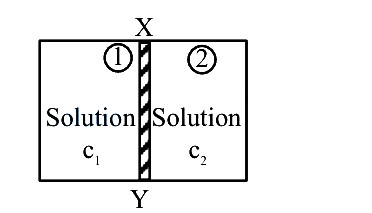
- (A) B and D only
- (B) A and D only
- (C) A and C only
- (D) C only
Show answer and solution
Correct Answer: (C)
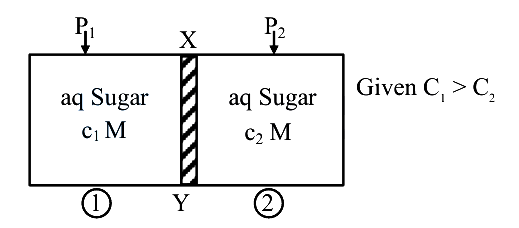
Normal osmosis occurs from (2) to (1)
For reverse osmosis from (1) to (2)
Pressure : \(\mathrm{P}_1 \gt \pi\)
\(\therefore\) Answer [A & C] only -
- (A) Green colour formation observed on side \(Y\).
- (B) Green colour formation observed on side \(\mathrm{X}\).
- (C) Molarity of \(\mathrm{K}_2 \mathrm{Cr}_2 \mathrm{O}_7\) solution is lowered.
- (D) Molarity of \(\mathrm{CuSO}_4\) solution is lowered.
Show answer and solution
Correct Answer: (D)
Only solvent Molecules are allowed to pass through the \(SPM\).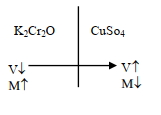
No questions on this page match these filters.
About Solution and colligative properties PYQs
Solution and colligative properties has 188 questions from 2013–2026. The most came in 2025 (29), 2023 (25) and 2021 (25).
The most asked topics are Method of expressing concentration of solution, Abnormal molecular mass and Depression of freezing point of the solvent.
9% are easy, 54% medium and 37% hard.
Solution and colligative properties PYQs by year
Frequently asked
How many Solution and colligative properties questions came in JEE Mains?
188 questions from 2013–2026, each with the correct answer and a full solution.
Which Solution and colligative properties topic is asked the most?
Method of expressing concentration of solution, with 32 questions, followed by Abnormal molecular mass with 28.
Which year had the most Solution and colligative properties questions?
2025, with 29 questions.
How difficult are Solution and colligative properties questions?
9% are easy, 54% medium and 37% hard.