


Questions
Newest firstShowing 1–13 of 13 questions
-
- (A) Both Statement I and Statement II are true
- (B) Both Statement I and Statement II are false
- (C) Statement I is true but Statement II is false
- (D) Statement I is false but Statement II is true
Show answer and solution
Correct Answer: (A)
Statement I: The standard reduction potential \(E^{\circ}_{\text{Al}^{3+}/\text{Al}}\) is \(-1.66\) V, which is highly negative, indicating that aluminium has a strong tendency to lose electrons and is highly electropositive. The standard reduction potential \(E^{\circ}_{\text{Tl}^{3+}/\text{Tl}}\) is \(+1.26\) V, which is positive, indicating that thallium is less electropositive than aluminium. Thus, Statement I is true.
Statement II: Boron has a very small atomic size, resulting in a very high sum of its first three ionization enthalpies. This high energy requirement prevents boron from losing three electrons to form \(\text{B}^{3+}\) ions, so it forms only covalent compounds. In contrast, aluminium has a larger size and a significantly lower sum of its first three ionization enthalpies, allowing it to easily form \(\text{Al}^{3+}\) ions in its compounds. Thus, Statement II is true.
Both Statement I and Statement II are true.
Answer: Both Statement I and Statement II are true -
- (A) Both Statement I and Statement II are true
- (B) Both Statement I and Statement II are false
- (C) Statement I is true but Statement II is false
- (D) Statement I is false but Statement II is true
Show answer and solution
Correct Answer: (D)
Statement I: Number of compounds in which sulphur does not follow the octet rule (from \(SO_2\), \(SO_3\), \(SF_4\), \(SF_6\) and \(H_2S\)).
\(SO_2\): The formal-charge-minimised structure \(O=S=O\) places \(10\) electrons around sulphur (expanded octet).
\(SO_3\): With three \(S=O\) double bonds, sulphur has \(12\) electrons around it (expanded octet).
\(SF_4\): \(4\) bond pairs \(+ 1\) lone pair \(= 10\) electrons around \(S\) (expanded octet).
\(SF_6\): \(6\) bond pairs \(= 12\) electrons around \(S\) (expanded octet).
\(H_2S\): \(2\) bond pairs \(+ 2\) lone pairs \(= 8\) electrons around \(S\) (obeys the octet rule).
Depending on whether formal-charge-minimised structures are used for \(SO_2\) and \(SO_3\), either \(2\) (\(SF_4, SF_6\)) or \(4\) (\(SO_2, SO_3, SF_4, SF_6\)) species violate the octet rule, but the number is never \(3\).
Hence, Statement I is false.
Statement II: Among the given sets, exactly one contains only molecules having one lone pair on the central atom.
Number of lone pairs on the central atom, \(\text{LP} = \dfrac{\text{valence electrons of central atom} - \text{number of bonded monovalent atoms}}{2}\):
\(H_2O\): \(\dfrac{6 - 2}{2} = 2\) lone pairs
\(ClF_3\): \(\dfrac{7 - 3}{2} = 2\) lone pairs
\(SF_4\): \(\dfrac{6 - 4}{2} = 1\) lone pair
\(NH_3\): \(\dfrac{5 - 3}{2} = 1\) lone pair
\(BrF_5\): \(\dfrac{7 - 5}{2} = 1\) lone pair
\(XeF_4\): \(\dfrac{8 - 4}{2} = 2\) lone pairs
Checking the sets:
\(\{H_2O\ (2),\ ClF_3\ (2),\ SF_4\ (1)\}\): not all have \(1\) lone pair.
\(\{NH_3\ (1),\ BrF_5\ (1),\ SF_4\ (1)\}\): all have exactly \(1\) lone pair.
\(\{BrF_5\ (1),\ ClF_3\ (2),\ XeF_4\ (2)\}\): not all have \(1\) lone pair.
\(\{XeF_4\ (2),\ ClF_3\ (2),\ H_2O\ (2)\}\): not all have \(1\) lone pair.
Exactly one set satisfies the condition, so Statement II is true.
Hence, Statement I is false but Statement II is true, which corresponds to option \((4)\). -
- (A) \(120^{\circ}\)
- (B) \(107^{\circ}\)
- (C) \(102^{\circ}\)
- (D) \(116^{\circ}\)
Show answer and solution
Correct Answer: (C)
\(N F _{ 3 }\)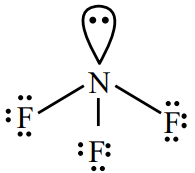 , hybridization : \(sp ^3\)
Number of lone pair in \(NF _3=10\)
Bond angle in \(NF _3 \approx 102^{\circ}\) -
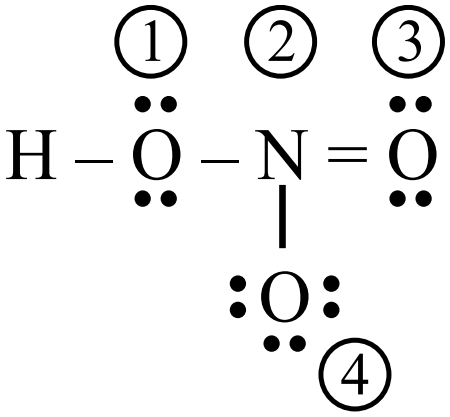
- (A) +1, 0, 0, -1
- (B) 0, -1, 0, +1
- (C) 0, +1, 0, -1
- (D) 0, 0, -1, +1
Show answer and solution
Correct Answer: (C)
Consider the structure of \(HNO_{3}\)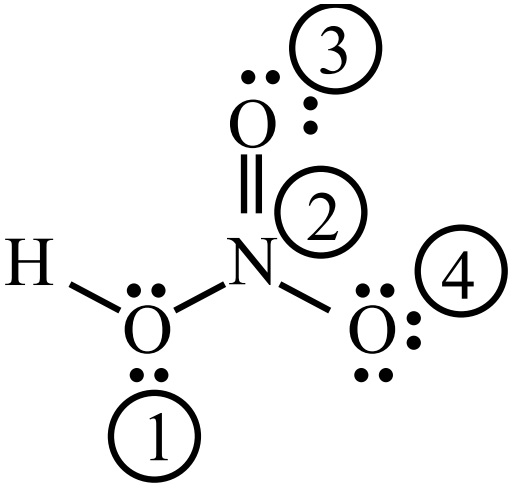
\(1 : 0\)
\(2 : (+1)\)
\(3 : 0\)
\(4 : (-1)\)
Formal charge = valence e's - non bonding e's - \(\left(\frac{\text { bonding electrons }}{2}\right)\) -
- (A) A, B and E
- (B) A and E
- (C) B, C and D
- (D) C and D
Show answer and solution
Correct Answer: (B)
Species with the same number of valence electrons and the same skeletal structure generally have similar Lewis dot structures (isoelectronic species).
For pair A: \(\text{SO}_3^{2-}\) has \(6 + 3(6) + 2 = 26\) valence electrons. \(\text{CO}_3^{2-}\) has \(4 + 3(6) + 2 = 24\) valence electrons. Since they have different numbers of valence electrons, they do not have similar Lewis dot structures (\(\text{SO}_3^{2-}\) has a lone pair on the central atom and is pyramidal, while \(\text{CO}_3^{2-}\) has no lone pair on the central atom and is trigonal planar).
For pair B: \(\text{O}_2^{2-}\) has \(2(6) + 2 = 14\) valence electrons. \(\text{F}_2\) has \(2(7) = 14\) valence electrons. Both have a single bond and three lone pairs on each atom, so they have similar Lewis dot structures.
For pair C: \(\text{CN}^-\) has \(4 + 5 + 1 = 10\) valence electrons. \(\text{CO}\) has \(4 + 6 = 10\) valence electrons. Both have a triple bond and one lone pair on each atom, so they have similar Lewis dot structures.
For pair D: \(\text{NH}_3\) has \(5 + 3(1) = 8\) valence electrons. \(\text{H}_3\text{O}^+\) has \(6 + 3(1) - 1 = 8\) valence electrons. Both have three single bonds and one lone pair on the central atom, so they have similar Lewis dot structures.
For pair E: \(\text{MnO}_4^{2-}\) has \(7 + 4(6) + 2 = 33\) valence electrons. \(\text{CrO}_4^{2-}\) has \(6 + 4(6) + 2 = 32\) valence electrons. Since they have different numbers of valence electrons (\(\text{MnO}_4^{2-}\) has an unpaired electron), they do not have similar Lewis dot structures.
Thus, pairs A and E do not have similar Lewis dot structures.
Answer: A and E -
- (A) A-IV, B-I, C-III, D-II
- (B) A-IV, B-II, C-I, D-III
- (C) A-II, B-IV, C-III, D-I
- (D) A-III, B-II, C-I, D-IV
Show answer and solution
Correct Answer: (B)
\(\mathrm{NO}=7 \mathrm{e}^{-}\)Incomplete octet with
\(\mathrm{NO}_2=7 \mathrm{e}^{-} \int \quad\) odd electron
\(\left.\begin{array}{l}\mathrm{BCl}_3=6 \mathrm{e}^{-} \\ \mathrm{AlCl}_3=6 \mathrm{e}^{-}\end{array}\right\}\)Incomplete octet
\(\mathrm{H}_2 \mathrm{SO}_4=12 \mathrm{e}^{-}, \mathrm{PCl}_5=10 \mathrm{e}^{-} \Rightarrow\) molecules with expanded octet
\(\mathrm{CCl}_4=8 \mathrm{e}^{-}, \mathrm{CO}_2=8 \mathrm{e}^{-} \Rightarrow\) molecules obeying octet rule - 7. In the lewis dot structure for \(\mathrm{NO}_2{ }^{-}\), total number of valence electrons around nitrogen is _______. 2024 Medium
- (A) \(8\)
- (B) \(9\)
- (C) \(15\)
- (D) \(20\)
Show answer and solution
Correct Answer: (A)
Number of valence \(\mathrm{e}^{-}\)around \(\mathrm{N}\)-atom \(=8\)
- 8. The covalency and oxidation state respectively of boron in \(\left[ BF _4\right]^{-}\), are 2023 Medium
- (A) \(4\) and \(3\)
- (B) \(4\) and \(4\)
- (C) \(3\) and \(4\)
- (D) \(3\) and \(5\)
Show answer and solution
Correct Answer: (A)
Number of covalent bond formed by Boron is \(4\)Oxidation number of fluorine is \(-1\),
Oxidation number of \(B +4 \times(-1)=-1\),
Thus, Oxidation number of \(B =+3\)

-
- (A) \(3\)
- (B) \(5\)
- (C) \(4\)
- (D) \(1\)
Show answer and solution
Correct Answer: (A)
\(ICl _4^{-}, BrF _3\) and \(NO _2^{+}\)do not have odd number of \(e^{-}\) - 10. The total number of lone pairs of electrons on oxygen atoms of ozone is \(...........\). 2023 Medium
- (A) \(5\)
- (B) \(6\)
- (C) \(4\)
- (D) \(3\)
Show answer and solution
Correct Answer: (B)
(Total no, of lone pairs on oxygen atoms \(=6\)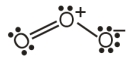
-
- (A) \(SO _2( s ), NH _3( s )\)
- (B) \(SO _2( s ), CO _2( s )\)
- (C) \(HCl ( s ), AlN ( s )\)
- (D) \(MgO ( s ), SO _2( s )\)
Show answer and solution
Correct Answer: (A)
\(SO _2\) and \(NH _3\) are polar molecules. They are constituent particles of polar molecular solids. - 12. Which of the following pair of molecules contain odd electron molecule and an expanded octet molecule? 2022 Medium
- (A) \(BCl _{3}\) and \(SF _{6}\)
- (B) \(NO\) and \(H _{2} SO _{4}\)
- (C) \(SF _{6}\) and \(H _{2} SO _{4}\)
- (D) \(BCl _{3}\) and \(NO\)
Show answer and solution
Correct Answer: (B)
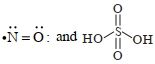
(A) \(BCl _{3} \rightarrow\) Even Electron molecule\(SF _{6} \rightarrow\) Expanded octet molecule
(B) \(NO \rightarrow\) Odd Electron molecule
\(H _{2} SO _{4} \rightarrow\) Expanded octet.
(C) \(SF _{6} \rightarrow\) Even Electron molecule
\(H _{2} SO _{4} \rightarrow\) Expanded octet.
(D) \(BCl _{3} \rightarrow\) Even Electron molecule
\(NO \rightarrow\) Odd Electron molecule
\(S \rightarrow 12e^{-}\) in outer orbit.
-
- (A) \(0\)
- (B) \(1\)
- (C) \(2\)
- (D) \(3\)
Show answer and solution
Correct Answer: (A)
Total electrons in CO = \(6 + 8 = 14\)
Total electrons in NO\(^+ = 7 + 8 - 1 = 14\)
Bond order for 14 electrons = \(\frac{10 - 4}{2} = 3\)
Bond order of CO = 3
Bond order of NO\(^+ = 3\)
Difference in bond orders = \(3 - 3 = 0\)
\(\frac{x}{2} = 0\)
\(x = 0\)
No questions on this page match these filters.
Other STD 11 - Chemical bonding and molecular structure topics
Frequently asked
How many Covalent bonding questions came in JEE Mains?
13 questions from 2021–2026, each with the correct answer and a full solution.
How difficult are Covalent bonding questions?
0% are easy, 77% medium and 23% hard.